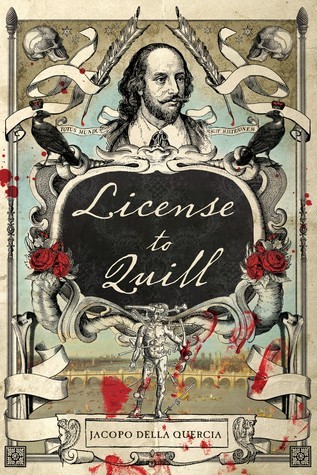
Shakespeare as you've never seen him before…a secret agent. Caught up in a world of corruption, secrets, staged deaths, and playwriting, Will must use but not abuse his license to quill.
License to Quill is a page-turning James Bond-esque spy thriller starring William Shakespeare and Christopher Marlowe during history's real life Gunpowder Plot. The story follows the fascinating golden age of English espionage, the tumultuous cold war gripping post-Reformation Europe, the cloak-and-dagger politics of Shakespeare's England, and lastly, the mysterious origins of the Bard's most haunting play: Macbeth. You won't want to miss this fast-paced historical retelling!
JACOPO DELLA QUERCIA is an award-winning educator, essayist, and novelist. His work has been featured on BBC America, Business Insider, CNN Money, Folger Magazine, The Huffington Post, Reader's Digest, Ripley's Believe It or Not!, Slate, and Princeton University's Electronic Bulletin of the Dante Society of America, among others.
As a writer, Jacopo strives to present otherwise obscure scholarly subjects in a manner more easily accessible and enjoyable for all audiences: a practice he honed in the classroom. His novels are The Great Abraham Lincoln Pocket Watch Conspiracy and its sequel, License to Quill, with many more to follow!
It has long been speculated that there was much about William Shakespeare that we simply don’t know. The keeping of records in his time was fairly spotty, so there are some gaps that historians have basically filled in using research and educated guesswork.
Jacopo della Quercia has chosen rather a different path to fill in those gaps. His novel “License to Quill” posits that Shakespeare – along with poet and peer Christopher Marlowe – was in fact an undercover operative with the English government, working as a spy in the battle against the enemies of his country.
Yes, really.
William Shakespeare is first and foremost a playwright, renowned for his wide-ranging and popular works. He also has a past as an espionage agent for the Crown’s Ordnance Office (a “Double-O” operative, if you will), though he’s been out of the game for a while. When he is approached by a gentleman calling himself John Johnson – a gentleman who turns out to be named Guy Fawkes – for help in executing a plot against the government, Shakespeare is drawn back into that world. On orders from his old boss, he agrees to the request made of him by the conspirators – to write a play with an anti-monarchist message based in Scotland.
(No spoilers, but you can probably figure out which of Shakespeare’s plays we’re talking about here.)
Meanwhile, in Italy, Christopher Marlowe – who also served as a Double-O operative once upon a time – has been living under an assumed name after faking his own murder years previous. However, he is drawn into the plot as well, finding himself in the crosshairs of a deadly group of assassins who want him out of the way for reasons he doesn’t fully understand.
Underhanded politics, tenuous alliances, cloak-and-dagger spycraft and a little bit of folklore for good measure – that’s just part of what follows as Shakespeare and Marlowe plunge ever deeper into the murky waters of conspiracy. With only the help of the spymaster Walsingham (“W” for short), quartermaster Sir Francis Bacon and W’s secretary Penny – and a few unexpected friends along the way – these two men must find a way to thwart the Gunpowder Plot conspirators and save not just England, but all of Europe.
And if Shakespeare can win the day, he will get to retain his most precious possession – complete creative freedom when writing and performing his plays. His license to quill, if you will.
This isn’t della Quercia’s first foray into the realm of alternate history; his debut novel was last year’s excellent “The Abraham Lincoln Pocket Watch Conspiracy.” Here, he goes farther back in time to a place where the blanks to fill in are larger and more numerous; using actual historical events and records as jumping-off points, he lets his imagination run rampant – much to the reader’s benefit.
“License to Quill” is an unlikely combination of elements. Meticulous research, detailed storytelling and strong characterization – as well as an abundance of humor that strikes a remarkable balance between highbrow and lowbrow – all come together into one piece of eminently readable, wildly enjoyable fiction. It is part spy thriller, part satire, part historical fiction – and all fantastic.
This is not genre gimmickry at work, no mere parodic pastiche; while della Quercia has certainly penned his share of comic pieces, he has legitimate skills of scholarship and he wields them with aplomb. It is precisely the juxtaposition presented by those two seemingly disparate approaches that makes his work so entertaining. He folds his tales expertly into the historical narrative, deftly mining the past and incorporating his findings seamlessly; he also offers footnotes and additional readings should the reader’s interest in the real-life history be piqued.
“License to Quill” works on a number of levels. History buffs and Shakespeare fans will obviously love this book, but really, anyone who enjoys fast, funny narratives populated by compelling characters and built upon a foundation of true events is going to dig this book.
The follow up to the brilliant The Great Abraham Lincoln Pocket Watch Conspiracy is another historical thriller with fantastical elements. Here, William Shakespeare is the protagonist who becomes unwillingly tangled in a conspiracy to throw the British government, meanwhile penning one of his greatest plays.
Sadly, I cannot say more about the story or plot, as so much of the fun of the novel are the many plot twists and the surprising historical figures who are integrated into the story. Oh, by the way, while this is a work of fiction, della Quercia still provides support for much of what he writes. The fact that this whimsy is grounded in reality, makes it cooler.
I can say that della Quercia is not afraid to throw in some low humor and there is a lot of winking and nodding here, but I find that part of the fun. Moreover, there are plenty of exciting action scenes, with one being so gripping I lost track on the train and narrowly missed getting out at the right el stop (the most excitement I've had on a commute home in years).
I think this is just a notch below della Quercia's prior novel, so I'd actually give it 4.5 stars, but that's still means it's a terrific read.
I was hooked from the start, but the best part was that I went in expecting it to be a bit ho-hum and instead was blasted away by the action-packed, thriller, James Bond-like adventure that included Christopher Marlowe and William Shakespeare and an 'alternative' imagining of history in which Shakespeare and Marlowe were a part of a conspiratorial plot with Marlowe dying multiple fake deaths and a Dark Lady femme fatale.
There were so many elements to enjoy in the story: the movement of the story was breakneck, the characters were all vividly imagined, the writing was wonderfully complex, the history was seamless and the connections to Shakespeare plays were intentional and informative. So color me surprised at how fast I read it and can think of quite a few different kids to recommend it to, and not really for the 'literary' elements but for its uniqueness. It's like the best of the fast-paced James Swanson nonfiction with the best of a Bill Bryson deep exploration.
This book is for everyone who ever said, "You know what William Shakespeare needs more of? Explosions. Explosions and James Bond-esque action."
We had good old Will Shakespeare and Christopher Marlowe serving as agents for the Ordnance Office - or "Double-O," thus making them Double-O operatives - thwarting the Guy Fawkes Gunpowder Plot. We had Thomas Walsingham as an M-like spymaster. We had Francis Bacon providing our brave hero with all kinds of gadgets, a la Q. Even the horses were named after British cars, with Shakespeare's shiny silver mount named Aston.
Plenty of humor, plenty of action, some very Shakespearean tragedy, and believe it or not, the author even takes a break every so often to teach REAL history. I just enjoyed this book SO MUCH. If nothing else, it's just fun to play "spot the James Bond reference" while reading this book! I definitely recommend this for anyone who has a sense of humor and likes spy thrillers and geeking out over Shakespeare and English history.
This book is AWESOME. Beginning with the title, clever wordplay shines throughout. Then the characters... We have William Shakespeare, Christopher Marlowe, and Sir Francis Bacon set against political intrigue with romance and adventure on every page. Will is a spy in this novel, complete with a set of appropriately clever gear to get him out of fixes. There is a conspiracy of witches rising throughout Europe! Will is writing MacBeth! My favourite character is Marlowe, hands down. There was a bit in the book where he was whining for coffee and I found myself mimicking him in empathy. I immediately made coffee, and was glad to turn the page and read Marlowe got his brew as well. Reading this book sent me on a research spiral of fun, aided by the author's amazing footnotes and list of research books in the back. I will be spending a lot of time jumping down these rabbit holes of history, and I owe it all to Jacopo della Quercia. Many thanks.
This book is a romp: James Bond meets Shakespeare meets the supernatural. Shakespeare's a spy, Francis Bacon is his disgruntled quartermaster, and Walsingham himself takes on the role of M/W. Della Quercia's story is fast, fun, and completely, totally ridiculous. Even so, he makes remarkable use of historical fact--he clearly knows his stuff, to the point where the book almost feels like a long inside joke aimed at other early modernists. Minor complaints include annoyingly florid speaker tags (the word 'said' isn't going to hurt you), completely unnecessary sex scenes (he's even worse than Fleming in this regard), and surprisingly little actual theatre. At times it's easy to forget that Shakespeare was really a playwright, in spite of della Quercia's tenacious insistence on always calling him 'the playwright' or 'the bard.'
I love anything and everything about William Shakespeare. This book doesn’t disappoint. The one liners referred to in this James Bondish type of story are wonderful and very funny. But there is tragedy too. This story really has it all. Spy’s, Goodguys, Badguys, Lovers, Thieves, Murder, Witches, and almost everything in between. If you know Shakespeare you will be laughing out loud while reading this book. If you don’t know Shakespeare this story will make you want to look up the plays that are part of this story.
I heard many good things about License to Quill from someone whose taste I trust (my dearest fan ;-), and being a historical fiction fan the book held a natural interest.
What to Expect
London, 1604/05. On the backdrop of King James VI of Scotland becoming James I of England, of the brewing Catholic-backed Gunpowder Plot, William Shakespeare writes the great Scottish Play, Macbeth. While this books explores all this, it does so in a lighthearted, fast-paced dark comedy style.
Expect Shakespeare working for the Ordnance Office (the Double-O), with himself as Bond, Sir Walsingham (the real-life English spymaster) as M, and Francis Bacon (father of modern science) as Q. Christopher Marlowe has also been recruited as a fellow agent (his demise a decade earlier apparently a ruse), and the plot spills and spans from England to Venice, across years of plague and other natural disasters.
This is a fast-paced, humorous, oh-so-slightly more than natural take on real events and people, in what were undoubtedly one of England's most exciting times.
What I liked
I loved the clear intimate familiarity of della Quercia with the period. Bacon training ravens to act as almost supernatural guards? Backed by his writings. An anaesthetic for surgery made of equal measures of boar bile, opium, hemlock, and lettuce (amongst other things)? A dwale straight out of 15th century recipe. Whenever della Quercia comes up with something outlandish, a small footnote of original sources shows where he got the idea from -- and makes us wonder about the rest of it.
What to be aware of
While the fast pace leads to a bit of too-fast jumping around (just like in a typical Bond movie), action scenes are a bit lacklustre. Also bear in mind that though this novel may be filed under "historical fantasy" for the anachronistic tropes, it's historical fiction. Excellent one, but not fantastical in the way most fantasy readers might expect.
Felix's Review
Felix had a run-in with his own government's version of priest-spies (again a slight exaggeration of reality), and all but applauded hiring the world's best dramatist into the role. While many things have changed in Britain since Rome ruled it, he found it comforting to know that, one, many of the foundational pieces of his culture remained as the underpinnings of civilisations millennia to come, and, two, how human nature had changed so little, what with all the backstabbing and plagues.
His only complaint was that the book would have been better written as a play, because the fight scenes were clearly badly staged even if the dialogue was brilliant.
Summary
It's a lovely piece for anyone who enjoys Shakespeare and the 16th/17th century London, in all its grime and glory.
Enjoying the reviews, but wondering who the heck is that Felix fellow? Glad you asked! He's the protagonist of the Togas, Daggers, and Magic series, an historical-fantasy blend of a paranormal detective on the background of ancient Rome.
Assaph Mehr, author of Murder In Absentia: A story of Togas, Daggers, and Magic - for lovers of Ancient Rome, Murder Mysteries, and Urban Fantasy.
Disappointing. The blurb was great, but the book didn't live up to its promise. I thought it sounded like a great combination between crime and history - a marriage made in heaven! - but it didn't seem to work, resulting, I think, in a fairly clunky work. I found the characters shallow and the situations unlikely. I'm quite happy to believe any number of impossible things before breakfast, but I'd prefer the writer to make the unlikely, likely! Sadly, this didn't happen for me. Great idea, though.
Bought this book today, after meeting the author during The Enchanted City. I spelled aloud my name to him when he signed the book. He laughed and said, "That's an odd way to spell it." I resisted the chance to reply with "And have you seen your name?". My aunt bought his other book, so we will be reading and swapping. They seem like good fun, and the author was so enthusiastic and personable, so hopefully they don't disappoint.
Dnf'd at 30% This alternate history genre mashup started out promisingly when I got an accurate description of Guy Fawkes, and the author remembered to give him a sense of humor. Things rapidly went down hill from there. Passive verbs, poor humor, and being ludicrous in a way that hasn't swung back to so bad it's funny turned an enjoyable read into a painful one. I just can't take the writing anymore. Espionage thriller should work for the Gunpowder Plot, but this reads more like an Assassin's Creed plot line, wait, no, that's an insult to Assassin's Creed. Assassin's Creed is at least entertaining.
2016 is the 400th anniversary of the death of William Shakespeare and the SF&F community already has a lot of tie-in media ready to go. For example, there is Shakespeare Vs Cthulhu by Jonathan Green up on Kickstarter and Abaddon Books is publishing the new fantasy series, Monstrous Little Voices, featuring characters from Shakespeare’s works. An early entry into the Shakespeare celebrations, which I will no review for you today, is License to Quill by Jacopo della Quercia (The Great Abraham Lincoln Pocket Watch Conspiracy, Cracked).
Our story takes place in the midst of the Gunpowder Plot. Guy Fawkes, the religious fanatic whose visage is sometimes worn by liberal American youth, approaches Shakespeare about writing a play that will incite the people against the King and return Catholic rule to England. The only real requirement is that the play has to include a certain reference to witches. Of course, our William is no mere playright. He is actually a former spy of England and as soon as he learns of the plot, brings news of it to Thomas Walsingham, England’s current spymaster. Walsingham (or “W”) reactivates Shakespeare as Office of Ordnance agent (or “OO agent”) to infiltrate the conspiracy to learn more about their plans, especially their alliance with the “cunning folk”. As Shakespeare begins to write his play (which he plans to set in Scotland), Christopher Marlowe is enjoying his exile in Venice, his “death” having been staged by Walsingham. He too, however, will find himself coming out of retirement as a mysterious woman wants to desperately meet him.
If you haven’t guessed, License to Quill is a fictional mash-up in the style of Pride and Prejudice and Zombies. In this case it combines the real lives of William Shakespeare and his contemporaries (including Francis Bacon) with the themes and tropes of James Bond. It actually works rather well given the history of the era. There are some blank areas in the life of Shakespeare, Marlowe was accused of being a spy and apparently the Walsinghams have a history of working in intelligence. In many ways this book is similar to Harry Turtledove’s Ruled Britannia, which also featured Shakespeare being tapped to write a play to incite a rebellion. Turtledove’s book, however, was set in an alternate history where the Spanish Armada successfully invaded England, while License to Quill is more of secret history. Nothing really changes to the timeline, we just learn that the official record isn’t exactly correct.
Despite my usual distrust of secret history works, I still enjoyed reading License to Quill. I thought Jacopo did an excellent job capturing the look and feel of early 17th century England, while melding it successfully with the world of James Bond. It was funny without being too obvious and I enjoyed all the references found within, including one from the Assassin’s Creed series. Plus Macbeth has always been my favorite Shakespearean play and I had fun learning its “true” history.
If I had to pick one thing to criticize, I would say the ending was a little rushed. Although I don’t want to spoil anything, it seemed like Jacopo was struggling to wrap all the different plot lines up at once and it became somewhat of a mess. License to Quill had been a pretty solid spy thriller up to this point, when it suddenly turned into something that would be at home in an epic fantasy. Maybe Jacopo just wanted a big ending or was trying to match what history tells us enough so that the secret history he was crafting still fit into the historical record, but it was a little over the top for me.
Still that is just a minor quibble. If you are one of those weird kids (like me) who actually enjoyed reading Shakespeare in high school or will always pay to see the new James Bond film, then you should pick up a copy of License to Quill.
License to Quill by Jacopo della Quercia is one part William Shakespeare, one part James Bond in Her Majesty's Secret Service and all the rest of the parts complete and hilarious fun! Working for the spymaster and nobleman Thomas Walsingham, referred to as "W", the spy and playwright Christopher Marlowe must disappear and so fakes his own death. In his stead steps the young playwright, William Shakespeare. Publicly known as London's greatest writer, he is also its most accomplished spy. But after a dispute with his employer that landed him in the infamous Tower, Shakespeare finds himself on the outside of the spy game. Until one day a stranger comes to call. A man history will remember as Guy Fawke.
"...The playwright furrowed his brow and looked down to the parchment. As he reached for it, Guy Fawkes seized Shakespeare's wrist. "Be careful who you share that with." The man cautioned with a tightening grip. William Shakespeare stared straight into Guy Fawkes eyes. Beneath the table both men had their hands on their swords. Without breaking eye contact, the Bard freed himself and took the paper. He unfolded it with one hand and examined it against his chest like a card player. Double, double, toile and trouble; Fire burne, and Cauldron bubble. Shakespeare raised his eyebrows. "Your employer requires a play on the occult?" "Not necessarily. All he requests is a tragedy set in Scotland covering the subjects we discussed. However you treat the stranger side of pagan history is entirely up to you. All we ask is that a group of witches say these lines at some point in the drama." "Witches?" Shakespeare repeated. "Yes. Three of them..."
Knowing this for being far more than the offer to write a new play. Shakespeare knows it to be an act of subversion against the crown and goes back to his old employer, W, to inform the spymaster on what he has found. The Bard is returned to service in the Ordnance Office, now referred to as the Double-O, Shakespeare must protect the crown from the act of rebellion that Fawke and his crew plan. But the Bard finds out that it goes back further than Fawke, to an people that have lived on the Island far longer than any Londoner. All this while he pens the play that would become; Macbeth.
To say this is just an irreverent tale meshing the character of Bond and the Secret Service and taking it back to the time of Shakespeare and making him Bond is to simply tip the iceberg of this novel. Jacopo della Quercia is not satisfied with simply doing that, no what he does instead is to write a historical thriller, melding humor, intrigue and international espionage with the backdrop of one of the most turbulent times in European history. When Britain was split between Protestant and Catholic and the attempted insurrection of Fawkes as he planned to bomb the Parliament building. Throw in some murdered Popes, lady assassins, a forgotten cult and love won and lost by the greatest writer in English history and you will begin to get a grasp of the grand scope that della Quercia chose to undertake. Only he didn't just undertake it, no he mastered it.
License to Quill, is in my hopes, the beginning of William Shakespeare's foray into espionage. This book is not to be missed by fans of Shakespeare, fans of James Bond and fans of just damn good story telling.
I've been yearning to read something fresh and unpredictable and Jacopo della Quercia's book is every bit of that and more. This fanciful historical novel places William Shakespeare and Christopher Marlowe in the service of their country as masters of espionage.
The plot revolves around Shakespeare's commission to write "a Scottish play" and reimagines how he came to develop MacBeth. In this book, he was hired by Guy Fawkes and his co-conspirators to write the play to foment unrest in the country,
Fear of witchcraft was rampant in Great Britain and sorcery plays a central role in this complicated plot. I was engrossed in the book from the very beginning and particularly liked the zany characterization of Christopher Marlowe and the role of Francis Bacon as an earlier incarnation of Q in the James Bond novels. Bacon provides his spies with poison decks of cards, exploding watches and life-saving devices designed by Leonardo da Vinci. Too much fun!
Perhaps the most whimsical and exotic resources offered to the spies were the protective flock of ravens who followed them everywhere and attacked their enemies when the "good guys" were in peril. Did I say this book was Fun?
It was a treat to inhabit Shakespearean England from this zany and privileged perch. I loved every minute of this whimsical, but well-written historical "re-imagining."
This is Shakespeare, but not as you know him. If you have a sense of humour (and I think the title of the book gives it away that it's not to be taken too seriously) this is a fun as well as absorbing read.
Bond meets Shakespeare in a delicious irreverent marriage of the two mediums. There are clever gadgets, amusingly named horses as well as all the characters you might meet in a Bond story but with more historical faces.
The story is set in the time of James I and Guido Fawkes is busy plotting the downfall of the kingdom. Enter stage right our historic poet and playwright who is adept at more than writing a pretty verse. However, he is not the only agent in the field. Another famous playwright that had rumouredly met his demise was working further afield.
Kit Marlowe and William Shakespeare are friends rather than rivals both dedicated to the safety of the realm. The story often pokes fun at the idioms of the Bond franchise as well as weaving a ridiculous but exciting plot where you never know quite what to expect next. A very entertaining read!
A very engaging read, avoids being just "James Bond in King James era England" by having fully developed and engaging principal characters in Shakespeare, Marlowe and Bianca the Dark Lady and well written secondary characters such as Penny, Walsingham and the Dragoman.
The history is well researched and you almost wish the fictional accounts of history and this novel were genuinely based on long forgotten and covered up facts, ones hidden for centuries and the author played the role of a treasure hunter uncovering the truth.
If I had any actual complaints, I would say that the ending leaned maybe too heavily on a downer ending. Not that can be a bad thing and it was a well written downer ending, but I felt too bad for all the characters by the end (which might be what the best option for a downer ending if its one that keeps you thinking of the story and the sad fates of the characters).
I expect a book to be clever, and Jacopo della Quercia does just that. With figures like Shakespeare, whose name nowadays often still elicits a response such as "some popular dead guy, right?", the author creates a story of incredible wit and liveliness. It breathes not in the way we would say if we were to set it down next to an open window, but on itself. Just a bit of interest in history or reading -- or both, which would be fine as well -- makes License to Quill a story worth pursuing. It is written with considerable knowledge of the time it takes place in, yet does not shy away from the necessary artistic licenses. It has something of both: It is a novel of today and yesteryears.
Personally, I came for the dialogue. The diaogue is very good.
I had a really hard time getting into this book. I started and stopped a couple of times. Not only did it jump back and forth in time, but in many instances information about characters or situations was just referred to, or hinted at. This left me feeling as though I was missing something, did not have important information, or should know something that I did not as I was reading the book. This kept me from really getting into the book. The idea was fun, and the attempts to turn well known people like Marlowe and Shakespeare into James Bond-like operatives was very fresh. I did enjoy all of the homages to 007. But I could not ever quite figure out what this book was trying to do.
It was interesting in the beginning but the book became lackluster near the end. I think it was great to read about Shakespeare and Marlowe working as spies for the Crown and seeing Sir Francis Bacon and his whole vault of ideas but the book relied on the occult too much towards the end in my opinion and I wasn't satisfied.
And frankly, I was reminded of the Doctor Who episode straight from the beginning and it wasn't easy to shake that given the nature of the book.
This entire review has been hidden because of spoilers.
I loved the idea behind this story and the writing was humorous and enjoyable, but the extent of the history behind the plot was unexpected. Ultimately the footnotes coupled with my lack of knowledge on this period of English history left me with more questions than answers. Didn't love it quite as much as I had hoped I would.
The premise of this made it something I should have liked, but the execution fell short. The plot was chaotic, the female characters poorly drawn and used, and frankly the ending was just bad. I also found the occasional historical errors taking me out of the story (although a non-nerd might not notice this). I found myself mentally rewriting to make it a better story.
This kind of novel can easily get too cute, winking a little too often at the reader with references. I felt that here in certain segments but on the whole it's restrained. The action was vibrant and in the end the book doesn't pull punches. A masterful genre bender.
It would have been a good read, it could have been a good read if it wasn't for the constant bibliographic notes at the bottom of each page. I mean it's lovely that you have composed your story around some historical facts but save the bibliography for the back of the book!
Action, intrigue, snappy dialogue & humor. Shakespeare as a secret agent. Fun & suspenseful from beginning to end. As usual, another great story from Mr. della Quercia. Huzzah!