What do you think?
Rate this book


524 pages, Kindle Edition
First published January 1, 1975

If you listen, you get sharper, and you begin to hear what the band is hearing{...}Marcus is a good listener. His analysis of the end of the 1960s still resonates:
—p.74
Too much war and too much public crime has poisoned the country to be easily put to rest by any kind of reform or vengeance. There is simply too much to forget. Our politics have robbed the good words of ethics of their meaning; an impenetrable official venality has robbed the good ideas of the last few years of theirs. What, in the sixties, looked like a chance to find new forms of political life, has been replaced by a flight to privacy and cynicism; the shared culture that grew out of a love affair with the Beatles has collapsed (not without their help) into nostalgia and crackpot religion. The revisionists have already gone to work on the last decade—which was, no matter how smug, self-righteous or naïve, a time of greater cultural and political freedom than most of us will likely know again.
—pp.88-89
As the members of an audience grow older, they lead less public lives. Their deepest affections shift from a multiplicity of friends—from the idea of friendship itself—to husbands, wives, children; they exchange the noisy heterogeneity of school for the quiet homogeneity of a job. They travel less frequently, act less impulsively. If politics once meant the fellowship of the street or the political community of a campus for those who were lucky enough to have known such things, more and more politics comes to mean voting—the most solitary political act there is—or, at best, talk with a few friends. A life that was fluid with possibility can solidify into loneliness. One looks harder for the comforts of similarity, and shies from the risks of diversity. It becomes easier to think that nothing is new under the sun, or that if there is, that one can no longer be a part of what is new. Too much is settled.Too much of that paragraph is all too true.
—pp.105-106
Within such a culture there are many choices: cynicism, which is a smug, fraudulent kind of pessimism; the sort of camp sensibility that puts all feeling at a distance; or culture that reassures, counterfeits excitement and adventure, and is safe. A music as broad as rock'n'roll will always come up with some of each, and probably that's just as it should be.At its best, this is what rock music does—and, at worst, this is what real rock music at least aspires to.
Sometimes, though, you want something more: work so intense and compelling you will risk chaos to get close to it, music that smashes through a world that for all its desolation may be taking on too many of the comforts of familiarity.
—p.89.
There's no clear thesis (despite the subtitle of the book), leading his analysis into strange digressions that he lazily attempts to connect to the artists: the biggest disappointment is the Sly Stone section, which could have lost the entire Stagger Lee component and still been a decent portrayal of black American's trying to find an identity in the early 1970s. The section on The Band nearly dispenses with any analysis after a few pages and instead traces how disappointed Marcus became with them after their 2nd album. The prose is tepid, refusing to delve into a deep critical analysis of the artists while neglecting any autobiographical elements that could shed light on the author's opinions. Marcus wants it both ways: His only support for the importance of these artists is their popularity (though Elvis was the only one to achieve a long-lasting version of it) and his own opinion of them; Billboard chart positions and record sales can support the former, but we aren't left with much to support the latter.
The discography section (which is about the same length as all of the preceding essays) does a better job of tracing the lineage of American music, though entire pages are simply a list of every version of "Stagger Lee" that Marcus could find. While the album & book suggestions are helpful, they are also extremely subjective, and his dismissive tone is off-putting.
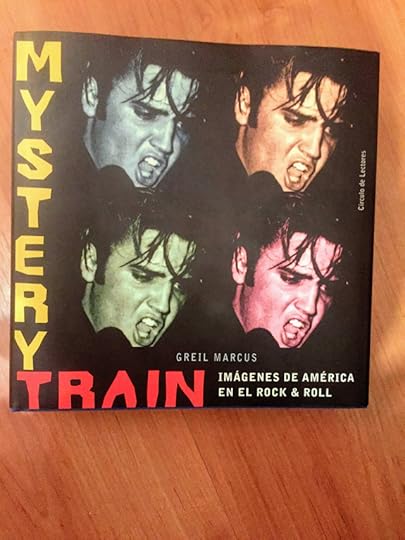
If you are interested in the musicians listed on the cover (Elvis, Sly Stone, The Band, Randy Newman), consider a separate biography about them. This isn't about rock 'n' roll as much as it as about how Greil Marcus sees rock 'n' roll.
 "
"