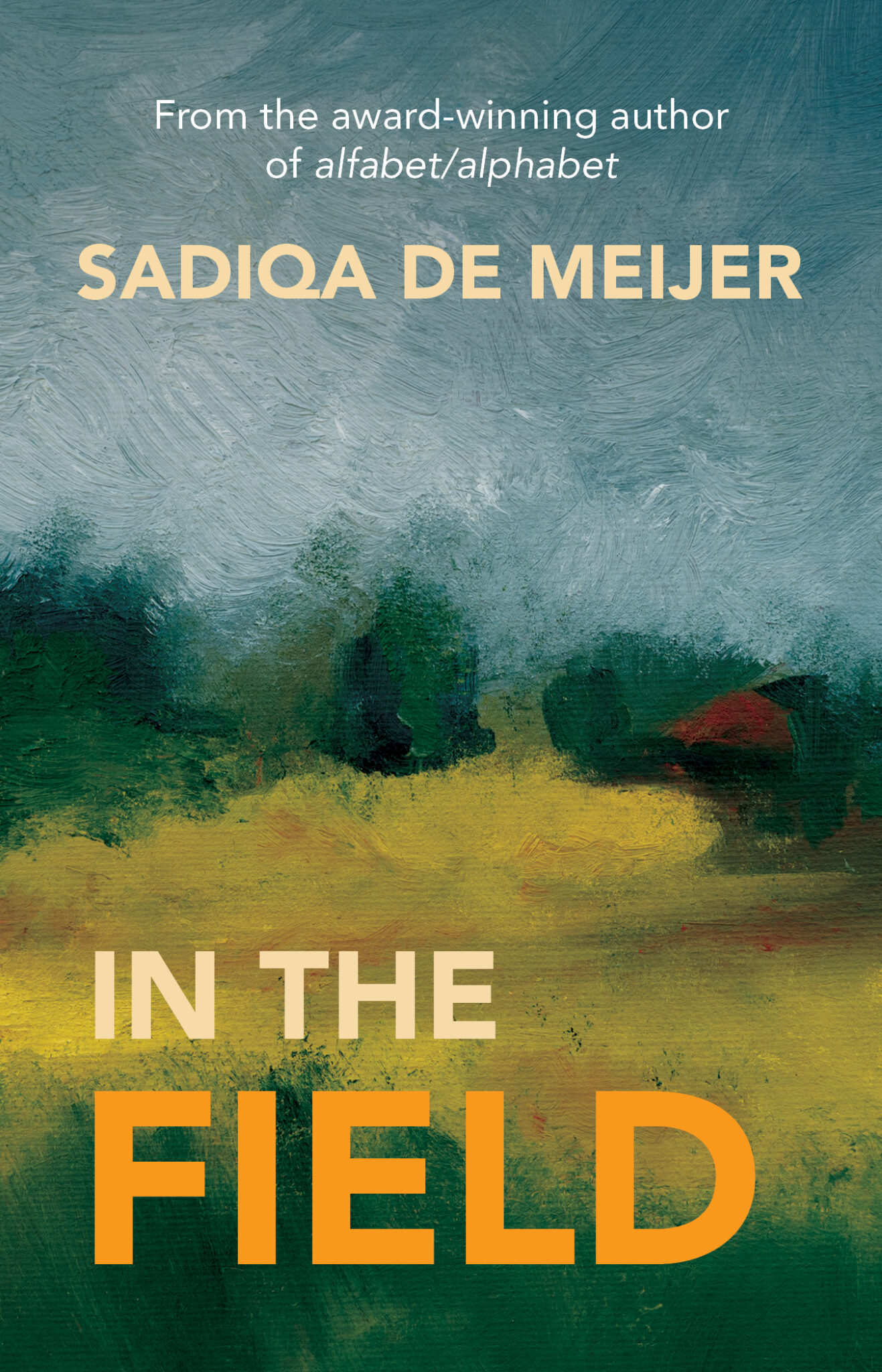
In The Field, Sadiqa de Meijer’s follow up to the Governor General’s Award winning alfabet/alphabet, brings us essays that move searchingly through their central questions. What meaning does a birthplace hold? What drives us to make contact with a work of art? How do we honour the remains of the dead? This writing constitutes a form of fieldwork grounded in intimate observation. In The Field is an extraordinary book, one that invites readers to bring renewed attention to their own lives and to embrace the subjectivity in the experiences of others.
Praise for Sadiqa de Meijer
“De Meijer has now clearly established herself as powerful essayist and memoirist.”—Canadian Journal of Netherlandic Studies
Sadiqa de Meijer is a Canadian poet. Her debut collection, Leaving Howe Island, was a nominee for the Governor General's Award for English-language poetry at the 2014 Governor General's Awards and for the 2014 Pat Lowther Award, and her poem "Great Aunt Unmarried" won the CBC's Canada Writes award for poetry in 2012.
She has also published short stories and essays in anthologies and literary magazines.
Born in Amsterdam and raised in Canada, she currently resides in Kingston, Ontario.
I received this review copy from River Street Writing in exchange for a fair review.
An interesting and thoughtful collection of small memoir-esque essays, In The Field is a clever title as almost all the essays revolve around "fields" in the literal, professional, or artistic sense.
I have not read the author's previous work, but I didn’t need to in order to understand this collection. It features nine short pieces, all of which are deep dives into the author’s (I’m presuming, given it’s a non-fiction) real-life experiences, but in a way that brings you in rather than tells you something. Some non-fiction is more about imparting information or worldview, and there are some, like this one, which use anecdotal experiences as a way to encourage thought.
I found all these essays interesting, though some grabbed me more than others. There is one about her job as a doctor while wasn’t really to my interest - I’m just not into medical stuff - or the one about Amsterdam, as I’ve never been there so a lot of it was like “whoosh over my head” but all the others, which I could relate to a more personal level at least in some aspects, I found really entrancing. And it’s not like the couple that weren’t to my interest were poorly written or something - it’s just a matter of subject matter taste.
The author has a lovely narrative voice that makes the collection easy to follow, and her points or questions asked to be raised in a way that is easy to understand.
What’s interesting is that she might be raising points that I wasn’t entirely on board with, but it felt more like a discussion than anything, in that while my opinion still stood, I understood her viewpoint. It’s like having an actual conversation with someone and not just arguing online or tuning one another out. For example, we share different opinions on reinternment, but it was interesting to read someone else’s perspective on it that didn't feel judgmental.
My favourite sections were Found, In the Field, and After Etty, though the last one was less “favourite” in terms of enjoyment and more an absolutely devastating piece that was incredibly heartbreaking to read.
In each essay, the author gently burrows down into the rich soil of an experience, layer by layer, taking you along with her. While reading this book, I felt I was carrying it with me through the day, as snippets would come to mind, giving new insights and ways of observing my own life. In this way, I felt the stirring of "dark and rustling" seed pod, planted within me by this author.
I adored this book of gorgeous essays. Birthplace, ancestral memory, the self, are all explored to such insightful depths.
« Every encounter shifts me in and out of imagined belonging. »
« … what I dread- that I will find that I have withheld myself, haven’t conveyed how deeply I love whom and what I love. »
Describing medical practice:
« we’ll dispense a measured, distracted kindness, not the whole force we are capable of inhabiting. »
Regarding visitors in a gallery touching art:
« I too have imagined my exceptionalism, deeming my own minor action to be harmless, when I know that collectively, we are the starlings plastering Rome. »
And my favourite:
« I feel the sway between loving a place and resisting the urge to align myself with its collective fictions. »
Sadiqa de Meijer took me by surprise. . . with essays, no less!
There are nine of them - wise beyond wise and off beat - the kind of off beat that is so very on track for real truth. I took notes. . .serious notes on them all. I'll grab a sentence here and there:
Chap - The Singing Bone As a med student she's had to deal with bones - was once given a complete skeleton for a class to study and put together. It didn't sit well with her. She is troubled and concerned about death rites not properly carried out. . . .". . I will carry the discord of those bones like a remainder in long division: a genealogy of downward figures, a reckoning that doesn't quite work out." (pg 25)
Chap - Found She lost her notebook. . .a hunt is undertaken. . .everywhere. . .its purpose is discerned as a means of gleaning, a tool. . .she realizes she is losing gleaning opportunities in this hunt. . .she just needs a new one, to continue her gleaning. . .that is as good as found.
Chap - Bloodwork Further experience as an intern, dealing with bodies, doctors and other students who anoint themselves with godlike powers and attitudes. She wants all to remember they are there to serve and help.
Chap - In The Field She is out there doing field work, in the field, and is reminded of Kafka: do not even listen, simply wait, be quiet, still and solitary. The world will freely offer itself to you to be unmasked, it has no choice, it will roll in ecstasy at your feet. . . Whether she's on the edge of a pond listening and noting bugs and insects, or the weather traversing the pond, she has been turning to the language of the indigenous peoples. It carries their wisdom in their names and stories in and of nature, lands, animals and folklore.
Chap - Dwaallichtjes Dwaallichtjes are little-wandering-lights – things of folklore that rove over bogs – bluish. They skip. . . because they are the souls of unbaptized children. Do not whistle around them, and never follow. Author ponders – about places. We leave them. . .for ‘radiant apparition of opportunity or love or survival itself. And do places remember us after?’ She thinks of places as a relationship one has with the place -
Chap - Spirit Materials Friends who write to each other in embroidery. . . .exploring faith – Amy’s Jewish origins, and the author’s Muslim and Christian ones – and ‘how we hold them in the present.’ ‘when we last saw each other, we were both considering the mystical traditions of our inherited, half-discarded faiths.’
Chap - Drawing Lines Considers the human need to 'draw lines' - DO NOT TOUCH THE ART - why do we do that? What are we saving?
Chap - Do No Harm This is amazing – on prisons – where, as a intern/student, there was a tour on one, and the number one rule was ‘never ask them what they did’ to be in the prison – in an effort to underscore the lack of that knowledge ensure equal treatment of each patient
Chap - After Etty Stunning about Esther Hillesum, aka Etty, who lived in the Netherlands. She and her family died in Auschwitz – This author treasures her journals written there as many folks adopt other writings as a kind of scripture, or guide for their life journeys.
Conclusion: A book of essays worth reading and owning a copy. Stunning.
*A sincere thank you to Sadiqa de Meijer, Literary Press Group of Canada | Palimpsest Press, and NetGalley for an ARC to read and review independently.* #IntheField #NetGalley 25|52:13m