

What do you think?

When There Are Wolves Again
'Vivid, tremendous, unforgettable' - KIM STANLEY ROBINSON on WHEN THERE ARE WOLVES AGAIN, the extraordinary speculative novel of past, present and future, a Guardian Best Science Fiction Book of 2025.
Decades from now, two women sit beside a campfire and reflect on their life stories.
Activist Lucy's earliest memories are of living with her grandparents during the 2020 pandemic and discovering her grandmother's love of birds. Filmmaker Hester was born on the day of the Chornobyl explosion and visits the site years later to film its feral dogs in the Exclusion Zone. Here she meets Lux, the wolf dog who will give her life meaning.
Over half a century, their journeys take them from London to the Highlands to Somerset, through protests, family rifts, and personal tragedy. Lucy joins the fight to restore Britain's depleted natural habitats and revive the species who once shared the island, whilst Hester strives to give a voice to those who cannot speak for themselves.
Both dream of a time when there are wolves again.
* * * Winner of the British Science Fiction Association Award for Best Novel 2025 * * *
A novel of life and of hope, WHEN THERE ARE WOLVES AGAIN is perfect for fans of Clade by James Bradley, The Wolf Border by Sarah Hall, and The Ministry for the Future by Kim Stanley Robinson.
Decades from now, two women sit beside a campfire and reflect on their life stories.
Activist Lucy's earliest memories are of living with her grandparents during the 2020 pandemic and discovering her grandmother's love of birds. Filmmaker Hester was born on the day of the Chornobyl explosion and visits the site years later to film its feral dogs in the Exclusion Zone. Here she meets Lux, the wolf dog who will give her life meaning.
Over half a century, their journeys take them from London to the Highlands to Somerset, through protests, family rifts, and personal tragedy. Lucy joins the fight to restore Britain's depleted natural habitats and revive the species who once shared the island, whilst Hester strives to give a voice to those who cannot speak for themselves.
Both dream of a time when there are wolves again.
* * * Winner of the British Science Fiction Association Award for Best Novel 2025 * * *
A novel of life and of hope, WHEN THERE ARE WOLVES AGAIN is perfect for fans of Clade by James Bradley, The Wolf Border by Sarah Hall, and The Ministry for the Future by Kim Stanley Robinson.
416 pages, Hardcover
First published October 9, 2025
About the author
E.J. Swift
25 books132 followersE. J. Swift is the author of The Osiris Project trilogy, a speculative fiction series set in a world radically altered by climate change, comprising Osiris, Cataveiro and Tamaruq. Her short fiction has appeared in anthologies from Salt Publishing, NewCon Press and Jurassic London, including The Best British Fantasy (Salt Publishing, 2013 and 2014).
Swift was shortlisted for a 2013 BSFA Award in the Short Fiction category for her story “Saga’s Children” (The Lowest Heaven, Jurassic) and was longlisted for the 2015 Sunday Times EFG Short Story Award for “The Spiders of Stockholm” (Irregularity, Jurassic).
Swift was shortlisted for a 2013 BSFA Award in the Short Fiction category for her story “Saga’s Children” (The Lowest Heaven, Jurassic) and was longlisted for the 2015 Sunday Times EFG Short Story Award for “The Spiders of Stockholm” (Irregularity, Jurassic).
Ratings & Reviews
Friends & Following
Create a free account to discover what your friends think of this book!
Community Reviews
Displaying 1 - 30 of 149 reviews

Read
January 6, 2026About two months ago* I had a kidney stone. I wouldn’t wish the intense pain—the equivalent of being stabbed in the kidneys for eight or nine hours—on any single person. Yes, even him.
I tell you this not for you to feel sorry for me, or to suggest that I drink more water, or to tell me about the time you had a kidney stone, but because I read this book over that period.** It’s a testament to Swift’s skills that I was able to enjoy the novel despite the misery and pain. It’s one reason I slotted it in at number three on my best-of-the-year list. It also happens to be an astonishing climate change novel.
When There Are Wolves Again is a thematic sequel to Swift’s previous (and tremendous) novel, The Coral Bones. But where that book is more cautionary—portraying a future two centuries from now in which most habitats have been devastated—When There Are Wolves Again, which begins during COVID and progresses five decades toward the 2070s, imagines what it would take to pull us back from the edge of the cliff.
The novel switches between two protagonists: Lucy and Hester. We meet Lucy during COVID (remember that old pandemic?), spending time with her grandparents, where she comes to appreciate the natural world—birds in particular. Along with her grandmother, she attends a climate protest inspired by Greta Thunberg. There she meets her lifelong friend Annie, and together they become influential climate activists.
Hester, born on the day of the Chernobyl nuclear meltdown, is a documentarian. When we encounter her, she is producing her first film, documenting rewilding efforts and wolves in the Chernobyl Exclusion Zone. She leaves Chernobyl with footage and a wolf-dog pup whom she names Lux. Hester’s documentary brings her fame and the freedom to chart her own course, one that focuses on the changing British landscape and on farmers—like her estranged brother—fighting against the inevitable loss of their land to climate change.
I’ve read a lot of near-future climate fiction,*** and a good chunk of it—especially novels that attempt to forecast what the coming decades will look like, such as Stephen Markley’s The Deluge—is justifiably bleak.**** With recent reports that the Arctic Ocean could be ice-free during summer by 2030, and given who we currently have sitting in the Oval Office, it’s hard to find a bright side. E. J. Swift’s approach is not to sugar-coat reality, but to place a little more faith in activism.
This doesn’t mean bad shit doesn’t happen. Climate catastrophe aside, Lucy is assaulted by a climate-denying, British-first, right-wing nutter, and Hester struggles to make peace with her brother, who is slowly losing his way of life as farmland is reclaimed as marshland. But Swift also offers a glimmer of hope: governments finally reducing carbon emissions to zero, rewilding efforts across Europe, and the King bequeathing his lands back to the commons. None of it is easy. People suffer and die. Families fracture. Friendships are tested. But there is a sense—however faint—that we can drag ourselves out of the climate mire.
While I’m sure I’ll read a great deal of climate fiction in the coming years, it will take one hell of a novel to surpass the passion, insight, and humanity of When There Are Wolves Again.
*Yes, that’s how far behind I am on these reviews.
** Modern pain relief is a miracle.
*** You can’t pay me to use the term “cli-fi.”
**** Jessie Greengrass’s The High House is another example—a true gut-punch of a novel.
I tell you this not for you to feel sorry for me, or to suggest that I drink more water, or to tell me about the time you had a kidney stone, but because I read this book over that period.** It’s a testament to Swift’s skills that I was able to enjoy the novel despite the misery and pain. It’s one reason I slotted it in at number three on my best-of-the-year list. It also happens to be an astonishing climate change novel.
When There Are Wolves Again is a thematic sequel to Swift’s previous (and tremendous) novel, The Coral Bones. But where that book is more cautionary—portraying a future two centuries from now in which most habitats have been devastated—When There Are Wolves Again, which begins during COVID and progresses five decades toward the 2070s, imagines what it would take to pull us back from the edge of the cliff.
The novel switches between two protagonists: Lucy and Hester. We meet Lucy during COVID (remember that old pandemic?), spending time with her grandparents, where she comes to appreciate the natural world—birds in particular. Along with her grandmother, she attends a climate protest inspired by Greta Thunberg. There she meets her lifelong friend Annie, and together they become influential climate activists.
Hester, born on the day of the Chernobyl nuclear meltdown, is a documentarian. When we encounter her, she is producing her first film, documenting rewilding efforts and wolves in the Chernobyl Exclusion Zone. She leaves Chernobyl with footage and a wolf-dog pup whom she names Lux. Hester’s documentary brings her fame and the freedom to chart her own course, one that focuses on the changing British landscape and on farmers—like her estranged brother—fighting against the inevitable loss of their land to climate change.
I’ve read a lot of near-future climate fiction,*** and a good chunk of it—especially novels that attempt to forecast what the coming decades will look like, such as Stephen Markley’s The Deluge—is justifiably bleak.**** With recent reports that the Arctic Ocean could be ice-free during summer by 2030, and given who we currently have sitting in the Oval Office, it’s hard to find a bright side. E. J. Swift’s approach is not to sugar-coat reality, but to place a little more faith in activism.
This doesn’t mean bad shit doesn’t happen. Climate catastrophe aside, Lucy is assaulted by a climate-denying, British-first, right-wing nutter, and Hester struggles to make peace with her brother, who is slowly losing his way of life as farmland is reclaimed as marshland. But Swift also offers a glimmer of hope: governments finally reducing carbon emissions to zero, rewilding efforts across Europe, and the King bequeathing his lands back to the commons. None of it is easy. People suffer and die. Families fracture. Friendships are tested. But there is a sense—however faint—that we can drag ourselves out of the climate mire.
While I’m sure I’ll read a great deal of climate fiction in the coming years, it will take one hell of a novel to surpass the passion, insight, and humanity of When There Are Wolves Again.
*Yes, that’s how far behind I am on these reviews.
** Modern pain relief is a miracle.
*** You can’t pay me to use the term “cli-fi.”
**** Jessie Greengrass’s The High House is another example—a true gut-punch of a novel.

Read
September 4, 2026Spec fic of climate change and a possible future for Britain that includes rewilding and reconnecting to the land, as told by two women, an environmental activist and a film-maker, giving the stories of their lives. It's not plot-driven but that doesn't make it any less compelling, and the vision of a possible future if people could be less greedy and cowardly is painfully desirable: it was hard not to cry for everything we're ruining and everything we could do. Passionate, compelling reading with a vehement stance against the grotesquerie of Britain's land ownership, fucking us up since 1066.

December 9, 2025
Why is sending humans to Mars more imaginable than reintroducing wolves to the Scottish highlands? That's a question asked in this book, but it's also a question this book asks of science fiction.
As in, every big project that takes long-term planning and executtion can be told as a decades-long science fiction saga, so why not talk about rewilding depleted ecosystems on Earth rather than heading out to other planets?
Full review on the podcast, SFBRP episode #577:
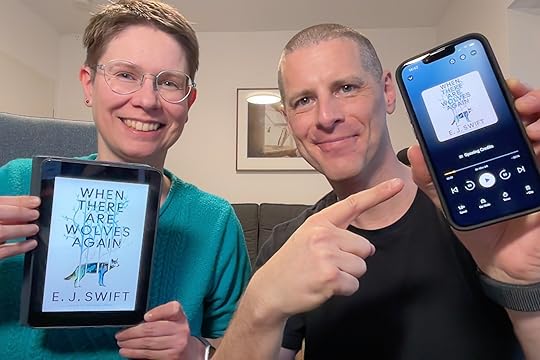
Juliane begins the podcast by wondering whether When There Are Wolves Again by E J Swift is even science fiction, and Luke has strong thoughts on that and other questions.
https://www.sfbrp.com/archives/2393
As in, every big project that takes long-term planning and executtion can be told as a decades-long science fiction saga, so why not talk about rewilding depleted ecosystems on Earth rather than heading out to other planets?
Full review on the podcast, SFBRP episode #577:
Juliane begins the podcast by wondering whether When There Are Wolves Again by E J Swift is even science fiction, and Luke has strong thoughts on that and other questions.
https://www.sfbrp.com/archives/2393

September 27, 2025
When There Are Wolves is a wonderful novel. Quite possibly the most hopeful "dystopian" novel I've ever read.
Split between two narrators -Hannah, the wildlife filmmaker and Lucy, a girl/young woman who cares deeply about the environment. The novel follows the changes in the UK from 2020 to 2070 beginning with Lucy telling her story to Hester.
This is not a political novel - no PMs, Presidents or parties are mentioned/blamed. This novel focuses on the lives of those affected by global warming, land use changes, fights for keeping the status quo and fights for change.
EJ Swift has drawn on many sources to pull together an engaging story about one possible outcome of climate change. We cannot know what will happen in ten or twenty or fifty years but EJ Swift has written a story that focuses on two human responses (along with that of their families) to what may happen.
I thoroughly enjoyed this book. It was, thankfully, a very optimistic novel, which restricts, quite rigidly, to the UK and to two women. And it's all the better for it in my opinion.
Highly recommended.
Thankyou to Netgalley and Quercus Books for the advance review copy. Most appreciated.
Split between two narrators -Hannah, the wildlife filmmaker and Lucy, a girl/young woman who cares deeply about the environment. The novel follows the changes in the UK from 2020 to 2070 beginning with Lucy telling her story to Hester.
This is not a political novel - no PMs, Presidents or parties are mentioned/blamed. This novel focuses on the lives of those affected by global warming, land use changes, fights for keeping the status quo and fights for change.
EJ Swift has drawn on many sources to pull together an engaging story about one possible outcome of climate change. We cannot know what will happen in ten or twenty or fifty years but EJ Swift has written a story that focuses on two human responses (along with that of their families) to what may happen.
I thoroughly enjoyed this book. It was, thankfully, a very optimistic novel, which restricts, quite rigidly, to the UK and to two women. And it's all the better for it in my opinion.
Highly recommended.
Thankyou to Netgalley and Quercus Books for the advance review copy. Most appreciated.
August 20, 2026
And whatever you do, you can't possibly let that old knowledge, that old kinship, those other untidy, unprofitable ways of being survive, because if you do let them, maybe, just maybe, the violence of your ownership will show its teeth.
Lucy, one of the two protagonists of this novel, along with Hester, muses the above, about when an English king in the middle ages decided to take ownership of vast swathes of land, removing it from common use and divvying it up amongst his friends. The result? Common folk like you and I (assuming there's no nobility reading this, no offence) being unable to access miles and miles and miles of countryside in our own backyard, just because a king said you know what? I've decided me and my mates own this and if you dare tread on my land, it's trespassing.
This may seem like somewhat of a digression, but land, ownership, community, and how we interact with nature form part of the backbone, the vertebrae even, of this work of speculative fiction. Normally anything labelled as sci-fi isn't super appealing to me, but the reviews intrigued me, and I'm glad I plunged in and took the risk.
But, is this really sci-fi? I'm not sure. At least, it isn't in the sense that we'd normally think about it. Climate change forms a core part of the novel, and new technologies are mentioned - airships, Bee drones - but the way E.J. Swift works them into the novel isn't the focus. This novel has a very human core, following activist Lucy from a primary-school-aged child during the Covid-19 pandemic up until the year 2070, as well as filmmaker Hester along the time scale, except Hester is in her twenties at the outset of the novel, working on a documentary about dogs in the Exclusion Zone in Pripyat, Ukraine, site of the 1986 Chernobyl disaster.
In addition to changes in the natural landscape, the novel tracks Lucy and Hester's personal growths, triumphs and tribulations, their friendships, relationships, and rivalries. Nothing seems far-fetched as they manoeuvre through a changing England, ranging from the death of King Charles III, dealing with Far-Right politics (the fictional - though plausible - Albion Party, here), and the conflict between capitalism and conservation.
I came to care deeply about the characters of Lucy and Hester, and the supporting cast that feature throughout: Lucy's grandparents and friends, Hester's brother Jake, and the dogs that follow Hester through her life, beginning with Lux, a half-dog half-wolf that she impulsively rescues as a pup from Pripyat.
As I keep typing this review, I realise that I can't really convey the multitudes that this novel contains. A novel where climate change is a central issue could very well go down the doom-and-gloom route, and at times, there are moments of despair - E.J. Swift would be remiss to try and write a feasible work of fiction beginning in this part of the century which is all rainbows and flowers.
However, at its core, this novel is hopeful. It paints a picture of a more caring, connected future, which in the timeline we're currently in, might just be the type of novel we all need to read. Thoroughly recommended, and I daresay the most important novel I've read this year, outside of the ones I teach in the classroom.
Lucy, one of the two protagonists of this novel, along with Hester, muses the above, about when an English king in the middle ages decided to take ownership of vast swathes of land, removing it from common use and divvying it up amongst his friends. The result? Common folk like you and I (assuming there's no nobility reading this, no offence) being unable to access miles and miles and miles of countryside in our own backyard, just because a king said you know what? I've decided me and my mates own this and if you dare tread on my land, it's trespassing.
This may seem like somewhat of a digression, but land, ownership, community, and how we interact with nature form part of the backbone, the vertebrae even, of this work of speculative fiction. Normally anything labelled as sci-fi isn't super appealing to me, but the reviews intrigued me, and I'm glad I plunged in and took the risk.
But, is this really sci-fi? I'm not sure. At least, it isn't in the sense that we'd normally think about it. Climate change forms a core part of the novel, and new technologies are mentioned - airships, Bee drones - but the way E.J. Swift works them into the novel isn't the focus. This novel has a very human core, following activist Lucy from a primary-school-aged child during the Covid-19 pandemic up until the year 2070, as well as filmmaker Hester along the time scale, except Hester is in her twenties at the outset of the novel, working on a documentary about dogs in the Exclusion Zone in Pripyat, Ukraine, site of the 1986 Chernobyl disaster.
In addition to changes in the natural landscape, the novel tracks Lucy and Hester's personal growths, triumphs and tribulations, their friendships, relationships, and rivalries. Nothing seems far-fetched as they manoeuvre through a changing England, ranging from the death of King Charles III, dealing with Far-Right politics (the fictional - though plausible - Albion Party, here), and the conflict between capitalism and conservation.
I came to care deeply about the characters of Lucy and Hester, and the supporting cast that feature throughout: Lucy's grandparents and friends, Hester's brother Jake, and the dogs that follow Hester through her life, beginning with Lux, a half-dog half-wolf that she impulsively rescues as a pup from Pripyat.
As I keep typing this review, I realise that I can't really convey the multitudes that this novel contains. A novel where climate change is a central issue could very well go down the doom-and-gloom route, and at times, there are moments of despair - E.J. Swift would be remiss to try and write a feasible work of fiction beginning in this part of the century which is all rainbows and flowers.
However, at its core, this novel is hopeful. It paints a picture of a more caring, connected future, which in the timeline we're currently in, might just be the type of novel we all need to read. Thoroughly recommended, and I daresay the most important novel I've read this year, outside of the ones I teach in the classroom.

September 4, 2026
4,5 stars rounded up. One of the best SF I've read in years. A hopeful one, too. FRTC if I have time and energy.

June 24, 2026
When There Are Wolves Again is definitely an appropriate book to read while Western Europe swelters in a record-breaking heatwave. It is a moving, hopeful, and involving story of climate change and rewilding. There are two protagonists, whose stories begin in 2020 and continue to 2070. Hester is a solitary documentary film-maker, Lucy an aspiring environmental campaigner. They both watch and try to influence Britain's environmental transformation as the climate changes. I found both narrators' points of view compelling, yet the true stars of the show are ecosystems and their fauna. Swift's previous novel The Coral Bones has similar structure, themes, and vividly evoked ecology, set in Australia. Perhaps When There Are Wolves Again felt more powerful to me because of local familiarity, but I don't think it's just that. The pacing and political insight also seemed more adept.
I really enjoyed When There Are Wolves Again and could not put it down. Some moments even made me cry. I hope Swift continues to write in this vein, as I have a great appetite for this kind of utopian environmental sci-fi. Swift depicts a plausible future in which much is lost due to climate change, yet hope remains and ecological recovery brings social transformation and joy. A good possibility to keep in mind on the hottest June day ever recorded in the UK.
I really enjoyed When There Are Wolves Again and could not put it down. Some moments even made me cry. I hope Swift continues to write in this vein, as I have a great appetite for this kind of utopian environmental sci-fi. Swift depicts a plausible future in which much is lost due to climate change, yet hope remains and ecological recovery brings social transformation and joy. A good possibility to keep in mind on the hottest June day ever recorded in the UK.

October 19, 2025
In 2024, EJ Swift released the climate fiction novel The Coral Bones. That book took the Great Barrier Reef as its central location and explored it in the past, present and future. The interesting aspect of The Coral Bones was Swift’s focus on resilience and adaptation. Her future is a difficult one but it is also one in which humanity has found ways to accommodates changes in climate. In her latest book When There Are Wolves Again, Swift does something similar, exploring the idea of rewilding as a response to climate change. And in this case her location is the whole of Britain.
The story of When There Are Wolves Again revolves around two women. Hester was born on the day of the Chernobyl disaster in 1986 and as a result feels herself connected to that place. So much so that as a film maker she goes there in the 2020s to document the attempted rehabilitation of the dog population, which had been left to go wild in the intervening 35 years. In doing so she ends up adopting a half wolf pup she calls Lux. Born thirty years later is Lucy, who is sent to live with her grandparents during the COVID lockdowns and in doing so learns about nature and the need to fight climate change. Later both will become involved in different projects to rewild different parts of Britain, their lives touching over the next fifty years as those projects gain traction.
When There Are Wolves Again is at its heart an incredibly optimistic piece of climate fiction. Much like The Coral Bones, Swift does not sugar coat the potential impacts of climate change, envisaging a disastrous heat wave in the 2030s. But she is focussed on what could happen if people took the environment seriously, if they worked to together to bring about a change that would make the landscapes they were living in more resilient and more resistant to dangerous changes. Over time she charts the changing of the British landscape and the reintroduction of species that had long since become extinct there.
In a literary landscape full of doom and gloom climate fiction it is refreshing to encounter an author who is selling a different message, That the future is not fixed, that everyone has the capacity to change and that we can make a difference if we want to and are prepared to work with the environment rather than against it.
The story of When There Are Wolves Again revolves around two women. Hester was born on the day of the Chernobyl disaster in 1986 and as a result feels herself connected to that place. So much so that as a film maker she goes there in the 2020s to document the attempted rehabilitation of the dog population, which had been left to go wild in the intervening 35 years. In doing so she ends up adopting a half wolf pup she calls Lux. Born thirty years later is Lucy, who is sent to live with her grandparents during the COVID lockdowns and in doing so learns about nature and the need to fight climate change. Later both will become involved in different projects to rewild different parts of Britain, their lives touching over the next fifty years as those projects gain traction.
When There Are Wolves Again is at its heart an incredibly optimistic piece of climate fiction. Much like The Coral Bones, Swift does not sugar coat the potential impacts of climate change, envisaging a disastrous heat wave in the 2030s. But she is focussed on what could happen if people took the environment seriously, if they worked to together to bring about a change that would make the landscapes they were living in more resilient and more resistant to dangerous changes. Over time she charts the changing of the British landscape and the reintroduction of species that had long since become extinct there.
In a literary landscape full of doom and gloom climate fiction it is refreshing to encounter an author who is selling a different message, That the future is not fixed, that everyone has the capacity to change and that we can make a difference if we want to and are prepared to work with the environment rather than against it.

October 6, 2025
One of the best reads of my year and I think another of my all time ones
A novel exploring the future of the century with an environmental focus and just an incredible read - hope even when we know the future is not easy - strongly recommended!
Full review - https://www.runalongtheshelves.net/bl...
A novel exploring the future of the century with an environmental focus and just an incredible read - hope even when we know the future is not easy - strongly recommended!
Full review - https://www.runalongtheshelves.net/bl...
December 7, 2025
Wonderful - one of my best reads of the year.
August 21, 2026
Two women telling stories around the fire, sharing snippets from their urgent, soaring lives. From 2020-2070 we follow nature enthusiast Lucy, and wildlife film documentarian Hester, from Covid, through stake-outs, recommoning laws, wild fires, hard won battles and innumerable losses. When There Are Wolves Again is a love letter to British landscape and wildlife, and an optimistic ‘thrutopia’ that sees a way of turning the tide on climate change through rewilding, and kindness. It’s certainly hard to read at times - she refuses to look away from the terror of climate change, the grief of endlings and the fear of new viruses, and the fury of those not willing to see change enacted against tradition.
One of the best books of 2026 for me, and I’m sure will be one I’ll return to over the years. Fans of Station Eleven, Birnam Wood and The Overstory, plus Isabella Tree and Nick Hayes’ non-fiction: here’s your next favourite read.
One of the best books of 2026 for me, and I’m sure will be one I’ll return to over the years. Fans of Station Eleven, Birnam Wood and The Overstory, plus Isabella Tree and Nick Hayes’ non-fiction: here’s your next favourite read.

June 5, 2026
J’ai adoré ce roman. Il m’a beaucoup rappelé « je pleure encore la beauté du monde » même si les loups sont moins centraux.
On suit deux point de vue de femmes : une où le style est en première personne du singulier, que l’on commence à suivre quand elle a 5 ans pendant le Covid alors qu’elle est déposé par ses parents chez ses grand-parents, l’autre en style seconde personne du singulier, avec un premier chapitre alors qu’elle fait un documentaire sur les chiens abandonnés de Tchornobyl.
On va suivre la trajectoire de chacune, parallèle dans leurs engagements écologiques et idéologiques, à travers les années et décennies. Ce qui fait de ce roman une œuvre de science-fiction est que l’on fonce vers l’avenir dans un futur pas si lointain que l’on peut envisager. À travers le parcours de ces deux femmes l’autrice imagine un futur à la fois dramatique (forcément vu sur quelle base nous sommes actuellement) et plein de possibilités, de réponses, de combats pour un avenir plus beau, plus vert. Sur son site elle décrit son roman comme de la « climate fiction » et je pense qu’on peut aussi comparer ce roman au « Ministère du futur » de Kim Stanley Robinson, même si je n’ai jamais fini ce roman que j’ai trouvé un peu long à l’époque. « Quand les loups reviendront » est beaucoup plus intimiste, et a su m’intéresser grâce à ses personnages touchantes. La passion de l’une pour les oiseaux, de l’autre pour ses chiennes/louves m’a énormément plu. J’ai aussi aimé la façon dont les événements sont toujours dans le fond, tout avance naturellement et organiquement, avec en toile de fond le thème du réensauvagement des terres.
On suit deux point de vue de femmes : une où le style est en première personne du singulier, que l’on commence à suivre quand elle a 5 ans pendant le Covid alors qu’elle est déposé par ses parents chez ses grand-parents, l’autre en style seconde personne du singulier, avec un premier chapitre alors qu’elle fait un documentaire sur les chiens abandonnés de Tchornobyl.
On va suivre la trajectoire de chacune, parallèle dans leurs engagements écologiques et idéologiques, à travers les années et décennies. Ce qui fait de ce roman une œuvre de science-fiction est que l’on fonce vers l’avenir dans un futur pas si lointain que l’on peut envisager. À travers le parcours de ces deux femmes l’autrice imagine un futur à la fois dramatique (forcément vu sur quelle base nous sommes actuellement) et plein de possibilités, de réponses, de combats pour un avenir plus beau, plus vert. Sur son site elle décrit son roman comme de la « climate fiction » et je pense qu’on peut aussi comparer ce roman au « Ministère du futur » de Kim Stanley Robinson, même si je n’ai jamais fini ce roman que j’ai trouvé un peu long à l’époque. « Quand les loups reviendront » est beaucoup plus intimiste, et a su m’intéresser grâce à ses personnages touchantes. La passion de l’une pour les oiseaux, de l’autre pour ses chiennes/louves m’a énormément plu. J’ai aussi aimé la façon dont les événements sont toujours dans le fond, tout avance naturellement et organiquement, avec en toile de fond le thème du réensauvagement des terres.

July 9, 2026
Superb speculative fiction. One of the best I've read.
Written with great care and immediacy.
The organic storytelling of Lucy's POV is brimming with nostalgia of a near future that truly felt lived. Whereas, Hester's POV is as if viewed through the lens, distancing herself from her own narrative.
A story for now. An important and impressive work of speculative fiction.
Written with great care and immediacy.
The organic storytelling of Lucy's POV is brimming with nostalgia of a near future that truly felt lived. Whereas, Hester's POV is as if viewed through the lens, distancing herself from her own narrative.
A story for now. An important and impressive work of speculative fiction.
May 28, 2026
So, I read this in one sitting. I don't think this is a book to be read in one sitting, I think this is a novel to be read slowly, deliberately, a story to be savoured, really chewed on. I will undoubtedly reconsume it once my initial awe has worn off and take it slow, allowing each individual story of saviour to soak into me like waters reclaiming old marshland. But for now, this is a novel I simply could not put down.
Never has a book filled me with such overwhelming rage and yet such overflowing hope. I went into this expecting a rather defeatist tale of conservation climaxing in the reintroduction of wolves. Instead, Swift feeds you the triumphs of conservation one by one, what can be accomplished when the people who care come together to make real change, all without being idealistic. I want to push this book into the hands of everyone I meet. I want to point wildly at it shouting "SEE! SEE! THIS IS WHAT WE CAN DO IF WE TRY!" I want to cry a little bit. At the world I'm stuck in. At the world Swift has dangled in front of me so cruelly, so kindly. Most of all, I want to walk up into the heather of the wild hills I am lucky enough to live in and say hello to the grouse, the rabbits, the red kites, the buzzards, the otters, the swallows, the oystercatchers. But it has been a long day of blaring sun sending the mercury up to 30° and my skin is red and peeling, so for now I'll sit watching the blue tits nesting in our shed and think how lucky I am to be one of the people that cares about these creatures so much it hurts.
Never has a book filled me with such overwhelming rage and yet such overflowing hope. I went into this expecting a rather defeatist tale of conservation climaxing in the reintroduction of wolves. Instead, Swift feeds you the triumphs of conservation one by one, what can be accomplished when the people who care come together to make real change, all without being idealistic. I want to push this book into the hands of everyone I meet. I want to point wildly at it shouting "SEE! SEE! THIS IS WHAT WE CAN DO IF WE TRY!" I want to cry a little bit. At the world I'm stuck in. At the world Swift has dangled in front of me so cruelly, so kindly. Most of all, I want to walk up into the heather of the wild hills I am lucky enough to live in and say hello to the grouse, the rabbits, the red kites, the buzzards, the otters, the swallows, the oystercatchers. But it has been a long day of blaring sun sending the mercury up to 30° and my skin is red and peeling, so for now I'll sit watching the blue tits nesting in our shed and think how lucky I am to be one of the people that cares about these creatures so much it hurts.
January 12, 2026
3.5 stars and I’m not sure how to review this piece of very well written and constructed piece of speculative fiction.
The book starts out following the lives of a documentary filmmaker who we first meet in Ukraine and a young girl in the care of her grandparents in England during the covid 19 pandemic. Both lives are shaped by ongoing challenges of climate change and loss of biodiversity and against a political and social backdrop that will be familiar to anyone living in the UK in the 21st Century.
It has its share of human drama, without being a page turner and for some reason evoked for me thoughts of Greenham Common and the anti nuclear movement of the 1980s.
The narratives of the lives of the two main protagonists are intertwined in a very tangential way up until the conclusion of the novel. It is thoughtful and optimistic and deserves to be widely read because it is clearly a labor of love. That said, it didn’t entirely grip me in the way I had hoped. It was solid and enjoyable and I suspect it will be well liked by readers of Ian McEwan’s “What We Can Know”.
The book starts out following the lives of a documentary filmmaker who we first meet in Ukraine and a young girl in the care of her grandparents in England during the covid 19 pandemic. Both lives are shaped by ongoing challenges of climate change and loss of biodiversity and against a political and social backdrop that will be familiar to anyone living in the UK in the 21st Century.
It has its share of human drama, without being a page turner and for some reason evoked for me thoughts of Greenham Common and the anti nuclear movement of the 1980s.
The narratives of the lives of the two main protagonists are intertwined in a very tangential way up until the conclusion of the novel. It is thoughtful and optimistic and deserves to be widely read because it is clearly a labor of love. That said, it didn’t entirely grip me in the way I had hoped. It was solid and enjoyable and I suspect it will be well liked by readers of Ian McEwan’s “What We Can Know”.

June 17, 2026
I admit I could not get into that book as much as the Coral Bones one - probably because my expectations were too high. The characters did not feel as real to be, especially Hester. But I loved the climate fiction aspects of it - the trophic catastrophies, the very real implications of even a small change in temperature has on our ecologies, that we are experiencing even now, is both hard to read and eye opening. A very lovely story in the end, of young people, and less so, trying to save the world by the little means they have. A very human story, and a deeply important one.

December 8, 2025
There's an episode of Ted Lasso where Higgins makes a dumb pun for the first time, and Ted slams through the door of Rebecca's office, points at Higgins, and says, "YES." That's how it felt reading this book. Just... YES. I loved it. Definitely one of my top reads of the year.

Want to Read
April 10, 2025For fans of Bradley's Clade? I'm in

Want to Read
April 6, 2026See Ian Mond's review, nearby.
$3 Kindle avail, 8/16/26. Now on hand. TBR!
$3 Kindle avail, 8/16/26. Now on hand. TBR!
May 14, 2026
A soulful look at our future, our hurdles and potential victories, with two very compelling main characters that you can't help feeling for. Loved it!
January 20, 2026
Dystopian but optimistic by the end. Though the optimism comes from somewhat contrived government actions. Understandable given the focus on individuals rather than government though.

April 21, 2026
Es possible que aquest llibre sigui particularment per mi, perquè m'obsessiona el tema del "rewilding" i l'experiència de Yellowstone, però he gaudit moltíssim de la novel·la. Crec que l'interès a priori, però, influeix molt en la seva recepció.

August 21, 2026
Beautiful novel about change, grief and hope, ecological and personal, told from the perspective of two women following them into the future. Often, it felt like it foretold our future: a mixture of hopeful changes and of terrible ones. I'm probably the ideal audience for this book, but would still recommend it to anyone to paint a picture of what a re-commoned future could look like.

June 13, 2025
What a powerful book! I read an eARC of this book on NetGalley so thank you to the author and the publisher.
This novel spans decades, following two characters. We have a young girl who is inspired into environmental activism by her grandparents, and a documentary filmmaker whose life is punctuated by the dogs she keeps, descended from a half wolf she rescues from Chornobyl.
The novel covers really important subjects, we look at issues we’ve already seen, and then environmental and social issues that we may face in the near future. The novel balances broad scale with the local impact too. Lucy is particularly concerned with the birds in her gran’s garden but then we also see political action, loss of habitat and species. There’s a lot of rage at what the characters and the world have to face in this story. It’s frightening how they have to battle not only the huge environmental issues, but also the violence and cruelty from other humans.
I feel largely positive about this book. The author made a couple of unusual choices in the writing construction. One is that the second perspective is written in second person. I didn’t mind this, it actually worked in this book and felt relevant to the recounting of that characters story. However this book was also written without speech marks. This was quite jarring and I found myself pulled out of the narrative flow to try and discern what was and wasn’t speech. This was a shame as it made the story feel stop/start in places which affected my immersion in the book. I’m sure these choices will be received well from a literary perspective for doing something unusual, however the lack of speech marks did affect my enjoyment of the book. Without this issue this would have been an easy five stars for the power of the book and the exploration of the content and how invested in felt in these characters.
This novel spans decades, following two characters. We have a young girl who is inspired into environmental activism by her grandparents, and a documentary filmmaker whose life is punctuated by the dogs she keeps, descended from a half wolf she rescues from Chornobyl.
The novel covers really important subjects, we look at issues we’ve already seen, and then environmental and social issues that we may face in the near future. The novel balances broad scale with the local impact too. Lucy is particularly concerned with the birds in her gran’s garden but then we also see political action, loss of habitat and species. There’s a lot of rage at what the characters and the world have to face in this story. It’s frightening how they have to battle not only the huge environmental issues, but also the violence and cruelty from other humans.
I feel largely positive about this book. The author made a couple of unusual choices in the writing construction. One is that the second perspective is written in second person. I didn’t mind this, it actually worked in this book and felt relevant to the recounting of that characters story. However this book was also written without speech marks. This was quite jarring and I found myself pulled out of the narrative flow to try and discern what was and wasn’t speech. This was a shame as it made the story feel stop/start in places which affected my immersion in the book. I’m sure these choices will be received well from a literary perspective for doing something unusual, however the lack of speech marks did affect my enjoyment of the book. Without this issue this would have been an easy five stars for the power of the book and the exploration of the content and how invested in felt in these characters.

July 14, 2026
A hopeful vision for the future where humanity (through activism) decides to protect and rewild, but read more like a manifesto than a compelling novel.
I liked the messaging about a lot of the environmental crisis is because of humans not seeing themselves as part of nature - and how urban living and separation from wild spaces deepens this divide. I just felt like the protagonists were more of a vehicle to explore these issues rather than fleshed out in their own right. Maybe it was the point to kind of de-centre them, but I didn't feel very connected to either of the main characters and that I never really learnt anything about them outside of their causes. I think a case of liking the ideas that were being explored and it felt realistic and thoughtful, but almost felt like it would be a story better suited to non fiction?
Overall it does have a good message about conservation and how change can be made through grassroots movements, but the parts based in reality felt the most interesting to me - how the recklessness of Chernobyl birthed a reserve only because of its inaccessibility to humans, and the tension between land ownership (which is tied to profit) and conservation for conservation's sake. I just wish it had done more as a story? Idk it feels like a weird critique to make but I ?? don't know
I liked the messaging about a lot of the environmental crisis is because of humans not seeing themselves as part of nature - and how urban living and separation from wild spaces deepens this divide. I just felt like the protagonists were more of a vehicle to explore these issues rather than fleshed out in their own right. Maybe it was the point to kind of de-centre them, but I didn't feel very connected to either of the main characters and that I never really learnt anything about them outside of their causes. I think a case of liking the ideas that were being explored and it felt realistic and thoughtful, but almost felt like it would be a story better suited to non fiction?
Overall it does have a good message about conservation and how change can be made through grassroots movements, but the parts based in reality felt the most interesting to me - how the recklessness of Chernobyl birthed a reserve only because of its inaccessibility to humans, and the tension between land ownership (which is tied to profit) and conservation for conservation's sake. I just wish it had done more as a story? Idk it feels like a weird critique to make but I ?? don't know
August 20, 2025
New author discovered! With thanks to Netgalley and Quercus Books, I already want this and The Coral Bones on my shelf.
WTAWA begins in covid times and, whilst I used to avoid virus plots, Swift combines these scenes with a nostalgic sense of childhood. As we jump through the years, we begin to see the toll our lifestyle is taking on Earth, and what Lucy and Hester do to fight for its wildlife.
I also really liked how Swift laid her chapters out, but I’ve seen that it draws some readers out (so you’ll just have to try it and see)! One character narrates in first person, whilst the other narrates in second, giving the impression that we’re sat around the fire too. We journey right up until the night they’re talking together, and I thought it was lovely to see what COULD be.
WTAWA begins in covid times and, whilst I used to avoid virus plots, Swift combines these scenes with a nostalgic sense of childhood. As we jump through the years, we begin to see the toll our lifestyle is taking on Earth, and what Lucy and Hester do to fight for its wildlife.
I also really liked how Swift laid her chapters out, but I’ve seen that it draws some readers out (so you’ll just have to try it and see)! One character narrates in first person, whilst the other narrates in second, giving the impression that we’re sat around the fire too. We journey right up until the night they’re talking together, and I thought it was lovely to see what COULD be.
January 10, 2026
3.5/5. Premise of this book couldn’t be more up my street but it felt a bit YA fiction at times and so I was a bit disappointed. Had read a good few of the books it was inspired by so it didn’t feel as fresh to me as it might have for other readers. Still enjoyed it

Read
September 1, 2026When the covid-19 pandemic hits and Lucy is sent to stay with her grandparents, she is six years old. Hester, a filmmaker born on the same day as the Chernobyl nuclear disaster who fled her family’s farm in Somerset at the earliest opportunity, is thirty-four. Over the next fifty years, their lives never quite touch (except at the novel’s end: the frame story is that Hester is filming Lucy as she speaks her memories). But they come very close at times, attending the same protests and caring about the same things. Lucy, inspired by Greta Thunberg, becomes a climate activist, a decision which both fulfills her and leads to some terrible losses; Hester’s documentary films, starting with Dogs of Chernobyl, are already famous by the time Lucy is an adult, and she keeps making them, following landscapes over years and decades.
This is a climate crisis novel and a political activism novel, but its speculative premises are not hard to buy. One is that a coalition government in the UK is forced to actually keep some campaign promises about legislating for sustainability. The other is that King Charles III, on his deathbed, leaves all of the land in the Royal Estates to the British people. (The royal family immediately mounts a legal challenge, which turns into a case that drags on for years, but ultimately it does happen.) These changes in the status quo help to spark greater, more meaningful progress in turning around some of Britain’s most substantial environmental problems: loss of biodiversity and habitat destruction. Without being unduly naive – Lucy and her colleagues face violent opposition during which her house is burned to the ground and she is shot, though not fatally; Hester’s brother, who inherits the farm on land that can no longer do what it once did, must change his life almost out of recognition or face destruction – E.J. Swift creates a vision of the future that accommodates not just human cruelty, but the more surprising and unpredictable qualities of human cooperation and mercy. An excellent Clarke Award winner: compelling, convincing, realistic but not defeatist.
This is a climate crisis novel and a political activism novel, but its speculative premises are not hard to buy. One is that a coalition government in the UK is forced to actually keep some campaign promises about legislating for sustainability. The other is that King Charles III, on his deathbed, leaves all of the land in the Royal Estates to the British people. (The royal family immediately mounts a legal challenge, which turns into a case that drags on for years, but ultimately it does happen.) These changes in the status quo help to spark greater, more meaningful progress in turning around some of Britain’s most substantial environmental problems: loss of biodiversity and habitat destruction. Without being unduly naive – Lucy and her colleagues face violent opposition during which her house is burned to the ground and she is shot, though not fatally; Hester’s brother, who inherits the farm on land that can no longer do what it once did, must change his life almost out of recognition or face destruction – E.J. Swift creates a vision of the future that accommodates not just human cruelty, but the more surprising and unpredictable qualities of human cooperation and mercy. An excellent Clarke Award winner: compelling, convincing, realistic but not defeatist.

August 2, 2026
This book is everything - heart-wrenching, hopeful and with an important message about the power of nature and the nature of humanity. It starts in the very recent past, in 2020 London, a time so recent and yet already so far behind us. I was crying within a few pages. There were times I wasn’t sure I could continue as I wasn’t sure I wanted to know what would come next, and I had to remind myself that it is still technically fiction. I will be recommending this book to everyone who will listen.
September 17, 2026
Really enjoyable if a little heavy handed. Made me sad to think that a lot of plot points are probably unrealistically hopeful. Found it pretty engaging throughout
Displaying 1 - 30 of 149 reviews