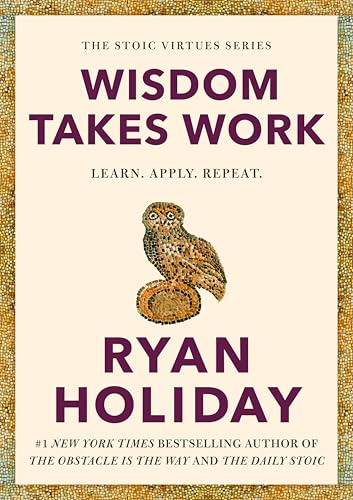
“Wisdom Takes Work” is the final book in Ryan Holiday’s series on the Stoic virtues, and there is so much brilliance in this book that it deserves to be read more than once. Throughout, Holiday offers insight on how we build wisdom through examples and wise advice.
While his previous books in the series (Courage Is Calling, Discipline Is Destiny, and Right Thing, Right Now) relied heavily on examples, this one focuses more on ideas. He defines wisdom in various ways and then uses stories to illustrate them. I think that's why this is my favorite of his writings. He shows
He does have an odd fascination with Elon Musk in this book. He admits that and shares frequent examples of Musk’s rise to riches and his odd behavior.
This is a practical book. Instead of abstract philosophy or motivational fluff, the book focuses on turning timeless ideas into daily habits. Each section is short, focused, and forces you to slow down and actually think about how you’re applying what you’re learning.
Memorable Highlights
Questions are the key not just to knowledge but to success, discovery, and mastery. They’re how we learned and how we get better.
Asking leads to answers, and answers lead to more questions. From not knowing, we get to knowing, and eventually to the truth. This is why we must understand that there is no such thing as a dumb question. In fact, a person becomes smart only by asking questions.
What’s the point of going to school or finding a mentor if you’re not going to listen? When you’re talking, what you’re doing is not hearing. When we open our mouths, we shut our ears. Really, what we’re doing is closing doors. We could have learned something. We could’ve gotten someone else’s perspective. We could’ve heard their experience. We could have gotten their advice.
It’s not enough to read; you need in practice capturing information and recording it so you can draw on it later.
History isn’t something that is presented to you; it’s something you unearth piece by piece, book by book, visit by visit, question by question. As we read and study, we become a pioneer, a refugee, a Union soldier, a slave owner, a colonizer in the native, a Greek, a Roman, and a barbarian. We must inhabit the world to understand it, see things through their eyes, feel the heat of the battle, the fear of persecution, the hope of a better future.
History, you must understand, is not about the past. It’s a lens for understanding the present. It’s a way of predicting, even determining the future.
The world is very big. Our culture is but one of many. There is wisdom and geography, wisdom in the generations of people who have lived in one place, adapting to the land and the environment around them. If we are only curious enough to learn it.
Bring your notebook, write down everything you see, feel, and think. Every building, every tree, has a story. Think of what they witness. Think of who stood where you are standing.
Only a fool goes with their first thought. A wise person takes time to contemplate.
We are all drowning in information, much of which is fascinating, that was once elusive. It’s on us to figure out how to filter and digest it, how to act, and what is true and consequential. When to focus and how to tune out.
We should absolutely do our research to borrow the term popular with conspiracy theorist but by that we mean actually do the research. Like, read really incredible authors on a topic, lots of them. Do actual thinking, not what feels like thinking. Ask real questions instead of just asking questions. Listen to the answers. Allow ourselves to be proven wrong. Allow ourselves to learn new things. A podcast is not a sufficient briefing on a topic. We must be ever vigilant against bullshit, which can be spread the day in ways that the ancients could not have imagined.
But this is what the wise do. They don’t just learn when they’re young but all their lives they identify as a student not as a person who has obtained wisdom. They don’t see themselves as better or apart. They are just like everyone else, still learning needing to be taught.