Whether it's to adhere to regulations, access markets by meeting specific standards, or devise data analytics and AI strategies, companies today are busy implementing metadata repositories—metadata tools about the IT, data, information, and knowledge in your company. Until now, most of these repositories have been implemented in isolation from one another, but that practice lies at the core of problems with data management in many companies today.
Author Ole Olesen-Bagneux, chief evangelist at Actian, shows you how to masterfully manage your metadata repositories by properly coordinating them. That requires a data discovery team to increase insights for all key players in enterprise data management, from the CIO and CDO to enterprise and data architects. Coordinating these repositories will help you and your organization democratize data and excel at data management.
This book shows you how.
Learn what metadata repositories are and what they doExplore which data to represent in these repositoriesSet up a data discovery team to make data searchableLearn how to manage and coordinate repositories in a meta gridIncrease innovation by setting up a functional data marketplaceMake information security and data protection more robust Gain a deeper understanding of your company IT landscapeActivate real enterprise architecture based on evidence
Book review: "Fundamentals of Metadata Management" by Ole Olesen-Bagneux Metadata is often summarised as 'data about data', but in "Fundamentals of Metadata Management", Ole Olesen-Bagneux shows why this view is too narrow. Metadata extends well beyond the semantic layer employed in analytics platforms. While the semantic layer focuses on creating a consistent vocabulary for reporting and business intelligence (BI), metadata management encompasses IT systems, processes, information and even organisational knowledge. The real problem that companies face is not the absence of metadata repositories, but rather that they have too many: fragmented, overlapping and rarely aligned.
What is good about the book is its practical approach. Olesen-Bagneux moves beyond the theory of metadata to focus on real-world issues, such as the multiple, conflicting 'truths' about the IT landscape that every enterprise struggles with. His proposed solutions — the Data Discovery Team, a cross-functional unit designed to coordinate metadata across silos, and the Meta Grid, a decentralised architecture inspired by microservices and data mesh — offer technical leaders a pragmatic way to strengthen governance, reduce duplication and enable innovation.
Readers should also be clear about what not to expect. This is neither a catalogue of metadata standards nor a detailed guide to formats such as XML, JSON, or RDF. Nor is it an attempt to replace the semantic layer with another 'single source of truth'. Instead, the book argues for coordination and contextualisation, helping organisations to connect repositories rather than standardising them into one monolithic model.
The message is clear: a shift in metadata management is needed. The problem is not a lack of metadata, but rather that it is scattered across silos. By connecting repositories through dedicated teams and decentralised architectures, companies can finally gain a resilient, holistic view of their IT landscape. For professionals navigating the intersection of data management, semantic layers and enterprise architecture, this book offers a thoughtful and forward-looking guide.
Just finished reading "Fundamentals of Metadata Management", and I found it very worthwhile and relevant to my team's work. The book gives an extensive (sometimes overwhelming) overview of metadata repositories used by large companies. It explains how they relate to each other and tie into the IT landscape. Probably because this is so extensive, it's no wonder that this is often implemented in silos, leading to the common problems like a lack of transparency, data quality issues, and missing connections that explain how things fit together.
The idea of having a cross-functional *Data Discovery Team* and first uncovering, then aiding / improving the existing *Metadata Grid* is interesting. Ole makes a point that you basically have to start from there, before you can even realistically go towards a technological solution. I think he's right. However, not every company takes such a holistic approach. In many cases, influence may only be possible from the bottom up. I would be interested in more practical tips and pointers on how to improve the organically grown, often chaotic metadata grid reality - maybe also just with a "coalition of the willing".
The book doesn't go much into technological solutions, it even states that the metadata grid is not a technology. But now with AI and companies that want to be data-driven, there is high value in bringing the most valuable metadata sources together in a way that is easy to consume, e.g. via Knowledge Graphs or Unified Metadata Repositories. But also: Aligning *everything* together into a single model and one technology is unrealistic, much less replacing and changing the many underlying sources and their domain focused models. It will be tricky and fun to find the right balances, a realistic working model and technologies to make it scale.
We cannot deny it, we all work with data in our daily work and thus also with metadata that describes this data from different user perspectives. Unfortunately in many situations this has grown historically into data islands with their own metadata repositories that can have overlap and that can conflict with each other. In practice this leads to serious challenges in our work activities when we try to discover, disclose, combine, use, process, govern and manage all this data in a coherent and consistent manner.
The meta grid is a decentralized architecture similar to micro services and data mesh that can help to uncover, unify and unleash the hidden potential that in many organizations is unused by bringing the metadata in different metadata repositories together in a pragmatic, coordinated approach with support from a dedicated data discovery team. A refreshing new way of thinking and working that makes use of the existing metadata repositories, which is clearly and concisely explained by Ole in this book. Highly recommended!!
How many times have you mapped your IT landscape, only to watch that map gather dust six months later?
The pattern is predictable: compliance needs visibility, so you map everything. Innovation project launches-another map. Operations initiative begins-same cycle repeats.
Ole Olesen-Bagneux's "Fundamentals of Metadata Management" book reframes this: "Metadata is defined not by what it is, but by where it exists."
Your ERP has metadata. Your CRM has metadata. Both describe the same enterprise reality, just shaped differently for their purposes. offers a way to break the cycle. The approach is pragmatic and non-invasive: - Acknowledge metadata silos will always exist - Build point-to-point connections where needed - Elevate metadata from afterthought to strategic asset
My takeaway: it's time to treat metadata coordination as an internal capability.
Essential reading for anyone leading data organizations.
A practical and insightful guide to solving one of the biggest challenges in enterprise data management: fragmented metadata repositories. Instead of adding more tools, Ole makes a compelling case for coordinating existing repositories into a meta grid, unlocking democratized data access, stronger compliance, a functional data marketplace, and evidence-based enterprise architecture. What I appreciated most is the balance of technical depth with real-world application making it a valuable read not just for CIOs and CDOs, but for anyone working to break silos and turn data into a true enterprise asset.
This book is a refreshing and practical take on a topic that’s often seen as too technical—metadata. Ole Olesen-Bagneux breaks it down in a way that feels approachable and relevant, especially for anyone working with data in a business setting. Instead of treating metadata repositories as isolated tools, he shows how connecting them can unlock real value across the organization. The ideas around building a discovery team and creating a coordinated “meta grid” are not just smart—they’re actionable. A great read if you're looking to bring more structure and insight to your data efforts.
This mornings Labor Day reading is Ole Olesen-Bagneux's new "Fundamentals of Metadata Management". Maybe not as 'technical' as Perrin/Brodas "Implementing Data Mesh", but Ole is nailing the Enterprise/Governance/Strategy representation of the data management challenge.
Am only through Preface+Ch1, but as Strengholt did 'Data Engineering' Perrin/Brodas did 'Data Management', maybe this is Olesen-Bagneux doing 'Data Policy'?
I love the concept but as Ole said himself "Whilst the technical solution architecture for the Meta Grid is simple, the organizational and intellectual understanding of the Grid is not. ". Read it, think about it and take action this is a journey - you won't get there today, or tomorrow or next year but it feels like a solution that could be worth the pain.
As I began reading Fundamentals of Metadata Management, I didn’t expect to see myself in it. I thought it would be one of those professional books I read: pen in hand, nodding at familiar frameworks, underlining useful distinctions, and then moving on. But a few pages in, I felt that familiar discomfort when a book doesn't introduce something new, but rather points out something you've already been experiencing.
Large organizations are often clouded by a strange, polite uncertainty. The lists of systems that no one quite dares to shut down. The outdated diagrams that everyone still uses. Conversations that circle around "the landscape" as if it were a stable object when, in reality, it keeps shifting depending on who is describing it.
Ole Olesen-Bagneux calls this metadata. He does not mean "data about data" in the narrow sense, but rather the language organizations use to describe themselves, including their systems, processes, risks, ownership structures, rules, and knowledge. Reading this, I found myself thinking, "Yes, that’s exactly it." This is not a technical layer. It’s how an organization knows what it is doing. Or thinks it does.
What stayed with me most was his insistence that missing documentation was not the problem. Rather, it is the excessive amount of documentation produced in isolation. As he explained IT management, data management, information management, and knowledge management, I kept mentally mapping them onto places I’ve worked. There's the CMDB that claims to know the infrastructure. The enterprise architecture tool that claims to understand applications. The data catalog that claims to know the data. There are also security registers, records systems, learning platforms, and quality systems. Each is maintained by competent people. Each is internally coherent. Yet, each conflicts with the others. Individually, they appear orderly. Together, however, they form something closer to a polite confusion.
I realized how often I have done this without naming it. I ask, "What systems do we have?" and receive different answers depending on who I ask. Trusting one repository in one meeting and another in the next. I speak about "single sources of truth" while knowing that, practically, the truth is always plural. I should know. Truth is always subjective. This book provides language for that experience in relation to metadata.
Ole particularly excels at demonstrating that this fragmentation is the result of structure, not a failure of intelligence or effort. Teams form around responsibilities, tools form around teams, and definitions form around tools. Before long, reality itself becomes segmented. It's like Conway's Law applied to knowledge. At some point, I stopped reading it as a book about metadata and started reading it as a book about organizations trying to understand themselves using instruments that were never designed for that purpose.
His proposal of a data discovery team seemed oddly delicate to me. It felt almost old-fashioned, borrowing more from the reference librarian than the data engineer. Ole envisions a group whose task is not to declare what is true, but rather to navigate between partial truths. They would know where descriptions exist, how they differ, where they are inaccurate, and how they can be combined without pretending they are the same. It felt less like an architectural solution and more like an ethical stance: humility toward complexity.
The same is true of the Meta Grid. I expected another type of platform, or another box in the system diagram. Instead, he describes something closer to a pattern more than a product. It's a structure that already exists, latent, between existing repositories. It's something to uncover rather than create. This idea was surprisingly convincing to me, not because it promises control, but because it doesn't.
If I have one reservation, it's that the description of coordination is calmer than I've ever seen it unfold. Aligning metadata is difficult and very political. It touches on issues of ownership, budgets, prestige, and professional identity. While some silos may be accidental, others exist because they are useful to someone. Some of these silos are small kingdoms in themselves, for better or worse. But perhaps that is precisely why the book resonates with me. It doesn't pretend that this is easy. It simply argues that failing to see the problem clearly is worse.
Reading it now, at a time when organizations are rushing to layer generative AI on top of infrastructures they barely understand, the argument feels even more relevant. These systems depend on context, and in companies, context is metadata. When enterprises hallucinate, their machines will too. Their models are either naive or purely designed, and the fractured descriptions of reality they inherit reflect this.
I closed the book with the uncomfortable feeling that it is less about metadata management and more about organizational self-knowledge. It's about whether we are willing to closely examine the machinery we already live inside before asking it to think on our behalf. After all, most companies do not fail because they lack intelligence, but rather because they stop paying attention. Ultimately, this book is about learning to notice again.
Fundamentals of Metadata Management is the first book that finally treats metadata the way real organizations actually work. Ole Olesen-Bagneux cuts through the hype and shows that the real problem is not “missing metadata” but too many uncoordinated metadata repositories, each telling a different story about the IT landscape.
The book is clear, pragmatic, and grounded in decades of enterprise reality. It maps the full spectrum of metadata repositories across IT, data, information, and knowledge management. More important, it shows how these parts can be aligned through two simple but powerful ideas: the Data Discovery Team and the Meta Grid. Both concepts are immediately usable. They help organizations stop rebuilding the same IT overview again and again and instead create a durable, coordinated understanding of applications, data, processes, and risks.
I appreciate that the book avoids idealistic “single source of truth” fantasies. It focuses on what already exists inside companies and shows how to uncover and coordinate it. The explanation of the Meta Grid as the “third wave of decentralization” is especially strong. It connects seamlessly to microservices and data mesh while staying more practical and far easier to implement.
If you work in enterprise architecture, data strategy, information security, or governance, this book gives you language, structure, and a roadmap you can use the next day. It explains the messy reality of metadata with precision and offers a realistic path to escape it.
A must-read for anyone who needs a complete, evidence-based view of their IT landscape—and is tired of paying for the same discovery work over and over again.
It was back in 2018 when I first began exploring metadata — the intriguing concept of “data about data.” My focus at the time was on electronic health records (EHR) data, where I quickly realized that metadata often originates from multiple sources, sometimes carrying overlapping or even conflicting meanings.
Reading Ole Olesen-Bagneux’s The Fundamentals of Metadata Management was refreshing because it brought structure and clarity to what can often feel like an abstract and fragmented field. Ole’s discussion of various metadata repositories and his systematic approach to understanding their interrelations resonated strongly with my own experiences.
While the underlying concept of metadata is straightforward, implementing effective metadata management is anything but simple. That’s where this book truly shines — it raises awareness and provides a well-structured framework that helps professionals from diverse backgrounds in information and computer sciences navigate the complexities involved.
This is a must-read for anyone trying to make sense of the data scattered across different technological systems. Although the examples and focus may start within IT, the principles Ole outlines are universally applicable across any industry that operates within a complex technology landscape.
In short, The Fundamentals of Metadata Management transforms the abstract idea of “data about data” into an accessible and actionable discipline — an essential resource for today’s data-driven world.
Fundamentals of Metadata Management places an interesting lens on the subject matter!
Main topics of the Book - What is Metadata and where do we find it in an organization? - How should teams in an organization come together to address metadata? - What the concept of the Meta Grid is and what it isn’t
Whilst reading the book I found myself shifting between two states of mind. 1) This absolutely makes sense, I can really relate to it 2) This is too abstract and detached from reality and I'm not really understanding where it is going
However as time has passed, I came to the conclusion that I had the second state of mind because I have not experienced the business scenario/context the text is trying to address and therefore cannot relate to the underlying wisdom which is being imparted (I tend to find this to be the case when re-reading books a few years later).
The sections I found most engaging were the overview of the types of systems where valuable pockets of metadata can be found , together with the social construct of "the good, the bad and the ugly". It hints towards one of the reasons why organizations end up where they do with their data landscape. It also triggered another question for me. "What can we do to avoid it? What guardrails can we leverage?"
The book is not too heavy or lengthy, it is definitely worth a read!
Fundamentals of Metadata Management by Ole Olesen-Bagneux is one of the few books that made me rethink metadata not as a tooling problem, but as a systems and organizational problem.
What stood out most is the book's core argument: organizations don't suffer from a lack of metadata, they suffer from fragmented, uncoordinated metadata repositories, each claiming to be a "single source of truth." Ole's concept of the Meta Grid reframes this reality in a pragmatic way: instead of centralizing everything, we coordinate what already exists.
As someone coming from a Data Engineering background, I found this especially valuable because it goes beyond data catalogs and lineage diagrams. The book connects metadata across IT, data, information, and knowledge management, and shows how this coordination becomes foundational for governance, enterprise search, and eventually AI systems.
The idea of the "company search engine" resonated deeply with me - metadata as a discoverable layer for understanding systems, data, ownership, and processes, usable by both humans and AI.
This is not a how-to guide for configuring tools. It’s a how-to-think book. I'd strongly recommend it to data engineers, architects, and technical leaders who want to design systems that remain understandable, governable, and AI-ready as they scale.
Ole Olesen-Bagneux’s Fundamentals of Metadata Management reframes metadata as the foundation for modern practices around data contracts and data products. Rather than proposing new standards, Ole shows how contracts evolved from integration repositories and should be treated as coordinated metadata artifacts, while his concept of the meta grid extends product thinking by turning fragmented repositories into composable, product-like units. Supported by a data discovery team, this approach aligns with data mesh principles, embeds governance by design, and makes metadata actionable for innovation and AI. The book’s real value lies in connecting historical practices with today’s product-oriented mindset, offering a pragmatic and holistic blueprint for enterprises navigating contracts, products, and decentralization.
I love Ole's style, the rich illustrations, and fluidity of the book. Great job!
Fundamentals of Metadata Management by Ole Olesen-Bagneux is an outstanding and timely contribution to the field of data and information management.
The book stands out for its clarity, practical frameworks, and innovative concepts—especially the “meta grid” and the idea of a cross-functional data discovery team. Olesen-Bagneux manages to make complex topics accessible, while also providing deep insights and actionable strategies for breaking down silos and coordinating metadata across IT, data, information, and knowledge domains. The writing is engaging, the examples are relevant, and the guidance is pragmatic.
This book is essential reading for data professionals, architects, and leaders who want to modernize their approach to metadata and unlock real business value. Highly recommended!
The book is a vibrant roadmap for transforming organisational “expensive ignorance" into a strategic masterpiece by coordinating the many repositories that already map our IT landscape. It introduces the Meta Grid, a decentralised architecture designed to bridge the gaps between IT, data, information, and knowledge management. A great model!
Through a knowledge management lens, metadata serves as the enterprise's "brain," acting as the connective tissue that binds human expertise—our episteme (theoretical knowledge) and techne (practical knowledge)—to digital machines. This approach prioritises a Data Discovery Team modeled after the curiosity and service of reference librarians, who treat fragmented silos not as obstacles, but as diverse sources to be curated into a shared understanding.
A very well-written book, which I highly recommend.
This entire review has been hidden because of spoilers.
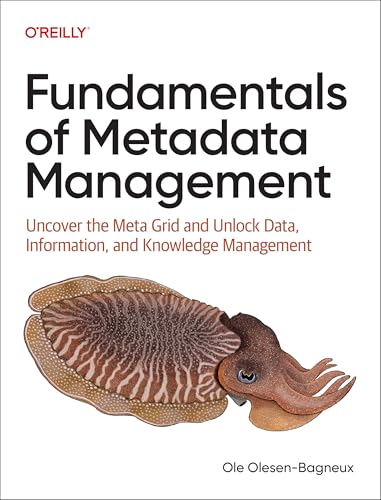
Ole Olesen-Bagneux is a spearhead in the quest for unifying business + information + data + IT: Multiple, diverse platforms based on symbols, concepts, linguistics, rules, cognition and formal logic must be understood together. Together they participate in a Meta Grid. Think of that as an ecosystem of actors and suppliers much like biological systems. The front page animal of the book cover is a cuttle fish (octopus) which can change color, extend its arms to great lengths – catching other beings. And, yes, it does eat other animals, including other octopusses. Keeps the systems going and the meta data flowing to everybody in need! Unifying data into information and then knowledge according to business needs and platform requirements.
Metadata the "Connective Tissue" of the AI Era ⭐⭐⭐⭐⭐
If Data and AI are going to scale, what is the minimum context we need to ship with every dataset? This book answers that question.
We recently had the pleasure of reviewing this with our #DataBookClub, and it’s a masterclass in shifting metadata management from "cataloging" to "holistic infrastructure." Why it matters right now: • It introduces the Four Domains Framework - a checklist for what you have vs. what you’re missing. • It promotes the Metagrid - connecting existing repositories rather than replacing them. • It sets the stage for Agentic AI, where metadata provides the retrieval context needed for automation.
A must-read for anyone serious about enterprise metadata, operational resilience and AI readiness.
Most books I’ve read in the data space focus on improving some model or re-arranging a framework. Rarely does someone offer a genuinely new way of looking at things but Fundamentals of Metadata Management is one of those rare exceptions. This is the most comprehensive exploration of metadata management I’ve come across. It goes way beyond the usual territory of metadata as database structures, data models or glossary definitions. I’d highly recommend this book to anyone struggling to make sense of their company’s metadata landscape. After reading it, you won’t see metadata the same way anymore.
Building on his earlier work, Ole takes metadata management to the next level with the concept of the Meta Grid. The book balances clear explanations of different metadata types with very practical, hands-on guidance. What stood out to me most were the human aspects around team behavior and collaboration - making it a must-read for anyone working with metadata today.
“ I’m PhD in library management” “There are many metadata repositories, never ever try to create a single source of truth” “Microservices, data mesh” The whole book in 3 quotes, lol. An absolute trash.
I love this book. It starts with a pain point for a business that can be solved by reading the book. The author offers specific insights into a particular problem, making it extremely valuable from a business perspective. You can start a consulting business using the knowledge in this book.
Fantastic book with clear ideas for problems and solutions!