

What do you think?

Words Whispered in Water, Anniversary Edition: Why the Levees Broke in Hurricane Katrina
"Rosenthal employs the surgical precision of an investigative journalist and the craft of a memoirist to expose the flaws, natural and human, behind the devastation caused by Hurricane Katrina." — The Eric Hoffer Award Program
2020 Nautilus Silver Winner
#1 New Release in Civil Engineering & Environmental, Urban & City Planning, Development, and Disaster Relief
In the aftermath of one of the worst disasters in U.S. history, Words Whispered in Water tells the story of one woman’s fight—against all odds—to expose a mammoth federal agency—and win. This anniversary edition, released twenty years after the devastating storm, includes a brand new foreword by Jordan Chariton.
It’s a horror story, a mystery, and David and Goliath story all in one. In 2005, the entire world watched as a major U.S. city was nearly wiped off the map. The levees ruptured and New Orleans drowned. But while newscasters attributed the New Orleans flood to “natural catastrophes” and other types of disasters, citizen investigator Sandy Rosenthal set out to expose the true culprit and compel the media and government to tell the truth. This is her story.
When the protective steel flood-walls broke , the Army Corps of Engineers—with cooperation from big media—turned the blame on natural types of disasters. In the chaotic aftermath, Rosenthal uncovers the U.S. corruption, and big media at root. Follow this New Orleans hero as she exposes the federal agency’s egregious design errors and eventually changes the narrative surrounding the New Orleans flood.
In this engaging and revealing tale of man versus nature and man versus man, Words Whispered in Water proves that the power of a single individual is alive and well.
2020 Nautilus Silver Winner
#1 New Release in Civil Engineering & Environmental, Urban & City Planning, Development, and Disaster Relief
In the aftermath of one of the worst disasters in U.S. history, Words Whispered in Water tells the story of one woman’s fight—against all odds—to expose a mammoth federal agency—and win. This anniversary edition, released twenty years after the devastating storm, includes a brand new foreword by Jordan Chariton.
It’s a horror story, a mystery, and David and Goliath story all in one. In 2005, the entire world watched as a major U.S. city was nearly wiped off the map. The levees ruptured and New Orleans drowned. But while newscasters attributed the New Orleans flood to “natural catastrophes” and other types of disasters, citizen investigator Sandy Rosenthal set out to expose the true culprit and compel the media and government to tell the truth. This is her story.
When the protective steel flood-walls broke , the Army Corps of Engineers—with cooperation from big media—turned the blame on natural types of disasters. In the chaotic aftermath, Rosenthal uncovers the U.S. corruption, and big media at root. Follow this New Orleans hero as she exposes the federal agency’s egregious design errors and eventually changes the narrative surrounding the New Orleans flood.
In this engaging and revealing tale of man versus nature and man versus man, Words Whispered in Water proves that the power of a single individual is alive and well.
- GenresNonfiction
352 pages, Paperback
Published August 26, 2025
About the author
Sandy Rosenthal
1 book6 followersSandy Rosenthal's debut book, "Words Whispered in Water," is about how she - against all odds - changed the national narrative about the flooding disaster in New Orleans during Hurricane Katrina. When Rosenthal is not advocating for safe levees, she plays tennis, practices yoga and dances to cajun music. Rosenthal is founding member of the Laurel Eagles, a mentoring program and the Divine Revelers of Terpsichore, a Mardi Gras parading group. She has three adult children and one granddaughter. She also has two small dogs named Twinkie and Cupcake.
Ratings & Reviews
Friends & Following
Create a free account to discover what your friends think of this book!
Community Reviews
Displaying 1 - 21 of 21 reviews

September 4, 2020
Some nonfiction books are histories: they analyze the occurrence and aftermath of big events. Others are primarily biographies: they look at the role individuals have played in those big events. WORDS WHISPERED IN WATER (2020) by New Orleans author Sandy Rosenthal belongs to the latter category: written in the first person, it seeks to hold the feet of the Army Corps of Engineers to the fire for underplaying, then obfuscating, its role in the September, 2005 levee breaches and flooding caused in New Orleans by Hurricane Katrina.
Rosenthal did not always face an easy task. She was truly offended by the myth (or, to use her words, “fairy tale”) that the devastation caused by Katrina could be laid at the feet of the people of New Orleans for living below river level, and at the local levee boards for tolerating slovenly construction and upkeep. In fact, it was the mighty Army Corps of Engineers (“ACE”) that controlled the narrative for years after the 2005 disaster. Demonstrating considerable flair for advocacy and publicity, Rosenthal, with her son’s help, set up her own website, then scheduled community events, initiated letter-to-the-editor (“LTE”) campaigns, and went on TV to offer her scenario. She even made friends with local bigwigs like Sen. Mary Landrieu and mockumentary star Harry Shearer to get the word out. It took years to prove that the ACE was not doing adequately the jobs of designing, building and maintaining the nation’s levees that Congress had charged it to do. (To this day, Rosenthal’s website, Levees.org, is up and running to address these issues.) Yet the very same ACE that was supposed to protect Sandy Rosenthal instead criticized her.
from the book:
It was eerie that the Army Corps (the organization tasked to protect us) were using government computers to attack us. This was not a general case of mean-spirited, anonymous commenting. This was a specific case of people in a position of public trust disguising their identities, pretending to be objective onlookers, and using NOLA.com’s comments section to attack people. (p. 223)
Happily, Rosenthal's tenacity eventually paid off: in 2015 her article in the peer-reviewed journal Water Policy was published--putting the right viewpoint on record.
Even so, WORDS WHISPERED IN WATER is far from perfect. Sandy Rosenthal has made her case that it was not local control, but a lack of local control, that saddled the Big Easy with a defective and disaster-prone levee system. However, too much of her book is taken up with personal and familial concerns like the screaming dog that had to be shipped to Baton Rouge, the family’s struggle to find a good private school for its youngest child, and the massive Thanksgiving dinner/family get-together that followed Katrina’s depredations.
from the book:
[My husband] Steve cooked fourteen dishes from scratch: turkey, gravy, oyster dressing, traditional stuffing, mashed potatoes, sweet potato casserole, mirliton (or chayote, a light-green, pear-shaped squash) stuffed with shrimp, broccoli casserole, steamed cauliflower, homemade cranberry sauce, three pies (apple, pecan and pumpkin), and a chocolate cake. (p. 197)
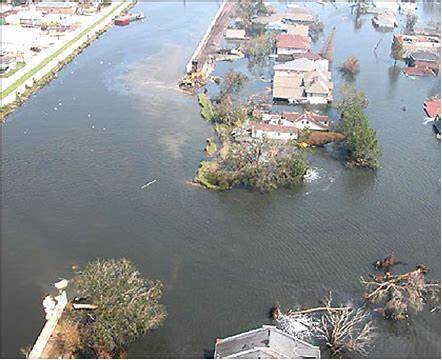
Photo: Levee breach in canal at 17th Street, New Orleans, 2005
Rosenthal did not always face an easy task. She was truly offended by the myth (or, to use her words, “fairy tale”) that the devastation caused by Katrina could be laid at the feet of the people of New Orleans for living below river level, and at the local levee boards for tolerating slovenly construction and upkeep. In fact, it was the mighty Army Corps of Engineers (“ACE”) that controlled the narrative for years after the 2005 disaster. Demonstrating considerable flair for advocacy and publicity, Rosenthal, with her son’s help, set up her own website, then scheduled community events, initiated letter-to-the-editor (“LTE”) campaigns, and went on TV to offer her scenario. She even made friends with local bigwigs like Sen. Mary Landrieu and mockumentary star Harry Shearer to get the word out. It took years to prove that the ACE was not doing adequately the jobs of designing, building and maintaining the nation’s levees that Congress had charged it to do. (To this day, Rosenthal’s website, Levees.org, is up and running to address these issues.) Yet the very same ACE that was supposed to protect Sandy Rosenthal instead criticized her.
from the book:
It was eerie that the Army Corps (the organization tasked to protect us) were using government computers to attack us. This was not a general case of mean-spirited, anonymous commenting. This was a specific case of people in a position of public trust disguising their identities, pretending to be objective onlookers, and using NOLA.com’s comments section to attack people. (p. 223)
Happily, Rosenthal's tenacity eventually paid off: in 2015 her article in the peer-reviewed journal Water Policy was published--putting the right viewpoint on record.
Even so, WORDS WHISPERED IN WATER is far from perfect. Sandy Rosenthal has made her case that it was not local control, but a lack of local control, that saddled the Big Easy with a defective and disaster-prone levee system. However, too much of her book is taken up with personal and familial concerns like the screaming dog that had to be shipped to Baton Rouge, the family’s struggle to find a good private school for its youngest child, and the massive Thanksgiving dinner/family get-together that followed Katrina’s depredations.
from the book:
[My husband] Steve cooked fourteen dishes from scratch: turkey, gravy, oyster dressing, traditional stuffing, mashed potatoes, sweet potato casserole, mirliton (or chayote, a light-green, pear-shaped squash) stuffed with shrimp, broccoli casserole, steamed cauliflower, homemade cranberry sauce, three pies (apple, pecan and pumpkin), and a chocolate cake. (p. 197)
Photo: Levee breach in canal at 17th Street, New Orleans, 2005

November 8, 2020
As someone who was living in New Orleans at the time of the Katrina, the 2005 flood, and lived through it, literally (I was in the city as it hit and evacuated as the city filled with water, one of the last vehicles across the Miss River Bridge before the it was blocked off by large trucks and armed men.) this is the book I have been waiting 15 years to read, though admittedly did not know it because I had lost hope that we would ever know the truth of how something we were told we could rely on completely (it was built by the Corps, after all) had failed so quickly and catastrophically.
Like many of us at that time, the months immediately after Katrina hit the Gulf Coast, I was just trying to survive, and by the time we started to be able to make sense of what had happened, the damage had been done. Deliberate spread of misinformation, media’s printing of manipulated truths and manufactured lies, and well as strategic spin and transference of responsibility to local officials and local residents themselves, served to obfuscate the fractions of truth buried within any not sensationalized news we were getting, pouring salt on still open wounds that for some us still reopen anytime a tropical depression finds its way beyond the Caribbean Sea.
This book gives me that closure, the nagging truth I thought I knew I knew but could not prove. It is a book, as its subtitle says, tells us, finally, “Why the Levees Broke in Hurricane Katrina.” But it is also a memoir of Sandy Rosenthal who founded Levees.org on sheer conviction aided at first by only her teen-aged son, and demonstrates what is needed to take and on and succeed in going up against governmental agencies to get not just the truth, but counter large-scale misinformation campaigns to change public opinion, and finally public policy. It requires dedication, determination, un-faltering resolve over several years, and a lot of help. For that reason, I would recommend this book to all community and grass-roots based activists and organizers as a primer for guidance on approach, attitude, and preparing one’s self with realistic expectations.
Words Whispered in Water reads like true crime, almost Grisham-esque in its complex story (complete with real-life eureka moments) about a cover-up spanning more than a decade for acts of negligence costing thousands their lives and billions in damages. And while I won’t say for me it was ‘enjoyable’ per se’ it was one of the most illuminating and satisfying books I know I will read this year.
Oh, also, one of the (glowing) advance book review blurbs is written by retired Lieutenant General Russel L. Honore’, the commanding officer responsible for safe the evacuation of the New Orleans Superdome and Convention Center. A person who certainly does not need to put his endorsement on books for any reason.
Like many of us at that time, the months immediately after Katrina hit the Gulf Coast, I was just trying to survive, and by the time we started to be able to make sense of what had happened, the damage had been done. Deliberate spread of misinformation, media’s printing of manipulated truths and manufactured lies, and well as strategic spin and transference of responsibility to local officials and local residents themselves, served to obfuscate the fractions of truth buried within any not sensationalized news we were getting, pouring salt on still open wounds that for some us still reopen anytime a tropical depression finds its way beyond the Caribbean Sea.
This book gives me that closure, the nagging truth I thought I knew I knew but could not prove. It is a book, as its subtitle says, tells us, finally, “Why the Levees Broke in Hurricane Katrina.” But it is also a memoir of Sandy Rosenthal who founded Levees.org on sheer conviction aided at first by only her teen-aged son, and demonstrates what is needed to take and on and succeed in going up against governmental agencies to get not just the truth, but counter large-scale misinformation campaigns to change public opinion, and finally public policy. It requires dedication, determination, un-faltering resolve over several years, and a lot of help. For that reason, I would recommend this book to all community and grass-roots based activists and organizers as a primer for guidance on approach, attitude, and preparing one’s self with realistic expectations.
Words Whispered in Water reads like true crime, almost Grisham-esque in its complex story (complete with real-life eureka moments) about a cover-up spanning more than a decade for acts of negligence costing thousands their lives and billions in damages. And while I won’t say for me it was ‘enjoyable’ per se’ it was one of the most illuminating and satisfying books I know I will read this year.
Oh, also, one of the (glowing) advance book review blurbs is written by retired Lieutenant General Russel L. Honore’, the commanding officer responsible for safe the evacuation of the New Orleans Superdome and Convention Center. A person who certainly does not need to put his endorsement on books for any reason.

February 7, 2021
I was about to give this two stars. But once we got 80% of the way through the book, we hit the reason I wanted to read this book: why the levees failed. But to understand that final 20% of the book, you need to sort of better understand how they got to that point. What Rosenthal did was daunting, and she succeeded I think at what her goal was. The book delves into how she got there, but as you’ll note from some other reviews, you definitely will be served with a lot of ancillary information about her day to day. And this isn’t something I would ever fault her for including in writing this book, because she went through so much and she deserves to tell that story. But for me, personally, it was not what I had hoped. Rosenthal’s mission seems to be less about WHY the levees failed than correcting the record where so many people believed that local government incompetence was the primary problem. I hoped for the former from my interest point of view. But she focused on her mission and there’s absolutely nothing wrong with that. She deserves credit for what she undertook. As an outsider observing Katrina’s impacts, I learned much from her and others.
From my “why did they fail?” point of view, to be abundantly clear: I’ve read multiple books about Katrina, and the final 50 or so pages of this book fall into required reading status as far as I’m concerned. I hope to see additional work, either from Rosenthal or someone else that dives further into the “why” behind the levee failures. Because that aspect needs to be better understood.
From my “why did they fail?” point of view, to be abundantly clear: I’ve read multiple books about Katrina, and the final 50 or so pages of this book fall into required reading status as far as I’m concerned. I hope to see additional work, either from Rosenthal or someone else that dives further into the “why” behind the levee failures. Because that aspect needs to be better understood.

September 2, 2020
Sandy Rosenthal changed the perspective of who is responsible for the Hurricane Kathrina disaster in New Orleans. Basically it wasn't the storm but weak levees which caused the damage. They were built by the national Army Corps of Engineers. It took years to correct this wrong picture which was painted by the media. That's Sandy Rosenthal and her organization Levees.org' s mission. In detail she describes in her book how she built the organization and the movement during 2005 - 2015.
February 28, 2021
‘Words Whispered in Water’ follows the extraordinary true story of one New Orleanian and how she started a nonprofit organization to take on big government and ensure truth prevailed in Hurricane Katrina’s murky political aftermath.
Sandy Rosenthal’s story is a compelling memoir detailing her rise to prominent civic activist and her struggle to improve the levees, to place blame where it belongs, and to spread the truth about how and why the levees of New Orleans failed during a hurricane that wasn’t as large as most of the country had believed. Through an easy-to-understand narrative Sandy shares many of her experiences fighting the Army Corps of Engineers and details the various methods they used to intimidate her.
Much of this fascinating story covers her trials and tribulations putting together Levees.org, a nonprofit organization. I was blown away by how complex the political environment is on just a local level. I was really impressed with how Sandy was able to make sense of it all and bring it all together for readers to dissect and decide for themselves. The majority of this thought-provoking memoir reveals the lengths to which government organizations will go to cover something up. It’s surprising, but Sandy has a way of slowly unveiling all of the necessary details you need to connect all the of the same dots that she did. Between all of the meetings, interviews, speeches and endless research the author is able to weave in emotionally charged stories from the survivors of Hurricane Katrina. It was this balance of fact and personal accounts that kept my interest throughout the book.
While Hurricane Katrina brought tragedy to New Orleans, ‘Words Whispered in Water’ sheds light on many of the things that the government would rather keep submerged in the aftermath. This is a concise and potent autopsy of one of the worst government blunders in American history. Sandy Rosenthal was in the trenches, tracking down every lead, reading reports, and all of that experience and research is brought together in one eloquent and emotional story that will leave you with a clear understanding of what happened during and after Hurricane Katrina.
Sandy Rosenthal’s story is a compelling memoir detailing her rise to prominent civic activist and her struggle to improve the levees, to place blame where it belongs, and to spread the truth about how and why the levees of New Orleans failed during a hurricane that wasn’t as large as most of the country had believed. Through an easy-to-understand narrative Sandy shares many of her experiences fighting the Army Corps of Engineers and details the various methods they used to intimidate her.
Much of this fascinating story covers her trials and tribulations putting together Levees.org, a nonprofit organization. I was blown away by how complex the political environment is on just a local level. I was really impressed with how Sandy was able to make sense of it all and bring it all together for readers to dissect and decide for themselves. The majority of this thought-provoking memoir reveals the lengths to which government organizations will go to cover something up. It’s surprising, but Sandy has a way of slowly unveiling all of the necessary details you need to connect all the of the same dots that she did. Between all of the meetings, interviews, speeches and endless research the author is able to weave in emotionally charged stories from the survivors of Hurricane Katrina. It was this balance of fact and personal accounts that kept my interest throughout the book.
While Hurricane Katrina brought tragedy to New Orleans, ‘Words Whispered in Water’ sheds light on many of the things that the government would rather keep submerged in the aftermath. This is a concise and potent autopsy of one of the worst government blunders in American history. Sandy Rosenthal was in the trenches, tracking down every lead, reading reports, and all of that experience and research is brought together in one eloquent and emotional story that will leave you with a clear understanding of what happened during and after Hurricane Katrina.

August 20, 2021
A couple times, about halfway through, I justified to myself why it would be ok to just quit reading it and go on to another book. This book right here showed me just how powerful my O.C.D. is over my rational mind. I thought I was going to enjoy it since it was about Katrina and my love for history, fascination with natural disasters and being someone who went through it and experienced it (although it was a lot different from what others were going through. I did lose my piece of shit damaged car, and that was like the only thing at that point that I owned and was mine. It did knock me out of college (and of course solely this) and prevented me from becoming the pompous, high-brow vegan with a lot of gay friends and the famous writer or intellectual that I was so obviously meant to be)...all those things make me think I would at least not hate this book. Wrong. I actually hated it. And I know it's probably not healthy to have such strong negative feelings towards a book I just read, but it's definitely like that. The premise behind the story could have probably been much more interesting if she did not explain her entire outfit and her friends husband who is some rich, sleazy wh0 happens to be in a current, high profile lawsuit, but whatever. I do love how she gives a nod to her son and his life when she throws in there that she helped her son and his partner move into their apartment, and that information had no relevance to anything else that she was talking about but she did it so her son would know he was accepted and I think that's really cool. I don't know how the dad felt about this particular subject, on his monthly fishing trip with the guys the old fashions were piling up and someone says something off-putting about your son, so you catch him one time in the right eye and put him down, because he's gotta show the guys that his son didn't get any of that punk shit from him. And all of that could have been avoided without exposing the child for your own self-satisfaction. Other than that it was just bland and ok.

September 10, 2020
Conspiracy theories run rampant these days (2020), but this book, a memoir by Sandy Rosenthal, describes a real conspiracy theory - the efforts of the U.S. Army Corps of Engineers to deny their role in the destruction and flooding of New Orleans as Hurricane Katrina passed by.
Rosenthal, who had evacuated New Orleans with her family, knew right away that something wasn't right. Yes, Hurricane Katrina was a powerful storm, but it didn't land a direct hit at New Orleans. Waves did not inundate the levees causing them to weaken, they failed outright, and Rosenthal began her quest to find out what happened mere days after the city was flooded.
At many points, she describes the luck she had. Her home didn't flood. Her husband's company was able to relocate quickly to Baton Rouge. They were able to find a temporary home as well as a high school for her son. So while she was affected by Katrina, she didn't have to face fighting insurance companies, trying to get compensation from the Road Home program, and rebuilding her house. Instead, she used her time to investigate the real causes of the flooding and mount a campaign to demand the truth the people of New Orleans deserved.
Rosenthal's story is both personal - you hear how her family reacted in the days, weeks, and months after the flood - and a Woodward and Bernstein style investigation to get to the bottom of why a powerful federal organization would not only lie but mount a campaign of intimidation against her and anyone who dared to cross them. Sandy Rosenthal is indefatigable, and she shares how, in the 15 years since the storm, she's learned how to stand tall, surround herself with knowledgeable people, and use her own strength to speak truth to power.
Rosenthal, who had evacuated New Orleans with her family, knew right away that something wasn't right. Yes, Hurricane Katrina was a powerful storm, but it didn't land a direct hit at New Orleans. Waves did not inundate the levees causing them to weaken, they failed outright, and Rosenthal began her quest to find out what happened mere days after the city was flooded.
At many points, she describes the luck she had. Her home didn't flood. Her husband's company was able to relocate quickly to Baton Rouge. They were able to find a temporary home as well as a high school for her son. So while she was affected by Katrina, she didn't have to face fighting insurance companies, trying to get compensation from the Road Home program, and rebuilding her house. Instead, she used her time to investigate the real causes of the flooding and mount a campaign to demand the truth the people of New Orleans deserved.
Rosenthal's story is both personal - you hear how her family reacted in the days, weeks, and months after the flood - and a Woodward and Bernstein style investigation to get to the bottom of why a powerful federal organization would not only lie but mount a campaign of intimidation against her and anyone who dared to cross them. Sandy Rosenthal is indefatigable, and she shares how, in the 15 years since the storm, she's learned how to stand tall, surround herself with knowledgeable people, and use her own strength to speak truth to power.

December 20, 2025
Words Whispered in Water, Anniversary Edition by Sandy Rosenthal is a gripping, courageous, and profoundly important work that reshapes how we understand the devastation of Hurricane Katrina. With the precision of an investigative journalist and the emotional depth of a memoirist, Rosenthal delivers a story that is as unsettling as it is inspiring.
What sets this book apart is its fearless pursuit of truth. Rather than accepting the convenient narrative of “natural disaster,” Rosenthal meticulously exposes the human and institutional failures behind the levee collapses. Her determination to challenge a powerful federal agency and the media narratives that protected it transforms this book into a true David-and-Goliath story. The result is a compelling investigation that reads like a mystery while carrying the weight of real lives and real consequences.
The anniversary edition feels especially timely, reinforcing how accountability, transparency, and citizen action remain essential in the face of systemic failure. Rosenthal’s journey demonstrates the extraordinary impact one persistent individual can have, even when confronting enormous power structures.
Clear, engaging, and deeply researched, this book is not only about New Orleans it is about truth, justice, and civic responsibility. Readers interested in disaster response, public policy, journalism, or social justice will find this work both eye-opening and empowering. Words Whispered in Water stands as a vital reminder that history must be questioned, and that truth often begins with a single voice brave enough to speak.
What sets this book apart is its fearless pursuit of truth. Rather than accepting the convenient narrative of “natural disaster,” Rosenthal meticulously exposes the human and institutional failures behind the levee collapses. Her determination to challenge a powerful federal agency and the media narratives that protected it transforms this book into a true David-and-Goliath story. The result is a compelling investigation that reads like a mystery while carrying the weight of real lives and real consequences.
The anniversary edition feels especially timely, reinforcing how accountability, transparency, and citizen action remain essential in the face of systemic failure. Rosenthal’s journey demonstrates the extraordinary impact one persistent individual can have, even when confronting enormous power structures.
Clear, engaging, and deeply researched, this book is not only about New Orleans it is about truth, justice, and civic responsibility. Readers interested in disaster response, public policy, journalism, or social justice will find this work both eye-opening and empowering. Words Whispered in Water stands as a vital reminder that history must be questioned, and that truth often begins with a single voice brave enough to speak.

July 7, 2021
3.5 stars (library eBook)
I have met Sandy through the levees.org bike tour where I have seen the location of the London Ave canal floodwall breach, the historic plaque, rain garden with informational displays, and flooded house museum. So I have heard Sandy tell a much shorter version of the story she told in the book.
I enjoyed the book. The first third tells the personal story of the hurricane and its aftermath. The last third focuses in on the Corps of Engineers response to levees.org unceasing shouting of the truth about who is the blame for the levee failures. The middle is a filled with bureaucracy and acronyms and harder to follow so mu interest flagged.
I didn't exactly learn anything I hadn't already heard from Sandy. Her determination ensure the truth -vetted facts - are publicized is inspiring as is the idea that one ordinary (albeit upper-class white) person can have a impact. The USACE public media campaign to shift blame is despicable. The story is interesting and engaging.
If you're interested in more scientific focused analysis of Katrina and the levee disasters another target of the USACE Ivor van Heerden (deputy director of the Louisiana State University Hurricane Center during and after Katrina until he was fired) wrote the book The Storm (2006). Published in 2006, although later discoveries are not included, the book still places blame on USACE design flaws and documents obstructionism from the USACE in the initial research studies of the disaster.
I have met Sandy through the levees.org bike tour where I have seen the location of the London Ave canal floodwall breach, the historic plaque, rain garden with informational displays, and flooded house museum. So I have heard Sandy tell a much shorter version of the story she told in the book.
I enjoyed the book. The first third tells the personal story of the hurricane and its aftermath. The last third focuses in on the Corps of Engineers response to levees.org unceasing shouting of the truth about who is the blame for the levee failures. The middle is a filled with bureaucracy and acronyms and harder to follow so mu interest flagged.
I didn't exactly learn anything I hadn't already heard from Sandy. Her determination ensure the truth -vetted facts - are publicized is inspiring as is the idea that one ordinary (albeit upper-class white) person can have a impact. The USACE public media campaign to shift blame is despicable. The story is interesting and engaging.
If you're interested in more scientific focused analysis of Katrina and the levee disasters another target of the USACE Ivor van Heerden (deputy director of the Louisiana State University Hurricane Center during and after Katrina until he was fired) wrote the book The Storm (2006). Published in 2006, although later discoveries are not included, the book still places blame on USACE design flaws and documents obstructionism from the USACE in the initial research studies of the disaster.

February 10, 2021
Full disclosure: I have had a love affair with NOLA for decades. Within a year after Katrina, we visited and surveyed the damage. John Goodman, who is part of this book, made the brief argument in his role in "Treme", the HBO series, which I rate as top-notch. In the first episode (or maybe number 2), Goodman gives a press conference and tells it all in stark terms.
Ms. Rosenthal is more refined and constrained. No cussing. No vendettas. Instead, she tells us how she started and gives credit to every soul who had any input. And plenty of people contributed to the decade-plus long struggle to get to the truth and to get it out. Two big surprises: first, the craven duplicity of the Army Corps of Engineers, whom I shall never trust again, and secondly, that no one ever tried to kill Ms. Rosenthal.
She and her organization achieved their goal: they got an academic paper published in a peer-reviewed journal and saw the story go national in a big way. The fault was finally placed where it deserved to be laid and the citizens of NOLA were exculpated.
Besides being a powerful story of a wrong righted this is a lesson in how one person can become an army; an army a tide that washes away evil and duplicity. We see more of this type of action today, but this Katrina story occurred at the dawn of the Internet, so to speak.
Recommended
I first reviewed this and mistakenly used the audio version, on February 6th.
Ms. Rosenthal is more refined and constrained. No cussing. No vendettas. Instead, she tells us how she started and gives credit to every soul who had any input. And plenty of people contributed to the decade-plus long struggle to get to the truth and to get it out. Two big surprises: first, the craven duplicity of the Army Corps of Engineers, whom I shall never trust again, and secondly, that no one ever tried to kill Ms. Rosenthal.
She and her organization achieved their goal: they got an academic paper published in a peer-reviewed journal and saw the story go national in a big way. The fault was finally placed where it deserved to be laid and the citizens of NOLA were exculpated.
Besides being a powerful story of a wrong righted this is a lesson in how one person can become an army; an army a tide that washes away evil and duplicity. We see more of this type of action today, but this Katrina story occurred at the dawn of the Internet, so to speak.
Recommended
I first reviewed this and mistakenly used the audio version, on February 6th.

August 17, 2026
Words Whispered in Water is the kind of book that stays with you long after you finish reading it.
Sandy Rosenthal takes readers beyond the familiar images and headlines of Hurricane Katrina and into the deeply human story of what happened before, during, and after the levee failures that devastated New Orleans. What makes this book especially compelling is Sandy's determination to ask difficult questions and keep asking them when the answers were uncomfortable.
This isn't simply a story about a natural disaster. It is a story about responsibility, perseverance, community, and the power of an ordinary person to keep pushing for answers when powerful institutions would rather the questions go away.
Sandy's journey is both deeply personal and remarkably relevant. Her persistence demonstrates that advocacy doesn't always begin with expertise or authority. Sometimes it begins with someone saying, "Something isn't right," and refusing to stop until the truth is understood.
Words Whispered in Water is an important read for anyone interested in New Orleans, Hurricane Katrina, disaster preparedness, government accountability, or simply the power of one determined voice to make a difference.
Sandy Rosenthal's story is a reminder that when we are willing to listen carefully, even the quietest voices can reveal something we desperately need to hear.
Sandy Rosenthal takes readers beyond the familiar images and headlines of Hurricane Katrina and into the deeply human story of what happened before, during, and after the levee failures that devastated New Orleans. What makes this book especially compelling is Sandy's determination to ask difficult questions and keep asking them when the answers were uncomfortable.
This isn't simply a story about a natural disaster. It is a story about responsibility, perseverance, community, and the power of an ordinary person to keep pushing for answers when powerful institutions would rather the questions go away.
Sandy's journey is both deeply personal and remarkably relevant. Her persistence demonstrates that advocacy doesn't always begin with expertise or authority. Sometimes it begins with someone saying, "Something isn't right," and refusing to stop until the truth is understood.
Words Whispered in Water is an important read for anyone interested in New Orleans, Hurricane Katrina, disaster preparedness, government accountability, or simply the power of one determined voice to make a difference.
Sandy Rosenthal's story is a reminder that when we are willing to listen carefully, even the quietest voices can reveal something we desperately need to hear.

August 27, 2021
Everyone who thinks they know the story behind what happened in the 2005 New Orleans flood (Hurricane Katrina) must read this book, especially if you are an engineer! This book reveals the truth behind common misconceptions and exposes the failures and apparent coverups facilitated by the US Army Corps of Engineers, after the catastrophic flood in 2005. Levees.org is a group focused on revealing the truth at all costs and this book is a testament to the fighting spirit of Sandy Rosenthal, H.J. Bosworth, Jr. and the whole Levees.org team!
Also the book was so compelling I finished it in one day!
Also the book was so compelling I finished it in one day!

September 19, 2020
I just finished Sandy's book a few days ago and I loved it! Having been a CAT for a long time now it was nice to read about how my actions have helped to spread her message. I was reminded of a lot of things that I had learned in the past and learned some new details as well. This is a story of how one person, standing up for what is right, can make a difference. I bet she had no idea how prophetic this sentence would be for our current times when she wrote it: "All my plans for the coming Autumn were not going to happen-perhaps not for the entire year.

November 9, 2020
I thought this book was fantastic and often found myself angry and shocked as to what was being done to stop Sandy from telling the truth. Well...my eyes have been opened and now I feel I understand what really happened in Katrina!
This is also a book of inspiration! I am in awe of how this one woman who cared about the people of New Orleans took on the Goliath to expose the truth at great hardship to herself. Her tenacity is astounding and goes to show what a difference one person can make when they stand in the truth!!!
I highly recommend this book to everyone!
This is also a book of inspiration! I am in awe of how this one woman who cared about the people of New Orleans took on the Goliath to expose the truth at great hardship to herself. Her tenacity is astounding and goes to show what a difference one person can make when they stand in the truth!!!
I highly recommend this book to everyone!
May 9, 2023
Sandy Rosenthal exposes the true cause of the levee collapse during hurricane Katrina in 2005.
The US Army core of engineers did a poor job then let others take the blame.
Rosenthal was relentless in her investigations and she deserves some sort of award for her setting the record straight.
A free audiobook from Audible.com
The US Army core of engineers did a poor job then let others take the blame.
Rosenthal was relentless in her investigations and she deserves some sort of award for her setting the record straight.
A free audiobook from Audible.com

October 15, 2024
Very inspiring! The author and new Orleans resident did a fabulous job in building a movement to educate all about the levee breaches during Hurricane Katrina in 2005. She demonstrated perseverance, leadership and courage to debunk the myths and call out the Army Corps of Engineers of being responsible— backed up with tremendous research and evidence.
October 23, 2024
Great story
I liked the energy of this story of one woman, armed only with conviction, made such a difference to uncover an engineering mistake. I'm an engineer. Let the book serve as a reminder to stay focused on good science. There will always be political and financial factors involved in all public design decisions, but don't let those overshadow proper design.
I liked the energy of this story of one woman, armed only with conviction, made such a difference to uncover an engineering mistake. I'm an engineer. Let the book serve as a reminder to stay focused on good science. There will always be political and financial factors involved in all public design decisions, but don't let those overshadow proper design.
December 18, 2024
Great Read
This book was well written and very informative and thought provoking! I’d love to know how levees.org is doing and would love to hear about the creating for the Museum they sponsored…. It did leave me with one question though… did Steve and Renee reunite with Monet??
This book was well written and very informative and thought provoking! I’d love to know how levees.org is doing and would love to hear about the creating for the Museum they sponsored…. It did leave me with one question though… did Steve and Renee reunite with Monet??

September 24, 2020
I received a complimentary copy.
A strength in character and a need to get to the truth creates a great atmosphere for this really well written story.
A strength in character and a need to get to the truth creates a great atmosphere for this really well written story.
March 19, 2022
Read this if you still want to know more about Katrina, flooding, and where the fault lies.
It is also about a woman determined to find the truth ... and her persistence.
It is also about a woman determined to find the truth ... and her persistence.
March 5, 2024
Not a book I would have picked up if I hadn’t recently visited New Orleans. Cover ups, red tape and astounding costs to do so - interesting but a bit dull in presentation
Displaying 1 - 21 of 21 reviews