**Longlisted for the Baillie Gifford Prize for Non-Fiction**
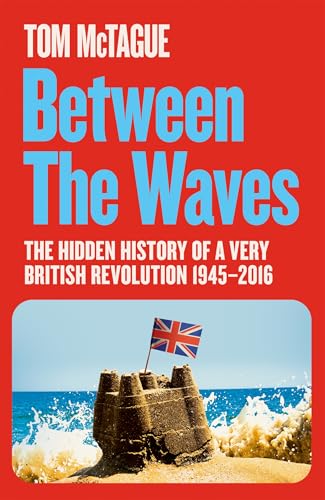
This is the definitive history of Britain’s tumultuous relationship with Europe – as it’s never been told before.
'Powerful, precise, morally engaged, wonderfully alert to character, context and the greater purpose of political life' – Rory Stewart, author of Politics on the Edge
'Alucid, thoughtful and richly provocative book' – Dominic Sandbrook, The Sunday Times
In a story of ambition and underhand politics, of nation, identity and belief, acclaimed political writer Tom McTague chronicles the battle of ideas, events and personalities that first took the country into the Common Market in 1973. Only to take it out of the European Union in an explosive referendum a little over forty years later.
Drawing on unpublished sources and exclusive interviews, McTague unearths the roots of ideological conflict that raged between the leading politicians of the twentieth century as they fought for the future of Europe – Charles de Gaulle, Harold Macmillan, Jean Monnet, Enoch Powell and Margaret Thatcher.
Alongside these famous figures are the lesser-known actors in Britain’s great post-war a coterie of Eurosceptic student radicals, Cold Warriors, eccentric billionaires and political strategists who turned the tide of history.
A riveting story of the clashing ideals that have pulled at Britain’s public imagination for more than seven decades, Between the Waves raises that most elemental of who are we?
'A sweeping, impressive and ambitious history of modern Europe' – Helen Lewis, author of Difficult Women
'Compelling, hugely well-informed . . . will stand for many years as the authoritative political history’ – David Kynaston, author of Austerity Britain, 1945-1951
We should pay more attention to the ideas of the right, rather than treating them only as epiphenomena. In that vein I welcome this intellectual-political history of Euroscepticism. I think McTague does a good job of tracing the development of opinion on Europe among conservative elites (and especially in the earlier stages, on the left as well) to show that it was almost always underpinned by an ambivalence about integration and an unwillingness to confront the implications of that ambivalence. Cakeism, you could say. Where he’s weaker is in delving into the roots of changing opinion (whose interests did different stages of euroscepticism serve?). He also sometimes elides elite opinion with ‘the public’ at large in a way that is unconvincing.
A fascinating, well-written portrait of the incommensurably historical figure Enoch Powell, who was also a racist. Wrapped around it is a teleological narrative about the triumph of a particular kind of anti-system right-wing crackup and the doom of an anti-democratic pro-European British (not English!) right. Its a narrow view characteristic of Tom McTague, who is always interested in (white people's) revealed preferences against liberal universalism and the breakdown of logics of history. Now that he's editor of the New Statesman he's working a little harder to conceal his power level and justify his grim fascinations. But I'm not convinced he isn't licking his chops as the world appears to many to ratchet toward apocalyptic barbarism.
10 years on from the event which concludes this narrative, Tom McTeagues sweeping historical epic charting Britains relationship with Europe since 1945 to 2016 makes the outcome of the referendum a decade ago seem less surprising than it did on that fateful morning in June 10 summers ago.
From the end of the Second World War right up until the votes were cast on Brexit polling day Britain had never entirely reconciled itself to being just another European nation among nations, reflecting the identity crisis confronting the country both before the end of the Second World War and in the decades since as a future of post imperial decline confronted the once dominant global power.
Rather than get bogged down in statistics about the economic upsides and downsides of EU membership, McTeague tells a story centred around a cast of people of varying significance but who taken altogether, propel the currents of history which determined Britain’s post war trajectory within and without the continent. Characters who may be unfamiliar to a young modern reader such as Jean Monnet as well as more contemporary but obscure individuals such as James Goldsmith are given airtime alongside the big political beasts of the time period such as Harold Wilson, Margaret Thatcher, Tony Blair, Nigel Farage etc
Despite having less name recognition than some of the big political hitters, McTeague makes it clear that when history is made there are no insignificant parts and no small moments. The Brexit decision is determined as much by the low key characters and sliding door moments as the historic and famous individuals and moments such as Thatchers Bruges speech and Blair’s decision to reject the euro.
10 years on from the point at which McTeague concludes the narrative in June 2016, the ending feels both ambiguous and somber. Speaking personally despite voting to remain in 2016 I have become increasingly Eurosceptic in the ensuing decade so the somber feeling of the book’s conclusion isn’t due to some wistful yearning for an idealised memory of the EU. Rather the feeling comes from McTeagues inferred conclusion that Britain never has and maybe never will resolve the question mentioned at the beginning of the review, ie who it is as a nation.
The answer feels no clearer than it was prior to entry to the common market in the 70s than it has in the 10 years which have elapsed since the Brexit referendum.
An impressive achievement; well-written and researched. McTague’s central thesis - that British Politicians have been unable to face up to the core principle of the EU, political unification - is very credible. I particularly enjoyed his account of the emergence of the individuals and groups in the 1980’s which lead us out of the EU. Also, his point on the myth of the EU as a way to promote British ‘influence’ is an effective inversion of the point made against Brexiteers of imperial nostalgia. This would be a great starting point for someone interested in the subject. I did, however, have a few criticisms.
1) The juxtaposition between the Monnet EU and UK works but it leaves European politics, and even the EU itself, seeming static and stale. McTague never really captures the debates within the EU and Europe over Monnet’s original idea and I question whether the UK is as unique as the books makes it seem.
2) The works is very “high political” history and focuses on key individuals or groups and their intellectual roots. McTague is then unable to really offer an effective explanation for why the public is so lukewarm to the EU beyond allusions to Conservative and Modernist thought. In other books of this sort, this is less of an issue but, in a history of a modern democracy, the analysis is weakened.
3) Some of the book reads awkwardly due to the fact that for many people, as Matthew Eliot acknowledges, the EU is a second-order issue. I read some chapters about Prime Ministers seemingly embattled and weakened by this issue, only for the chapter to be ended with them being returned with a stonking great majority. This probably ties into criticism 2 and the lack of public opinion.
A compelling, if uneven, political history of Britain's postwar relationship with Europe. McTague follows our intrinsic national Euroscepticism, arguing that no Prime Minister - with the exception of Ted Heath - ever truly embraced European unity. Britain pursued a half-in, half-out stance driven by lingering imperial delusions: an urge to shape Europe while maintaining a unique separation. Decades of 'cakeism' ensued, of membership without obligations which would tie Britain into ever closer political and financial union.
McTague's focus on key personalities is insightful, if sometimes heavy-handed. It's unclear how the 'sceptred isle' conservatism of Roger Scruton or Norman Stone influenced or reflected public opinion, although their indirect effects - through a formative influence on Michael Gove or Dominic Cummings - were perhaps profound.
Inspired, among others, by Rick Perlstein's sweeping histories of insurgent American conservatism, McTague's narrative shines once we reach the 1980s and the rumblings of a targeted, grassroots Eurosceptic movement. But the first half lacks fresh insights (beyond the surprising Algiers contingency) and seems unimaginatively structured around election cycles. A deeper look at left-wing Eurosceptics like Tony Benn and Michael Foot would have added richness, or otherwise I would be minded to start the story proper with the Thatcher–Delors clashes of the latter 1980s.
Despite these flaws, Between the Waves is a reflective account, wistful in places, of Britain wrestling with its past and future self-conception through the prism of its European relations.
A mammoth tome I have been reading since October. Finally over. Finally free. This was an incontestable 5 star read until the last 2 chapters where I felt he took a major slant in favour of the Tory party / vote Leave / eurosceptism. That, and the fact that the actual content on the 2016 referendum and leaving process felt overly rushed (could tell that he also was running out of steam by the end of writing this book), ruined the book for me. Maybe the eurosceptic/conservative slant had been there throughout and I had just missed it(likely - don’t know enough about history to tell from his assessment of politics at the time)? But it really ruined what had been, to that point, the best book on modern British / European history I’ve ever read (maybe one of the only I’ve read to be fair). Just felt like he left out a lot about Corbyn’s Labour Party and the failures of Ed Miliband before him / the whole vote remain system. Once I started to recognise the politics from my own memory, I realised he was a bit off and not telling the whole story (in my opinion). Wayyy too into Dominic Cummings and Nigel Farage. A real shame. But I learned a lot. Just ultimately I feel like it wasn’t the whole story and I need to flesh out my understanding of Britain’s relationship with Europe with other sources. But also idk if I can ever read a book about the EU again after this. It’s over!!!
This is a well-researched book that charts a considerable amount of post-war British political history. It is told mostly from the point of view of the anti-European camp. There is lots of interesting stuff in it. But what I thought was missing was an overarching thesis of why we ended up leaving the EU. I suspect Tom McTague and others might say, “it’s obvious, do I have to spell it out even more?”. Well “yes” would be my answer.
McTague comes closest to articulating his views in his conclusion. He seems to be saying that Brexit was probably inevitable. Certainly, in his eyes, there were events around the referendum that could have tipped the balance, and if these had not happened then “Remain” might have won. But there had always been a tension in our membership of the European Union. Other countries wanted greater integration, and we didn’t. McTague seems to be arguing that Britain’s history made us reluctant to join wholeheartedly with the rest of Europe. Empire and our role in the second world war are important here. Sadly, he doesn’t mention 1966, warm beer, or village cricket, though I suspect those things are part of a nostalgia for the past that also sits behind our antipathy towards Europe.
Every Prime Minister with the exception of two thought they could manage this apparent contradiction and still keep us at the heart of Europe, while maintaining our unique independence. One exception was Ted Heath, who was very much in favour of the UK being part of an integrated Europe. The other was probably Tony Blair, who started by trying to manage the inherent conflict in the British position. But ultimately he would probably have rather signed up for more integration, including membership of the euro, had his political power and influence not waned after Iraq. Cameron was the unlucky one who was finally defeated by these historical forces.
McTague also argues that most people were not that bothered by Europe for most of the post-war period, at least not in the same way that politicians were. It was really the accession of eastern European countries and the subsequent migration that made the EU more contentious and emotive.
However, right at the end of the book, McTague says that being a member of a European Club is also now a part of our history too. So those memories, some of them good, could perhaps swing us back towards Europe again.
Apologies to Tom McTague if I have misrepresented him. It’s an interesting read, and I recommend it.
A fantastic explainer of the currents and counter-currents of Britain's involvement in the European project.
Considering the centrality of the EU in making and breaking British political projects, it is often sidelined sidelined by- very important- topics such as yclass and left-right ideology. But this books shows how Europe breaks through class and ideological alliances through topics such as sovereignty, nationality, immigration, and trade. Particularly enlightening is how James Goldsmith was able to institutionalise euroskepticism by influencing the selection of MPs- a war of manoeuvre.
Audio. I picked up this book because it certainly looked interesting. Boy, was I wrong! Rich history? More like a tedious history! I suppose this book would be of more interest to Brits. I would imagine the geopolitics between Britain and the rest of Europe would be fascinating and intriguing. But what I got was a very dry and dull rendition of the politics and boring characters. I gave up after a few chapters and just jumped to the last chapter and the author's conclusions. Even the discussion about Brexit was a garbled mess. Some serious editing is needed here.
A sweeping overview of 70 years of British dithering about Europe. Did the impossible and made me feel vaguely sympathetic for David Cameron as the one who finally tried to resolve the issue (even if he failed). Could have done with being a bit less of an elitist history (it's very focused on the top power players in governments) but nonetheless enlightening, entertaining and infuriating (in a good way).
Good chronological account of historical events leading up to Brexit vote and just after. Informative and thought provoking. Sovereignty, self governance, immigration and exceptionalism alongside naked political opportunism and ineptitude figure strongly in the narrative.
Most of the reviews already have already picked up on the good/bad points, and I am not massively familiar with 20th century UK history (or 19th century or 18th cent…)
It does feel like a journalist’s book, with a reliance on interviews rather than detailed explanations of institutions, mass movements or treaties. That can lead to confusion, such as when describing the abortive European Defence Council in reference to NATO, without having even introducing NATO first. In that sense it compares poorly with Haywire where the time-periods described overlap.
However, I do believe there is value in this book if you treat it as an oral history of some of the major players in Britain’s European integration/dis-integration. McTague gives us a look at some of the anti-European lobby groups and ,while I am not sure how much influence they actually wielded, they add some pieces to the puzzle of Brexit and explain the nature of the 2016 campaign.
As a qualification to the above, Between the Waves is elitest, or at least favourable to the viewpoints of those a reporter may rub shoulders with. The BNP exists only as an external force, an opponent to integration along with a competitor to the far more heavily covered Farage’s start ups and flash-in-the-pan lobbyists. There’s probably a justification for this approach that goes beyond “who your mates down at the pub were”, but I am a little suspicious, nonetheless.
Within these constraints, I rate Between the Waves as four stars as there is depth and good writing. As you should read multiple books about the UK’s relationship with Europe anyway, I am happy enough with the limited perspective.