Jump to ratings and reviews
Rate this book

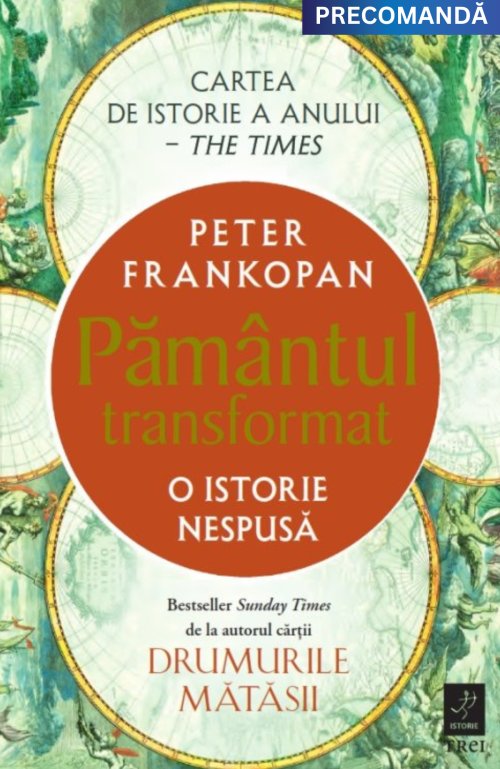
Pământul transformat: O istorie nespusă

Rate this book
Ce rol a jucat mediul înconjurător în ascensiunea și decăderea imperiilor? De ce seceta și foametea întețesc flăcările războaielor? Cum pot duce erupțiile vulcanilor la pandemii?

Ne gândim rareori la felul în care mediul înconjurător a influențat războaiele, revoluțiile sau comerțul global – dar remarcabilul istoric Peter Frankopan plasează natura, mediul și clima în centrul istoriei. În cea mai recentă capodoperă a sa, Frankopan ne poartă de la Big Bang până în prezent, analizând modul în care erupțiile vulcanice, activitatea solară, schimbările de nivel ale apelor oceanului planetar, curenții maritimi, inundațiile și secetele au jucat un rol crucial și adesea neglijat în istorie. Pe măsură ce ne confruntăm cu un viitor tot mai precar, nu a fost niciodată mai important să învățăm cum anume omenirea a folosit, exploatat și adaptat Pământul la nevoile noastre, în bine și în rău – și să tragem învățăminte din acest trecut.

752 pages, Paperback

First published March 2, 2023

1509 people are currently reading
25183 people want to read

About the author

Peter Frankopan

32 books1,573 followers
Peter Frankopan studied History at Jesus College, Cambridge, where he was Foundation Scholar, Schiff Scholar and won the History Prize in 1993, when he took an outstanding first class degree. He did his D.Phil (Ph.D) at Corpus Christi College, where he was elected to a Senior Scholarship before moving to Worcester College as Junior Research Fellow in 1997. He has been Senior Research Fellow since 2000 and is Director of the Oxford Centre for Byzantine Research at Oxford University. He is a Fellow of the Royal Historical Society, the Royal Society of Arts, the Royal Anthropological Institute, and the Royal Asiatic Society.

Peter has held visiting Fellowships at Dumbarton Oaks (Harvard) and Princeton, and has lectured at universities all over the world including Cambridge, Harvard, Yale, Princeton, NYU, Notre Dame, King's London and The Institute of Historical Research. He writes regularly for the national and international press about current affairs and about how history helps to explain the present. His work has been translated into twelve languages.

Peter chairs a collection of family businesses in the UK, France, Croatia and the Netherlands, including A Curious Group of Hotels which he set up with his wife Jessica in 1999.

He is actively involved with several charities, mainly in the areas of education, international development, gender studies and classical music. Both he and Jessica are Companions of the Guild of Benefactors at Cambridge University. He has been a Governor of Wellington College since 2006.

He chairs the Frankopan Fund, which has awarded more than a hundred scholarships and awards to outstanding young scholars from Croatia to study at leading academic institutions in the UK, USA and Europe.

A chorister at Westminster Cathedral as a boy, music scholar at school and choral scholar at Cambridge, he is an accomplished musician and has recorded many albums as a singer and instrumentalist.

A keen sportsman, Peter won blues at both Oxford and Cambridge for minor sports, and represented Croatia internationally at cricket. He plays for the Authors CC, a team of writers whose members has included PG Wodehouse and Sir Arthur Conan Doyle. In recent years, the team has toured India and Sri Lanka, and played against the Pope's 1st XI - St Peter's CC - in England and in Rome.

In the summer of 2013, Bloomsbury published The Authors XI. A Season of English Cricket from Hackney to Hambledon. It was as one of The Guardian's Books the year, and was one of Hilary Mantel's Books of the Year in the Observer.

Ratings & Reviews

What do you think?
Rate this book

Friends & Following

Create a free account to discover what your friends think of this book!

Community Reviews

5 stars
750 (29%)
4 stars
1,016 (40%)
3 stars
574 (22%)
2 stars
137 (5%)
1 star
41 (1%)
Displaying 1 - 30 of 365 reviews
Profile Image for Henri.
115 reviews
January 31, 2023
The Earth Transformed is hard to summarise, and certainly harder to pin to a category. It is more than a history book, more than just a history of the world.

If you've read Silk Roads, that cemented Frankopan's reputation as one of history's finest - you will find much that you loved there. This book is immaculately researched, well organised and put together, thought-through general history of the world. As someone with background in higher history education, I don't normally enjoy general 1-volume histories of world/nation/race - normally it is too little, too condensed and doesn't actually touch on anything in depth, not really. With this however, the author manages to unravel, chapter by chapter the story of the development of the human world and the world around us, - from the origin of species and the first molecules millions of years ago to the current age. Everything is reasonably split into manageable and digestible chunks - with practical and Frankopanesque utility, everything has it's place and no paragraph is wasted on conjecture - it's not your case of a historian throwing opinions here and there - all facts are to the point and included for a reason. For those who read lots of history you will find a unique way at looking at things here - firstly, not many general world histories dedicate this much time to the environment and how it shaped our development - especially in what we arrogantly call 'prehistory'. Secondly, the last few millenia get the usual treatment and yes, some of the buzzwords are the same here, industrial revolution/great divergence etc. but for once these are viewed with an interesting tint to it - that of climate and environment around us. This is what makes this book unique, there are not many recent and general histories of the world that do the human history well and get the climate/environment part right. Here, finally is what hopefully is a popular history title that allocates our planet and it's climate the rightful place in our path from multimicrobial organisms to book review-writing beings.

This unfortunately is what I found to be one of the only weak spots of the book. Perhaps I am looking at this from the lens of a historian and someone more interested in human socio-political development side of things. But whilst I found the climate-environment-science parts incredibly fascinating I also at times saw them as slightly tedious and at places a bit too involved. I am probably over-thinking this and hope I am wrong in saying it but I can imagine the rather involved analysis of air-pollution, volcanic activity or climate oscillation in the introduction might put some people off.

Having said all of the above, I implore everyone even with a slight interest in human history/development and/or climate change to read this book. Here is a unique opportunity to learn about our history from one of the greatest historians of our generations whilst also brushing up on the relationship between our race and the world around us. I hope this book invites people to reconsider that relationship and do more to take ourselves back to living in peace with the world around us. As the author conlcludes, historians wouldn't bet on us getting there by peaceful means.

Finally I would like to extend thanks to Bloomsbury and Waterstones/Blackwells for providing me an early proof a few months ahead of everyone else and many thanks to the author himself for speaking about it at our conference and signing my copy. I am excited to see other reviews of this and hope that the book is a trendsetter.
Profile Image for Dallin Kohler.
Author 1 book2 followers
July 1, 2023
The book's thesis is basically that climate has influenced human history. Rather than present and evaluate different arguments for/against this or analyze specific case studies, Frankopan proceeds to give a history of THE ENTIRE WORLD and relate it to climate and the environment whenever relevant. The book's 655 pages present a winding history of human civilization from the beginning of time to the present day.

His main point (that climate is influential and we would be stupid to ignore the looming effects of contemporary climate change) is great. The breadth of the book is amazing. But the lack of depth and analysis was underwhelming, and the sheer length of the book wore on me. It's like when you ask someone a question and they launch into a really long, tangential explanation that is related to your question but doesn't quite provide a satisfactory answer. I groaned when I realized that there was no list of references included--the 200+ pages of references are online--meaning I was not near as close to being done as I thought. It is a long read.

I was hoping for something like a climate version of "Guns, Germs, and Steel". I wanted history woven in with in depth analysis and a compelling, fleshed out argument. This was just a history book, and not a particularly gripping one.

The history was still somewhat interesting, and I especially appreciated that Frankopan didn't overlook China and other non western countries. The sentences are well constructed and paragraphs flow nicely; Frankopan is a good writer. The book just wasn't compelling enough. Too little depth, too many words.

2.5 stars. Rounding down, sorry.
Profile Image for Boudewijn.
844 reviews203 followers
May 22, 2023
Global history through a new lens

Peter Frankopan is a professor of global history at Worcester College, Oxford. He is perhaps best known for his book Silk Roads which I read in April 2021 and offered a new history on human history by placing the focus on the role of the East in shaping global events, rather than the traditional Western-centric view of history.

Read more of my reviews here
604 reviews3 followers
July 3, 2023
Tucked in the pages of this 658 page work is a 328 page book screaming to be let out. The author's understanding of his subject, which is the interaction between climate events and the earth's and human history--is almost unbelievably broad. I often found myself marveling that anyone could know so much. The first problem with the book is that he insists on telling it all to his readers. Where one illustration would do, he gives eight. The end result is that the book is both exhaustive and exhausting. Add to this his focus on disaster and things don't get better. I actually found myself feeling numb when he reported yet another climate event led to millions of deaths. Of course, this all culminates with his views on the problem of climate change, which is indeed threatening. But his view is so dismal that he only allows himself two pages of optimism (643-644 if you are interested.) The basic tome is that we are all doomed. This may be true, but why waste what time we have being paralyzed with dispair?
Profile Image for Colleen Browne.
407 reviews124 followers
January 20, 2024
I would give this a 4.5 if I could only because it is so dense, has so much information, that I found it hard to get through. It is written as a world history of the climate, its impact on civilization, and civilization's impact on it. It does not approach the topic simply from a Western perspective. It approaches the subject as it impacted the entire world from ancient history to the present and does an excellent job. It is a long read- not just because it is well over 700 pages but because of the gravity of the topic and because the amount of information contained is voluminous. I recommend the book because it is something we should all read but something that is not easy.
Profile Image for Henk.
1,192 reviews283 followers
August 27, 2025
A chunky book which basically follows the whole of human history, examining our relationship with nature through countless cycles of booms, busts and unintended side-effects
Pliny the Elder, writing not long afterwards, noted sadly that too many people undermine nature with the sole purpose of self-enrichment; it should hardly come as a surprise, therefore, that the earth should occasionally show its displeasure, through disasters such as earthquakes.

Having loved the Silkroads I am a bit disappointed with this broad ranging history of our interactions with nature.
While the book is immense in reach, I lacked depth, especially on the sparse rulers who successfully countered traps of capitalism, greed, pressure from regional rivals or just plain power hunger, and preserved nature.
Much more thoughts to follow!
Profile Image for Emiliya Bozhilova.
1,906 reviews376 followers
July 6, 2025
Климатът има значение, особено когато се промени към по-лошо. Сушата, унищожените реколти, последвалият глад, развърлувалите се епидемии и избухналите несекващи конфликти са рецепта за повсеместно унищожение, която в наши дни сякаш е набрала такава скорост, че възпиращите механизми са натегнати до краен предел и сякаш всеки момент ще се скъсат.

Човечеството никога не е било сляпо за собственото си влияние в посока изчерпване на ресурсите и унищожение на околната среда (било то за изсичането на горите в средновековието и на амазонската джунгла днес). Но винаги краткосрочните ползи са били предпочитани, като са съществували периоди и примери на по-отговорно поведение.

Франкопан се е хвърлил храбро в бездънния кладенец на историята на климатичните промени и техните ефекти от праисторията до днес. Резултатът обаче е крайно незадоволителен.

Хронологичният начин на изложение, съчетан с неистов стремеж с всеки нов абзац да се подскача из различно кътче на света за някой дребен и спорен детайл, е влудявашо разконцентриращ и откровено мъчителен. Невъзможно е човек да си изгради цялостна картина - тъкмо се съсредоточиш, и - хоп! - ново хаотично прекъсване. Повторенията и крещящите липси се редуват до такава степен, че дори малкото любопитни факти се изгубват в миш маша. Така и не се стига до единен разказ, заменен от сбирщина случайни факти и доста нагласени или - обратното - липсващи тези (така и не стана ясня позицията на Библията и Корана към природата, например) и спекулации. Някои части са откровено интересни (от XIX век нататък), но за да попаднеш на тях се изисква преплуване на тонове хаос. В случая тематичният подход би бил не просто по-удачен, а задължителен.

Поради пълния хаос в изложението книгата вероятно изглежда и далеч по-дебела, отколкото е. Все пак, ако беше само наполовина и по-фокусирана, също щеше да е много по-удачна и полезна.

Една важна тема е просто пропиляна. Авторът има нужда от решителен редактор, който да реже здраво и да оформя структура за хвърчащите му във всички посоки мисли и проучвания.
Profile Image for Tanja Berg.
2,266 reviews565 followers
June 6, 2023
An alternative world history with focus of some areas of the world that are often overlooked and ignored. The author sets events in connection with the climate changes in the past, and how this influence events. Often not clearly and only as part of the picture. However, the climate change we now are up against will be of a magnitude our species have not encountered before and it is caused by us. The author focuses on history though and not on future scenarios. Well worth reading, very educational!
Profile Image for Rose.
1,522 reviews
April 27, 2023
I really liked the first half of the book - that was earning a solid 4 stars from me. It taught me a lot about climate factors in the early formation of society, and made me consider how the human relationship with the environment started off.

There was still a lot to appreciate in the second half as well, but it lost my favour because it became quite repetitive. From that point on, a lot of examples were given that were essentially all illustrating the same idea. The last few examples rarely added any more to the overarching idea. While each example was individually worth studying, in a book of this scope including so many didn't help overall.

However, I still had a lot of time for the book as a whole. I appreciated the way data was used and discussed, and disagreements over it's reliability acknowledged. I appreciated the sheer scope of information used in putting the book together. Mostly, though, I respect the attempt to give a broad overview of humanities relation to the natural world throughout our history. The attempt to recontextualize our history with particular attention paid to climate concerns helps make sense of environmental issues today. My only real complain was that I wish the book had been punchier in this, because I found myself loosing interest in something that should be interesting to everyone.
Profile Image for Nainika Gupta.
Author 2 books98 followers
Want to read
February 23, 2023
As someone in the environmental science/engineering field, I'm eagerly anticipating this book!
Profile Image for Ashley Daviau.
2,259 reviews1,061 followers
May 1, 2024
Such an interesting and informative read. Absolutely terrifying as well, to see how we’ve destroyed our planet and that it’s only bound to get worse. A real life horror story.
Profile Image for Brian Moore.
397 reviews3 followers
March 20, 2023
As others have commented this is neither a quick nor an easy read. Nevertheless you will be rewarded with some fine history and even more insight into events their causes and their effects.
Well worth the effort.
Profile Image for Libby Low.
335 reviews9 followers
April 19, 2023
Incredibly well researched but it was very academic and dense - definitely not a book I could sit down with for a long time. My favourite part was the section on potatoes.
Profile Image for Andrew Deakin.
72 reviews4 followers
May 7, 2023
The much promoted and hyped 2023 book The Earth Transformed - a history of the impact of climate on civilization - is a major disappointment. It accepts uncritically the current climate catastrophism, and foregrounds the role of climate in human history to a degree that blots out other relevant developments and detail. The book is more through a glass darkly than a revelation.

The author Peter Frankopan is Professor of Global History at Oxford, and heads the Oxford Centre for Byzantine Research. He has previously published two notably successful and well received books: The First Crusade (2012), which clarified the causation of that major event by stressing Constantinople's call for Western assistance against Muslim incursions; and in 2015 Silk Roads ('A New History of the World'), which stressed the determinative role of the Eurasian trade routes in history.

The intelligent revision of traditional western history evident in the earlier books suggested major new insights would be available in Frankopan's magnum opus on climatic impacts on world history. Regrettably, cliché rather than insights abound. In hindsight, this is not surprising. Climate obviously shapes the world (Frankopan likens it to a stage on which we perform), but to suggest it is a major element in human history and development confuses the backdrop with the dramatic action.

Frankopan is smart enough not to argue environmental determinism. His claim seems to be that the impact of climatic variation on historical developments has been under appreciated. Nevertheless, the book's ambitions are monumental.

The history begins with the Big Bang, and notes that relative climatic tranquility ushered in by the Holocene enabled humanity on earth to flourish. Thereafter, major warm periods during Roman and medieval times presented no major obstacles to their in situ societies.

Volcanic eruptions and associated temperature drops are recorded along with the disruptive impacts on civilizations. Empires that over exploit resources available to them rise and fall, crop failures during drought and other events motivate inter-territorial aggressions, and the European expansion from the 14th century onwards is contrasted with Chinese enclosure, albeit with a less than convincing driving role attributed to climate rather than cultural factors.

These broad brush developments had complex social, political, and economic motivations that receive relatively little attention, with the result the book becomes more a superficial digest of events and climate variations rather than an informative analysis of causes. The digest is a useful summary of global history, but not a valuable guide to why things happened and how harmful actions can be avoided in future.

The future would seem to be Frankopan's real concern. He states that three objectives motivated his latest book: to record the effect of climate on human development, to note the impact of human actions on the climate (the 'transformation' in the title), and to propose that history in future should be written with greater regard to natural phenomena.

The third objective can be left to professional historians to assess. The two other objectives seem to derive from Frankopan's apparent belief that the current global warming observed since the end of the Little Ice Age (1550 - 1800) is both man made and catastrophic.

He subscribes uncritically to the climate change hypothesis, in its most extreme form. Most damagingly, he records uncontestably the many forecasts of resource depletion and wars that accompanied the Malthusian concerns about population explosion in the 1970s, without once noting that the predictions not only failed to materialize, but that advances in agricultural technology and practice improved conditions substantially for humanity.

The final two chapters of Earth Transformed record the modern fixation on climate change theories since the 1960s ('The Sharpening of Anxieties', and 'On the Edge of Ecological Limits'). No prediction is too absurd to be quoted uncritically: 'crop failures, food and water shortages, rising prices, mass migration, rising levels of violence, and increased prospects of warfare' are vented fully, along with the prediction that the earth as we know it will disappear under a new mass extinction not seen since prehistorical times.

Cautions and criticisms of the climate change hypothesis go unrecorded. He even seems to endorse the extreme view that we need to substantially depopulate the earth. Herein, we find Frankopan in the company of the most misanthropic of modern climate catastrophists.

Earth Transformed provides 658 pages of text, reflecting a gargantuan sweep of primary reading of history and science books, and related articles. Frankopan's academic talent is obvious, albeit deployed in the service of a modern movement that tends towards end of times mania than rational analysis.

Frankopan has provided an engaging summary of global history as seen through the prism of the physical environment. I enjoyed it, despite being amused by the crescendo of alarmism towards the book's climax. But it is shameful to have to record an egregious and comic typo on page 574, where a discussion of representations to President Kennedy about atomic bombs calls for 'an end to nuclear texting by any country.'

2,820 reviews71 followers
September 19, 2023
A BOOK OF TWO HALVES

2.5 Stars!

Set the time machine to 2007 and I’m at a train station somewhere in Perth, Australia and this older man comes up to me (always a surprise as I have an aggressive resting face) and began talking intensely at me about a whole load of random, historical subjects. Two things became apparent, he had a lot of knowledge, and he was er very eccentric. This went on for about fifteen minutes (even on the train) until I got off and ran away.

Anyway that was a convoluted way of saying that this book, for the first couple of hundred pages at least, was like the literary equivalent of that experience. If my memory serves me correctly, this author came across as fairly lively and engaging during a recent interview and there’s no doubt that Frankopan has the data, but he can’t edit and as a consequence both this book and the reader suffer as a result.

“Today in the US the disparity between deaths of infants born to white and black mothers is actually greater than it was in the first half of the nineteenth century.”

The numbers, years and dates mentioned in here start to melt your head after a while. This is clearly an ambitious and brave undertaking, but I found his style far too dry, dense and verbose to hold my interest for long enough spells, until we got around 300 pages in and then this suddenly grew into a good book.

He makes some good points about the temptation and issues that can arise through over-simplifying data or conflating results from one region to another etc. It was also interesting to learn about the many ways in which scientists gather more detailed, historical data from ice, bones, faeces, pollen and tree rings and other sources which allows them to learn about major events like the intense and repeated volcanic events around the planet which had such vast and lasting impact on so much of the world.

“From the middle of the seventh century onwards, regular raiding, coupled with the rising costs of the military defences, led not only to long-term economic decline but to lowered living standards and falling life expectancy which created a vicious circle downwards that took centuries to correct.”

Sound familiar?...This was in reference to the Byzantine Empire. And what about,

“Around 800 wealthy elites had started successfully to build up landholdings, using status, connections and political pressure to influence taxation systems and water allocations. This brought about short-term gains at the expense of long-term sustainability-both economic and environmental.”

This was in Mesopotamia around the 800s, again it’s hard to ignore the similarities.

Frankopan also shows the huge importance of El Nino and let’s not forget the potatoes. When viewed over such a vast period of history the cycles of famine, disease, war, poverty and greed are almost comforting in their predictability. In many ways very little changes, the rich and powerful will always resort to almost anything to remain that way, and have very little regard for the majority who made them rich. He is also good on the myth of the Little Ice Age, showing that it is far more complex and nuanced than many authors and historians would have you believe.

So this was really a book of two, very different halves, the first part was a real battle, where the good was too often and too quickly crowded out by the sheer verbiage. But if you can endure the first couple of hundred pages and push through to the better stuff then you will find some reward, though I can’t promise it was worth it, you will certainly learn a lot.

Ultimately, there’s no shortage of middle age white men churning out these kinds of books, I’ve certainly read my fair share, and I would say that this is an example to show aspiring authors and academics on how not to write them. This would have been so much better if only the editor had been as brave and self-indulgent as the author.
Profile Image for Hugh.
142 reviews3 followers
November 8, 2023
An epically comprehensive review of almost all of human history through the lense of the changing climate.

This book didn't score higher than 3 for me because it took almost to the end of the book to tie all of it together. Those who prefer massive amounts of detail will probably rate it higher. Others who like a book that is much like an essay, one that structurally sets out facts in support of a conclusion that is reasonable, persuasive and well rounded, will adore it. Sadly, for me, it doesn't really do it.

One of the most interesting facts I found was the point that Northern European countries developed faster than South European ones after the reformation and translation of the bible into native languages (Protestant v Catholics) because it encouraged all citizens to learn to read and enhanced the role of women in society. Huh, who knew? I don't think this was what I was meant to focus on, but goes to show the rambling, all encompassing nature of this book that is interesting, but isn't particularly driving or inspiring.

Some of the parts about Russia and Ukraine regarding food production are also interesting considering the ongoing war there.

However, having said that, the last chapter is brilliant. A great part of the book where Frankopan uses all his details to talk through how we can approach the difficulties of the climate crisis and adapt as previous civilisations have. He notes that otherwise we will all die because humans are animals that rely on the natural world. Quite something.

If you are interested in demographics, food production, general history and anthropology you will probably enjoy this book. If you aren't, give it a miss. I would only recommend it if you have a lot of time, otherwise read something that isn't as rambly.
Profile Image for Peter Tillman.
4,025 reviews475 followers
Want to read
November 8, 2023
WSJ review: https://www.wsj.com/articles/the-eart...
(Paywalled. As always, I'm happy to email a copy to non-subscribers)
Excerpt:
"Mr. Frankopan never disguises the fact that he is on the greenish side of the climate-change conversation, [but] he steers clear of enviro-preaching and finger-wagging. Many readers will conclude, in truth, that he is rather agnostic about the doomsday scenarios painted by the climate activists who beset us. He makes clear that he is far more worried about the effect on the environment of nuclear escalation, outbreaks of disease and volcanic activity. In words that will startle many of us, he says that “by far the biggest risk to global climate comes from volcanoes.” He contrasts the “considerable thought and attention” that have gone into planning for a warming world with the almost complete absence of planning or funding on the likely implications of major volcanic eruptions. Estimates put the chances of a mega-eruption—one that could cost “hundreds of millions of lives”—at one in six before the year 2100.

Mr. Frankopan, a popular and charismatic professor of global history at Oxford University, sticks faithfully to his métier in “The Earth Transformed.” “As a historian,” he says, “I know that the best way to address complex problems is to look back in time.”

Sounds like my kind of book. On reserve. Looking forward to reading it!
Profile Image for Coco Smit.
80 reviews7 followers
January 31, 2024
Fucking brilliant. Sure, it's cherry picking history but it's good cherry picking history and Frankopan includes the whole world so well that it's a pretty good history book for a noob like me. It really liked the chronological order and how that in turn put it more in perspective how the world's human history evolved and interacted. Yes, it's about climate and how humans had to adapt or perish. But it's so dense that you get a pretty wide overview.

Absolutely terrifying too. The world's unsafety is really something.

Don't let my slow reading of this book fool you. Yes, it took me 3 weeks but I ultimately only read 13 days of it perhaps. It reads fast and easy and I really found everything interesting and engaging.
14 reviews
August 6, 2023
If I could give this book more stars, I would - for how comprehensive, insightful and wide ranging its arguments are. However, I do feel that someone as pessimistic as I am shouldn’t have read it at all. On the other hand, it has helped me arrive at, what I feel, is the gist of life, which, needless to say, is not very optimistic. It is what it is and nothing that we’re doing is making it any better.
Profile Image for Aidan EP.
116 reviews5 followers
August 21, 2025
I almost gave this book three stars… it was a very close run thing but I decided to be charitable to the amount of research that has obviously gone into this book, and the heights of prose, analysis, and intrigue that it reaches at points. But god is it sloppy! It clearly needed more time in the editing room to get it to a more coherent form with a more discernible through line. There are so many seemingly random tangents that have absolutely nothing to do with the book’s thesis or focus area at all. I was struck by something my friend Angus said about writers with as much profile and pedigree as Frankopan: they’re so big they don’t bother anymore, or rather perhaps too big to tackle properly as an editor. And that’s a real shame: whilst I am glad I read this book and very much enjoyed it, particularly the first few chapters and final sections, it could have been so much more impressive.

Some other notes:

1. I would have liked to see more about Australia and the Pacific. He did apologise in the introduction for this omission but I know for a fact (and from experience) that there is much more information out there that Frankopan could have used.

2. Chernobyl didn’t seem to be mentioned? I may have missed it as I was reading the last couple of chapters at quite a pace, but it seems like an oversight not to talk about such a massive environmental catastrophe that as far as I am aware did much to elevate the consciousness of environmental risks?

3. Volcanoes are fucking insane.

Profile Image for Jacob Stelling.
607 reviews27 followers
December 4, 2024
Another very ambitious book from Frankopan, aiming to tell the story of Earth’s long history set against the backdrop of environmental and climatological changes. In terms of geographic, chronological and scientific scope, Frankopan cannot be faulted, with a clear amount of research having gone into the writing of this book.

That being said, overall I am left feeling disappointed. I think firstly this is because the aim was too ambitious, aiming to tell a complete global history as well as introducing elements of environmental history to the equation. This led to the book feeling like it meandered at times, and Frankopan seems to get lost in the reeds, leading to this feeling at times like a history of the world with the environmental conditions at any given moment shoehorned in.

There was also a lack of a coherent argument or deep analysis about the role that climate and its change plays in world affairs, beyond surface level analysis about particular regions or events. This is disappointing, and was particular noticeable in the conclusion, where Frankopan had the opportunity to tie up his overall historical analysis but instead chose to warn about the dangers of future climate change. A book this long needs a coherent argument to prevent the reader getting lost in the detail, which sadly is what happened here.

Overall a very ambitious and interesting book, but definitely needed to be more focused and more deeply analytical to justify the long length and scope.
Profile Image for K H.
199 reviews
April 6, 2024
Generally, the take away is societies have been impacted and have impacted the environment throughout history. “It is worth bearing in mind, however, that much of human history has been about the failure to understand or adapt to changing circumstances in the physical and natural world around us, and about the consequences that ensue” (p. 655). For a bit early, the writing seemed to run together, so I had to take a break. I think being more familiar with names of more recent history helped me parse the later chapters better.

The last few chapters were a good summary of a lot of the issues we humans have created most recently. This book does close with a techno-utopian view of the future, and something that surprised me the most was the amount of cloud seeding that apparently goes on.
Profile Image for Mahya danesh.
117 reviews
August 24, 2024
بلاخره این کتاب بعد از تقریبا دوماه تموم شد .
باید بگم یکی از هیجان انگیزترین موضوعاتی بود که تا به حال خوندم .فکر کن یه تاریخ نگار میاد بررسی تاریخی انجام میده که چطوری زمین از اغاز تا همین الان دچار تغییرات زیست بومی شده؟ نقش ادم ها رو از همون اول در بروز یه سری از تغییرات بررسی میکنه و اینقدر لحن تاریخی گیرایی داره که شما نمیدونید دقیقا دارید تاریخ میخونید یا یه متن علمی مرتبط با محیط زیست .از اونجایی که خودم رویکرد تاریخی نسبت به چالش های زیست بومی دارم این کتاب و پیدا کردنش برای من مثل یه نشونه بود .
نمیدونم ترجمه فارسی شده یا نه ولی امیدوارم اگه ترجمه شد حتما بخونیدش ،من که فکر کنم خودم دوباره بعدا بازم بخونمش
Profile Image for Nadirah.
810 reviews38 followers
April 24, 2023
Rating: 4.5

“The Earth Transformed” by Peter Frankopan is an ambitious project with the aim of looking at the history of the Earth & its inhabitants as we know it through the lens of the environment and climate that arguably shaped us into what and who we are now.

Fashioned into twenty-five chapters, each chapter focuses on different centuries, starting from 'the world from the dawn of time (c.4.5bn-c.7m BC) up to where we are now, 'on the edge of ecological limits (c.1990-today)'. Throughout this journey through time, Frankopan presents readers with an overview of ancient civilizations and their interaction with nature and how this dynamic evolved into the current trend of humankind's exploitation of natural resources. As an aside: I appreciate how Frankopan's overview is atypical in that it is not overly Eurocentric as most other historical non-fiction can be, as it talks about all of the continents with the available data he had managed to gather.

Armed with numerous facts from other historical data and text, Frankopan postulates how the climate, landscape, and flora & fauna of each continent play a role in the development of how human's societies shaped themselves, up to the point that these societies grew into larger and more complex civilization when globalization and trading became more widespread as the centuries moved along.

It's not hard to see that there are cyclical patterns to human interaction with nature, not when the author has laid it all out for us to see. Based on this exhaustive data-driven book, it's clear that climate disasters and epidemics have helped to provide a 'check and balance' to the population trends throughout the millenniums. However, starting from the industrial revolution, it is the humans themselves who are courting & propelling along more such climate disasters and epidemics. Due to our rapacious need to extract natural resources from the Earth with little regard as to its limitations (not to mention the pollution due to the by-products of such extraction), we are now hastening the doom that has been 'prophesized' by climate scientists from centuries before this.

Not gonna lie, it's hard not to feel bleak when reading this kind of book, not least when the author himself seems to be going through it with the final paragraph of his book:

The UK government's Office for Budget Responsibility recently put it, it is easy to answer the question of how the problem of climate change is solved: it would be nature, rather than human action, that ultimately brings net emissions towards zero. It will do so through catastrophic depopulation, whether through hunger, disease or conflict. [...] Perhaps we will find our way back there through peaceful means; a historian would not bet on it.


And honestly? I kind of agree with him. It's hard not to be pessimistic when historical data have shown again and again that humans do not care for the repercussions of their own actions until they are finally paying the final price for it. I would say that this is a great book to read to better understand how civilizations have blundered repeatedly in their mismanagement of the Earth, and it's a book that is best taken in small doses (otherwise you will experience high blood pressure every time you stumble upon yet another bumbling mistake made by humankind). It's an eye-opening book and a timely one given the state of today's world. Best to know what we are up against rather than continue to believe that all will be well again so that we are better prepared for when nature inevitably comes for us.

Thank you to Definitely Books for the review copy. All opinions are my own.
Profile Image for Karolína.
16 reviews4 followers
August 12, 2024
I was excited to read about how climate shaped (and was shaped by) humanity. However, environmental factors were often drowned out by the sheer amount of historical context the author provided.

Make no mistake, this book is incredibly well-researched and its breadth is astounding, covering Earth’s history from the Big Bang to the present (200+ pages of endnotes that didn’t fit in this book’s 710 pages 🤯). But this was more like a world history book. It felt as if the author went off at too many tangents of historical/sociological/political facts & figures and then tried to link them all to climate change.

This was also one of Frankopan’s drier works. While I wished that The Silk Roads: A New History of the World was longer because it was so enjoyable and enriching to read, I found myself wishing that The Earth Transformed: An Untold History was much shorter.
Profile Image for Shahin Keusch.
79 reviews24 followers
April 28, 2023
⁸Well researched book for sure and well written. I really enjoyed it while I was reading it. But the topic is so huge and wide that a day later I forgot what I read. I'd have to read it again and this time actually take notes. And truthfully I wouldn't mind reading it again anyways. And I will surely buy the Waterstones special edition of this book just because it's so beautiful with the sprayed edge. And I might even get the audiobook of this as well. 

So while I prefer history books that are about a specific topic, event or person, this book's topic and message makes it a must read. I'd recommend Peter Frankopans books to anyone.
Profile Image for Nicky Rossiter.
107 reviews1 follower
March 2, 2023
The scholarship in this book is immense.
Just as in The Silk Roads he brings us complex historical ideas and makes them real. The one thing I will warn is that you must give the book time and attention. This is not a quick read.
It is amazing to learn the amount and diversity of research that is going on worldwide and the findings.
Profile Image for Martin Empson.
Author 19 books165 followers
April 1, 2023
The breadth of Peter Frankopan's historical analysis, and his dialectical approach to the environmental and societal interaction does not match up to his lacklustre and cynical analysis of the contemporary ecological crisis. Read it for the excellent historical backdrop to modern society, less for his analysis of the modern world.
Profile Image for Ashley.
153 reviews1 follower
April 27, 2023
I was physically unable to read all of this book! 600+ pages and at least 2.5kg in weight, I could not hold the book for any length of time! The author's research and message are surely directed at academics! This is a book I put down on too many occasions!
36 reviews1 follower
May 6, 2023
Disappointing. Lots of facts strung together in illogical ways to support his views. I felt preached to rather than presented with facts to help form my own opinions
Displaying 1 - 30 of 365 reviews

Can't find what you're looking for?

Get help and learn more about the design.