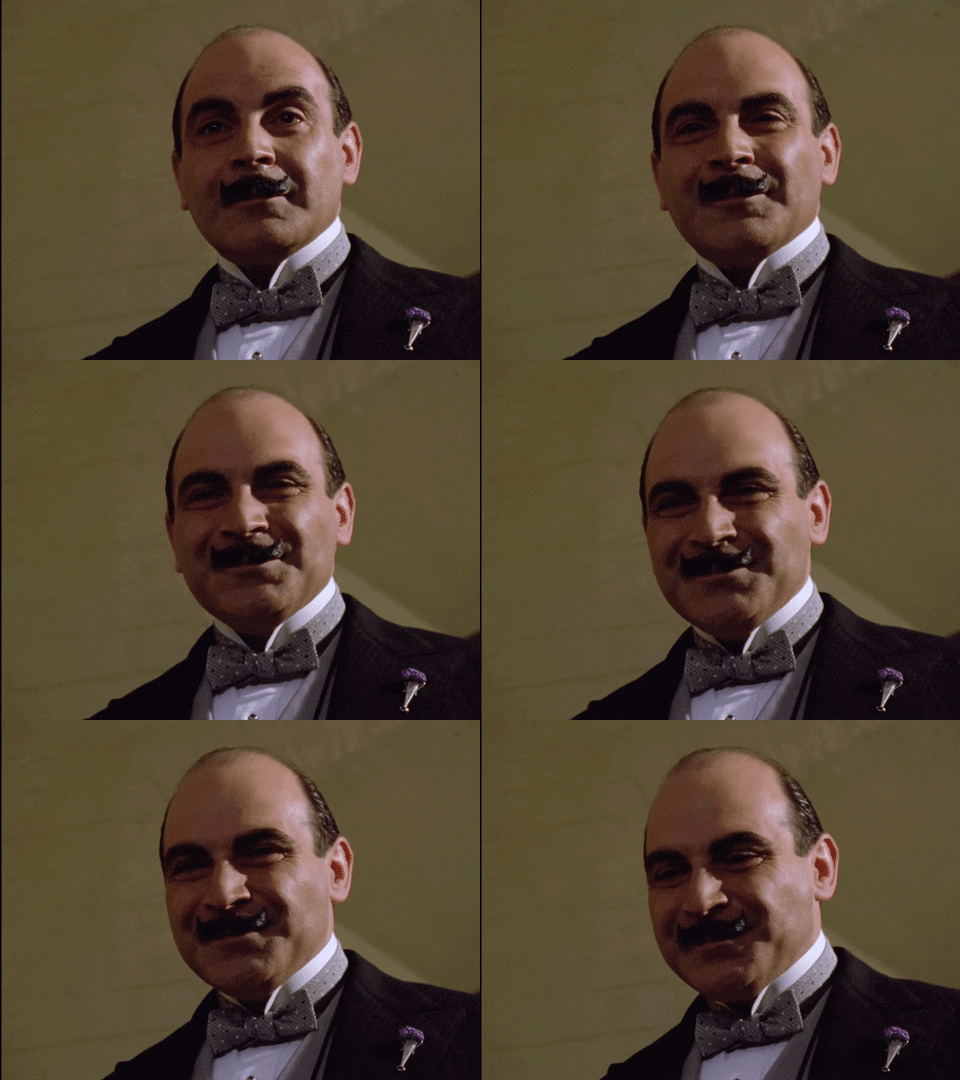
We venture onwards - to Hercule Poirot's second challenge in his effort to duplicate the tests confronted by Hercules of Greek mythology. This short story is part of the Agatha Christie 12 story collection published in 1947, "The Labours of Hercules."
In mythology, the Lernean Hydra was a water monster thought to be protecting an entrance to the underworld. It had numerous heads; with the chopping off of one, two would replace it.
A doctor from the village of Market Loughborough in Berkshire, Charles Oldfield, is convinced that Poirot can't do anything but, with prodding by our great detective, he is persuaded to get something off his chest. He despairs that the village gossips are convinced that he murdered his recently deceased wife in order for him to marry his younger medical dispenser, Miss Jean Moncrieffe.
Here we have rumour as the many-headed Lernean Hydra. It cannot be stopped and keeps coming back. Poirot's challenge? To flush out the rumours and kill them once and for all.
Librarian's note: this entry is for the story, "The Lernean Hydra." Collections of short stories by the author can be found elsewhere on Goodreads. Individual entries for all Poirot short stories can be found by searching Goodreads for: "a Hercule Poirot Short Story."
Dame Agatha Mary Clarissa Christie, Lady Mallowan, DBE (née Miller) was an English writer known for her 66 detective novels and 14 short story collections, particularly those revolving around fictional detectives Hercule Poirot and Miss Marple. She also wrote the world's longest-running play, the murder mystery The Mousetrap, which has been performed in the West End of London since 1952. A writer during the "Golden Age of Detective Fiction", Christie has been called the "Queen of Crime". She also wrote six novels under the pseudonym Mary Westmacott. In 1971, she was made a Dame (DBE) by Queen Elizabeth II for her contributions to literature. Guinness World Records lists Christie as the best-selling fiction writer of all time, her novels having sold more than two billion copies.
This best-selling author of all time wrote 66 crime novels and story collections, fourteen plays, and six novels under a pseudonym in romance. Her books sold more than a billion copies in the English language and a billion in translation. According to Index Translationum, people translated her works into 103 languages at least, the most for an individual author. Of the most enduring figures in crime literature, she created Hercule Poirot and Miss Jane Marple. She atuhored The Mousetrap, the longest-running play in the history of modern theater.
Cut of one head and two grow back - Hail Hydra! I kid, I kid. But seriously.
The hydra in this story is referencing gossip. In particular, the gossip of a small village when the local doctor's wife dies and poison is suspected to be the culprit.
Dr. Charles Oldfield's wife was an annoying, extremely demanding, invalid of a woman. When she died a year prior, presumably of a gastric ulcer, her husband inherited quite a bit of money. Not to mention, the freedom to pursue a sweet young dispenser named Jean who works for him. However, due to the gossip swirling about him, he can't ask Jean to marry him without implicating her in the scandal. So he goes to Poirot and asks for his help in proving that he didn't do it.
A few interviews with servants, a few twists to the story, and a few red herrings later - et voilà! Poirot knows all. It's a pretty good yarn, especially if you're looking for a short Christie mystery.
Alright so this is one of the stories that has been collected in the famous The Labors of Hercules anthology, but was originally published in This Week magazine in 1939. Recommended for fans of the little Belgian detective.
4 Stars. Fair warning, the end is a surprise. Gossip must be an integral part of the human condition. Whether it be around the fire ten millennia ago, shopping along Main Street in the 19th century, or on social media today, disparaging scuttlebutt about other people of mutual interest seems unstoppable. The adage, "There's no smoke without fire," is the heartbeat of rumour. Every language must have its own version, and rumour is Poirot's challenge in this second of 12 efforts by him to match the labours of Hercules. I found it in "Hercule Poirot The Complete Short Stories" from 1999; the original is from the American magazine "This Week" of 1939. The village tabbies are convinced that there's something sinister to the death of Dr. Oldfield's wife a year ago. She was sickly but, did he give her an assist with a touch of arsenic so that he could marry his lovely and younger office assistant, Jean Moncrieffe? Poirot decides to attack the prevailing wisdom head on - determine the source and start there. In his approach, he may have provided a lesson or two for the 21st century. Can you see the Facebook article? "How to Stop Online Rumours!" Enjoy. (May 2021)
"These two have come out of its shadow into the sun," says Hercule Poirot, and that's one of my favorite lines in all of Christie. Maybe it's a little simplistic but I'm just drawn to it for some reason.
A nice, compact little mystery with an easy-to-understand puzzle and solution -- it's part of a collection based on the Labors of Hercules, but it stands alone on its own feet, too. One of her "village mysteries", where rumor drives the plot, but this time it's Poirot untangling it and not Miss Marple.
I like the forensics twist in this one. And you can also see the handprint of Christie's pharmacy career, but as always, it's never in a way where you'd have to be a pharmacist yourself to understand.
Poirot is implored to come to a small town where rumors of the doctor killing his wife is killing the doctor's practice and preventing any re-marriage (rumor seen as hydra).
Poirot talks with people all over the village and calls the Home Office to exhume the wife's body. The verdict is that the woman died of an overdose of arsenic. Evidence is brought to light by the nurse....
A very good story by Agatha Christie. Poirot is intrigued by a story from a country doctor that the passing of his wife was in fact murder, and HE, the doctor himself was/ is the murderer. Poirot decides to investigate.
Toujours très plaisant de lire un Agatha Christie, surtout ces textes qui sont des réécritures des douze travaux d'Hercule. Ici, la figure mythique et monstrueuse de l'hydre de Lerne est déguisée sous les traits d'une rumeur, qui enfle de jour en jour, alimentée par les ragots quotidiens. L'histoire se base donc sur un docteur, accusé d'avoir empoisonné sa femme, décédée il y a un an. Il clame son innocence, et Hercule Poirot tient à faire éclater la vérité au grand jour. A contrario de son homonyme, Poirot cherche la quête de la justice et non pas celle de l'exploit guerrier.
5/5. C'est toujours un bonheur, même pour un court laps de temps (la nouvelle est très courte et se lit d'une traite) de se replonger dans ces classiques policiers.
3.5 I was really intreagued by the premise, after all, how do you manage to stop a gossip, something not tangible? After all the only way is to find out who really dunnit but I was expecting something a little bit more creative.
Another great Poirot story. Short story that should probably have been a mid sized story. Some of the character development could have been a bit stronger and this would have been even more of a classic.
An invalid wife dies and soon the rumor mill is in full force as to the cause of death. A couple of twists along the way doesn’t deter Poirot from getting to the bottom of the problem. Definitely recommended
I'd inadvertently skip this short in the book in the overnight adjustment. I went back, and found to my delight, another happily ever after solution to the many headed problem of rumor mills. So, please read this story with interest as the ending turns quickly into happiness.
While the idea of gossip as a hydra, while true, seems to be a reach in a detective novel, I thought it was a good premise for Hercule to be asked to kill a rumor.
L'histoire est bonne mais le dénouement est difficile à comprendre et les personnages sont difficiles à différencier car leurs nom de famille sont semblables.