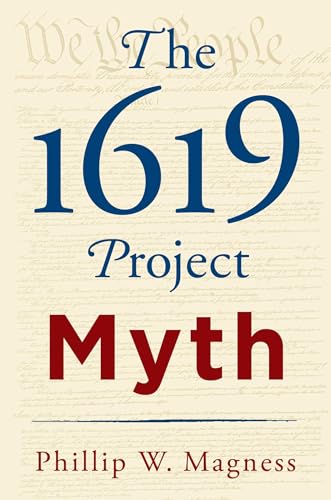
“There is no one better to pick apart the disastrous 1619 Project than Phil Magness. If every classroom that incorporated the 1619 Project into its curriculum replaced it with this book, the country would be better off.” —Coleman Hughes
Slavery is part of America’s story—its greatest shame. But abolition is part of America’s story, too.
Ignoring the latter isn’t just bad scholarship.
It’s brazen deceit.
And more often than not, it’s done for political reasons.
But that didn’t seem to bother the writers at the New York Times when they launched the 1619 Project in August 2019. Advertised as a journalistic deep dive on the history of slavery, the series promised thematic explorations on a number of topics ranging from the first slave ship’s arrival in Jamestown, Virginia, in 1619, to the present day.
Independent Institute Senior Fellow and David J. Theroux Chair Phillip W. Magness was intrigued. What he found, though, was something else entirely.
To say he was disappointed is putting it mildly.
The 1619 Project was riddled with partisan hysteria, sloppy “scholarship,” blatant errors of fact and interpretation, and, above all else, an anti-capitalist ideological agenda to make the case for tearing down our free market economy. Worse still, its transformation from intellectual debate to political dogma poisoned discourse on the right and the left. Angry Twitter mobs canceled and called for the censoring of all critics. Civil discourse and rational thinking became almost impossible.
Almost impossible.
Thankfully, The 1619 Project Mythboldly sounds the alarm on the New York Times’ outright ideological warfare against American history. It’s the essential guide to the many lies, distortions, and propaganda peddled by the 1619 Project and its defenders.
Magness’ writing is cool, calm, collected, and firm. An acclaimed academic and historian in his own right, he debunks and dismantles every myth and blunder of the 1619 Project, how the 1619 Project’s creator Nikole Hannah-Jones twisted history into shallow political propaganda (just in time for election season); why the Project’s activist defenders rely on sneering derision instead of historical facts; why capitalism is not racist … and, in fact, helped free the slaves; why reparations are a moral and logistical dead end; how the American Historical Association fumbled a chance to protect its institutional integrity and defend real scholarship; how Hannah-Jones responded to her critics by ignoring their corrections and making her message even more partisan, political, and anti-capitalist; and so much more…
In these pages, Magness delivers a long-overdue rebuke to “scholars” who treat history as a political weapon. History isn’t a tool for scoring points. It’s a long, complicated, and morally nuanced story that demands humility, intelligence, and moral courage from every scholar who dares plumb its depths.
This is a must-read book on slavery, freedom, and the true American story.
Magness does a thorough analysis of the fraud of the 1619 project
The NYT created 1619 without paying much attention to history. It argues that American history should begin in 1619 when a ship traded a group of slaves for provisions. The lead author jumbled together a bunch of writers to create this myth and when legitimate scholars in history and economics with specializations in the specific topics began to point out errors - rather than responding to the criticisms doubled down on the false narratives. Magness does a good job of describing the perfidy of Hannah Jones efforts to create an ideological story. Even though the project has been discredited the NYT has done two things. First they have spent a fair amount of dough trying to get the curriculum adopted by school districts. Second they have vigorously denied any of the criticisms.
I’ve often wondered about the true profitability of southern plantations before the Civil War. In the memoirs I’ve read, it seems that the owners are constantly in debt and worrying how they’ll make ends meet much less pay off their debts. James Henry Hammond is a prominent example of this type. And the structure of plantation debt seems very strange to me. It sometimes seems that plantation owners mostly borrowed from other plantation owners across a largely casual network of family and neighbors rather than from banks. It’s very mysterious, although this book’s footnotes reference a 1958 work that apparently will resolve the mystery. For this I am appreciative.
Relatedly, I’m curious about the calculations behind the demands for reparations. Do they reasonably account for the plantation owners’ costs of providing housing, food, health care, retirement benefits etc over a lifetime? (What’s the difference between slavery and lifetime employment?) I have to assume they do, but assumptions can be odious. And I wonder if reparations estimates net out the value of social welfare benefits in various forms paid to the descendants of slaves over the decades, in excess of the taxes paid by those same people. (What about black-owned businesses?) One could, I suppose, argue that under the progressive US tax system, taxes paid by ‘the rich’ (and by corporations) in excess of benefits received by those same ‘rich’ (i.e., white) taxpayers already fund ‘reparations’ that have in effect already been paid. It’s all a very interesting logic problem, no? In view of the profound understanding of accounting, national as well as enterprise accounting, shown by some of the 1619 Project’s contributors as well as by the professoriate that sustains them, I’m sure agreement can be reached on a fair and reasonable amount. No?
In any case, I greatly appreciate this book for pointing me in the direction of works that may prove enlightening. I trust the K-12 curricula being taught in at least some schools will be supplemented by comparable materials drawn from this book and others like it. Yes, I’m quite sure that’s the case.
Philip Magness has done a tremendous service with his work. Buy the book, read it, pass it on, give copies to young people, to libraries, to anyone and everyone.