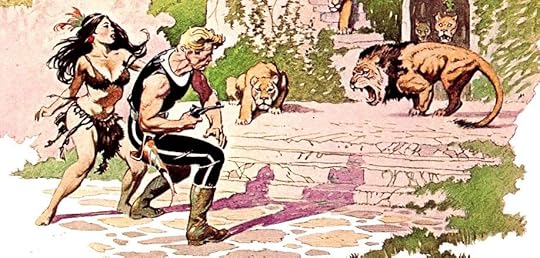
By the year 2137 Europe has become a largely forgotten, savage wilderness. Fierce bands of hunters rove the crumbling ruins of once mighty, war-ravaged cities. On the other side of the Atlantic a prosperous Pan-American Federation has emerged, claiming all lands and seas between the 30th and 175th longitudes and forbidding contact with the rest of the world. All who cross beyond thirty are sentenced to death.
Beyond Thirty is the story of Captain Jefferson Turck and the crew of his aero-submarine, who through accident and sabotage are forced beyond the thirtieth longitude and embark on an epic quest to rediscover the legendary lands of the Old World. Their adventures stand as one of Edgar Rice Burroughs's most imaginative and subtly crafted tales. Burroughs wrote the story in 1915 in reaction to the growing horrors of the First World War, and his devastating vision of its consequences provides a haunting and enduring warning for the twenty-first century.
Edgar Rice Burroughs was an American author, best known for his creation of the jungle hero Tarzan and the heroic John Carter, although he produced works in many genres.
This is a relatively short and somewhat overlooked pulp science fiction adventure written early in Burroughs' career near the beginning of the first World War. It's a post-apocalyptic story about a young military officer who is stranded in a forbidden zone and the events that befalls him as he is swept up on a world tour and witnesses the results of bad decisions of earlier world events. There's a political aspect that grows a tad tiresome, but on the other hand it's a remarkably progressive anti-racist and pro-tolerance plot with a strong female. Originally titled Beyond Thirty, the Eastern and Western hemispheres have been cut off from one another and Jefferson Turck solves the isolationist ills and save the world. He starts by landing in Great Britain where he immediately meets his soul mate, who happens to be the rightful Queen. (This happened more than you might think to pulp protagonists... just ask John Carter.) I read the under-sized Ace paperback with the cool Buck Rogers-looking Frank Frazetta cover many years ago, before I really appreciated everything ERB was saying, and have just finished listening to a nice Librivox audiobook recording from a talented young lady in Australia. People will always think of Africa, Barsoom, and Pellucidar first when Burroughs is mentioned, but he wrote quite a few other gems as well.
A relatively obscure but enjoyable little book, very similar in both plot and structure to A Princess of Mars - except that instead of finding himself marooned on the Red Planet, our hero here finds himself stranded in 2137 Europe, two hundred years after an endless "Great War" and the severance of all contact between the Americas and Europe/Asia. Western Europe has been reduced to rubble and barbarism - and lions! - although fortunately for our hero, it is somehow still able to produce a very Dejah Thoris-like princess:
Written in 1915 when an isolationist America still expected to stay out of the war, Burroughs not only takes on the insanity of "World War," but also takes a neat stab at slavery and racism as well. So if (and probably ONLY if) you enjoy John Carter, you will likely get a kick out of this as well.
Undoubtedly the pro-isolationist sentiment that gripped the United States at the prior to and after the commencement of World War I has much to do with the inspiring theme of this story. Set in the year 2137, this might be the only narrative by this author that would nudge the genre of science fiction. In order to assure neutrality in the war that was bleeding Europe to death, North and South America prohibit travel eastward, effectively cutting off all communication with Europe and the rest of the world. In the elapsed time the two isolated continents ban together to form one super-state, Pan America. Through a technical problem, a Pan American ship is forced beyond the legal limit and through a mutiny five of the crew is stranded on the high seas. Their only chance at survival is to head east and hope for a landfall. What they find and which trials they face you will have to read about but I must express one impression. Burroughs oddly assumes that technology suddenly becomes dormant. Conditions described two hundred years in the future are the same that they were at the turn of the nineteenth century. Considering technological has vastly accelerated in the last fifty years, this premise of quiescent seems highly unlikely. Nevertheless I enjoyed reading the book and consider it one of the author’s best.
By 1916, Edgar Rice Burroughs was already a popular and regular contributor to the pulp periodicals of the day. Though a late starter--his first work, the John Carter story "Under the Moons of Mars," was serialized in "All-Story Magazine" in 1912, when Burroughs was 36--his output increased rapidly, to the point that by 1916, he had already seen the first three Carter works, the first two Tarzan titles, the first Pellucidar entry ("At the Earth's Core"), plus such various works as "The Eternal Savage," "The Monster Men" and "The Cave Girl," all printed in that same magazine. But despite his reputation at "All-Story," he still managed to get his manuscript for "Beyond Thirty" rejected there. This short novel was written between July and August 1915, and ultimately appeared in the February 1916 issue of "All-Around Magazine." Though not nearly as highly regarded as some of those other works mentioned above, this slim book is an interesting and exciting one nevertheless.
The hippies of the 1960s had an expression that went "Don't trust anyone over 30." Well, in Burroughs' novel, which takes place in the year 2137, the united Pan-American Federation (all the countries in North, Central and South Americas) might as well have a saying that goes "Don't trust anyone beyond 30"; the 30th longitude, that is. It would seem that in 1921, the warring continent of Europe had been barred from all communication with any countries west of that line. From the 30th longitude bisecting the Atlantic all the way west to the 175th (just west of Hawaii), the citizens of the Federation have freedom of movement. But any communication or travel beyond those lines is strictly forbidden; in other words, complete isolation from Europe and its self-destructive ways. But when 21-year-old Lt. Jefferson Turck, commander of the flying submarine Coldwater, finds himself adrift EAST of 30--the result of sabotage, a monster storm and the mutinous actions of one of his officers--he determines to investigate the forbidden European zone, along with three of his men. His explorations of the now-decimated continent, replete with savage beasts and barely civilized inhabitants, and his run-ins with the still-functional armies of Abyssinia and China, make up the bulk of this swift-moving tale.
"Beyond Thirty" is fairly relentless in its pace, and Turck's battles with tigers, lions (ironically, before he arrives in lion-infested London--or rather, what's left of it--he tells us that he hopes to be "feted and lionized"!) and savages should appeal to all red-blooded action fans. Burroughs throws a bit of romance into his tale when Turck encounters a savage young woman named Victory, who claims to be the queen of England (if only Elizabeth II were as spunky and appealing!), and his book ultimately does manage to please, short as it is and a bit skimpy in the area of fully fleshed-out characterizations. It certainly did strike this reader as an effective antiwar piece, so I was surprised to read, in Phillip R. Burger's scholarly essay for the Bison Books edition, that Burroughs rather intended his story to be a call for American military preparedness, in the event that our participation in the Great War should come about. (This Bison Books edition, by the way, also includes excellent essays by Burroughs scholars David Brin and Richard A. Lupoff, and is certainly the volume to go with, despite the inexcusable number of typos that it contains.) Burroughs also provides the reader with clues as to his feelings on race relations in the course of the novel...ambivalently, for the most part. It is difficult to tell precisely how he feels about those Abyssinian warriors here. His attitude toward the Chinese, however, seems a lot more lenient than that found in Sax Rohmer's Fu Manchu "yellow peril" novels of that same era. So brief as the novel is (102 pages in this edition), it yet provides food for thought.
Though many of Burroughs' books are filled with inconsistencies, I only found one worthy of mention here. Though the year is said to be 2137 on several occasions during the course of his story, at one point, Turck tells us that the isolation zone was set up in 1921, "two hundred and six years ago." Of course, that should read "two hundred and sixteen," but this could merely be still another typo in a book riddled with so many; let's give Edgar Rice the benefit of the doubt here. The bottom line is that "Beyond Thirty" is both a gripping and fascinating tale, and one well worth reading, almost 100 years after its initial release. Needless to say, it is a must-read for all ERB completists....
When I found this title by Burroughs, I hoped I had found a hidden gem. I hoped that perhaps he had written a book unlike his other books with more original characters, story and themes. I was wrong.
The setting itself is interesting; what if the USA never came to aid in WW1? However, from the moment the characters landed in England, I knew I had read this story before in all of Burroughs other books.
The main man, a manly army man with great honor and no impulse control, is stranded in a primitive world where everything seems almost pre-historic. My hopes did rise, however, when he has not captured by the first people he encountered. I thought "finally, a story where he is not immediately captured and imprisoned.", but then he met more people and, of course, they had captured the only pretty woman for miles. After defeating the biggest and baddest guy singel handedly, he's captured and imprisoned.
Further into the book, I thought I found originality. After Europe bombed itself into the earth, Africa began to prosper. The whole continent was gathered under one ruler, as one nation. This nation then started up colonies throughout Europe; I loved this idea of how the tables had turned and was excited to see what intrigues would arise. But, alas, this was written by Burroughs. The africans are merely weaponly superior, the rest of their culture is just as savage as all other enemy cultures in Burroughs' books. They take slaves by the millions, mistreat them, rape women and war against all others. Naturally, the main man kills the king of this entire nation without breaking a sweat or suffering a single blow, because the king tried to rape the main man's love interest. The woman is mad at him because of some misunderstanding (this happens in every Burroughs book), but forgives him because he says he loves her. And before he has to deal with the repercussions of killing the king, China invades the land and saves them.
When they reach China, the main man is, of course, lucky enough to meet an immensely wealthy and kind hearted man who gives them not only a huge house and servants, but also enough money to do whatever they want. They are then called to meet the emperor of China, for some reason, and are sent back to America. The main man is naturally found to be a hero, while the man who "betrayed" him by following the strict laws at the time, is for some reason found guilty of mutiny(? I can't remember). The strict separation from Europe is, of course, stopped because of the main man's experiences there, before America send troops to retake Britain for Victory, the main man's woman, who is also the last in british royal family line, and thereby to rule Britain.
I have yet to read a book by Burroughs where the main man is not really manly manly, hot-headed, stupidly noble and able to defeat any enemy with ease. And where a woman is not kidnapped, then later rescued by the main man, which makes her fall in love with him. The woman is almost always a Princess of some sort, and her relationship with Main man brings him a lot of riches as a result. She starts to hate him at some point due to a misunderstanding, which always is her fault for believing. But she always forgives him when he confesses his love for her, which she always reciprocates.
I found the settings and different parties to be really interesting. Too bad Burroughs is unable to properly flesh out any culture but one of savages and idiots. A better author would have been able to create something better which would deal with the change in roles of colonizers, the political war with Asia, and more. I'm disappointed by the wasted potential of this book, and found the main story to be the least interesting part of it.
2012 review - reposting because its the only Burroughs I've got a saved review for. Highly recommend you read Tarzan or Barsoom instead if you're looking to try some ERB. Burroughs is problematic in many ways, but still has something to offer, for one thing he knew how to write a fight scene, and for another some of his stuff is hilariously homoerotic, presumably unintentionally.
Original Review:
2.5-3 stars. (AKA "meh")
Why this book is "meh":
This book has two main problems. The first is that, like Princess of Mars, it has a bit of the travelogue about it. One wanders through the world Burroughs has created, gaping at the various sights. But the sights and events simply happen to our hero, rather than being driven by either him or opposing forces. It lacks a narrative drive. It lacks plot. And unfortunately, the world presented here is not so fascinating as Barsoom and so the sightseeing draw is much weaker.
The second problem in The Lost Continent is the narrative style. This book suffers greatly from being written in the first person. Now, I am not a fan of the first person in general. Not that I won't read it, or dislike everything written in it, some of my all time favorite writers commit the first person on a regular basis and do it wonderfully. I know some people prefer the first person, they find it more intimate, and the third person "distancing". I do not entirely understand these people, because it's quite the opposite for me. With third person I feel like I am watching the events unfold, much as one would on TV or film. In first person it all too often feels as though someone is describing events to me over the telephone while I sit trapped in an elevator wishing they'd just get on with opening the door. First person also automatically reduces the narrative tension as it makes a stronger implication that the hero/narrator will survive than does third. In The Lost Continent, Burroughs takes that implication to it's logical conclusion, dispensing with even the pretext of a contemporary telling with all sorts of "if I knew then" and other blatant acknowledgements that the events of the story are distant memories sprinkled here and there throughout the text.. He doesn't go quite so far as using the framing device of the old soldier sitting in front of the fire recounting his glory days. (Was that ever considered a good idea?) But everything short of that is here. Burroughs has taken suspense out back behind the house and shot it dead.
Mercifully it's quite a short book, or I might have abandoned it. Not recommended for anyone other than hard core Burroughs fans.
A fascistic aristocrat experiences doubts about militarism while on an adventure through barbarian Europe and... just sticks with it. The narrative seems to do the same: war destroyed European civilization, better fix it with more war.
Burroughs manages to still be misogynistic despite a heroic woman counterpart and be racist despite the barbarians being white . Honestly so much could be written about race in this text, although I don't think the text is worth writing much about!
The last 20% of the book was monstrously racist, almost comically so. That’s my review. The plot was very engaging and I don’t think I’ll ever forget this read. Here’s a summary, needless to say, reading past this point will reveal spoilers.
The year is 2130 or so, and Europe has devolved into post war collapse where cities are now overrun with lions and tigers. In a bid to reclaim Europe, a pan American travels there, discovering primitive white hunters who wear deer skin, and a young nubile amongst their ranks. Thriving black nations make contact with the whites, initially enslaving them and throwing the nubile into a harem. Our “protagonist” recognizes that the black and white tribes both practice Christianity, which allies them both against the “savage yellow people”. Short skirmishes end after this, and the protagonist and his nubile crush head to Asia to make contact with the people there. He discovers they are peaceful people. Upon realization of this, he forms an alliance with them to recognize him and his nubile crush as supreme leaders of a pan American white nationalist expansionary empire founded on Christian values. He is welcomed with open arms by the Americans, and in closing scenes heads for Europe to cleanse it of ethnic and cultural diversity. The end.
This was written in 1915, and Edgar Rice Burroughs self described himself as a eugenicist. I’d describe him as a monster. 😳
This entire review has been hidden because of spoilers.
Questo breve e poco noto romanzo di Edgar Rice Burroughs ci porta nel lontano 2137, in un mondo in cui la follia della guerra ha irreparabilmente devastato l'Europa intera, riconducendola a un mucchio di selvaggi che vivono in uno stato barbaro e primitivo e in territori ormai dominati da animali feroci, facendo da contraltare alla Panamerica, patria del protagonista, rimasta incontaminata dal conflitto e progredita economicamente e culturalmente per secoli. Considerato il periodo storico in cui fu scritto il libro, il 1916, è facile pensare che questa ambientazione rappresenti una visione catastrofica e portata agli estremi delle conseguenze della prima guerra mondiale, che stava sconquassando l'Europa e da cui gli Stati Uniti erano inizialmente convinti di potersi sottrarre... La struttura del libro ricorda molto quella degli altri testi tipici di Burroughs, presentando la collaudatissima formula in cui il coraggioso e indomito protagonista si viene a trovare in un mondo sconosciuto (che in questo caso, dopo secoli di isolamento panamericano, è un'irriconoscibile e selvaggia Europa), affrontare mille pericoli e minacce e imbattersi in una splendida fanciulla guerriera la cui strada si separerà e ricongiungerà più volte con la sua. Chi conosce e apprezza lo stile e il contenuto delle sue opere si troverà a suo agio anche questa volta, ma Il continente perduto è senz'altro un titolo minore, che al di là del concetto di base sulla follia e i danni catastrofici prodotti da una guerra globale, non ha molto altro da offrire, a fronte del world building e delle situazioni ben più interessanti espressi in altri cicli, primo tra tutti quello di Barsoom. Un libro comunque piacevole, da leggere soprattutto se amate Burroughs e avete già esaurito tutto ciò che era stato pubblicato in Italia, ma ancora non vi basta.
I really want to like this book. The setting is incredibly intriguing, and the plot has everything needed for a short, fun adventure story in an alternate future. Unfortunately, Burroughs cannot help but make it horribly racist. As with all of these early 20th century adventure stories, the author can't help but mention skull shape or use heavily dated ways of talking about different cultures. Beyond Thirty, however, seems to take it a step further.
War is bad not because people die, but because the greatest civilizations of Europe have been destroyed. The greatest crime of the New empire that has arisen in Africa is not that they have slaves, but that the slaves are white (the narrator gets violent about seeing black people order around white people). There are also apparently very few people of color in the unified Americas, which makes me question how that happened.
The worst part is that a lot of these details are entirely unnecessary to the story. The main plot could remain nearly the exact same without the racism, but Burroughs is compelled by some evil force within himself to include with every mention of black people that they lack the faculties for civilization. In fact, the story could be tweaked in minor ways to argue the opposite of everything Burroughs is suggesting. War is bad because it kills innocents. Humans of all backgrounds act and feel in the same ways. And the harmony of a common humanity can bring about a true utopia.
Napisan u vrijeme dok je Amerika vodila politiku izolacionizma (1915., objavljen 1916.) nasuprot Europi koja je bila već duboko zašla u Veliki rat, ovaj roman odiše upravo takvom atmosferom iako se radnja događa oko 200 godina u budućnosti. Granice svijeta po kojem se dozvoljeno kretati i gdje živi glavni junak priče Jefferson Truck, nalaze se između 30.og i 175.og zapadnog meridijana. Tamo je stvorena jedinstvena i napredna Panamerička država izvan koje je ostali svijet (stari kontinenti) nepoznanica u koju je zabranjeno kročiti. Igrom slučaja Jefferson dospijeva preko 30.og meridijana u Europu koja je poharana Velikim ratom vraćena u stanje kamenog doba s divljim životinjama koje su zavladale njenim krajolikom. Nakon niza pustolovina, Jefferson dolazi u dodir s naprednim Abesinskim carstvom u kojem su bijelci robovi, a Afrikanci imaju svoje kolonije u Europi. Njima su suprotstavljeni Kinezi koji su prosvijećeni narod i žele Europu vratiti u normalno stanje, odnosno na svoju razinu. Roman je primjer pulp literature, ima dosta klišeja, ali i nekoliko dobrih i naprednih ideja. Budući da je roman produkt svog vremena, treba ga i gledati kao takvog, inače se neke stvari mogu činiti zastarjelima.
By the 22nd century, America has been cut off from Europe, which is something of a wilderness, thanks to all the previous warfare. Jefferson Turck is forced by circumstances to go "beyond 30", which was forbidden to Americans, and so begins his adventures. Written in the World War I years but prior to America's entrance into it, the book reflects the isolationism of those times.
Ein Karniveur und Gentleman oder Der im Irrgarten der Barbarei herumtaumelnde Kavalier
Einen Pulp-Roman zu bewerten ist so eine Sache und eine leichte dazu, wollte man BEYOND THIRTY mit einem Stern abstrafen. Man kan soetwas tun, zumal dieser nicht zu ERBs großen Romane zählt. So manches ist hier nicht gelungen und die Fehler wiegen nicht leicht. Ein Held, so wenig charismatisch wie der deutsche Durchschnittspolitiker, eine Handlung, die viel Potential verschenkt und ERB-typisch zu einem überstürzten Ende kommt: einen Orden gewinnt der Autor dafür nicht, und wir sind nicht überrascht, dass sein Verleger die Herausgabe zunächst ablehnte. Und doch!
SCIENCE FICTION! BEYOND THIRTY, während des Ersten Weltkriegs geschrieben und 1916 erstveröffentlicht, als Woodrow Wilson im amerikanischen Wahlkampf beworben wurde mit dem Slogan „He kept us out of war“, ist eine der frühen Arbeiten von ERB. Es gab lange Zeit nur zwei Nachdrucke, eine limited edition bei Bradford Day (1957) und eine gekürzte ACE-Ausgabe unter dem Titel THE LOST CONTINENT. ERB schildert in diesem „If-this-goes-on“-Subgenre der SciFi die möglichen Konsequenzen eines großen Krieges rückblickend aus dem Jahre 2137.
Während Amerika sich wegen des Weltkrieges seit zwei Jahrhunderten von Europa isoliert hat, herrschen dort inzwischen Barbarei und Gewalt. Als „cordon sanitaire“ gegen Minenfelder und Kriegswahnsinn legte der auf der westlichen Halbkugel neu gegründete Pan-Amerikanischen Staat die Fläche zwischen dem 30. und dem 175. Längengrad fest: "From 30 to 175 is peace, prosperity and happiness. Beyond was the great unknown. Even the geographies of my boyhood showed nothing beyond. We were taught of nothing beyond. Speculation was discouraged. For two hundred years the Eastern Hemisphere had been wiped from the maps and histories of Pan-America.”
Der Erzähler, Captain Jefferson Turck, Offizier der Navy, ist nach über 200 Jahren der erste Pan-Amerikaner, die den 30. Längengrad überschreitet und in das inzwischen sagenhafte Europa vordringt. Er gehört damit zu ERBs Entdeckern fantastischer „Lost Continents“: „I am glad that it was given to me to be an instrument in the hands of Providence for the uplifting of benighted Europe, and the amelioration of the suffering, degradation, and abysmal ignorance in which I found her.” Keine kleine Aufgabe! Arno Schmidt könnte dieses Setting gefallen haben. Turck allerdings wird von Abenteuerlust getrieben, nicht von Bildungshunger oder Antimilitarismus.
ROBINSONADE! Technische Pannen und Sabotage sind verantwortlich dafür, dass die "Coldwater" auf ihrer Patrouillenfahrt entlang des 30. Längengrades plötzlich manöverierunfähig wird und Captain Turck und seine Gefährten Snider, Taylor und Delcarte nicht nur diese "Schattenlinie" verbotswidrig überqueren, sondern in einem kleinen Beiboot, das die Rückkehr über den Ozean zurück nach Amerika nicht schaffen würde, in England stranden. Das Festland ist "tigerverseucht", so dass man sich entschließt, zunächst lieber auf einer vorgelagerten Insel, der Isle of Man, zu landen. Hier allerdings stellt sich heraus, dass die "Ureinwohner" Englands durch den Krieg auf den Entwicklungsstand einer steinzeitlichen Gesellschaft zurückgefallen sind. Sie haben keine geschichtlichen oder geographischen Kenntnisse mehr und beherrschen gerade noch die Kunst des Feuermachens. Da Turck von diesen Menschen nicht erfahren kann, was seit dem Großen Krieg geschah, setzt sich unser Expeditionstrupp ab in Richtung London.
Ein wenig erinnert der Rückfall in die Steinzeit an die Comic-Reihe MIGHTY SAMSON, allerdings spielte diese nach dem atomaren Inferno eines dritten Weltkrieges, und von Atomwaffen konnte Burroughs noch nichts ahnen. So gehen die Gefahren hier einstweilen von wilden Tieren anstatt von mutierten Bestien aus.
ABENTEUER! Und was für Tiere sich auf der englischen Insel herumtreiben: Tiger, Antilopen, Löwen und afrikanische Elefanten. Denkt gerade jemand an Tarzan und den Dschungel? Ich auch, und es gibt weitere Verbindungen. So ist nicht nur Tarzen auf das Verzehren (um einmal nicht von Fressen zu sprechen) von rohem, roten Fleisch versessen, sondern diverse Safari-Teilnehmer in Tarzan-Romanen können sich nicht alleine von Früchten und Pflanzen ernähren und benötigen das Fleisch wie der Vampir das Blut. Ist es eine Besessenheit von ERB oder mehr? Jedenfalls jagd auch Captain Turck bei London Antilopen, um endlich wieder Fleisch essen zu können. Wilde Tiere, Jagd, die Lust auf Fleisch: stellt Burroughs mit diesen Motiven den Rückfall in die Barbarei nach dem Ersten Weltkrieg dar, oder handelt es sich um stereotype Elemente, die er schon im ersten Tarzan-Roman verwendet hat? Vermutlich hat ERB selber das gar nicht so sorgsam trennen wollen: "A lion reigned, undisturbed, within a few miles of the seat of one of the greatest governments the world has ever known, his domain a howling wilderness, where yesterday fell the shadows of the largest city in the world." (S. 34) Als ein Löwe Turck aus seinen Betrachtungen reißt, indem er den Erzähler umstandslos angreift, ist dieses ein guter Anlass für ERB, einmal mehr eines seiner Lieblingsnomen zu Gehör zu bringen: CARNIVORA (also Fleischfresser). Auch in London und vor allem im Palast selbst sind unzählige Löwen, doch vermute ich, dass ERB weniger an den Englischen Löwen gedacht hat als an das Abenteuerpotential und die Exotik, die diese Tiere mit sich bringen.
ROMANTIK! Und was wäre ein solcher Adventure-Roman ohne Romantik? Kein Grund zur Beunruhigung, es gibt sie auch in BEYOND THIRTY. Turck rettet eine junge gutaussehende Frau aus den Fängen ihrer Entführer, wird selbst kurz darauf von einem Bösewicht gefangen genommen, der die junge Frau zum Weib begehrt, und es stellt sich heraus, dass die Schöne in der weiblichen Erblinie die Königin Englands ist und ihr künftiger Mann entsprechend der König. Turck soll an die Löwen verfüttert werden, kann von Victory - ja, so heißt sie tatsächlich - gerettet werden und gemeinsam flieht man nach London in die Stadt der Löwen. Keine Frage, Turck kann Victory hier nicht alleine lassen: “Too, she was queen of England; but, by far the most potent argument in her favor, she was a woman in distress – and a young and very beautiful one.“ Da ist sie, ein Tusch: Romantik!
Und mit welcher FLEISCHESLUST weckt die edle Wilde unseren Helden: "Antelope!" she whispered in my ear; and, as I raised my head, she pointed upriver. Crawling to my knees, I looked in the direction she indicated, to see a buck standing upon a little knoll some two hundred yards from us. There was good cover between the animal and me, and so, though I might have hit him at two hundred yards, I preferred to crawl closer to him and make sure of THE MEAT WE BOTH SO CRAVED." Was für ein Erwachen! Als man schließlich nach Ostende übersetzt und den Rhein hinauf fährt, auf der Suche nach einer Zivilisation, braucht man was? "We were in need of fresh meat".
VERRAT! Snider verrät seine Landsleute und läßt sie ohne das Schiff und ohne Victory zurück, die er entführt. Und obwohl sich Turck von ihr so sehr angezogen fühlte, hat er offenbar nicht viel Vertrauen in seine queen. Als er eifersüchtig auf Snider war, mit dem sie tuschelte, war sie eine "uncultured little savage"; als er befürchtet, dass sie nun mit Snider gemeinsame Sache macht: "She was a half-naked little savage, I a gentleman and an officer in the world´s greatest navy". So setzt die Eifersucht der Liebe zu.
GESELLSCHAFTSKRITIK! Auf der Suche nach Victory gerät Turck in Gefangenschaft des Abyssiniers Colonel Belik und wird sein persönlicher Sklave. Hier verkehrt ERB die in Amerika herrschenden Verhältnisse: Belik ist Farbiger, ein Christ, und er gehört zur machthabenden Rasse. Zu Zeiten des Ku-Klux-Klan, als ERB den Roman schrieb, gewiß eine gewagte Idee. Zusammen mit mit der Darstellung des Unterganges der Zivilisationen durch den Krieg könnte man diesen Teil des Romans als Gesellschaftskritik lesen, aber vorsichtig, denn wie schon erwähnt, Turck ist Offizier der Navy, kein Antimilitarist.
Auf den letzten Seiten überschlagen sich nun die Ereignisse. Die Abyssinier sind im Krieg mit den Chinesen, die sich als das letzte Kulturvolk Eurasiens herausstellen, und von eben diesen wird Turck befreit und erlangt Ehre & Ruhm in Pan Amerika zurück, wo er als großer Entdecker gefeiert wird. Und wer mag ihn wohl bei der Rückkehr in die Heimat begleiten?
Fazit: Die Stärken von BEYOND THIRTY sind der hohe Unterhaltungswert und die Kürze, die keine Langeweile aufkommen läßt. In der "Bison Frontiers of Imagination"-Reihe wurde zum 100-seitigen Roman-Text eine Einleitung von David Brin sowie die beiden Kurz-Essays "The War to End All Future Wars" von Phillip R. Burger und "Beyond 1965, Beyond 2137, Beyond 30" von Richard A. Lupoff zugegeben, die für Leser sehr interessant sind, die sich nicht nur oberflächlich mit ERB beschäftigen möchten. Ein lesenswerter Roman für alle, die nicht nur Tarzan oder Barsoom kennen wollen.
An interesting tale of rediscovering an isolated Europe after 200 years but found the ending to be too tidy of an ending. I still enjoyed most of it though.
This is about as pulpy as pulp fiction gets, which is a good thing. Written in 1915, before America joined the Great War, it’s a post-apocalyptic story of the desolation of Europe after America self-isolates in WWI, and the subsequent discovery of civilization that has reverted to stereotypical hunter-gatherer.
Kudos to Burroughs for at least trying to portray women with less misogyny. Our busty and beautiful heroine is good with a knife, and a nice nod is given to matriarchy, even though the king still rules and the queen is still a prize to be taken by might. If you consider this was written before women won the vote then it means a bit more, despite the often patronizing tone. The racist attitude is atrocious, but again, context must be considered, kind of like when you read Tom Sawyer.
This is a fast and entertaining He-Man read, with the old standard adventure tropes. I picked it for my reading challenge as a book published 100 years ago. It is in the public domain and available for free download from Gutenberg, who does an awesome thing by making classics readily available and deserves even a couple bucks if that’s all you can donate.
This is a older style Fantasy novel following a similar way of writing as the more well known Barsoom (John Carter) books; also by Burroughs.
A brave, courageous and chauvinistic American Navy man goes off course and ends up in ruined Europe; England in particular. He finds the 'primitive locals' and has a series of adventures; also happening to meet a beautiful woman of royal ancestry of course.
The character development is minimal and there are plot inconsistencies and mistakes but because it's a lighter read and manages to be fun, if a little silly, I enjoyed it whilst not minding it flaws.
Good but dated in the way not so great pulp books of the early twentieth century are. Dense, heavy, and try-hard prose. It comes off clumsy and untrained unlike Robert E Howard or HP Lovecraft. Burroughs wasn't a trained writer and it shows. If you can get past the sexism,misogyny, xenophobia,and racism then you get a really short, antiquated story that is a fun little read. Yes we all understand those things were the status quo and the norm back then, doesn't make it easy to digest. It just baffles me how truly ignorant, hateful, and contemptuous ideas were not only accepted but expected in early 20th century American writing. It really is astonishing, we had telephone lines, railroads, electricity, and yet were more barbaric and savage in our minds and hearts than any of the "inferior" peoples we thought so beneath us. Truly sad and embarrassing as an American. This today would never be published and rightfully so, remember this was written barely a hundred years ago, not in ancient Greece thousands of years ago where a lapse of collective judgement tantamount to blatant cultural racism could maybe be excused. Not sorry, because even if you strip it of all the pompous, self-righteous, weak-minded rhetoric of Western/Caucasian superiority complex of the imperialist age, it's at best a 3 star book.
Originally published as BEYOND THIRTY in All Around Magazine in 1915 the short novel was then un-published until 1955 when Ace released the mass market ERB paperbacks re-titling it as THE LOST CONTINENT. Sort of a post-apocalyptic Lost World story that tells of a period 200 years in the future where Europe has been decimated by war and has returned to tribal barbarism and overrun by jungle animals. The Panamerican narrator/hero is forced to cross the 30th parallel, which is strictly banned and enforced, and he ends up in England dealing with lions, tigers, and wolves, plus uncivilized natives including a beautiful princess, A pretty typical ERB adventure yarn with the flowery prose of the time and cardboard characters. The hero’s marriage to the queen of England was an unexpected and somewhat outlandish touch. An okay Lost World story that doesn't quite measure up to the Caspak and Pellucidar books.
📌 Warning: This is a long review but I go over the entire book.
Premise
In 1937, a Great War left Europe in ruins. Now, 200 years later, the Americas have been linked under the "Pan-American Federation" and its borders (longitude lines 175dW and 30dW) are heavily patrolled, sealing off the entire Western Hemisphere from the rest of the world.
Our protagonist, the 21-year-old Jefferson Turck, is a lieutenant in the navy. We find him newly promoted to commander of "the aero-submarine Coldwater" and charged with patrolling 30dW.
EVERYTHING BELOW CONTAINS SPOILERS
Summary (of chapters 1-7)
Unfortunately, his vessel, which the tightfisted government refused to repair or replace, is overwhelmed by countless technical weaknesses and it is during Jefferson's patrol that the combination of several mechanical failures, a raging storm, and sabotage by his jealous second officer sends Coldwater over the border. Two weeks pass and Jefferson and his crew drift farther and farther from 30ºW. Miraculously, it is on the day that Jefferson has decided to go fishing in a small boat that Coldwater is repaired and, to his amazement, the vessel travels westward, leaving him and three men behind in the open sea. Left with no option but to travel towards the nearest land, Jefferson and his comrades go eastward, to "ancient England".
When Jefferson reaches ancient England, now known as “Grabittin”, he discovers the mainland is occupied by wild animals once native to Africa and Asia and the people have returned to a simple, nonindustrial way of life. The Great War that led to this dramatic change is never explicitly explained. All we are told is that the English were attacked and slain by an enemy. The few who survived fled to the continent. In later chapters, we learn that the descendants of these refugees were enslaved. It appears all of Europe went to war against itself and only those who did not participate (the Americas, Africa, Asia) survived. Then Europe was up for grabs.
While searching the land for food and civilized life, our protagonist just so happens to stumble upon a England’s princess, Victory. (Obviously, she belongs to a less substantial English monarchy than 19th and 21st century readers are accustomed.) She has been bound and beaten by men from "Elephant Country" and Jefferson rescues her. Their victory is short-lived, however, as they are soon apprehended by Victory’s own people. Victory is betrothed to Buckingham, a cruel and ambitious man that killed her father and married her dying mother in order to obtain a tentative position as king. From there, they fight, they flee, they try to survive. Many hijinks ensue.
Thoughts (pre-chapter 8)
1. In the beginning of the book, our protagonist laments the lack of opportunity in times of peace for men to exhibit the strength and bravery that was demanded of them in "the good old days of wars, revolutions, and riots" when "the streets ran red with blood". As a fan of character development, as any reader should be, and I was glad to see Jefferson experience a change in perspective. After exploring the lost continent, he comes to the obvious conclusion that war is the pestilence responsible for man's self-destruction.
2. I was grateful to Burroughs for resisting the temptation to give Jefferson a superiority complex. (Edit: At least not over the men of Grabittin). Our protagonist possessed natural curiosity and was understandably dismayed by the diminished state of the land and his fellow man. (Burroughs uses the word “savage” a lot throughout the book, but given this is a dated oeuvre, I had presumed he was utilizing the word in a very literal sense: a way to describe people who were not of a postindustrial, literate, well-educated society.) Unlike other fictional explorers, Jefferson made a point of declaring his unwillingness to harm these men unless completely necessary, instead searching, though in vain, for a knowledgeable person to explain the history of the Great War.
3. I was also grateful Jefferson lacked a savior complex. Yes, he is often eager to save Victory and his Pan-American comrades in the face of danger, but not to the extent of self-adulation. In fact, he is repeatedly humbled and left to the mercy of others (mainly, my girl Victory!) or chance alone.
Racial commentary
The third act twist—black people are the first civilized men our protagonist encounters on the lost continent—led me to believe that Edgar Rice Burroughs might have been an advocate of racial equality. (I had no knowledge of the author’s personal life prior to reading this book. My ignorance was such that I thought this book might have been written prior to the abolition of slavery—I had not even checked the publication date.) It seemed to me that Burroughs’s reversal of the standard racial order was an effort to force white readers to consider the position of Blacks in the West. He not only wrote of a “powerful Black nation” that had conquered all of Africa and most of Europe, he also made them, with small exceptions, superior to the whites of both Grabittin and Pan-America in numbers, weaponry, and, seemingly, infrastructure. He purposefully created a fictional world in which “the black race has thrived far better in the past two centuries under men of its own color than it had under the domination of whites during all previous history”. (“All” was a farcical choice of word but it hardly detracts from his main point, which I perceived to be a pure, undiluted admission of the destructive power whites held over Blacks throughout history.) (Edit: I am now wondering if that was a call for racial segregation.) On top of that, Burroughs included an assertion that Abyssinia (Ethiopia) “is the oldest civilized country in the world”. These sound like the designs of a man who wants to discount a racist narrative, right?
Well, while in the middle of chapter 8, the chapter with the third act twist, I decided to do a Google search of our author. Turns out, Burroughs was an infamous proponent of eugenics and “scientific racism”, all of which came as a surprise to me. (I have not done any further research because I wanted to finish The Lost Continent and read Tarzan unbiased—though I’ll probably draw the same conclusions as most of its readers and analysts.)
I honestly had not detected any racism—at least not overt racism—up to this point, though after my Google search, I began to look for it.
As I returned to chapter 8, our man Jefferson describes the emperor as a “revolting” and “gross-looking man”. I didn’t think much of it because I could easily imagine the same adjectives applied to a white character. (Burroughs never shied from making insulting remarks about “the savage tribes of whites” in this book.) This characterized seemed to come from the fact that the emperor was exceedingly old, and he still went on to describe the emperor as a man of dignity. The only thing that made me pause was the claim that “in his youth he may have been a rather fine looking black,” instead of a “fine looking man”. I could see where one might argue that Burroughs was implying a fine looking Black man is less fine than a fine looking (white) man, but you would have to be reading into it, or so I wished. It's fair to say I was upset to read of Burroughs's personal views. And I’m going to be honest, (as a Black woman, if that is at all significant to you,) part of me just wanted to enjoy the book in ignorance! ...Jefferson later goes on to describe the upsetting destiny of the “poor white women” who had been taken by the emperor as slaves and the humiliation of being a slave himself, remarks I would have thought part of the effort to put white people in Black people’s shoes, back when I was unaware of Burroughs’s private racism. To think this book contained covert abolitionist thought under the guise of science fiction…
As I progressed through chapter 8, things became a little clearer: At one point Jefferson admonishes himself for doing nothing to help an enslaved girl “of [his] own race”; her race, not her general enslavement, being the primary reason for offense. With that, my wishful thinking ceased.
Final summary (chapter 8-9)
So, as previously stated, a black nation has conquered Africa and Europe… and Jefferson has been captured and enslaved by Abyssinian soldiers belonging to one of many imperial outposts. (A random conversation reveals, to Jefferson’s shock, that the Abyssinians are Christian.) Thanks to “the natural kindliness” of his master, the colonel of the outpost, Jefferson is spared punishing work and serves as a “body servant”. With this raise in position, he is afforded the opportunity to travel to “ancient Berlin”, observe the goings-on of the empire, including the bloody encroach of enemies from China, and attend a banquet in honor of the Abyssinian emperor. At said banquet, female slaves are presented to the emperor for his amusement. It is here that Jefferson spots Victory, whom he once thought lost to him, and ultimately kills the emperor to prevent her rape. Thereafter, the two fight their way out of captivity while the Abyssinians are distracted by attacks from the east. Funnily enough, Jefferson and Victory also become distracted by the attacks and they’re captured again! (This is the FOURTH time Jefferson has been captured.)
Jefferson and Victory are made to march to “ancient Moscow” and it is there that Jefferson finally encounters a man familiar with ancient history and who, unlike the Abyssinians, recognizes the royals of other nations. It is due to this consideration that Jefferson is able to wrangle a meeting with the Chinese emperor. He learns that the emperor’s ancestors conquered all of Asia and now the emperor seeks “to wrest [Europe] from the hands of the blacks”, commence in a campaign of enlightenment, and establish an alliance with Pan-American to secure world peace.
…Apparently, the blacks can have Africa and keep to themselves! (Jefferson is untroubled by this. Not even shared faith can increase the worth of black people in his eyes. In fact, China and Pan-America are the only “two great peace powers whom God has preserved”.) Whoopee!
The book ends with a quick change in pace and narrative. Essentially, Jefferson gets his happily ever after: Jefferson is delivered from prosecution by the testimony of his first officer on the Coldwater, the government decriminalizes crossing the borders of Pan-America, he marries Victory, and he returns safely to his home country with a hero’s welcome. His final act involves yet another journey. He and Victory, accompanied by the military forces of Pan-America, are going back to the lost continent to reclaim England.
All in all, I enjoyed this book... until I didn’t. The adventure was compelling, the tension and excitement that comes with exploring dangerous and unfamiliar land well conveyed. The walk through—and escape from—Lion Country in chapter 5 was my favorite part of the book, closely followed by the dramatic sequence in chapter 1 that resulted in the cross over 30dW. But by chapter 9, I felt like an idiot, duped and disappointed. (Victory’s still my girl, though.)
I listened to the first chapter. The premise sounded interesting to me, but I don't care for the beginning. Not so excited that I wish to keep listening. Just not for me, but someone else more invested in futuristic adventure books could be thrilled by it.
This 1916 novel is in public domain, and can be obtained in free ebook format. Edgar Rice Burroughs was the early twentieth century prolific American author of the Tarzan and Barsoom (John Carter of Mars) books. Originally published with the title "Beyond Thirty", it is a short stand-alone; probably it would be categorized as a novella today.
When reading science fiction of this vintage, you need to consider the state of the world in which it was written. The Lost Continent is set 200 years forward from a time when World War I had broken out, and was perceived as a European conflict between England and Germany, which the US would not participate in. In the novel, American isolationism has intensified to the point where it has long been a capital offense for anyone from the Pan-American Union to cross the longitudinal lines of 30E or 175W. From the resulting stagnant American class-ridden culture, Jefferson Turck, our hero, descended from generations of naval commanders, commands an airborne naval ship. Its gravitational generators break down during a storm mid-Atlantic, and then it drifts east over the line. That is the last piece of technological speculation involved in the story, and it quickly becomes a men's fantasy and adventure story. Burroughs' vision of the retrograde future of the Eastern Hemisphere is drenched in unwelcome, but commonplace racial and gender assumptions of the time, and unrealistic natural wildlife. In any ERB novel, I feel it is not a spoiler to reveal that there is also, of course, a noble half-dressed barbarian girl involved.
Beyond the escapist adventure story, Burroughs' message is the futility of that first world war, when no one realized it was a precursor of worse things yet to come. "Those who did not fight were the only ones to reap any of the rewards that are supposed to belong to victory."
This is a surprisingly "modern" science fiction tale written in 1916, a mere 4 years after Burroughs' Tarzan tales first appeared. The airship/submarine at the opening is very steampunk, and the political scenario is intriguing, considering the WWI wasn't quite finished at the time of its publication. Some of the racist and sexist overtones are a bit off-putting in the main character, but it's to be expected in an 100 year old book. A must read for all Edgar Rice Burroughs fans.
This book was written in 1915 by the author who came up with Tarzan. The story takes place 200 years in the future (2116 or so). It is a speculation of what would happen if Europe, Asia, and Africa continue to tear themselves apart with the First World War. In reaction to the Eastern Hemisphere War, a unified Western Hemisphere, Pan-America, has been formed as a defense against getting pulled into the conflict (This aspect to the story is in part a reaction by Burroughs to the rise at the time of the book’s writing of Isolationism within the US.). As a part of the described defensive posture, for generations no one from Pan-America has crossed the 30th and 175th lines of longitude. The narrator of the story of course does cross the 30th line of longitude. This sets up his recounting his finding of a Europe that due to generations of Germans and English grinding themselves into mincemeat through unending warfare though degenerating warfare has regressed to a Paleolithic lifestyle.
Too short! What if the United States had decided in 1916 that rather than become involved in WW1 they would seal the America's off from the rest of the world? What if for over 200 years they had patroled the Atlantic and the Pacific at 30 degree and 175 degrees sinking every ship that tried to cross and forbidding on pain of death their own people to attempt contact with Asia, Africa, Europe, or Australia?
That is the premise of this book. The year is 2137 and an old Panamerican naval vessel that should have been mothballed long ago is blown across 30 degrees in the Atlantic as the engines fail. The Captain and several members of the crew wind up landing in the British isles as there are mutinies aboard ship leaving them marooned there. This is the story of what they discover.
Written today, this would have been hundreds of pages longer. The style at the time was to write short. This 108 page novel could have filled a 1000 page trilogy easily though.
I listened to the free audiobook available from librevox.org on my Android phone.
This book was published in 1916 and is most likely a reaction to the horrific war going on in Europe. It's been at least 200 years since WWi and citizens of Pan-America, as it is called by then, are forbidden to travel to Asia or Europe. No one knows what is going on there.
But our hero, captain of a naval ship which is sort of an amphibious dirigible, gets blown past the forbidden meridian 30 to the shores of what used to be England.
It's a cynical story as you might expect. It portrays the effect of constant war on people and property. And all of this before the term, "bomb them back to the Stone Age" was coined.
It's an interesting tale from an imaginative author. I would have given it 4 stars but I removed one for the jarring racist references at times. I'm glad we don't refer to blacks that way any more and have come so far. We're closer to judging people by the content of their character these days, thankfully.
BEYOND THIRTY (A.K.A. THE LOST CONTINENT) is a lightweight action/adventure story that gets more absurd with each plot twist. It's not great, but in some ways it's ahead of its time. Not only does it anticipate much of PLANET OF THE APES, but it also posits a future in which white people are subjugated by more-highly-evolved African races (a scenario I imagine caused controversy when the book was first released). Ultimately, though, it's the Chinese who sweep across the globe and basically take everything over...not so different from what's happening in real life, at least from a business perspective. There are some interesting ideas behind this novel, but Burroughs doesn't really know what to do with them. And so, he mostly spends each chapter writing about people being chased by lions and searching for their missing comrades. And, of course, the main character is a naval officer who just happens to cross paths with a beautiful barbarian princess...
Oohohohohohooh. Sa püha pask, kui õudne raamat. Teistele hoiatuseks: kui kavatsete seda kaunist, õilsat üllitist lugema hakata, siis pange heaga kätte, mis raamatut ei hoia, paks pajakinnas. Seda läheb vaja lauba kaitsmiseks, sest muidu laksite end juba poole raamatu peal ogaraks. Jube. JUBE. Ülihormonaalse ja endast jube heal arvamusel oleva, aga vaimult ja teadmistelt päris vaese tiineka self-insert male fantasy fulfillment, ütleme nii. Aju hakkas valutama seda lugedes. Nii õblukeses teoses nii palju idiotismi, seksismi, rassismi, etnotsentrismi ja üldse vist kõiki muid halvamaigulisi isme korraga esitada on ikka omaette saavutus, tõesõna. Aplaus ja lillevarred autorile, tubli töö.
Honestly, for me this book failed. It was such a tiny book but spent the vast majority of its time on the least interesting aspect of its world (barbarian England). I thought the much more interesting aspect of the world, the emergence of a united African/black empire and an Asian empire was so interesting but rushed through. And while I understand the theme of constantly talking about barbarism relating to Europe's treatment of native populations during colonization I felt like it was too aggressively hammered home. I am just angered it created a decently unique world but then rushed through that part in favor of a more boring/expected (from the cover) side of the narrative.
Despite a resonably promising opening, this story falls flat on its face once it reaches "mysterious" Europe. Every single tired ERB trope is shamelessly trotted out, with none his customary flair. He's on autopilot here, and it's frankly painful to read for the most part. It's set in the future, though you wouldn't know it from the trapped-in-amber prose and dialogue and the baffling lack of imagination. I usually enjoy ERB's books, but he's just not trying here.