Two holidaymakers die of a mysterious condition while on holiday in Corfu, piquing neurologist Lauren Furrows's interest. She investigates, finding help in the unlikely form of Richard Anger: independent bookshop owner, avant garde (unpublished) short story writer and borderline alcoholic. Together they discover the killer: best-selling author Gary Sayles and his insipid novels. Will they be able to stop him before millions die?
Wildly humorous, this is a book that will challenge and play with your brain, wryly.
When two tourists drop dead, it peaks neurologist Lauren Furrow’s interest and seeks out indie bookseller Richard Anger to help her uncover this mystery. What they find is something unexpected. Have you ever read a book so mediocre that your brain stops working? Best-selling author Gary Sayles’s books are doing just that. Charlie Hill’s Books will take a satirical look at the state of our book industry today.
This novel starts out with Richard Anger, an angry book seller with the best bookshop ever mentioned in a novel. “A bookshop full of long-forgotten noir fiction, modernist classics, chapbooks, transgressive experimentation, translated erotica, minimalism, short stories, satires, samizdat, surrealist poetry and smut.” This is the kind of book shop I would love to spend my time in, it’s the type of store I would love to own; it just sounds amazing. Is it bad that I identified and really enjoyed the character of Richard Anger? I just thought his whole attitude and personality really tied the book together, offsetting the humour with some bitterness.
As this is a satire, I paid closed attention at what Hill was parodying. A particular favourite of mine was the literary critic, who was a blogger. As a book blogger I’ve heard it so many times, people calling blog reviews into question and while running a blog gives you more freedom to explore your own style and voice but that doesn’t mean what we say is less relevant. This tiny dig at literary criticism amused me greatly but then again I enjoyed the many little pokes being made at the book industry.
As an overview of this novel, Books is satire on the sheer amount of books that are extremely similar being published. You know the styles, I won’t point out books but there are heaps of examples of books that feel very much like a carbon copy of a similar book that was popular. There are genres out there that have the same thing being published over and over again because they sell. Books takes a look at this practise and just made fun of it.
People are devouring these books that are so similar that they all die from SNAPS (Spontaneous Neural Atrophy Syndrome). Books reads similar to a thriller but there are so many laugh out loud moments. I love how on the surface this novel seems like a genre-based novel but if you explore it a little deeper you see so much. You can spend a lot of time trying to dissect Books and seeing everything Charlie Hill is doing here.
If you are a fan of books and want a good laugh at the expense of the book industry, then Books is for you. I had so much fun reading this book and equally as much fun thinking about what is written. I picked up this book because I love books about books and satire and I was not disappointed. This could be on my best of 2014 list but it is way too early to tell. Highly recommend Books, it is fun to read and you’ll enjoy the fun it made at the book industry.
It’s all very well to decry the mediocrity of many of the books produced nowadays, but this postmodern comedy about Hornby-esque lad lit so dull it literally kills its readers is just plain silly. As is the case with some (but not all) satires, the main characters are just cutouts wearing their viewpoints on their cardboard chests – how much more obvious can you get than a bookselling protagonist called “Richard Anger”? A real disappointment.
had to create this book. I know Charlie slightly and am going to the book launch next week...
..3.7 stars to be precise.
Fun, a satire that bites. The conceit – a marvellous one – is that mediocrity kills. A tourist drops dead after reading the manuscript of Gary Sayles latest male confessional novel (his fourth), and Richard Anger, the last independent bookshop owner in Birmingham and Lauren Furrows, a professor at the University of Birmingham witness the death. The event brings them together, and they set out to try and prove their joint thesis that bad writing causes SNAPS, a deadly neural disease. Meanwhile the sharply drawn duo Pippa and Zeke, performance artists of the Gilbert-and-George sort, are involving Sayles in an elaborate stunt by pretending to be Sayles’s fans and organising a ‘People’s Tour of Literature’ for him. More people die – agents and editors – as the book is being prepared for a launch.
You can tell from the names what sort of characters they are, and what sort of book this is. It is an exhilarating rant against mediocrity and a passionate plea for literature with meaning/substance, that provokes something beyond mere recognition. Anger: I believe fiction should make people smart and dribble and blether and snort and gibber and hustle and ogle and fart. It should confront the terrible truths of the world…If I’m reading a book, I don’t want to be sitting there nodding like a dashboard dog, I want to be gazing in wild surmise. I want to be moved. And by that I don’t mean just emotionally manipulated, moved as in chasing my tail. I mean moved as in having my perceptions altered, my perspectives shifted. I want to be made to feel or think differently about life.
There’s some great satire about publishers and editors and agents, about students, lecturers and artists. Yes the characters are types – eg Richard the drunken literary sort (a terrible short story is included) fighting against total misanthropy and cynicism (and trying to get his leg-over); Sayles the blandest of the bland, believing in his own hype – but they manage to break free of this occasionally and the passion hits home. Oddly enough I found the art-as-commodity performers, Pippa and Zeke, the most touching in their childlike ruthlessness. Anyway it is a zippy and successful book. As Mariella Frostup said in her radio interview with Hill he is holding a hostage to fortune when ranting about mediocrity, and insisting on excellence. He more than gets away with it.
I read this book last year, and I wouldn't have bothered to write a review of it now, except that it seems to have garnered universal praise and I wish to add a dissenting voice. I thought it was one of the worst books I've ever read. Hill tries very hard to be original by using words and phrases in unusual ways, but it comes across as deeply pretentious. He can't write very well himself, which renders his attempts to poke fun at other writers embarrassing. I really thought it was going to be a great book, as it has a wonderful concept at its heart - the publication of a book so boring it literally kills those who read it. But the characters are all ridiculous stereotypes, particularly the artist couple and the Nick Hornby-esque author, and the plot is very predictable. The only character who has any depth is Richard Anger, and I suspect he's based closely on Hill himself. If you love books, there are so many better ones to read than this.
It is a truth universally acknowledged that bestselling writers are talentless cheesemongers and cynical fakers, especially the sub-Hornby authors, those who heaved up from the lowest gutter of Hell the ‘male confessional’ novel. The readers of these novels need saving from themselves. They need an injection of dark, transgressive cult literature to raise their collective blood pressure and bust the suffocating membranes of their mediocre, junk-cultural lives.
Unknown
These aren’t my opinions but those of Richard Anger, indie bookseller, bilious bibliophile, experimental short story writer and protagonist of Charlie Hill’s smart, entertaining and necessary new novel Books.
At the outset we meet Anger on holiday in Corfu, where in a café he catches sight of the lovely Lauren and is instantly drawn. Any chance of Anger and Lauren making a connection is scotched when another woman keels over dead in the café. Anger notices that she’s been reading a rubbish novel by rubbish novelist Gary Sayle, bestselling author of mediocrity-fellating male confessionals and Cheesemonger General. Anger, whose bile has been on a brisk simmer for years, remarks that it’s hardly surprising that a Sayle could bore you to death.
Back in Birmingham, Lauren, a Professor of Neurology realizes that the spontaneous death in Corfu was an incidence of SNAPS (Spontaneous Neural Atrophy Syndrome), her specialist subject, and duly tracks down Richard Anger. As an awkward friendship between them develops, Richard and Lauren between them realize that Sayle’s new novel The Grass is Greener is so bad it does induce SNAPS. If its publication isn’t stopped, they will be a massacre. Meanwhile, Gary Sayle, the Cheesemonger General, develops a sort of messiah complex when he decides to go on a ‘People’s Literature Tour’ to connect with his readers, those whose mediocrity he serves, one that will be filmed by two super fans who are actually the Nathan Barleyish Pippa and Zeke, gratingly annoying conceptual artists who have concocted their own plans for a Sayle happening.
All this is achieved by some crisp and witty writing reminiscent of Jonathon Coe if he were more post-punk than prog. It’s a compact novel, but one that picks its fights wisely. This isn’t a novel aimed at writers marginalized by a new publishing reality, but at readers for whom fiction’s breadth of possibility has been curtailed in recent years, who have grown inured to the supermarket hackwork served up by writers like Sayle. Hill manages to trace the entire publishing process here, from the booksellers on the ground who can’t shift non-branded authors; readers who seem unable to relate to fictions that aren’t mere comforts, ‘ just something to look at,’ as literary titan Sharon Osbourne once said of her own novel Revenge; a book reviewing system dependent on nepotism and publishers without the drive or integrity to promote anything that isn’t already cookie-cut into a pre-existing marketing plan. Richard Anger is used to focus this survey, but Richard himself is so swept up in the myth of the transgressive writer, the boozed-up, ‘out there’ antagonist set against the towering ruins that he can’t see that his own work is unreadable, as terrible in its own way as the brain-death served up by Sayle and his like. How he retreats back from this limit is also part of the story.
This is a brave, playful and human book. If you have any real love or longing for fiction, don’t buy the next Gary Sayle just because everyone else is and it’s a quid in Asda. Buy this. If you’re writing, this is a book you should read before you browse those online articles on How to Get a Killer Agent or Ten Tips to Successfully Publish Your Novel or pay to go to some seminar where a posho tells you to write about the ‘everyman hero’ and that your choice is between ‘making a statement or making a lot of money’. Make statements. Tell the truth. This is what books are for. It’s what this one does. There’s no such thing as the everyman hero. Richard Anger, in his shabby and shambolic way is the nearest we’re going to get. There are far more Angers than single-parent firemen called to fight off a zombie invasion. There’s nothing heroic about being a name typed on a page who has arguments in IKEA about Star Wars, or whose seminal moments occur watching ER surrounded by ciphers . At least Richard Anger isn’t one of these.
Well, either the book was smarter than me, or it was an embarrassing example of the mediocre, self-important "pop-lit" that it kept trying to tell me was what was wrong with the publishing world. My eyes kept glazing over with its ranting about "good" books. And dear god! Stop telling me that "books are important"! I'm reading, aren't I?!
Richard Anger is, well, angry. Owner of the “last little bookshop in town” he is both saddened and enraged by the state of the publishing industry. His girlfriend has left him for another man, his profits are non- existent and he is drinking too much. He is attempting to relax on a trip to Corfu when a tourist falls over and dies, while reading the manuscript of a new novel by Gary Sayles. Also present is Professor of Neurology Lauren Furrows, who begins to investigate an unknown neurological condition called SNAPS. Richard and Lauren join up to ask the question – can bad fiction actually kill you?
This is a clever and controversial read, in which the stories of Richard and Lauren join with those of other characters; bestselling author Sayles himself, his wife Amy and performance artists Zeke and Pippa. In a sense this reminded me of Zoo Time by Howard Jacobson, in that it looks at some pretty serious issues and wraps them in a light hearted, comedy storyline. Do the bestsellers available on supermarket shelves really represent what people want to read? Is there still a place for individualistic bookshops? Does serious literature still matter? Of course, the story itself is a fun read and the characters, especially those of Lauren and Richard Anger, work really well. However, it is obvious that, in these changing times, everyone who loves reading is worried about the changing state of publishing, the e-book revolution and the loss of bookshops, and this novel voices those concerns very cleverly.
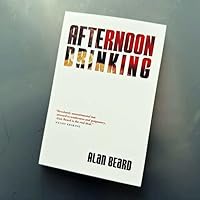
Just a note that the cover is misleading. Despite the cover illustration of a fanged book, and the tag line "read it and die!" do not expect pulpy, exploding-brains, silly horror humour. The storyline and humour are primarily romantic in nature.
In Books, a novel by Birmingham writer Charlie Hill, disreputable Birmingham bookseller Richard Anger and neurologist Lauren Furrows set about uncovering the mystery of a spate of sudden deaths. Meanwhile in London a pair of hipster artists are planning the comeback of a writer of very mainstream slice-of-life novels.
Books is that curious phenomenon, a novel which is also a commentary on itself and what is around it. It is a funny novel, but also a call for genuineness and the importance of good literature by which you mean literature that doesn't just rehash the everyday middle way of suburbia - mortgage - family.
None of which things in and of themselves are wrong but they aren't the be all and end all, and Gary Sayles, the beige-prose novelist whose comeback hipster situationists Zeke and Pippa are planning, is all about them and nothing else. Sayles is sort of Nick Hornby but one could kindly say that he is a Hornby / Mike Gayle imitator, writing Male Confessional novels - in which The Bloke is a poor lost soul (as Richard Anger says, 'men who didn't take advantage of being men' and has to find the Lurve of a Good Woman, which if you think about it is both misogynist (woman as solution) and misandrist (man as dependent) to say nothing of socially conservative.
Other related styles (so to speak) include Misery Lit, which your present reviewer invented for himself when young, positing his own Horror Autobiography - working title "Tell His Mum!" - but didn't think the concept could ever become a reality.
Anyway back to Charlie Hill and Books. Zeke and Pippa the hipster artists (I can't think of a better term for them) are suitably vacuous and irritating but on the other hand are at least doing something. Richard is also somewhat up himself and is one of recent literature's great pissheads and like the best ones do, does pretty much sober up during the book, thereby Gaining Stature. The style of the book is largely straightforward in the best sense, in that it doesn't mess about with you. It's funny but not a joke.
At the very beginning Richard notes a book by David Foster Wallace which he has been unable to get into for more than a few pages. I wondered from the start whether mentioning Wallace was significant, because Wallace was all about genuineness and frequently called out people like Brett Easton Ellis for writing mean shallow stupid novels because that was all Ellis and those like him were capable of doing. According to Wallace, 'Fiction's is about what it means to be a human being.'
But also: If you've read Wallace's Infinite Jest you'll recall that the central device of the book is a film which induces such fascination in its viewers that they become catatonic and may even die. In Books Gary Sayles' dreadfully unambitious beige prose has a similar lethal effect. These books can kill, but through their very mundanity.
This is a book about the value of books. It is something of a polemic based around a single idea - that popular bland fiction is bad for us while smart intelligent fiction is good. Hill offers this up with deft Swiftian maneuvers which have an entertainment value that overrides the otherwise in-cohesive plot elements and one-note feel. The book is, ironically, populist in so far as it is eminently and easily readable.
A smart and irreverent story that doesn’t take itself too seriously while still delivering high stakes. The idea of a bestselling author as the villain is both hilarious and unsettling, and the humor lands consistently. It’s the kind of book that surprises you just when you think you know where it’s going.
This was being satirical, at the expense of the story. Not sure it carried me along very well. I liked the black books character, although he became a bit squidgy near the end which was disappointing.
A book about a mediocre author writing mediocre books that somehow kill people by their mediocrity. Full-on rants about how books 'should be'. It tries too hard to be clever and I'm afraid I found it to be, well, mediocre.
I enjoy reading books about books. Love a literary allusion here and there. This book however played up the silly and a felt a little French farcical in some points. It was nice to see one of my favourites David Lodge get a mention in a crucial scene.
Another three and a half stars. But it hovers around the four star mark for being quite enjoyable and entertaining.
It starts out a little clumsy, prose-wise, but settles as it goes on. The writing is far from terrible, just a little... uncomfortable, early on. Things like a segment from one character's point of view naming a character they haven't met as she acts. It's a niggling thing but something that for me makes a book feel not fully polished. Although, as I say, it felt as if it got smoother through the book (or I was immersed enough not to notice, which is a good thing either way).
The book feels a little preachy in places, but since the whole thrust of the book is 'books with meaning and depth and artistry' versus 'bestselling books of formulaic mundanity' (my phrases, not quotes from the book), literary vs. mass market, if you like, then perhaps the preachyness is unsurprising.
There's a point at which one of the protagonists, a bookseller, receives proofs in the mail and despairs at "more of the same old same old, a steady accretion of grim."
"Where were the dazzlers, the men and women on the edge of their art, those who would present the world not as it sometimes seemed - muddy, impressionistic, torporific - but as it should be - brilliant and intriguing, perverse and beautiful and vile? Those who would rent and tear at the fabric of mediocrity? Those who would move us on?"
And I can't help but wonder if the author himself is aspiring to such things with Books. The book does challenge in some ways, it does do unusual and interesting things, but I don't think it quite reaches such heady heights. It is an absurdist novel, in the tradition of The Man Who Was Thursday, and in fact, although in subject the two are vastly different, the reading experience felt quite similar to me.
I know you shouldn't transpose the author onto his characters; they are, after all, characters, creations. And the art of the author is in creating whole and believable people, whether they be nice or nasty, whatever their personalities. But while I am not saying that the author (who I do not know) is anything like the character in the book in personality, he is an ex-bookseller, and it's hard not to see the book-related rants as being him speaking through the book. Being a bookseller myself, they are conversations and rants I hear often. It's not at all a bad thing, but we come back round to it sometimes seeming a little preachy.
The characters are interesting and realistically changeable. Even some of the more minor characters feel motivated in many and various ways, and all develop as we go.
It's an entertaining book, particularly if you have an interest in books themselves (beyond just reading them). It's not going to change the world, but it's a step away from the usual mindless entertainment, a step sideways, with one foot going down a surprisingly deep rabbit hole. If you're up for something a little different, a little odd, and more than a little entertaining, then go for it.
The more I read, the clearer it became that this book was just like all the mediocre books it attempted to belittle filled with stereotypical characters.
Clever novels are rare enough these days, and funny ones rarer still. A clever, funny novel, therefore, such as Charlie Hill's Books, is something to be treasured.
Books is a ferocious satire on the contemporary literary scene, in which author Gary Sayles, king of the male confessional, writes a novel so numbingly mediocre that it shuts down the brain of anyone who reads it, causing them to drop dead. Our heroes are Richard, a drunken bookseller, and Lauren, an uptight professor of neurology, who team up to try to stop the novel being published.
Comedy relies on precision, and the humour here is laser sharp. The cultural references are spot on (except those coming from Gary Sayles, which misfire brilliantly), the comic timing excellent. And Books bristles with ideas, and with the joy of ideas: there are impassioned debates about what constitutes “good” literature, references to the Stuckists, French surrealist poetry, a pitch-perfect parody of Alt Lit, and a procession of authorial name-checks which would provide an excellent reading list for the intellectually curious.
At times the ideas crowd out the characters, and the satire becomes too broad. Gary Sayles in particular did not convince me, coming across more as an “Aunt Sally” than a real human being, a target for Hill's rage against mediocre fiction. However, he is balanced by his wife Amy, who emerges from the shadows to reveal a character with depth and humanity (this in itself is a comment on the tendency of “lad lit” to sideline female characters – Gary is not even aware of his wife's backstory.) Pippa and Zeke, the performance artists who make Sayles their “project”, are marvellous creations too, transcending their satirical function to find and evoke real emotion.
What really drives Books is not its cynicism, though this is the source of most of the humour. It is the genuine passion, for art and what it means to humanity. “Books matter” is Richard's mantra, and it is this conviction that gives the novel real heft. It takes courage to describe your ideal novel in your own work, as Hill does, inviting comparison between aspiration and achievement. So how does Books match up? I wouldn't go so far as to say it made me “smart and dribble and blether and snort and gibber and hustle and ogle and fart,” but it made me laugh out loud, more than once. It made me stay up till 2am reading. It made me think, and see the world in a different way. It entertained, and it provoked. Job done, I would say.
The premise is fun: certain mediocre authors who write increasingly mediocre novels to increasing numbers of mediocre people have managed to get these “readers” so attuned to their mediocrity that it actually affects the synapses in their brains which, with the right conditions, will actually kill them. One such writer is specifically chosen by our indubitable hero and heroine and ironically by a weird conceptualist artist duo; the question is: what is to be done about it? How can this author be “destroyed”? (actually this author-villain has such an ego that his own actions of themselves would have sufficed to bring him down…) The more important question is: how can we get people to read decent literature, and so save them from themselves?
Hill writes a more or less pleasant, chatty, style (though some of the jargon relative to the no doubt young readership he is appealing to did no resonate with me that much — enough said!) which is relatively easy to read; but somehow the thrust of the book seems a bit dissipated. A love-story or sorts develops between the main protagonists, and in the end perhaps this is the main final image.
The plot to attack the mediocre is, however, a bit of a fiasco (funny enough in itself, but hardly to be taken seriously, I thought) and ultimately rather silly. The fairytale ending of the “solution” to the book problem, with “proper” books being rained down onto the public for them to read is just, well, ridiculous (sorry Charlie!).
Personally, I would have preferred that nothing were done: then all the people who relish their reading of mediocre books would eventually eliminate themselves, there would be no one left to buy them anymore, and the market would disappear, thereby liberating the publishers from their obsession to feed mediocrity to the masses… thus the problem is not-a-problem — it solves itself… Or am I missing something here?
This entire review has been hidden because of spoilers.
This is a darkly comic book, with anti-hero bookseller Richard Anger (oh, the irony of the name) appearing at first to be very much like the proprietor of 'Black Books' (the TV series). He drinks too much, fancies himself a writer (oh, he so isn't...), and he's fairly unpleasant to everyone except the women he wants to shag. And sometimes them, too. His only saving grace is that he believes in books; he believes they are important in the world. Yee-ha. He crosses paths with neurologist Lauren Furrows (the name - a reference to brain furrows? ???) - and they discover that people are beginning to die from a condition called SNAPS (don't ask me to explain the pathology). It simply occurs when someone reads the very mediocre fiction written by author Gary Sayles (oh, the name): their brains shut down and they quietly drop dead. The race is on to prevent people from reading Sayles's drivel, but first the world has to believe them. Yeah, good luck proving that crack-pot theory, even when readers start dropping like flies. The book has its tongue stuck firmly in cheek, and the multiple pop culture and literary references fly past to battle and bamboozle and bludgeon, well, everyone, including the reader. It's a pacy read, with a darkly humorous, entirely chaotic and visual ending suitable for film. A tremendous satire on literary culture.
Mediocre writing = words on paper indicating a smooth progression from A to B that detracts from the sum total of human experience...
So if you are reading one of these, watch out; you may keel over from a SNAPS attack (Spontaneous Neural Atrophy Syndrome).
This very fun/funny book is about Richard (anti-hero bookseller of Backstreet Books) and heroine (the beautiful Lauren, famous SNAPS neurologist) as they search for the murderer (writer Gary S.--author of dad and lad lit (for the hard-of-thinking), while pondering the relationship btwn sex and literature and wit and spontaneity and wine.
Books matter. Not just to "present the world as it sometimes seems--muddy, impressionistic, torporific--but as it should be--brilliant and intriguing, perverse and beautiful and vile." The interesting stuff is on the edge. Along the way they conjure the Banality (or Yawnsnoozecoma) Rating, among other things.
Will they save the world? A romp thru "Books" and you will find out.
Restoring my faith in contemporary literature, this bodacious satire is one of the funniest things I've read all year. A mediocre author's mind-numbing work dulls the brain cells so severely that it causes mass deaths across the reading public. Only the inquisitive neurology professor Lauren Furrows and the embittered bookseller Richard Anger can save modern readers from Gary Sayles' constant stream of 'male confessional' shit.
The mediocre author character reminded me somewhat of a cross between Nick Hornby and Karl Ove Knausgaard. Just me?
Hilarious farcical interludes, memorably zany characters and a genuine message at its heart. Charlie Hill, please write more.
This was a heck of a fun read, I finished it off in one afternoon. The plot is predicable: four people : a disgruntled independent book store owner who views mediocrity as the worst fate in life, a psychologist who is afraid of living, and two over-the-top performance artists, go out to destroy the reputation of Gary Sayles, a "male-confessional" novelist (loosely based on Nick Hornby) who is beginning to take himself a bit too seriously. His newest novel is so bland, it causes a mental shutdown, resulting in death. The symbolism and message is obvious and Charlie Hill doesn't pull any punches, but he doesn't intend to. This is entertainment, not art and he made bloody good work of it.
For being a long rant against bad books, this is a pretty bad book. Don't bother. However, it gives a list of quality authors, which made me buy some books by those I hadn't read earlier: John Crace, for example... That might be Books's only redeeming feature.
I really enjoyed this. Short but a lot crammed in and well paced even though there were a couple of looseish threads at the end and written, set and published in Birmingham too for extra points.