From the literary agent behind some of today’s most successful authors comes a narrative guide geared specifically to the needs of aspiring and working nonfiction writers, demystifying the world of publishing and offering a practical roadmap to getting your book published
Alia Hanna Habib remembers what it was like to be on the outside of the publishing world, looking in. Arriving in New York, a first-generation college student with a love of reading and loads of ambition, she hadn’t any idea how to break into the business of books. Now, years later, in her career as an agent, she hears from prospective clients who, whether they’re experts at the top of their fields or wholly new to the writing game, consider finding success in publishing to be a mysterious and daunting endeavor. Ever determined to flout the stereotype of agent as gatekeeper, however, Habib is prepared to hand emerging writers the key.
Drawing on wisdom from her star-studded list of clients, including Hanif Abdurraqib, Merve Emre, Nikole Hannah-Jones, and Judy Batalion, in Take It from Me Habib provides context and clarity to each step of the publishing process, from the germination of a book idea to finding an agent to represent it, from crafting an engaging proposal to navigating the perils of publicity. Readers will find real-life samples of her authors' pitch letters and book proposals, as well as templates writers can use when querying agents or promoting their work on social media. She also incorporates the advice of trusted industry colleagues—attorneys, accountants, editors, publishers, publicists, and more—gifting readers with a full team of experts to answer all the questions they’ve had about the publishing world, but were too afraid, or didn’t know, to ask.
Essential for both the aspiring novice and the seasoned professional, Take It from Me is a guidebook writers will return to again and again. At times laugh-out-loud funny, at others brutally honest about her own experiences in publishing, and in life, Habib offers a clear-eyed look at the challenges facing today’s aspiring nonfiction writers and then gives them the comprehensive, expert guidance they need to put those roadblocks in the rearview mirror.
Alia Hanna Habib is a Vice President and literary agent at The Gernert Company, where she represents MacArthur Fellows, Pulitzer Prize-winning journalists, National Book Award finalists, and numerous New York Times bestselling authors. She lives in Brooklyn, NY.
From Pitch to Publication, Without the Panic: My Review of “Take It from Me” and the Emotional Reality of Modern Publishing
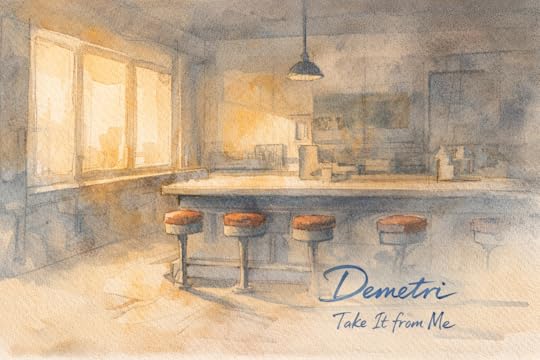
Watercolor Piece by Demetris Papadimitropoulos
Alia Hanna Habib’s “Take It from Me” is, on its face, a guidebook: a cleanly staged tour through the machinery of contemporary publishing for nonfiction writers. But the book’s real accomplishment is not that it explains the machine. It’s that it teaches you how to live inside it without letting it colonize your mind. Habib’s most valuable gift is not “insider tips,” that powdered genre of advice content; it’s orientation. She writes like someone who has spent years watching smart, capable people misread silence as judgment, misread rejection as indictment, misread publicity as love, misread a deal as deliverance – and who finally decided to put an end to the misreadings.
In an industry built on mystique, “Take It from Me” is almost provocatively literal. It wants writers to understand what is happening, when it happens, why it happens, and how much of it is out of their control. This is not merely practical. It is, in Habib’s hands, an ethic. Publishing has a habit of turning private longing into public performance – a habit that can make writers both vain and ashamed, sometimes in the same hour. Habib’s answer is to insist that knowledge is not cynicism, and that clear-eyed process literacy can coexist with serious literary ambition. The book doesn’t sneer at writers’ dreams. It simply refuses to flatter them with fantasies.
The structure announces that refusal early. Habib begins where most aspirants don’t want to begin: with the small, unglamorous work of pitching essays and articles, of learning to make an editor’s life easier, of proving – not declaring – that you can deliver. She offers an early parable in Dorothy Brown, a professor who wanted her scholarship to reach beyond academia and who pursued that goal not by waiting for an agent’s blessing but by sending op-eds into the world again and again until the world began to answer. Habib’s point is not that Brown is a saint of persistence; it’s that publishing rewards momentum more reliably than it rewards longing. The byline is not a halo. It’s a receipt.
What Habib does so well here is reframe rejection as information rather than prophecy. Editors are busy; inboxes are crowded; the timing is often wrong; the news cycle is tyrannical; internal staffing changes can scramble priorities in ways writers never see. Habib writes with an unshowy empathy for the person on the other side of your pitch – the editor triaging a day that already contains too many emergencies. In another book this would become a lecture about gratitude or patience. Here it becomes a practical discipline: be persistent, yes, but be specific; follow up, but don’t hover; make it easy for someone to say yes; and if they say no, don’t transmute that no into a story about your worth.
This insistence on not turning process into morality recurs throughout the book. When Habib moves into the question of education – and the cultish, class-coded anxiety around it – she refuses both the romance and the backlash. She is not an evangelist for graduate programs; she is not an iconoclast either. She tells her own story with a kind of bracing candor: she loved school, pursued a doctorate in English literature, accumulated debt, left the program, and later realized that much of what the experience taught her was not academic prestige but professional practice. The “dirty work” of the academy – grading, line-editing, sharpening arguments, responding to people who would rather be anywhere else – turned out to be an education in the very skills that sustain publishing: clarity, rigor, stamina, and the ability to revise without collapsing.
It is one of Habib’s quiet strengths that she treats education less as credential and more as formation. What matters is not whether you have a degree; it’s whether you have built the habits that degrees supposedly certify – the ability to think in structure, to read like an analyst, to sustain an argument, to welcome feedback without surrendering your voice. This emphasis is, in its own way, a rebuke to the prestige economy: it suggests that the real work can be done anywhere, that seriousness is portable, that legitimacy is not only bestowed from above.
Then Habib interrupts herself with a short interstitial on the most anxious word in the modern publishing lexicon: platform. She calls it vague, even Orwellian, and you can feel her impatience with the way the term has been used to reduce writers into a set of metrics. The relief she offers is not the false relief of “it doesn’t matter.” It does matter. But she widens the definition until it becomes something a serious person can live with. Platform is not only followers; it is reach, access, and credibility. It is the evidence that you know where readers are and how to speak to them. It may be a newsletter, an academic field, a professional network, a community organization, a beat you’ve covered, an area where people already trust you to explain something difficult. This reframing has a political edge: it pushes against the idea that visibility is the only form of power. It also has a psychological edge: it allows writers to describe what they truly have rather than pretending to be someone else online.
The heart of “Take It from Me,” though, is the proposal chapter, which arrives under a title that sounds like a scolding and reads like a liberation: don’t be boring. Habib is not asking writers to become entertainers; she is asking them to remember that a proposal is a reading experience. Too many proposals fail because they treat the reader as a bureaucrat rather than a human being. Habib insists on voice, movement, stakes. A proposal should not announce importance in foggy terms; it should demonstrate importance by being specific enough to feel inevitable. It should not hide behind abstraction; it should show, early, what it sounds like when this author takes control of the material.
Here the book reveals its true allegiance: not to the market as a tyrant but to attention as a moral resource. Attention is finite. If you want it, you have to earn it – sentence by sentence. Habib’s advice is often craft advice in disguise. She encourages writers to open proposals with something that functions like a sample: a scene, an argument, a mini-essay that lets the reader feel the book rather than merely understand it. This is a commercial technique, yes, but also an aesthetic one. It suggests that even at the transactional stages of publishing, the art is still present, still detectable, still decisive.
If the proposal chapter teaches writers how to present their work, the agent chapter teaches them how not to mythologize the people who represent it. Habib is frank about what an agent is for: shaping, positioning, strategy, negotiation, advocacy. She is equally frank about what an agent is not for: personal salvation, guaranteed prestige, magical publicity. The agent can open doors, but cannot force someone to fall in love with what’s inside. A large portion of misery in publishing comes from misplaced expectations, and Habib’s approach is to return expectations to their proper scale.
This pragmatism is underwritten by a kind of moral seriousness about money. Habib explains how agents are paid, why reputable agents do not charge upfront fees, and why writers should understand the basic math and mechanics of their contracts rather than outsourcing the knowledge and hoping for the best. There is, in these pages, a steady push against learned helplessness. Publishing has trained writers to feel grateful for whatever they are given. Habib’s argument is that gratitude and literacy are not mutually exclusive. You can be thankful and still read the fine print.
The most psychologically perceptive chapter is the one on submission, the stage that turns writers into fortune-tellers of their own doom. Habib approaches submission like a doctor with an honest bedside manner. She opens with a small story about blood draws – the rare nurse who narrates what will happen, who doesn’t soothe you with falsehoods but with procedure. That metaphor lingers because it captures the peculiar pain of submission: the pain is partly the needle, yes, but also the waiting for it, the sense that your body (your book) is being handled by someone else, the fear that the result will confirm your worst suspicions.
Habib refuses the melodrama that often surrounds submission narratives – the auction fantasies, the preempt myths, the dream of instant validation. She explains what actually happens: editors reading on different timelines, internal meetings, the slow conversion of enthusiasm into institutional commitment. She clarifies why feedback can be vague, why “no” can arrive wrapped in praise, why silence is sometimes just silence. A writer reading this chapter will not be spared discomfort, but may be spared self-hatred. Habib’s great skill is to make the system legible enough that writers can stop treating every delay as a referendum on their talent.
If submission is the needle, publication is the long recovery – the stage where many writers discover, to their shock, that the deal was not the end of anxiety but the beginning of a new kind. Habib is at her most useful here, because she refuses to romanticize the “big push.” Most books do not receive fireworks. Most books live in the midlist, where the work is incremental, where the attention is partial, where the author has to learn to collaborate with a team that is busy, constrained, and sometimes imperfect. Habib explains the difference between marketing and publicity, between paid and earned attention, between what a publisher can promise and what it can only attempt. She addresses the comparison trap – the way writers watch other books get coverage and interpret their own quieter rollouts as failure.
What makes Habib’s approach feel contemporary is that she writes in the shadow of our current cultural conditions without name-dropping headlines. She understands that we live inside an attention economy that punishes nuance, inside institutions strained by layoffs and budget cuts, inside a public sphere where platform has been turned into a fetish. She writes about the emotional labor of being a writer now – the need to regulate your expectations, to tolerate ambiguity, to keep your mind from refreshing its own panic. “Take It from Me” is, among other things, a book about endurance.
This is why the conclusion works better than most guidebook endings. Instead of triumph, Habib offers continuity. The question “what’s next?” arrives too quickly for many authors after publication. Habib acknowledges the strange emptiness that can follow the moment you imagined would complete you. She gives practical guidance on timing, on how contracts shape the next steps, on how to avoid turning every relationship into an immediate demand. But the emotional counsel is the deeper gift: you are not failing because you feel unmoored. You are simply experiencing the truth that a writing life is not a single event but a series of cycles.
The appendices, which cover contracts and foreign rights, elevate the book from narrative guidance to reference manual. Habib and her collaborators translate legal machinery into language a writer can actually use: definitions of “out of print,” the logic of reserves against returns, the implications of deep discounting, the basics of foreign-rights licensing. These sections also feel especially timely, because they touch the kinds of clauses and anxieties that have sharpened in recent years – morality clauses in an era of social-media blowback, and the growing debates around artificial intelligence and rights language. Habib’s point, again, is not to incite paranoia but to encourage literacy. The writer who understands these terms is less likely to be surprised later.
Comparisons help locate a book like this in the broader advice ecosystem. “Take It from Me” sits comfortably beside Jane Friedman’s work on the business realities of writing, and it shares some DNA with Betsy Lerner’s “The Forest for the Trees” in its compassion for the psychological life of authors. It also has kinship with Courtney Maum’s “Before and After the Book Deal,” though Habib is more agent-forward and more willing to linger in the pre-deal stages where most writers actually live. What distinguishes Habib is her tone: conversational without being cute, candid without being cruel, direct without being didactic. She has the voice of someone who has made a career inside the system but has not developed Stockholm syndrome for it.
The book’s limitations are mostly those of scope. It is a nonfiction book, and it largely assumes a traditional publishing pipeline. It does not spend much time on alternative routes, and writers who want the book to offer a revolution – a way to bypass gatekeepers entirely – may find its pragmatism almost austere. It also assumes that the reader is already committed to craft; it does not teach you how to write beautiful sentences or build scenes. Instead it teaches you how to protect the conditions under which beautiful sentences can continue to be written.
And yet these boundaries are part of what makes the book trustworthy. Habib does not pretend that publishing is fair, and she does not pretend that clarity guarantees success. She refuses the fantasy of deservingness. The world does not owe the writer a deal. What the writer can do – what Habib keeps returning to – is build competence, build evidence, build relationships, and build the emotional resilience required to keep going when the system, inevitably, is slow, opaque, and imperfect.
In the end, “Take It from Me” is less a promise than a posture. It asks writers to trade superstition for understanding, to replace the fever dream of instant validation with the calmer ambition of a durable career. It treats writers as adults: capable of desire, prone to panic, worthy of honest information. In a cultural moment that often confuses visibility with value and speed with destiny, that steadiness is not merely useful. It is, in its own modest way, radical.
An agent presents standard advice about book proposals and such, supplemented by anecdotes and interviews focused on writing narrative non-fiction. For scholarly non-fiction, I would recommend: The Book Proposal Book: A Guide for Scholarly Authors.
This is a situation where I wish I could buy copies of a book in bulk and give them away to people in need. I love that a) the author identifies as first-gen to college and b) uses the book to dispel myths and to dispel the hidden curriculum about publishing. My focus is on self-publishing, but this book is incredibly insightful and inspired so many ideas. At points, I had to stop reading to let me mind settle down. Congrats to the author!
Great, informative book. I do intend to publish nonfiction writing in the coming years, so I am the target audience for this book.
I read this all in one go— but I think it’s better used as a manual to read each chapter as they apply to you in your particular situation and phase. That being said, Habib is thorough and generous in her publishing intel. So much was illuminated for me and motivated me into action!
the publishing/writing book that’s literally a beach read! I read it by the beach and by the pool. it’s informative. it’s laugh-out-loud funny. it’s a page turner. regarding pre-publication, “it’s time to shine for anyone who’s ever asked you ‘how’s the book going?’”
If you’re interested in writing nonfiction I highly recommend.
Alia Hanna Habib is an agent to several NYT best-selling authors and in this book she demystifies the publishing process for nonfiction authors.
This book contains a wealth of information from how to pitch shorter articles, how to query, how to write a book proposal, and how to handle the editing and publication phase of your book project.
As someone who spent the last 5 years navigating this process... I wish this book had existed in 2021! But, I am so glad it exists for upcoming authors now.
Incredibly specific with examples of query letter log lines, book proposals, writing and publishing advice from major authors and editors, and insights into building writing career and platform — this book is unprecedented in its helpfulness for emerging nonfiction writers, and witty to boot!
Habib has peeled back the curtain on many professional practices of agents and editors (how to pitch articles, how to build relationships with editors, how to avoid the agent slush pile, the format of a proposal) that so many writers are eager to understand. Take It from Me is the masterclass we’ve been waiting for.
I'm not actually trying to build an nonfiction writing career, but I love reading nonfiction and was curious about what goes on behind the scenes.
This book honestly included a lot more practical information than I expected it to, especially about things like contracts, etc.
I would highly recommend this book to anyone that wants to write nonfiction or is even considering it and wants to get a look at the publishing behind nonfiction books.
As a new writer in a new country, I have been trying to figure out how to make writing my career. Navigating the industry is hard enough, but it becomes much more difficult when you don't even know the system. 📖
I had read a bunch of books and articles telling you the basics of writing, editing, pitching, and publishing. But no one goes into much detail about how? And as someone who works well after knowing the step-by-step but not in an info dump style, this book really gives you all the information like you're sitting down with a friend for coffee. ☕
I am taking it in small portions as Alia suggested, but I am learning tons (most of the first chapter is highlighted by now)!! If you're a nonfiction writer trying to set up your career, you have to read this! 😁
Alia Hanna Habib’s Take It From Me is a book that radiates enthusiasm. You can practically feel her love for nonfiction publishing dripping off every page. Through engaging anecdotes and a confident voice, Habib makes it clear that she’s not just sharing tips—she’s letting you into her world, pulling back the curtain on the inner workings of the publishing industry.
That said, buckle up.
This book is dense. Like, “you-might-want-to-take-notes” dense. To her credit, the depth reflects a true mastery of the subject and a whole lot of research. But at times, I found myself wishing for a bit more clarity—or at least shorter paragraphs. Some chapters dive into detailed explanations that go on for pages, and while the information is valuable, I often felt like it could’ve been said in half the space.
This might be fine if the reader were, say, a literary agent or a seasoned editor. But most folks picking up this book are likely aspiring authors just trying to understand how to get their work published. In that sense, Habib may have overestimated how much we want—or need—to know about the inner machinery of the industry.
The first chapter, in particular, is a whirlwind. It dives headfirst into the mechanics of pitching, submitting to agents, and navigating publishing houses. By the end, I felt like I’d just taken a crash course in publishing law. It’s good stuff—but it’s a lot.
At its core, this book’s message is: Don’t quit. And I admire that. Habib gives practical advice on how to persist in the face of rejection and what to do when you’re not writing, but even that advice can feel emotionally exhausting. It’s almost ironic—she’s trying to encourage writers, but the sheer intensity of the information might leave some readers feeling more overwhelmed than motivated.
Still, I can’t fault Habib’s dedication. Her commitment to excellence is obvious, and her belief in the power of good writing is genuinely inspiring. She makes it clear that if you’re going to aim for publication, you should aim high—Premier League-level high.
In the end, Take It From Me is a powerhouse of a guide—best suited for writers who are ready to treat publishing like a second full-time job. If that’s you, you’ll find this book invaluable. But if you’re hoping for a breezy read to dip your toes into the process, be warned: this one’s deep, and it pulls no punches.
If an aspiring writer of nonfiction wanted to get published, that person needs to read Habib’s book. She not only provides her own experienced agent’s perspective but those of many other professionals from the conception, dipping-the-toes essay articles through editing to pub day—the day the book is finally released to the public. From the outside, publishing looks daunting: so many manuscripts aren’t even read by editors and fewer are accepted. But if the writer wants to break through into the “real” publishing world, and not remain in self-publication, Habib provides the do’s and donor’s of submission, marketing, etc.
There are helpful summaries at the end of each chapter: key takeaways. So if the reader is re-reading, or trying to know which pitfalls to avoid in the next stage of launching a book, these are really helpful. Also, helpful because a few chapters can be too long.
The book itself is very readable, as if the author is in a conversation with you. Also, there are moments when the author pulls back the veil on the process for this book. But being in the publishing world and having shepherded many authors’ books onto bookstore shelves, there are plenty of anecdotes to back up her advice. And a few moments of vulnerability as well when describing the stumbles by the author when negotiating on her clients’ behalf.
If I was interested in publishing (again), I would definitely refer to Habib’s book many times for guidance.
I’m appreciative of the publisher for providing an advanced copy.
Alia Hanna Habib has a way of explaining things that feels reassuring, almost like someone sitting beside you and walking you through a world that usually feels confusing and closed off. She covers everything from shaping an idea to writing a proposal, finding an agent, understanding contracts, and what to expect after a book sells. It is clear, helpful, and surprisingly comforting.
I think almost everyone has dreamed of becoming a writer at some point, and I am definitely one of those people. I have always wanted to tell my story, but I never knew where to begin. That is why I was so excited when my request for this eARC was approved. Reading it felt like someone handed me a map. It was genuinely informative, and I am already planning to buy a finished copy so I can return to it when I finally work up the courage to start writing. Or if the author happens to be reading this, I would very kindly accept a copy to have on my shelf :)
One of the things I appreciated most was how practical the book is. The sample query letters, proposal examples, and real behind the scenes advice make this feel like something you can use, not just something you read once and forget. There are a few sections that feel a little dense, especially if you are new to the publishing world, but the honesty and clarity throughout the book make it worth the read.
If you have ever wondered how authors actually break into nonfiction publishing, or if you are someone like me who hopes to write one day but does not know where to start, I really think this book could help. I am grateful I had the chance to read it.
Thank you to NetGalley and the publisher for the eARC in exchange for my honest review.
I was lucky enough to snag a copy before publication—and I’m positively giddy about it. Sure, there’s no shortage of books and blogs explaining the publishing process, and just as many hair-raising cautionary tales. But Habib manages to cut through the noise, dismantle the mystery, and—miracle of miracles—never once lull you into a yawn. Her secret weapon? A deliciously cheeky sense of humor and spot-on metaphors that make you snort-laugh while learning. Every page sparkles with little “aha!” gems, busting myths and steering you away from common pitfalls. I’m walking away feeling not only armed and ready to take on the publishing world, but also equipped with the know-how to make my work truly stand out.
Every page of "Take It from Me" reads like having a conversation with someone who listens to your questions carefully and answers all them thoroughly. It's a learning experience and, at the same time, an enjoyable reading to whoever love books and feels curious about the journey from authors ideas to bookshelves.
I also love the fact that Habib not only shared her expertise, but also brought real-life examples from the industry. By doing that, she sustains her opinions, gives practical models to follow, and make you feel like you're among the insiders. Great book! Would give it 6 starts if I could.
Talk about demystifying...I think I love this book. As a writer who has not yet published, this was a welcome and well needed guidebook for future endeavors. It takes all those questions you have (and anxieties about your work being judged) and gives you in depth answers, guidance and even some timelines to consider and prepare for. I recommend this to anyone who has considered becoming a published author and even to those who might be curious about what goes into getting a book out there for the masses.
The blurb on the dust cover of ‘Take it from Me’ is not hyperbole, this book really is a comprehensive guide to building a non-fiction writing career from scratch.
Alia Hanna Habib’s writing style is direct but not colorless (to borrow her own turn of phrase) and she disseminates an enormous amount of information over almost 300 pages. Herein lies part of my struggle with the book, that information often takes the form of walls of text which send my ADHD brain into a sort of hardcover hypnosis. However, if you manage to scale those walls you will receive enormous value on the other side.
I devoured the audiobook in just a few days. Such a helpful guide! I've read several books on publishing, and this is the best I've come across. I bought the print version today because I was bookmarking things constantly, and I need to have this as a reference. (I only wish it was available in paperback, but it came out this week.) Highly recommend for nonfiction writers. The author is a literary agent. Also love her Substack newsletter if you're looking to learn more: aliahabib.substack.com
This was a great, informative book for anyone who is looking to get into publishing non-fiction. There is a lot of information here that might be overwhelming at first, but Habib did a great job of laying it all out in an organized way that will make it easy to find the exact information you need right when you need it.
Definitely a title I'm going to keep on my shelf to refer back to in the future!
Thinking about writing or actively writing a nonfiction book? This is required reading with lots of great insights, ideas, and previews of what to expect and how you can prepare. It makes a great companion to the other two books I’d recommend on this topic, which are “Thinking Like Your Editor” and “The Essential Guide to Getting Your Book Published”.
Both informative and fun. While the focus is on narrative nonfiction, there are several chapters that would be helpful for any aspiring author to better understand the publishing world. Would recommend the audiobook format.
Enormously helpful, readable, motivating, smart ... and even funny at times! Thank you, Alia Hanna Habib, for helping nonfiction/memoir authors like me navigate the process of developing a platform and launching a book into the world.
This book is brilliant for anyone thinking of publishing a book (particularly non-fiction) whether you choose to find an agent, or traditional publishing deal, or whether you go hybrid or self-publish. There is so much great advice in this book.
Incredibly helpful book giving a clear picture of what to expect when you’re either expecting to write or actually writing a book. I’m glad i had our library order it so others can benefit from its practical advice.
This book is an absolute must read for anyone hoping to break into the world of non-fiction book publishing.
I have long been fascinated by the world of publishing, and this finally gave a great glimpse into the process that goes into pitching, proposing, publishing, and promoting books from the author who is an agent herself.
It breaks down the nuances of the differences in the fiction publishing business and points out where nonfiction is unique. This was super interesting to me!
This isn’t a craft book, but it is a really entertaining and informative guide on how to break into non fiction publishing. Would recommend this to writers or professionals thinking of writing nonfiction! Thank you to writer and publisher for the eARC.