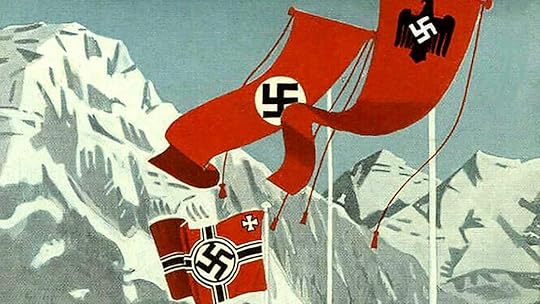
“Like a gigantic operation the work of rejuvenating Germany began…There was to be a boycott of Jews beginning on April Ist: there were to be new passport regulations; fresh censorship on newspapers. There were to be murders. The bursting accumulation of frantic energy, held in leash so long, was to be set loose. It could no longer be controlled. Patriotism must run its course. All was open and free for it.”
Sally Carson’s novel first appeared in 1934 yet it’s a startingly topical, immensely disturbing reminder of just how quickly a society can fall apart and a pernicious brand of authoritarianism can take hold. Clear-eyed, refreshingly unsentimental, it covers six months in the life of a small German town close to the Austrian border. Kranach, known for its picturesque mountains and lakes, is a version of popular holiday destination Schliersee, not far from Munich. A place Carson visited several times during the early 1930s. Her experiences there inspired her novel. It opens in December 1932, snow-covered Kranach resembles scenes from a festive Hallmark movie. The Kluger family are excitedly preparing their seasonal celebration, one of the small pleasures that help this close-knit group cope with everyday anxieties. Like so many in Depression-era Germany, money’s tight, work’s scarce. But this Christmas is special, Lexa Kluger is newly engaged, eagerly anticipating her wedding, set for the coming June. She’s due to marry Moritz an up-and-coming, Catholic doctor, whose father is a close family friend. The Kluger home’s filled with greenery, even the photograph of Hitler has been covered with foliage. The picture belongs to Helmy, Lexa’s brother, unemployed for three years, he’s been a committed Nazi since 1929.
As elections loom and Hitler’s victory seems certain, Helmy takes steps to make sure Lexa understands the dangers of associating with Moritz. In the past, Helmy’s had no issues with Moritz. But now, at least for Helmy, it’s simple, Moritz’s surname is Weissman, a name which marks him out as Jewish, someone the “new Germany” can’t and won’t tolerate. As the countdown to the election speeds up, so does the violence. Just out of frame, Jews are being brutally assaulted, Communists and fascists are caught up in furious street fights. Moritz loses his job and can’t find another one. But Lexa finds it difficult to understand exactly what’s happening and why. Naïve, bouncily energetic, Lexa resembles a character from a vintage girls’ school story ruthlessly transplanted into a tale of star-crossed lovers and mounting horrors.
In early 1933 Hitler takes power, Communists and anyone else deemed left-wing or hostile to the regime, are killed or “unspeakably” tortured, survivors dispatched to newly-created camps like Dachau. Among them is Hermann once part of Lexa’s circle, an overnight pariah because he refused to join in with the Hitler salutes. And slowly Lexa starts to understand that her world has totally changed. But Carson doesn’t depict this revolutionary shift in melodramatic terms. What she captures so brilliantly is how easily the unthinkable becomes the taken-for-granted. The casual compartmentalisation that means Lexa’s brother Erich can go out to oversee the lynching of Jews then arrive home in time for tea and their mother’s homemade soup. This splitting, this division of reality, reminded me of Apartheid-era South Africa or the American South during Jim Crow; neighbours slaughtering neighbours in Rwanda; the atrocities that took place during the Balkan Wars.
Carson doesn’t offer her readers easy or comforting explanations. Her Nazis aren’t inherently evil, radically different from the rest of us, most of her characters aren’t even Nazis. They’re mostly men, and women, caught up in, or taking advantage of unfolding events. A few like Erich are fervent believers, others like Helmy are seeking an income, a status and recognition otherwise denied them. Others just want to avoid sticking out or see the likely benefits of supporting Hitler. Carson doesn’t hesitate to highlight the terrifying consequences of men like Helmy’s choices. But she also highlights the damage these choices can inflict on men like him; such as the young Nazi who takes part in the murder of an elderly Jewish man, who’s later overwhelmed with guilt and grief. Carson’s interested in how the economic and the political intersect with the cultural: destructive forms of masculinity, poverty, scapegoating, exclusionary nationalisms, exploited by politicians whose relentless propaganda campaigns hold out the promise of an idyllic future. My sense is that, alongside sounding the alarm over Germany, Carson was issuing a warning about England’s possible future – the far-right were already on the rise. Unfortunately it’s a warning that’s increasingly relevant today. Carson may have been writing in and about the early 1930s but the scenario is uncomfortably familiar. With minimal tweaking, a 1934 review of Carson’s haunting novel could be describing growing movements within Trump’s America:
“The irrational doctrine of racial hatred embraces in its brutal activity the innocent as well as the guilty… And when one comes to think of it, the very title, "Crooked Cross," is a parable in itself; suggestive of the caricature of Christianity, which the Nazi movement would establish; which is just as much a distortion of the Gospel of Jesus Christ as the swastika symbol is of His Cross.”