Jump to ratings and reviews
Rate this book

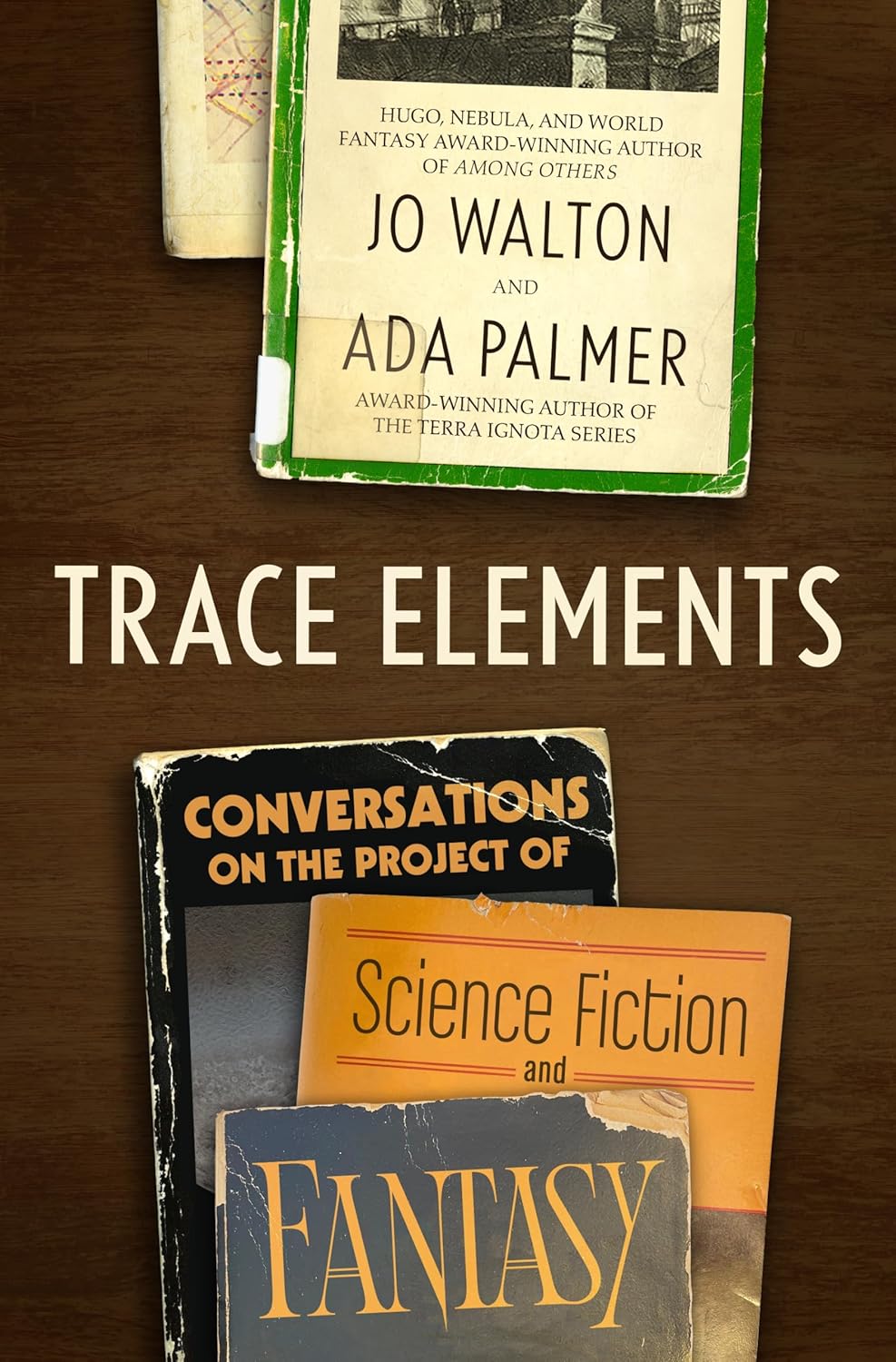
Trace Elements: Conversations on the Project of Science Fiction and Fantasy

Rate this book
From two of the most acclaimed writers in the field today, a groundbreaking look at how SF and fantasy writing—and reading!

Jo Walton and Ada Palmer are two of the most innovative and insightful writers to emerge in the SF and fantasy genres in this century. As writers of fiction they’ve each won multiple awards. As commenters on SF and fantasy in print and in visual media, they’ve both sparked new conversations that expanded our imaginations and understanding of how SF and fantasy work, and what more it could be doing.

Now, in Trace Elements, Walton and Palmer have come together to write a book-length and supremely entertaining look at modern science fiction and fantasy, at how our genre is written and how it is read, that will join nonfiction works like Ursula K. Le Guin’s The Language of the Night, Samuel R. Delany’s The Jewel-Hinged Jaw, and Understanding Comics by Scott McCloud on the short shelf of titles essential to all readers of our genre.

Subjects covered include the nature of genre itself, the history of SF publishing, the implicit contract between author and reader, the ways SF and fantasy disguise themselves as one another, what SF&F can learn from outside influences ranging from Shakespeare to Diderot to anime, the role of complicity in reading, the need to expand our “sphere of empathy”, and finally the need for optimism, the importance of rejecting “purity” culture, and the fact that the human story for centuries to come will be composed of hard work.

368 pages, Hardcover

First published March 24, 2026

17 people are currently reading
2865 people want to read

About the author

Jo Walton

86 books3,107 followers
Jo Walton writes science fiction and fantasy novels and reads a lot and eats great food. It worries her slightly that this is so exactly what she always wanted to do when she grew up. She comes from Wales, but lives in Montreal.

Ratings & Reviews

What do you think?
Rate this book

Friends & Following

Create a free account to discover what your friends think of this book!

Community Reviews

5 stars
7 (31%)
4 stars
10 (45%)
3 stars
5 (22%)
2 stars
0 (0%)
1 star
0 (0%)
Displaying 1 - 18 of 18 reviews
Profile Image for Erin.
537 reviews46 followers
September 1, 2025
I've been a big fan of Jo Walton's takes on science fiction for years (Tooth and Claw is my favorite of her books I've read so far, but her Thessaly trilogy is overdue for a reread). She reads omnivorously and has the best-informed perspective on what SF has been and is becoming. Her book on the Hugo's is an example of some of my favorite kind of writing about books. I don't know Ada Palmer's work at all, but clearly she brings a deep knowledge of manga and anime to the mix, as well as a more overtly political viewpoint.

Some thoughts, in no particular order:

This collection includes personal essays from both women, giving us insight into their journeys to publication and experiences with disability. Definitely worth a read. (There are also poems, which I mostly skipped, but ymmv.)

Some of my favorite essays here are the ones that zoom out for an industry-wide view. The examination of imprint SF vs. "external" SF gave voice to ideas I've felt but struggled to articulate - why, for example, Ishiguro's highly praised Klara and the Sun feels so boringly basic to me, who grew up reading Asimov's Robot stories. Literary SF annoys me because it's written and praised by people who don't read SF and think they're offering original takes on topics that have been well-mapped by generations of SF writers. For Walton and Palmer, they much more diplomatically describe it as the difference between a 101 explanation and one written for people in a 300-level class.

The essay breaking down the history of fantasy/SF publication was fascinating, and I learned a ton about mass market paperbacks that I never knew, even as a librarian. I got less out of the multiple essays about manga, only because I always find that literature difficult to get into. (It's so mind-bogglingly vast and the number of volumes you have to read for a single story is not inviting for an "external" reader who has barely dipped a toe into the format.)

Walton's essay "What's Reading For?" answered some lingering questions I have had about her ability to finish several books a day, and gave me a new place to aspire to in my reading life: "Reading is the most fun I can have at any given moment." Delightful.

The essay "Spear Point Theory" is immediately going into my canon of useful ideas from its very first sentence. As a lifelong SF fan, I live for the moment the spear punches through at full power. I'm now going to have to reread some favorites (and re-watch Farscape) to re-experience those moments with this fresh insight.

I very much disagree with Palmer's critiques of "Providentialist" thinking. I do believe in Providence because I'm a Christian. Though I appreciate the way SF explores interesting ideas in an infinite variety of possible worlds, in our world there are wrong answers to certain questions. At one point Palmer writes "Western SF basically never pauses to ask whether extinction is a better choice than the bomb. When this does come up in Western SF, it is, sadly, often unexamined and the answer is always to keep killing, and even when it is examined, with the idea that the killing has a cost, that cost is always paid." I'm not totally sure what she means in the second sentence, but choosing extinction is insane. Next question.

As a stylistic quibble, I think both writers should lay off using italics for emphasis. I've always thought italics should be used as sparingly as exclamation points. The sentences rarely changes meaning without the italicized words, so if it lacks punch use stronger words.

Overall, anyone who loves SF and fantasy would get a lot out of these thoughtful essays. I'm glad I read them, and they've added to my reading list (check out my "jo-walton-says" tag for books I've added over the years because of her essays).

Received a free copy from Edelweiss in exchange for an honest review.
Profile Image for Peter Tillman.
4,116 reviews493 followers
Want to read
March 15, 2026
Jo Walton is one of my favorite writers, and a usually trustworthy guide on what to read: her monthly reading lists are a fertile source for new TBRs. Ada Palmer is more problematic for me, fiction-wise. But perhaps these two going back-and-forth on worthy 3rd-party reads will prove worthwhile. I look forward to trying this one. A definite winner in the cover-art dept!
Profile Image for Mel.
802 reviews24 followers
September 19, 2025
**I received an ARC of this book from Netgalley.**

I don't read much writing that dissects genre, writing trends, or the possibilities of fiction, so this was a real feast for me. There are a lot of wonderfully interesting essays here, some thought-provoking, and some eye-opening. The first three in particular are really excellent at the latter: getting into the weeds of why imprint SFF and external SFF feel different was incredible in a did-not-know-I-needed-to-hear-that way. I also really enjoyed the deep dives into anime and romance and The Princess Bride. (I was way less enthused by all the mentions of AI rights. I know it's meant to refer to person-like AI, but spending the last year or so watching artists and writers get their hard work ripped off by AI, plus having it obtrusively shoved into every corner of online life has given me a reflexive flinch to "AI," never mind the much more galling "AI rights." Crazy how fast the night changes, huh? But even that element was thought-provoking.)

There are, of course, a few less than interesting pieces. I'm not sure why we needed the acknowledgements of another book in this book (and since they were there, why wasn't the standard form for acknowledgements played with a bit? after all these essays on trying out new narrative styles in writing, c'mon!) and some of the poems didn't really hit for me. But overall, this is a really compelling collection. If you're at all interested in genre fiction, or, hell, just love thinking about fiction in general there is definitely something you'll enjoy here.

On the other hand, if you're looking to keep your TBR - or To Be Watched list - nice and lean (why, though?)...run, don't walk. This is not the book to help you with that!
Profile Image for Marianne.
1,567 reviews53 followers
March 31, 2026
a splendid book. some of these essays (and other pieces) I'd read, some I hadn't. they weave together wonderfully well, and as a whole, they have a clear shape in the same way that a really good story collection or musical album does. this book exceeded my ridiculously high expectations and whetted my appetite for another collection of their nonfiction work. if you love books about how books work and or books about sff, you have a great chance of loving this book too. I will be keeping and rereading this one.
Profile Image for Bas.
459 reviews67 followers
March 31, 2026
4,5/5 stars

This was an absolutely great collection of essays and criticism about SF/F and reading in general. It's clear that both these authors are well read and know about which they write and they present their ideas in a very accessible but also entertaining way. What I appreciated was not just their broad knowledge and being well read but also being able to compare with narrative traditions from other cultures.

This is a book for readers who are interested in the genres of sci-fi and fantasy , in their history and in it's tropes, it's evolution and what it makes work. The biggest part of the book is about genre ( what is it, why is it but also with a large sections about the history of SF), the second part is shorter and is much more personal more memoir like (about their personal life and struggles with pain and disability and how it influenced their writing) while the final part is more general about writing/reading and broader topics adjacent to that. It's a book that made me think and reflect about the books I have read and while not always agreeing with their points ( though often I do ) I feel it has made me much more conscious of elements in writing while also giving me a lot of energy in the joy of reading.
If I had to give some negatives there are 2 : the collection also contains some poems for which I didn't care and some of the essays aren't completely new if you have been following their online presence ( though that is often the case with these types of books).

But in the end my feelings are very positive and I feel like I learned a lot and have gotten a whole new books/manga to put on my tbr.
My favourite pieces of the book were:

Where does Dystopia fit as a genre ?

A Mitfreude of Manga and Anime

A Mitfreude of Genre Romance

The Ghost did what ?! Translation exposing Providentalist thinking

Writing/realizing disability+power ( this is just 5 stars and was an absolute emotional piece of writing by Ada Palmer about her own experiences with chronic pain and disability )

The Protagonist problem
Profile Image for Alaina.
101 reviews2 followers
Read
March 18, 2026
Disclaimer: I read this eARC as someone who 1) doesn't read that much nonfiction, and 2) has yet to read either of these authors, but 3) reads a lot of scifi/fantasy. All that considered, I really enjoyed this! As with any essay collection, the material varies, both in topic and how much each one gripped me, but overall I walked away from this with a renewed joy in the art and history and culture of genre fiction.
Profile Image for Dan Trefethen.
1,254 reviews78 followers
April 1, 2026
This book of essays (and a little poetry) is divided into three sections: The first discusses science fiction as a genre and its history (the essay specifically on publishing history is quite good); the second is more personal, describing the two authors' development as writers, and discussing their separate disability issues. The essay by Ada Palmer is especially good, about gradually recognizing that her 'invisible affliction' (Crohn's Disease) meant that she was disabled and entitled to seek and receive all the accommodations that disabled people need and deserve. The third section discusses the craft of writing SF &F, and has a nifty essay on dystopias and utopias. There's also a good one on the subgenre called hopepunk.

Many of these essays were written during or right after Covid sequestering, and reflect the mental corrosion that the pandemic afflicted us all with.

In the first section there are lengthy essays on manga and anime, as well as one on genre romance. For those of us who don't indulge in those things, the essays can seem superfluous but the authors are so engaging and enthusiastic that even a noob like me enjoyed them.

Jo and Ada are both thoughtful, well-researched practitioners and appreciators of science fiction and fantasy, and are both entertaining and enlightening.
Profile Image for Marlene.
3,498 reviews244 followers
March 27, 2026
I picked this up because I loved two of Jo Walton’s previous books that looked into both the business of and the writing of science fiction and fantasy, What Makes This Book So Great and An Informal History of the Hugos, and was hoping for more of the same – except with different books.

What I got wasn’t like either of those first two, but it IS in dialogue with both of them, as well as the business of writing genre fiction in general AND an actual dialog between Walton and her co-author Ada Palmer.

I read it for two reasons, the first being a Library Journal assignment that I pretty much begged for. I mean that I seriously wanted to read this. I just didn’t expect it to lend itself to the kinds of in-depth reviews I usually write.

But I can’t stop thinking about it, and what it has to say about not just Fantasy and Science Fiction, but about genre fiction for adults in general. I’ve discovered it to be, not so much “What Makes This Book Great” because Walton has already written that book and it was awesome. Instead, I found this to be “What Makes This Book Great FOR YOU”, or NOT.

Not by talking about specific books – although yes, sometimes they do – but by addressing the blenderizing of genre – which is something I run into – and get run over by – a lot in the reading and reviewing that I do.

The part of Trace Elements that is sticking in my head are the discussions about genres that are settings vs. genres that are formulas vs. genres that are emotion driven. Which is all a ball of thoughts that I’ve been working through on my own.

What does that mean? What does it relate to specifically?

It gets into books like last year’s Orbital and The Ministry of Time, which were hugely popular with general readers but didn’t resonate nearly as much with SF readers even though EVERY single review labelled them as SF. Basically, it turned into a discussion of why “literary sf” doesn’t hit the right beats when it’s marketed to actual SF readers. Because it uses the furniture of SF but doesn’t follow the actual conventions of the literature itself. It’s not in conversation with what came before in SF because it’s not intended to be.

As more and more genres mix and mingle – those issues are becoming increasingly prevalent. It’s the issue that’s at the heart of any and all discussions of ‘romantasy’, but also the increasing amount of both science fiction and fantasy mysteries, about what tropes near-future and dystopian fiction are intended to follow, and about what audiences those books that ride a dividing line between two or more genres are intended to appeal to.

The above is not the only “trace element” of the discussion that’s still swirling around in my head, but it is the part that’s swirling the hardest.

Reality Rating B: This wasn’t a book to be read for pleasure, at least not exactly. I certainly did enjoy parts of it, and Walton in particular is someone I always enjoy listening to in person at Worldcon. She calls it like she sees it, or like she saw it when it happened, and it’s a perspective that works for me.

I haven’t read much of her co-author’s work, although it’s been recommended and I have quite a bit. I can see it wiggling up the virtually towering TBR pile out of the corner of my eye but it hasn’t made its way to the top yet. I’m particularly interested in her Inventing the Renaissance nonfiction book, which I bought and is also worming its way up that TBR pile as it’s likely to be on this year’s Hugo ballot in the “Best Related Work” category.

Like any collection of anything, not everything will work for every reader. I found the discussions on the business of genre, its history and the reasons for its appeal to be the most interesting from a personal perspective. And I always love good writing about how the sausage gets made – especially when it’s sausage that I enjoy.

But as a whole work, it didn’t draw me in and keep me glued to the page the way that Walton’s solo works on the genre did. This one just doesn’t gel into a whole the way that both What Makes This Book So Great and An Informal History of the Hugos managed to do. OTOH, parts of this one really made me think, even though others didn’t quite grab me. Your reading mileage will probably vary on which are which.

Anyone who reads genre broadly and is interested in what makes it work and not work and for whom and why will find the discussion fascinating. Many readers will be particularly taken with Walton’s comments about the author’s (unwritten) contract with the reader and how that works from each side.

Trace Elements is a difficult book to encapsulate, and I recognize that I’m struggling with that a bit here. However, I’m still thinking about a lot of what I read in this book, and will continue to do so. If you enjoy discussions about literature even half as much as you do reading the literature itself, Trace Elements is definitely worth a bit of your reading time.

It certainly informed my read of Walton’s forthcoming book, Everybody’s Perfect and made the experience that much richer. I kept looking for where she kept that contract between the author and the reader, and where she subverted the expectations and kept it anyway, and was just delighted all the way around.

Originally published at Reading Reality
Profile Image for Alan.
1,289 reviews163 followers
Want to read
November 10, 2025
Rec. by: Previous work, and a Goodreads giveaway
1,979 reviews59 followers
Review of advance copy received from Netgalley
February 27, 2026
My thanks to NetGalley and Tor Publishing Group for an advance copy of this new book that looks at the genre of science fiction through various points of views, examining the history, what makes good stories work, writing for a living, and bringing one's viewpoints and expectations to a genus of literature that has changed with the times, but always looks towards the future.

I don't trust memoirs as I know as a human I have forgotten, misconstrued, or reimagined many things in my past. Such as when I started getting into science fiction. If asked I would have said that Star Wars and Star Trek were my gateway drugs. Recently though I found an entire set of Tom Swift books in a box in my Mom's attic, along with Hardy Boys and others. So were the boy inventor's adventures my first science fiction? And does is matter. That is the great thing about speculative fiction. There are so many possibilities in stories. Boy inventors, space the final frontier, galaxies far, far away. Even twenty minutes into the future. Science fiction is a wonderful world to explore, and this new book shows us new worlds and new adventures, along with how to understand, even in some places how to write our own worlds. Trace Elements: Conversations on the Project of Science Fiction and Fantasy are a collection of essays written by Jo Walton and Ada Palmer which looks at the genre that many of us love, that shaped our understanding of the world, examing why we do, what it gives us, what we should expect, and what we can learn from it varied history.

The book is a series of essays, some previously published, some commissioned for the book, written by both writers together, or separately. The first is new and is about what the reader of a story expects not just from science fiction, but from certain stories, the covenant that links readers and writers, and what happens when that trust fails, or expectations messed with. The book also has a look at the history of science fiction publishing, discussing the magazines, the early days of the golden age, and those gate keepers who advanced in some ways the field, and others who excluded certain voices, a legacy the genre is still dealing with. The authors look also at fantasy stories, their shared traits and what defines the different forms of fantasy. Plus there is a big section on Japanese manga and anime, which might serves as a good introduction for new readers and watchers.

Considering the authors, one knows this will be well-written, well-researched, and well-thought out. The essays cover a lot of different subjects, including diversity and even an essay on disability in science fiction from a writer's point of view. The essays cover more subjects than I listed, and go into different sub-genres, enjoyment of science fiction and even writing tips. Added to that are poems that serves as a slight breather from the more headier subjects these essays delve into. There are a lot of titles that are mentioned that should be added to a person's to be read list. As with many collections some essays land just right with a reader, and some don't, so results might vary depending on the point of view of the reader. All of them are quite good, and offer information and new ways of thinking about the genre, that are quite enjoyable.

For fans of the two authors and for those enjoy the field of science fiction in all its myriad ways. The authors offer a lot of new ways of thinking, new looks at what was a familiar past, and much hope for the future in both science fiction, publishing, and for all of us.
Profile Image for Therearenobadbooks.
2,018 reviews104 followers
Review of advance copy received from Netgalley
March 4, 2026
Loved this one. There's so much that could be said and discussed, but the book does it better. So, I'll focus on how I reacted to it. I feel it's a great collection of essays, but I wish it were a documentary. It's a great tool for readers, writers, and reviewers (to be lazy about listing who could benefit from this book).
I relate to the authors in a lot of aspects so I felt seen as a reader, reviewer, and writer.

I felt seen, understood, and I wished many parents would have this set of mind, Our dreams can be achieved but there is a window, and that window closes, so we have to invest, do our best, and get informed, adding to the help of the ones educating us and surrounding us. otherwise a dream is just a dream.

Very rich and with good points of view towards the evolution of SF. Definitely will make me a better reviewer, I will be more empathic.

It goes from a more negative critique tone (maybe negative is not the right word, more in your face truth) towards a more positive hopeful tone.

It made me understand better the difference between what I call Hardcore Sci-fi and mainstream published novels (fantasy too).

They point out how things work, the system, the culture, the marketing world, the expectations from readers and market, the formulaic plots, the usage of fantasy or sci-fi elements in a plot (as what I call accessories and makeup) not the core of the plot.

Sometimes I felt the ideals contradicted, but this is written by two authors they are entitled to have different opinions.

Loved the chapter dedicated to the history of sci-fi and fantasy authors since ancient Greece.

The pointing out that we have different motivations to read and how the format of novels changed... sometimes it was due to random events like the price of glue.

There's a deep understanding of manga, a Japanese approach to genres, and an explanation of it, excellent chapters.

One dedicated to romance, explaining, and differentiating it, the same for chick lit.

I am an eclectic moody reader, I do like to read out of my favorite genre because I know what to expect from it.

An extensive chapter focused on chronic pain and this was so uplifting because it gives us hope that with the right community, we can achieve more than be defined by pain.

Another chapter favorite of mine was the one dedicated to craft and the author's experience of publishing.

p.s: "Blame Canada" eheheh just laughed out loud at that reference
Profile Image for Linda.
Author 4 books42 followers
Review of advance copy received from Goodreads Giveaways
February 11, 2026
Disclaimer: I received an advance copy of this book in a Goodreads giveaway.

First off, I think it's important to know that I entered the giveaway for this book knowing that I love the works of one author and had a bad experience with the other. I thought this might level the field, as it were.

In short: this is a great set of essays on a broad range of science fiction & fantasy topics. It gives the reader a lot of think about, from pondering what counts as science fiction - and the even hotter topic of where fantasy fits in - disability in fiction, English-centric scifi/fantasy and how that has shaped the genre(s), the history of publishing, authors who use scifi/fantasy but don't claim it (what the two authors here call "external SF&F"), reasons for writing, etc. There's something in here for any scifi/fantasy fan - and I daresay for those who aren't fans.

The tone is approachable and very easy to read, though I think the way the book was advertised as a conversation between the authors is a bit of a stretch. Many of the chapters were published elsewhere first, so it's not all original content, but many republished chapters have been expanded and revised for this book.

I think my favorite chapter was The Ghost Did What?! Translation Exposing Providentialist Thinking, which discusses how more scifi/fantasy in translation is appearing in the English publishing world. For decades, the trend has been mainly that English-language scifi/fantasy gets translated to other languages, but as for other genres, English-language publishers don't bother getting books translated into English, and we're all poorer for it. This is starting to change, and here Palmer explains just a short bit of why, using Japanese ghost stories as an example. I wish there'd been more about more languages, not just Japanese, but I suppose beggars can't be choosers.
Profile Image for Ron.
4,139 reviews13 followers
Review of advance copy received from Netgalley
February 11, 2026
Take two award winning authors who are friends and turn them loose on the broad definition of science fiction and fantasy (SF&F). What comes out is Trace Elements - a compilation of previously published and newly written essays, genre reflections, poems, and biography that lets the reader peek behind the curtain and watch a bit of sausage-making.

Jo and Ada divided Trace Elements into three sections. Section 1: Genre, Or the Modern Proteus has thirteen essays and poems dealing with the contract between the author and reader, the history of science fiction, definitions, why science fiction or fantasy might pretend to be the other genre, plus the role of robots, and the interaction of SF&F with romance, manga/anime, and mysteries.

Section 2: Anyone Who Says Differently is Selling Something provides the reader a glimpse into how each author works and how they became the author that they are over the course of five essays.

Section 3: Craft contains twelve essays and poems on the purpose of writing science fiction and/or fantasy, why reading, the necessity of diversity in protagonists, the issue of censorship and writing around it, and a very interesting look at The Princess Bride (both the book and the movie).

So if you are looking for different approaches to science fiction/fantasy or you just enjoy reading well crafted essays on a variety of topics, do pick up this volume and delve into it yourself. Your time will be well spent!

Thanks Netgalley and Tor Publishing for the fun of reading this title
Profile Image for J. L. R..
187 reviews34 followers
April 1, 2026
Ada Palmer has written my favorite science fiction series of all time (Terra Ignota) and the two books I've read by Jo Walton (Among Others and Lent) are excellent, and I was a fan of Palmer & Walton's now-defunct podcast talking about Science Fiction and Fantasy literature, so it was a no-brainer to check out this collection of essays by the two. It's a mix of pre-published blog posts and new essays, divided into three parts: (1) a general history of SF, Fantasy, manga/anime, and romance, (2) personal essays about writing with chronic pain and about being published, and (3) essays about writing craft and the moral valence (or lack thereof) of reading and writing.

Since I've been following these two for a while, I'd already read some of the pieces before. The first and longest part, the historical stuff, is the strongest, tracing the material, circumstantial, and ideological reasons why F&SF exist as novel genres in the first place. I especially loved their reframing of genre as conversation; the main difference between "genre SF" and "literary fiction that plays with SF elements" is that they are in conversation with different books and different readers. I've been reading F & SF all my life, so I've been building up knowledge and inventions by these genres, so that new books can assume I've encountered previous ideas and can expand and innovate them in new ways without having to grind to a halt.

The other essays are more hit-or-miss, and while the writing with chronic pain essays are quite moving, they feel a little tangential to the project.
Profile Image for Kayla Shaw.
47 reviews5 followers
Review of advance copy received from Netgalley
March 22, 2026
I struggled a bit with this book. One challenge I had with this book is how different the content was from what I thought it was going to be based on the description. While the first part of the book consisted of conversations about the Fantasy and Science Fiction genres, the other two parts of the book seemed to be more focused on the personal experiences and opinions of the two authors. Another struggle I had with this book is the choppiness of the content, with each chapter being a separate essay, some of which were written in previous years for various publications and then adapted for this book. This caused the book to be repetitive in parts, as the authors reference the same authors, books, and concepts within genre fiction in different essays. It also made it difficult for me to always follow the point of a given essay or to connect the ideas from one section of the book to another. I found some parts of this book to be interesting and I did learn some new things about Fantasy and Science Fiction.
Thank you to NetGalley and Tor Publishing Group for an early copy of this book in exchange for an honest review.
Profile Image for Rachel (TheShadesofOrange).
2,941 reviews4,954 followers
Review of advance copy received from Publisher
March 21, 2026
3.0 Stars
I recently read my first Ada Palmer and Jo Walton novels so I was initially excited to read their book of essays. I don't read a ton of non fiction but I've been working to more regularly incorporate it into my reading life. So this lined up well with my reading intentions.

Unfortunately this is very much the case where I appreciated this book far more than I enjoyed it. I realized that since I read science fiction and fantasy for escapism, I don't get that same experience by reading non fiction reflections on the genres.

Moreso, my bigger challenge was that I didn't find the topics discussed to be particularly interesting or fresh. Many of the essays focused on the generalities of the

Disclaimer I received a copy of this book from the publisher.
Profile Image for Lori.
708 reviews
November 18, 2025
It really is essays about reading and writing science fiction & fantasy. But even for a scifi/fantasy reader, it was pretty dull. Only recommend for aspiring writers.
Only giving it three stars because its Jo Walton.
I received an ARC of this work from Netgalley for my honest review.
Profile Image for James.
243 reviews3 followers
Review of advance copy
December 23, 2025
Introduces some heady concepts on what science fiction is, how disability affects people, and how writing is often a way of developing, or at least exploring, our individual identities.
Displaying 1 - 18 of 18 reviews