

What do you think?

The Renovation
A woman discovers that her bathroom has been remodeled into a prison cell—where she is an unlikely inmate—in this surreal novel of exile, grief, memory, and migration.
In Salerno, Italy, Dilara spends her days caring for her aging father and her hypochondriac husband. Since leaving her native Istanbul, she’s been unable to find a job—adrift, she becomes increasingly fixated on domestic improvement, specifically on the renovation of a second bathroom. When the work is completed, she enters and finds herself not in a bathroom but in a prison cell, and a Turkish one at that.
As she tries and fails to conceal the unfortunate discovery from her husband, she confronts the prison’s other inhabitants—the buffoonish guards who refuse to believe her conundrum; the other women who begin filling the cells beyond hers—and the strange things that drift through the smell of the Bosporus, her mother’s voice, calls to prayer . . .
Has she gone mad? Is she the victim of a terrible prank? Is it a portal, a dream, a simulation? As she burrows deeper into her cell, her life beyond it begins to fall apart—her husband disappears, her father’s grip on reality loosens, political dictatorship threatens to destroy everything worth keeping.
In his slender, disquieting first novel, Kenan Orhan tells a story of modern migration like no other. The Renovation is a tragic comedy of displacement, a story that remodels its own form to the dazzling inevitable end.
In Salerno, Italy, Dilara spends her days caring for her aging father and her hypochondriac husband. Since leaving her native Istanbul, she’s been unable to find a job—adrift, she becomes increasingly fixated on domestic improvement, specifically on the renovation of a second bathroom. When the work is completed, she enters and finds herself not in a bathroom but in a prison cell, and a Turkish one at that.
As she tries and fails to conceal the unfortunate discovery from her husband, she confronts the prison’s other inhabitants—the buffoonish guards who refuse to believe her conundrum; the other women who begin filling the cells beyond hers—and the strange things that drift through the smell of the Bosporus, her mother’s voice, calls to prayer . . .
Has she gone mad? Is she the victim of a terrible prank? Is it a portal, a dream, a simulation? As she burrows deeper into her cell, her life beyond it begins to fall apart—her husband disappears, her father’s grip on reality loosens, political dictatorship threatens to destroy everything worth keeping.
In his slender, disquieting first novel, Kenan Orhan tells a story of modern migration like no other. The Renovation is a tragic comedy of displacement, a story that remodels its own form to the dazzling inevitable end.
256 pages, Hardcover
First published March 26, 2026
About the author
Kenan Orhan
6 books90 followersKenan Orhan is a Turkish American writer and a recipient of the O. Henry Prize. His stories have appeared in The Paris Review, Massachusetts Review, Prairie Schooner, The Common, and elsewhere, and have been anthologized in The Best American Short Stories. Orhan received his MFA from Emerson College and lives in Kansas City. I Am My Country is his first book.
Ratings & Reviews
Friends & Following
Create a free account to discover what your friends think of this book!
Community Reviews
Displaying 1 - 30 of 746 reviews

August 8, 2026
Longlisted for the 2026 Booker Prize
In a world where migration remains one of the most important topics, this novel refuses to be distracted by the noise and presents a thoughtful representation of the mental dilemmas of a life in exile.
"Exile is an abusive relationship, and even when you leave, when you pack up your duffel bag, and take off into the long, long sea hoping to resurface in some shining world without pain, and instead end up in a place with its own harms and passions and joys and tortures (that is everywhere), and you set up a life again, safeguarded this time, put into a special box, your homeland reaches out a cruel hand and injures you again, even here, even in your haven, because what people don't mention about exile is the hostages it creates."
The Renovation opens with a woman discovering that her new bathroom was remodeled into a Turkish prison cell. The bathroom is in Salerno, Italy; the prison cell is in Istanbul, and that's where the magical realism stops. This is one of those rare examples when the idea isn't just a gimmick, but an innovative representation of exactly what the novel is about.
After Dilara, our protagonist, gets past the unusualness of this new situation (some of it because of financial reasons, as she can't afford another renovation), she gets to reflect on what this magical event really means. We learn the history of her family, the realities of living under the Erdogan regime, why she left the country in which she was born, and how she adapted to the new country that accepted her family.
"As we learn a new language, it explained, we become a different person. As we access different linguistic structures, our personalities shift, to reflect the different concepts available to us through different words, but also because of the new company we keep in a new language, and because of our preconceived notions about the language, all these things alter who we become under it."
How much of our problems in the world come from the inability of people to put themselves in someone else's shoes? If literature can make a difference, this is the kind of book that makes you understand how different a life can be because you were born in another country, how easy or hard it is to adapt to new environments, how much you become someone else, and how much you can't forget who you really are deep down.
"When had it last struck me that I should miss Turkey?"
This is also a political novel done right. The portal offers not only a way for Dilara to remember her personal history, but also serves to tell us about the abuses from the state that caused her exile and the feeling of guilt for all the people left behind. The inability of democratic forces to combat authoritarian regimes in a world that can no longer censor words and information is part of the same loss of empathy for the other. That's why history repeats itself.
I don't know how much noise a reflective novel like this can make to combat the problems in the world, but understanding a problem is a mandatory step in finding the solution.
In a world where migration remains one of the most important topics, this novel refuses to be distracted by the noise and presents a thoughtful representation of the mental dilemmas of a life in exile.
"Exile is an abusive relationship, and even when you leave, when you pack up your duffel bag, and take off into the long, long sea hoping to resurface in some shining world without pain, and instead end up in a place with its own harms and passions and joys and tortures (that is everywhere), and you set up a life again, safeguarded this time, put into a special box, your homeland reaches out a cruel hand and injures you again, even here, even in your haven, because what people don't mention about exile is the hostages it creates."
The Renovation opens with a woman discovering that her new bathroom was remodeled into a Turkish prison cell. The bathroom is in Salerno, Italy; the prison cell is in Istanbul, and that's where the magical realism stops. This is one of those rare examples when the idea isn't just a gimmick, but an innovative representation of exactly what the novel is about.
After Dilara, our protagonist, gets past the unusualness of this new situation (some of it because of financial reasons, as she can't afford another renovation), she gets to reflect on what this magical event really means. We learn the history of her family, the realities of living under the Erdogan regime, why she left the country in which she was born, and how she adapted to the new country that accepted her family.
"As we learn a new language, it explained, we become a different person. As we access different linguistic structures, our personalities shift, to reflect the different concepts available to us through different words, but also because of the new company we keep in a new language, and because of our preconceived notions about the language, all these things alter who we become under it."
How much of our problems in the world come from the inability of people to put themselves in someone else's shoes? If literature can make a difference, this is the kind of book that makes you understand how different a life can be because you were born in another country, how easy or hard it is to adapt to new environments, how much you become someone else, and how much you can't forget who you really are deep down.
"When had it last struck me that I should miss Turkey?"
This is also a political novel done right. The portal offers not only a way for Dilara to remember her personal history, but also serves to tell us about the abuses from the state that caused her exile and the feeling of guilt for all the people left behind. The inability of democratic forces to combat authoritarian regimes in a world that can no longer censor words and information is part of the same loss of empathy for the other. That's why history repeats itself.
I don't know how much noise a reflective novel like this can make to combat the problems in the world, but understanding a problem is a mandatory step in finding the solution.

Review of advance copy received from Netgalley
When we emigrated, something about my dad’s condition, something about how he conflated the present with the past, kept me feeling safe—like we were bringing a little of the old Istanbul with us. It wasn’t so bad to leave the apartment I had grown up in, it wasn’t so bad to become an exile, it wasn’t so bad that our homeland was in ruins, because we had with us a little old man carrying its halcyon days in a kerchief on a stick. His voice came from before all the loss. The way he talked was a bridge to our lives left behind. Maybe that is what we do—the children, I mean: we make our parents into portals.
Longlisted for the 2026 Booker Prize as I had hoped
Longlisted for the 2026 National Book Award as I predicted
The debut novel from a Turkish-American author previously known for his short stories (and prize listed short story collection “I Am Country”) – and this novel too is an expanded version of a short story of the same name published in “The Atlantic” in 2023 and proceeding from the same premise.
A Turkish family (widowed political activist and University lecturer Father, school psychologist daughter and her accountant husband) fled Istanbul in 2017 after the threats of imminent repressive action from the Erdoğan regime became too clear to ignore and emigrate to a small commune in the Italian countryside (in Campania), the father by now suffering more and more clearly from dementia, the daughter/wife Dilara (our first party narrator) is unable to get a job and her husband can only get work as a mechanic.
At the story/novel’s opening – builders carrying out a renovation to expand the small en-suite in their bedroom (so as to let the Father – who now stays with them full time) instead inexplicably install a prison cell (straight from Silviri Prison – incidentally now Mamara Prison, the renaming of things by Erdoğan’s regime is a side-subject of the novel): a cell which turns out not just to resemble an Istanbul prison cell but to actually be one as prison guards walk outside the cells.
The guard, who really could have been my contractor in disguise, seemed genuinely shocked to see me. “What, what is this?” he exclaimed in Turkish. He paused with a stupefied look on his face, and I asked him in Italian to explain himself. Confused, he asked me in Turkish what I wanted. “Where am I?” I responded in Turkish. “Are you sick? Silivri Prison.” I was growing impatient. “That’s not right. This is supposed to be a waterfall shower with two heads and massaging jets and a marble bench.” “Massaging jets, haha! No, this is the prison.” “But what’s it doing in my bathroom?” I asked.
For her fearful husband this is too much and he moves away, for her Father increasingly lost in his own world it is of little consequence but for Dilara this leads to a complex set of emotions.
Initially it more brings back her memories of the deteriorating political regime in Turkey which lead to the families exile – we trace the history forwards from the Gezi Park protests, through to the July 2015 Gülen coup and beyond alongside the increasing erosion of political and human rights and of the economy, and the erosion of the secular Turkish republic.
And aside this she reflects on the experience of politically imposed exile – and though the prison cell and its sights and sounds (and the stories of the fellow prisoners who start to fill up neighbouring cells and who she starts to join in exercise periods) she starts to find same nostalgic even if laced in tragedy escape that she had originally found in her Father’s memories frozen in the past (he for example increasingly thinks she is her mother/his wife) – as tries to hold on to her own memories and sensory impressions of Istanbul.
And this leads to a series of moving passages and thoughtful reflections and a powerful and appropriate ending.
In an Atlantic interview accompanying the short story the author described articulately his choice of an absurdist premise to capture both political exile and neurological illness for a reader who has never experienced either, as well as the way in which both threads (exile and dementia) conflate ideas of memory, longing and loss – and I will quote this at length as it captures the novel’s ideas so well:
I have been obsessed with memory and loss lately. The idea of an ailing father, and a family in exile, fell out of the sky because I’ve been thinking about such things, reading about them too. Soon a dichotomy revealed itself, and I think dichotomies are a good base for short stories. There is natural tension and irony in the relationship: One person wishes only to remember, and one person can’t do it at all.
We pull a lot of our identities out from the soils of where we have lived, especially where we grew up. I think for anyone who has left behind some limb of themselves in another, unrevisited place, our natural inclination is to reexperience the things we miss through pictures. Often I find myself instead talking with relatives about memories of Istanbul, usually completely unspurred by external factors. Maybe we’re at a restaurant, and I might say I miss the marzipan of our favorite confectioners in Bebek. Then we take turns remembering the bakery and peripheral moments and then other places, almost like driving up the street of time, and they are nostalgic discussions—melancholic and brooding—but communal, sometimes even competitive (who can remember more precisely?). It’s a less harsh way of realigning our memories than relying on photographs. Photographs are unforgiving with their starkness. Relatives can allow for a freedom of reality. And that is what the narrator is doing, I think. She is using her father’s memories almost as a plane to travel back home. She wants to use his stunted memory to hold on to a past now obliterated. She is maintaining a pathway back to the city, back to her happiness and homeland, but as this starts to fade, she finds a similar tonic—a similar pathway—in the magic of the prison cell.
Alzheimer’s or any sort of neurological disease or mental illness is difficult to capture with realism, at least in any way that is interested in the experience of the illness. I don’t view reality as stably as I might, and I often find realism too impersonal for my taste. Political exile, on the other hand, is such an absurd and strange notion on its own that perhaps, like very good comedies and slapsticks, the more seriously you take it, the better it will be. But now I’ve now conflated seriousness with realism. I think a weakness of realism is that sometimes its scenes only speak deeply to those already affected by or familiar with the conditions described. That is why I favor a bit of surrealism/fabulism. The surreal can bridge the gaps of experience by weirding life down to a more universal ether. Someone who has never missed a homeland can better understand the longing when memories become magical. Loss and grief then become starker in the absence of this golden magic.
I include this at length as I think it captures so well why for me this was an outstanding novel – a melancholic but still powerful one which uses a unique device to cleverly conflates and capture two experiences (an elderly loved on suffering both a physical and mental reversion away from normality; and living under an oppressive regime which not just rides over accepted political norms but tries to redefine and relabel normality) which feel like increasingly are becoming the inevitable if terrible destiny of all our lives and all our countries.
As an aside I would say that the novel (as I commented) has universal applicability – but did have particular resonance for me – Istanbul was one of my favourite Cities in the world for its unparalleled history, fabulous cuisine (especially when served in Bosphorous-side restaurants some of which – just as for the narrator with a key memory – are perhaps idealised in my mind) and fantastical continent spanning location; and I spent various working trips there in the early 2010s working with various Turkish insurers and prospective investors in what was then seen as a country on an inevitable political and economic trajectory towards the West …….. so (to a very small extent) I share the narrator’s regret-tinged nostalgia for what has been lost.
A novel I would love to see gain prize recognition – not least on the Booker Prize (although I think the Orwell Prize and National Book Award are also strong possibilities).
My thanks to Penguin General and Farrar Strauss and Giroux for an ARC via NetGalley.

May 7, 2026
This unusual variation on a portal fantasy is narrated by Dilara who left Turkey with her husband and father for a small Italian village. The move was prompted by her father being cast as a political dissident, a label which also cost Dilara her job. Unable to find work in Italy, Dilara’s stuck at home facing the prospect of looking after her father who has a form of Alzheimer’s that’s rapidly progressing. Now that her father’s set to move into her apartment more space is needed. But when the required building work’s completed, instead of opening onto an extra bathroom, her bedroom’s directly connected to a prison cell in Turkey’s maximum security Siliviri Prison (now Marmara Prison). The revelation startles Dilara’s husband so much, he immediately flees but Dilara’s curiously accepting of this bizarre development. In time she even comes to embrace it, providing as it does, a route back into a motherland and a culture she desperately misses.
Although there are passages of frenetic prose, Kenan Orhan’s narrative is dense and largely matter of fact. The fantasy element is little more than a device, a means of enabling an exploration of broader issues around nostalgia, memory, confinement and repression. These are split between Dilara’s everyday isolation and exhaustion caring for a parent who no longer even recognises her, and an overview of shifts in Turkish society as Erdoğan’s grip tightened. As her father’s memory falters, Dilara’s more and more caught up in recollections of her recent past. These offer up perspectives on Turkey particularly the impact of creeping authoritarianism: from the uprisings in Gezi Park to the 2016 coup attempt.
Dilara finds herself increasingly drawn to the cell, relishing hearing her own language, as well as smells and sounds that remind her of what’s lost. It becomes an unlikely refuge and even a source of community, forged from mingling with other women in her cell block. The women’s stories also provide insights into Turkey since Dilara left: the summary imprisonment of journalists and rights activists, the long stretches of pre-trial incarceration used to subdue opposition. Dilara’s gradual adjustment to possible imprisonment indirectly comments on those who tolerate life under dictatorial regimes. Those who elect to remain silent rather than risk becoming outcasts like Dilara and her family. Taken together, Dilara’s experiences form an arresting meditation on identity, the nature of exile, and what cannot easily be left behind. They’re also a poignant reminder of what it is to be a full-time carer; a role so often, so casually assigned to women, imprisoning them in domestic spaces, rendering them close to invisible. Admittedly the symbolism - and the storytelling in general - leans towards heavy-handed but overall a moving, illuminating piece.
Thanks to Netgalley and publisher Hamish Hamilton for an ARC
Rating: 3.5
Although there are passages of frenetic prose, Kenan Orhan’s narrative is dense and largely matter of fact. The fantasy element is little more than a device, a means of enabling an exploration of broader issues around nostalgia, memory, confinement and repression. These are split between Dilara’s everyday isolation and exhaustion caring for a parent who no longer even recognises her, and an overview of shifts in Turkish society as Erdoğan’s grip tightened. As her father’s memory falters, Dilara’s more and more caught up in recollections of her recent past. These offer up perspectives on Turkey particularly the impact of creeping authoritarianism: from the uprisings in Gezi Park to the 2016 coup attempt.
Dilara finds herself increasingly drawn to the cell, relishing hearing her own language, as well as smells and sounds that remind her of what’s lost. It becomes an unlikely refuge and even a source of community, forged from mingling with other women in her cell block. The women’s stories also provide insights into Turkey since Dilara left: the summary imprisonment of journalists and rights activists, the long stretches of pre-trial incarceration used to subdue opposition. Dilara’s gradual adjustment to possible imprisonment indirectly comments on those who tolerate life under dictatorial regimes. Those who elect to remain silent rather than risk becoming outcasts like Dilara and her family. Taken together, Dilara’s experiences form an arresting meditation on identity, the nature of exile, and what cannot easily be left behind. They’re also a poignant reminder of what it is to be a full-time carer; a role so often, so casually assigned to women, imprisoning them in domestic spaces, rendering them close to invisible. Admittedly the symbolism - and the storytelling in general - leans towards heavy-handed but overall a moving, illuminating piece.
Thanks to Netgalley and publisher Hamish Hamilton for an ARC
Rating: 3.5

September 8, 2025
Booker long listed 2026!
Hope is a symptom of the strangeness of life. Who was I to say what is and isn't possible while I hid in a prison in my bathroom?"
"When there is something missing from you, how do you fill the space? Do you describe the boundary of the void obsessively, or simply cover its shapelessness with a veil?"
Is it too early to identify a Booker nominee for 2026?
The Renovation by Kenan Orhan is a book that requires attention.
Dilara with her husband and father are exiles. They have moved to a village near Salerno in Italy to escape the persecution of her father in Turkey- an outspoken opponent of the Erdogan administration. Leaving behind the control of a government and the rise of political prisoners. However, life changes when the request for a new bathroom is turned upside down when the builders install a Turkish prison cell. and Dilara's father life changes as the shadow of Alzheimers deepens and he closes in on himself.
Dilara finds herself bewitched by this room - she hears the voices of female prisoners, the orders of guards and the aromas of a past life. She is drawn to the cell as a place of escape.
The metaphorical comparison of living in a new country with no friends to feeling imprisoned is evident; the decline of her father as his world closes down and he withdraws into his own solitary existence( a personal cell); the continual fear of persecution and potential repercussions echo through Dilara's mind especially as she reflects upon the turmoil caused in their lives in Turkey and subsequent "escape". as well as the isolation of being away from family and a past life. Dilara finds solace in a cell.
This is a story of millions fleeing wars, political conflicts and regimes and the internal struggles and the cells that people find themselves living within longing to be free in their homelands.
Powerful, haunting, captivating - a book that will leave you unsettled but equally makes us reflect upon the harsh realities of life.
Hope is a symptom of the strangeness of life. Who was I to say what is and isn't possible while I hid in a prison in my bathroom?"
"When there is something missing from you, how do you fill the space? Do you describe the boundary of the void obsessively, or simply cover its shapelessness with a veil?"
Is it too early to identify a Booker nominee for 2026?
The Renovation by Kenan Orhan is a book that requires attention.
Dilara with her husband and father are exiles. They have moved to a village near Salerno in Italy to escape the persecution of her father in Turkey- an outspoken opponent of the Erdogan administration. Leaving behind the control of a government and the rise of political prisoners. However, life changes when the request for a new bathroom is turned upside down when the builders install a Turkish prison cell. and Dilara's father life changes as the shadow of Alzheimers deepens and he closes in on himself.
Dilara finds herself bewitched by this room - she hears the voices of female prisoners, the orders of guards and the aromas of a past life. She is drawn to the cell as a place of escape.
The metaphorical comparison of living in a new country with no friends to feeling imprisoned is evident; the decline of her father as his world closes down and he withdraws into his own solitary existence( a personal cell); the continual fear of persecution and potential repercussions echo through Dilara's mind especially as she reflects upon the turmoil caused in their lives in Turkey and subsequent "escape". as well as the isolation of being away from family and a past life. Dilara finds solace in a cell.
This is a story of millions fleeing wars, political conflicts and regimes and the internal struggles and the cells that people find themselves living within longing to be free in their homelands.
Powerful, haunting, captivating - a book that will leave you unsettled but equally makes us reflect upon the harsh realities of life.

August 30, 2026
Longlisted for the Booker Prize 2026
Longlisted for the National Book Review 2026
“It was the era of insurmountable information, where the problem was not insufficient language but far too much of it. Only the loudest were heard, and what is the fate of facts, then? What is the fate of reality when all manner of counterfeit narratives sweep over the people in ridiculous noise? What happens to the truth of things when those who whisper it can’t be heard over the most grotesquely repeatable, the most engagingly idiotic, absurd, and outrageous lies?” (p.84)
One of the things I like best about the Booker Longlist is that I often come across a debut novelist I wouldn’t have encountered otherwise. This year, that author is Kenan Orhan. In his novel, The Renovation, Orhan examines the trauma of exile and memory through a clever use of magical realism.
Dilara, her husband, and her father, a dissident academic and novelist, left Turkey after the failed 2016 coup against Erdogan, which led to a crackdown and intensified autocracy. Seven years after arriving in Salerno, Italy, Dilara, a child psychologist, still could not find a job, and her husband, an accountant in Turkey, worked as an auto mechanic. Her father’s memory was rapidly deteriorating, so he moved in with them. To make the move easier, they decided to install a new bathroom next to their bedroom. When the work was complete, Dilara removed the tarp and found not a bathroom but a prison cell connected to Silivri prison, the main incarceration center for political prisoners outside Istanbul.
Her husband, terrified of the Turkish surveillance state, fled to Milan, leaving Dilara trapped in two prisons: as caregiver for her father as he slips into Alzheimer's and the surreal prison cell linked to her past, which she enters for longer periods each day. Orhan’s lucid prose illuminates the pain of exile and the fragility of memory as Dilara struggles to make sense of her present and past and the role history plays in shaping life chances.
The Renovation is an impressive debut novel. Highly recommend.
Longlisted for the National Book Review 2026
“It was the era of insurmountable information, where the problem was not insufficient language but far too much of it. Only the loudest were heard, and what is the fate of facts, then? What is the fate of reality when all manner of counterfeit narratives sweep over the people in ridiculous noise? What happens to the truth of things when those who whisper it can’t be heard over the most grotesquely repeatable, the most engagingly idiotic, absurd, and outrageous lies?” (p.84)
One of the things I like best about the Booker Longlist is that I often come across a debut novelist I wouldn’t have encountered otherwise. This year, that author is Kenan Orhan. In his novel, The Renovation, Orhan examines the trauma of exile and memory through a clever use of magical realism.
Dilara, her husband, and her father, a dissident academic and novelist, left Turkey after the failed 2016 coup against Erdogan, which led to a crackdown and intensified autocracy. Seven years after arriving in Salerno, Italy, Dilara, a child psychologist, still could not find a job, and her husband, an accountant in Turkey, worked as an auto mechanic. Her father’s memory was rapidly deteriorating, so he moved in with them. To make the move easier, they decided to install a new bathroom next to their bedroom. When the work was complete, Dilara removed the tarp and found not a bathroom but a prison cell connected to Silivri prison, the main incarceration center for political prisoners outside Istanbul.
Her husband, terrified of the Turkish surveillance state, fled to Milan, leaving Dilara trapped in two prisons: as caregiver for her father as he slips into Alzheimer's and the surreal prison cell linked to her past, which she enters for longer periods each day. Orhan’s lucid prose illuminates the pain of exile and the fragility of memory as Dilara struggles to make sense of her present and past and the role history plays in shaping life chances.
The Renovation is an impressive debut novel. Highly recommend.

August 22, 2026
First Impressions
“The Renovation” is a brilliant debut novel whose profundity develops gradually over the course of the story. On the surface it has a fairly straightforward, symbolic premise: a woman has her bathroom renovated, and instead of a bathroom, the workers leave behind a prison cell. Some readers quite rightly will label this as surreal, or Kafkaesque, but for me it carried such real-world emotional weight that I connected with it on multiple levels at once.
Premise
We follow Dilara, who moved to Italy from her native Turkey about a decade ago with her husband and her father. He has now moved in with them as he’s developing Alzheimer's. The renovation happens to make more room for him, but when the construction finishes, Dilara finds a Turkish prison cell where her bathroom should be, eventually revealed to be modelled on Turkey's real Silivri Prison. On one level, this obviously mirrors how caring for her father has come to feel like its own kind of imprisonment, and how living in exile from a country she and her family had to flee for their safety carries its own confinement. But the novel builds far more nuance than that reading alone would suggest, as Dilara finds herself drawn back into this cell again and again, encountering guards and more and more prisoners, even as she keeps stepping back out into her ordinary life caring for her father in Italy.
Caregiving and the Loss of Memory
There are so many harrowing, heart-rending scenes of her father's decline, and the novel occasionally slides into second person when addressing the larger experience of caregiving directly, as though reaching out to any reader who has lived through something similar: the emotional toll of watching someone you love become a husk of who they were, and the way that tragedy doesn't erase the ordinary, complicated tensions that were already present in a family. There's a lovely, devastating image of family love as a kind of orbit, everyone circling each other in connection and familiarity without ever fully touching, and the novel asks what happens to that orbit once the shared memories holding it together start to disappear. Dilara herself starts losing her grip on her own memories under the sheer exhaustion and stress of caregiving; there's a striking moment where she vividly recalls a family gathering, certain that photographs exist of it, only to find the actual photos show something quite different from what she remembers.
The story doesn't shy away from the practical wreckage either: dwindling money, her husband eventually leaving after the Turkish cell triggers real fear that their old government has somehow found them, and Dilara left alone, unable to find work despite once having been a practicing child psychologist. Her sense of her own identity grows slippery too, especially once her father begins mistaking her for her own mother, who died suddenly years earlier, a contrast that throws the slow, grinding nature of his decline into sharp relief.
Exile, Language, and Nationhood
There's a poignant nostalgia woven through the sections set in the cell, particular tastes and objects such as coffee and marzipan that briefly transport Dilara back to Turkey before slipping away again, a past she can never fully recover. That resonated with me personally, as someone who has lived outside my own native country for my entire adult life; a certain sensation can transport me back there in my mind but whenever I return to the United States now it's a genuinely different place from the one I left. For Dilara, that displacement is sharpened by real political danger back home, and the novel captures how ordinary people get swept into extraordinary circumstances almost without realising it, including one darkly funny aside about a relative bringing unpaid parking tickets to a protest just to find a policeman to sort them out. Language becomes another marker of that drift: Dilara and her husband mostly speak Italian together, and she finds herself forgetting Turkish words, only reconnecting with the language inside the cell itself, talking with guards and prisoners. Her father, meanwhile, keeps repeating one phrase throughout the book, insisting that what he's experiencing "is not correct," a line that works on the level of his own disorientation but also as a much larger judgment on the state of his home country and his family.
Verdict
I connected with this novel on some simpler levels too, like Dilara's friends back in Istanbul teasing her for only ever reading depressing literary fiction, which is very much my own reading diet. But beyond that, what struck me most is how the book extends the idea of imprisonment well past its literal setting: when someone is caught in circumstances entirely outside their control, they can become a kind of prison cell themselves. There’s a tension throughout about whether Dilara might literally be in a Turkish prison cell and her life in Italy is purely an escapist fantasy. I found real echoes in this novel of Kafka and Beckett, but most powerfully of Georgi Gospodinov's “Time Shelter”, in how both novels braid together the experience of dementia with a country's oppressive political history. For anyone who has cared for a family member, partner, or friend through Alzheimer's, I'd also strongly recommend Sam Mills's memoir “The Fragments of My Father”, which captures the physical, emotional, and financial toll of that experience in unflinching detail.
I was genuinely so impressed by the nuance and complexity with which this novel handles memory and identity, and by how strongly it resonated with me. Orhan previously published a short story collection, and I understand this novel actually grew out of one of those stories, which makes me want to go back and read that prior book. If you've read this one, or have other recommendations of literature that grapples honestly with Alzheimer's and caregiving, I'd love to hear about it.
Read more of my reviews on my book blog LonesomeReader or check out the videos on my BookTube channel or consider joining my Bookclub
“The Renovation” is a brilliant debut novel whose profundity develops gradually over the course of the story. On the surface it has a fairly straightforward, symbolic premise: a woman has her bathroom renovated, and instead of a bathroom, the workers leave behind a prison cell. Some readers quite rightly will label this as surreal, or Kafkaesque, but for me it carried such real-world emotional weight that I connected with it on multiple levels at once.
Premise
We follow Dilara, who moved to Italy from her native Turkey about a decade ago with her husband and her father. He has now moved in with them as he’s developing Alzheimer's. The renovation happens to make more room for him, but when the construction finishes, Dilara finds a Turkish prison cell where her bathroom should be, eventually revealed to be modelled on Turkey's real Silivri Prison. On one level, this obviously mirrors how caring for her father has come to feel like its own kind of imprisonment, and how living in exile from a country she and her family had to flee for their safety carries its own confinement. But the novel builds far more nuance than that reading alone would suggest, as Dilara finds herself drawn back into this cell again and again, encountering guards and more and more prisoners, even as she keeps stepping back out into her ordinary life caring for her father in Italy.
Caregiving and the Loss of Memory
There are so many harrowing, heart-rending scenes of her father's decline, and the novel occasionally slides into second person when addressing the larger experience of caregiving directly, as though reaching out to any reader who has lived through something similar: the emotional toll of watching someone you love become a husk of who they were, and the way that tragedy doesn't erase the ordinary, complicated tensions that were already present in a family. There's a lovely, devastating image of family love as a kind of orbit, everyone circling each other in connection and familiarity without ever fully touching, and the novel asks what happens to that orbit once the shared memories holding it together start to disappear. Dilara herself starts losing her grip on her own memories under the sheer exhaustion and stress of caregiving; there's a striking moment where she vividly recalls a family gathering, certain that photographs exist of it, only to find the actual photos show something quite different from what she remembers.
The story doesn't shy away from the practical wreckage either: dwindling money, her husband eventually leaving after the Turkish cell triggers real fear that their old government has somehow found them, and Dilara left alone, unable to find work despite once having been a practicing child psychologist. Her sense of her own identity grows slippery too, especially once her father begins mistaking her for her own mother, who died suddenly years earlier, a contrast that throws the slow, grinding nature of his decline into sharp relief.
Exile, Language, and Nationhood
There's a poignant nostalgia woven through the sections set in the cell, particular tastes and objects such as coffee and marzipan that briefly transport Dilara back to Turkey before slipping away again, a past she can never fully recover. That resonated with me personally, as someone who has lived outside my own native country for my entire adult life; a certain sensation can transport me back there in my mind but whenever I return to the United States now it's a genuinely different place from the one I left. For Dilara, that displacement is sharpened by real political danger back home, and the novel captures how ordinary people get swept into extraordinary circumstances almost without realising it, including one darkly funny aside about a relative bringing unpaid parking tickets to a protest just to find a policeman to sort them out. Language becomes another marker of that drift: Dilara and her husband mostly speak Italian together, and she finds herself forgetting Turkish words, only reconnecting with the language inside the cell itself, talking with guards and prisoners. Her father, meanwhile, keeps repeating one phrase throughout the book, insisting that what he's experiencing "is not correct," a line that works on the level of his own disorientation but also as a much larger judgment on the state of his home country and his family.
Verdict
I connected with this novel on some simpler levels too, like Dilara's friends back in Istanbul teasing her for only ever reading depressing literary fiction, which is very much my own reading diet. But beyond that, what struck me most is how the book extends the idea of imprisonment well past its literal setting: when someone is caught in circumstances entirely outside their control, they can become a kind of prison cell themselves. There’s a tension throughout about whether Dilara might literally be in a Turkish prison cell and her life in Italy is purely an escapist fantasy. I found real echoes in this novel of Kafka and Beckett, but most powerfully of Georgi Gospodinov's “Time Shelter”, in how both novels braid together the experience of dementia with a country's oppressive political history. For anyone who has cared for a family member, partner, or friend through Alzheimer's, I'd also strongly recommend Sam Mills's memoir “The Fragments of My Father”, which captures the physical, emotional, and financial toll of that experience in unflinching detail.
I was genuinely so impressed by the nuance and complexity with which this novel handles memory and identity, and by how strongly it resonated with me. Orhan previously published a short story collection, and I understand this novel actually grew out of one of those stories, which makes me want to go back and read that prior book. If you've read this one, or have other recommendations of literature that grapples honestly with Alzheimer's and caregiving, I'd love to hear about it.
Read more of my reviews on my book blog LonesomeReader or check out the videos on my BookTube channel or consider joining my Bookclub

September 2, 2026
Sanırım romanın yola çıktığı fikrin muhteşemliği nedeniyle biraz pozitif önyargı kurbanı oldum. Kitap ilerledikçe bir türlü ilk 20-30 sayfasının etkisini aşamadı.
Kenan Orhan’ın özellikle orta bölümde ana karakteri Dilara’yı yeterince derinleştirmeyi seçmemiş olması mı yoksa son 20 yıldır Türkiye’de yaşayan ve akıl, vicdan sahibi milyonlarca insanın fazlasıyla Dilara’ya dönüşmüş olmasından mıdır bilmem, ana karakter bir noktadan sonra bize TC yakın tarihi özetlemekten başka bir şey yapmadı gibi hissettim.
Tüm bunların ötesinde galiba son derece hazin bir şekilde bu kitabın bana bir şey yapmasını bekledim. Derdimizi tüm dünyadan milyonlarca okuyucunun radarına sokması dışında bir şey… Bu noktada kişisel bir hayal kırıklığı olabilir benimki.
Pek çoğumuz ya evinde ya zihnindeki bir odayı çoktan küçük bir Silivri hücresine dönüştürmüş durumda maalesef. Henüz daha şanslı olanlarımızın bile bir sevdiği muhakkak oralarda bir yerlerde. Hal böyle olunca şuna sığındım; bir roman bazen hayat kurtaramaz ama iyi bir hücre arkadaşı olabilir. Bu roman benimle saatlerce dertleşti, kimse kazanmadı ve ikimiz de kaybettik gibi hissediyorum. Ama mücadeleye devam işte. Edebiyatla, sanatla, vicdanla, neyle olursa olsun…
Kenan Orhan’ın özellikle orta bölümde ana karakteri Dilara’yı yeterince derinleştirmeyi seçmemiş olması mı yoksa son 20 yıldır Türkiye’de yaşayan ve akıl, vicdan sahibi milyonlarca insanın fazlasıyla Dilara’ya dönüşmüş olmasından mıdır bilmem, ana karakter bir noktadan sonra bize TC yakın tarihi özetlemekten başka bir şey yapmadı gibi hissettim.
Tüm bunların ötesinde galiba son derece hazin bir şekilde bu kitabın bana bir şey yapmasını bekledim. Derdimizi tüm dünyadan milyonlarca okuyucunun radarına sokması dışında bir şey… Bu noktada kişisel bir hayal kırıklığı olabilir benimki.
Pek çoğumuz ya evinde ya zihnindeki bir odayı çoktan küçük bir Silivri hücresine dönüştürmüş durumda maalesef. Henüz daha şanslı olanlarımızın bile bir sevdiği muhakkak oralarda bir yerlerde. Hal böyle olunca şuna sığındım; bir roman bazen hayat kurtaramaz ama iyi bir hücre arkadaşı olabilir. Bu roman benimle saatlerce dertleşti, kimse kazanmadı ve ikimiz de kaybettik gibi hissediyorum. Ama mücadeleye devam işte. Edebiyatla, sanatla, vicdanla, neyle olursa olsun…

Read
August 3, 2026Longlisted for the 2026 Booker Prize
A surreal examination of memory, national identity, and caregiving. Kenan Orhan's debut novel ties together the threads of fable-like tale with the intense history of Turkey and the ways in which we never truly leave our homelands--or how they never leave us.
Dilara looks after her father who has dementia. While making room for him in the Italian apartment she shares with her husband, a renovation goes awry leaving them not with an extra bathroom but with a Turkish prison cell instead. This intrusion in their lives sends her husband skittering off and Dilara left to pick up the pieces: struggling to make ends meet, care for her father, and reckon with the memories of their homeland they were forced out of.
I didn't expect this book to have such humorous moments, at times. The ridiculousness of the situation is laughable, but then immediately grounded by the sobering reality they have and continue to live through. Dilara is a dry and witty narrator who comes to life through a complexly rendered characterization--as daughter, mother-figure (though she's not a mother herself), and immigrant.
So many parallels in this story, depicting the slow decline into authoritarianism and the political precariousness of her homeland will resonate with readers, especially those of us in the U.S. It's a compelling, page-turning story that also gets to the heart of national remembrance, the disastrous effects of forgetting, and the pain of hope.
A surreal examination of memory, national identity, and caregiving. Kenan Orhan's debut novel ties together the threads of fable-like tale with the intense history of Turkey and the ways in which we never truly leave our homelands--or how they never leave us.
Dilara looks after her father who has dementia. While making room for him in the Italian apartment she shares with her husband, a renovation goes awry leaving them not with an extra bathroom but with a Turkish prison cell instead. This intrusion in their lives sends her husband skittering off and Dilara left to pick up the pieces: struggling to make ends meet, care for her father, and reckon with the memories of their homeland they were forced out of.
I didn't expect this book to have such humorous moments, at times. The ridiculousness of the situation is laughable, but then immediately grounded by the sobering reality they have and continue to live through. Dilara is a dry and witty narrator who comes to life through a complexly rendered characterization--as daughter, mother-figure (though she's not a mother herself), and immigrant.
So many parallels in this story, depicting the slow decline into authoritarianism and the political precariousness of her homeland will resonate with readers, especially those of us in the U.S. It's a compelling, page-turning story that also gets to the heart of national remembrance, the disastrous effects of forgetting, and the pain of hope.

August 20, 2026
Booker’a son yıllarda biraz mesafeli olsam da rahatlıkla söyleyebilirim ki The Renovation, listenin hakkını veren kitaplardan. Dahası, Kenan Orhan’ın ilk romanı olduğunu düşününce beklentileri tatmin eden bir metin bence. Ev, göç, tutsaklık ve hafıza gibi daha önce defalarca okuduğumuz meseleleri kuvvetli bir metafor üstünden anlatıyor; İtalya’daki bir evin banyosuyla Silivri’deki bir hücre arasındaki sınırın giderek ortadan kalkması, memleketten gitmekle memleketten kurtulmanın aynı şey olmadığını anlatmak için hayli güçlü bir fikir. Özellikle hafızayı hem insanı eve bağlayan hem de tutsak eden bir şey olarak ele alışını sevdim. Yer yer fazla politik bilgi verdiğini, bu bilginin hikayenin önüne geçtiğini ve ne yazık ki sadece Batılı okura seslendiğini düşünüyorum. Bu da özellikle Türkiyeli okur için tatsız. Aynı şekilde karakterlere dair veri de çok az, bu da hem bağ kurmayı hem de siyaseten nerede durduklarına dair karakterleri konumlandırmayı zorlaştırıyor ama ilk romanlarda bunun gibi kusurlar olması da çok olağan bir yandan. Romanın da siyaseten durduğu yeri ve karakterlerine bakışını ayrıca tartışmak mümkün ama orada da kolayca niyet okumaya düşülebilir; o yüzden o topa hiç girmiyorum.

August 7, 2026
Kenan Orhan’s The Renovation (2026) has a fascinating premise. My curiosity was piqued by the blurb, and I went in feeling intrigued and excited, expecting a Kafkaesque, surreal novel.
The book follows Delara, a Turkish immigrant living in Italy. Although she is a child psychologist by profession, she no longer practises. Instead, her life is consumed by caring for her father, who suffers from Alzheimer’s. The novel is firmly grounded in extensive, often harrowing detail about Turkey’s political regime. While I knew the situation there was serious, I hadn’t fully grasped just how grave it was. The surreal element enters through the bathroom of Delara and her husband’s apartment: suddenly, and seemingly out of nowhere, it mysteriously transforms into a women’s prison.
The background on Turkey’s political landscape was deeply enlightening. I feel immense sympathy for all those Turkish people who have been forced to flee a country that has brutally persecuted anyone critical of the regime, or with too many degrees, or who spoke Kurdish or Arabic, or was a communist, or was trans or homosexual or an unmarried woman, or childless: anyone who undermined the state by breathing, beating, living. I respect Kenan Orhan’s commitment to bearing witness to these innocent victims. Unfortunately, I often found these passages dealing with political content overwhelming. At times, they read more like newspaper reportage than fiction. Had learning about Turkey’s political system been my main reason for picking up the book, I might have been satisfied, but the stark contrast between the documentary realism and the surrealist elements often felt jarring.
The prison metaphor is effective, but rather heavy-handed. It seems to represent the subjugation of women, the oppressive political regime, the broader human condition, and even the oppressive nature of caregiving itself. I felt deeply sorry for Delara—both for the trauma she has endured and for her present circumstances—but her self-pity was sometimes difficult to take. I deserved better than a dying father, an absent husband, a squandered country. I am human, and so I deserve. This quote practically serves as her motto. The reasons for her bitterness are clearly stated, but that doesn't change the fact that I found her cold and distant.
Where the novel truly shines, however, is in its portrayal of exile, uprooting and homesickness. These nostalgic fragments are moving and painfully evocative, for example: Those seven years now heavy as the midday sun would fall away, collapsing us into each other, collapsing me into all the missed moments. I could already taste the lamb kofte from my favourite little kebab shop, the sticky lokma I would buy from the old confectioner’s in Bebek. The rip of engines would jump down alleys, their diesel wakes lingering in the nose. Cats would come out onto the balconies and mew welcomes until the fog and the rain came in sliding panes over the city, and little slugs would crawl out onto the apartment steps each night to sing their sluggy songs.
As my first dip into this year’s Booker longlist, The Renovation leaves me torn. I genuinely admire the beauty and ambition of Orhan’s debut, and I have a great deal of respect for what he is trying to accomplish. But ultimately, the novel left me more frustrated than moved.
The book follows Delara, a Turkish immigrant living in Italy. Although she is a child psychologist by profession, she no longer practises. Instead, her life is consumed by caring for her father, who suffers from Alzheimer’s. The novel is firmly grounded in extensive, often harrowing detail about Turkey’s political regime. While I knew the situation there was serious, I hadn’t fully grasped just how grave it was. The surreal element enters through the bathroom of Delara and her husband’s apartment: suddenly, and seemingly out of nowhere, it mysteriously transforms into a women’s prison.
The background on Turkey’s political landscape was deeply enlightening. I feel immense sympathy for all those Turkish people who have been forced to flee a country that has brutally persecuted anyone critical of the regime, or with too many degrees, or who spoke Kurdish or Arabic, or was a communist, or was trans or homosexual or an unmarried woman, or childless: anyone who undermined the state by breathing, beating, living. I respect Kenan Orhan’s commitment to bearing witness to these innocent victims. Unfortunately, I often found these passages dealing with political content overwhelming. At times, they read more like newspaper reportage than fiction. Had learning about Turkey’s political system been my main reason for picking up the book, I might have been satisfied, but the stark contrast between the documentary realism and the surrealist elements often felt jarring.
The prison metaphor is effective, but rather heavy-handed. It seems to represent the subjugation of women, the oppressive political regime, the broader human condition, and even the oppressive nature of caregiving itself. I felt deeply sorry for Delara—both for the trauma she has endured and for her present circumstances—but her self-pity was sometimes difficult to take. I deserved better than a dying father, an absent husband, a squandered country. I am human, and so I deserve. This quote practically serves as her motto. The reasons for her bitterness are clearly stated, but that doesn't change the fact that I found her cold and distant.
Where the novel truly shines, however, is in its portrayal of exile, uprooting and homesickness. These nostalgic fragments are moving and painfully evocative, for example: Those seven years now heavy as the midday sun would fall away, collapsing us into each other, collapsing me into all the missed moments. I could already taste the lamb kofte from my favourite little kebab shop, the sticky lokma I would buy from the old confectioner’s in Bebek. The rip of engines would jump down alleys, their diesel wakes lingering in the nose. Cats would come out onto the balconies and mew welcomes until the fog and the rain came in sliding panes over the city, and little slugs would crawl out onto the apartment steps each night to sing their sluggy songs.
As my first dip into this year’s Booker longlist, The Renovation leaves me torn. I genuinely admire the beauty and ambition of Orhan’s debut, and I have a great deal of respect for what he is trying to accomplish. But ultimately, the novel left me more frustrated than moved.

August 31, 2026
So far my favourite of the Booker long listed books of 2026
A bathroom refurbishment turns into an Istanbul inspired cell.
Exile is an abusive relationship
The narrator of The Renovation lives in Italy and is a Turkish school psychologist turned unemployed, while her husband the accountant works. She lives in a village close to Salerno where a patronising couple form her main social circle. Her world, already precarious, starts to fall apart when her bathroom turns out to be a Turkish cell. A father with dementia and a husband who is far from dependable or stress resilient make things worse. What Kenan Orhan does in terms of conjuring what it means to be exiled from your country, is impressive and claustrophobic. The decay of liberal democracy in Turkey is mirrored in the loss of capacities of her father and in the end only the familiar, however painful, seems to be an option.
Quotes:
But leaving always looks easier from the outside
A country is a constant struggle
More than that it never felt to me I had left Turkey; rather it had abandoned me
You have to have a prison before you have prisoners, the ward said, you have to make room for criminals before you have criminals.
I was a shroud in the form of his past
And it turned you into a prison cell yourself, hollow yet heavy
Pain is life after all. Painlessness is death.
I don’t want to miss my country anymore
A bathroom refurbishment turns into an Istanbul inspired cell.
Exile is an abusive relationship
The narrator of The Renovation lives in Italy and is a Turkish school psychologist turned unemployed, while her husband the accountant works. She lives in a village close to Salerno where a patronising couple form her main social circle. Her world, already precarious, starts to fall apart when her bathroom turns out to be a Turkish cell. A father with dementia and a husband who is far from dependable or stress resilient make things worse. What Kenan Orhan does in terms of conjuring what it means to be exiled from your country, is impressive and claustrophobic. The decay of liberal democracy in Turkey is mirrored in the loss of capacities of her father and in the end only the familiar, however painful, seems to be an option.
Quotes:
But leaving always looks easier from the outside
A country is a constant struggle
More than that it never felt to me I had left Turkey; rather it had abandoned me
You have to have a prison before you have prisoners, the ward said, you have to make room for criminals before you have criminals.
I was a shroud in the form of his past
And it turned you into a prison cell yourself, hollow yet heavy
Pain is life after all. Painlessness is death.
I don’t want to miss my country anymore

September 26, 2026
There are prisons made of concrete and steel. Others made of illness, memory, guilt and exile. And then, there are the prisons we carry inside us even without realizing it. “The Renovation” by Kenan Orhan is about all of them.
The novel is set in Italy and follows Dilara, a Turkish woman, who lives there after being exiled from her home country with her husband and father that suffers from Alzheimer’s disease. When the work of renovating her bathroom is finished she opens the door and realizes that behind it there is a prison cell from Silivri prison in Instanbul; and this becomes the central paradox of the book, as Dilara has escaped Turkey, but Turkey has somehow found its way into her home. Inside the prison she encounters guards and imprisoned women and the surreal premise becomes psychologically powerful. Because as a political exile attempting to establish a new life, Dilara struggles professionally, in her marriage and with her demented father whose memories are disappearing. So the prison becomes strangely comforting and simultaneously the physical embodiment of exile, political trauma, memory and the impossibility of ever completely leaving home behind. I do not understand how this book did not enter the shortlist for the Booker Prize 2026. The premise is unforgettable. But the real achievement is that Orhan manages to turn the absurd premise into something emotionally meaningful. His writing is magic. Elegant and lyrical, yet clean and controlled masterfully. I loved some parts so much that I kept reading them again and again. Dilara might not be a fully developed character but you can’t help but feeling sad for her and in extension for all those people that fled their countries. The use of dementia in the storyline gives the political story an intimate dimension, as the memory of a human being is lost simultaneously with the memory of a country. The ending is soooooo good leaving you with the thought that we can be imprisoned by the things we love just as easily as by the things we fear, and among the countless novels about immigration, this, is one that will stay in your mind forever (and that’s a promise!).
This is a book about home, belonging and exile. Refugees, emigration and homesickness. Separation and the guilt of leaving. Exile as a form of imprisonment. About the feelings of abandonment and being trapped when you are away from home. Our need to find comfort in the familiar. A story about memory and dementia. The fact that memory is not something we simply possess; it is something we constantly reconstruct. Holding on to something that is disappearing. The opposition between body and mind. Alzheimer’s disease and the burden of responsibility for caregivers. How you might feel imprisoned by duty when you care for an ill person. It is also a book about political repression, countries in struggle and the erosion of democracy. Police raids, bombings, crackdowns and curfews, arrests, murders, leftist protests and ultranationalist rallies ending with violence. How political violence continues to shape someone’s identity after decades. About authoritarian regimes and the fear of holding tyrants into account. A story about the power of our mother language and the sense of identity it gives. Racism, misogyny and the exploitation and oppression of women. Activism and the need to revolt. Mostly though, this is a book about the strange psychological condition of leaving a place but never really escaping it. The fact that you can lose your homeland without ever finding another one. The idea that freedom and imprisonment can become two sides of the same experience. About the feeling you do not deserve what you are going through and the need to escape the harsh absurdity of life. The promise of returning home, for which you might sacrifice everything.
Why should you read “The Renovation”?
Because you will understand the burden of distance between you and your home country when you live abroad.
Because you will realize that when you use a different language you become a new person because your identity changes.
Because you will acknowledge how much it hurts to watch someone you love evaporating and have a mind that is dissolving because of Alzheimer’s disease.
Because you will feel the fear of your memories falling away.
Because you will accept that emigration feels like exile.
Because you will reflect on the fact that the strangest thing about exile is that leaving your country does not necessarily mean you leave it behind.
Favorite quotes:
“As we learn a new language, we become different person. As we access different linguistic structures, our personalities shift: to reflect the different concepts available to us through different words, but also because of the new company we keep in a new language, and because of our preconceived notions about the language-all these things we become under it”.
“Language is a fickle, feeble pathway. When it retreats from us, what means remain for revealing ourselves to others? Music without lyrics. Film without dialogue. Paintings without subjects. Am I less of a person, the fewer words I have in my pocket? Or am I simply shallower?”.
“Leaving always looks easier from the outside. How much do we bellyache when the nearest supermarket is closed and the next one is a half hour out of our way? How impossible then to cross a border-illusory or otherwise.
“What is the weight of a memory?”.
“Do you think is hard to be a woman?
No, I do it everyday. What appears to be difficult is for others to approach my existence as a woman with compassion”.
“What a torturous existence to have a bit of imagination”.
“Exile is an abusive relationship, and even when you leave-when you pack up your duffel bag, and take off into the long, long sea hoping to resurface in some shining world without pain, and instead end up in a place with its own harms and passions and joys and tortures (that is everywhere), and you set up a life again, safeguarded this time, put into a special box-your homeland reaches out a cruel hand and injures you again, even here, even in your haven, because what people don’t mention about exile is the hostages it creates. For every exile, there is a family of hostages, a host of lovers, friends, colleagues, rivals, affable greengrocers, lascivious taxi drivers-all left behind in their hostage’s bindings, and the country calls out that it misses you, don’t you miss it back? To prove it, it is time for pain!”.
The novel is set in Italy and follows Dilara, a Turkish woman, who lives there after being exiled from her home country with her husband and father that suffers from Alzheimer’s disease. When the work of renovating her bathroom is finished she opens the door and realizes that behind it there is a prison cell from Silivri prison in Instanbul; and this becomes the central paradox of the book, as Dilara has escaped Turkey, but Turkey has somehow found its way into her home. Inside the prison she encounters guards and imprisoned women and the surreal premise becomes psychologically powerful. Because as a political exile attempting to establish a new life, Dilara struggles professionally, in her marriage and with her demented father whose memories are disappearing. So the prison becomes strangely comforting and simultaneously the physical embodiment of exile, political trauma, memory and the impossibility of ever completely leaving home behind. I do not understand how this book did not enter the shortlist for the Booker Prize 2026. The premise is unforgettable. But the real achievement is that Orhan manages to turn the absurd premise into something emotionally meaningful. His writing is magic. Elegant and lyrical, yet clean and controlled masterfully. I loved some parts so much that I kept reading them again and again. Dilara might not be a fully developed character but you can’t help but feeling sad for her and in extension for all those people that fled their countries. The use of dementia in the storyline gives the political story an intimate dimension, as the memory of a human being is lost simultaneously with the memory of a country. The ending is soooooo good leaving you with the thought that we can be imprisoned by the things we love just as easily as by the things we fear, and among the countless novels about immigration, this, is one that will stay in your mind forever (and that’s a promise!).
This is a book about home, belonging and exile. Refugees, emigration and homesickness. Separation and the guilt of leaving. Exile as a form of imprisonment. About the feelings of abandonment and being trapped when you are away from home. Our need to find comfort in the familiar. A story about memory and dementia. The fact that memory is not something we simply possess; it is something we constantly reconstruct. Holding on to something that is disappearing. The opposition between body and mind. Alzheimer’s disease and the burden of responsibility for caregivers. How you might feel imprisoned by duty when you care for an ill person. It is also a book about political repression, countries in struggle and the erosion of democracy. Police raids, bombings, crackdowns and curfews, arrests, murders, leftist protests and ultranationalist rallies ending with violence. How political violence continues to shape someone’s identity after decades. About authoritarian regimes and the fear of holding tyrants into account. A story about the power of our mother language and the sense of identity it gives. Racism, misogyny and the exploitation and oppression of women. Activism and the need to revolt. Mostly though, this is a book about the strange psychological condition of leaving a place but never really escaping it. The fact that you can lose your homeland without ever finding another one. The idea that freedom and imprisonment can become two sides of the same experience. About the feeling you do not deserve what you are going through and the need to escape the harsh absurdity of life. The promise of returning home, for which you might sacrifice everything.
Why should you read “The Renovation”?
Because you will understand the burden of distance between you and your home country when you live abroad.
Because you will realize that when you use a different language you become a new person because your identity changes.
Because you will acknowledge how much it hurts to watch someone you love evaporating and have a mind that is dissolving because of Alzheimer’s disease.
Because you will feel the fear of your memories falling away.
Because you will accept that emigration feels like exile.
Because you will reflect on the fact that the strangest thing about exile is that leaving your country does not necessarily mean you leave it behind.
Favorite quotes:
“As we learn a new language, we become different person. As we access different linguistic structures, our personalities shift: to reflect the different concepts available to us through different words, but also because of the new company we keep in a new language, and because of our preconceived notions about the language-all these things we become under it”.
“Language is a fickle, feeble pathway. When it retreats from us, what means remain for revealing ourselves to others? Music without lyrics. Film without dialogue. Paintings without subjects. Am I less of a person, the fewer words I have in my pocket? Or am I simply shallower?”.
“Leaving always looks easier from the outside. How much do we bellyache when the nearest supermarket is closed and the next one is a half hour out of our way? How impossible then to cross a border-illusory or otherwise.
“What is the weight of a memory?”.
“Do you think is hard to be a woman?
No, I do it everyday. What appears to be difficult is for others to approach my existence as a woman with compassion”.
“What a torturous existence to have a bit of imagination”.
“Exile is an abusive relationship, and even when you leave-when you pack up your duffel bag, and take off into the long, long sea hoping to resurface in some shining world without pain, and instead end up in a place with its own harms and passions and joys and tortures (that is everywhere), and you set up a life again, safeguarded this time, put into a special box-your homeland reaches out a cruel hand and injures you again, even here, even in your haven, because what people don’t mention about exile is the hostages it creates. For every exile, there is a family of hostages, a host of lovers, friends, colleagues, rivals, affable greengrocers, lascivious taxi drivers-all left behind in their hostage’s bindings, and the country calls out that it misses you, don’t you miss it back? To prove it, it is time for pain!”.

August 18, 2026
Those of you who know me as a reader already know magical realism isn't my favorite. However, here it's done well. A flawed bathroom remodel in an Italian apartment turns out to be a prison cell in a Turkish prison. Reading the prison cell as a metaphor worked for me.
The protagonist, Dilara is trapped. She is exiled in Italy. Trapped by her need to care for an aging demented father. Trapped by her financial circumstance after her husband leaves her. So, the fact that she seems to find refuge in a prison cell (what's more trapped than that?) seems both ironic and apropos.
So hat's off to Orhan for beautiful writing and a clever premise. I also really appreciate the education on the circumstances in Turkey, a place I knew little about, but now which I am very curious to learn more about.
Unfortunately, this book was marred for me by a couple of things. The latter half of it seems unfocused and also gets a little dull. After a promising start, the book never again really gains momentum from a plot standpoint. Worse, I actually didn't think the main character was that well developed. I'm not sure how it is possible, but my empathy for her was limited. Somehow, I really didn't feel anything about her and her predicaments. The stakes didn't seem to raise to the height the words on the page suggested.
For the first half, I was thinking 5 star and number 1 in my Booker rankings . . .and by the end, I was like, alas, no.
The protagonist, Dilara is trapped. She is exiled in Italy. Trapped by her need to care for an aging demented father. Trapped by her financial circumstance after her husband leaves her. So, the fact that she seems to find refuge in a prison cell (what's more trapped than that?) seems both ironic and apropos.
So hat's off to Orhan for beautiful writing and a clever premise. I also really appreciate the education on the circumstances in Turkey, a place I knew little about, but now which I am very curious to learn more about.
Unfortunately, this book was marred for me by a couple of things. The latter half of it seems unfocused and also gets a little dull. After a promising start, the book never again really gains momentum from a plot standpoint. Worse, I actually didn't think the main character was that well developed. I'm not sure how it is possible, but my empathy for her was limited. Somehow, I really didn't feel anything about her and her predicaments. The stakes didn't seem to raise to the height the words on the page suggested.
For the first half, I was thinking 5 star and number 1 in my Booker rankings . . .and by the end, I was like, alas, no.

Review of advance copy received from Netgalley
Longlisted for the 2026 Booker Prize
Longlisted for the 2026 National Book Award
He had drifted off the earth into the dark chasm of dementia that erases a person so completely from being. In that moment, it felt like all of Istanbul was retreating, along with my father, into this abyss.
The Renovation is narrated by Dilara. She and her husband left Istanbul for exile in Italy, taking her father with them who was both under imminent threat of arrest from the Erdoğan regime, but also suffering from dementia.
Her father, in the late stages of the condition, has moved in with them, and Dilara's builder are coming to the end of some renovation work to add an extra bathroom - but as the novel opens, and Dilara inspects their work, she finds to her surprise:
I don’t know by what accident the builders had managed it, but instead of a remodeled bathroom attached to my bedroom, they had installed a prison cell.
And this is not just a replication of a prison cell, but rather the door to the bathroom is a portal to an actual cell in a newly built, and rapidly filling-up, Turkish women's prison for those arrested by the authorities for sedition and similar offences.
Dilara's husband flees, convinced the authorities will be able to enter their Italian property via the cell, and arrest them. But Dilara herself increasingly spends time in the cell, albeit one she is able to furnish to a rather different standard to her fellow prisoners, the cell acting as both a refuge from her father's condition - as his dementia worsens he becomes increasingly angry - but also a passport to memories of Istanbul that are fast slipping from her mind, her interactions with the inmates driven less by empathy on their predicament and more by nostalgia:
I really didn’t care about their misfortunes, which were like a hiccup in the heart. In truth I wanted to hear about their neighborhoods, their cities and villages. I wanted them to tell me about the new restaurants in Bebek and the old ones that had stayed afloat. Had they smuggled a piece of pistachio marzipan into the prison and to share, morsel by indulgent morsel, with me? Had their relatives, when they were allowed to visit the prison, brought a few packs of Turkish cigarettes, tea from Rize, a twist of simit?
This is a deceptively simple fable, Exit West meets Pamuk-lite, but with a powerful and at times moving portrayal of the experience of having a love one with dementia, and with some interesting links between exile, imprisonment and memory.
The judges' commendation
‘The Renovation starts with a surreal domestic disaster. Dilara, a Turkish exile living in an unremarkable Italian village, has asked some builders to renovate her bathroom. When they finish, she finds they have built her instead a brand-new prison cell, complete with a resident guard and mysteriously connected to a prison in Istanbul. It’s a hilarious fantasy which had some of the judges laughing out loud. But it’s more than that. It poses questions about political activism, about where you really belong, and about the different forms that ‘imprisonment’ can take (from dementia to exile). It’s humour with a decidedly unsettling side.’
Longlisted for the 2026 National Book Award
He had drifted off the earth into the dark chasm of dementia that erases a person so completely from being. In that moment, it felt like all of Istanbul was retreating, along with my father, into this abyss.
The Renovation is narrated by Dilara. She and her husband left Istanbul for exile in Italy, taking her father with them who was both under imminent threat of arrest from the Erdoğan regime, but also suffering from dementia.
Her father, in the late stages of the condition, has moved in with them, and Dilara's builder are coming to the end of some renovation work to add an extra bathroom - but as the novel opens, and Dilara inspects their work, she finds to her surprise:
I don’t know by what accident the builders had managed it, but instead of a remodeled bathroom attached to my bedroom, they had installed a prison cell.
And this is not just a replication of a prison cell, but rather the door to the bathroom is a portal to an actual cell in a newly built, and rapidly filling-up, Turkish women's prison for those arrested by the authorities for sedition and similar offences.
Dilara's husband flees, convinced the authorities will be able to enter their Italian property via the cell, and arrest them. But Dilara herself increasingly spends time in the cell, albeit one she is able to furnish to a rather different standard to her fellow prisoners, the cell acting as both a refuge from her father's condition - as his dementia worsens he becomes increasingly angry - but also a passport to memories of Istanbul that are fast slipping from her mind, her interactions with the inmates driven less by empathy on their predicament and more by nostalgia:
I really didn’t care about their misfortunes, which were like a hiccup in the heart. In truth I wanted to hear about their neighborhoods, their cities and villages. I wanted them to tell me about the new restaurants in Bebek and the old ones that had stayed afloat. Had they smuggled a piece of pistachio marzipan into the prison and to share, morsel by indulgent morsel, with me? Had their relatives, when they were allowed to visit the prison, brought a few packs of Turkish cigarettes, tea from Rize, a twist of simit?
This is a deceptively simple fable, Exit West meets Pamuk-lite, but with a powerful and at times moving portrayal of the experience of having a love one with dementia, and with some interesting links between exile, imprisonment and memory.
The judges' commendation
‘The Renovation starts with a surreal domestic disaster. Dilara, a Turkish exile living in an unremarkable Italian village, has asked some builders to renovate her bathroom. When they finish, she finds they have built her instead a brand-new prison cell, complete with a resident guard and mysteriously connected to a prison in Istanbul. It’s a hilarious fantasy which had some of the judges laughing out loud. But it’s more than that. It poses questions about political activism, about where you really belong, and about the different forms that ‘imprisonment’ can take (from dementia to exile). It’s humour with a decidedly unsettling side.’

August 28, 2026
Booker Longlist #12
Oddly enough, I finished this the same day my contractor finished renovating my own bathroom! Luckily, mine turned out a lot better than the one in this novel.
My main issue with this is that I have little to no interest in the history of Turkey and Erdogan's regime and this veered quite a bit into didactic territory for my taste. Reminded me a LOT of '22's shortlisted Glory in taking a satirical/magical realist slant to tell the heathen the story of the author's country's plight.
For a first novel, it wasn't bad, and it was short enough - and simplistic enough - for me to breeze through in two days, but just not my cuppa - and the basic premise was kind of a one-trick pony.
Oddly enough, I finished this the same day my contractor finished renovating my own bathroom! Luckily, mine turned out a lot better than the one in this novel.
My main issue with this is that I have little to no interest in the history of Turkey and Erdogan's regime and this veered quite a bit into didactic territory for my taste. Reminded me a LOT of '22's shortlisted Glory in taking a satirical/magical realist slant to tell the heathen the story of the author's country's plight.
For a first novel, it wasn't bad, and it was short enough - and simplistic enough - for me to breeze through in two days, but just not my cuppa - and the basic premise was kind of a one-trick pony.

August 1, 2026
Dilara is shocked to find that the construction crew she hired to remodel her bathroom have instead opened a portal into a Turkish prison cell. She is upset at first, but she comes to find that the cell connects her to her homeland and offers a respite from the pressures of her life: a phobic husband, an aging father slipping into Alzheimer's, and the struggle to build a meaningful life in Italy. The family had left Türkiye after her father was nearly killed and she was fired for her political connections. The fear of arrest was real.
I have been reading through the Booker Longlist, and I have finally found a book with substance. It is beautifully written, evoking the atmosphere of an Istanbul of former days. Through the prison portal, Dilara relates the story of Türkiye's transformation under Erdoğan's regime into an authoritarian state, and she does it entirely through her family's personal experience. I became fully immersed. The words flowed and time disappeared.
Magical realism is not usually my preference, but it works beautifully here to portray the toll of migration: the longing for one's homeland and the difficulty of being accepted in a new country. It is also an ode to caretakers, to the hardships of watching a loved one decline, here from Alzheimer's. The prison cell becomes a perfect metaphor for both halves of Dilara's life, caregiver and political exile, the place where the country she fled and the life she is trying to build come together.
The book addresses subjects that feel urgent right now. It offers insight into the contemporary situation in Türkiye, where people are arrested and brutalized and the names of institutions and organizations are changed to erase collective memory. It happened there, and it is not hard to extrapolate to circumstances elsewhere, including the US. I encourage everyone to read it. It is brilliant.
I have been reading through the Booker Longlist, and I have finally found a book with substance. It is beautifully written, evoking the atmosphere of an Istanbul of former days. Through the prison portal, Dilara relates the story of Türkiye's transformation under Erdoğan's regime into an authoritarian state, and she does it entirely through her family's personal experience. I became fully immersed. The words flowed and time disappeared.
Magical realism is not usually my preference, but it works beautifully here to portray the toll of migration: the longing for one's homeland and the difficulty of being accepted in a new country. It is also an ode to caretakers, to the hardships of watching a loved one decline, here from Alzheimer's. The prison cell becomes a perfect metaphor for both halves of Dilara's life, caregiver and political exile, the place where the country she fled and the life she is trying to build come together.
The book addresses subjects that feel urgent right now. It offers insight into the contemporary situation in Türkiye, where people are arrested and brutalized and the names of institutions and organizations are changed to erase collective memory. It happened there, and it is not hard to extrapolate to circumstances elsewhere, including the US. I encourage everyone to read it. It is brilliant.

August 11, 2026
Longlisted for the Booker Prize 2026
An interesting book which deserves its place on the longlist and may well make the shortlist. The main protagonist Dilara has emigrated with her husband and her father from Istanbul to Italy. The father has Alzheimers, and coupled with the exile theme this makes the nature of memory central to the story. The author has said that this book grew out of a short story, and the surreal plot device at its centre, that a botched building job has created a portal directly from the house in Italy to a prison cell in Istanbul, is a striking one which perhaps leavens the darker and more involved political subtext of the story. Orhan's handling of the central relationships is impressive, but the later parts of the book seemed a little directionless. I would certainly recommend reading it.
An interesting book which deserves its place on the longlist and may well make the shortlist. The main protagonist Dilara has emigrated with her husband and her father from Istanbul to Italy. The father has Alzheimers, and coupled with the exile theme this makes the nature of memory central to the story. The author has said that this book grew out of a short story, and the surreal plot device at its centre, that a botched building job has created a portal directly from the house in Italy to a prison cell in Istanbul, is a striking one which perhaps leavens the darker and more involved political subtext of the story. Orhan's handling of the central relationships is impressive, but the later parts of the book seemed a little directionless. I would certainly recommend reading it.

August 29, 2026
This was astonishing. Lapped up every word from the start. Loved everything about it.
Review to come
Review to come

August 8, 2026
3.5, rounded down

August 19, 2026
What is a prison sentence if not s self-imposed exile when you lose the person you were before, lose your joys and sorrows and hopes, and become yourself a prison cell?
School psychologist Dilara has fled from Erdogan’s Turkey with her university lecturer father who is a target of the regime and is rapidly falling into dementia. Her husband, an anxious man who was an accountant and now works as a mechanic, joins them as they resettle in the Italian countryside.
But quickly, things go wrong. When Dilara decides to remodel the bathroom attached to her bedroom, the surly and secretive builders won’t let her check their progress. After they hurriedly leave, Dilara is shocked to discover that where her shower and double vanity should have been, there is now a perfect tableau of a prison cell. It is modeled after Silivri Prison in Istanbul. All her calls to the builders to rectify the mistake go to voicemail. Her husband, already a bundle of nerves, quickly vacates the place and moves away from her.
Dilara’s cell is metaphorical of course – her own politically imposed exile from the country she loves, with its beautiful sea and the smell of marzipan and her father’s favorite coffee shop. Left alone, far away from relatives, now the sole caregiver of her father, who is rapidly losing his memories, she is also increasingly entombed in her father’s implosion into eternity. Day after day, the indignities mount: dealing with his slipping mind, his bodily functions, his belief that she is not herself, but her mother. The memories her father held so clearly, memories that have sustained her in her new home that does not feel like home, are disappearing. And she is losing her grip on her past.
As her father deteriorates, she seeks refuge in the cell, trying to connect with the women who suddenly appear in the prison. Yet as someone who has escaped, she is not part of them – nor is she a part of the county she escaped to. Still, the cell offers some solace and connection to her true homeland.
It is impossible to read The Renovation without connecting the dots to the present regime in the United States, where corruption reigns, beauty is destroyed, and the values we abided by are fading and unrecognizable. The Renovation is a book of identity and belonging, of trying to find pathways home, and of the despair that follows when adult children turn parents into portals and the portals gradually close. It is the story of modern exile and how much we give up when our own memories – and the memories of one-time parental caregivers – fade, leaving everything stark.
School psychologist Dilara has fled from Erdogan’s Turkey with her university lecturer father who is a target of the regime and is rapidly falling into dementia. Her husband, an anxious man who was an accountant and now works as a mechanic, joins them as they resettle in the Italian countryside.
But quickly, things go wrong. When Dilara decides to remodel the bathroom attached to her bedroom, the surly and secretive builders won’t let her check their progress. After they hurriedly leave, Dilara is shocked to discover that where her shower and double vanity should have been, there is now a perfect tableau of a prison cell. It is modeled after Silivri Prison in Istanbul. All her calls to the builders to rectify the mistake go to voicemail. Her husband, already a bundle of nerves, quickly vacates the place and moves away from her.
Dilara’s cell is metaphorical of course – her own politically imposed exile from the country she loves, with its beautiful sea and the smell of marzipan and her father’s favorite coffee shop. Left alone, far away from relatives, now the sole caregiver of her father, who is rapidly losing his memories, she is also increasingly entombed in her father’s implosion into eternity. Day after day, the indignities mount: dealing with his slipping mind, his bodily functions, his belief that she is not herself, but her mother. The memories her father held so clearly, memories that have sustained her in her new home that does not feel like home, are disappearing. And she is losing her grip on her past.
As her father deteriorates, she seeks refuge in the cell, trying to connect with the women who suddenly appear in the prison. Yet as someone who has escaped, she is not part of them – nor is she a part of the county she escaped to. Still, the cell offers some solace and connection to her true homeland.
It is impossible to read The Renovation without connecting the dots to the present regime in the United States, where corruption reigns, beauty is destroyed, and the values we abided by are fading and unrecognizable. The Renovation is a book of identity and belonging, of trying to find pathways home, and of the despair that follows when adult children turn parents into portals and the portals gradually close. It is the story of modern exile and how much we give up when our own memories – and the memories of one-time parental caregivers – fade, leaving everything stark.

February 10, 2026
This book has a very promising premise. I was expecting a story that would really make me question things like: "What's happening?" But well … sadly, it did not meet my expectations. I hoped the magical realism element would feel stronger, and the prison cell would be explored much deeper, with more mystery around it. Instead, I felt the story focused more on other things, and the prison cell became less important than I expected. I also didn't relate to the characters or feel the metaphor the author was trying to deliver. In the end, this book is just not for me. But it might be for you.

August 5, 2026
Bumping this to 5 stars because I seem to be judging books partly by their afterlife, and somehow I am still in that strange cell...
“All of the city was in there with me—all of the country. It swirled in a great and terrible form, as if everything I had ever loved and feared had been scooped out of me and thrown into a kaleidoscope.”
“All of the city was in there with me—all of the country. It swirled in a great and terrible form, as if everything I had ever loved and feared had been scooped out of me and thrown into a kaleidoscope.”

August 30, 2026
It’s a hilarious fantasy which had some of the judges laughing out loud. - Booker judges 2026. Me : Really ?!
The premise of this debut novel is disturbing for those contemplating bathroom renovations... Instead of a new bathroom with a rainfall shower head, what Dilara, a Turkish exile living in Italy, is left with is, to her surprise, a prison cell. This conceit may feel familiar to readers of Mohsin Hamid's "Exit West" which has lots of transcontinental portals. I don't know if in this case we are dealing with a metaphysical portal or a portal of the mind - but look, I am getting too much into the portal weeds here.
It's not all about the portal.
There is Dilara's father, who has lost his memories to advancing Alzheimer's; there are the fragmentary memories of Turkey, political persecution, Erdoğan's silencing and jailing of dissidents; in short, it's a potentially powerful novel. But after the early set up of the portal, I don't know if the promise of it was delivered upon? Maybe the allegorical / fabulist style of the novel is difficult for me to grapple with.
The premise of this debut novel is disturbing for those contemplating bathroom renovations... Instead of a new bathroom with a rainfall shower head, what Dilara, a Turkish exile living in Italy, is left with is, to her surprise, a prison cell. This conceit may feel familiar to readers of Mohsin Hamid's "Exit West" which has lots of transcontinental portals. I don't know if in this case we are dealing with a metaphysical portal or a portal of the mind - but look, I am getting too much into the portal weeds here.
It's not all about the portal.
There is Dilara's father, who has lost his memories to advancing Alzheimer's; there are the fragmentary memories of Turkey, political persecution, Erdoğan's silencing and jailing of dissidents; in short, it's a potentially powerful novel. But after the early set up of the portal, I don't know if the promise of it was delivered upon? Maybe the allegorical / fabulist style of the novel is difficult for me to grapple with.

September 11, 2026
For the first time before a book review, I feel this empty. I felt so little while reading this book that I couldn't gather anything to say. Should I critique it, or praise it? If I'm to critique it, which parts should I critique; and if I'm to praise it, which parts should I praise... I don't know.
Is it just because my scales lean more toward genre fiction when it comes to literary vs. commercial fiction that I’m dissatisfied; and the fact that it took me over two weeks to finish a mere 250-page book... I don't know.
Or my story receptors, used to constant set-ups and pay-offs, seeing Chekhov's gun in every scene and waiting for it to go off (like waiting for the moment why the father constantly saying "this isn't right, this isn't right" would be revealed; waiting to see if he would visit the cell and the cell would interact differently with his fading mind, or if a different fate would begin in that cell as the old Turkey fades away along with the fading father (our version of the Iran-father story in A Separation)) as I was weighing all these possibilities, wondering what would happen, where the story would go, but in truth all these expectations of mine, were they just cheesy gimmicks, while Kenan Orhan protected the book's literary value by not falling into those traps? I don't know.
Or those pages where Dilara searches for the photo of the restaurant overlooking the Bosphorus, the moments the mother appears in the photo... Was there really nowhere all of this was going? Did they contribute something to the story just by existing, and I simply couldn't see it?
I don’t think that what I'm doing is the equivalent of Hıncal Uluç level of idiocy, saying “the rolling apple in 'Once Upon a Time in Anatolia' should have stopped where the body was buried” (or is it the same... I don't know), but I couldn't get what I wanted from this book. While that cell offered a bunch of different narrative paths, almost none of them being chosen, and the story turning into the diary of an elderly alzheimer's patient gradually fading away is to me a colossal waste of opportunity.
But let me stop here. After all, it was unthinkable for a literal-minded person like me not to have a problem with the genre (is it a genre?) called “magical realism” (and there's no surprise why my main protagonist in my story has a problem with it too :))
I'd better find a tight thriller or sci-fi as a palette cleanser now... one of those books that promises to answer every question that arises, and actually keeps that promise.
Is it just because my scales lean more toward genre fiction when it comes to literary vs. commercial fiction that I’m dissatisfied; and the fact that it took me over two weeks to finish a mere 250-page book... I don't know.
Or my story receptors, used to constant set-ups and pay-offs, seeing Chekhov's gun in every scene and waiting for it to go off (like waiting for the moment why the father constantly saying "this isn't right, this isn't right" would be revealed; waiting to see if he would visit the cell and the cell would interact differently with his fading mind, or if a different fate would begin in that cell as the old Turkey fades away along with the fading father (our version of the Iran-father story in A Separation)) as I was weighing all these possibilities, wondering what would happen, where the story would go, but in truth all these expectations of mine, were they just cheesy gimmicks, while Kenan Orhan protected the book's literary value by not falling into those traps? I don't know.
Or those pages where Dilara searches for the photo of the restaurant overlooking the Bosphorus, the moments the mother appears in the photo... Was there really nowhere all of this was going? Did they contribute something to the story just by existing, and I simply couldn't see it?
I don’t think that what I'm doing is the equivalent of Hıncal Uluç level of idiocy, saying “the rolling apple in 'Once Upon a Time in Anatolia' should have stopped where the body was buried” (or is it the same... I don't know), but I couldn't get what I wanted from this book. While that cell offered a bunch of different narrative paths, almost none of them being chosen, and the story turning into the diary of an elderly alzheimer's patient gradually fading away is to me a colossal waste of opportunity.
But let me stop here. After all, it was unthinkable for a literal-minded person like me not to have a problem with the genre (is it a genre?) called “magical realism” (and there's no surprise why my main protagonist in my story has a problem with it too :))
I'd better find a tight thriller or sci-fi as a palette cleanser now... one of those books that promises to answer every question that arises, and actually keeps that promise.

August 23, 2026
Booker Longlist Read #6
I went into this one with high expectations, as the combination of magical realism and very real issues like dementia and exile sounded like exactly the kind of story I usually adore.
There was a lot that was beautifully done. I especially connected with the sadness, anger and helplessness of losing someone close to you to dementia, or, as the author so beautifully puts it, "...to watch someone dissolve beneath their own skin."
I also loved the way she captured the complicated emotions of exile — how even speaking a different language can make you feel like a different person, and how you can be grateful to have escaped and be safe, yet still desperately long to go home.
Unfortunately, the prison element didn't work nearly as well for me. I think I understand the symbolism behind it — feeling imprisoned by caring for her father and by her longing for Turkey — but it still felt like the weakest part of the novel.
Beautiful writing and some incredibly moving observations, but the central metaphor never quite connected with me.
I went into this one with high expectations, as the combination of magical realism and very real issues like dementia and exile sounded like exactly the kind of story I usually adore.
There was a lot that was beautifully done. I especially connected with the sadness, anger and helplessness of losing someone close to you to dementia, or, as the author so beautifully puts it, "...to watch someone dissolve beneath their own skin."
I also loved the way she captured the complicated emotions of exile — how even speaking a different language can make you feel like a different person, and how you can be grateful to have escaped and be safe, yet still desperately long to go home.
Unfortunately, the prison element didn't work nearly as well for me. I think I understand the symbolism behind it — feeling imprisoned by caring for her father and by her longing for Turkey — but it still felt like the weakest part of the novel.
Beautiful writing and some incredibly moving observations, but the central metaphor never quite connected with me.

August 6, 2026
Another book I just read from the 2026 Booker longlist, RENOVATION is certainly different and confusing!
The novel appears to have grown from a short story to this length and as is usually the case, I think it may have been better to leave it short. Dilara the female narrator is facing several problematic issues in her life. After having fled Turkey for Italy years ago, she is most of all still suffering from the exile experience .The main problem seems to be that her bathroom renovation has somehow turned out to be a copy of a prison cell. This fact affects all the rest of the book and interactions with both her husband and father, who is suffering from Alzheimer's. I think it is perhaps a bit too experimental to be chosen for the Booker short list but if it was, I would welcome the chance to read it again and hear more about what other readers think of it! 3*
The novel appears to have grown from a short story to this length and as is usually the case, I think it may have been better to leave it short. Dilara the female narrator is facing several problematic issues in her life. After having fled Turkey for Italy years ago, she is most of all still suffering from the exile experience .The main problem seems to be that her bathroom renovation has somehow turned out to be a copy of a prison cell. This fact affects all the rest of the book and interactions with both her husband and father, who is suffering from Alzheimer's. I think it is perhaps a bit too experimental to be chosen for the Booker short list but if it was, I would welcome the chance to read it again and hear more about what other readers think of it! 3*

August 6, 2025
4.5 stars
With its fantastical premise and candidly raw emotional core, The Renovation is a powerful literary gem. I’m glad I was drawn in by its outlandish hook—a botched renovation where a residential bathroom inexplicably transforms into a prison cell—judging on the subject matter alone, I might have passed it by as too literary for my taste. The touch of magical realism is seamlessly woven throughout, holding my attention and pulling me into a vulnerable, deeply human character study. More than once, I found myself double-checking to make sure this wasn’t a nonfiction memoir—the protagonist’s journey feels that vivid and real.
The Renovation tackles heavy themes: a parent’s dementia and Türkiye’s political turmoil over the past decade. Despite this, it never feels overwrought; instead, it’s resonant and surprisingly balanced. For someone who doesn’t regularly engage with Türkiye’s politics, it’s also insightful without being overly academic. As an immigrant myself, I found the depiction of complicated feelings toward one’s homeland strikingly accurate—on the surface, countless reasons to leave, yet underneath, an unbreakable emotional longing. Oddly enough, Crying in H Mart by Michelle Zauner kept coming to mind while I was reading this—likely because of its reflective portrayal of a parent–child relationship.
Ultimately, The Renovation was a refreshing change of pace from my usual thriller and horror reads: more introspective and serious, yet still delightfully quirky thanks to its unconventional setup and fluid, unpretentious writing style. There’s so much metaphor and symbolism to unpack that I know this story will stick with me for a long time.
**This ARC was provided by the publisher via NetGalley in exchange for an honest review. Much appreciated!**
With its fantastical premise and candidly raw emotional core, The Renovation is a powerful literary gem. I’m glad I was drawn in by its outlandish hook—a botched renovation where a residential bathroom inexplicably transforms into a prison cell—judging on the subject matter alone, I might have passed it by as too literary for my taste. The touch of magical realism is seamlessly woven throughout, holding my attention and pulling me into a vulnerable, deeply human character study. More than once, I found myself double-checking to make sure this wasn’t a nonfiction memoir—the protagonist’s journey feels that vivid and real.
The Renovation tackles heavy themes: a parent’s dementia and Türkiye’s political turmoil over the past decade. Despite this, it never feels overwrought; instead, it’s resonant and surprisingly balanced. For someone who doesn’t regularly engage with Türkiye’s politics, it’s also insightful without being overly academic. As an immigrant myself, I found the depiction of complicated feelings toward one’s homeland strikingly accurate—on the surface, countless reasons to leave, yet underneath, an unbreakable emotional longing. Oddly enough, Crying in H Mart by Michelle Zauner kept coming to mind while I was reading this—likely because of its reflective portrayal of a parent–child relationship.
Ultimately, The Renovation was a refreshing change of pace from my usual thriller and horror reads: more introspective and serious, yet still delightfully quirky thanks to its unconventional setup and fluid, unpretentious writing style. There’s so much metaphor and symbolism to unpack that I know this story will stick with me for a long time.
**This ARC was provided by the publisher via NetGalley in exchange for an honest review. Much appreciated!**
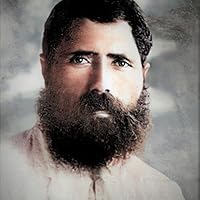
October 1, 2026
Kenan Orhan, a short story writer, makes his novel debut with The Renovation. Dilara, a child psychologist, fled Istanbul for the Italian village of Baronissi in 2017 with her husband and father. Her father, a novelist-professor, was dismissed from his post by the Turkish government of President Erdoğan. He has Alzheimer's disease, so the couple remodel a second bathroom. The builders deliver a cell from Silivri Prison, the Istanbul jail known for holding government critics, complete with a guard. Her anxious husband is due home by dinner.
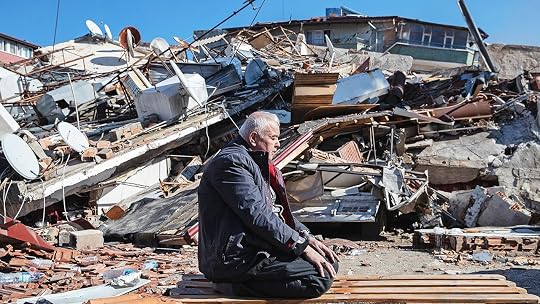
The cell is the novel's central absurd image. Dilara left Turkey. Turkey followed her into the bedroom. Inside, her homesickness gets served. Order coffee from her old Istanbul café. A cup appears. Carry the marzipan into the flat, the flavor goes first, then the sweetness.
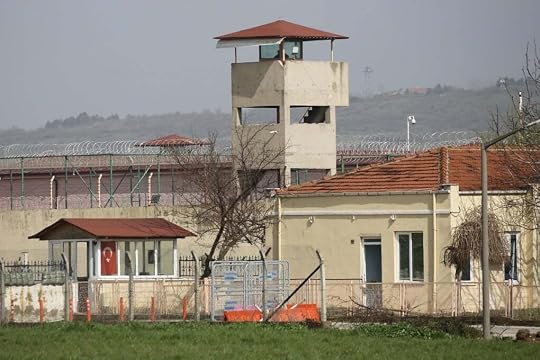
Orhan pairs this exile with a second loss. Dilara's father forgets words, then people. He calls her by her mother's name, since her mother died young. Dilara's own Turkish fails mid-sentence at the stove, and Italian, she notes, gave her few words for bad. Both lose a language, a self along with it.
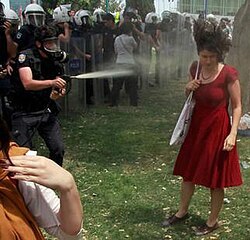
Memory gets its own test through two photographs. Dilara kept them as the last images of a family farewell dinner in Istanbul. On a recovered hard drive they show a crowded terrace, different strangers, a different light, so her recollection proves wrong. Then a printed copy seats her dead mother at the table.
Orhan lets the caregiver behave badly. Dilara sets her father's cane behind him, out of reach. She answers to her mother's name so he takes her for his wife, a mercy and a cruelty in one gesture.
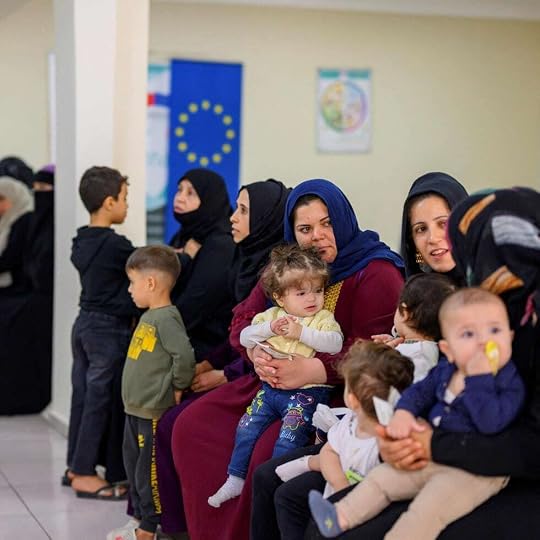
The Gezi Park protests of 2013, the failed coup of 2016, the 2023 earthquake in eastern Turkey and that year's election come as dated haunting briefings. The prison's supervisor explains that a prison needs cells before it has prisoners, so builders take space wherever they find it, even a bathroom in Italy.
One flat holds a father losing sentences alongside a daughter serving one. It is borderline brilliant, fitting for a book about borders. Orhan aims his best energy at what a passport fails to record, the exiled mind's loyalty to its old citizenship. Delight comes in small portions here, Turkish or otherwise.
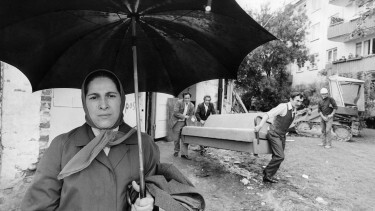
Borders move bodies while memory stays a resident. On a ski slope, Dilara sums up her host country in one sentence, "Italy is like a stepfather country." Her husband answers that a home and a homeland differ. The book lives in that difference. Italy hands her potato soup, a chairlift, a good afternoon. Adoption stops short of belonging. A stepfather can be kind. The surname still belongs to someone else.
Turkey dismissed more than 100,000 public employees by decree after July 2016. The UN refugee agency counts well over 100 million forcibly displaced people worldwide. Regimes confiscate careers. Nostalgia confiscates the remainder.

A tale that began as a short story in The Atlantic sometimes remembers its origins, restating its situation longer than it develops it. Yet somehow it manages to teach about The Turkish tragedy, tear your heart out, bring the plight of caregivers to the surface, and shine a light on migration and immigration from personal and societal perspectives. Quite remarkable.
[image error]
Kenan Orhan comes with credentials. His collection I Am My Country and Other Stories was a finalist for the PEN/Robert W. Bingham Prize, making him penultimate in the literal sense, and long-listed for the Story Prize, so he is long on lists. His fiction has appeared in The Atlantic, The Paris Review, The O. Henry Prize Stories and The Best American Short Stories. This novel shows a short story can grow long.

The novel indicts the tyrannical racist Erdoğan and the puppet government under him on a long docket. Dozens of citizens are sued daily for insulting the president, children questioned over chat-forum posts included. Twitter and news sites get shut down during protests. Police meet leftist demonstrators with tanks, tear gas, nightsticks, while ultranationalist mobs beat Kurds, burn Arab shops, then get dispersed. Elected Kurdish mayors are dismissed or arrested, then replaced with governor-appointed ones. A Kurdish grandmother is taken in as a terrorist sympathizer for speaking Kurdish, her granddaughter cuffed beside her.

Women serve time for remarks about prices or tomatoes. Turkey withdraws from the Istanbul Convention on domestic violence, judges systematically reduce sentences for domestic abuse, and the book cites a 1,400 percent rise in femicide across his first decade. A corruption scandal ends in a witch hunt, with hundreds of investigators, lawyers, judges, journalists arrested.
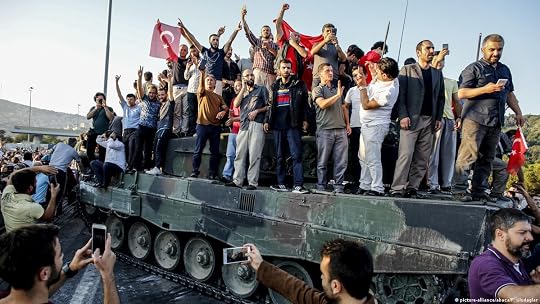
Gülen turns into a dog whistle for critics, degree holders, Kurds, communists, trans people, gay people, unmarried women. A university rector is installed by decree, a friend of the president's son-in-law. A referendum abolishes the prime minister's office, handing him the government too.
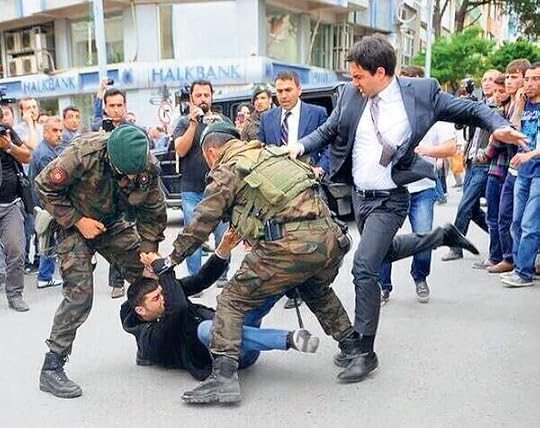
The dollar climbs from two lira to twenty-five. Contracts go to builders hiding safety violations. Soma and other mines pay for it. Bridges, squares, even three animal species get new names to erase Armenia and Kurdistan. He hails the attempted overthrow with "The coup is a gift from God," a phrase the book presents as his policy for two years. But that genocidal maniac has the nerve to demonize Israel. What a filthy set of individuals that allow this garbage to happen.

Dilara states the equation outright. After her father's public humiliation, she concludes that a man lacking memories belongs in a prison. Meals get served, medications get handed out, the yard offers exercise where wandering off is impossible. Minimum-security prisons, she decides, sit a step above hospice, with the same expectations of mistreatment, but free.
She then names prison's worst feature, monotony. Repetition stacks until it replaces the person inside, leaving a cell where a self stood. That fits the caregiver as well as the inmate. The same meal, the same question, the same cleanup, and Dilara's hours belong to someone else. Her bathroom cell makes the routine visible, with guards, a schedule, a recreation hour. She also plays warden, deciding what her father may believe about the world.
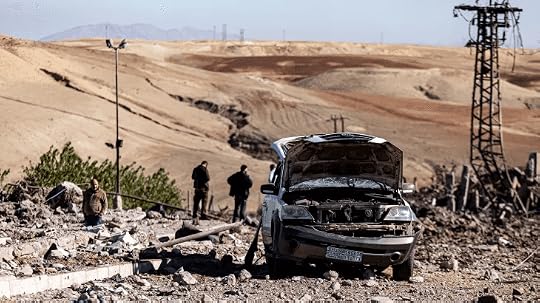
The political reading sits in the same room. The inmates are women jailed for remarking on food prices, for wondering how to afford tomatoes. An old inmate says elections bring the prisons new wings. Turkey under Erdoğan needs only a mood, so any woman could occupy those cells, Dilara included.
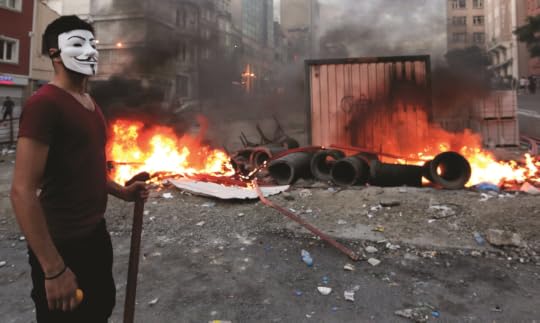
The two readings lock together on memory. Inside the cell she recalls her mother, her city, her friends with a bright click of certainty, yet the sense of it evaporates on the walk back to the flat. Nostalgia behaves like dementia, a sensation of remembering, hollow inside. Her father lives in a reality where his wife is alive and his country stayed loyal, so the disease grants him the amnesty the state withheld. Dilara draws the reverse sentence, perfect memory of what she lost.
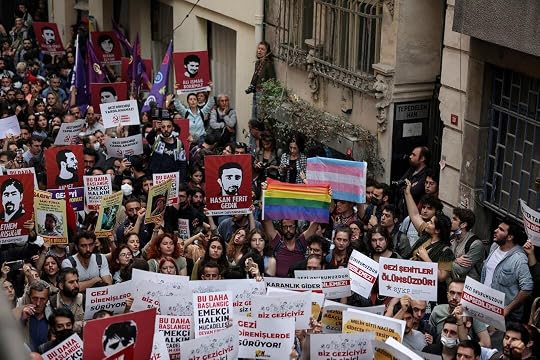
Both jailers share a method, erasure. Alzheimer's deletes the past from her father. The regime rewrites names and histories. Dilara stands between two forgettings, keeping records for both.
Hope completes the lock. She states, "Hope is a symptom of the strangeness of life," meaning it prolongs the torture. She staked hope on election after election ending exile. Hope also sabotages her nightly rehearsal of his death, since her mind drifts to tomorrow's lunch. Both sentences run indefinitely, term unset, trial skipped.
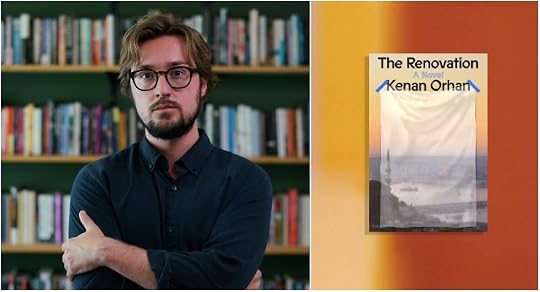
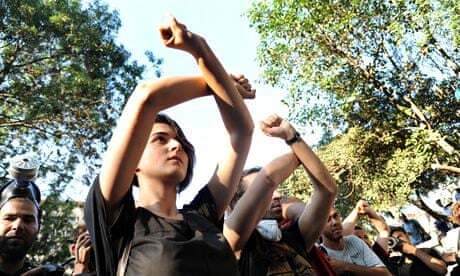
❤️ 🇮🇱
The cell is the novel's central absurd image. Dilara left Turkey. Turkey followed her into the bedroom. Inside, her homesickness gets served. Order coffee from her old Istanbul café. A cup appears. Carry the marzipan into the flat, the flavor goes first, then the sweetness.
Orhan pairs this exile with a second loss. Dilara's father forgets words, then people. He calls her by her mother's name, since her mother died young. Dilara's own Turkish fails mid-sentence at the stove, and Italian, she notes, gave her few words for bad. Both lose a language, a self along with it.
Memory gets its own test through two photographs. Dilara kept them as the last images of a family farewell dinner in Istanbul. On a recovered hard drive they show a crowded terrace, different strangers, a different light, so her recollection proves wrong. Then a printed copy seats her dead mother at the table.
Orhan lets the caregiver behave badly. Dilara sets her father's cane behind him, out of reach. She answers to her mother's name so he takes her for his wife, a mercy and a cruelty in one gesture.
The Gezi Park protests of 2013, the failed coup of 2016, the 2023 earthquake in eastern Turkey and that year's election come as dated haunting briefings. The prison's supervisor explains that a prison needs cells before it has prisoners, so builders take space wherever they find it, even a bathroom in Italy.
One flat holds a father losing sentences alongside a daughter serving one. It is borderline brilliant, fitting for a book about borders. Orhan aims his best energy at what a passport fails to record, the exiled mind's loyalty to its old citizenship. Delight comes in small portions here, Turkish or otherwise.
Borders move bodies while memory stays a resident. On a ski slope, Dilara sums up her host country in one sentence, "Italy is like a stepfather country." Her husband answers that a home and a homeland differ. The book lives in that difference. Italy hands her potato soup, a chairlift, a good afternoon. Adoption stops short of belonging. A stepfather can be kind. The surname still belongs to someone else.
Turkey dismissed more than 100,000 public employees by decree after July 2016. The UN refugee agency counts well over 100 million forcibly displaced people worldwide. Regimes confiscate careers. Nostalgia confiscates the remainder.
A tale that began as a short story in The Atlantic sometimes remembers its origins, restating its situation longer than it develops it. Yet somehow it manages to teach about The Turkish tragedy, tear your heart out, bring the plight of caregivers to the surface, and shine a light on migration and immigration from personal and societal perspectives. Quite remarkable.
[image error]
Kenan Orhan comes with credentials. His collection I Am My Country and Other Stories was a finalist for the PEN/Robert W. Bingham Prize, making him penultimate in the literal sense, and long-listed for the Story Prize, so he is long on lists. His fiction has appeared in The Atlantic, The Paris Review, The O. Henry Prize Stories and The Best American Short Stories. This novel shows a short story can grow long.
The novel indicts the tyrannical racist Erdoğan and the puppet government under him on a long docket. Dozens of citizens are sued daily for insulting the president, children questioned over chat-forum posts included. Twitter and news sites get shut down during protests. Police meet leftist demonstrators with tanks, tear gas, nightsticks, while ultranationalist mobs beat Kurds, burn Arab shops, then get dispersed. Elected Kurdish mayors are dismissed or arrested, then replaced with governor-appointed ones. A Kurdish grandmother is taken in as a terrorist sympathizer for speaking Kurdish, her granddaughter cuffed beside her.
Women serve time for remarks about prices or tomatoes. Turkey withdraws from the Istanbul Convention on domestic violence, judges systematically reduce sentences for domestic abuse, and the book cites a 1,400 percent rise in femicide across his first decade. A corruption scandal ends in a witch hunt, with hundreds of investigators, lawyers, judges, journalists arrested.
Gülen turns into a dog whistle for critics, degree holders, Kurds, communists, trans people, gay people, unmarried women. A university rector is installed by decree, a friend of the president's son-in-law. A referendum abolishes the prime minister's office, handing him the government too.
The dollar climbs from two lira to twenty-five. Contracts go to builders hiding safety violations. Soma and other mines pay for it. Bridges, squares, even three animal species get new names to erase Armenia and Kurdistan. He hails the attempted overthrow with "The coup is a gift from God," a phrase the book presents as his policy for two years. But that genocidal maniac has the nerve to demonize Israel. What a filthy set of individuals that allow this garbage to happen.
Dilara states the equation outright. After her father's public humiliation, she concludes that a man lacking memories belongs in a prison. Meals get served, medications get handed out, the yard offers exercise where wandering off is impossible. Minimum-security prisons, she decides, sit a step above hospice, with the same expectations of mistreatment, but free.
She then names prison's worst feature, monotony. Repetition stacks until it replaces the person inside, leaving a cell where a self stood. That fits the caregiver as well as the inmate. The same meal, the same question, the same cleanup, and Dilara's hours belong to someone else. Her bathroom cell makes the routine visible, with guards, a schedule, a recreation hour. She also plays warden, deciding what her father may believe about the world.
The political reading sits in the same room. The inmates are women jailed for remarking on food prices, for wondering how to afford tomatoes. An old inmate says elections bring the prisons new wings. Turkey under Erdoğan needs only a mood, so any woman could occupy those cells, Dilara included.
The two readings lock together on memory. Inside the cell she recalls her mother, her city, her friends with a bright click of certainty, yet the sense of it evaporates on the walk back to the flat. Nostalgia behaves like dementia, a sensation of remembering, hollow inside. Her father lives in a reality where his wife is alive and his country stayed loyal, so the disease grants him the amnesty the state withheld. Dilara draws the reverse sentence, perfect memory of what she lost.
Both jailers share a method, erasure. Alzheimer's deletes the past from her father. The regime rewrites names and histories. Dilara stands between two forgettings, keeping records for both.
Hope completes the lock. She states, "Hope is a symptom of the strangeness of life," meaning it prolongs the torture. She staked hope on election after election ending exile. Hope also sabotages her nightly rehearsal of his death, since her mind drifts to tomorrow's lunch. Both sentences run indefinitely, term unset, trial skipped.
❤️ 🇮🇱

February 14, 2026
4/4.5
Renovation is the debut novel by Kenan Orhan and gives us the story of Dilara, her husband and father. They have fled to Italy to escape Erdoğan's regime in Turkey. But Dilara cannot find work and soon finds herself beginning to become her father's carer as his memory loss descends into Alzheimer's.
In order to give her father more space Dilara and her husband remodel their apartment to give themselves a private bathroom but the builders are curiously secretive about the work until completion. As Dilara pulls back the curtain which has kept the bathroom under wraps she finds herself in a cell in a Turkish prison. She can move between the two countries with ease but how to explain this to her husband, who already fears they are being kept under surveillance.
Kenan Orhan's fascinating novel delves into the political situation in Turkey as well as dealing with Dilara's increasingly precarious personal life. It almost feels as though the erasure of Turkey's past as Erdoğan moulds the country in his own image, mirrors the loss of her father's memory and her own faulty recollections. The prison cell, which Dilara's husband fears becomes a refuge for Dilara as her father's disease progresses.
The premise of the novel is startling but doesn't go where I expected at all. Dilara could easily become a figure of pity but her natural resilience and ability to adapt make her a very sympathetic character, full of determination to survive.
I would definitely recommend this novel and am keen to read more by Orhan.
Thankyou to Netgalley and Farrar, Strauss and Giroux for the digital review copy.
Renovation is the debut novel by Kenan Orhan and gives us the story of Dilara, her husband and father. They have fled to Italy to escape Erdoğan's regime in Turkey. But Dilara cannot find work and soon finds herself beginning to become her father's carer as his memory loss descends into Alzheimer's.
In order to give her father more space Dilara and her husband remodel their apartment to give themselves a private bathroom but the builders are curiously secretive about the work until completion. As Dilara pulls back the curtain which has kept the bathroom under wraps she finds herself in a cell in a Turkish prison. She can move between the two countries with ease but how to explain this to her husband, who already fears they are being kept under surveillance.
Kenan Orhan's fascinating novel delves into the political situation in Turkey as well as dealing with Dilara's increasingly precarious personal life. It almost feels as though the erasure of Turkey's past as Erdoğan moulds the country in his own image, mirrors the loss of her father's memory and her own faulty recollections. The prison cell, which Dilara's husband fears becomes a refuge for Dilara as her father's disease progresses.
The premise of the novel is startling but doesn't go where I expected at all. Dilara could easily become a figure of pity but her natural resilience and ability to adapt make her a very sympathetic character, full of determination to survive.
I would definitely recommend this novel and am keen to read more by Orhan.
Thankyou to Netgalley and Farrar, Strauss and Giroux for the digital review copy.

August 8, 2026
3.5 stars
The detailed review I posted last week has disappeared from Goodreads.
The detailed review I posted last week has disappeared from Goodreads.
Displaying 1 - 30 of 746 reviews