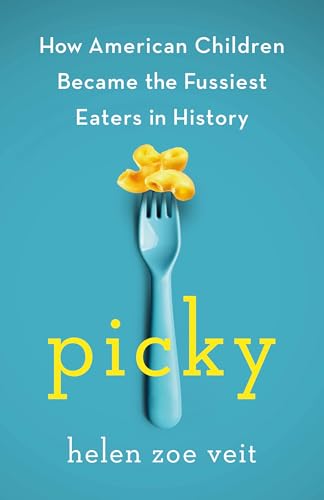
An eye-opening investigation into why American kids no longer eat broadly and with gusto
Are children naturally picky? It sure seems that way. Yet, amazingly, pickiness used to be almost nonexistent. Well into the 20th century, Americans saw children as joyful omnivores who were naturally curious and eager to eat. Of course, this doesn't make sense today. Don't kids have special taste buds? Aren't they highly sensitive to food's texture and color? Aren’t children incapable of liking “adult foods,” and don’t parents risk harming kids psychologically by urging them to eat?
But Americans in the past didn’t think any of those things. They assumed that children could enjoy the same foods as adults, and children almost always did. They loved spicy relishes, vinegary pickles, and bitter greens. They spent their allowances on raw oysters and looked forward to their daily coffee. So how did modern kids become such incredibly narrow eaters? The story is fascinating – and about much more than rising abundance. Picky shows how fussy eating came to define "children’s food" and reshape American diets at large. Maybe most importantly, it explains how we can still use the tools that parents used in the past to raise happy, healthy, wildly un-picky kids today.
Helen Zoe Veit is an award-winning historian and writer. An associate professor of history at Michigan State University, she is the director of the What America Ate and the America in the Kitchen projects, was an advisor for HBO's The Gilded Age, and is a former editor of Gastronomica. She is often cited in the New York Times, Washington Post, Wall Street Journal, and more. Her book Modern Food, Moral Food was a James Beard Award finalist, and her edited volume Food in the Civil War Era: The North won a Gourmand International award.
This is an exhaustive history of the dietary habits of children but there’s nothing here to help parents who struggle on a daily basis with picky children,
I have (now adult) children who have an adventurous healthy palate for a wide variety of foods. So why are my grandchildren Picky McPicky? I don’t know? I was hoping to glean helpful tips. But there’s nothing here that isn’t widely available with a quick google search.
If you are interested in the palates of children in previous generations, this is the book for you.
If you are looking for helpful tips, there’s nothing here that you can’t find in a Google search.
The last 50% of the book is a bibliography
I received a digital review copy via NetGalley All opinions are my own
The first thing you should know about this book is that it is a cultural history written by a historian. Viet is an expert in the history of food and its attendant social, and familial ramifications, with some detours into psychology. Veit has clearly done an enormous amount of research into what people have eaten, and how those practices and patterns have evolved over decades or even centuries. The first couple of chapters are just that: examples of foods eaten by people, largely in North America in the last century or so, but also include reports of diets in communities across the globe. Veit’s premise is that in the nineteenth and early twentieth century, kids ate exactly what their parents ate. They loved vegetables. They drank coffee. They loved spicy, heavily salted or preserved foods. They ate what was on the table and they liked it. There was no pickiness.
Then, enter the “experts” – the quotation marks are Veit’s. In an era lacking antibiotics or other effective medications, many children (and adults) died of a variety of diseases. Some children, notably indigenous, minority, or immigrant children, faced poverty and insufficient nutrition. “Nutrition scientists” (again, Veit’s quote marks) began to explore the benefit or dangers of diet. Nursing a sick child seemed to demand special foods: bland, mild foods that would not upset a child’s “delicate digestion,” or “strengthening” foods like liver or meat broths. Children’s digestive systems were seen to be special, different from adults. Nuts and fiber were said to be dangerous; whole grains would “disarrange” a child’s intestines. Vegetables should be boiled into mush. Granted, much of this advice was wrong-headed, so many of these experts deserved Veit’s scare quotes. By the 1930s, parents were subject to an onslaught of advice, warnings, recommendations, and rules about what their kids should eat, how much and when. I especially loved a recommended children’s menu comprising Creamed Calves Brains on Toast, Stuffed Prune Salad, Lima Bean Casserole, Red-Hot Bananas, and Liver-Paste Sandwiches. I couldn’t resist checking the reference on that, which curiously cited an article by Dr. Morris Fishbein (among others), head of the American Medical Association, which said nothing at all about these delicious recipes. Hmm.
There is actually a wealth of fascinating material in subsequent chapters, covering the pressure placed on parents regarding what to feed their kids. One small 2-year study of motherless children living in a hospital for two years laid out an array of fruits, vegetables, whole grains, meats raw and cooked, and let them free feed entirely independently. They ate everything. They thrived. One boy ate liver for breakfast every day, till he got tired of it and switched to something else. The media went wild, shouting that this proved that you should should let your kids eat whatever they wanted and it would be fine… ignoring the fact that the foods offered were all wholesome, healthful choices. So yes, they did well.
On to the 1950s, with the appearance of Dr. Spock and his gentler, more permissive, friendly advice. A convinced Freudian, he urged that forcing a reluctant child to eat something she did not like was cruel and could cause deep psychological damage. What were anxious parents (read: mothers) to do? The advice was pouring in from all sides, and if you didn’t make sure your child ate the right foods in the right way, you were a lousy parent and might be damaging your child irreparably.
Enter the sea change in food availability and marketing. With technological progress, most families had refrigerators and convenient stoves and ovens. Foods that had been limited to certain regions or seasons were now available year round and locally. Choices exploded in expanding grocery stores. Kids were towed along the aisles of A&P. And the marketers starting adding sugars, salt, preservatives, and cartoon characters on the labeling. “Mom! Buy me THAT cereal!” And a whole new wave of “kid foods” poured across the country.
And so, here we are. So many choices, many of them less than healthy. If a kid refused the veggies on the dinner table, he’d be offered snacks to tide him over till morning. If he didn’t like a particular food, it would vanish from the repertoire – he won! As one boy put it: “If I don’t like what Mom buys, she has to eat it herself.”
Veit concludes that the appropriate response to a picky child is to repeatedly offer a disliked food, to the extent of “popping it right into the child’s mouth” until the child “learns to like it.” She believes any kid can be taught to like pretty much anything: witness the huge variety of foods kids scarfed down and loved in the last century. She makes no mention at all of children with developmental disorders, such as autism. Her sources lean heavily on newspaper and magazine articles, historical documents, letters, cookbooks – and comparatively few actual medical studies, while she frequently mentions a lack of studies to support ideas that she criticizes. A cursory search of PubMed (“picky and (eating or eaters)” in article titles) produced nearly two hundred articles, delving into nutritional, health status, management, psychological and developmental aspects of the picky eater. It is not clear that Veit has examined this literature in as much depth as the problem warrants. In this day of scientific evidence being all too readily dismissed or challenged, her final advice in the epilogue is troubling. While there is much to admire in the detailed presentation of the effects of history, culture, society, and corporate and technological developments on the issue of food aversions and picky eating in today’s children, this book is not one that offers much in the way of recommendations to worried parents of those kids. Conversations with knowledgeable pediatricians, psychologists, and nutrition specialists would be an essential addition for those concerned parents.
I thank NetGalley for an ARC of this book in exchange for an honest review.
I don’t have kids, but I have four nephews ages 8 to 20, and I’ve seen picky eating firsthand…..especially with the youngest. He’s pushed every boundary when it comes to food, which is what led me to Picky.
This book offers a surprising look at the history of children’s eating habits. It turns out kids used to enjoy all kinds of bold flavors, and picky eating wasn’t seen as normal. Picky explains how that changed and why.
What I liked most is that the book is thoughtful, not judgmental. It shows that picky eating isn’t just something we have to accept—it’s something we can influence. Even as an aunt, I found it helpful and eye-opening.
I’d recommend Picky to parents, teachers, and anyone who spends time with kids. It’s a smart, engaging read that gives real hope for raising curious eaters.
A huge thanks to NetGalley, the author & the publisher for the opportunity to read this advanced copy! It was very enlightening!
As I read this book, I considered does the research make sense and does it explain why I am a lifelong picky eater? The book is well researched and well sourced. It is thorough and accessible. It is not jargony or « too academic » and it is easy to follow. The conclusions made common sense and I appreciated the thoughtful analysis. I struggled when trying to see myself in the cultural context presented here. Primarily, except for the end, her view is from a population perspective, as in why is there a generation of picky eaters in the United States? From that perspective, it is very well done. Yet I still wonder why so many of my peers who were young children in the seventies have memories of the table as a battleground and how this dynamic contributed to pickiness? As a picky eater, I seriously dislike certain foods and have never « learned » to like them, as the author suggests is possible, seemingly in a universal way. I would suggest then that this is the flaw in her book. That is, trying to take this cultural perspective and apply it to individual child feeding practices for today’s parents. I’m still giving it four stars because I learned new things and it made me think. Thanks to the author, the publisher St Martin’s Press and #NetGalley for the advanced copy in exchange for an honest review.
I really enjoyed this book! I was expecting a simple history of highly processed foods taking over our food systems, and while that’s part of the story, there’s a lot more to it.
If you’re looking for a guide on how to address food pickiness this is not the book. Rather, the book is a historical account of the events that resulted in mass pickiness. Even though the author gives advice for addressing pickiness in the final chapter, I think the book makes clear that this is a systemic problem that will need systemic responses. The first step to responding, though, is understanding how we got here. And this book does accomplish that!
Did this book make me, the mother of a not-even-six-month-old, feel like an authority on picky eating and how to avoid it? Yes. Did it discuss what to do with a child who is already picky or who declares they dislike a food to any level of satisfaction or helpfulness? It did not. Did I feel like my parents had done much of what was described in the book as strategies to avoid picky eaters and I still hate summer squash with a passion? Yes.
I enjoyed the historical elements. Extremely repetitive book. I was thankful when I realized that the last half of the book was notes and sources and such because by the end there were zero new thoughts being shared.
Definitely my genre. I enjoyed this one. Would recommend.
This was an exhaustive historical exploration of how children were weaned and expected to eat through time and what cultural shifts changed all that. It was all very intuitive and almost obvious, but to get the confirmation from this highly-sourced and researched book really helped drive home the point. I think all parents who are weaning or have young children should read this to remind ourselves how humans and families lived before we let capitalism and marketing take over. It was easy and had a logical flow, a great read. Thank you NetGalley for the ARC; these opinions are completely my own.
I found the premise of Picky to be very intriguing but the execution landed at 3 stars for me. This was a very well researched book however it started to feel very repetitive after a while. Lots of restating of the fact that children used to "eat whatever their parents ate" and that recent generations of children have drifted far away from that. I believe the book would have been improved with more personal narrative inserted in to break up the factual information.
Thank you to NetGalley and St. Martin's Press for the advanced copy. Picky hits shelves on February 24, 2026.
I guess this book really was a history of how America’s children became picky, but I was hoping for a little bit more on how to address it. There were some good things at the end, but felt so fast!
4.5 stars. This is about a niche history - childhood eating in America. I found it captivating. It is less a directive to modern parents about how to "cure" their picky eaters, though the epilogue does cover some of this information.
I do wish the book had addressed how parents might approach eating with autistic children and how picky children have now grown up to be picky adults who are now responsible for introducing their children to a wide variety of foods so they won't be picky children.
The author narrates the audiobook and does a fantastic job. I found this audiobook easy listening as I prepped my non-picky dinner.
A lot of interesting information and historical perspective on the phenomenon of kids who are picky eaters. Great research into the history of children's eating habits. Interesting presentations of the process by which Dr. Spock came upon his ideas, and how they changed over time. I saw this author on the PBS Newshour and her summary on the segment pretty much summed up the entire book. You can watch that interview here:
This book taps into conversations I have had with friends over the past years regarding the phenomenon of the"kids menu" that we have now. When I was young (granted, a long time ago) the children's menu was just smaller portions of the full menu, it didn't consist of entirely different offerings.
If you are interested in this history of feeding children you will get something out of this book. It is a good bus book.
I read this book being a picky eater myself and knowing so many people who have picky eaters in their family.
The book is pretty much only a historical understanding of American food and eating habits for children from the 1850s to around the 1980s.
I was hoping I guess for more than just a history lesson. More on this later. Focusing on the historical and research for the book - it is extremely thorough. Only 47% of this book is the part written by Veit. The last half of the book is all the sources. Theres over 750 sources in the roughly 150 pages of content.
Let that sink in. Where are the theories and opinions of Veit? Completely missing other than a few intro and ending paragraphs. The only parts not sourced are repeated facts from the earlier chapters.
It’s like Veit didn’t think we read an earlier chapter and completely rehashes the same points over and over. It was a little comical because it would be a turn of a page and I’m reading another chapter but the same summary. I had to laugh through the exact same reiterations to make it through them.
And the sources? Overwhelming anecdotal. My personal opinion is the weakest of arguments. But the book relies heavily on hundreds of people reflecting on what they loved as a kid, mother’s viewpoints on cooking, even commercial ads and how people interpreted them.
It’s not that it’s not valid or even weak evidence but it just felt a little boring and lacks a strong voice from Veit to guide these sources into new a thought provoking insights from her.
I also found there to be this underlying tone maybe it was urgency but it rubbed me the wrong way. I appreciated the note not blaming parents exclusively but I also feel like the tone didn’t represent this attitude. Again maybe it’s because we don’t have a clear voice for Veit in places you’d want empathy we just get another source of data. It’s tonally cold and devoid of a clear voice that could take a softer approach especially to some of the sad concepts like how terrible these mothers must feel or any empathy at all for the obesity epidemic.
I also felt overwhelmed by all the sources I definitely did not click on all of them to see (my copy is a e-book that has a sources you can click on to see which is how I know how many pages were sources as they are all at the end) I am not use if the physical books have footnotes or not but 750 footnotes to read or even sources to flip to back and forth is just way too much. Even half the sources would have delivered the same effect. The key thing missing again is a strong viewpoint from Veit and without that the sources lose their punch. I mean realistically anyone could just reach the source material and it wouldn’t be much different then how the book is compiled.
And because it’s so dense it took me a long time to finish.
I was really shocked how the book pretty much cuts off at the early 90s. Theres some more modern stuff in there but there’s no mention of current day issues so applying any suggestions she made however short is hard to do.
Things not discussed - social media, the two income households / single parent households, the rise of neurodiversity especially Autism. The psychology fields that are for things like disordered eating in children including things like ARFID, and the more modern technology in kitchens.
I feel like missing those and I’m sure even more relevant topics really hurts the book because what drives us past what the underlying issues are? How do parents who already have kids ingrained in the social structure of food can really overcome it (is it really just denying meals and not having processed food and removing snacking all there can be as solutions?)
I was curious about cooking trends - do families still make different meal offerings for each member? How many parents rely on processed foods for dinner? Has new technology like air fryers, instapots, convection microwaves, dehydrators, freeze drying affect anything like the technology affected the 1950s and later? How does food scarcity today impact children and what does it even look like vs the past?
Overall I did learn new things which is always good and like I said the book is strongly researched. I just didn’t connect with it and feel like I can’t take what the book shared and apply it or even talk about with others as it is so hyper specific. I just don’t think parents will read this and it will be something that changes the problems we are faced with. And maybe it’s unfair to go in thinking this book will have tools and resources when it’s really just a history book. But then I’m not sure the target audience because if doesn’t seem like it was me.
That being said if you like American history or anecdotal commentary this is more a book for you. If you are a parent of picky eaters or planning to have kids and are worried I just don’t think this will offer a lot of help. There’s some insight we can glean from history but overwhelmingly the issues we face are bigger than one housefodk can remediate.
Thankful for a copy from NetGalley and St Martins Press for an advance copy.
This was a really interesting look at what picky eating is, and where it originated a concept. I found the sections about what was considered a proper diet (no raw vegetables?) in the past to be really cool. Also, as a daily pot of coffee drinker, I was relieved to know that it probably won’t stunt my son’s growth if he gets his hands on some.
Honestly, it was fine. Heads up that this reads a lot more like a dissertation or thesis (granted, a very good one) than a book to easily glean tips from.
I was disappointed that we didn't get actionable advice throughout the book about how to counter pickiness in our kids today until the literal epilogue. And even then, it was BRIEF.
As a parent currently introducing solids to her 6 month old, I have to say I was disappointed. If you're interested in the straight up history of picky eating overtime, this is a great and very well researched read. If you, like me, were looking for more general background info on how we got to pickiness culture and then an emphasis on what we can do to correct it in our kids today, I would have to recommend skipping this one.
Thank you to Netgalley and St. Martins Press for access to this advanced copy in exchange for my honest review!
One day, I put it down and then I never picked it up again. I’ve seen a couple other reviews mentioned that it’s an “exhaustive history of…” I guess exhaustive is the right word. I think several chapters could’ve been summed up with “kids ate everything“. As mum to one severely autistic child – who actually eats really well, and one ‘typical’ child, who is a super picky eater, I suppose I was looking for some insight. And maybe there is some in the book, but I just could not get past the, well, ‘exhaustive’ list of foods.
One of my top goals as a parent was to not raise a picky eater. I was aware that kids had become ahistorically picky as of late, and I had seen firsthand what a pain that can be. So we established some rules at a young age: Our daughter will eat what we eat at every meal (with reasonable adjustments) and we won't be offering alternative meals. When my daughter entered preschool, one of the teachers pulled me aside to let me know that my daughter was, in her words, "The best eater of her age that I've ever seen".
At the time I took this solely as a compliment to my incredible parenting skills, and I suppose I deserve SOME level of credit. But what I didn't know at the time was that she was also speaking to just how bad pickiness has become with Kids These Days.
I was a picky eater myself, and grew up around plenty of others like me. Also, like others around me, I grew out of it. Some of the things I've seen since becoming a parent in my daughters peers that are totally foreign to what I experienced growing up are things like: Only eating four or five different foods; Only eating specific foods from specific fast food restaurants (Plain Cheese Pizza is okay from Chain A but not Chain B, for instance); Literal gagging and vomiting when being asked to try a new fruit or vegetable. Not in outstanding cases, but among MANY of her peers. But the thing that disturbs me the most is seeing how so many of these kids simply don't seem to get any PLEASURE from eating even the foods they supposedly enjoy!
So, when I saw this book that acknowledged how bad things have become and purports to show how we ended up here, I scooped it right off of the library shelf. Some of what the author outlines are things I've already witnessed: Parents becoming short-order cooks and making separate meals for their children, vegetables being served in an unappealing manner, kids showing up to the dinner table already full from snacking all afternoon. But it also challenged some of the wrongheaded preconceived notions I had about eating (turns out childrens taste buds are pretty-much exactly the same as ours).
As other reviewers have noted, if you're looking for solutions, you might just skip to the Epilogue. But if you do, you'll be missing out on a very entertaining ride through the history of childrens eating habits and how they devolved into what we have now.
Every parent tasked with feeding a child should read this book. Understanding how ideas about children and food have evolved over the last 100 years reveals that how children eat is culturally determined.
So many things that I accepted as true and have parroted without thinking turn out to be based on just Dr. Spock vibes or misinterpreted studies. For example, “toddlers are evolutionarily picky because they needed to not eat dangerous things in the forest” is not based on any historical or scientific evidence. In fact, children needed to be willing to eat broadly and enthusiastically because pre-agricultural revolution, they were eating mostly foraged greens and grains that are MUCH more bitter and unpalatable than what we eat today. Basically, marketers have convinced us that children needed special food, so we’ll buy whatever it is they’re selling. Children’s food is an invention. We perpetuate pickiness by 1) giving kids hyper palatable processed food, which renders more wholesome food less tasty in comparison, 2) allowing them to snack between meals so they do not come to the table with a hearty appetite, and 3) offering alternatives to the family meal.
The author does not present any revolutionary quick fixes, this is a history book after all, but in the epilogue she does charge parents with teaching their children to not just eat, but ENJOY family foods. She suggests rejecting convenience foods, limiting snacking, and not offering other foods if a child initially rejects the family food. The author encourages parents to trust themselves. We wouldn’t allow a child to not brush their teeth or wear pants, she argues. Instead, we teach them to do it. The same is true with food.
Knowing my history here will inform my attitudes around the dinner table moving forward.
I received an advanced copy of this book from NetGalley and the publisher
Food and science/medicine historian Helen Veit is back with intriguing information about cuisine and culture. This time, she tackles “picky” eating and the rise of the “children’s menu”. Veit uses an array of rich, historical materials (including articles from 19th century newspapers and books) to support the notion that picky eating is not natural and that it became a societal phenomenon during the second half of the 20th century.
The first part of the book delves into the lives of children in the United States during the 19th and 20th centuries and what they ate. Children from assorted backgrounds describe their favorite meals and treats, many we could not imagine children enjoying today. Their delicacies ranged from snails, bean soups, and brined vegetables to full glasses of buttermilk. The interviewee’s descriptions are so passionate, the reader might find their mouth water.
Taking readers into the 20th century, Veit notes how an abundance of poor advice from psychologists, some based on little to no evidence of their findings, changed how the growing middle class purchased and consumed food. The idea that children should dictate mealtime surfaced. Cartoons on cereal boxes full of prizes and TV advertisements, cleverly directed towards children, nod to this concept. Pairing addictive TV jingles with the explosion of mass-produced food (teeming with sugar and preservatives of dubious quality) and increased snacking between meals has severely narrowed children’s palettes. Veit also shares research that reveals how pickiness possibly correlates to the escalating obesity rate in the United States, something unimaginable 100 years ago. Veit brilliantly argues that what we have learned about pickiness is mainly a myth and that children can learn how to eat like adults, as they have for several millennia.
Veit concludes the book with suggestions for parents to consider during mealtimes. Tips include reducing unnecessary snacking, limiting exposure to food advertising, discussing nutrition with children, and not giving up! Just because a child might not like an ingredient in one dish does not mean they will reject it in another dish. Veit stresses that this countercultural outlook is not cruel and ultimately reduces waste while increasing satisfaction during mealtime.
Veit brilliantly ties archival findings with modern data to provide information we need more than ever. Parents looking to expand their children’s tastes and those concerned about current food quality will find great insight.
Okay I found the many pages of this book interesting!
I loved fitting US children feeding practices into the historical contexts: Child mortality, World War 2, the rise of Freud, home televisions and modern grocery stores. I loved hearing old favorite childhood foods and records of eating practices from early America! It's been a great topic of conversation for all my friends and coworkers.
Now the objections:
I cannot understand how a person can write a book about children food in the United States and touch on so many aspects of food culture more generally and COMPLETELY avoid the question of dieting and fatphobia. Imagine talking about the 1940- today and not mentioning the impacts on children of diet culture? Obesity was mentioned only a handful of times as concerning impacts on children being allowed to choose their own meals.
Also eating disorders were framed as a modern invention?? In reaction to modern food habits?? And rare in ancient days... And this was sort of quickly packed together with obesity and blamed on "modern food permissiveness of parents"...
Also if you're not going to really TACKLE DOWN the industrial food complex and capitalism as insane forces in this conversation about feeding... Well then I am not entirely sure you belong in this arena.
All around just great to read a smart book written by a smart woman with whom you disagree about some things. A healthy practice and I have no regrets! Nice to hear my brain churn and munch.
Finally a small note: it's gets very repetitive by the end. I kept thinking I was accidentally rereading past chapters!!
I may have misinterpreted the blurb from this book so while I did learn a lot from this, it was definitely more research and history forward than practical applications regarding picky kids which is what I was hoping for.
The amount of research this author did is clear, but at times this definitely read like a research paper or scholarly article because of the constant quotes/references from works the author researched. I don’t mind some history and it think that gives a good base for any topic but I would have loved a larger section at the end with practical advice for how to avoid a picky eater in current time, not just explaining how we got to this point. I feel like a lot of things that currently effect diets for Americans (ie. the obstacles to healthier and more diverse diets) could have been discussed more in depth over the history lesson, but again that could have been because I went into this expecting something more along those lines.
This was very interesting! The history of American children’s eating habits and how we culturally shifted to individualized children’s meals and menus was fascinating (and also infuriating because of course, capitalism). The level of detail of the author’s research was impressive, though at times a bit excessive. I’d recommend to those who don’t mind when almost half the book is the author’s works cited, but probably not for parents who are sleep deprived and just want their kids to eat a green bean before they pull their hair out.
Thank you to NetGalley and St. Martin’s Press for the ARC!
Wow liked this so much. Extensively researched and gives the context for where we are now. Don’t have kids but enjoyed it a lot anyways. I liked how she brought in primary sources so much to show how dramatically things have changed in America and increasingly around the world. I’ve watched this firsthand in the U.S. but also seen it in Indonesian small villages where mothers complain that their kids only want snack foods and are rejecting rice. Really fascinating
This was an interesting Historical analysis on why children eat the way they do today. Much of it is common sense, but I enjoyed listening to the historical context and examples of what children ate pre-20th century. This is not a parenting book because it doesn't offer advice for how to get your kids off the beige diet, but I found it Fascinating and Informative nonetheless.
This book was interesting enough but sort of basic. I was hoping for some tips about how to treat pickiness but they are not in this book. Good audiobook.
Probably a good intro to the topic. I thought it started slow...and then just when it gets more interesting it's over. I would be interested in reading more from Veit though.