

What do you think?
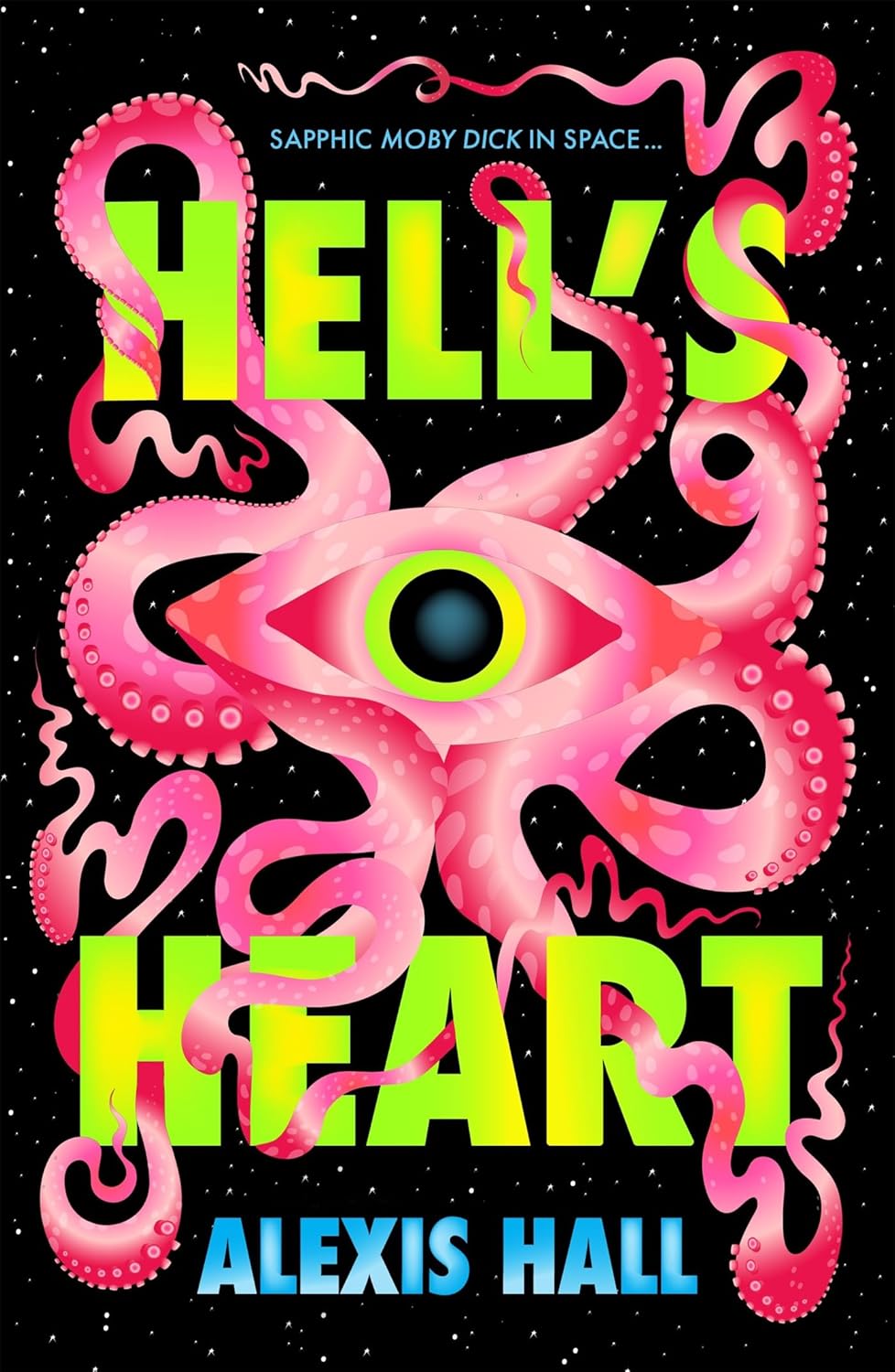
Hell's Heart
Gideon the Ninth meets Moby Dick in USA Today bestselling author Alexis Hall's science fiction debut, Hell's Heart!
Earth is a ruin, and the scattered remnants of humanity scavenge what they can from the stars under the watchful auspices of a grab-bag of collectives, corporations, and churches which are all that remains of what we once called society. Having long exhausted any conventional sources of energy, life in the solar system is now sustained by a volatile, hallucinogenic substance called spermaceti, which is harvested from the brains of vast cetacean-like Leviathans that swim the atmospheric currents of Jupiter.
Finding herself with no money and little to occupy her groundside, the narrator (“I”) takes a commission aboard the hunter-barque Pequod as it sets out in pursuit of precious spermaceti. Once aboard, however, she finds herself pulled inexorably into the orbit of the barque’s captain, a charismatic but fanatically driven woman who the narrator names only as “A”. As the Pequod plunges ever deeper into the turbulent, monster-haunted atmosphere of the gas giant, the narrator begins to lose herself in the eerie word of Leviathan-hunting and the captain’s increasingly insistent delusions; the only thing that might keep her grounded is the bond she develops with Q, a woman from the wreck of Old Earth whose skin is marked with holographic light and who remembers things otherwise lost.
At the Publisher's request, this title is being sold without Digital Rights Management Software (DRM) applied.
Earth is a ruin, and the scattered remnants of humanity scavenge what they can from the stars under the watchful auspices of a grab-bag of collectives, corporations, and churches which are all that remains of what we once called society. Having long exhausted any conventional sources of energy, life in the solar system is now sustained by a volatile, hallucinogenic substance called spermaceti, which is harvested from the brains of vast cetacean-like Leviathans that swim the atmospheric currents of Jupiter.
Finding herself with no money and little to occupy her groundside, the narrator (“I”) takes a commission aboard the hunter-barque Pequod as it sets out in pursuit of precious spermaceti. Once aboard, however, she finds herself pulled inexorably into the orbit of the barque’s captain, a charismatic but fanatically driven woman who the narrator names only as “A”. As the Pequod plunges ever deeper into the turbulent, monster-haunted atmosphere of the gas giant, the narrator begins to lose herself in the eerie word of Leviathan-hunting and the captain’s increasingly insistent delusions; the only thing that might keep her grounded is the bond she develops with Q, a woman from the wreck of Old Earth whose skin is marked with holographic light and who remembers things otherwise lost.
At the Publisher's request, this title is being sold without Digital Rights Management Software (DRM) applied.
453 pages, Hardcover
First published March 10, 2026
About the author
Alexis Hall
62 books15.7k followersOne of those intricate British queers.
Please note: I don’t read / reply to DMs. If you would like to get in touch, the best way is via email which you can find in the contact section on my website <3
Please note: I don’t read / reply to DMs. If you would like to get in touch, the best way is via email which you can find in the contact section on my website <3
Ratings & Reviews
Friends & Following
Create a free account to discover what your friends think of this book!
Community Reviews
Displaying 1 - 30 of 922 reviews

August 24, 2026
"Something funny?"When Earth has been plundered for every available resource and the remaining people live scattered across the sky, there is only one thing worthwhile to do among the cosmos.
"Fools and mad folks go to the hunt."
Whale hunting.
While not exactly part of the Earth-bound whale species, the Leviathans living amongst Jupiter's ever swirling gaseous clouds do contain an essential ingredient, which when refined enough, allows for humans to access power for their ships, cities, and colonized worlds.
"She was bone white ... Whatever visionary, whatever dreamer, whatever force of incarnate chaos had designed this ship ... took away all my breath..."
But a three year journey is quite the commitment, and early on, the main character realizes that the captain is a bit...out there. She keeps talking about hunting down the Mobious Beast - a mysteriously white Leviathan who is known for its violence.
Surely...nothing could go wrong, right?
Ahhh...I'm a bit torn. Cause on the one hand, I really like most of Alexis Hall's books and one thing I appreciate about their writing is that I never know what genre I'll get. Very prolific, very diverse.
On the other hand, Moby Dick is was always going to be a hard sell...even if you throw in a ton of lesbians in space.
Ultimately, this one just didn't work for me.
I will say, I did enjoy the way Hall unveiled the worldbuilding - the parallels between society, religion, and relationships between now and their futuristic society was really interesting to me.
I liked learning about how the religion splintered and fractioned, and how the interpretations feel like offshoots of our current society's but magnified.
And the narrative structure was interesting - very stream of conscious but I kinda liked it.
However, I just really struggled to connect to the story on a whole, in part because of the pacing and the detached sex.
I've tried to read the original Moby Dick twice...and failed both times. And while I thought I could do better with a book based on the original classic novel...It was still a very...very...long story.
This book crammed 3 years worth of events (which honestly were mostly like: we floated around, didn't find something, woohoo killed something, then we floated around) into a single story. And it just kinda got a bit boring to me.
And there was a lot of sex - but not the sexy-sex if that makes sense.
The main character gets around, which is fine, you do you...but I just don't really click with books where there's not a lot (if any) emotional connection between the characters.
So, to me, the sex scenes felt bland and detached, which kept me from becoming invested in the story.
Ultimately, I do appreciate the worldbuilding and the way Alexis Hall is always trying something new, but I think I'll pass if there's going to be a sequel.

June 10, 2026
The thing with horny scifi books is that I really like to read them from time to time but wouldn't exactly recommend them to anyone, and that also happened with this sapphic Moby Dick retelling set in space. I'm actually quite illiterate when it comes to classics, but from what I've read in a summary of the original, Hell's Heart takes the same characters and follows the plot pretty neatly. Alexis Hall just makes everyone queer and has them constantly sleeping with each other, and the watership becomes a spaceship and the whale becomes an alien abomination from hell. Instead of taking place sometime in the 1800s, the story feels futuristic and by that I don't mean the shiny-and-superior way but the dystopian-and-run-down way. Humans may have traveled and settled beyond planet Earth, but now they are just suffering on multiple planets instead of one. So if you are perpetually broke and out of options like the unnamed narrator of the story, you might as well sign up for the dangerous job of leviathan hunting. It might kill you, but at least you don't have to worry about homelessness for the time of the voyage. It's the crew's job to hunt leviathans for their sperm (don't ask, it's some kind of energy source or whatever) and the captain is unhealthily obsessed with that one enormous beast that bit her leg off. It's a long journey and while the crew was confronted with weird apocalypse cults, alien porn, space pirates and one or two mutinies, the story was really dragging. The narrator's tone is snarky, dark and horny and I loved the whole mess that she was, but she also randomly started getting lost in biological or technical details that no one really asked for. And that didn't help with the pacing either. I never felt like there was any progress, because many chapters were just about her getting fingered by various women. Then there were constant sperm jokes and this whole chapter about leviathan dicks, and I don't know what to tell you, but I also kinda loved it. I think it worked for me, because the book is very aware of its strangeness and addresses all of its flaws directly. Every criticism more or less just dissolved for me because of that. The writing is messy? Well yes, it's the memoir of a deeply fucked-up person and sometimes it's important to her that the reader has all the necessary information so she adds all the details and she really is trying her best to put events in the right order, ok? Your complaint is that the whole book is basically just about fucking and killing? I think it literally says so on the page. Stop it with the sperm jokes? The narrator tries, but it's not her fault that this valuable substance is called spermaceti. So many things just made sense to me as I kept reading. And by that I don't mean that I'm better than everyone, but that I think that I got the author's vision and I'm really happy about it. At the same time it's really not a book that I would recommend to anyone, because I can totally understand the low average rating and the negative reviews. It really is its own thing entirely and if you don't catch the right vibe, you will easily hate it. Consider me surprised that I'm not a hater this time.
Huge thanks to NetGalley and Pan Macmillan / Tor for providing a digital arc in exchange for an honest review.
Huge thanks to NetGalley and Pan Macmillan / Tor for providing a digital arc in exchange for an honest review.

Review of advance copy received from Netgalley
Thank you to NetGalley and Tor for this e-ARC. Unfortunately, it’s going to be a soft dnf @ 30% (ch 25.) I say soft dnf because I was really looking forward to this book and might try the audiobook after release.
(( Update: the audiobook did not save it. Moby Dick isn’t exactly a fast paced book, but this is just…not good. I am incredibly disappointed. The characters aren’t just uninteresting, but are also incredibly annoying. The plot details are all shared though infodumps. The one positive I can give it is that it is giving the promised amount of sapphic, but in the worst possible way. ))
I do not like this main character. Moreover, I feel like I’ve read this same exact character a million times and I haven’t enjoyed it once. She genuinely has zero personality outside of attempts at quirky, wry humor and sex. Not that actual Moby Dick is a fast paced novel, but I am 25 chapters in and nothing has happened. You’re writing sapphic Moby Dick in space? Slay that’s all I want, but by chapter 25 I had better care about the characters or the setting enough to want to hold out for the plot. I genuinely do not care about any of these people except maybe Q, and even then, she’s just not enough to keep me going. I cannot handle another almost 300 pages of tongue-in-cheek humor that repeatedly misses paired with insane info dumps. Don’t get me excited about a Gideon the Ninth comp if you’re not going to give me Gideon the Ninth quality I’m not emotionally stable enough for that with the Alecto release nowhere in sight.
(( Update: the audiobook did not save it. Moby Dick isn’t exactly a fast paced book, but this is just…not good. I am incredibly disappointed. The characters aren’t just uninteresting, but are also incredibly annoying. The plot details are all shared though infodumps. The one positive I can give it is that it is giving the promised amount of sapphic, but in the worst possible way. ))
I do not like this main character. Moreover, I feel like I’ve read this same exact character a million times and I haven’t enjoyed it once. She genuinely has zero personality outside of attempts at quirky, wry humor and sex. Not that actual Moby Dick is a fast paced novel, but I am 25 chapters in and nothing has happened. You’re writing sapphic Moby Dick in space? Slay that’s all I want, but by chapter 25 I had better care about the characters or the setting enough to want to hold out for the plot. I genuinely do not care about any of these people except maybe Q, and even then, she’s just not enough to keep me going. I cannot handle another almost 300 pages of tongue-in-cheek humor that repeatedly misses paired with insane info dumps. Don’t get me excited about a Gideon the Ninth comp if you’re not going to give me Gideon the Ninth quality I’m not emotionally stable enough for that with the Alecto release nowhere in sight.

Did Not Finish
January 11, 2026DNF @ 21%: This is all over the place, random women keep fingering her and I can't be bothered reading infodumps about whales. I'm literally so bored.

January 31, 2026
Hell’s Heart by Alexis Hall is a queer space opera retelling of Moby Dick. The narrator, named I, boards a Leviathan-hunting spaceship captained by A and spends most of the book fucking around, both metaphorically and literally, with A and a Latin-speaking harpoonist from Earth named Q. The whole thing feels like it started with learning about sperm whales, realizing Moby Dick is about a whale, making the extremely obvious “Moby DICK / SPERM whale” connection, and deciding to make it sapphic with a side of cosmic horror.
I’ve seen a lot of people say they DNF’d this book, and honestly, I get it. The book never quite decides what it wants to be. It’s written like a memoir, sometimes talks directly to the reader, and moves at a painfully slow pace. The main character is a self-proclaimed intellectual trying to show off and fuck constantly (in short, obnoxiously unlikable), the sex scenes are constant and repetitive (I gets fingered by women she barely knows every five minutes), and the narrator seems to assume the reader is here for sex stuff exclusively. I wasn’t.
Q speaking only in Latin was another thing that wore me down. I get what the author was going for, but it was distracting and annoying. Even when I understood the Latin, I kept thinking: why am I being made to work this hard for a character I don’t care about? She never said anything interesting. Though, to be fair, I don’t think any of the characters ever said anything interesting 🤷♀️ The choppy, uninteresting narration is sort of explained at the end by the narrator saying she didn’t get the implants/alterations to be eloquent and this can work for a novella but this was a long book packed with irrelevant nonsense.
I can see what the book was trying to be, and I don’t think it’s bad, but the execution is terrible. The plot makes sense, and there are tense moments here and there. I just didn’t care about the characters at all. I and A never grew on me, and Q never became more than a gimmick. The characters had no growth throughout the book and seemed to be only there to move the plot forward and have sex, which made it all unexciting and uninteresting after a while. On top of that, there are frequent info dumps about whales and world-building details that only matter for whatever scene is happening at the time. The constant and repetitive sex stuff made the narrator feel very immature. Like, they’re hunting a Leviathan. Why is she making allegories about dildos? Every time I got immersed in the story, the writing would switch tone and start talking about sex stuff that had nothing to do with anything, and I’d stop caring about the scene. Like, we’re hunting a Leviathan and the narrator’s like, “you can skip the next two chapters to get back to the sex stuff,” keeps offering to have sex with people and being like “your loss” if they refuse, sexualizes people and puts forward fantasies constantly “as a defense mechanism,” points out that the ship had many officers and that an officer “is someone else that needs doing,” and speaks about the doctor only at the end of the book because, even though the main character visited him often for issues with the implants, they didn’t fuck, so the doctor wasn’t relevant. It was all a waste of words that cheapened the story. This was obviously intended by the author, but it didn’t work for me at all.
You’d think I’d enjoy a book that mentions Ganymede every five pages. Somehow, I still found it boring. The alien religion stuff from the early chapters was far more interesting to me than all the sperm whale material we got afterwards. All in all, I just think this book tried to be a humorous space opera, queer smut, a philosophical memoir, a retelling, and an adventure cosmic horror thing, and I’m sad to say it was all mediocre and didn’t mix well for me. I hope other readers will find some joy in it, but it was an annoying read for me with a lackluster ending.
ARC received for free. This hasn’t impacted my rating.
I’ve seen a lot of people say they DNF’d this book, and honestly, I get it. The book never quite decides what it wants to be. It’s written like a memoir, sometimes talks directly to the reader, and moves at a painfully slow pace. The main character is a self-proclaimed intellectual trying to show off and fuck constantly (in short, obnoxiously unlikable), the sex scenes are constant and repetitive (I gets fingered by women she barely knows every five minutes), and the narrator seems to assume the reader is here for sex stuff exclusively. I wasn’t.
Q speaking only in Latin was another thing that wore me down. I get what the author was going for, but it was distracting and annoying. Even when I understood the Latin, I kept thinking: why am I being made to work this hard for a character I don’t care about? She never said anything interesting. Though, to be fair, I don’t think any of the characters ever said anything interesting 🤷♀️ The choppy, uninteresting narration is sort of explained at the end by the narrator saying she didn’t get the implants/alterations to be eloquent and this can work for a novella but this was a long book packed with irrelevant nonsense.
I can see what the book was trying to be, and I don’t think it’s bad, but the execution is terrible. The plot makes sense, and there are tense moments here and there. I just didn’t care about the characters at all. I and A never grew on me, and Q never became more than a gimmick. The characters had no growth throughout the book and seemed to be only there to move the plot forward and have sex, which made it all unexciting and uninteresting after a while. On top of that, there are frequent info dumps about whales and world-building details that only matter for whatever scene is happening at the time. The constant and repetitive sex stuff made the narrator feel very immature. Like, they’re hunting a Leviathan. Why is she making allegories about dildos? Every time I got immersed in the story, the writing would switch tone and start talking about sex stuff that had nothing to do with anything, and I’d stop caring about the scene. Like, we’re hunting a Leviathan and the narrator’s like, “you can skip the next two chapters to get back to the sex stuff,” keeps offering to have sex with people and being like “your loss” if they refuse, sexualizes people and puts forward fantasies constantly “as a defense mechanism,” points out that the ship had many officers and that an officer “is someone else that needs doing,” and speaks about the doctor only at the end of the book because, even though the main character visited him often for issues with the implants, they didn’t fuck, so the doctor wasn’t relevant. It was all a waste of words that cheapened the story. This was obviously intended by the author, but it didn’t work for me at all.
You’d think I’d enjoy a book that mentions Ganymede every five pages. Somehow, I still found it boring. The alien religion stuff from the early chapters was far more interesting to me than all the sperm whale material we got afterwards. All in all, I just think this book tried to be a humorous space opera, queer smut, a philosophical memoir, a retelling, and an adventure cosmic horror thing, and I’m sad to say it was all mediocre and didn’t mix well for me. I hope other readers will find some joy in it, but it was an annoying read for me with a lackluster ending.
ARC received for free. This hasn’t impacted my rating.

March 8, 2026
Unfortunately climate change did not destroy the Earth fast enough to spare me from having read this book.
Thank you to NetGalley and Tor Books for the ARC of this book.
Thank you to NetGalley and Tor Books for the ARC of this book.

March 18, 2026
This is Moby-Dick for weird dykes who are never going to read Moby-Dick.
I loved everything about this. So much weird shit crafted Just For Me.
- A horny, irreverent, fourth-wall-breaking, unreliable narrator writing this story retroactively as a memoir.
- Trans lesbians. Toxic open relationships. Sex galore.
- Captain Ahab is a fanatical queer woman who likes flogging and only listens to ChatGPT.
- A love interest who primarily speaks Latin. Yes, Latin. (Thank God I got a Classics degree so that I could understand this futuristic space opera’s lesbian sex scenes.)
- An uptight nonbinary rule follower first mate who, like our narrator, is in love with the captain. And fucking other women on the ship.
- Space worm whale monologues. Sometimes during the sex scenes.
- Hard sci-fi worldbuilding with anti-capitalist religious commentary.
- Language that ranges from academic to Melville-esque to *checks notes* 21st century edging jokes.
- So much sperm.
This book is ridiculous in the exact kind of way I enjoy. It commits to the bit. It oozes fun. It has a premise no one else was ever going to write. It both takes itself seriously and knows that you aren’t going to take it seriously. It sticks very closely to the source material yet manages to be wholly original in the most batshit ways. The cover is gorgeous. The ending made me feel something in spite of – because of – the narrator’s constant attempts to push me away.
One of the few books comped to Gideon the Ninth that actually deserves the comparison. This is Gideon’s limited perspective and irreverent wit multiplied tenfold. Lots of similarly scoped space stuff. Gay, though in a more adult way. Pluto mentioned. Rah.
The audiobook narrator, Charli Anne Delores, is wonderful at voices and accents. I legit thought this was an ensemble cast for a while. She brings plenty of humor and charm to the role. 10/10 performance.
All of the negative reviews saying they’d rather read Moby-Dick are lying. I’m sorry, but a stuffy 19th century 700 page book about an old man hunting a whale is not fractionally as interesting as contemporary horny sci-fi lesbians trying to get laid while hunting a space whale. You’re lying to yourself. Open your hearts to joy and whimsy. Not to knock Moby-Dick, which I’ve mostly heard good things about and haven’t hated the excerpts of which I’ve read, but classics don’t need to be put on an untouchable pedestal just because your sixth-grade English teacher’s sixth-grade English teacher told him so.
Another gripe I’ve seen is, “We don’t need queer Moby-Dick because Moby-Dick is already queer-coded.” Yeah, it is. But there’s a big difference between implied gay male relationships and frequent on-page lesbian fingering. What are we on about.
I need more of the weird lesbians who devoted themselves to books like Gideon to read this. I need to see Tumblr analysis about these characters and the cleverness of this writing the way 45-year-old professorial men have 15-year-old Reddit threads devoted to obscure Moby-Dick analysis that they still update regularly. Because this writing is that clever and that meta and there is, truly, that much to sit with and analyze and only notice on your third re-read.
I can see how this book isn’t for everyone, but I was shocked to see so many negative reviews. This book is fun and creative and voice-y and one of the more interesting, unique books you’re going to read in a while. It’s exactly my kind of absurd, and I believe we need more beautifully strange works of original art like this in the world. 5 Stars.
I loved everything about this. So much weird shit crafted Just For Me.
- A horny, irreverent, fourth-wall-breaking, unreliable narrator writing this story retroactively as a memoir.
- Trans lesbians. Toxic open relationships. Sex galore.
- Captain Ahab is a fanatical queer woman who likes flogging and only listens to ChatGPT.
- A love interest who primarily speaks Latin. Yes, Latin. (Thank God I got a Classics degree so that I could understand this futuristic space opera’s lesbian sex scenes.)
- An uptight nonbinary rule follower first mate who, like our narrator, is in love with the captain. And fucking other women on the ship.
- Space worm whale monologues. Sometimes during the sex scenes.
- Hard sci-fi worldbuilding with anti-capitalist religious commentary.
- Language that ranges from academic to Melville-esque to *checks notes* 21st century edging jokes.
- So much sperm.
This book is ridiculous in the exact kind of way I enjoy. It commits to the bit. It oozes fun. It has a premise no one else was ever going to write. It both takes itself seriously and knows that you aren’t going to take it seriously. It sticks very closely to the source material yet manages to be wholly original in the most batshit ways. The cover is gorgeous. The ending made me feel something in spite of – because of – the narrator’s constant attempts to push me away.
One of the few books comped to Gideon the Ninth that actually deserves the comparison. This is Gideon’s limited perspective and irreverent wit multiplied tenfold. Lots of similarly scoped space stuff. Gay, though in a more adult way. Pluto mentioned. Rah.
The audiobook narrator, Charli Anne Delores, is wonderful at voices and accents. I legit thought this was an ensemble cast for a while. She brings plenty of humor and charm to the role. 10/10 performance.
All of the negative reviews saying they’d rather read Moby-Dick are lying. I’m sorry, but a stuffy 19th century 700 page book about an old man hunting a whale is not fractionally as interesting as contemporary horny sci-fi lesbians trying to get laid while hunting a space whale. You’re lying to yourself. Open your hearts to joy and whimsy. Not to knock Moby-Dick, which I’ve mostly heard good things about and haven’t hated the excerpts of which I’ve read, but classics don’t need to be put on an untouchable pedestal just because your sixth-grade English teacher’s sixth-grade English teacher told him so.
Another gripe I’ve seen is, “We don’t need queer Moby-Dick because Moby-Dick is already queer-coded.” Yeah, it is. But there’s a big difference between implied gay male relationships and frequent on-page lesbian fingering. What are we on about.
I need more of the weird lesbians who devoted themselves to books like Gideon to read this. I need to see Tumblr analysis about these characters and the cleverness of this writing the way 45-year-old professorial men have 15-year-old Reddit threads devoted to obscure Moby-Dick analysis that they still update regularly. Because this writing is that clever and that meta and there is, truly, that much to sit with and analyze and only notice on your third re-read.
I can see how this book isn’t for everyone, but I was shocked to see so many negative reviews. This book is fun and creative and voice-y and one of the more interesting, unique books you’re going to read in a while. It’s exactly my kind of absurd, and I believe we need more beautifully strange works of original art like this in the world. 5 Stars.

September 4, 2025
Hell’s Heart wants to be a lot of things a space-faring fever dream, a queered-up Moby Dick, a poetic meditation on obsession and survival. And maybe it is, in a way. But mostly, for me, it felt like being stuck in a long, winding conversation with someone who loves the sound of their own voice.
There’s a ship. There’s space. There’s ruin. There’s a narrator who watches everything and feels very little until suddenly she’s supposed to feel everything. I kept waiting to be pulled in. To feel the weight of Jupiter’s storms in my chest. But all I found were words. So many words. Describing, explaining, telling. Never quite letting me breathe.
I wanted to care. I really did. But caring requires connection, and this book never stopped long enough to make one.
I suppose some people will find it brilliant. I wanted to like it. I just found it exhausting. Thank you to the publisher and author for this ARC.
There’s a ship. There’s space. There’s ruin. There’s a narrator who watches everything and feels very little until suddenly she’s supposed to feel everything. I kept waiting to be pulled in. To feel the weight of Jupiter’s storms in my chest. But all I found were words. So many words. Describing, explaining, telling. Never quite letting me breathe.
I wanted to care. I really did. But caring requires connection, and this book never stopped long enough to make one.
I suppose some people will find it brilliant. I wanted to like it. I just found it exhausting. Thank you to the publisher and author for this ARC.

Currently Reading
September 23, 2025A pub assistant reached out to ME about reading an ARC of this book and I have never felt so special in my WHOLE LIFE.

March 28, 2026
Every bit of advertising I’ve seen for Hell’s Heart (and I’ve seen more than just a little, Tor really wants this one to succeed) has described it as some variation of “gender-swapped Moby-Dick retelling in space.”
Which is technically true. But it’s really not the whole story.
See, if I say something is a “retelling,” the general public has some impression of what that term means. Retellings are endemic in genre fiction—we’re absolutely awash in fairy tale retellings, Greek myth retellings, and yes, classic literature retellings. A “retelling” has come to mean that the author has kept the framework of the original story, at least some of the characters, and the major story beats, but has added some kind of nifty twist to make things shiny and new. For example, what if Cinderella was under a curse of obedience (Ella Enchanted)? What if Circe was just really, really misunderstood (Circe)? What if Pride and Prejudice had zombies (do I really have to tell you the title of this one?)?
The problem is that Hell’s Heart isn’t really a retelling. It’s a rewriting.
If you’ve never read Moby-Dick, you’re missing out, not because it is the Great American Novel (debatable, frankly), but because it’s weird as shit. There is a story, about Captain Ahab chasing the white whale which took his leg, but there are also tons of sections where Melville-as-Ishmael writes lengthy asides about the whaling industry, the prosperity gospel, and deeply incorrect cetacean anatomy. Whole chapters are, bizarrely, written in play/script format. It does not read like a novel, which may nor may not be the point, or part of the point. I’m not a Moby-Dick scholar and have no real desire to be.
When I say Hell’s Heart is a rewriting, I mean that author Alexis Hall takes more than just the story of Moby-Dick as inspiration. They take a big chunk of the structure, too, script format and all. (Though it does seem like Hall either forgot about or got tired of that particular gimmick for a good 75% of the novel. It’s less pervasive than I feared it would be.) And the result, at least for someone who doesn’t particularly care about Moby-Dick, is exhausting.
That’s hardly the only issue I had with Hell’s Heart. Here’s a breakdown of what the book is about:
• 40% sex or thinking about sex
• 20% religion or thinking about religion
• 20% musings about whales—excuse me, Leviathans
• 10% irritating metatextual commentary, i.e., Hall sucking their own dick
• 10% stuff actually happening
This is the horniest book I’ve ever read, and please note that “horny” does not mean “sexy.” Scarcely a page goes by without narrator I (abbreviated for something never revealed, it’s the Ishmael stand-in) having sex, wanting to have sex, or finding some way to insert sex into the narrative. I get it, this is a messed-up person whose sex-and-death instinct got very, very tangled and it’s the only way she can cope. It still doesn’t make it interesting reading.
All the story beats from Moby-Dick are present in some order, though the semi-nonlinear structure of the book makes them tricky to pick out in places. I got so, so bored of I’s constant navel-gazing and sex addiction. By the time the Möbius Beast actually showed up to wreck the Pequod, I was more than ready for all these characters to die.
There were some interesting ideas about flying spacecraft in Jupiter’s atmosphere and the way the Leviathans supposedly work, and I’d be lying if I said I didn’t enjoy, just the tiniest bit, the takedown of the prosperity gospel and how fundamentally ridiculous it is. But the book really didn’t work for me on the whole, and judging by the low review average, I’m not the only one.
For an ending note (or a parting shot?), let’s talk about humor. Humor is subjective, to be sure, but you know what’s worse than a joke you don’t find funny? A joke you don’t find funny that is then repeated ad nauseam. In the book, Leviathans are hunted because they possess a substance known as spermaceti which is used as fuel, an exact parallel for the whaling industry of the 19th Century. (That’s how sperm whales got their name, incidentally.) Hall cannot resist referring to it as “sperm,” talking about how magical and wonderous it is, and most irritatingly, constantly telling the reader not to laugh because sperm is srs bzns.
I assure you, I didn’t laugh the first time, let alone the second, third, or hundredth time.
Which is technically true. But it’s really not the whole story.
See, if I say something is a “retelling,” the general public has some impression of what that term means. Retellings are endemic in genre fiction—we’re absolutely awash in fairy tale retellings, Greek myth retellings, and yes, classic literature retellings. A “retelling” has come to mean that the author has kept the framework of the original story, at least some of the characters, and the major story beats, but has added some kind of nifty twist to make things shiny and new. For example, what if Cinderella was under a curse of obedience (Ella Enchanted)? What if Circe was just really, really misunderstood (Circe)? What if Pride and Prejudice had zombies (do I really have to tell you the title of this one?)?
The problem is that Hell’s Heart isn’t really a retelling. It’s a rewriting.
If you’ve never read Moby-Dick, you’re missing out, not because it is the Great American Novel (debatable, frankly), but because it’s weird as shit. There is a story, about Captain Ahab chasing the white whale which took his leg, but there are also tons of sections where Melville-as-Ishmael writes lengthy asides about the whaling industry, the prosperity gospel, and deeply incorrect cetacean anatomy. Whole chapters are, bizarrely, written in play/script format. It does not read like a novel, which may nor may not be the point, or part of the point. I’m not a Moby-Dick scholar and have no real desire to be.
When I say Hell’s Heart is a rewriting, I mean that author Alexis Hall takes more than just the story of Moby-Dick as inspiration. They take a big chunk of the structure, too, script format and all. (Though it does seem like Hall either forgot about or got tired of that particular gimmick for a good 75% of the novel. It’s less pervasive than I feared it would be.) And the result, at least for someone who doesn’t particularly care about Moby-Dick, is exhausting.
That’s hardly the only issue I had with Hell’s Heart. Here’s a breakdown of what the book is about:
• 40% sex or thinking about sex
• 20% religion or thinking about religion
• 20% musings about whales—excuse me, Leviathans
• 10% irritating metatextual commentary, i.e., Hall sucking their own dick
• 10% stuff actually happening
This is the horniest book I’ve ever read, and please note that “horny” does not mean “sexy.” Scarcely a page goes by without narrator I (abbreviated for something never revealed, it’s the Ishmael stand-in) having sex, wanting to have sex, or finding some way to insert sex into the narrative. I get it, this is a messed-up person whose sex-and-death instinct got very, very tangled and it’s the only way she can cope. It still doesn’t make it interesting reading.
All the story beats from Moby-Dick are present in some order, though the semi-nonlinear structure of the book makes them tricky to pick out in places. I got so, so bored of I’s constant navel-gazing and sex addiction. By the time the Möbius Beast actually showed up to wreck the Pequod, I was more than ready for all these characters to die.
There were some interesting ideas about flying spacecraft in Jupiter’s atmosphere and the way the Leviathans supposedly work, and I’d be lying if I said I didn’t enjoy, just the tiniest bit, the takedown of the prosperity gospel and how fundamentally ridiculous it is. But the book really didn’t work for me on the whole, and judging by the low review average, I’m not the only one.
For an ending note (or a parting shot?), let’s talk about humor. Humor is subjective, to be sure, but you know what’s worse than a joke you don’t find funny? A joke you don’t find funny that is then repeated ad nauseam. In the book, Leviathans are hunted because they possess a substance known as spermaceti which is used as fuel, an exact parallel for the whaling industry of the 19th Century. (That’s how sperm whales got their name, incidentally.) Hall cannot resist referring to it as “sperm,” talking about how magical and wonderous it is, and most irritatingly, constantly telling the reader not to laugh because sperm is srs bzns.
I assure you, I didn’t laugh the first time, let alone the second, third, or hundredth time.

February 4, 2026
PSA: This👏Book👏Is👏Horny👏
-----------------
I've never read it, but the narrator in this is so horny that I fully forgot for the first 30% or so that this is a Moby Dick retelling.
...unless Moby Dick has always been really raunchy? lol I assumed not but I could be wrong.
4/5
The Writing:
This book is mostly written in first person, but isn't averse to breaking the fourth wall and addressing the reader directly with some frequency. As the book itself puts it, it's full of "weird chronality and constant digressions," and I imagine that that style of writing could be quite off-putting to some readers.
Also I just really cannot underscore the horniness here. If there's someone introduced to the story and they have 2 or fewer legs, odds are the narrator has already or will want to bed them. I didn't find the sex scenes to be overly titillating like an erotica? But their mentions are copious.
The Queerness:
I believe the narrator refers to themself as a young boy but as a woman now, and they make several references to overhauling their physicality such as: "this body is basically a rental anyway." So I'm fairly certain they're a transwoman and predominantly entering sexual relationships with women? I don't recall if the text is explicit or just heavily inferred (gender and sexuality are a spectrum, but at the very least the text is incredibly, incredibly queer).
The World-Building (Religion/Enterprise):
My favourite part of this novel were the little world-building nuggets that were never in the forefront of the story, but always building a bigger picture in the background. In particular I found it really entertaining the way that the fervent Christian dogma of modern America might be spun if its only progenitors were the ultra wealthy who destroyed and fled Earth then convinced themselves of their righteousness. I'm mostly saving these quotes so I can look back on them myself, but also I know some of my friends will be put off by the sex in this novel and might want to see this tiny slice all the same.
Overall:
This book was a lot but I appreciated that it was voicey and had something to say. I find the Classics very dull and difficult to get immersed in, so this was probably my only shot at ever engaging with Moby Dick and I think it's pretty neat that this exists.
Audiobook Notes:
I thoroughly enjoyed the narrator and their decisions throughout the entire novel. Very clear quality and distinct voices, too.
Thank you to NetGalley and Macmillan Audio for granting me an audio ARC. All thoughts and opinions are my own.
-----------------
I've never read it, but the narrator in this is so horny that I fully forgot for the first 30% or so that this is a Moby Dick retelling.
...unless Moby Dick has always been really raunchy? lol I assumed not but I could be wrong.
"As you might've worked out by now I'm an erotic, chaotic slut with so many issues I could write an allegorical novel about them."
4/5
The Writing:
This book is mostly written in first person, but isn't averse to breaking the fourth wall and addressing the reader directly with some frequency. As the book itself puts it, it's full of "weird chronality and constant digressions," and I imagine that that style of writing could be quite off-putting to some readers.
Also I just really cannot underscore the horniness here. If there's someone introduced to the story and they have 2 or fewer legs, odds are the narrator has already or will want to bed them. I didn't find the sex scenes to be overly titillating like an erotica? But their mentions are copious.
The Queerness:
I believe the narrator refers to themself as a young boy but as a woman now, and they make several references to overhauling their physicality such as: "this body is basically a rental anyway." So I'm fairly certain they're a transwoman and predominantly entering sexual relationships with women? I don't recall if the text is explicit or just heavily inferred (gender and sexuality are a spectrum, but at the very least the text is incredibly, incredibly queer).
The World-Building (Religion/Enterprise):
My favourite part of this novel were the little world-building nuggets that were never in the forefront of the story, but always building a bigger picture in the background. In particular I found it really entertaining the way that the fervent Christian dogma of modern America might be spun if its only progenitors were the ultra wealthy who destroyed and fled Earth then convinced themselves of their righteousness. I'm mostly saving these quotes so I can look back on them myself, but also I know some of my friends will be put off by the sex in this novel and might want to see this tiny slice all the same.
Overall:
This book was a lot but I appreciated that it was voicey and had something to say. I find the Classics very dull and difficult to get immersed in, so this was probably my only shot at ever engaging with Moby Dick and I think it's pretty neat that this exists.
Audiobook Notes:
I thoroughly enjoyed the narrator and their decisions throughout the entire novel. Very clear quality and distinct voices, too.
Thank you to NetGalley and Macmillan Audio for granting me an audio ARC. All thoughts and opinions are my own.

January 20, 2026
This was so epic; a sapphic sci-fi retelling of Moby Dick, with plenty of gore, drama, smushing in space and interstellar battles.
The storytelling in this one is pretty unique; it’s written in first person, but our narrator, known only as ‘I’, is narrating directly to the reader, which means we get a lot of asides and reminiscing. But it was very engaging and I think reflects the original story really well.
The crew of the ship was varied and fascinating. I enjoyed Q, I’s main love interest, who speaks entirely in Latin, and the assorted crew members who start as casually religious folks and descend rapidly into a cult that worships face-eating leopards. Or something. It’s an allegory.
I was a really engaging narrator. She’s cowardly, chaotic and completely unreliable. She just wants to be loved, but due to religious trauma, doesn’t feel like she deserves it. I also think she’s trans… but if anyone else reads this and has thoughts, I’d love to discuss it! She’s on the run as she’s had her whole body reconfigured (ie. hands being made smaller, limbs reshaped) and she cannot pay the big pharma company’s bills, hence her joining the doomed quest to hunt the Mobuis Beast. I adored her and her absolute devotion to getting laid, no matter the circumstances.
The whole book explores religion and capitalism and how they are intertwined. I loved how some of the characters (Captain, Marsh) speak in ‘old timey’ language that reminds the reader that this is a retelling of an old work. Then there is Locke, who speaks almost entirely in corporate jargon. It’s such a fun dichotomy.
Overall a chaotic read but one that I really enjoyed; perfect for queer sci-fi enthusiasts and those who want to shake their heads and roll their eyes at religion and capitalism simultaneously.
Read Hells Heart for:
✨ Sapphic Moby Dick retelling in space
✨ Speculative fiction
✨ Unreliable narrator
✨ Fictional memoir
✨ Trans MC (at least in my interpretation)
✨ Is it a religion, or a cult?
✨ So many sperm jokes. So many.
Thank you so much Tor Books for a physical proof of this book! It’s available on 12th March 2026 ✨
The storytelling in this one is pretty unique; it’s written in first person, but our narrator, known only as ‘I’, is narrating directly to the reader, which means we get a lot of asides and reminiscing. But it was very engaging and I think reflects the original story really well.
The crew of the ship was varied and fascinating. I enjoyed Q, I’s main love interest, who speaks entirely in Latin, and the assorted crew members who start as casually religious folks and descend rapidly into a cult that worships face-eating leopards. Or something. It’s an allegory.
I was a really engaging narrator. She’s cowardly, chaotic and completely unreliable. She just wants to be loved, but due to religious trauma, doesn’t feel like she deserves it. I also think she’s trans… but if anyone else reads this and has thoughts, I’d love to discuss it! She’s on the run as she’s had her whole body reconfigured (ie. hands being made smaller, limbs reshaped) and she cannot pay the big pharma company’s bills, hence her joining the doomed quest to hunt the Mobuis Beast. I adored her and her absolute devotion to getting laid, no matter the circumstances.
The whole book explores religion and capitalism and how they are intertwined. I loved how some of the characters (Captain, Marsh) speak in ‘old timey’ language that reminds the reader that this is a retelling of an old work. Then there is Locke, who speaks almost entirely in corporate jargon. It’s such a fun dichotomy.
Overall a chaotic read but one that I really enjoyed; perfect for queer sci-fi enthusiasts and those who want to shake their heads and roll their eyes at religion and capitalism simultaneously.
Read Hells Heart for:
✨ Sapphic Moby Dick retelling in space
✨ Speculative fiction
✨ Unreliable narrator
✨ Fictional memoir
✨ Trans MC (at least in my interpretation)
✨ Is it a religion, or a cult?
✨ So many sperm jokes. So many.
Thank you so much Tor Books for a physical proof of this book! It’s available on 12th March 2026 ✨
Did Not Finish
March 1, 2026I'm an Alexis Hall fan and I really wanted to love this one. Lesbians in space? Sign me up. Unfortunately, I had to DNF this one. This just wasn't for me. I enjoyed the beginning, but got so bored after only a few chapters. The plot was all over the place and I couldn't bring myself to keep reading. :/
This book comes out on March 10th, 2026.
Thanks to the publisher, the author, and NetGalley for providing the ARC in exchange for an honest review.
This book comes out on March 10th, 2026.
Thanks to the publisher, the author, and NetGalley for providing the ARC in exchange for an honest review.

December 19, 2025
The sky itself will remember our names.
4.5 stars rounded up because it's Alexis Hall.
Honestly, I don't really know what more I can say to convince anyone to pick this up. If the cover and "SAPPHIC MOBY DICK IN SPACE" doesn't convince you to immediately drop everything and read this book, I don't know what will. Also, "sapphic Moby Dick in space" kinda tells you everything. It's Moby Dick. In space. With lots of queerness.
For those who already love Alexis Hall, you know what to expect: it's irreverent, fun, sarcastic, and will make you feel things at unexpected moments. There are lovely shiny moments were the narrator (Call her... whatever) muses on the logic behind hunting beautiful beasts so you can take them apart, religion and how it is used (and abused). Yes, sometimes they go off on tangents (which they freely admit early on) and ramble a bit but let's be honest: it's Moby Dick in space, if you didn't expect that then. Well...
And one last time: it's sapphic Moby Dick in space! Enjoy.
*I received an ARC from the publisher via NetGalley in exchange for an honest review*
4.5 stars rounded up because it's Alexis Hall.
Honestly, I don't really know what more I can say to convince anyone to pick this up. If the cover and "SAPPHIC MOBY DICK IN SPACE" doesn't convince you to immediately drop everything and read this book, I don't know what will. Also, "sapphic Moby Dick in space" kinda tells you everything. It's Moby Dick. In space. With lots of queerness.
For those who already love Alexis Hall, you know what to expect: it's irreverent, fun, sarcastic, and will make you feel things at unexpected moments. There are lovely shiny moments were the narrator (Call her... whatever) muses on the logic behind hunting beautiful beasts so you can take them apart, religion and how it is used (and abused). Yes, sometimes they go off on tangents (which they freely admit early on) and ramble a bit but let's be honest: it's Moby Dick in space, if you didn't expect that then. Well...
And one last time: it's sapphic Moby Dick in space! Enjoy.
*I received an ARC from the publisher via NetGalley in exchange for an honest review*

February 1, 2026
Received from NetGalley, thanks!
Okay, this book was absolutely fucking brilliant. This was Alexis Hall being *the most* Alexis Hall.
I made sure to read Moby Dick before diving into this, and I’m really glad that I did. It’s certainly not necessary, I think that anyone would enjoy this regardless. But having read the source material, I was able to pick up on all of the little nods made to the original, as well as when the original is being lovingly made fun of.
I adored our narrator, she is funny and cynical and horny and an amazing narrator. I was also lucky enough to listen to an audio ARC, and Charlie Anne Delores was so very good.
I’m not sure what else to say. I just really really loved this book and can’t wait until it’s out in the world for everyone else to read!
Okay, this book was absolutely fucking brilliant. This was Alexis Hall being *the most* Alexis Hall.
I made sure to read Moby Dick before diving into this, and I’m really glad that I did. It’s certainly not necessary, I think that anyone would enjoy this regardless. But having read the source material, I was able to pick up on all of the little nods made to the original, as well as when the original is being lovingly made fun of.
I adored our narrator, she is funny and cynical and horny and an amazing narrator. I was also lucky enough to listen to an audio ARC, and Charlie Anne Delores was so very good.
I’m not sure what else to say. I just really really loved this book and can’t wait until it’s out in the world for everyone else to read!

Read
January 7, 2026
Book Riot’s Most Anticipated Books of 2026:
If Sky Daddy was 2025's unhinged take on Moby-Dick, Hell's Heart is 2026's. Given that Moby-Dick is my favorite book of all time, I am always eager to read anything that claims it as an influence. This spacefaring version follows the narrator I in pursuit of spermaceti, a hallucinogen produced by Leviathans swimming in Jupiter's currents. With women cast in the roles of Ishmael, Ahab, and Queequeg, this book promises a story even more queer than the original, and that's saying something. —Isabelle Popp
If Sky Daddy was 2025's unhinged take on Moby-Dick, Hell's Heart is 2026's. Given that Moby-Dick is my favorite book of all time, I am always eager to read anything that claims it as an influence. This spacefaring version follows the narrator I in pursuit of spermaceti, a hallucinogen produced by Leviathans swimming in Jupiter's currents. With women cast in the roles of Ishmael, Ahab, and Queequeg, this book promises a story even more queer than the original, and that's saying something. —Isabelle Popp

Want to Read
February 22, 2025This still doesn't sound like a real thing that's happening to me.

September 19, 2025
I received a free copy from Tor Books via Netgalley in exchange for a fair review. Publish date March 10th, 2026.
I've been a longtime fan of Alexis Hall's, and I was interested to see what he'd do in his science fiction debut. In Hell's Heart, aimless and self-destructive I- signs on a space whaling voyage in order to flee her merciless medical creditors, who own her body and soul. In this retelling of Moby Dick, she begins to realize that their charismatically deranged captain is hell-bent at hunting down the leviathan who injured her--even at the cost of her life and the lives of the entire crew.
Well! As someone who's familiar with Herman Melville's Moby Dick, I should not have been surprised that the lesbians in space retelling had a pace as slow as molasses, interspersed with endless and aimless asides to the reader. Because I- states directly how the book ends from very early on, the four hundred plus pages of boat antics and Leviathan slayings feel like mere filler before the ultimate end. The effect is exacerbated by narrator I-, who is passive, depressed, and has a very detached perspective that makes the narration feel distant. I know many of you like your women soggy and pathetic, but personally I prefer the aggressively digging themselves deeper into a hole type rather than the facedown on the floor type.
By far the strongest point of the novel was the worldbuilding. Since the original novel was set midway through the process of driving whales nearly to extinction in the Atlantic, it's fitting that the retelling is also set in a capitalistic hellscape, albeit one set in a retro-style Solar System limited space future. While I- has mostly left the awful religion she was brought in (a grotesquerie of a certain type of prosperity Christianity), she accepts the values her culture presents her without much question, and drops the awful little details as casual little asides. Onboard the ship, shower minutes are billed and taken directly out of their wages. I's surgery (implied to be gender-affirming) puts her in debt to a pharma-corp conglomerate, and if she misses a payment, they can repossess her organs. People can be sold into debt-slavery for the crime of inheriting a patented gene complex. And so on and so forth. It's a fitting accompaniment to the grim plot.
Overall, Hell's Heart is a throwback to Hall's complex early steampunk novels rather than his frivolous recent historicals. It certainly isn't a romance novel--while I- has unhappy escapist sex with a number of women, there's no romance and nothing I'd consider a full sex scene. However, I did enjoy I-'s crewmate and sometimes-lover Q-. Q- is from Earth, speaks nearly exclusively in untranslated Latin in the text, and has a sort of smartphone reference device that I- doesn't understand and refers to as her "idol". Alas, Q- is almost entirely opaque to I-, who doesn't really understand her, and therefore to the reader as well.
There's some fantastic details here, but not much substance. I think this would have been a much stronger work chopped down into a novella..
I've been a longtime fan of Alexis Hall's, and I was interested to see what he'd do in his science fiction debut. In Hell's Heart, aimless and self-destructive I- signs on a space whaling voyage in order to flee her merciless medical creditors, who own her body and soul. In this retelling of Moby Dick, she begins to realize that their charismatically deranged captain is hell-bent at hunting down the leviathan who injured her--even at the cost of her life and the lives of the entire crew.
Well! As someone who's familiar with Herman Melville's Moby Dick, I should not have been surprised that the lesbians in space retelling had a pace as slow as molasses, interspersed with endless and aimless asides to the reader. Because I- states directly how the book ends from very early on, the four hundred plus pages of boat antics and Leviathan slayings feel like mere filler before the ultimate end. The effect is exacerbated by narrator I-, who is passive, depressed, and has a very detached perspective that makes the narration feel distant. I know many of you like your women soggy and pathetic, but personally I prefer the aggressively digging themselves deeper into a hole type rather than the facedown on the floor type.
By far the strongest point of the novel was the worldbuilding. Since the original novel was set midway through the process of driving whales nearly to extinction in the Atlantic, it's fitting that the retelling is also set in a capitalistic hellscape, albeit one set in a retro-style Solar System limited space future. While I- has mostly left the awful religion she was brought in (a grotesquerie of a certain type of prosperity Christianity), she accepts the values her culture presents her without much question, and drops the awful little details as casual little asides. Onboard the ship, shower minutes are billed and taken directly out of their wages. I's surgery (implied to be gender-affirming) puts her in debt to a pharma-corp conglomerate, and if she misses a payment, they can repossess her organs. People can be sold into debt-slavery for the crime of inheriting a patented gene complex. And so on and so forth. It's a fitting accompaniment to the grim plot.
Overall, Hell's Heart is a throwback to Hall's complex early steampunk novels rather than his frivolous recent historicals. It certainly isn't a romance novel--while I- has unhappy escapist sex with a number of women, there's no romance and nothing I'd consider a full sex scene. However, I did enjoy I-'s crewmate and sometimes-lover Q-. Q- is from Earth, speaks nearly exclusively in untranslated Latin in the text, and has a sort of smartphone reference device that I- doesn't understand and refers to as her "idol". Alas, Q- is almost entirely opaque to I-, who doesn't really understand her, and therefore to the reader as well.
There's some fantastic details here, but not much substance. I think this would have been a much stronger work chopped down into a novella..

March 25, 2026
Hell's Heart
by Alexis Hall
Science Fiction Retelling
NetGalley eARC
Pub Date: Mar 10, 2026
Tor Publishing
Ages: 18+
As Earth dies, humans ventured out into space to live under domes on other planets, but as they ventured out, in the gas sky of Jupiter, they found the Leviathans, cetacean-like creatures that swim in the planet's atmosphere. But what makes those creatures special is the substance in their brains that can power this new human society that was inspired by corporations and churches of old, now mixed together with different beliefs, beliefs that the faithful must pay to attend and to be saved.
Knowing that her debt is coming due, and if she doesn't pay, her body enhancements will be taken back, she joins the Leviathan hunting ship the 'Pequod', and discovers that the captain is obsessed with the giant Leviathan that had taken her leg, and killed a part of her last crew.
This is a Moby Dick retelling that takes place in space, and the whales are the leviathans that live in the atmosphere of Jupiter. So, going into this book, I knew what was going to happen, and that did take a lot of the fun away from the adventure. But the spin was unique, as was what the brain fluid from these creatures was called: 'Spermaceti'. Yes, the word sperm was used a lot. Some of the usage was funny, but eh.
Told from a first-person POV, the narrator never really identified herself, and also changed the names of the 'more important' characters like the captain. But this narrator has very bad self-esteem and comes from a messed-up upbringing due to the 'church's belief system. (Sadly, I feel that this and the other religious systems are highly inspired by our current religious and corporate regimes.) And this woman acts as if she believes she deserves and likes to be sexually abused, thus making it seem as if it was written by a horny male teenager who believes women are something to abuse because they mess around and are willing to do anything and everything.
In all honesty, I didn't care much for this story. I told myself not to request this because of it being a re-telling, but space and creatures, I couldn't say no to that. But now I wish I had. I got bored really quickly.
Even though the vast amount of sexual themes are not detailed, I don't think this book is suitable for readers under eighteen. And there is violence, threats, and the killing and dissection of the creatures.
1 Star
by Alexis Hall
Science Fiction Retelling
NetGalley eARC
Pub Date: Mar 10, 2026
Tor Publishing
Ages: 18+
As Earth dies, humans ventured out into space to live under domes on other planets, but as they ventured out, in the gas sky of Jupiter, they found the Leviathans, cetacean-like creatures that swim in the planet's atmosphere. But what makes those creatures special is the substance in their brains that can power this new human society that was inspired by corporations and churches of old, now mixed together with different beliefs, beliefs that the faithful must pay to attend and to be saved.
Knowing that her debt is coming due, and if she doesn't pay, her body enhancements will be taken back, she joins the Leviathan hunting ship the 'Pequod', and discovers that the captain is obsessed with the giant Leviathan that had taken her leg, and killed a part of her last crew.
This is a Moby Dick retelling that takes place in space, and the whales are the leviathans that live in the atmosphere of Jupiter. So, going into this book, I knew what was going to happen, and that did take a lot of the fun away from the adventure. But the spin was unique, as was what the brain fluid from these creatures was called: 'Spermaceti'. Yes, the word sperm was used a lot. Some of the usage was funny, but eh.
Told from a first-person POV, the narrator never really identified herself, and also changed the names of the 'more important' characters like the captain. But this narrator has very bad self-esteem and comes from a messed-up upbringing due to the 'church's belief system. (Sadly, I feel that this and the other religious systems are highly inspired by our current religious and corporate regimes.) And this woman acts as if she believes she deserves and likes to be sexually abused, thus making it seem as if it was written by a horny male teenager who believes women are something to abuse because they mess around and are willing to do anything and everything.
In all honesty, I didn't care much for this story. I told myself not to request this because of it being a re-telling, but space and creatures, I couldn't say no to that. But now I wish I had. I got bored really quickly.
Even though the vast amount of sexual themes are not detailed, I don't think this book is suitable for readers under eighteen. And there is violence, threats, and the killing and dissection of the creatures.
1 Star

March 29, 2026
This was a good book, that I enjoyed, though I have some conflicted thoughts now that I am trying to rate it!
The worldbuilding and overall premise was interesting and the writing was good. I enjoyed a lot of sections of this novel. The way the author recontextualized religion and history to make the new churches of the future was equally clever and depressing, and I appreciated the creativity. The world was incredibly well developed, and I loved the narration style.
On the flipside this novel felt exceptionally long and like there were many sections that dragged. For each part I loved, there were others that were agony to get through. There were many sections of infodumping about the fictional world, the nature of the leviathans, the characters background, etc, and I feel like your overall experience will be directly tied to how much you enjoy these lessons on fictional history/religion/animal life. There were a lot of tangents and side plots that didn’t really go anywhere; I enjoyed them for the most part but also felt like it constantly slowed down the story, thus the conflicting feelings.
The ending was particularly underwhelming to me. I feel like after so many pages of setup, the novel fell very flat right at the end and left me disappointed.
I think that a lot of people will like this novel, but others not so much. I honestly don’t know if I would recommend it or not! Sorry folks.
Thank you to NetGalley for providing a free ARC. This honest review was left voluntarily.
The worldbuilding and overall premise was interesting and the writing was good. I enjoyed a lot of sections of this novel. The way the author recontextualized religion and history to make the new churches of the future was equally clever and depressing, and I appreciated the creativity. The world was incredibly well developed, and I loved the narration style.
On the flipside this novel felt exceptionally long and like there were many sections that dragged. For each part I loved, there were others that were agony to get through. There were many sections of infodumping about the fictional world, the nature of the leviathans, the characters background, etc, and I feel like your overall experience will be directly tied to how much you enjoy these lessons on fictional history/religion/animal life. There were a lot of tangents and side plots that didn’t really go anywhere; I enjoyed them for the most part but also felt like it constantly slowed down the story, thus the conflicting feelings.
The ending was particularly underwhelming to me. I feel like after so many pages of setup, the novel fell very flat right at the end and left me disappointed.
I think that a lot of people will like this novel, but others not so much. I honestly don’t know if I would recommend it or not! Sorry folks.
Thank you to NetGalley for providing a free ARC. This honest review was left voluntarily.

April 24, 2026
CW: [graphic:] animal death, violence, sexual content, religious bigotry, [moderate:] medical content
Unfortunately, I do actually think Melville would have liked this book. I didn't like this book because I didn't like Moby Dick the first time around. But he did.
To the shock of every person who knew me while taking AP Literature in high school, I am actually interested in attempting a reread of Moby Dick, but until then this review will rely on my memory of it from 2014.
Unfortunately, sapphics in space couldn't save this one for me. Probably mostly because I found the narrator insufferable (Which, hey, true to the original!) but also because her relationship was less ethical non-monogomy and more sleeping around and then being given a thumbs up after she was prepared to confess to cheating.
The book itself was written in an incredibly strong and consistent narrative voice. Unfortunately, I despised that voice. I'm not sure what I disliked more - the constant over explaining of metaphors or the endless repetitions of the same un-funny sperm joke.
Unfortunately, I do actually think Melville would have liked this book. I didn't like this book because I didn't like Moby Dick the first time around. But he did.
To the shock of every person who knew me while taking AP Literature in high school, I am actually interested in attempting a reread of Moby Dick, but until then this review will rely on my memory of it from 2014.
Unfortunately, sapphics in space couldn't save this one for me. Probably mostly because I found the narrator insufferable (Which, hey, true to the original!) but also because her relationship was less ethical non-monogomy and more sleeping around and then being given a thumbs up after she was prepared to confess to cheating.
The book itself was written in an incredibly strong and consistent narrative voice. Unfortunately, I despised that voice. I'm not sure what I disliked more - the constant over explaining of metaphors or the endless repetitions of the same un-funny sperm joke.

Did Not Finish
April 4, 2026DNF @ 29%
I'm just not gelling with this one and I'm really sad about it :( Also, I read the ending and I think this is the right choice for me. Not rating.
I'm just not gelling with this one and I'm really sad about it :( Also, I read the ending and I think this is the right choice for me. Not rating.

March 16, 2026
The idea of a queer space opera reimagining of Moby Dick? Yes, please. I couldn’t wait to jump into this book because, come on, who doesn’t want that in their life!?
Unfortunately, once I started the book, my excitement slowly vanished, and finishing this book became a chore.
First, I must applaud the narrator. Charli Anne Delores’s range is impressive, and I felt all the voices she did matched the characters perfectly. Outside of the concept of this book, her narration was the only aspect I enjoyed.
Where this book lost me was the main character. I understand having a main character be unlikable on purpose, but I got the feeling this wasn’t an intentional situation. She was constantly cracking jokes, which I typically love. This book gets compared to Gideon the Ninth a lot, and while yes, I can see similarities in tone, those characters were witty and lovable with their snark. This main character, who is never actually named, was insufferable.
In this story, the primary fuel source is called spermaceti. The sperm jokes were funny at first, but after the 1000th sperm joke, I had to fight myself to not DNF this book. The main character couldn’t go a single chapter without comparing everything (EVERYTHING) to ‘fucking’ which she did so often and with everyone. It quickly got tiring.
Overall, I didn’t enjoy this book. I believe there is an audience for every book, and that wasn’t me. If you are looking for a queer, horny Moby Dick that focuses more on the characters than plot, you might enjoy this one.
Thank you so much to Macmillan Audio for the ALC of this book in exchange for my honest review.
Unfortunately, once I started the book, my excitement slowly vanished, and finishing this book became a chore.
First, I must applaud the narrator. Charli Anne Delores’s range is impressive, and I felt all the voices she did matched the characters perfectly. Outside of the concept of this book, her narration was the only aspect I enjoyed.
Where this book lost me was the main character. I understand having a main character be unlikable on purpose, but I got the feeling this wasn’t an intentional situation. She was constantly cracking jokes, which I typically love. This book gets compared to Gideon the Ninth a lot, and while yes, I can see similarities in tone, those characters were witty and lovable with their snark. This main character, who is never actually named, was insufferable.
In this story, the primary fuel source is called spermaceti. The sperm jokes were funny at first, but after the 1000th sperm joke, I had to fight myself to not DNF this book. The main character couldn’t go a single chapter without comparing everything (EVERYTHING) to ‘fucking’ which she did so often and with everyone. It quickly got tiring.
Overall, I didn’t enjoy this book. I believe there is an audience for every book, and that wasn’t me. If you are looking for a queer, horny Moby Dick that focuses more on the characters than plot, you might enjoy this one.
Thank you so much to Macmillan Audio for the ALC of this book in exchange for my honest review.

Review of advance copy received from Netgalley
Thank you to Netgalley and the publishers for the e-ARC of this book in exchange for my honest review.
I picked this book up purely based on the description "a lesbian retelling of Moby Dick in space" so I had very little idea really of what to expect and somehow this book was still so much more than I expected.
It's one of those books that I absolutely adored reading and I can't even really put into words why, I just had a great time every time I picked it up, and I was constantly desperate to get back to it whenever I put it down. It manages to be both irreverent and profound, witty and emotional, at times cutting and at times devastating.
It follows a nameless main character on a space voyage to hunt monstrous leviathans that are killed and harvested for their brain fluid (spermaceti), which is used as a form of power. On board are a whole cast of characters, the main important ones being the captain, A, and our main character's bunkmate, Q, both of whom she is in some form of a relationship with. Like the original Moby Dick, the plot is meandering and slow, but the journey is still so compelling and along the way manages to make scathing points about religion, AI, society, and humanity, as well as relentless sperm jokes throughout.
Overall it was a delightful, thought-provoking fever dream, unlike pretty much anything else I've ever read.
I picked this book up purely based on the description "a lesbian retelling of Moby Dick in space" so I had very little idea really of what to expect and somehow this book was still so much more than I expected.
It's one of those books that I absolutely adored reading and I can't even really put into words why, I just had a great time every time I picked it up, and I was constantly desperate to get back to it whenever I put it down. It manages to be both irreverent and profound, witty and emotional, at times cutting and at times devastating.
It follows a nameless main character on a space voyage to hunt monstrous leviathans that are killed and harvested for their brain fluid (spermaceti), which is used as a form of power. On board are a whole cast of characters, the main important ones being the captain, A, and our main character's bunkmate, Q, both of whom she is in some form of a relationship with. Like the original Moby Dick, the plot is meandering and slow, but the journey is still so compelling and along the way manages to make scathing points about religion, AI, society, and humanity, as well as relentless sperm jokes throughout.
Overall it was a delightful, thought-provoking fever dream, unlike pretty much anything else I've ever read.

January 2, 2026
[now]
I enjoyed this, but not nearly as much as I anticipated enjoying this. Not my favorite Alexis Hall. I did love the protagonist, *I*, a very horny messy person. I enjoyed the relationship with *Q* and the whole concept of Q only speaking Latin. There were great worldbuilding elements and I specifically loved and chuckled at the revealing prosperity gospel bullshit commentary. Did not feel much for the captain of the boat, *A*, nor the self-destructive relationship *I* had with her. Maybe that's why I didn't love the whole book more. Still, an Alexis Hall is always a good time for me!
3.5/5, rounded up.
[then]
Oh my god, this is where I deploy the I am seated. I am so seated that I've cuffed myself to the chair, swallowed the key (not looking forward to digesting it!) and nobody can remove me from the premises under threat of law!
I enjoyed this, but not nearly as much as I anticipated enjoying this. Not my favorite Alexis Hall. I did love the protagonist, *I*, a very horny messy person. I enjoyed the relationship with *Q* and the whole concept of Q only speaking Latin. There were great worldbuilding elements and I specifically loved and chuckled at the revealing prosperity gospel bullshit commentary. Did not feel much for the captain of the boat, *A*, nor the self-destructive relationship *I* had with her. Maybe that's why I didn't love the whole book more. Still, an Alexis Hall is always a good time for me!
3.5/5, rounded up.
[then]
Oh my god, this is where I deploy the I am seated. I am so seated that I've cuffed myself to the chair, swallowed the key (not looking forward to digesting it!) and nobody can remove me from the premises under threat of law!

February 13, 2026
I was genuinely really looking forward to this book, which makes the disappointment hit even harder. Unfortunately, it just didn’t work for me. I couldn’t connect with the characters at all, the storyline failed to keep my interest, and the overall execution felt weak. On top of that, the humor came across as unnecessary and immature, pulling me out of the story rather than adding anything to it. Sadly, this one missed the mark for me.

March 12, 2026
Thank you Tor Books & NetGalley for the eARC in exchange for an honest review!
Hell’s Heart is sold to you as ‘sapphic Moby Dick retelling but in space’ and as someone who has not actually read Moby Dick, I can’t tell you how accurate the retelling aspect is, but I can tell you it is in space and pretty damn gay.
The book is a memoir that’s written by our main character for the consumption of those in her universe (our universe, but the future, perhaps?) and as such, it’s very metatextual. Our narrator, who is unnamed save for being referred to as ‘I’, is running from her weird religious upbringing, her chronic fleeting suicidal thoughts, and also the pharma state she owes a lot of money to. So it makes sense she ends up on the hunter voyage of a lifetime - or rather, to end lifetimes. Over the three years on ship, we follow I, her bunk mate and also lover, Q, and the captain of the ship (and also I’s lover - she has a lot of those), A, as they set sail for the deepest parts of Jupiter in the hopes of finding the Möbius Beast, a massive Leviathan who took the captain’s leg (and probably sanity) years ago.
This book is, as I said, very meta. The fourth wall is constantly broken. Our narrator is a self-deprecating, self-confessed unreliable storyteller who may or may not remember things in the particular order they happened. Or maybe they didn’t happen. And maybe it’s a metaphor. That’s the kind of vibe to expect from the book. It’s also, in my opinion, pretty funny. Tongue-in-cheek funny but also pretty vulgar - so if that’s not for you, maybe you’ll find it cheap. But I’m a cheap gal, I guess, because I fucked with it a lot.
It’s a real difficult book to review because it’s just so weird. I had a pretty fun time, that is true. I found very funny at times, particularly the commentary on the interstellar Churches and their doctrines - very clever and witty. I found I to be a charming narrator, despite very clearly not being a great, or even good, person. The cast of characters was very interesting and I do have to mention specifically my boys Dawlish and Flint, and my angel baby Locke. I would probably die for Locke???
I do fully understand that this book will not be everyone’s cup of tea. However, I love a chaotic space slut making questionable choices mostly based on some psychosexual infatuation with her Captain, who is definitely delusional in a way that is super unsafe, but like, she’s so sexy?? And like, maybe it will be fine. But probably not.
4 🌟
Hell’s Heart is sold to you as ‘sapphic Moby Dick retelling but in space’ and as someone who has not actually read Moby Dick, I can’t tell you how accurate the retelling aspect is, but I can tell you it is in space and pretty damn gay.
The book is a memoir that’s written by our main character for the consumption of those in her universe (our universe, but the future, perhaps?) and as such, it’s very metatextual. Our narrator, who is unnamed save for being referred to as ‘I’, is running from her weird religious upbringing, her chronic fleeting suicidal thoughts, and also the pharma state she owes a lot of money to. So it makes sense she ends up on the hunter voyage of a lifetime - or rather, to end lifetimes. Over the three years on ship, we follow I, her bunk mate and also lover, Q, and the captain of the ship (and also I’s lover - she has a lot of those), A, as they set sail for the deepest parts of Jupiter in the hopes of finding the Möbius Beast, a massive Leviathan who took the captain’s leg (and probably sanity) years ago.
This book is, as I said, very meta. The fourth wall is constantly broken. Our narrator is a self-deprecating, self-confessed unreliable storyteller who may or may not remember things in the particular order they happened. Or maybe they didn’t happen. And maybe it’s a metaphor. That’s the kind of vibe to expect from the book. It’s also, in my opinion, pretty funny. Tongue-in-cheek funny but also pretty vulgar - so if that’s not for you, maybe you’ll find it cheap. But I’m a cheap gal, I guess, because I fucked with it a lot.
It’s a real difficult book to review because it’s just so weird. I had a pretty fun time, that is true. I found very funny at times, particularly the commentary on the interstellar Churches and their doctrines - very clever and witty. I found I to be a charming narrator, despite very clearly not being a great, or even good, person. The cast of characters was very interesting and I do have to mention specifically my boys Dawlish and Flint, and my angel baby Locke. I would probably die for Locke???
I do fully understand that this book will not be everyone’s cup of tea. However, I love a chaotic space slut making questionable choices mostly based on some psychosexual infatuation with her Captain, who is definitely delusional in a way that is super unsafe, but like, she’s so sexy?? And like, maybe it will be fine. But probably not.
4 🌟

April 10, 2026
Such a weird and wacky take on a classic tale. It definitely had me laughing and speechless at times. More than once left me a bit muddled and puzzled. I wouldn’t say I’m a prude, but the sex was over the top and really took away from the story.
Thank you to the author, narrator, and Macmillan Audio for a copy!
Thank you to the author, narrator, and Macmillan Audio for a copy!

Did Not Finish
March 21, 2026DNF :( Unfortunately I think I need a break from this author. "A Lady For a Duke" is one of the best books I've ever read but everything else I've picked up from them since has been a major let down. I'm really hoping that I enjoy one of their books again soon.

Read
August 6, 2026This book is Art. I spent about a month with it, dipping in and out while I read other (easier) books. The imagination on display is wild; a world of spaceships and space monsters harvested for their precious "sperm," so coveted because it powers a ruined capitalistic hellscape. I'm not surprised Goodreads' deeply flawed rating system has punished this book because it is absolutely not for everyone. It's bonkers and weird and the ending is deeply sad. I'm so glad I read it, and I respect the author's wild pivot from charming contemporary rom-coms to this monstrous creature. All the stars in all the galaxies.
Displaying 1 - 30 of 922 reviews