

What do you think?

SAS The Great Train Raid: The Most Daring SAS Mission of WWII
So secret was this mission, the SAS seizure of a train to raid deep into enemy territory to liberate a concentration camp, that it wasn't until 1968 - twenty-seven years after the formation of the SAS - that a short mention of it was made in the Rover and Wizard annual, under the headline 'Who Dares Wins'. No further published record exists.
Best-selling author Damien Lewis has unearthed the full incredible story from long-hidden files and first hand-testimony, his latest elite forces narrative delivering a scintillating tale of bravery, daring and determination which simply beggars belief. This is the SAS at their very finest; there is no other mission like it from the Second World War.
Best-selling author Damien Lewis has unearthed the full incredible story from long-hidden files and first hand-testimony, his latest elite forces narrative delivering a scintillating tale of bravery, daring and determination which simply beggars belief. This is the SAS at their very finest; there is no other mission like it from the Second World War.
400 pages, Hardcover
First published October 23, 2025
About the author
Damien Lewis
88 books484 followersNot to be confused with the actor, Damian Lewis.
Damien Lewis became an author largely by accident, when a British publisher asked him if he'd be willing to turn a TV documentary he was working on into a book. That film was shot in the Sudan war zone, and told the story of how Arab tribes seized black African slaves in horrific slave raids. Lewis had been to the Sudan war zone dozens of times over the past decade, reporting on that conflict for the BBC, Channel 4 and US and European broadcasters.
His slavery documentary told the story of a young girl from the Nuba tribe, seized in a raid and sold into slavery in Khartoum, Sudan's capital city, and of her epic escape. The publisher asked Lewis if the Nuba girl would be willing to write her life story as a book, with his help as co-author. The book that they co-wrote was called 'Slave', and it was published to great acclaim, becoming a number one bestseller and being translated into some 30 lanc guages worldwide. It won several awards and has been made into a feature film.
Over the preceding fifteen years Lewis had reported from many war, conflict and disaster zones – including Sudan, Sierra Leone, Eritrea, Zimbabwe, Nigeria, Iraq, Syria, Burma, Afghanistan and the Balkans (see Author's Gallery). He (and his film crew) traveled into such areas with aid workers, the British or allied military, UN forces or local military groups, or very much under their own steam. He reported on the horror and human impact of war, as well as the drama of conflict itself. Often, he worked alone. Often, he filmed his own material over extended periods of time living in the war or conflict zone.
During a decade spent reporting from around the world Lewis lived in deserts, rainforests, jungles and chaotic third world cities. In his work and travels he met and interviewed people smugglers, diamond miners, Catholic priests 'gone native', desert nomads, un-contacted tribes, aid workers, bush pilots, arms dealers, genocidal leaders, peacekeepers, game wardens, slum kids, world presidents, heroin traffickers, rebel warlords, child prostitutes, Islamist terrorists, Hindu holy men, mercenaries, bush doctors, soldiers, commanders and spies. He was injured, and was hospitalised with bizarre tropical diseases – including flesh-eating bacteria, worms that burrow through the skin and septicemia – but survived all that and continued to report.
It was only natural that having seen so much of global conflict he would be drawn to stories of war, terrorism, espionage and the often dark causes behind such conflicts when he started writing books. Having written a number of true stories, in 2006 he was chosen as one of the 'nation's 20 favourite authors' and wrote his first fiction, Desert Claw, for the British Government's Quick Read initiative. Desert Claw tells of a group of ex-Special Forces soldiers sent into Iraq to retrieve a looted Van Gogh painting, with a savage twist to the tale. That fiction was followed up by Cobra Gold, an equally compelling tale of global drama and intrigue and shadowy betrayal.
Damien Lewis's work, books and films have won the Index on Censorship (UK), CECRA (Spain), Project Censored (US), Commonwealth Relations (UK), Discovery-NHK BANFF (Canada), Rory Peck (UK), BBC One World (UK), BBC-WWF Wildscreen (UK), International Peace Prize (US), Elle Magazine Grande Prix (US), Victor Gollanz (Germany), and BBC One World (UK) Awards. He is a Fellow of the Winston Churchill Memorial Trust, and a Fellow of the Royal Geographical Society.
Damien Lewis became an author largely by accident, when a British publisher asked him if he'd be willing to turn a TV documentary he was working on into a book. That film was shot in the Sudan war zone, and told the story of how Arab tribes seized black African slaves in horrific slave raids. Lewis had been to the Sudan war zone dozens of times over the past decade, reporting on that conflict for the BBC, Channel 4 and US and European broadcasters.
His slavery documentary told the story of a young girl from the Nuba tribe, seized in a raid and sold into slavery in Khartoum, Sudan's capital city, and of her epic escape. The publisher asked Lewis if the Nuba girl would be willing to write her life story as a book, with his help as co-author. The book that they co-wrote was called 'Slave', and it was published to great acclaim, becoming a number one bestseller and being translated into some 30 lanc guages worldwide. It won several awards and has been made into a feature film.
Over the preceding fifteen years Lewis had reported from many war, conflict and disaster zones – including Sudan, Sierra Leone, Eritrea, Zimbabwe, Nigeria, Iraq, Syria, Burma, Afghanistan and the Balkans (see Author's Gallery). He (and his film crew) traveled into such areas with aid workers, the British or allied military, UN forces or local military groups, or very much under their own steam. He reported on the horror and human impact of war, as well as the drama of conflict itself. Often, he worked alone. Often, he filmed his own material over extended periods of time living in the war or conflict zone.
During a decade spent reporting from around the world Lewis lived in deserts, rainforests, jungles and chaotic third world cities. In his work and travels he met and interviewed people smugglers, diamond miners, Catholic priests 'gone native', desert nomads, un-contacted tribes, aid workers, bush pilots, arms dealers, genocidal leaders, peacekeepers, game wardens, slum kids, world presidents, heroin traffickers, rebel warlords, child prostitutes, Islamist terrorists, Hindu holy men, mercenaries, bush doctors, soldiers, commanders and spies. He was injured, and was hospitalised with bizarre tropical diseases – including flesh-eating bacteria, worms that burrow through the skin and septicemia – but survived all that and continued to report.
It was only natural that having seen so much of global conflict he would be drawn to stories of war, terrorism, espionage and the often dark causes behind such conflicts when he started writing books. Having written a number of true stories, in 2006 he was chosen as one of the 'nation's 20 favourite authors' and wrote his first fiction, Desert Claw, for the British Government's Quick Read initiative. Desert Claw tells of a group of ex-Special Forces soldiers sent into Iraq to retrieve a looted Van Gogh painting, with a savage twist to the tale. That fiction was followed up by Cobra Gold, an equally compelling tale of global drama and intrigue and shadowy betrayal.
Damien Lewis's work, books and films have won the Index on Censorship (UK), CECRA (Spain), Project Censored (US), Commonwealth Relations (UK), Discovery-NHK BANFF (Canada), Rory Peck (UK), BBC One World (UK), BBC-WWF Wildscreen (UK), International Peace Prize (US), Elle Magazine Grande Prix (US), Victor Gollanz (Germany), and BBC One World (UK) Awards. He is a Fellow of the Winston Churchill Memorial Trust, and a Fellow of the Royal Geographical Society.
Ratings & Reviews
Friends & Following
Create a free account to discover what your friends think of this book!
Community Reviews
Displaying 1 - 24 of 24 reviews
June 9, 2026
I've enjoyed Damien Lewis' war escapes before, but this was a tough read and difficult to follow. It felt messy in terms of structure, and there were far too many stories intertwined to make much sense of it.
There's also not much about a train! I kept waiting for the train to appear in the story. Only 10% of the book is about the train overall, and 90% about saving POW in the same part of Italy.
All this might have put me off his books for the foreseeable future..
There's also not much about a train! I kept waiting for the train to appear in the story. Only 10% of the book is about the train overall, and 90% about saving POW in the same part of Italy.
All this might have put me off his books for the foreseeable future..
December 31, 2025
Another belter of a book from the author The historical aspects are truly astounding and I love the extras at the end with what happened to everyone afterwards

Want to Read
January 18, 2026Imagine the conversation in the publishing office:
"The books about a train?"
"Yes, so let's stick a photo of a train on the front."
"Which photo."
"Oh, anyone will do."
"OK. Let's photoshop the number off the front bit. Then nobody will notice."
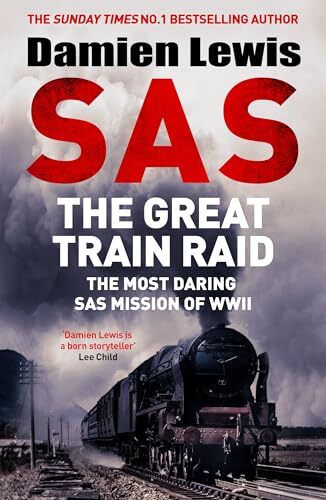
OK, so that's a photograph of a British steam locomotive. Specifically, it's a Rebuilt Royal Scot (or maybe a Rebuilt Patriot or Rebuilt Jubilee — it's difficult to tell without getting a good look at the cab). The photograph has been mirrored, so (1) the reversing rod is visible on the right-hand side of the engine (it should be on the left of the engine, running from the cab to the valve gear), (2) the vacuum break pipe is on the left of the buffer beam (it should be on the right), and (3) the train appears to be running on the right (trains in Britain usually run on the left). It's passing over some water troughs, so I think the location is Dillicar Troughs on the West Coast Main Line. The engine has had its smokebox door number plate photoshopped off, but not its shed plate (12A Carlisle Upperby). The photo is most likely postwar and may be by Eric Treacy (it's certainly in his style).
This is pretty much the equivalent of writing a book about a Tiger tank and putting a picture of a Cromwell tank on the front.
"The books about a train?"
"Yes, so let's stick a photo of a train on the front."
"Which photo."
"Oh, anyone will do."
"OK. Let's photoshop the number off the front bit. Then nobody will notice."
OK, so that's a photograph of a British steam locomotive. Specifically, it's a Rebuilt Royal Scot (or maybe a Rebuilt Patriot or Rebuilt Jubilee — it's difficult to tell without getting a good look at the cab). The photograph has been mirrored, so (1) the reversing rod is visible on the right-hand side of the engine (it should be on the left of the engine, running from the cab to the valve gear), (2) the vacuum break pipe is on the left of the buffer beam (it should be on the right), and (3) the train appears to be running on the right (trains in Britain usually run on the left). It's passing over some water troughs, so I think the location is Dillicar Troughs on the West Coast Main Line. The engine has had its smokebox door number plate photoshopped off, but not its shed plate (12A Carlisle Upperby). The photo is most likely postwar and may be by Eric Treacy (it's certainly in his style).
This is pretty much the equivalent of writing a book about a Tiger tank and putting a picture of a Cromwell tank on the front.

May 19, 2026
This might seem harsh to some people, but it's a slightly disappointing book in some ways to me.
Firstly, I should say that those complaining that the dust jacket shows a British train are pointing out something that many people won't know or care about. As a locomotive enthusiast myself, I couldn't care less.
I found this book disappointing strangely not for its content but for its title. One would assume that a book called The Great Train Raid, would be principally about a raid on or with a train. I'm afraid not. There is certainly a train involved, whereby POWs are freed and whisked away with a train, however this happens in the first third or so of the book. The majority of the book is actually about SAS squads helping send POWs back to safety via sea or land methods without so much as a hint of a train. I also found that the chapters covering the train were actually fairly short and rushed through.
I kept expecting there to be a more significant episode with a train towards the end of the book. It's more a story about the SAS finding and spiriting POWs away from danger whilst enlisting the help of Italian locals to disrupt the fascists. By no means does this mean it's an unworthy episode of history to tell, it just would have been nice had the author not used the premise of a train for actually a fairly minor part of the book.
Firstly, I should say that those complaining that the dust jacket shows a British train are pointing out something that many people won't know or care about. As a locomotive enthusiast myself, I couldn't care less.
I found this book disappointing strangely not for its content but for its title. One would assume that a book called The Great Train Raid, would be principally about a raid on or with a train. I'm afraid not. There is certainly a train involved, whereby POWs are freed and whisked away with a train, however this happens in the first third or so of the book. The majority of the book is actually about SAS squads helping send POWs back to safety via sea or land methods without so much as a hint of a train. I also found that the chapters covering the train were actually fairly short and rushed through.
I kept expecting there to be a more significant episode with a train towards the end of the book. It's more a story about the SAS finding and spiriting POWs away from danger whilst enlisting the help of Italian locals to disrupt the fascists. By no means does this mean it's an unworthy episode of history to tell, it just would have been nice had the author not used the premise of a train for actually a fairly minor part of the book.
January 16, 2026
To be honest, I am a little disappointed after reading the book. The title, blurb, and every article about the book talk about learning the story of the Great Train Raid, which is true to some extent. However, the story featured on the cover actually only makes up 10-15% of the book.
Listening to an interview with the author, it turns out that most of the book was already written when he came across the train story. So it's understandable why there's only such a short section about it in the book, but regardless, I feel cheated.
The rest of the book doesn't really find its focus either. We read very short, separate stories with lots of characters. Regardless, I don't regret reading it at all, I just want to warn everyone that you may not get what you expect.
Listening to an interview with the author, it turns out that most of the book was already written when he came across the train story. So it's understandable why there's only such a short section about it in the book, but regardless, I feel cheated.
The rest of the book doesn't really find its focus either. We read very short, separate stories with lots of characters. Regardless, I don't regret reading it at all, I just want to warn everyone that you may not get what you expect.

December 29, 2025
The central story, the one the title refers to, is the audacious breakout of detainees at the first concentration camp the Allied forces came across at Pisticci near Taranto. This was a camp with the usual collection of Jews, Slavs, communists, intellectuals and dissidents, interred in brutal conditions. Whilst still in enemy hands, there remained the danger that many would be sent to the extermination camps in the East. It was an escapee from the camp that alerted the SAS to its existence and being the unit to act quick and think on its feet, within 48 hours it had a plan. Bold, reckless but incredibly simple. They would commandeer a locomotive, steam to the nearest location to the camp, yomp to the camp, free the prisoners and return by the same route.
The bulk of the stories included are a direct result of the infamous ‘stay put’ order issued by MI9 in opposition to other direct orders. When the Italian forces surrendered early into the Allied invasion and liberation of Italy MI9 made a very bad judgement call, telling the POWs in the Italian camps to ‘stay put’ and wait for the allied forces to reach them. The Italians may have capitulated, but the Germans doubled down, reinforcing their lines and taking over the camps. Prisoners were relocated to Germany and those who had escaped were hunted down, sometimes using lethal force. It was against this backdrop the SAS went behind enemy lines to locate these escapees and guide them back safely to the safety of the Allied lines.
If you have read any of the Author’s earlier SAS books you will have a good idea how they operate, hiding up during daylight, improvising and using what is available, striking quick and hard before retreat and capturing any enemy arms and ammunition. Here new skills are developed, and the men are in their element. Extraction by sea brings in a piratical element, even down to attire, the regiment never being one for strict uniform code. To aid the capture of escaped POWs the German’s issued bounties for information leading to their discovery. Summoning the spirit of Robin Hood the SAS located these individuals, often the local fascist bigwigs, who would then be relieved of their reward, which the SAS used to finance their activities, such as providing boots and warm clothing to the escapees. It may all sound romantic and swashbuckling, with a sprinkling of ex French Foreign Legionnaires and the odd US don added to the mix, but mistakes would be fatal.
The bravery wasn’t restricted to the soldiers, many Italians, especially farmers, risked life and property to help the SAS and the POWs. Their spirit and generosity are rightly recognised.
The bulk of the stories included are a direct result of the infamous ‘stay put’ order issued by MI9 in opposition to other direct orders. When the Italian forces surrendered early into the Allied invasion and liberation of Italy MI9 made a very bad judgement call, telling the POWs in the Italian camps to ‘stay put’ and wait for the allied forces to reach them. The Italians may have capitulated, but the Germans doubled down, reinforcing their lines and taking over the camps. Prisoners were relocated to Germany and those who had escaped were hunted down, sometimes using lethal force. It was against this backdrop the SAS went behind enemy lines to locate these escapees and guide them back safely to the safety of the Allied lines.
If you have read any of the Author’s earlier SAS books you will have a good idea how they operate, hiding up during daylight, improvising and using what is available, striking quick and hard before retreat and capturing any enemy arms and ammunition. Here new skills are developed, and the men are in their element. Extraction by sea brings in a piratical element, even down to attire, the regiment never being one for strict uniform code. To aid the capture of escaped POWs the German’s issued bounties for information leading to their discovery. Summoning the spirit of Robin Hood the SAS located these individuals, often the local fascist bigwigs, who would then be relieved of their reward, which the SAS used to finance their activities, such as providing boots and warm clothing to the escapees. It may all sound romantic and swashbuckling, with a sprinkling of ex French Foreign Legionnaires and the odd US don added to the mix, but mistakes would be fatal.
The bravery wasn’t restricted to the soldiers, many Italians, especially farmers, risked life and property to help the SAS and the POWs. Their spirit and generosity are rightly recognised.
September 6, 2026
An amazing start with moments of brilliance hampered by inconsistent narrative.
Pro's:
Chapter 1 I was thinking this might be a 5 star book, the opening scenes were so gripping and I wish we could have stayed with those people throughout. And of course as this is all based off true events I am inspired by the bravery of the men in the book and what they went through to help save all the POW's.
Con's:
The pacing was a bit all over the place and the narrative was really inconsistent, going from chapter to chapter each with different people and missions introduced in place of those from the chapters previously (with a few exceptions). Plus, only like 2 chapters were actually about the train rescue mission!
Overall:
Nothing but respect for the real heroes of the book and for the author for researching all of this, but couldn't help but feel like I was reading lot's of different accounts of events that were not tied together in a way that made much narrative sense.
Pro's:
Chapter 1 I was thinking this might be a 5 star book, the opening scenes were so gripping and I wish we could have stayed with those people throughout. And of course as this is all based off true events I am inspired by the bravery of the men in the book and what they went through to help save all the POW's.
Con's:
The pacing was a bit all over the place and the narrative was really inconsistent, going from chapter to chapter each with different people and missions introduced in place of those from the chapters previously (with a few exceptions). Plus, only like 2 chapters were actually about the train rescue mission!
Overall:
Nothing but respect for the real heroes of the book and for the author for researching all of this, but couldn't help but feel like I was reading lot's of different accounts of events that were not tied together in a way that made much narrative sense.

October 23, 2025
I read the book in a single 14-hour sitting because I couldn't put it down. I felt like I was there with the men, experiencing the war as they did.
It is an incredible story, masterfully written with humour and suspense, featuring plot twists that highlight the unpredictability of situations behind enemy lines.
It is an incredible story, masterfully written with humour and suspense, featuring plot twists that highlight the unpredictability of situations behind enemy lines.

March 13, 2026
SAS: The Great Train Raid is a wonderful piece of work that captures both the audacity and sheer bravery of the newly formed SAS. Damien Lewis brings to life an operation so daring it almost defies belief — a mission carried out by men whose courage bordered on the unbelievable.
What struck me most was the mindset of these soldiers. Their willingness to take on near-impossible odds, armed with little more than ingenuity and determination, is something I can’t help but admire. They were true heroes, and it’s hard to imagine we’ll ever see their like again.
Having previously read SAS Rogue Heroes, I found it fascinating to encounter some familiar figures here. It adds an extra layer of depth, seeing those same men in action again, reinforcing just how remarkable that original group really was.
This is gripping, well-told history — both thrilling and deeply respectful of the men who carried out one of the most daring raids of the Second World War.
What struck me most was the mindset of these soldiers. Their willingness to take on near-impossible odds, armed with little more than ingenuity and determination, is something I can’t help but admire. They were true heroes, and it’s hard to imagine we’ll ever see their like again.
Having previously read SAS Rogue Heroes, I found it fascinating to encounter some familiar figures here. It adds an extra layer of depth, seeing those same men in action again, reinforcing just how remarkable that original group really was.
This is gripping, well-told history — both thrilling and deeply respectful of the men who carried out one of the most daring raids of the Second World War.
August 11, 2026
This is an easy to read adventure story of the SAS in Italy just after that country's surrender in 1943.
The SAS motto of "Who Dares Wins" doesn't do justice to the exploits or abilities of those people. Neither does it get close to addressing how undiluted luck can play a major part in the difference between life and death.
Thoroughly recommended.
The SAS motto of "Who Dares Wins" doesn't do justice to the exploits or abilities of those people. Neither does it get close to addressing how undiluted luck can play a major part in the difference between life and death.
Thoroughly recommended.
August 13, 2026
Fascinating account of the soldiers in the British Secret Air Service in Europe during WWII. Although there is an account of a dramatic rescue of concentration camp prisoners by stolen train the book itself recounts the exploits of the SAS in prisoner rescues throughout the European landmass, including Bergen-Belson. For a history book, it was hard to put down.
February 10, 2026
Excellent
Masses of relevant material, carefully selected and excellently used as a fast moving triumph of a novel. I was attracted by the idea of a rescue by a train. Will read more about the SAS.
Masses of relevant material, carefully selected and excellently used as a fast moving triumph of a novel. I was attracted by the idea of a rescue by a train. Will read more about the SAS.
July 3, 2026
Not sure why this hasn't been made into a movie yet. It might be that nobody would believe it. Steal a train, take it hundreds of kilometres behind enemy lines then rescue the inmates of an Italian concentration camp and transport them back to allied lines using the same train. Incredible stuff
This entire review has been hidden because of spoilers.
August 17, 2026
The books Damien Lewis writes are real page turners. He is great at conveying the 'daring do' of the actions the SAS took part in. His research is extensive and his narrative exciting. I have enjoyed reading other books by him and this one is no acceptation.
January 22, 2026
Excellent as always.
February 8, 2026
A great read, well written, all the more enjoyable as it’s all based on interviews and war diary’s
Read
February 9, 2026If you watched the BBC SAS series, this is very like it. Lots of great stuff I didn't know and told in great personal stories/bio that made it come alive
February 28, 2026
Never realised the extent of the Nazi reach into Italy

March 25, 2026
Not as good as previous books by Damien Lewis unfortunately. Not quite what the title suggests
June 19, 2026
Another decent read. Fascinating what these guys did for us.
June 26, 2026
Routine and rather plodding retelling of SAS operations in southern Italy.
August 3, 2026
A interesting history, struggled occasionally with the style but enjoyed the narrative.
September 8, 2026
Very little of the book is actually about the titular mission, though it's very informative about a lot of wartime exploits and an interesting read.
January 13, 2026
Another great SAS historic book, sadly it didn’t go to any great lengths regarding the “train story” but mostly about what it lead onto.
This has not put me off reading other Damian Lewis SAS stories as I have found him to be an excellent teller of their stories.
A good book if you don’t want to read another Paddy mayne or David Sterling book.
This has not put me off reading other Damian Lewis SAS stories as I have found him to be an excellent teller of their stories.
A good book if you don’t want to read another Paddy mayne or David Sterling book.
Displaying 1 - 24 of 24 reviews