What do you think?
Rate this book


204 pages, Hardcover
First published January 20, 2026
★★★★☆ 4 Stars
Sharp, inventive, and emotionally haunting: a story of sisterhood, identity, and survival.
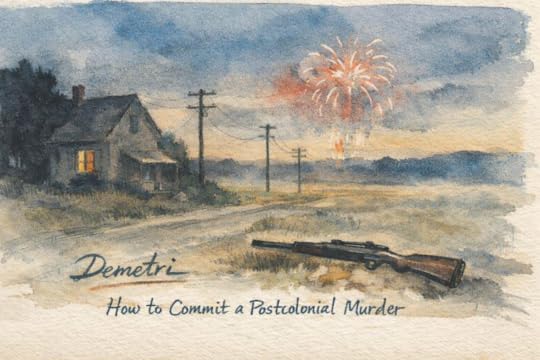
How to Commit a Postcolonial Murder by Nina McConigley is set in a small Wyoming town in 1986 and explores what it means to grow up mixed-race and visibly “other” in Reagan-era rural America. At its heart, it’s a powerful tale of sisterhood and the ways identity can fracture under the pressure of trauma and belonging.
McConigley writes with lived authority. She is half-Indian and half-white and was raised in Wyoming, and that perspective shapes the novel’s emotional truth, from the sting of microaggressions to the complicated feeling of being “split” between cultures.
Trigger warning: sexual abuse (pedophilia).
From the start, narrator Georgie Ayyar tells us plainly that she and her sister killed their uncle, and that they had a very good reason: they wanted the abuse to end. The novel then unfolds as Georgie walks us back through the circumstances that led to that moment, layering in both tenderness and rage, memory and meaning.
At the center of this book is the idea of “splits” -- between cultures, between girlhood and womanhood, between what the mind remembers and what it must set aside to survive.
McConigley conveys the experience of being biracial as a constant dividing line, between how you see yourself and how others insist on seeing you. That theme deepens as Georgie reflects on how trauma can create another kind of split: emotional dissociation, a separation that becomes a survival mechanism.
What makes the book even more devastating is the author’s restraint. The abuse is not described graphically; instead, McConigley allows the reader to infer the horror. That choice makes the story easier to read on the surface, but more unsettling to process afterward.. the silence becomes its own weight.
The motif of splitting extends outward into history. Georgie reflects on colonialism and the British reshaping and partitioning of India — an imposed division that alters identity and belonging, and the book draws subtle parallels between these historical fractures and the personal ruptures the sisters endure.
Even with its heavy subject matter, the novel is threaded with dark humor and sharp observation, which makes the narrative voice both engaging and oddly buoyant in places. The structure also takes bold, unexpected turns: several passages appear as multiple-choice “romance quiz” questions reminiscent of teen magazines, horrifying and amusing in equal measure, and a surprisingly effective way to capture adolescent confusion and dread.
I listened to the audiobook, beautifully narrated by Reena Dutt. At just over five hours, it’s a compact listen that still delivers a strong emotional impact.
A beautifully written, inventive, and thought-provoking story about sisterhood, identity, and what it takes to survive. 🎧✨
… [Amma] planted hundreds of [daffodil] bulbs in our yard during our first fall at Cottonwood Cross, when I was a baby … Every spring thereafter they’d come up through the snow, and every spring thereafter, the deer would come down from the creek and eat them.