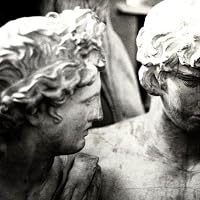
La mejor manera de hablar de la estupidez sin caer en su trampa consiste en dejar que hable ella. Que nos hable de los beneficios que ha reportado a lo largo de los siglos a eruditos, ricos y poderosos, a cortesanos, clérigos y dogmáticos, embebidos todos ellos del don del orgullo, esa hada madrina que cumple todos los deseos del estúpido.
Jean Paul nos ofrece en estos escritos, llenos de humor fino e ironía incisiva, un monólogo de la estupidez que es a su vez un catálogo de tipologías humanas para que cada uno de nosotros decida con cuál se siente más identificado: hay donde escoger.
Humorous and sentimental novels of German writer Jean Paul Friedrich Richter under pen name Jean Paul include Titan (1800-1803) and Years of Indiscretion (1804-1805).
In the Fichtelgebirge mountains of Bavaria, his father worked as an organist. This fathre served in 1765 as a pastor at Joditz near Hof and in 1767 at Schwarzenbach but died on 25 April 1779, leaving the family in great poverty. After attending the gymnasium at Hof, Jean Paul went in 1781 to the University of Leipzig. His original intention was to enter his father's profession, but theology did not interest him, and he soon devoted himself wholly to the study of literature. Unable to maintain himself at Leipzig, he returned in 1784 to Hof, where he lived with his mother. From 1787 to 1789 he served as a tutor at Töpen, a village near Hof; and from 1790 to 1794 he taught the children of several families in a school he had founded in nearby Schwarzenbach. Jean Paul began his career as a man of letters with Grönländische Prozesse ("Greenland Lawsuits", published anonymously in Berlin) and Auswahl aus des Teufels Papieren ("Selections from the Devil's Papers", signed J. P. F. Hasus), the former of which was issued in 1783-84, the latter in 1789. These works were not received with much favour, and in later life Richter himself had little sympathy for their satirical tone. A spiritual crisis he suffered on 15 November 1790, in which he had a vision of his own death, altered his outlook profoundly. His next book, Die unsichtbare Loge ("The Invisible Lodge"), a romance published in 1793 under the pen-name Jean Paul (in honour of Jean Jacques Rousseau), had all the qualities that were soon to make him famous, and its power was immediately recognized by some of the best critics of the day. Encouraged by the reception of Die unsichtbare Loge, Richter composed a number of books in rapid succession: Hesperus (1795), Biographische Belustigungen unter der Gehirnschale einer Riesin (1796), Leben des Quintus Fixlein (1796), Der Jubelsenior (1797), and Das Kampaner Tal (1797). Also among these was the novel Blumen- Frucht- und Dornenstücke, oder Ehestand, Tod und Hochzeit des Armenadvokaten Siebenkäs in 1796-97. The book's slightly supernatural theme, involving a Doppelgänger and pseudocide, stirred some controversy over its interpretation of the Resurrection, but these criticisms served only to draw awareness to the author. This series of writings assured Richter a place in German literature, and during the rest of his life every work he produced was welcomed by a wide circle of admirers. After his mother's death in 1797, Richter went to Leipzig, and in the following year to Weimar, where he started work on his most ambitious novel, Titan, published between 1801-02. Richter became friends with such Weimar notables as Herder, by whom he was warmly appreciated, but despite their close proximity, Richter never become close to Goethe and Schiller, both of whom found his literary methods repugnant; but in Weimar, as elsewhere, his remarkable conversational powers and his genial manners made him a favorite in general society. In 1801 he married Caroline Meyer, whom he had met in Berlin the year before. They lived first at Meiningen, then at Coburg; and finally, in 1804, they settled at Bayreuth. Here Richter spent a quiet, simple and happy life, constantly occupied with his work as a writer. In 1808 he was fortunately delivered from anxiety about outward necessities by Prince Primate Karl Theodor von Dalberg, who gave him a pension. Titan was followed by Flegeljahre (1804-5), two works which he himself regarded as his masterpieces. His later imaginative works were Dr Katzenbergers Badereise (1809), Des Feldpredigers Schmelzle Reise nach Flätz (1809), Leben Fibels (1812), and Der Komet, oder Nikolaus Marggraf (1820-22). In Vorschule der Aesthetik (1804) he expounded his ideas on art; he discussed the principles of education i
En «Elogio de la estupidez» es la propia figura personificada de la estulticia quien toma la palabra para justificar su existencia.
Del mismo modo que en su contenido, la Literatura Universal da a conocer los grandes movimientos estéticos, las principales obras literarias y autores que han ido conformando nuestra realidad cultural, también presenta, e incorpora en esencia, en este caso en continuo contraste con la sabiduría, la propia estupidez humana.
Leer e interpretar este texto literario, con sus fragmentos representativos de una sociedad que, por sus propias costumbres, se parodia a sí misma, constata la presencia de la estupidez no ya como tema recurrente —común a todo ser humano en todas las culturas—, sino como vía para comprender y valorar críticamente las manifestaciones, no tanto literarias como sociales, de su expresión en una época que bien puede equipararse con la nuestra en no pocas descripciones.
La estupidez, como si se viera obligada a ello, asiste, en calidad de abogado defensor, a una sala vacía donde un tribunal invisible supuestamente la acusa de cuantas creaciones y sentimientos individuales y colectivos, infructuosos e inservibles, fatuos y absurdos ha acumulado en su larga existencia. La acusada, en ese afán humano por explicarse el mundo a ella misma y a otros (los lectores), se defiende, desenmascarando a una sociedad que se señala a sí misma al quedar retratados muchos de sus miembros en no pocas y diversas manifestaciones del espíritu...
A través de su divertidísima disertación, el lector reconoce no pocos atributos, algunos de los cuales, por más que asociados a sujetos particulares, describen maneras y costumbres inherentes al ser humano en toda época y lugar, no sólo la de Jean Paul. Por supuesto, cada cual se identifica sólo con algunos atributos y quizá con algún sujeto en particular, aunque ni siquiera en todos los casos; pero son los otros que rechazamos, los que no resultan tan ajenos como podría uno desear, los que sin duda constatan la presencia de la estupidez en nosotros mismos, esa negativa a reconocer que nada escapa a su presencia, menos aún la propia literatura; pues lo mismo funciona como soporte, que le sirve de vehículo.
Disfrute de su lectura. ___________
MUSIL, R.; ERDMANN, J.E. «Sobre la estupidez». Trad.: F. de Lara López. Abada, Madrid, 2007. LOTMAN, I.M. «Los mecanismos de los procesos dinámicos en la semiótica», en Rev. Entretextos, n.º 5 (may., 2005), pp. 80-92. QUEIROZ, E. «(Notas contemporáneas:) La decadencia de la risa», Biblioteca Nueva, Madrid, 1917. RICHTER, J.P.F. «Elogio de la estupidez». Trad.: Juan de sola. Cómplices Editorial, Barcelona, 2012. ROTTERDAM, E. «Elogio de la locura» Trad.: Pedro Voltes Bou. Espasa, Barcelona, 1999.
Un pequeño panegírico de la estupidez que es, al mismo tiempo, un arduo ataque a la razón y los dogmas. Hay en este libro una prueba de la utilidad que da la estupidez al hombre y muchos ejemplos de cómo esta demuestra su superioridad en los terrenos del arte, la religión, la medicina, la corte, etcétera.