

What do you think?
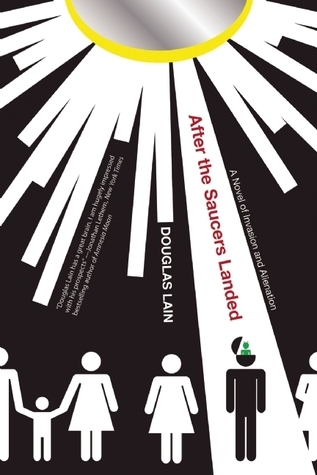
After the Saucers Landed
“When the alien gets around to unzipping her jumpsuit it’ll be impossible to see what’s underneath.”
UFOlogist Harold Flint is heartbroken and depressed that the aliens that have landed on the White House lawn appear to be straight out of an old B movie. They wave to the television cameras in their sequined jumpsuits, form a nonprofit organization offering new age enlightenment, and hover their saucers over the streets of New York looking for converts.
Harold wants no part of this kitschy invasion until one of the aliens, a beautiful blonde named Asket, begs him to investigate the saucers again and write another UFO book. The aliens and their mission are not as they seem.
Asket isn’t who she seems either. Tracking down her true personality leads Harold and his cowriter through a maze of identity and body-swapping madness, descending into paranoia as Harold realizes that reality, or at least humanity’s perception of it, may be more flexible than anyone will admit.
After the Saucers Landed is a deeply unsettling experimental satire, placing author Douglas Lain alongside contemporaries like Jeff VanderMeer and Charles Yu as one of his generation’s most exciting and challenging speculative fiction voices.
UFOlogist Harold Flint is heartbroken and depressed that the aliens that have landed on the White House lawn appear to be straight out of an old B movie. They wave to the television cameras in their sequined jumpsuits, form a nonprofit organization offering new age enlightenment, and hover their saucers over the streets of New York looking for converts.
Harold wants no part of this kitschy invasion until one of the aliens, a beautiful blonde named Asket, begs him to investigate the saucers again and write another UFO book. The aliens and their mission are not as they seem.
Asket isn’t who she seems either. Tracking down her true personality leads Harold and his cowriter through a maze of identity and body-swapping madness, descending into paranoia as Harold realizes that reality, or at least humanity’s perception of it, may be more flexible than anyone will admit.
After the Saucers Landed is a deeply unsettling experimental satire, placing author Douglas Lain alongside contemporaries like Jeff VanderMeer and Charles Yu as one of his generation’s most exciting and challenging speculative fiction voices.
248 pages, Paperback
First published August 4, 2015
Ratings & Reviews
Friends & Following
Create a free account to discover what your friends think of this book!
Community Reviews
Displaying 1 - 30 of 55 reviews

June 16, 2015
Okay, I'm officially abandoning this one (though still marking it as "read" since I had to put up with it for so long).
I had high hopes for the story, but it just didn't grab me. The idea of being invaded by underwhelming aliens with 70s style is possibly a good one, and it might have been presented in an interesting way. It just didn't happen in this book. It's too slow to get to the point, and it's deliberately confusing in a way that doesn't really add to the story at all. Also, I have simply no motivation to care about the whiney, self-absorbed protagonist. In short, there's not much I can say about this book that I liked.
I wish I could've liked it. I wanted to like it. But I didn't.
I had high hopes for the story, but it just didn't grab me. The idea of being invaded by underwhelming aliens with 70s style is possibly a good one, and it might have been presented in an interesting way. It just didn't happen in this book. It's too slow to get to the point, and it's deliberately confusing in a way that doesn't really add to the story at all. Also, I have simply no motivation to care about the whiney, self-absorbed protagonist. In short, there's not much I can say about this book that I liked.
I wish I could've liked it. I wanted to like it. But I didn't.

February 18, 2016
There are books that are easy to fall into, the story flows and carries a reader away. And then there are those that take a lot of concentration, the story lies as much in the craft of the sentences than the words themselves. "After the Saucers Landed" is one such story.
The aliens have arrived, and they are a 1950s stereotype, complete with silver saucers filled with white plastic modular furniture. But along with the missing time and sparkly jumpsuits, hiding behind the happy crappy scientology-esque enlightenment lies some disquieting revelations about personality, identity and the future of the human race.
I must admit I had a hard time getting into this book, I don't like struggling to make sense of the plot, or even a scene. But I'm glad I persevered, there were some interesting nuggets to be found within about identity, memory and humanity.
I read this because it's nominated for the 2015 Philip K Dick awards. It falls well within the parameters and actually felt a lot like the spirit of PKD, not just looking forward, but off to the side and skewed a bit.
The aliens have arrived, and they are a 1950s stereotype, complete with silver saucers filled with white plastic modular furniture. But along with the missing time and sparkly jumpsuits, hiding behind the happy crappy scientology-esque enlightenment lies some disquieting revelations about personality, identity and the future of the human race.
I must admit I had a hard time getting into this book, I don't like struggling to make sense of the plot, or even a scene. But I'm glad I persevered, there were some interesting nuggets to be found within about identity, memory and humanity.
I read this because it's nominated for the 2015 Philip K Dick awards. It falls well within the parameters and actually felt a lot like the spirit of PKD, not just looking forward, but off to the side and skewed a bit.

March 4, 2016
I was really looking forward to reading this, because I thought the premise sounded amazing. And I think it would have been a great story if it stuck to the idea the book's promotion claims it's about, and tried to keep some semblance of a plot, instead of trying to be super literary, experimental and meta. And if it was written by someone with a solid talent for lyrical prose and subtle witticisms, like Douglas Adams. Reading Adams (just using him as an example because he's been on my mind a lot lately having just read Dirk Gently) one can find oneself thinking "what the...? what's going on? this is weird and a bit confusing", but it doesn't really matter because the writing is so fluid and interesting in itself that you can't help but keep reading and eventually things start to come together and fall into place and you can see how this story has been intricately woven. That was not the case with this story (if one can even call it that, or should I say 'piece'?). This felt like someone, as an attempt at an avant-garde project, took my Philosophy 101, Art History and Comparative Litt 101 textbooks, shredded them and then glued the shreds onto blown up stills from Plan 9 From Outer Space. When I think about it, that might be what the author was going for, but I still think it failed...

August 10, 2015
I liked the book a lot, but I have to admit it was confusing at times. After all, when an author draws one into questions of identity and "What is reality?", it's necessarily going to risk some confusion. If you're not willing to look beneath appearances and chew on stuff a bit, you'd better pick up another science fiction novel.
I enjoyed following the everyman characters trying to sort out their lives. The author was clearly having fun with them, and inviting us to find out how much of ourselves we could see in their attitudes even while we are tempted to feel superior to them.
Lain's kitschy aliens aren't going to save the human race or amaze us. If we don't think too hard, we can become cult followers and fit in to the new reality they impose. If we try to pin them down, we can desperately try to fit them into an ordinary understanding of how things work. If we are willing to set aside assumptions (about them and, more importantly, about ourselves) and accept ambiguity and impermanence, we might be able to realize or construct a more authentic reality that fits better than the stories we've been telling about ourselves.
"How can I know that I am who I believe myself to be?" Sort of scary and exciting, isn't it? Is it time to change personalities? Don't wait until after the saucers land.
I enjoyed following the everyman characters trying to sort out their lives. The author was clearly having fun with them, and inviting us to find out how much of ourselves we could see in their attitudes even while we are tempted to feel superior to them.
Lain's kitschy aliens aren't going to save the human race or amaze us. If we don't think too hard, we can become cult followers and fit in to the new reality they impose. If we try to pin them down, we can desperately try to fit them into an ordinary understanding of how things work. If we are willing to set aside assumptions (about them and, more importantly, about ourselves) and accept ambiguity and impermanence, we might be able to realize or construct a more authentic reality that fits better than the stories we've been telling about ourselves.
"How can I know that I am who I believe myself to be?" Sort of scary and exciting, isn't it? Is it time to change personalities? Don't wait until after the saucers land.

Read
February 14, 2016"This sentence is in French."
I've been struggling with ways to describe this book to my friends. When I do, I say things like, "Okay, so you know how in the 1970s there was this whole groovy concept of aliens as Space Brothers? Yeah, so what if those were the aliens we made first contact with? Or...um, maybe they thought that was what we wanted so appeared like that... maybe? Unless, it's not real at all, but something we created.... okay, I don't really know, but it's a good book?"
Because I do think this is a good book, I'm just not sure I understood it.
I've been struggling with ways to describe this book to my friends. When I do, I say things like, "Okay, so you know how in the 1970s there was this whole groovy concept of aliens as Space Brothers? Yeah, so what if those were the aliens we made first contact with? Or...um, maybe they thought that was what we wanted so appeared like that... maybe? Unless, it's not real at all, but something we created.... okay, I don't really know, but it's a good book?"
Because I do think this is a good book, I'm just not sure I understood it.
September 24, 2015
This is not a review
Part Vertigo, part Stanley Parable, Lain’s novel confronts the insatiable American appetite for novelty, spectacle and self-help, the Hungry Ghost of consumer society that must dispel every mystery in favor of a tacky, penny arcade reality full of Aliens in sequined jumpsuits and B-movie UFOs. “After the Saucers Landed” is a meditation on the closing of the frontier of the American consciousness by that rarest of beasts: an intellectual with a sense of humor.
Part Vertigo, part Stanley Parable, Lain’s novel confronts the insatiable American appetite for novelty, spectacle and self-help, the Hungry Ghost of consumer society that must dispel every mystery in favor of a tacky, penny arcade reality full of Aliens in sequined jumpsuits and B-movie UFOs. “After the Saucers Landed” is a meditation on the closing of the frontier of the American consciousness by that rarest of beasts: an intellectual with a sense of humor.

July 30, 2015
The author seems to suffer from what I call Terry Goodkind Syndrome: He's absolutely desperate to prove how smart he is (never quite accomplishing anything of the sort), and is so focused on that that he seems to forget his main job is to write a good story with a plot that makes sense.
The whole lost time concept could have been interesting, had the author not used it in a desperate and thinly-veiled attempt to hide how absolutely terrible he is at writing transitions.
The whole lost time concept could have been interesting, had the author not used it in a desperate and thinly-veiled attempt to hide how absolutely terrible he is at writing transitions.

August 14, 2015
This one is quite trippy and definitely not a typical alien invasion novel. It is told from the viewpoint of a writer who experiences strange shifts in reality (such as an alien who assumes the identity of his wife, as well as several other identities). It can be confusing at times but is nonetheless interesting. If you like having your mind played with, I recommend it.

October 20, 2015
I had reasonably high hopes and low expectations, but, still, the experience was consistently "meh."

January 30, 2016
Douglas Lain’s After the Saucers Landed is definitely a book that sits firmly in my wheelhouse. Not because it’s deliberately self-aware or because it’s a “post modern” and “post capitalist” take on the UFO phenomena or because it wears its academic and literary influences on its sleeves. It tickles my fancy because it’s like nothing I’ve read before. And given the amount of cookie cutter fiction that’s published on a regular basis, reading a novel that doesn’t give a shit if the reader “gets it” is genuinely exciting and, yes, enjoyable.
The novel’s title is a neat summary of the central conceit. In 1991 UFOs land on the front lawn of the White House. The aliens that emerge are straight out of an old B-Movie, humanoid and dressed in sequined jumpsuits. Even the saucer’s internals look like something that’s been cobbled together on a shoestring budget. The ordinariness of the aliens shatters the beliefs of Ufologist Harold Flint who expected something so much more profound. Flint, who’d written a number of novels about the UFO phenomena (prior to their arrival) and who is dealing with the death of his wife, decides to walk away from his life’s work. But then one day his co-writer, Brian Johnson, brings home a female alien named Asket who asks Harold to return to his investigation into UFO phenomena. While Flint says no he’s steadily drawn into an increasingly paranoid world of missing time, identity swaps and the most banal of invasions.
While the UFO craze hit its straps in the 1950s, it’s never really left us as exhibited by Mulder’s lengthy conspiracy rant during the opening episode of the newly resurrected X-Files. But Lain pokes fun and wonderfully deconstructs the mythology, all those poorly lit rooms hiding coffee stained files of alien infiltration, by having the Pleidiens (the aliens) reflect a nostalgic expectation of the flying saucer phenomena. The cherry on top is that rather than rely on alien probes and men dressed in black, the Pleidiens invade by converting people to their version of New Age enlightenment.
Identity sits front and centre throughout the novel, specifically the fragile nature of human consciousness. Lain cuts the topic in a number of ways, both through the philosophy of Rene Descartes and via hypnosis as Asket details her identity swapping adventures. Lain’s overall thesis might be that we’re losing (or have already lost) our identities to a capitalist / consumerist culture that prides the Real Housewives and the Kardashians over genuine philosophical interrogation. At least that’s the message I took away from the novel.
If I have a problem with After the Saucers Landed it’s that it lacks a human touch. Brian Johnson, our narrator, but not necessarily the protagonist, is a thinly drawn character. There’s a plot reason for this, but it does mean that I found it hard to engage with Johnson’s plight, in particular the disappearance of his wife who may, or may not, have surrendered herself to the Pleidiens. Asket, who follows Johnson for most of the novel, is a far more interesting and developed character – which is ironic given her personality never stays stable for more than twenty pages.
After the Saucers Landed might be described as pretentious by some. There were certainly easter eggs and references scattered throughout the text that I didn’t register until later, such as the antecedent to the name Asket. Other reviewers have noted a level of critical theory embedded in the novel that, if there, went completely over my noggin. But Lain’s mix of philosophy, nostalgia and identity is interesting and exciting because it does require some chewing over, because it doesn’t speak down and because it takes the risky move of avoiding cliché.
The novel’s title is a neat summary of the central conceit. In 1991 UFOs land on the front lawn of the White House. The aliens that emerge are straight out of an old B-Movie, humanoid and dressed in sequined jumpsuits. Even the saucer’s internals look like something that’s been cobbled together on a shoestring budget. The ordinariness of the aliens shatters the beliefs of Ufologist Harold Flint who expected something so much more profound. Flint, who’d written a number of novels about the UFO phenomena (prior to their arrival) and who is dealing with the death of his wife, decides to walk away from his life’s work. But then one day his co-writer, Brian Johnson, brings home a female alien named Asket who asks Harold to return to his investigation into UFO phenomena. While Flint says no he’s steadily drawn into an increasingly paranoid world of missing time, identity swaps and the most banal of invasions.
While the UFO craze hit its straps in the 1950s, it’s never really left us as exhibited by Mulder’s lengthy conspiracy rant during the opening episode of the newly resurrected X-Files. But Lain pokes fun and wonderfully deconstructs the mythology, all those poorly lit rooms hiding coffee stained files of alien infiltration, by having the Pleidiens (the aliens) reflect a nostalgic expectation of the flying saucer phenomena. The cherry on top is that rather than rely on alien probes and men dressed in black, the Pleidiens invade by converting people to their version of New Age enlightenment.
Identity sits front and centre throughout the novel, specifically the fragile nature of human consciousness. Lain cuts the topic in a number of ways, both through the philosophy of Rene Descartes and via hypnosis as Asket details her identity swapping adventures. Lain’s overall thesis might be that we’re losing (or have already lost) our identities to a capitalist / consumerist culture that prides the Real Housewives and the Kardashians over genuine philosophical interrogation. At least that’s the message I took away from the novel.
If I have a problem with After the Saucers Landed it’s that it lacks a human touch. Brian Johnson, our narrator, but not necessarily the protagonist, is a thinly drawn character. There’s a plot reason for this, but it does mean that I found it hard to engage with Johnson’s plight, in particular the disappearance of his wife who may, or may not, have surrendered herself to the Pleidiens. Asket, who follows Johnson for most of the novel, is a far more interesting and developed character – which is ironic given her personality never stays stable for more than twenty pages.
After the Saucers Landed might be described as pretentious by some. There were certainly easter eggs and references scattered throughout the text that I didn’t register until later, such as the antecedent to the name Asket. Other reviewers have noted a level of critical theory embedded in the novel that, if there, went completely over my noggin. But Lain’s mix of philosophy, nostalgia and identity is interesting and exciting because it does require some chewing over, because it doesn’t speak down and because it takes the risky move of avoiding cliché.

July 13, 2015
Read all my reviews on http://urlphantomhive.booklikes.com
To start with the good: It is unlike any other alien invasion books I've ever come across. It provides an answer to the question which bother us all: what if the discovery of aliens showed that they were nothing but completely underwhelming, with their jumpsuits and new age-y religion.
The bad: I had a constant feeling when I was reading this that it was trying to convey something to me, but I couldn't find out what. It is partly a criticism on society I suppose, but I didn't think it was a particular strong one.
The ugly: I was bored. A lot. Part of the book is really confusing, and while I think that's intentional, it made that I could never get invested in the story. Basically, I was counting the percentages I still had to read on my Kindle.
All in all, an interesting concept, but its execution didn't work for me.
Thanks to the publisher and Edelweiss for providing me with a free copy of this book in exchange for an honest review!
To start with the good: It is unlike any other alien invasion books I've ever come across. It provides an answer to the question which bother us all: what if the discovery of aliens showed that they were nothing but completely underwhelming, with their jumpsuits and new age-y religion.
The bad: I had a constant feeling when I was reading this that it was trying to convey something to me, but I couldn't find out what. It is partly a criticism on society I suppose, but I didn't think it was a particular strong one.
The ugly: I was bored. A lot. Part of the book is really confusing, and while I think that's intentional, it made that I could never get invested in the story. Basically, I was counting the percentages I still had to read on my Kindle.
All in all, an interesting concept, but its execution didn't work for me.
Thanks to the publisher and Edelweiss for providing me with a free copy of this book in exchange for an honest review!

May 15, 2018
At least it was short.

September 1, 2015
Alien invasions in fiction often serve as a means to explore themes of common humanity — characters are forced to overcome differences and band together to respond to some radical, threatening other. Douglas Lain takes a very contrary tack in his intriguing novel, After the Saucers Landed, in which the “soft” alien invasion of the benevolent Pleidiens triggers an identity crisis among the main characters, whose travails lead the reader through a series of questions about the nature of reality itself.
As with much of Lain's work, there is a strong philosophical flavour to this novel. Generally, philosophy-oriented fiction is best when it observes Wittgenstein’s observation about Tolstoy: “when [he] turns his back to the reader, then he seems to me most impressive. His philosophy is most true when it’s latent in the story”. Lain’s approach is pretty full-frontal. Although his main characters are academics and artists, who we might expect to wax a little, it seems that every character in the book is a dabbling epistemologist — even the FBI agents quote Descartes. But Lain’s book is tackling the relationship between ideas and reality, so his didacticism can be justified as performative. Once I settled into the surreal rhythm of the novel, I enjoyed the over-the-top cerebral jousting between the characters, and the instances of what would otherwise be dismissed as jarring authorial intrusion work pretty well to reinforce Lain’s points about narrative and identity.
While the novel is very intellectually satisfying, I took the most pleasure from Lain’s characterization of the bewildered Brian Johnson and his fumbling attempts at intimacy and negotiating an era that is gradually passing him by. The attention to detail and cataloguing of 90s tropes and cultural artefacts is entertaining and adroit — the humdrum minutiae strikes a satisfying balance with the lofty themes in a way that is somewhat reminiscent of DeLillo’s White Noise.
This is a well-written and smart book, but it isn’t for everyone. Fans of naturalism or classic SF invasion yarns will be thoroughly alienated. Lain’s approach might also annoy a proportion of academically-oriented readers. In order to appreciate all the references and ideas, the book demands a reader who is fairly well-versed in — and sympathetic towards — cultural and critical theory (and, ideally, the history of art movements). While endlessly diverting, the blunderbuss blast of references makes it difficult to trace a central argument, which may or may not have been intentional. Being familiar with Lain’s other work (having listened to his philosophy/culture podcast and read his other written work), I can guess what he’s driving at, but I’d be interested to know what sorts of impressions the average intelligent reader would take away from this.
As with much of Lain's work, there is a strong philosophical flavour to this novel. Generally, philosophy-oriented fiction is best when it observes Wittgenstein’s observation about Tolstoy: “when [he] turns his back to the reader, then he seems to me most impressive. His philosophy is most true when it’s latent in the story”. Lain’s approach is pretty full-frontal. Although his main characters are academics and artists, who we might expect to wax a little, it seems that every character in the book is a dabbling epistemologist — even the FBI agents quote Descartes. But Lain’s book is tackling the relationship between ideas and reality, so his didacticism can be justified as performative. Once I settled into the surreal rhythm of the novel, I enjoyed the over-the-top cerebral jousting between the characters, and the instances of what would otherwise be dismissed as jarring authorial intrusion work pretty well to reinforce Lain’s points about narrative and identity.
While the novel is very intellectually satisfying, I took the most pleasure from Lain’s characterization of the bewildered Brian Johnson and his fumbling attempts at intimacy and negotiating an era that is gradually passing him by. The attention to detail and cataloguing of 90s tropes and cultural artefacts is entertaining and adroit — the humdrum minutiae strikes a satisfying balance with the lofty themes in a way that is somewhat reminiscent of DeLillo’s White Noise.
This is a well-written and smart book, but it isn’t for everyone. Fans of naturalism or classic SF invasion yarns will be thoroughly alienated. Lain’s approach might also annoy a proportion of academically-oriented readers. In order to appreciate all the references and ideas, the book demands a reader who is fairly well-versed in — and sympathetic towards — cultural and critical theory (and, ideally, the history of art movements). While endlessly diverting, the blunderbuss blast of references makes it difficult to trace a central argument, which may or may not have been intentional. Being familiar with Lain’s other work (having listened to his philosophy/culture podcast and read his other written work), I can guess what he’s driving at, but I’d be interested to know what sorts of impressions the average intelligent reader would take away from this.
September 7, 2015
What happens when the transcendent becomes utterly immanent, and the impossible commonplace? You might as well ask what life is like within the Q Continuum, or regenerating like the Doctor across all time and space, not that this books has anything to do with those points of reference.
This book is about the fluidity of identity, and I loved reading it because it was interesting and refreshingly weird, and it goes great with coffee. Would I say it's like a Murakami novel, only slightly faster paced? No. I want to make comparisons to his work and to David Lynch's and Gene Wolfe's, but I totally won't. Instead I'll say that such comparison's fail to encapsulate the feeling I'm trying to evoke, but maybe the combined aftertaste of those suggestions will point a potential reader in the right direction.
This is a book about the mysteries hidden in plain sight, and the liminal nexus between the alien and the familiar.
This book is about the fluidity of identity, and I loved reading it because it was interesting and refreshingly weird, and it goes great with coffee. Would I say it's like a Murakami novel, only slightly faster paced? No. I want to make comparisons to his work and to David Lynch's and Gene Wolfe's, but I totally won't. Instead I'll say that such comparison's fail to encapsulate the feeling I'm trying to evoke, but maybe the combined aftertaste of those suggestions will point a potential reader in the right direction.
This is a book about the mysteries hidden in plain sight, and the liminal nexus between the alien and the familiar.

June 29, 2017
I was worried that this novel might be disorganized and confused like some of Doug Lain's podcasts. I was delighted to find that he is a very clear and competent author and the book moved along. The novel was more about the problem of identity and in an odd way, was more reminiscent of The Prisoner of Zenda, or The Prince and the Pauper - pushed to the limits; but using "space aliens" as offering the abilities to become somehow someone else as a means of deriving new insights. Instead of simply taking on a new identity while really remaining the same person, what happens when we become the person of the new identity? I definitely intend to read more of Doug Lain's work.

August 3, 2015
Fantastic. Full review to come.
January 7, 2020
Lame, it was just downright silly.

January 14, 2016
A friend gave me this book awhile back. And now I hear this book has been nominated for a Philip K Dick award. Mmm I hope it wins.
Yes, buy the book, I liked it, I read it twice. It is a snappy, fun book. It doesn’t take itself too serious, in fact it is maybe too tongue in cheek for me at times, too surreal for me at times and though I might have felt I got lost in the shuffle, there are great moments to be found by being a touch lost. So go on the journey into the strange! And if you are like me you might want to go back read it again, especially once you have mastered the voice, tone and are finally able to lose the excess baggage that some of your expectations bring to the book. But, but because it is snappy and fun, I think reading it twice is quite nice. And reading it knowing you will be going back, will allow you to see that “After the Saucers landed” is quite light hearted, and yet genuine to life, to a life, to our lives. So yes I suggest reading it twice. I mean all of the scenes were sorta better on the second time through...
I warn, this book is a strange find, it is part sci-fi, part philosophical puzzle, part art history all wrapped together with a mystery. I think at the center of the book is alienation, and not so much to do with aliens, and there are many alienations that Lain describes. Lain’s protagonist Brian finds himself to lose himself to find himself to lose and we all will lose our alienation only to find it again. But isn't this how our lives are too, I mean, aren’t we always not quite ready to give in? And when we DO give in we often forget the struggle and why we didn't give in earlier. Yet the book (correctly) seems suggest that if we give in (and forget ourselves) we are in a way, losing ourselves a little bit, without noticing, and thus making ourselves little less original, and maybe even making ourselves a little alien to ourselves. Do we resist it? Do we embrace it?
Ok, ok a few words on Lain’s method...but first, so you know, I never finished “Moby Dick,” but irregardless, I did read enough of “Moby Dick” to know that “Moby Dick” is the sort of book that was written to grab you and take you on a journey. However “Moby Dick” is thick, the style is similar to reading an encyclopedia, which was maybe too much for me (sorry), but I have to believe that Melville did this because he was a man of his time and, at that time people had not seen or done the things we have today..no Netflix, no internet, no Google! And maybe “Moby Dick” is special, even for its time, (people think so, I will finish someday) and maybe, just maybe I should not compare “Moby Dick” to “After the Saucers Landed,” but well, I think there is a lesson of forms, and well please allow me to compare them even if they are not truly comparable.
I mean, Lain is a man of our times and nowadays you can google it and when you read Doug Lain’s novel I think you owe it to the book that you do google all or any of those things that are alien to you. There that is my point...not that we can compare the two, the Dick to “Saucers,” but that the author of “Saucers” knows his time, and has crafted something that will be odd if you don’t know all of the various lovelies he wants to tell you about.
So yes, that is what I found, the author of “Saucers” wants you to take interest in the journey itself and to find yourself and lose yourself and find yourself while taking his trip, so buy the ticket and take the ride! But beware! I think to get the most out of Saucers you have to google a few things...like Pleiadians, if you are unfamiliar with their mythology. If you Google ‘What do the Pleiadians look like?’ then you will find something like: “also known as Nordic aliens, are humanoid aliens, that come from the stellar system surrounding the Pleiades stars, and they’re really really really concerned about Earth and our future”
Next there is another reference that you may want to familiarize yourself with, the art movement Fluxus...and when Googling: What is the Fluxus art movement? I found: “a name taken from Latin word meaning “flow, flux” (noun); “flowing, fluid” (adj)-is an international network of artists, composers and designers noted for blending different artistic media and disciplines in the 1960.”
And there was a hidden depth to the book that i know I, for the most part, failed to appreciate. I mean started off being sorta over focused on the plot, the narrative and I think I failed to see where all the book was taking me. Yet I think you can appreciate this book without researching things, I think you will find to take the journey (like “Moby Dick”) you will need to some research, break out the encyclopedia! If you do so, “Saucers “is every bit as much a travelogue as “Moby Dick” albeit a sci-fi, pop culture, and sorta fun house warped mirror look at one’s identity.
Finally, I really do recommend this book. You should read it. Unlike the “Moby Dick,” I was able to finish “Saucers.” “Saucers” asks you to Enjoy! (in the same tone as you have been asked to “Enjoy Coke” for years and years this book asks you to not question, but enjoy!) So go at your speed and enjoy it in your own way.
I mean for me, I like to enjoy! things slowly and with care, but you might just be looking to divert yourself for a few quick moments...and though I stand by the slow read, the book can be a quick read, especially if you want to just enjoy! So enjoy! all its snappy, and snarky and fun moments! You could very easily read it quickly and laugh at it and be done!
But I will say that even if you are quickly going through you should try to wrestle with the central quest...who or what are these aliens a metaphor for? are they from our past? from our future? are we them, are they us? where are the coming from and where are they asking us to go?
My answer, the alien (in thought) is everywhere. My solution to the central quest is that we are on a journey, life is in flux, and that we are not able to conceive all of our lives, but only to try to conceive what we can of it. We fail but don’t recognize it as a failure. So unlike the ‘Dick’ life is not some distant sea voyage, but the science of the self, and we should find that all these alien parts are just parts of our divided self, our divided psychologies, divided social lives together.. that we often identify with so many different and perhaps contradictory points. Nostalgia and beliefs are divided, our lives are less personalized or harmonized. The self is more of a collage of choices, of desires, of whatever pop culture we have consumed, or whatever art we prefer, or whatever religion we subscribe to (or not), or, or, or all the forces that our culture (the man) has over us, and has to affect us.
The aliens are a part of us, and here to stay. The aliens are our various alienations, separate from us and yet also not so separate...our loves and lives are from, all derived from the pleiades...haha,! Go read it and see what you find!
Yes, buy the book, I liked it, I read it twice. It is a snappy, fun book. It doesn’t take itself too serious, in fact it is maybe too tongue in cheek for me at times, too surreal for me at times and though I might have felt I got lost in the shuffle, there are great moments to be found by being a touch lost. So go on the journey into the strange! And if you are like me you might want to go back read it again, especially once you have mastered the voice, tone and are finally able to lose the excess baggage that some of your expectations bring to the book. But, but because it is snappy and fun, I think reading it twice is quite nice. And reading it knowing you will be going back, will allow you to see that “After the Saucers landed” is quite light hearted, and yet genuine to life, to a life, to our lives. So yes I suggest reading it twice. I mean all of the scenes were sorta better on the second time through...
I warn, this book is a strange find, it is part sci-fi, part philosophical puzzle, part art history all wrapped together with a mystery. I think at the center of the book is alienation, and not so much to do with aliens, and there are many alienations that Lain describes. Lain’s protagonist Brian finds himself to lose himself to find himself to lose and we all will lose our alienation only to find it again. But isn't this how our lives are too, I mean, aren’t we always not quite ready to give in? And when we DO give in we often forget the struggle and why we didn't give in earlier. Yet the book (correctly) seems suggest that if we give in (and forget ourselves) we are in a way, losing ourselves a little bit, without noticing, and thus making ourselves little less original, and maybe even making ourselves a little alien to ourselves. Do we resist it? Do we embrace it?
Ok, ok a few words on Lain’s method...but first, so you know, I never finished “Moby Dick,” but irregardless, I did read enough of “Moby Dick” to know that “Moby Dick” is the sort of book that was written to grab you and take you on a journey. However “Moby Dick” is thick, the style is similar to reading an encyclopedia, which was maybe too much for me (sorry), but I have to believe that Melville did this because he was a man of his time and, at that time people had not seen or done the things we have today..no Netflix, no internet, no Google! And maybe “Moby Dick” is special, even for its time, (people think so, I will finish someday) and maybe, just maybe I should not compare “Moby Dick” to “After the Saucers Landed,” but well, I think there is a lesson of forms, and well please allow me to compare them even if they are not truly comparable.
I mean, Lain is a man of our times and nowadays you can google it and when you read Doug Lain’s novel I think you owe it to the book that you do google all or any of those things that are alien to you. There that is my point...not that we can compare the two, the Dick to “Saucers,” but that the author of “Saucers” knows his time, and has crafted something that will be odd if you don’t know all of the various lovelies he wants to tell you about.
So yes, that is what I found, the author of “Saucers” wants you to take interest in the journey itself and to find yourself and lose yourself and find yourself while taking his trip, so buy the ticket and take the ride! But beware! I think to get the most out of Saucers you have to google a few things...like Pleiadians, if you are unfamiliar with their mythology. If you Google ‘What do the Pleiadians look like?’ then you will find something like: “also known as Nordic aliens, are humanoid aliens, that come from the stellar system surrounding the Pleiades stars, and they’re really really really concerned about Earth and our future”
Next there is another reference that you may want to familiarize yourself with, the art movement Fluxus...and when Googling: What is the Fluxus art movement? I found: “a name taken from Latin word meaning “flow, flux” (noun); “flowing, fluid” (adj)-is an international network of artists, composers and designers noted for blending different artistic media and disciplines in the 1960.”
And there was a hidden depth to the book that i know I, for the most part, failed to appreciate. I mean started off being sorta over focused on the plot, the narrative and I think I failed to see where all the book was taking me. Yet I think you can appreciate this book without researching things, I think you will find to take the journey (like “Moby Dick”) you will need to some research, break out the encyclopedia! If you do so, “Saucers “is every bit as much a travelogue as “Moby Dick” albeit a sci-fi, pop culture, and sorta fun house warped mirror look at one’s identity.
Finally, I really do recommend this book. You should read it. Unlike the “Moby Dick,” I was able to finish “Saucers.” “Saucers” asks you to Enjoy! (in the same tone as you have been asked to “Enjoy Coke” for years and years this book asks you to not question, but enjoy!) So go at your speed and enjoy it in your own way.
I mean for me, I like to enjoy! things slowly and with care, but you might just be looking to divert yourself for a few quick moments...and though I stand by the slow read, the book can be a quick read, especially if you want to just enjoy! So enjoy! all its snappy, and snarky and fun moments! You could very easily read it quickly and laugh at it and be done!
But I will say that even if you are quickly going through you should try to wrestle with the central quest...who or what are these aliens a metaphor for? are they from our past? from our future? are we them, are they us? where are the coming from and where are they asking us to go?
My answer, the alien (in thought) is everywhere. My solution to the central quest is that we are on a journey, life is in flux, and that we are not able to conceive all of our lives, but only to try to conceive what we can of it. We fail but don’t recognize it as a failure. So unlike the ‘Dick’ life is not some distant sea voyage, but the science of the self, and we should find that all these alien parts are just parts of our divided self, our divided psychologies, divided social lives together.. that we often identify with so many different and perhaps contradictory points. Nostalgia and beliefs are divided, our lives are less personalized or harmonized. The self is more of a collage of choices, of desires, of whatever pop culture we have consumed, or whatever art we prefer, or whatever religion we subscribe to (or not), or, or, or all the forces that our culture (the man) has over us, and has to affect us.
The aliens are a part of us, and here to stay. The aliens are our various alienations, separate from us and yet also not so separate...our loves and lives are from, all derived from the pleiades...haha,! Go read it and see what you find!

August 31, 2020
I picked this up at an independent book shop (Farley's in New Hope PA), where I always find interesting books outside the mainstream. Author Douglas Lain reminds me here of Barry N. Malzberg, one of my favorite SF writers. Both will use extraordinary situations -- here, the aftermath of the public introduction of alien visitors, which Lain makes surprising and humorous -- and involve the day-to-day emotional insecurities and preoccupations of ordinary people. I like that Lain involves real UFO authors and witnesses from the past, examines the challenges of what happens after that climactic First Contact moment, and considers how their existence alters human self-awareness. The novel gets a bit heady and convoluted at times, but that's part of the adventure.

April 10, 2024
I can see why this was nominated for a PKD Award. It’s all about identity and the self which are ever present tropes in Dick books. Very strange and again not what I was expecting but perhaps in a good way, although it never reach a level where I found it amazing.

February 2, 2016
Douglas Lain's novel, After the Saucers Landed, is set in the early 1990s, when aliens, with the theatrical sense of B-movie directors, land flying saucers on the White House lawn.
At first, the visitors seem fit for a Las Vegas chorus line; they're tall, attractive and never leave their spaceships without donning sequined jumpsuits. Even the name of their leader–Ralph Reality–is marquee-ready.
But is Reality as real as he seems?
That's the question that Lain poses for readers and his first-person narrator, Brian Johnson, who confronts the alien invasion head-on when one of the interstellar travelers assumes the identity of his wife. This propels Johnson into an examination of reality through various prisms: popular culture, science, philosophy, art, and even fiction.
A kaleidoscope of personalities, artists and thinkers are name-checked as Johnson and his colleagues search for the ultimate truth. There are as many nods to mainstream culture (think Elvis Presley, Arsenio Hall and David Letterman) as there are to high-brow (e.g., René Magritte, Marcel Duchamp and Jean Baudrillard). And topping it off are the writings of ufologists, including the work of one of the characters, Harold Flint, who is so disappointed by the aliens' tackiness that he decides to stop studying UFOs altogether.
I had the privilege of talking to Lain for New Books in Science Fiction & Fantasy podcast. You can check it out here: http://newbooksinsciencefiction.com/2...
At first, the visitors seem fit for a Las Vegas chorus line; they're tall, attractive and never leave their spaceships without donning sequined jumpsuits. Even the name of their leader–Ralph Reality–is marquee-ready.
But is Reality as real as he seems?
That's the question that Lain poses for readers and his first-person narrator, Brian Johnson, who confronts the alien invasion head-on when one of the interstellar travelers assumes the identity of his wife. This propels Johnson into an examination of reality through various prisms: popular culture, science, philosophy, art, and even fiction.
A kaleidoscope of personalities, artists and thinkers are name-checked as Johnson and his colleagues search for the ultimate truth. There are as many nods to mainstream culture (think Elvis Presley, Arsenio Hall and David Letterman) as there are to high-brow (e.g., René Magritte, Marcel Duchamp and Jean Baudrillard). And topping it off are the writings of ufologists, including the work of one of the characters, Harold Flint, who is so disappointed by the aliens' tackiness that he decides to stop studying UFOs altogether.
I had the privilege of talking to Lain for New Books in Science Fiction & Fantasy podcast. You can check it out here: http://newbooksinsciencefiction.com/2...

March 27, 2016
Humor is tricky. Once you don't think a funny book is funny, there isn't necessarily anything else left. It's books like this that make we wonder if I will appreciate The Hitchhiker's Guide to the Galaxy and its followups on a re-read. I'd like to believe that Hitchhiker is an always-funny. This book was basically an intellectual joke. It made references to times and places that I didn't care about. And joked about philosophical things that I didn't care about. It had no straightforward plot and the characters were literally interchangeable. The conceit of the book was that flying saucers landed and it was just like it was talked about in the 50's in the ufo community. And it just didn't matter. It kind of reminded me of Steve Martin's joke about going to heaven and finding pearly gates. Which wasn't actually one of his funnier jokes. This though was a bunch of drek. https://www.youtube.com/watch?v=CZfmo...

January 22, 2016
Interesting little book. It deals with with a world were they aliens have landed and all is happy, except when the aliens show the ability to copy other people. It addresses issues of identity and how we distinguish ourselves(or fail to).
I felt like this was a book I should be studying in a college class, this isn't a bad thing but it isn't necessarily a good thing either. Early it left the main characters relatively flat but later the story climaxes and fully explores the ideas it laid out enough for it to get that 4th star.
I felt like this was a book I should be studying in a college class, this isn't a bad thing but it isn't necessarily a good thing either. Early it left the main characters relatively flat but later the story climaxes and fully explores the ideas it laid out enough for it to get that 4th star.

August 22, 2015
This is one interesting book. It takes a familiar science fiction trope, alien invasion, and puts an intriguing spin on it. The aliens arrive in flying saucers, speak English, dress in jumpsuits with sequins, and use what looks like outdated computer equipment. The aliens, in short, look and act like they belong in a crappy sci-fi B-movie. But, B-movie crappiness aside, what is their real purpose in coming to Earth? This is one to savor and ponder.
April 18, 2016
I have to join the folks on the end of the scale who didn't like this book. I just couldn't get into it and many times wanted to quit. It's slow, over written, and confusing. There is a lot a needless, tedious philosophy. The premise is great. There were hints of some direction that could be great but it just never went there...then ended.

April 4, 2016
What if the saucers landed, and our expectations were not met? What if swapping bodies was a thing? This brilliant novel reminds me of the works of Philip Karen. Dick. I enjoyed it, even though it was perplexing.

October 6, 2019
Creates its own world with every word and phrase, leading you in and surrounding you with a reality shift - making an A-affect in the Brechtian sense, (Verfremdungseffekt). Literary, political and science fiction combined.

March 9, 2016
This book lost momentum at the end but hey it was interesting...
March 29, 2016
Brilliant take on the situation
February 14, 2019
As the title suggests this book is set in a time after aliens have come to Earth. Things, however, are not as dedicated Ufologists would have wished. They came down in a mundane manner – exactly as expected, setting down on the White House lawn as if they were an incarnation of Klaatu, the alien from When the Earth Stood Still. (That was also the name of the band which first recorded the song Calling Occupants of Interplanetary Craft, which is referenced in the text.) The time these aliens landed though was not in the future but in the 1990s - making this an Altered History - but this allows Lain to saturate the book with cultural references from then and the immediately preceding decades. The aliens, called Pleidiens, do not seem to be concerned with conquest but wander around in sequined jumpsuits, hovering their disc-shaped “saucers” over the streets of the US (no wider perspective of their impact on the world is afforded to the reader) offering redemption of a wishy-washy sort. There is some discussion of a phenomenon called Missing Time and of time travel to a second before things happen but this is never developed and the aliens are more like an absence in the book rather than a driving force. This may be the point, though. New dispensations, what might once have been wonders, tend to become accepted relatively quickly and soon settle down to normality. Still, bits of this reminded me vaguely – very vaguely – of Philip K Dick’s mainstream fiction.
The novel’s main protagonist is Brian Johnson, once an author of UFO books, who encounters an alien capable of morphing into - in effect becoming – people, specifically Johnson’s wife Virginia (though Johnson is able to perceive slight differences. (Others are also impersonated in like fashion.) The Pleidien, Asket, wants Johnson to investigate the aliens and write another UFO book. However, there is very little resembling a plot here. Lain presents us with a metafictional construct, frequently addressing the reader and discussing events to come later in a matter of fact way.
What meat there is in this may be contained in the revelation vouchsafed to Johnson by the chief Pliedien, Ralph Reality, “The Pleidien doctrine was simple but absurd. The universe was imaginary..... your head was imaginary too.”
The novel’s main protagonist is Brian Johnson, once an author of UFO books, who encounters an alien capable of morphing into - in effect becoming – people, specifically Johnson’s wife Virginia (though Johnson is able to perceive slight differences. (Others are also impersonated in like fashion.) The Pleidien, Asket, wants Johnson to investigate the aliens and write another UFO book. However, there is very little resembling a plot here. Lain presents us with a metafictional construct, frequently addressing the reader and discussing events to come later in a matter of fact way.
What meat there is in this may be contained in the revelation vouchsafed to Johnson by the chief Pliedien, Ralph Reality, “The Pleidien doctrine was simple but absurd. The universe was imaginary..... your head was imaginary too.”
Displaying 1 - 30 of 55 reviews