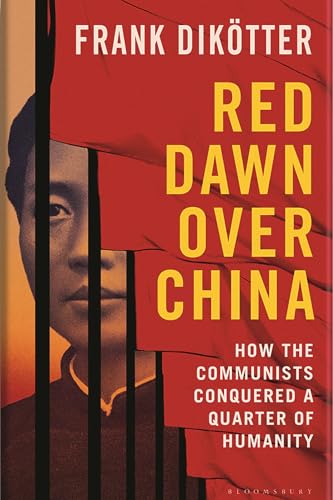
From renowned historian Frank Dikötter, a commanding history recasting how communists seized power in China.
In April 1927, soldiers and detectives descended upon the Russian Embassy in Beijing, revolvers drawn. An hour later, they emerged with a trove of documents, some of them partly damaged by Russians who had tried quickly to destroy them. In these singed and soggy papers was proof that Moscow, despite agreeing three years earlier not to “propagate communistic doctrines,” had, in fact, sent what amounts to millions in today's dollars, along with shiploads of arms and advisors to support nothing less than a revolution in China.
These findings are hardly ever mentioned by historians-until now. The history of modern China has long been framed as an organic enterprise, wherein Communists mobilized the “peasants,” took land from the rich and redistributed it to the poor. Drawing on the Beijing raid as well as several other overlooked archives, Red Star Over China reveals how unlikely a communist victory actually was, had it not been for massive financial and military support from the Soviet Union; a brutal war of occupation by Japan; severe miscalculations by the United States; and-most of all-the Party's unflinching will to conquer at all costs. Frank Dikötter reveals how what began in 1921 with thirteen delegates in a dusty room led to a red flag being raised over the Forbidden City in 1949, forever altering the course of history for a quarter of humanity and shaping the global balance of power as we know it today.
Frank Dikötter (Chinese: 馮客; pinyin: Féng Kè) is the Chair Professor of Humanities at the University of Hong Kong and Professor of the Modern History of China on leave from the School of Oriental and African Studies, University of London.
Born in the Netherlands in 1961, he was educated in Switzerland and graduated from the University of Geneva with a Double Major in History and Russian. After two years in the People's Republic of China, he moved to London where he obtained his PhD in History from the School of Oriental and African Studies (SOAS) in 1990. He stayed at SOAS as British Academy Postdoctoral Fellow and as Wellcome Research Fellow before being promoted to a personal chair as Professor of the Modern History of China in 2002. His research and writing has been funded by over 1.5 US$ million in grants from various foundations, including, in Britain, the Wellcome Trust, the Arts and Humanities Research Council, The Economic and Social Research Council and, in Hong Kong, the Research Grants Council and the Chiang Ching-kuo Foundation.
He has published a dozen books that have changed the ways historians view modern China, from the classic The Discourse of Race in Modern China (1992) to China After Mao: The Rise of a Superpower (2022). His 2010 book Mao's Great Famine: The History of China's Most Devastating Catastrophe was selected as one of the Books of the Year in 2010 by The Economist, The Independent, The Sunday Times, the London Evening Standard (selected twice), The Telegraph, the New Statesman and the BBC History Magazine, and is on the longlist for the 2011 Samuel Johnson Prize for non-fiction.
Frank Dikötter has set himself a difficult task—to explain how the Chinese Communists came to power in just over 270 pages in his book “Red Dawn Over China.” The challenge is compounded by the fact that Dikötter has chosen to focus on two aspects of the story: Moscow’s critical assistance to the Chinese Communist Party and the Party’s very brutal history in its march to power.
Both of these elements were critical but, in my opinion, by focusing so intensely on these two aspects, Dikötter has distorted their importance. To be fair, he touches on many of the other factors but in passing: the difficulty the Nationalists had in uniting the country, the contribution of foreign dominance to the raise of Chinese nationalism, the aggression of Japan, the impact of the global depression on the Chinese economy, the corruption and misrule of the Nationalist regime, etc.
Dikötter has broken the story into eight neat segments taking the reader from the roots of the party’s founding to its ultimate military victory in 1949. The book’s maps are very helpful in tracking the story and the author has made extensive use of Western and Chinese sources. There are a lot of names—people, places, and incidents—as you would expect in so sweeping a tale. But it becomes repetitive: Moscow sends people or money, the Communists take over an area, brutalize the population, and move on. I do not minimize the accuracy or importance of this. But the repetitiveness is boring after a bit.
The “then this happened” style narrative is also frustrating because there is so much more to the story, especially the fight for the control of the CCP by Mao and others against the faction sent and backed by Stalin, who was driven in large measure by his own struggle to consolidate his power in Russia. I think the book falls between two stools: too many names, places and events for the casual reader interested in how the Chinese revolution happened and not enough detail for someone who brings considerable knowledge to the book. For that second reader, I am not sure there is anything new in Red Dawn Over China.
I recommend the following books (some of them quite old now) for readers who want to understand the Chinese revolution, a precursor to understanding China (and Xi) of today: The Search for Modern China by Jonathan Spense (1990) is a very readable and sweeping narrative of China’s struggle “to stand up” from the Qing Dynasty to the start of the Deng Xiaoping era. Origins of the Chinese Revolution 1915-1949 by Lucien Bianco (1971) is an excellent examination of the intellectual roots of Chinese Communism and the role of nationalism. Moscow and the Chinese Communists by Robert C. North (1953 and 1962) is a detailed rendering of the complex, duplicitous, and often hostile relationship between Stalin and the men who contended for control of the party. And Mao the Unknown Story by Jung Chang and Jon Halliday (2005) is biography that is absolutely chilling in its portrayal of man.
Not a fan of the narrative approach by the author. The bias against the Mao and towards Chiang Kai-Shek was too aggravating at times. Mao was described as dishonest when using underhanded tactics, whilst Chiang Kai-Shek was praised as cunning when in similar situations.
Some of the writing was bland, repetitive and kept following the same structure of 'and then this happened in town X'. Not friendly to those with limited knowledge of this period in China's history.
Frank Dikötter’s “Red Dawn Over China: How Communism Conquered a Quarter of Humanity” is a concise, forceful account of the Chinese Communist Party’s rise to power—one that rejects the comforting mythology of an inevitable peasant revolution. Dikötter argues instead that Mao’s victory in 1949 emerged from a brutal convergence of civil war, foreign invasion, political coercion, opportunism, and institutional collapse. The result is not merely a history of Communist triumph, but an anatomy of how a revolutionary movement captures a state. The book’s greatest strength is its clarity. Dikötter writes with the momentum of narrative history while retaining an unsentimental eye for power. He restores contingency to events often told as foregone conclusions: the Nationalists were not simply doomed by corruption, nor were the Communists carried forward by spontaneous popular devotion. Both sides made consequential choices, but the CCP proved exceptionally effective at exploiting disorder, building disciplined local control, and using terror selectively enough to suppress opposition while presenting itself as the agent of reform. Dikötter is especially persuasive when describing the human cost embedded in Communist consolidation. Land reform, propaganda, rectification campaigns, and “mass participation” appear here not as abstract revolutionary programs but as instruments for identifying enemies, remaking village life, and binding ordinary people to a new political order through fear, complicity, and survival. His emphasis on coercion does not deny that many Chinese desired stability, land, national renewal, or an end to warlordism and Japanese occupation. Rather, it explains how those aspirations could be appropriated by a party determined to monopolize every source of authority. The portrait of Mao that emerges is chillingly pragmatic. He is neither a romantic guerrilla hero nor an omnipotent mastermind, but a leader whose strategic patience and ideological ruthlessness made him uniquely suited to China’s catastrophic mid-century upheaval. Dikötter also shows that Communist victory depended on structures as much as personalities: cadres, intelligence networks, disciplined armies, and a readiness to treat civilian society as terrain to be controlled. At 335 pages, the book moves briskly and occasionally leaves one wanting fuller engagement with Communist governance, Nationalist military constraints, and regional variation. Yet its compression is also a virtue. “Red Dawn Over China” is an incisive corrective to triumphalist revolutionary narratives and a sobering reminder that political legitimacy can be manufactured amid exhaustion, violence, and fear.
Frank Dikötter’s Red Dawn Over China is an antidote to the comforting myth that history unfolds according to destiny. There was nothing inevitable about the Chinese Communist Party’s victory in 1949. If anything, Dikötter presents it as a movement that repeatedly demonstrated an impressive ability to sabotage itself before finally inheriting a country whose ruling government seemed equally determined to self-destruct.
For readers expecting a tale of millions of Chinese peasants enthusiastically marching beneath red banners, Dikötter offers a far less romantic picture. The Communist Party’s most reliable supporters were not “the Chinese people” in any broad sense, but a comparatively small cadre of dedicated revolutionaries, political activists, opportunists, local collaborators, and those who calculated that surviving under the next regime was preferable to dying under the current one. Many ordinary Chinese, meanwhile, simply wanted to be left alone. They had survived warlords, Japanese invasion, famine, occupation, inflation, conscription, corruption, and enough competing political movements to conclude that ideology was largely a luxury enjoyed by people carrying rifles.
That distinction is one of the book’s greatest strengths. Dikötter reminds readers that silence should never be mistaken for enthusiasm. Compliance is not always consent, particularly when every available alternative seems capable of making life worse.
Equally fascinating is the role of the Soviet Union. Dikötter argues that Soviet involvement proved far more consequential than many popular histories acknowledge. Moscow’s support provided the CCP with critical opportunities while Stalin’s often complicated relationship with Chiang Kai-shek shaped the strategic environment in ways that repeatedly influenced the outcome of the conflict. Whether one agrees with every aspect of Dikötter’s interpretation, he makes a compelling case that the Communist victory cannot be understood solely as an indigenous uprising divorced from international politics.
Ironically, the CCP’s greatest enemy often appeared to be…the CCP. Internal purges, ideological disputes, factional rivalries, and periodic campaigns against insufficiently pure comrades gave the movement a remarkable tendency to consume its own leadership. Revolutionary movements frequently promise a brighter tomorrow; this one spent an astonishing amount of time making sure yesterday’s revolutionaries never lived long enough to see it. They were perfectly willing to eat their young, their old, and anyone unfortunate enough to be standing nearby when political winds shifted.
And yet they survived.
Why? Because the Nationalist government under Chiang Kai-shek consistently undermined its own position. Dikötter portrays a regime crippled by corruption, economic collapse, political miscalculation, and an inability to maintain popular confidence after years of exhausting warfare. While Communist propaganda certainly mattered, reality proved to be an even more persuasive recruiter. The Nationalists were often less defeated by Communist brilliance than by their own accumulating failures.
There is a deliciously sardonic lesson buried beneath the narrative. History often celebrates winners as though victory itself proves competence. Dikötter’s account suggests something far messier. The CCP did not simply seize victory through flawless strategy. It survived repeated self-inflicted wounds while its principal opponent repeatedly charged headfirst into disaster. Sometimes history is less a story of one side conquering the summit than of two exhausted climbers slipping down opposite sides of the mountain until one discovers they have landed slightly higher than the other.
Dikötter’s prose is accessible without sacrificing scholarship, and his willingness to challenge longstanding assumptions makes the book both engaging and provocative. Even readers who disagree with some of his conclusions will find themselves reconsidering familiar narratives about revolution, legitimacy, and popular support.
Ultimately, Red Dawn Over China is less a celebration of Communist triumph than an autopsy of Republican collapse. It reminds us that political movements need not be universally loved to prevail. Sometimes they merely need to remain standing after everyone else has finished setting themselves on fire. It is not the most inspiring path to power, but history has rarely shown much concern for elegance.
‘At heart, a romantic tale of Communism fighting in the hills of freedom, a David and Goliath story in which sympathy goes to the boy with the sling’
This book is an homage to all the victims of this rotten edifice of an ideology called Communism. Imagine an ideology that, when it materialized, reaped millions and millions of lives—people either brutally killed by a Georgian “pickpocket-turned-leader” or starved to death by a “peasant-turned-chairman” and his blinded myrmidons.
“Time and again, they discovered that there was no magical surplus to be doled out. The result of land seizure was greater poverty for all, as farmers with even the slightest portion of wealth were forcibly dispossessed.”
If we get past the last chapter of the book, which is centered around the civil war, then this book is a complete 10/10. The writer scrupulously detailed the horrors inflicted by the communists, who wiped out a whole generation of Chinese people. I can’t quite decide whether it was my fault or the writer’s that I couldn’t understand how this newcomer from out of the muck and mire, named Mao, had managed to climb the Party's ladder.
"Communism was never popular in China, no more so than in Finland or in the United States, and it was brought to the population at the barrel of the gun.”
What appeared to be a fringe movement started to attract many converts. The writer went into minute detail to show the world the brutality and savagery of the communist specimen that emerged in China. These red ideologues toppled the legitimate government, brutally conquered all of China and left it in shambles, and indoctrinated an entire population—the descendants of one of the grandest civilizations—through a sheer convergence of internal and external circumstances; the sea did indeed part for them.
Frank Dikötter is an eminent writer about China’s more recent history. This is another great book; about a difficult to understand episode in Chinese history (say from the 1920ies until 1949); “How communism conquered a quarter of humanity”. There is little “humanity” in the story and the simple summary is “what a mess”. The central theme of his book is that the communists were hardly popular with the Chinese people but still managed to outsmart Chiang Kai Chek and were victorious in the civil war.
What makes this book very worthwhile to read is to compare Dikötter's perspective on how China became communist, which is somewhat different from the narrative of the communist party of its own history. One inconvenient topic that is addressed in the book is who did the most fighting against the Japanese aggressors; the author has a clear opinion.
The overall story of the Chinese civil war is complicated and there is no simple explanation as to why the communists won. One recurring element is the extreme violence and ruthlessness applied by the communist, also within their own ranks. As a non Chinese reader I wonder how the Chinese people accepted all that, other than as a result of incredible violence. And also knowing that the suffering would continue for several decades until the death of Mao.
Sobering read about untold suffering of the Chinese people.
This book is an excellent read for those already well-versed in the trajectory of modern Chinese history. It offers a relatively novel conclusion—departing from conventional narratives—and reflects the kind of empirical analysis needed to truly comprehend such a complex and vast historical landscape. My thanks go to Professor Frank for his work.
I found this book enlightening, especially about how much was happening in China in the Thirties. Usually one hears only about a few things: the Northern Expedition, the purge of the communists by Chiang Kai-shek in 1927 and the Long March. This book explains the way the communist armies would capture a city or piece of territory and set up a soviet — and give the locals hell. Aside from executions and massacres so many men would be conscripted into the army that farming would suffer.
Chiang Kai-shek comes out of the story better than usual. If he had not had the Japanese invasion to contend with he might have crushed the communists and that psychopath Mao and saved China from the misery ahead.
Though Dikotter does not mention it, a big question in the United States in the Fifties was, “Who lost China?” The orthodox answer has been, “No one— the locals fought and the Kuomintang lost.” But no. As Dikotter explains the communist armies were well supplied by the Soviet Union and arsenals in Manchuria. Meanwhile the Truman administration starved Chiang Kai-shek of weapons etc. The communists did so by conning Westerners, portraying themselves as nominal communists who were really rural formers who wanted democracy and did a marvellous job of helping Chinese in areas they controlled. One of the most suckered westerners was Truman’s personal representative General George C. Marshall. Hook, line and sinker.
Dikotter draws attention to the fact that during the civil war after World War II, all the refugees headed towards the Kuomintang government. The Chinese had learned what to expect of communist from hard experience in the Thirties and Forties.
Communism was the worst thing to happen to China since the Mongol invasion seven centuries earlier.
Red Dawn Over China by Frank Dikötter is one of those gateway books. There is a lot of information that will probably lead you to looking up a bunch of other books on specific moments from the narrative. However, this is a shotgun blast of knowledge which can be overwhelming at times.
Dikötter tells the story of how the Communist Party took over China. Starting in the early 1900s, Dikötter shows how this was not some sort of predestined ascendancy. Rather, this was a concerted effort by Russia and a healthy dose of hubris and overconfidence by their opponents. It was also brutal, callous, and done with an iron fist.
Dikötter throws a lot of stuff at the reader. I only have a vague understanding of this time period in China and the author fills in a lot of gaps. However, it is not in-depth especially with the characters, and I am sure scholars may find certain entries which are a bit too simplified. That said, there is clearly extensive research done, and Dikötter certainly did his homework. If you are like me and a bit ignorant of this time period in this part of the world, give it a read.
(This book was provided as a review copy by NetGalley and Bloomsbury Pub.)
Some of the startling highlights from this book: The CCP was, for all intents and purposes, a creation of the Soviet Union, and in particular, after he achieved power, of Stalin. The Communists spent very little time or energy fighting the Japanese during WW2. They spent most of their energy fighting the Nationalists and establishing their grip on the small areas that they controlled through terror and mass murder. The cult of personality that Mao established was fully in place by the surrender of the Japanese in September of 1945. The Chinese Communist Party killed as a matter of policy. They starved, raped and murdered people in every area they controlled. The average Chinese peasant had no interest or knowledge of communism. The US political leadership was insanely naive about the intentions of Mao and the CCP. A horrifying read.
I come to this history as an avid amateur not a fellow historian or a diligent student of Chinese history. I found the introductory chapter persuasive and significant in supporting a counter argument to the uncritical (and deliberately misleading ) reporting by Edward Snow of Mao’s ( and the Communists) coming to power in China.
The balance of this book is a case of not explaining the forest, as each tree is identified and added to the list.
No doubt some of my losing interest is due to my unfamiliarity with Chinese names of people and places. But nonetheless that is what happened for me.
China was liberated... But at what cost? China treated cancer... But at what cost?
Honestly, flip to the back of this book and you will find exactly this sort of garbage summary of events. The throughline for a lot of this awful work of narrative history is that somehow Chiang Kai Shek, a fascist, is epic and cool and cunning when he uses underhanded tactics, but Mao is evil and sneaky when doing the same thing. Also, somehow it is some big surprise that the Soviets and the CPC worked together? As if liberal nations don't work together, or fascists don't work together to also achieve ideological goals?
Dit boek beschrijft de opkomst van het communisme in China en zijn vestiging met Mao. Gaat zeer ver in de verschillende stadia, maar er zijn zoveel namen en data en plaatsen dat men de bomen in het bos niet meer ziet, tenzij men de geschiedenis en het land grondig kent. De chaos die er in die jaren in China moet geweest zijn is overduidelijk en angstaanjagend. Doet zeker nadenken over het impact van leiders, propaganda, media en beïnvloedbaarheid van de massa hierdoor, wat leert dat de geschiedenis helaas niet leert om een betere wereld te verzekeren!!
The start was a bit painful - felt like a chronological list of things happening. But as it progressed more and more interesting points emerged. Like why the long march was handled by the Nationalists the way it was, about how well intentioned US efforts to limit fighting disproportionately helped one side, the impact of economics, etc. Ended up enjoying it and learning a fair bit. Would have been 5 stars if not for the slow start.
Not as good as some of his previous works, but great nonetheless. This is a great (and succinct) summation of the rise of the CCP and Mao’s politicking that explains the foundations of Modern Asia. Two complaints. 1) the civil war is so hurriedly covered. 2) more expansion on western ideologues’ infatuation with the CCP. Edward Snow is only fleetingly mentioned but is discussed by the author in interviews at great lengths.
Probably my first ever history book that I have finished. 10 foreign names and 4 dates per page, non of which I knew really. But overall interesting red to understand the struggles and power dynamics between Communists and Nationalists in China since the collapse of the empire and til the formation of the Communist China.
I had no clue that Communists in China used such brutal methods.