

What do you think?

And the Sea Gave Up the Dead
For fans of Jennifer Thorne's Diavola and We Have Always Lived in the Castle comes William Friend's latest stunning novel following a young woman's return to her family's crumbling chateau to stay with her aging aunt - but grief, mystery, and something undead haunts her family, and soon, a dark history will repeat itself.
"In the woods... between the trees..."
Morwenna knows she needs to visit Bethan. Her aunt is wasting away in the family's crumbling chateau by the French seaside, where she's lived alone since the mysterious disappearance of her husband. The locals claim Bethan is responsible, though Morwenna knows her aunt is simply declining and in desperate need of company.
Grief lives in that house, and Morwenna has avoided it for years. Until a disturbing phone call from Barbara finally pushes her to act. So she packs up her children and new partner to stay for a week.
But the chateau changes people. Old magic has seeped into the ground. The village remembers what happened at the grand old house, centuries ago. They remember who died, and what came back. Soon, this place will leave its mark on Morwenna's family. And she cannot escape the feeling that, unless she learns the truth about what happened to her uncle, something ancient and evil will rise, and a dark history will repeat itself at the chateau.
"In the woods... between the trees..."
Morwenna knows she needs to visit Bethan. Her aunt is wasting away in the family's crumbling chateau by the French seaside, where she's lived alone since the mysterious disappearance of her husband. The locals claim Bethan is responsible, though Morwenna knows her aunt is simply declining and in desperate need of company.
Grief lives in that house, and Morwenna has avoided it for years. Until a disturbing phone call from Barbara finally pushes her to act. So she packs up her children and new partner to stay for a week.
But the chateau changes people. Old magic has seeped into the ground. The village remembers what happened at the grand old house, centuries ago. They remember who died, and what came back. Soon, this place will leave its mark on Morwenna's family. And she cannot escape the feeling that, unless she learns the truth about what happened to her uncle, something ancient and evil will rise, and a dark history will repeat itself at the chateau.
304 pages, Paperback
First published August 18, 2026
Ratings & Reviews
Friends & Following
Create a free account to discover what your friends think of this book!
Community Reviews
Displaying 1 - 30 of 108 reviews

June 6, 2026
thank you to netgalley for this arc!!!
this was a solid gothic horror with a really strong atmosphere. the chateau, family secrets, and constant sense of dread/confusion made it super easy to get immersed in the story.
my main ‘criticism’ is that the pacing occasionally felt too slow, and some of the reveals didn't quite have the impact i was expecting after so much buildup. it was a bit more of a meandering plot, especially for the first half, so i wouldn’t go into this expecting action from the get go. the main reveal at the end did very much get me though!!
overall, it's a well-written, unsettling read with a great sense of creepy and disturbing atmosphere. definitely worth picking up if you enjoy gothic fiction and family-centred horror with a good helping of weirdness!!
this was a solid gothic horror with a really strong atmosphere. the chateau, family secrets, and constant sense of dread/confusion made it super easy to get immersed in the story.
my main ‘criticism’ is that the pacing occasionally felt too slow, and some of the reveals didn't quite have the impact i was expecting after so much buildup. it was a bit more of a meandering plot, especially for the first half, so i wouldn’t go into this expecting action from the get go. the main reveal at the end did very much get me though!!
overall, it's a well-written, unsettling read with a great sense of creepy and disturbing atmosphere. definitely worth picking up if you enjoy gothic fiction and family-centred horror with a good helping of weirdness!!

Review of advance copy received from NetGalley
2.5⭐️
Morwenna is traveling with her partner Christian and her children to visit her Aunt Bethan in the Var region of France, a mountainous area located on the southern coast. In telephone and mail communications, Aunt Bethan, who was widowed the previous year when her husband disappeared at sea, is giving Morwenna cause for concern as she seems to be having memory slips. Morwenna's own mother suffers from dementia, and she herself is a widow, having lost the father of her two boys nine years prior. Upon arrival at the grand but dusty chateau, Morwenna's anxiety for her aunt is at first validated, as Bethan has forgotten their visit and claims to still see her dead husband Jim. But as Bethan seems to grow healthier and stronger with each passing day, Morwenna finds her own grip on reality, and her relations with her family, slipping into the fog.
At first sustained by the gothic atmosphere, I found that And the Sea Gave Up the Dead squadered the buildup of the first 30% or so and became a tedious mess. There were way too many dangling threads as the story moved from atmosphere to action, and it read to me like the author wrote the novel with no clear story or objective in mind. I am a reader who generally likes ambiguity and I don't mind a minimal plot, but I ultimately found this book to have about as much substance as the creeping fog that surrounds the house. I also found some of the reveals at the end at once predictable and silly.
Thank you NetGalley and Poisoned Pen Press for the digital arc. And the Sea Gave Up the Dead will be published August 18, 2026.
Morwenna is traveling with her partner Christian and her children to visit her Aunt Bethan in the Var region of France, a mountainous area located on the southern coast. In telephone and mail communications, Aunt Bethan, who was widowed the previous year when her husband disappeared at sea, is giving Morwenna cause for concern as she seems to be having memory slips. Morwenna's own mother suffers from dementia, and she herself is a widow, having lost the father of her two boys nine years prior. Upon arrival at the grand but dusty chateau, Morwenna's anxiety for her aunt is at first validated, as Bethan has forgotten their visit and claims to still see her dead husband Jim. But as Bethan seems to grow healthier and stronger with each passing day, Morwenna finds her own grip on reality, and her relations with her family, slipping into the fog.
At first sustained by the gothic atmosphere, I found that And the Sea Gave Up the Dead squadered the buildup of the first 30% or so and became a tedious mess. There were way too many dangling threads as the story moved from atmosphere to action, and it read to me like the author wrote the novel with no clear story or objective in mind. I am a reader who generally likes ambiguity and I don't mind a minimal plot, but I ultimately found this book to have about as much substance as the creeping fog that surrounds the house. I also found some of the reveals at the end at once predictable and silly.
Thank you NetGalley and Poisoned Pen Press for the digital arc. And the Sea Gave Up the Dead will be published August 18, 2026.

Review of advance copy received from NetGalley
And the Sea Gave Up the Dead follows a woman, Morwenna, and her family, as they travel to France to visit her Aunt Bethan on holiday.
Morwenna has been putting off visiting Aunt Bethan for way too long, and she's starting to feel really guilty about it. Her aging Aunt just seems to be wasting away in the family chateau by the French seaside. Ever since her Uncle mysteriously disappeared, Bethan has lost her spark.

Packing up her new husband, Christian, and two sons, Jamie and Louis, the family heads out. It'll be good for them, and it'll be good for Morwenna to get eyes on Bethan, to assess her mental and physical health.
We follow the family as they arrive at the chateau and the boys get to meet their eccentric Great Aunt and tour the property. From the very start, Friend does an incredible job building up the atmosphere and uncertainty at this chateau.
Morwenna is an interesting character. She's had a lot of personal loss, and she also had a difficult time helping her own Mom through dementia. Because of that, she's extra sensitive to Bethan's every move, which is relatable.
This fact though also makes you wonder how much you can trust Morwenna's perspective. Is she overly sensitive? Is she seeing issues where there aren't any?
I liked that. Unreliable narrators are something I do tend to enjoy, and though I wouldn't classify her as a full-on unreliable narrator, there's an air about her, that makes your mind go, really, Morwenna? Are you sure?
I also loved how Friend kept me guessing. As I was reading, I had no idea what direction we were heading in. Was it a haunted house, or maybe a possession situation?

In a way, Friend's writing feels heavy. There's an ominous feeling drenching every moment. In addition to Morwenna's perspective, we also get the perspectives of her two young sons, Jamie and Louis. I thought Friend did a fantastic job showing the fear these boys experienced in this house.
The descriptions, and their thought-processes through these nail-biting moments, felt so realistic to me. Even though there is a lot of creepiness in this story however, you do need to have patience with it, not gonna lie.
At times it felt like it was taking forever to get anywhere, but at the same time, I was really eating up the building suspense and unpredictability.
As the conclusion approached, I actually felt fear for this family. I feel like because we'd taken our time getting there, I felt like I knew them, and I did start to care for them. Especially the boys.
This is one of those books where my first thoughts upon completion was, what the frick did I just read? My brain hurt (in a good way). That last 20%, what in actual...
I really liked it though. It was unexpected. There was so much going on, and all the moving pieces, I felt like Friend was pulling off some major slight of hand. I'd be looking one way, and something would happen just outside my peripheral vision to knock me off-center.
It was unsettling, and I think I'm going to be scratching my head about this conclusion for quite some time to come. I would recommend this for Horror Readers who don't mind a slow burn, and who love an unsettling atmosphere.
Thank you to the publisher, Poisoned Pen Press, for providing me with a copy to read and review. A fantastic Sophomore Showing from William Friend.
I look forward to more!
Morwenna has been putting off visiting Aunt Bethan for way too long, and she's starting to feel really guilty about it. Her aging Aunt just seems to be wasting away in the family chateau by the French seaside. Ever since her Uncle mysteriously disappeared, Bethan has lost her spark.
Packing up her new husband, Christian, and two sons, Jamie and Louis, the family heads out. It'll be good for them, and it'll be good for Morwenna to get eyes on Bethan, to assess her mental and physical health.
We follow the family as they arrive at the chateau and the boys get to meet their eccentric Great Aunt and tour the property. From the very start, Friend does an incredible job building up the atmosphere and uncertainty at this chateau.
Morwenna is an interesting character. She's had a lot of personal loss, and she also had a difficult time helping her own Mom through dementia. Because of that, she's extra sensitive to Bethan's every move, which is relatable.
This fact though also makes you wonder how much you can trust Morwenna's perspective. Is she overly sensitive? Is she seeing issues where there aren't any?
I liked that. Unreliable narrators are something I do tend to enjoy, and though I wouldn't classify her as a full-on unreliable narrator, there's an air about her, that makes your mind go, really, Morwenna? Are you sure?
I also loved how Friend kept me guessing. As I was reading, I had no idea what direction we were heading in. Was it a haunted house, or maybe a possession situation?
In a way, Friend's writing feels heavy. There's an ominous feeling drenching every moment. In addition to Morwenna's perspective, we also get the perspectives of her two young sons, Jamie and Louis. I thought Friend did a fantastic job showing the fear these boys experienced in this house.
The descriptions, and their thought-processes through these nail-biting moments, felt so realistic to me. Even though there is a lot of creepiness in this story however, you do need to have patience with it, not gonna lie.
At times it felt like it was taking forever to get anywhere, but at the same time, I was really eating up the building suspense and unpredictability.
As the conclusion approached, I actually felt fear for this family. I feel like because we'd taken our time getting there, I felt like I knew them, and I did start to care for them. Especially the boys.
This is one of those books where my first thoughts upon completion was, what the frick did I just read? My brain hurt (in a good way). That last 20%, what in actual...
I really liked it though. It was unexpected. There was so much going on, and all the moving pieces, I felt like Friend was pulling off some major slight of hand. I'd be looking one way, and something would happen just outside my peripheral vision to knock me off-center.
It was unsettling, and I think I'm going to be scratching my head about this conclusion for quite some time to come. I would recommend this for Horror Readers who don't mind a slow burn, and who love an unsettling atmosphere.
Thank you to the publisher, Poisoned Pen Press, for providing me with a copy to read and review. A fantastic Sophomore Showing from William Friend.
I look forward to more!

September 9, 2026
Morwenna and her two sons, 16 year old Jamie, and 7 year old Louis, take a road trip with Morwenna's boyfriend, Christian, to visit her Aunt Bethan at her chateau in France. Since her Uncle Jim passed away she has started growing concerned with her Aunt Bethan and whether she is beginning to shows signs of dementia like her own mother once had.
Upon arrival Morwenna is filled with dread. Light never seems to permeate the chateau as if they are always walking in shadows. Jamie grows angrier by the day and young Louis seems to have discovered a taste for the macabre which chills Morwenna to the bone. Christian is losing his patience with the boys and Bethan is an enigma she can't seem to unravel, one moment lucid and the next moment non-sensical. On top of that nightmares plague Morwenna's sleep.
Has an empowering darkness seeped into the walls of the chateau? You'll have to read this to find out!
I loved Friend's debut Let Him In so I was really looking forward to this one. Unlike many readers I tend to peruse reviews before starting a book and I was surprised at the amount of negative reviews from readers that also enjoyed his debut. I was a little worried of how my experience would fare. Now that I've finished I agree with all the reviewers both positive and negative.
Friend is undoubtedly a talented writer. The atmosphere is rich in foreboding dread but the pacing is slow. Friend takes his time painting the picture and that requires a lot of the readers patience. This is a relatively short novel but seems to read much longer than it is. If Friend doesn't pique your interest early on then many readers, as per the reviews, were unable to finish this. There was just enough here to keep me curious and flipping the pages. It's all very mysterious and I was constantly wondering what path we were being led down. I never would have guessed the ending though I can't say I entirely understood it either.
I may not have loved this but I definitely liked it well enough and I'm eager to see what Friend thinks up next. Recommended with caution. 3 stars!
Upon arrival Morwenna is filled with dread. Light never seems to permeate the chateau as if they are always walking in shadows. Jamie grows angrier by the day and young Louis seems to have discovered a taste for the macabre which chills Morwenna to the bone. Christian is losing his patience with the boys and Bethan is an enigma she can't seem to unravel, one moment lucid and the next moment non-sensical. On top of that nightmares plague Morwenna's sleep.
Has an empowering darkness seeped into the walls of the chateau? You'll have to read this to find out!
I loved Friend's debut Let Him In so I was really looking forward to this one. Unlike many readers I tend to peruse reviews before starting a book and I was surprised at the amount of negative reviews from readers that also enjoyed his debut. I was a little worried of how my experience would fare. Now that I've finished I agree with all the reviewers both positive and negative.
Friend is undoubtedly a talented writer. The atmosphere is rich in foreboding dread but the pacing is slow. Friend takes his time painting the picture and that requires a lot of the readers patience. This is a relatively short novel but seems to read much longer than it is. If Friend doesn't pique your interest early on then many readers, as per the reviews, were unable to finish this. There was just enough here to keep me curious and flipping the pages. It's all very mysterious and I was constantly wondering what path we were being led down. I never would have guessed the ending though I can't say I entirely understood it either.
I may not have loved this but I definitely liked it well enough and I'm eager to see what Friend thinks up next. Recommended with caution. 3 stars!

August 20, 2026
3,5*
This is a great example of a tale in which you will question if it is places or people that are haunted.
Morwenna returns to her family’s crumbling chateau to spend some time with her aging aunt but something else is waiting there for her and her family.
The chateau is by the French seaside and Mowenna’s sons will have the chance to play on the beach and make some summer friends. But grief will hold on to this family with teeth and nails. A tragic past, an unbearable loss and an uncertain future.
The chateau changes people. Morwenna sees how the place is affecting her family and she will have to make a decision before it is too late.
The story had at the beginning a lot of that gothic mysterious atmosphere but the plot started to become quite convoluted and it ended up being more enjoyable for the atmosphere, setting and mood than for the plot, unfortunately.
However I did enjoy the book and I can see why people compare it with Diavola by Jennifer Thorne, which is the reason why I wanted to read it.
The pacing was quite slow but it does catch up a bit towards the end where all the plot twists happen. Some of which you already suspected. But I have to say again…there were too many things and themes the author rammed into this book and it was uncertain at times what the core message of the book was. That grief is a beast we can never escape and it will always catch up with us sooner or later no matter where we are. Moving on from grief is not possible unless you face it first.
Still, I would recommend this book to other readers and I am excited to see what the author does next because there were some good creepy moments in the book and it had a really good atmosphere.
This is a great example of a tale in which you will question if it is places or people that are haunted.
Morwenna returns to her family’s crumbling chateau to spend some time with her aging aunt but something else is waiting there for her and her family.
The chateau is by the French seaside and Mowenna’s sons will have the chance to play on the beach and make some summer friends. But grief will hold on to this family with teeth and nails. A tragic past, an unbearable loss and an uncertain future.
The chateau changes people. Morwenna sees how the place is affecting her family and she will have to make a decision before it is too late.
The story had at the beginning a lot of that gothic mysterious atmosphere but the plot started to become quite convoluted and it ended up being more enjoyable for the atmosphere, setting and mood than for the plot, unfortunately.
However I did enjoy the book and I can see why people compare it with Diavola by Jennifer Thorne, which is the reason why I wanted to read it.
The pacing was quite slow but it does catch up a bit towards the end where all the plot twists happen. Some of which you already suspected. But I have to say again…there were too many things and themes the author rammed into this book and it was uncertain at times what the core message of the book was. That grief is a beast we can never escape and it will always catch up with us sooner or later no matter where we are. Moving on from grief is not possible unless you face it first.
Still, I would recommend this book to other readers and I am excited to see what the author does next because there were some good creepy moments in the book and it had a really good atmosphere.

Did Not Finish
August 12, 2026DNF @ 32%
Perhaps folk horror is just not for me; however, I also think the author's writing style is not a match for what I like in this genre. I tend to like Gothics that feature a lot of imagery and a stronger emotional impact. I don't mind a more detached writing style (like Zola), but even that usually has very vivid descriptions.
There were scenes where I would've loved more detail. For example, the lack of in-depth description of the chateau felt, to me, like a real missed opportunity to amp up the atmosphere; the lack of it made the story feel flat, and I was never moved by any weird happenings in the chateau as a result. Perhaps the focus was meant to be on the characters, but because the narrator is so detached, I wasn't interested in reading about anyone in this story and was bored.
Ultimately, it's just an expectations mismatch, but I think there is an audience for this. People who liked Home Sick by Rhiannon Grist might appreciate this book.
Perhaps folk horror is just not for me; however, I also think the author's writing style is not a match for what I like in this genre. I tend to like Gothics that feature a lot of imagery and a stronger emotional impact. I don't mind a more detached writing style (like Zola), but even that usually has very vivid descriptions.
There were scenes where I would've loved more detail. For example, the lack of in-depth description of the chateau felt, to me, like a real missed opportunity to amp up the atmosphere; the lack of it made the story feel flat, and I was never moved by any weird happenings in the chateau as a result. Perhaps the focus was meant to be on the characters, but because the narrator is so detached, I wasn't interested in reading about anyone in this story and was bored.
Ultimately, it's just an expectations mismatch, but I think there is an audience for this. People who liked Home Sick by Rhiannon Grist might appreciate this book.

June 12, 2026
comparing this book to “diavola” is such a disservice bc this book was TONS better than that one.
thanks to netgalley for the arc!!
thanks to netgalley for the arc!!

August 7, 2026
Review of an advanced copy received from NetGalley
2.5 stars
I don’t know if I’m angry, tired, impressed, or legally obligated to sue the château.
And the Sea Gave Up the Dead has a very strong premise: a widowed woman, two sons, a house in France, a grief that never quite closes, and a gothic atmosphere where the past seems to be seeping through the walls. At its best, the book does manage something beautiful and sad: it speaks about motherhood after loss, about the fear of your children growing away from you, about the temptation to keep living with the dead because the living inevitably change.
The problem is that this emotional core is buried under approximately seventeen layers of twists, symbols, ghosts, revenants, dreams, fake dreams, visions, trauma, blood, the sea, clocks, wheels, haunted houses, dead lovers, confused teenagers, supernatural predators, and very late explanations.
There are moments when the book works. Morwenna remembering David, her pain as she accepts that he will not come back, and the final idea that “to live is to change” do carry weight. Her relationship with her sons is also interesting: Jamie is no longer the child she understands, Louis is on that strange edge between childhood and independence, and Morwenna does not know how to be a mother without turning grief into a cage. I liked that.
But the book does not trust that drama. Every time it seems ready to sit with an emotion, it screams “plot twist!” and throws another chair out the window.
First it seems like a story about grief. Then a haunted house story. Then a ghost story. Then a revenant story. Then a story about family secrets. Then a story about predation, guilt, and murder. Then it turns out half the world is dead, except when it isn’t, but also yes, but it depends on the threshold, the sea, Halloween, judgment in the afterlife, and who has unfinished business. By the time the final explanation arrives, I did not feel enlightened; I felt like the book was trying to hand me a map after deliberately getting me lost for 200 pages.
And yes: I understand the metaphor. The house is grief. The sea is death. David represents the love that must be released. Bethan represents attachment to the past. Christian is selfish, predatory desire, rejected even by the afterlife. The children represent the future. All of that is there. The problem is that the book builds so much supernatural machinery around the metaphor that the story ends up seeming like it wants to be The Haunting of Hill House, The Sixth Sense, a family drama, a gothic thriller, and a moral tale all at once.
Not everything is bad: The prose has some beautiful moments and some of the images are genuinely unsettling. The idea of the dead being trapped in a house that refuses to let them go is good, but the execution felt excessive, manipulative, and, at times, exhausting. There are too many consecutive “ah, but actually…” moments. After a certain point, every new twist stopped surprising me and started making me laugh.
My biggest frustration is that the book had a clear and strong emotional story: a woman who must choose to live, even if that means leaving behind the man she loves. That was enough. We did not need a magic wheel, three levels of death, an explanation of who came back and who did not, a revenant villain, seductive teenage ghosts, and a dead aunt functioning as a spiritual guide with a haunted Airbnb complex.
In the end, what hit me the hardest was not the mystery, but the feeling of emotional fraud: the book asked me to invest in the horror, the grief, the threat, the house, the dead, Christian, David, Jim, Bethan, the children… only to resolve everything with a fairly simple moral: living means changing.
Beautiful message. Ridiculous journey.
The real haunted house was the grief processing we did along the way, and maybe that was the point.
But also: fuck you, book.
2.5 stars
I don’t know if I’m angry, tired, impressed, or legally obligated to sue the château.
And the Sea Gave Up the Dead has a very strong premise: a widowed woman, two sons, a house in France, a grief that never quite closes, and a gothic atmosphere where the past seems to be seeping through the walls. At its best, the book does manage something beautiful and sad: it speaks about motherhood after loss, about the fear of your children growing away from you, about the temptation to keep living with the dead because the living inevitably change.
The problem is that this emotional core is buried under approximately seventeen layers of twists, symbols, ghosts, revenants, dreams, fake dreams, visions, trauma, blood, the sea, clocks, wheels, haunted houses, dead lovers, confused teenagers, supernatural predators, and very late explanations.
There are moments when the book works. Morwenna remembering David, her pain as she accepts that he will not come back, and the final idea that “to live is to change” do carry weight. Her relationship with her sons is also interesting: Jamie is no longer the child she understands, Louis is on that strange edge between childhood and independence, and Morwenna does not know how to be a mother without turning grief into a cage. I liked that.
But the book does not trust that drama. Every time it seems ready to sit with an emotion, it screams “plot twist!” and throws another chair out the window.
First it seems like a story about grief. Then a haunted house story. Then a ghost story. Then a revenant story. Then a story about family secrets. Then a story about predation, guilt, and murder. Then it turns out half the world is dead, except when it isn’t, but also yes, but it depends on the threshold, the sea, Halloween, judgment in the afterlife, and who has unfinished business. By the time the final explanation arrives, I did not feel enlightened; I felt like the book was trying to hand me a map after deliberately getting me lost for 200 pages.
And yes: I understand the metaphor. The house is grief. The sea is death. David represents the love that must be released. Bethan represents attachment to the past. Christian is selfish, predatory desire, rejected even by the afterlife. The children represent the future. All of that is there. The problem is that the book builds so much supernatural machinery around the metaphor that the story ends up seeming like it wants to be The Haunting of Hill House, The Sixth Sense, a family drama, a gothic thriller, and a moral tale all at once.
Not everything is bad: The prose has some beautiful moments and some of the images are genuinely unsettling. The idea of the dead being trapped in a house that refuses to let them go is good, but the execution felt excessive, manipulative, and, at times, exhausting. There are too many consecutive “ah, but actually…” moments. After a certain point, every new twist stopped surprising me and started making me laugh.
My biggest frustration is that the book had a clear and strong emotional story: a woman who must choose to live, even if that means leaving behind the man she loves. That was enough. We did not need a magic wheel, three levels of death, an explanation of who came back and who did not, a revenant villain, seductive teenage ghosts, and a dead aunt functioning as a spiritual guide with a haunted Airbnb complex.
In the end, what hit me the hardest was not the mystery, but the feeling of emotional fraud: the book asked me to invest in the horror, the grief, the threat, the house, the dead, Christian, David, Jim, Bethan, the children… only to resolve everything with a fairly simple moral: living means changing.
Beautiful message. Ridiculous journey.
The real haunted house was the grief processing we did along the way, and maybe that was the point.
But also: fuck you, book.
This entire review has been hidden because of spoilers.

August 26, 2026
It has taken me three days to write this review. Horror is absolutely not my genre but I was intrigued by the sense of dread, exploration of grief and relationships with children changing as they grow and age.
This book just…tried to do too many things at once. If it chose 3 or 5, fine. Especially with how short it is. But we have the grief of two characters, a murder mystery, multiple mental breaks/psychoses, haunted house, undead, dreamwalkers, sexy magic twins, paranormal elderly lesbians, a feud with the entire town, an abusive stepdad, a coming out story, vampires, revenants, religious cults, magic artifacts, more murder, then the dumbest most predictable but unsatisfying nonsensical plot twist ever. this one is headed straight to the LFL
This book just…tried to do too many things at once. If it chose 3 or 5, fine. Especially with how short it is. But we have the grief of two characters, a murder mystery, multiple mental breaks/psychoses, haunted house, undead, dreamwalkers, sexy magic twins, paranormal elderly lesbians, a feud with the entire town, an abusive stepdad, a coming out story, vampires, revenants, religious cults, magic artifacts, more murder, then the dumbest most predictable but unsatisfying nonsensical plot twist ever. this one is headed straight to the LFL
August 28, 2026
Has plenty of good (which is to say, not always likeable) character writing and moments of fine, exquisitely doled out horror—right until it no longer does, and then it is sweet and lovely bitter, which is a perilous turn for fiction, but to my mind William Friend handles it damnably well. Tinklingly. Like glissandos on an extradiagetic harp.
____
This review has been based on an advanced review copy, provided by Poisoned Pen Press through NetGalley. Bias? Exists, for as long as my heart wakes.
____
This review has been based on an advanced review copy, provided by Poisoned Pen Press through NetGalley. Bias? Exists, for as long as my heart wakes.

Review of advance copy received from NetGalley
I loved Let Him In - Friend takes a similar concept but flips the perspective. A slow build, pressure cooking plot and ending with so many revelations
I loved the challenge of surviving life - you don't recover from some losses, like partner who has been by your side by decades. The stickiness of dating his best friend a few years later, forming a bond turned into romance.
Aging family members - struggles with their bodies and mental health. The castle is just perfection. Bethan - always a little off kilter.
And of course - children who experience everything on a different level.
I loved the challenge of surviving life - you don't recover from some losses, like partner who has been by your side by decades. The stickiness of dating his best friend a few years later, forming a bond turned into romance.
Aging family members - struggles with their bodies and mental health. The castle is just perfection. Bethan - always a little off kilter.
And of course - children who experience everything on a different level.

September 5, 2026
4.5/5⭐️ OK, I seriously did not see that plot twist coming, but absolutely loved it! This story will not be for everyone: it has an extremely slow build-up, a lot of focus on atmosphere (and by the gods is this well-done, extremely unnerving and even claustrophobic at times), and various seemingly random story threads, all meant to lull you into false conclusions. Themes such as grief, handling guilt, and changing family dynamics are really well-handled. The one complaint I do have, however, is that I felt that the reveal of the "big bad" was relatively abrupt, with a mask seemingly slipping out of nowhere, without almost the tiniest hint or tease before that.
That being said: that opening chapter was, in my humble opinion, iconic, and immediately sets the tone for the rest of the story.
A big thanks to Poisoned Pen Press and NetGalley for this ARC!
That being said: that opening chapter was, in my humble opinion, iconic, and immediately sets the tone for the rest of the story.
A big thanks to Poisoned Pen Press and NetGalley for this ARC!
This entire review has been hidden because of spoilers.

August 20, 2026
I was excited to read this book. I love seaside settings and gothic horror, and I really thought this would be a great read. It was not.
This book is about Morwenna and her family visiting an old aunt in a seaside town in France. Morwenna’s uncle died a mysterious death years ago, and she hasn’t visited the chateau since the death of her own husband. The chateau is wreathed in mystery, and there are secrets to be uncovered.
I expected a slow burn gothic horror from this book. The pacing of the book was horrible. It wasn't a slow burn, it was no burn. I literally kept falling asleep reading this book, it was so slow.
I did like some of the backstory of the chateau, and I thought there were some great scary scenes. However, there was a drastic lack of focus in this book overall. It kept pingponging around within each POV to the most strange tangents that didn’t add to the story. There was some character development, but the lack of focus meant that the development that did get through had to survive a maze of purple prose and several unnecessary tangents to be absorbed by the reader. Honestly, I don’t think it made it. Also, there was some weird period stuff that was just odd and unnecessary and read like it was written by a 13 year old boy who just found out that girls have them.
Ultimately, this book read to me like the manuscript your 20 year old hipster boyfriend who smokes clove cigarettes and lots of pot to “open his mind” gives you to read in college because he wants you to tell him how brilliant he is and how wonderful it is for him to suffer the “midnight disease” so that the rest of us can enjoy his genius prose. I can’t not recommend this one enough.
This book is about Morwenna and her family visiting an old aunt in a seaside town in France. Morwenna’s uncle died a mysterious death years ago, and she hasn’t visited the chateau since the death of her own husband. The chateau is wreathed in mystery, and there are secrets to be uncovered.
I expected a slow burn gothic horror from this book. The pacing of the book was horrible. It wasn't a slow burn, it was no burn. I literally kept falling asleep reading this book, it was so slow.
I did like some of the backstory of the chateau, and I thought there were some great scary scenes. However, there was a drastic lack of focus in this book overall. It kept pingponging around within each POV to the most strange tangents that didn’t add to the story. There was some character development, but the lack of focus meant that the development that did get through had to survive a maze of purple prose and several unnecessary tangents to be absorbed by the reader. Honestly, I don’t think it made it. Also, there was some weird period stuff that was just odd and unnecessary and read like it was written by a 13 year old boy who just found out that girls have them.
Ultimately, this book read to me like the manuscript your 20 year old hipster boyfriend who smokes clove cigarettes and lots of pot to “open his mind” gives you to read in college because he wants you to tell him how brilliant he is and how wonderful it is for him to suffer the “midnight disease” so that the rest of us can enjoy his genius prose. I can’t not recommend this one enough.
August 18, 2026
⭐️⭐️⭐️⭐️
And the sea gave up the dead by William Friend
Published by @poisonedpenpress
OUT NOW!!!
For the fans of Diavola by Jennifer Thorne!
I loved that book so much that i needed to read this book.
We have Morwenna who is the main character and her kids go to an old French chateau that is in the family.
Eerie vibes all from the moment she arrives there.
In the chateau lives her aunt Bethan alone.
Her husband is gone and nobody knows what happend to him.
Morwenna and the kids notice that not everything is right with the place.
Rooms and time shift and all strange things happen.
We have a lot of folklore and questions that will rise to your thoughts.
What is the sea and the chateau are trying to say and does Morwenna knows the truth in time?
This is one for the spooky HALLOWEEN month!!
Thanks to @netgalley and @poisonedpenpress
for my E arc
Poisonedpenpress You always deliver the best books!
Thanks to @williamfriendauthor for this spooky and Eerie story. It will haunt my brain for months to come.
#netgalley #andtheseagaveupthedead
#booksta #booktok #books
And the sea gave up the dead by William Friend
Published by @poisonedpenpress
OUT NOW!!!
For the fans of Diavola by Jennifer Thorne!
I loved that book so much that i needed to read this book.
We have Morwenna who is the main character and her kids go to an old French chateau that is in the family.
Eerie vibes all from the moment she arrives there.
In the chateau lives her aunt Bethan alone.
Her husband is gone and nobody knows what happend to him.
Morwenna and the kids notice that not everything is right with the place.
Rooms and time shift and all strange things happen.
We have a lot of folklore and questions that will rise to your thoughts.
What is the sea and the chateau are trying to say and does Morwenna knows the truth in time?
This is one for the spooky HALLOWEEN month!!
Thanks to @netgalley and @poisonedpenpress
for my E arc
Poisonedpenpress You always deliver the best books!
Thanks to @williamfriendauthor for this spooky and Eerie story. It will haunt my brain for months to come.
#netgalley #andtheseagaveupthedead
#booksta #booktok #books
August 19, 2026
Even though I found this book very plodding, I still enjoyed the first half. The mystery surrounding the Chateau kept me curious, and I wanted to know what it was all building toward.
Unfortunately, the payoff never came. I found the ending disappointing, completely lackluster, and, frankly, it made very little sense to me. I love a good slow burn, but this one had no burn. It was just slow, with no satisfying payoff at the end.
I also found the frequent interjections of French distracting. Rather than adding to the atmosphere, they kept pulling me out of the story.
There was enough intrigue in the first half to keep me reading, but ultimately the ending undid much of what I had enjoyed along the way. Unfortunately, I can't recommend this one.
Unfortunately, the payoff never came. I found the ending disappointing, completely lackluster, and, frankly, it made very little sense to me. I love a good slow burn, but this one had no burn. It was just slow, with no satisfying payoff at the end.
I also found the frequent interjections of French distracting. Rather than adding to the atmosphere, they kept pulling me out of the story.
There was enough intrigue in the first half to keep me reading, but ultimately the ending undid much of what I had enjoyed along the way. Unfortunately, I can't recommend this one.

Review of advance copy received from NetGalley
Deliciously twisted, sensuously morbid - And the Sea Gave Up the Dead is the gothic portrait of a family splintered. When Morwenna, her partner, and her sons pay a visit to her ailing aunt’s chateau on the French seaside, unsettling things begin fomenting in the shadows. Mysteries surrounding the chateau deepen and grief overwhelms the spaces in between, appertaining the reality of loss, and the loss of reality.
Written with sonorous prose, the novel unfolds at a languid pace and seamlessly shifts between character perspectives. Bits of each family member’s personality and latent memories are dispensed at just the right intervals to capture attention, as well as further the narrative, which elapses over the span of about a week. The French setting is moody and rich, from the beach to the thicket of woods surrounding the chateau, to the chateau itself. The novel employs a wide array of horror, both psychological and supernatural. Eerie, disquieting, and foreboding; I found the creepiness delectable.
It's a novel that you can tell is carefully composed - stories within stories that parallel the film and folklore motif throughout. Everything culminates adroitly by the end. While the conclusion itself is not a novel concept, it is rendered with enough idiosyncrasy that I didn't mind the nature of the twist. Everything clicks into place satisfyingly. It might be a slow burn, but a worthwhile one.
Ultimately, I think And the Sea Gave Up the Dead is a splendid, spooky read that I thoroughly enjoyed. Recommended to those looking for a haunted family drama with complicated dynamics and dread steeped into every page.
Thank you to NetGalley and Poisoned Pen Press for the opportunity to read this book.
Written with sonorous prose, the novel unfolds at a languid pace and seamlessly shifts between character perspectives. Bits of each family member’s personality and latent memories are dispensed at just the right intervals to capture attention, as well as further the narrative, which elapses over the span of about a week. The French setting is moody and rich, from the beach to the thicket of woods surrounding the chateau, to the chateau itself. The novel employs a wide array of horror, both psychological and supernatural. Eerie, disquieting, and foreboding; I found the creepiness delectable.
It's a novel that you can tell is carefully composed - stories within stories that parallel the film and folklore motif throughout. Everything culminates adroitly by the end. While the conclusion itself is not a novel concept, it is rendered with enough idiosyncrasy that I didn't mind the nature of the twist. Everything clicks into place satisfyingly. It might be a slow burn, but a worthwhile one.
Ultimately, I think And the Sea Gave Up the Dead is a splendid, spooky read that I thoroughly enjoyed. Recommended to those looking for a haunted family drama with complicated dynamics and dread steeped into every page.
Thank you to NetGalley and Poisoned Pen Press for the opportunity to read this book.
August 18, 2026
I won this book in a giveaway and god am I grateful because it was fantastic. It grabbed my attention and did not let it go. Mesmerizing, curious, haunting, and surprising (and it’s hard to surprise me). If you like mysteries and folklore, I recommend this one.
August 4, 2026
this was an eerily gothic horror story that was told very well. I felt at times it was a little choppy but overall the premise of the book was good. It was a pretty quick read and if I had time I would have sat down and read the whole thing in one sitting. Definitely a good choice for halloween coming up! Thank you poisoned pen press and net galley for the e arc.

June 7, 2026
I requested this book having loved the author’s Let Him In. Early on, I found didn’t gel with the French setting nor the characters. It didn’t feel natural to me so I read on unconvinced, which is often the nail in the coffin when reading horror. The authors last book was beautifully ‘normal’ and had a Hill House (the show, not the book) feel with the emotional undertones of the characters and the grief. The horror was incredibly well done in the background of this very human and emotional element. This instead felt like a tall tale and I didn’t get swept away with it sadly. DNF.
Thanks to Netgalley for the arc.
Thanks to Netgalley for the arc.

September 7, 2026
3⭐️
The years have passed for Morwenna and she feels guilty for not seeing nor hearing from her reclusive Aunt Bethan. Morwenna decides to take her boyfriend and two sons with her across the Channel and vacation with her aunt for awhile. From the moment they make the climb to Bethan's crumbling chateau, Morwenna feels unease and terror, visions of her sons bloody and her boyfriend dead. When they make it to the manor, Morwenna's tensions are only intensified by the appearance and odd actions of her Aunt Bethan. All of the characters then start to have terrible hallucinations, experiences and changes in their behavior. Is Aunt Bethan really Bethan or is the landscape of the chateau changing everyone for the worse?
My opinion:
I was excited at first about reading this, but the pacing was incredibly slow. I couldn't get into it as much as I was hoping I would. The characters were interesting, but there wasn't enough about them that was fleshed out for me to care. And I really hated a lot about the ending. The ending felt like a cope out and unfortunately rushed. I'm disappointed in how it turned out. I think this could have been a really captivating book, but there were too many things that weren't fleshed out.
Thank you to NetGalley, the publisher and author for an advanced reader's copy for review. All opinions are my own.
The years have passed for Morwenna and she feels guilty for not seeing nor hearing from her reclusive Aunt Bethan. Morwenna decides to take her boyfriend and two sons with her across the Channel and vacation with her aunt for awhile. From the moment they make the climb to Bethan's crumbling chateau, Morwenna feels unease and terror, visions of her sons bloody and her boyfriend dead. When they make it to the manor, Morwenna's tensions are only intensified by the appearance and odd actions of her Aunt Bethan. All of the characters then start to have terrible hallucinations, experiences and changes in their behavior. Is Aunt Bethan really Bethan or is the landscape of the chateau changing everyone for the worse?
My opinion:
I was excited at first about reading this, but the pacing was incredibly slow. I couldn't get into it as much as I was hoping I would. The characters were interesting, but there wasn't enough about them that was fleshed out for me to care. And I really hated a lot about the ending. The ending felt like a cope out and unfortunately rushed. I'm disappointed in how it turned out. I think this could have been a really captivating book, but there were too many things that weren't fleshed out.
Thank you to NetGalley, the publisher and author for an advanced reader's copy for review. All opinions are my own.

September 30, 2026
3.5⭐️ solid. This was a good page turner & I really liked the twist at the end. I was thinking it was one thing & then BAM….it was different! This takes place in a creepy French Chateau where the townsfolk believe that it’s haunted by vampires. So I’d definitely recommend reading it if you like gothic horror but there is NO audiobook available.
Review of advance copy received from NetGalley
4.5
A thrilling sea-side horror about grief and what it means to live its wake.
And the Sea Gave up the Dead is so much more than a haunted house story; rather, it is an atmospheric battle of how our past can define us. The main character’s grief is so consuming that it presents itself as a character within the narrative alongside the main cast.
One of the most compelling parts of this story is the family itself. They feel as unique as the town Friend casts. He manages to wonderfully balance each character’s arc, so no one feels underdeveloped. While this is a horror story so much about it is about life transitions. The family feels very realistic in that way. While the mother is battling her own fears about her children, her eldest son is going on a coming-of-age journey. Friend does a wonderful job of showing how one event can be seen through so many eyes, including the history of the town.
I won’t spoil anything about the town or the house, but the setting made this novel. The history of the town feels like the type of story you would hear from at a local pub or on a ghost tour. History is alive in the town, and those who live inside it are subjected to this living legacy. Anyone who grew up in a small town will feel at home within this story of over-invested locals and odd claims to fame.
Finally, Friend’s pacing was fantastic. Unlike so many mysteries, it does not feel like information is being held back to trick us as readers. Rather we are learning with the characters, and each reveal brings with it a new wave of dread. I would honestly recommend this novel for its pacing alone. Every sentence in this book helps move the plot forward.
Overall, I would recommend this story for fans of history, mystery and family horror. I will be looking out for more of Friend’s novels in the future. Arc provided to me for review.
A thrilling sea-side horror about grief and what it means to live its wake.
And the Sea Gave up the Dead is so much more than a haunted house story; rather, it is an atmospheric battle of how our past can define us. The main character’s grief is so consuming that it presents itself as a character within the narrative alongside the main cast.
One of the most compelling parts of this story is the family itself. They feel as unique as the town Friend casts. He manages to wonderfully balance each character’s arc, so no one feels underdeveloped. While this is a horror story so much about it is about life transitions. The family feels very realistic in that way. While the mother is battling her own fears about her children, her eldest son is going on a coming-of-age journey. Friend does a wonderful job of showing how one event can be seen through so many eyes, including the history of the town.
I won’t spoil anything about the town or the house, but the setting made this novel. The history of the town feels like the type of story you would hear from at a local pub or on a ghost tour. History is alive in the town, and those who live inside it are subjected to this living legacy. Anyone who grew up in a small town will feel at home within this story of over-invested locals and odd claims to fame.
Finally, Friend’s pacing was fantastic. Unlike so many mysteries, it does not feel like information is being held back to trick us as readers. Rather we are learning with the characters, and each reveal brings with it a new wave of dread. I would honestly recommend this novel for its pacing alone. Every sentence in this book helps move the plot forward.
Overall, I would recommend this story for fans of history, mystery and family horror. I will be looking out for more of Friend’s novels in the future. Arc provided to me for review.
September 4, 2026
Many thanks to the Poisoned Pen Press, William Friend and NetGalley for the ARC.
This story brings forth a horror story with gothic themes, local town lore, superstitions, reclusiveness, and unsolved mystery which are all entangled in a family setting. Unresolved past, longing for deceased ones, past regrets, isolation and how a haunted house changes all of its dwellers were weaved to deliver a unique story that explores not just uncovering hidden secrets but also navigating a troubled family and how to resolve this issue.
At the novel, we follow Morwenna’s vacation to a French countryside after deciding to pay a visit to her aunt Bethan who has grown distant with her based on her recent correspondence with her aunt. Morwenna takes her two kids and boyfriend to accompany her and spend the vacation on a seaside getaway. As the story unfolds, the author delivers the telling of events using third-person POV. The narration also took a slow story building by prioritising first the introduction of the characters’ dynamics and explaining Morwenna’s state of mind especially her thoughts with her aunt.
Throughout the story, readers can also expect a creative narration of backstories which are injected alongside the flow of current events. A major plot turn happened at the middle of the book, which served as an introduction to the local lore and superstition that drove the next half of the story.
What I liked about the author’s literary prose is the world building and how he described an eerie setting which for me is necessary to help the readers feel more the background and not just tell that a location is scary without any further explanation. The usage of an old chateau, old paintings, antiques, dim-lighted local parish, creeping fog, a gothic group holding candles and wearing gothic clothing while performing a ritual at the sea, and nightmares all came up together perfectly in showing a haunting and creepy atmosphere. I also liked how the author made the readers doubt the main character’s narration, essentially hinting that Morwenna is also undergoing changes inside her mind and not just to her aunt Bethan.
This book doesn’t follow the typical horror narration because the author spent a significant amount of chapters to delve onto Morwenna’s perspective. Other readers who prefer a pragmatic, sharp prose without a lot of unnecessary exposition might find this book too dragging. The narrative was also explained in a slow-paced manner which other readers would shy away from having a lot of pages wasted on creepiness, vibes, development etc.
Nevertheless, this kind of narration works well with me because I also wanted to stay for a character-driven plot in which horror is just one of the elements of plot device and not the entire focus of the story.
This story brings forth a horror story with gothic themes, local town lore, superstitions, reclusiveness, and unsolved mystery which are all entangled in a family setting. Unresolved past, longing for deceased ones, past regrets, isolation and how a haunted house changes all of its dwellers were weaved to deliver a unique story that explores not just uncovering hidden secrets but also navigating a troubled family and how to resolve this issue.
At the novel, we follow Morwenna’s vacation to a French countryside after deciding to pay a visit to her aunt Bethan who has grown distant with her based on her recent correspondence with her aunt. Morwenna takes her two kids and boyfriend to accompany her and spend the vacation on a seaside getaway. As the story unfolds, the author delivers the telling of events using third-person POV. The narration also took a slow story building by prioritising first the introduction of the characters’ dynamics and explaining Morwenna’s state of mind especially her thoughts with her aunt.
Throughout the story, readers can also expect a creative narration of backstories which are injected alongside the flow of current events. A major plot turn happened at the middle of the book, which served as an introduction to the local lore and superstition that drove the next half of the story.
What I liked about the author’s literary prose is the world building and how he described an eerie setting which for me is necessary to help the readers feel more the background and not just tell that a location is scary without any further explanation. The usage of an old chateau, old paintings, antiques, dim-lighted local parish, creeping fog, a gothic group holding candles and wearing gothic clothing while performing a ritual at the sea, and nightmares all came up together perfectly in showing a haunting and creepy atmosphere. I also liked how the author made the readers doubt the main character’s narration, essentially hinting that Morwenna is also undergoing changes inside her mind and not just to her aunt Bethan.
This book doesn’t follow the typical horror narration because the author spent a significant amount of chapters to delve onto Morwenna’s perspective. Other readers who prefer a pragmatic, sharp prose without a lot of unnecessary exposition might find this book too dragging. The narrative was also explained in a slow-paced manner which other readers would shy away from having a lot of pages wasted on creepiness, vibes, development etc.
Nevertheless, this kind of narration works well with me because I also wanted to stay for a character-driven plot in which horror is just one of the elements of plot device and not the entire focus of the story.

Read
September 18, 2026There was a lot going on here, and from the reviews it's clear your mileage may vary, but I think I benefitted from reading about 75% of this on a train ride in almost one sitting. The atmosphere is lush and transportive and dreamlike, and things are never what they seem or as they're presented. It's sex and death and blood and wine and the forest and the sea and while it wasn't perfect, it's definitely a vibe that I was into.

September 17, 2026
Don’t read this before bed! I loved this spooky story because it also has a lot of heart and soul.

Review of advance copy received from NetGalley
The Château Is Haunted, the Rosé Is Flowing, and Nobody Knows When to Leave
William Friend’s “And the Sea Gave Up the Dead” Finds Its Best Gothic Joke in a Family That Takes Holding On Much Too Literally
By Demetris Papadimitropoulos | August 9th, 2026
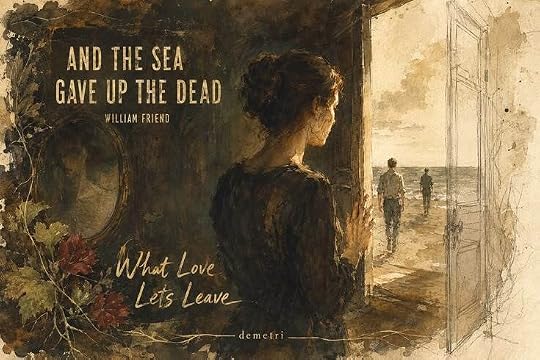
“What Love Lets Leave” – Morwenna stands between the heavily painted world of memory and the still-unfinished lives of her sons, a threshold image for William Friend’s “And the Sea Gave Up the Dead” in which love is measured not by what it can preserve, but by what it can bear to let keep changing.
Death is not the most frightening form of disappearance in William Friend’s “And the Sea Gave Up the Dead.” People can vanish while their bodies stay put: a child grows past the self a parent knew best; an aging mind alters the person across the table; desire introduces a version of oneself not yet admitted into the family; grief smooths a dead spouse into an image so polished that the living can barely compete. Friend builds his Gothic around the fantasy of stopping all that motion. What if the dead came back, the children stayed children, the body stopped aging, the family photograph never required rearranging? His answer is severe: permanence can be another name for possession.
Entering that argument by way of a crumbling château in Var, Friend first appears to be arranging familiar Gothic furniture. Morwenna drives from England with her sons Jamie and Louis and her new partner, Christian, to visit her elderly aunt Bethan, who has lived alone since her husband Jim disappeared. Villagers have long wondered whether Bethan knows more than she says. Bethan herself has begun seeing Jim in the woods. Before her guests arrive, she drinks rosé above a buried head and remembers the biblical promise that the sea will give up its dead. Then she catches something on the mistral and identifies the scent with satisfaction: blood. Horror has rarely had such good table manners.
Morwenna arrives carrying a dead husband of her own. David died nine years earlier, leaving her with Jamie and, as she has always told everyone, a pregnancy already underway. Bethan’s château was once a refuge after that loss, then became so saturated with it that Morwenna stopped visiting. On this return, the place seems to have taken memory’s bad habits for its own. Corridors shift. Mirrors misbehave. Smells arrive without bodies. Louis knows things about the estate’s revenant legends that nobody remembers teaching him. Jamie encounters desires he cannot name without fearing they will rename him. Morwenna cannot shake the sense that whatever catastrophe she fears has already happened.
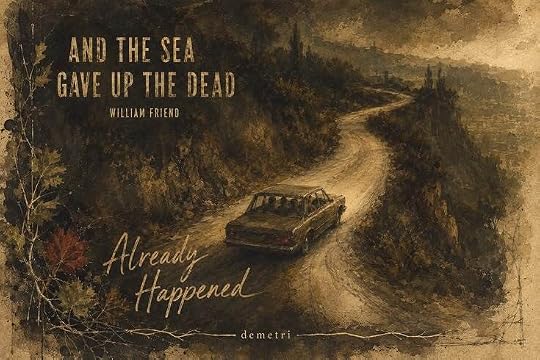
“Already Happened” – The family car is still moving through Var, yet a second graphite road seems to run beneath the painted one, turning Morwenna’s first unease into the visual suspicion that catastrophe may already exist a few minutes ahead of consciousness.
Eventually, that sensation proves exact. Morwenna, Christian and the boys never safely reached the château. Their car crashed in the hills near La Garde-Freinet, and much of the novel unfolds in a territory between life and death. Bethan is dead too, as are several figures around the estate. Halloween and All Souls’ Day have thinned the border between worlds, giving memory, appetite and bodily sensation the rude freedom of dreams. The revelation does not erase the week we have read. It explains why the château has been so obliging to private wishes: here, what someone cannot relinquish can acquire a room, a voice, sometimes a body.
The dead are only the most obvious absences. Morwenna has already lost several Jamies – the baby, the little boy, the child who needed her to translate the world. Sixteen-year-old Jamie is becoming sexually and emotionally private, which to his mother can feel like subtraction. Louis will follow. Morwenna’s mother, Dolly, remained bodily present through cognitive decline while becoming harder to reach. Bethan seems at first to be going the same way. Morwenna’s own body begins hinting at menopause. Friend returns to the discomfort of loving people whose next selves arrive without asking permission.
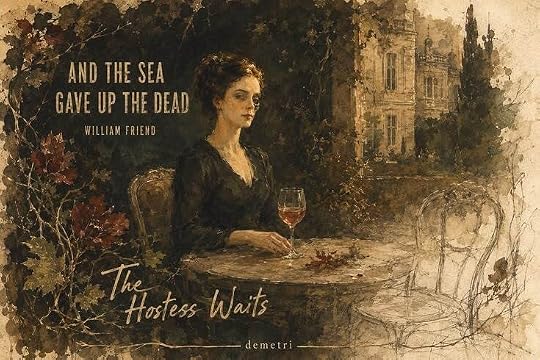
“The Hostess Waits” – Bethan sits impeccably amid rosé, dark vegetation and barely buried anatomy, a portrait of hospitality shading almost imperceptibly into possession as the cover’s restrained reds surface like blood remembered rather than blood spilled.
Running beside Morwenna’s fear is Jamie’s own anxiety about change. He fears that wanting Nico will swallow his identity, turning one fact about him into the explanation for everything else. Morwenna fears a neighboring catastrophe from the other side. Jamie worries that becoming will cancel who he was; Morwenna worries that becoming will cancel the people she knew. His scenes with Nico are strongest when they refuse melodrama. Desire adds to Jamie; it does not replace him.
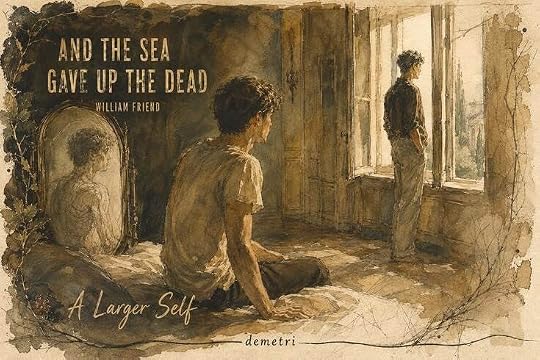
“A Larger Self” – Jamie and Nico occupy the same quiet room without collapsing its distance, while a displaced reflection allows Jamie’s new desire to enlarge the outline he already inhabits instead of replacing the person he has been.
In Gerardo Sámano Córdova’s “Monstrilio,” grief also becomes a problem of form: what does love owe someone who returns changed rather than restored? Friend asks a related question with more Gothic machinery and considerably more rosé. Bethan and David eventually give opposite answers. Bethan wants love to keep its objects within reach. David can bear to lose his family a second time. Bethan keeps setting the table; David understands that Jamie and Louis must be allowed to get up and leave.
Plenty happens while these ideas are taking shape. The château comes stocked with revenant lore, saints, the predatory Lord of Love, an enchanted spinning wheel, dismembered remains, a drowned girl, old film reels and Jim’s faded celebrity. Jim once starred in “The Rise of Saint Célestin,” playing both the saintly servant and the masked monster who opposes him. That double role belongs in a novel crowded with unstable pairings: dead husband and living partner, remembered child and growing adolescent, mirror image and missing reflection. Almost nothing in the house is idle, though a few symbols are made to pull a double shift.
As the structure tightens, even the section headings change jobs. “Apéritif” and “Digestif” bracket “Départ” and “Retour,” French labels that initially seem almost decorous beside the bloodletting. “Départ” begins as a journey into France and ends up naming a departure from ordinary life. “Retour” gathers revenants, resurfacing memories, David’s restoration and finally the possibility that Morwenna and her sons might return to life. Friend does not spring the book’s best formal effect with the crash, however. He saves it for what comes after the apparent happy ending.
Perhaps the most audacious sequence is the one in which Morwenna receives exactly what grief has trained her to want. Christian disappears. David is restored. Jamie receives his father’s easy acceptance after spending the night with Nico. Louis meets the man whose photographs have defined fatherhood for him. Bethan looks healthier, the château brightens, and David walks back into the family portrait as though bereavement were an administrative error finally corrected. It works because it is not immediately sinister. For a few pages, the fantasy feels almost reasonable. Bad heavens advertise themselves as heavens.
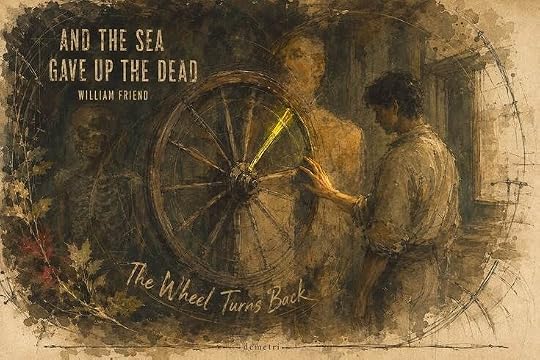
“The Wheel Turns Back” – Louis reaches toward the spinning wheel as two male presences overlap behind its rib-like spokes, and the series’ rare acidic yellow flares most brightly at the precise moment when reversal becomes beautiful enough to mistake for salvation.
And then Morwenna looks back. The château becomes abandoned. Bethan’s decomposing body lies near the telephone, exactly where Morwenna once glimpsed it in what seemed an anxious hallucination. A mirror fails to return Morwenna herself. Bethan explains the crash, and the restored family reveals its price. Stay. David can remain. Jamie and Louis need never grow old. Morwenna need never undergo the decline she fears. Here is the maternal fantasy purified into horror: you may keep your children forever, provided they never get to become anyone else.
David refuses that bargain because he understands what Bethan cannot. He did not return after his original death simply because he wanted his family; he did not believe they needed him. They had Morwenna. Grief stories often flatter the dead by making them irreplaceable; Friend allows David a harder dignity. His love does not require proof of indispensability. When Morwenna asks whether she and the boys can return to life unchanged, the answer is no. To live is to keep becoming. The children she saves will someday outgrow the versions of themselves she is saving.
If Jim and Dolly seem, at first, to belong to different books, they finally give Morwenna two opposite experiences of losing someone. Jim has no body and therefore never becomes securely dead in Bethan’s imagination. Dolly keeps hers while cognitive decline makes the mother Morwenna recognizes progressively harder to reach. Bethan eventually occupies both states: present but inaccessible, then dead but insistently present. Friend’s ghosts are most persuasive here, where the supernatural gives shape to an ordinary impossibility – someone can be gone without leaving, or remain without being reachable.
More than anything, Friend writes through appetite. He likes smells, tastes, sweat, weather, wine, blood, fruit, meat, wet stone, sea air and vegetation. The prose rarely floats when it can drip, stain, bruise, sour or ripen. Bethan is usually near the center of that physical world, drinking, correcting grammar and saying something appalling with the serenity of a woman judging an underseasoned sauce. She is the character most likely to outlive the plot because Friend permits her to be lonely without becoming harmless, controlling without becoming a stock monster, and funny without losing her menace.
Images return as persistently as the dead. Blood begins as a vampiric joke and becomes kinship, injury, inheritance and evidence of the crash. Mirrors move from Gothic ornament to proof of who is alive. The sea holds Jim, David, Elodie and the possibility of return. Most tellingly, Jim survives in films made when he was young, while Bethan fears those images will replace the elderly husband she actually loved. Memory, like cinema, edits. The danger begins when the edit becomes easier to love than the person.
The sentences tend to gather texture at an easy walking pace, then stop short on a fragment or declaration. “We’re in danger,” Morwenna thinks as the family approaches Var. Friend often lets a paragraph fill with sensory unease before isolating the sinister conclusion. The rhythm suits a book in which consciousness keeps receiving news a beat before it understands it. Used too often, though, the short emphatic line starts to resemble a finger placed beneath the sentence: look here. He can guide a reader right past unease and into explanation.
Repetition creates much of the book’s pleasure, then taxes it. The dangerous road, Christian’s hospital dream, inexplicable blood, false reflections and Morwenna’s vision of Bethan’s corpse all sharpen after the crash revelation. But Friend does not always trust those clues to do their own work. Revenant lore arrives through Louis, Bethan, Diana and June, village history, “The Rise of Saint Célestin,” dreams and finally a long metaphysical explanation. At times the book resembles an excellent host who has fed you handsomely and is wounded that you declined the cheese course.
Of the major characters, Christian receives the least room to remain contradictory. At first he is the living man entering a family still emotionally organized around a dead husband. Jamie resents him; Morwenna wants a new life without knowing how to build one beside the old. Christian might have remained a credible alternative to David’s polished memory, especially after we learn that he is Louis’s biological father and that Morwenna has concealed this for nine years. For a while, the family geometry becomes genuinely difficult.
Pressed hard enough, Christian’s complexity collapses. He resents Jamie, sexualizes the much younger Elodie, sleeps with her, secretly destroys David’s watch and substitutes a copy, and is finally revealed to have slipped drugs into David’s drink on the night David died. Each disclosure lands. Together they turn a complicated man into an argument the prosecution has forgotten to stop making. The watch nearly suffices: Christian wants not just a place beside David’s memory but the power to erase its evidence. Everything added afterward makes Morwenna’s rejection of him morally easier than the novel’s own ideas deserve.
Once Christian has been reduced to a verdict, the book’s own argument begins to pinch. “And the Sea Gave Up the Dead” insists that people exceed the versions others fix them into, yet Christian is eventually fixed very firmly indeed. The same appetite for certainty appears in the lore. Friend is strongest when grief, cognitive decline, repression and supernatural influence overlap so closely that none cancels the others; once the cosmology is fully itemized, some of that pressure escapes. The book wants its meanings alive, but it also likes them accounted for.
Under the weight of all that explanation, the ending still changes the question. Jim’s disappearance becomes almost secondary. Christian’s guilt is not the deepest revelation. Even the discovery that Jim may have survived matters chiefly because of what it exposes in Bethan: she spent years mourning a man unavailable to her in either life or death. Her tragedy is not simply that she could not get Jim back. She organized herself around return until absence became the only relationship she knew how to sustain.
Louis and Jamie, meanwhile, keep doing the ordinary thing Bethan cannot allow: growing. Jamie cannot remain the boy preserved in David’s home videos; Louis cannot remain the child delighted by monsters and maps; neither should have to. Jamie’s intimacy with Nico makes the point without ceremony. He discovers something new about himself without invalidating what came before. His identity gets larger. Beside the corpses, revenants and enchanted machinery, the idea looks almost modest. It is also the reason Morwenna has to leave.
Of the novel’s literary kin, Julia Armfield’s “Our Wives Under the Sea” offers the sharpest contrast: another story in which return proves less simple than recovery. Armfield prefers ambiguity, compression and the ache of what remains unsaid; Friend prefers folklore, explanation and a house full of mechanisms. His novel is noisier, funnier and more visibly constructed. Yet both recognize the cruel wish tucked inside grief: not only that somebody come back, but that departure should have changed nothing.
Still, “And the Sea Gave Up the Dead” earns 82/100, or 4/5 Goodreads stars. Its construction is surer than its restraint, and its feeling often runs deeper than its explanations. The finest insight arrives after the dead have done most of their returning. Morwenna realizes there will someday be a last swim with her sons. They will grow older, move farther from her, acquire selves she cannot supervise, and perhaps remember the day differently. None of that empties the water. The sea remains after the swimmers leave it. Love need not keep anyone from going in order to keep what happened there from vanishing.
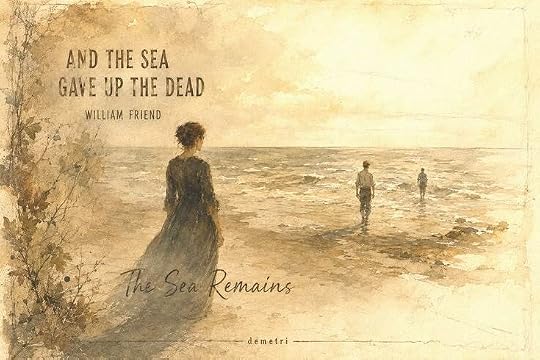
“The Sea Remains” – Morwenna watches Jamie and Louis move separately toward open water, the Gothic darkness loosening into exposed paper and unfinished horizon as the final image exchanges the fantasy of keeping them for the harder grace of allowing them to go on becoming.
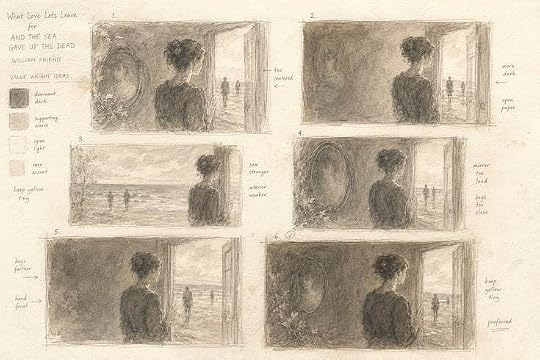
Compositional Thumbnail Sheet
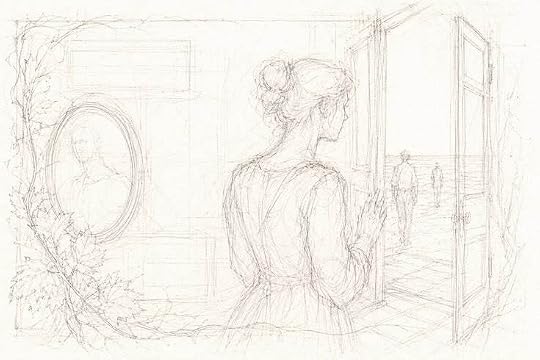
Faint Pencil Underdrawing
[image error]
Light / Value-Massing Study
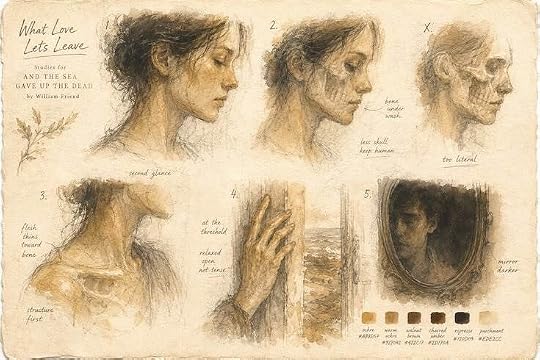
Character Anatomical / Memento-Mori Study
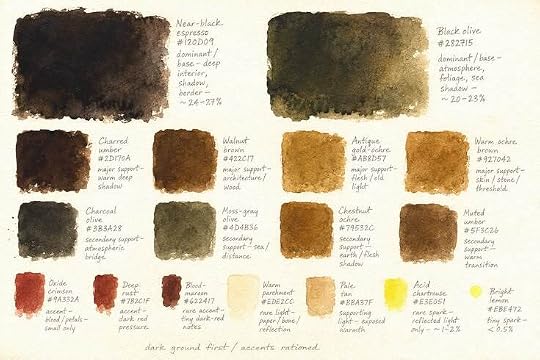
Cover-Palette Proportion / Color Swatch Sheet
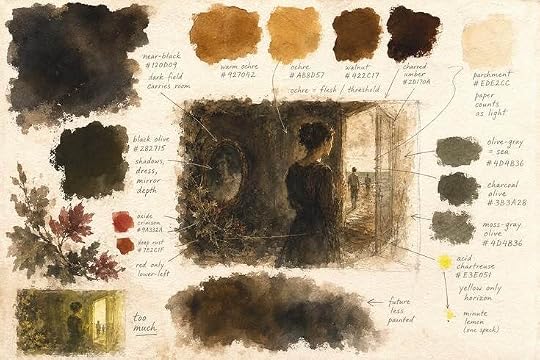
Proportional Pigment Ledger / Cover-Color Translation Map
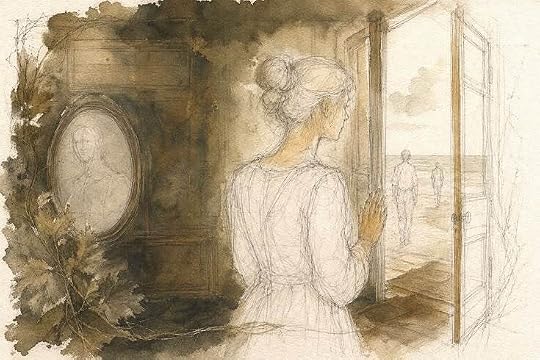
Pencil + First Wash Stage
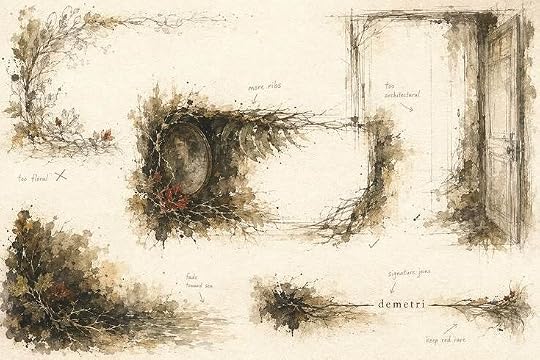
Watercolor Border Study
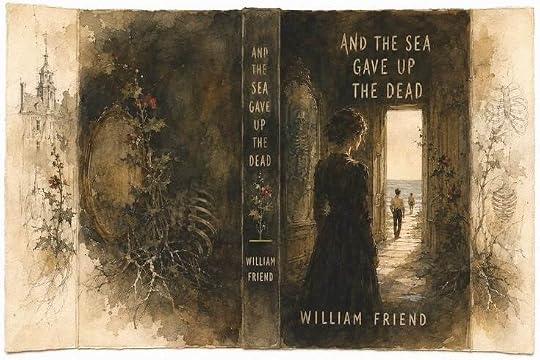
Proposed Alternative Full Dust Jacket With Flaps
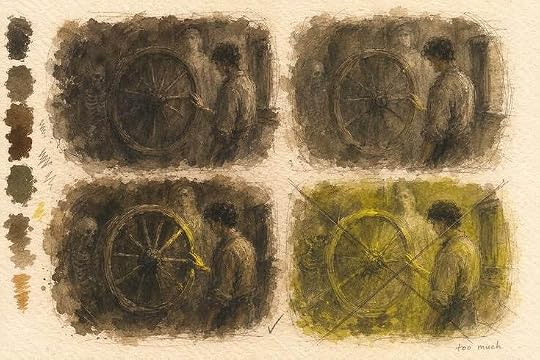
Chartreuse-Light / “The Wheel Turns Back” Study
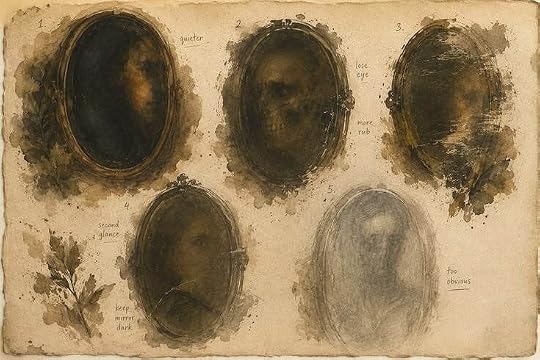
Mirror / Reflection Test Sheet
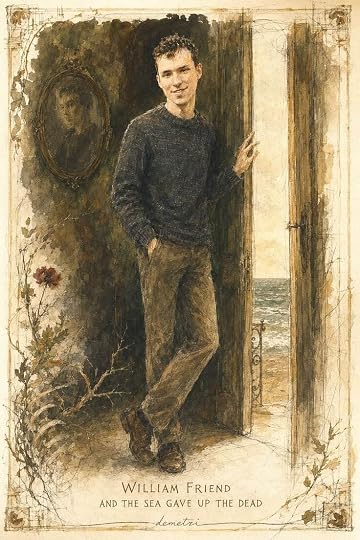
William Friend – A hand-painted literary caricature portrait of the author of “And the Sea Gave Up the Dead,” placing him at a threshold between dark interior, uncertain reflection and open sea while the book cover’s olive-black, ochre, earth and restrained red palette carries the atmosphere.
All watercolor illustrations by Demetris Papadimitropoulos.
Watercolors are done on 140lb vellum and then scanned into the computer using an Epson scanner. From there, they are finalized in Procreate. All art and opinions are my own.
William Friend’s “And the Sea Gave Up the Dead” Finds Its Best Gothic Joke in a Family That Takes Holding On Much Too Literally
By Demetris Papadimitropoulos | August 9th, 2026
“What Love Lets Leave” – Morwenna stands between the heavily painted world of memory and the still-unfinished lives of her sons, a threshold image for William Friend’s “And the Sea Gave Up the Dead” in which love is measured not by what it can preserve, but by what it can bear to let keep changing.
Death is not the most frightening form of disappearance in William Friend’s “And the Sea Gave Up the Dead.” People can vanish while their bodies stay put: a child grows past the self a parent knew best; an aging mind alters the person across the table; desire introduces a version of oneself not yet admitted into the family; grief smooths a dead spouse into an image so polished that the living can barely compete. Friend builds his Gothic around the fantasy of stopping all that motion. What if the dead came back, the children stayed children, the body stopped aging, the family photograph never required rearranging? His answer is severe: permanence can be another name for possession.
Entering that argument by way of a crumbling château in Var, Friend first appears to be arranging familiar Gothic furniture. Morwenna drives from England with her sons Jamie and Louis and her new partner, Christian, to visit her elderly aunt Bethan, who has lived alone since her husband Jim disappeared. Villagers have long wondered whether Bethan knows more than she says. Bethan herself has begun seeing Jim in the woods. Before her guests arrive, she drinks rosé above a buried head and remembers the biblical promise that the sea will give up its dead. Then she catches something on the mistral and identifies the scent with satisfaction: blood. Horror has rarely had such good table manners.
Morwenna arrives carrying a dead husband of her own. David died nine years earlier, leaving her with Jamie and, as she has always told everyone, a pregnancy already underway. Bethan’s château was once a refuge after that loss, then became so saturated with it that Morwenna stopped visiting. On this return, the place seems to have taken memory’s bad habits for its own. Corridors shift. Mirrors misbehave. Smells arrive without bodies. Louis knows things about the estate’s revenant legends that nobody remembers teaching him. Jamie encounters desires he cannot name without fearing they will rename him. Morwenna cannot shake the sense that whatever catastrophe she fears has already happened.
“Already Happened” – The family car is still moving through Var, yet a second graphite road seems to run beneath the painted one, turning Morwenna’s first unease into the visual suspicion that catastrophe may already exist a few minutes ahead of consciousness.
Eventually, that sensation proves exact. Morwenna, Christian and the boys never safely reached the château. Their car crashed in the hills near La Garde-Freinet, and much of the novel unfolds in a territory between life and death. Bethan is dead too, as are several figures around the estate. Halloween and All Souls’ Day have thinned the border between worlds, giving memory, appetite and bodily sensation the rude freedom of dreams. The revelation does not erase the week we have read. It explains why the château has been so obliging to private wishes: here, what someone cannot relinquish can acquire a room, a voice, sometimes a body.
The dead are only the most obvious absences. Morwenna has already lost several Jamies – the baby, the little boy, the child who needed her to translate the world. Sixteen-year-old Jamie is becoming sexually and emotionally private, which to his mother can feel like subtraction. Louis will follow. Morwenna’s mother, Dolly, remained bodily present through cognitive decline while becoming harder to reach. Bethan seems at first to be going the same way. Morwenna’s own body begins hinting at menopause. Friend returns to the discomfort of loving people whose next selves arrive without asking permission.
“The Hostess Waits” – Bethan sits impeccably amid rosé, dark vegetation and barely buried anatomy, a portrait of hospitality shading almost imperceptibly into possession as the cover’s restrained reds surface like blood remembered rather than blood spilled.
Running beside Morwenna’s fear is Jamie’s own anxiety about change. He fears that wanting Nico will swallow his identity, turning one fact about him into the explanation for everything else. Morwenna fears a neighboring catastrophe from the other side. Jamie worries that becoming will cancel who he was; Morwenna worries that becoming will cancel the people she knew. His scenes with Nico are strongest when they refuse melodrama. Desire adds to Jamie; it does not replace him.
“A Larger Self” – Jamie and Nico occupy the same quiet room without collapsing its distance, while a displaced reflection allows Jamie’s new desire to enlarge the outline he already inhabits instead of replacing the person he has been.
In Gerardo Sámano Córdova’s “Monstrilio,” grief also becomes a problem of form: what does love owe someone who returns changed rather than restored? Friend asks a related question with more Gothic machinery and considerably more rosé. Bethan and David eventually give opposite answers. Bethan wants love to keep its objects within reach. David can bear to lose his family a second time. Bethan keeps setting the table; David understands that Jamie and Louis must be allowed to get up and leave.
Plenty happens while these ideas are taking shape. The château comes stocked with revenant lore, saints, the predatory Lord of Love, an enchanted spinning wheel, dismembered remains, a drowned girl, old film reels and Jim’s faded celebrity. Jim once starred in “The Rise of Saint Célestin,” playing both the saintly servant and the masked monster who opposes him. That double role belongs in a novel crowded with unstable pairings: dead husband and living partner, remembered child and growing adolescent, mirror image and missing reflection. Almost nothing in the house is idle, though a few symbols are made to pull a double shift.
As the structure tightens, even the section headings change jobs. “Apéritif” and “Digestif” bracket “Départ” and “Retour,” French labels that initially seem almost decorous beside the bloodletting. “Départ” begins as a journey into France and ends up naming a departure from ordinary life. “Retour” gathers revenants, resurfacing memories, David’s restoration and finally the possibility that Morwenna and her sons might return to life. Friend does not spring the book’s best formal effect with the crash, however. He saves it for what comes after the apparent happy ending.
Perhaps the most audacious sequence is the one in which Morwenna receives exactly what grief has trained her to want. Christian disappears. David is restored. Jamie receives his father’s easy acceptance after spending the night with Nico. Louis meets the man whose photographs have defined fatherhood for him. Bethan looks healthier, the château brightens, and David walks back into the family portrait as though bereavement were an administrative error finally corrected. It works because it is not immediately sinister. For a few pages, the fantasy feels almost reasonable. Bad heavens advertise themselves as heavens.
“The Wheel Turns Back” – Louis reaches toward the spinning wheel as two male presences overlap behind its rib-like spokes, and the series’ rare acidic yellow flares most brightly at the precise moment when reversal becomes beautiful enough to mistake for salvation.
And then Morwenna looks back. The château becomes abandoned. Bethan’s decomposing body lies near the telephone, exactly where Morwenna once glimpsed it in what seemed an anxious hallucination. A mirror fails to return Morwenna herself. Bethan explains the crash, and the restored family reveals its price. Stay. David can remain. Jamie and Louis need never grow old. Morwenna need never undergo the decline she fears. Here is the maternal fantasy purified into horror: you may keep your children forever, provided they never get to become anyone else.
David refuses that bargain because he understands what Bethan cannot. He did not return after his original death simply because he wanted his family; he did not believe they needed him. They had Morwenna. Grief stories often flatter the dead by making them irreplaceable; Friend allows David a harder dignity. His love does not require proof of indispensability. When Morwenna asks whether she and the boys can return to life unchanged, the answer is no. To live is to keep becoming. The children she saves will someday outgrow the versions of themselves she is saving.
If Jim and Dolly seem, at first, to belong to different books, they finally give Morwenna two opposite experiences of losing someone. Jim has no body and therefore never becomes securely dead in Bethan’s imagination. Dolly keeps hers while cognitive decline makes the mother Morwenna recognizes progressively harder to reach. Bethan eventually occupies both states: present but inaccessible, then dead but insistently present. Friend’s ghosts are most persuasive here, where the supernatural gives shape to an ordinary impossibility – someone can be gone without leaving, or remain without being reachable.
More than anything, Friend writes through appetite. He likes smells, tastes, sweat, weather, wine, blood, fruit, meat, wet stone, sea air and vegetation. The prose rarely floats when it can drip, stain, bruise, sour or ripen. Bethan is usually near the center of that physical world, drinking, correcting grammar and saying something appalling with the serenity of a woman judging an underseasoned sauce. She is the character most likely to outlive the plot because Friend permits her to be lonely without becoming harmless, controlling without becoming a stock monster, and funny without losing her menace.
Images return as persistently as the dead. Blood begins as a vampiric joke and becomes kinship, injury, inheritance and evidence of the crash. Mirrors move from Gothic ornament to proof of who is alive. The sea holds Jim, David, Elodie and the possibility of return. Most tellingly, Jim survives in films made when he was young, while Bethan fears those images will replace the elderly husband she actually loved. Memory, like cinema, edits. The danger begins when the edit becomes easier to love than the person.
The sentences tend to gather texture at an easy walking pace, then stop short on a fragment or declaration. “We’re in danger,” Morwenna thinks as the family approaches Var. Friend often lets a paragraph fill with sensory unease before isolating the sinister conclusion. The rhythm suits a book in which consciousness keeps receiving news a beat before it understands it. Used too often, though, the short emphatic line starts to resemble a finger placed beneath the sentence: look here. He can guide a reader right past unease and into explanation.
Repetition creates much of the book’s pleasure, then taxes it. The dangerous road, Christian’s hospital dream, inexplicable blood, false reflections and Morwenna’s vision of Bethan’s corpse all sharpen after the crash revelation. But Friend does not always trust those clues to do their own work. Revenant lore arrives through Louis, Bethan, Diana and June, village history, “The Rise of Saint Célestin,” dreams and finally a long metaphysical explanation. At times the book resembles an excellent host who has fed you handsomely and is wounded that you declined the cheese course.
Of the major characters, Christian receives the least room to remain contradictory. At first he is the living man entering a family still emotionally organized around a dead husband. Jamie resents him; Morwenna wants a new life without knowing how to build one beside the old. Christian might have remained a credible alternative to David’s polished memory, especially after we learn that he is Louis’s biological father and that Morwenna has concealed this for nine years. For a while, the family geometry becomes genuinely difficult.
Pressed hard enough, Christian’s complexity collapses. He resents Jamie, sexualizes the much younger Elodie, sleeps with her, secretly destroys David’s watch and substitutes a copy, and is finally revealed to have slipped drugs into David’s drink on the night David died. Each disclosure lands. Together they turn a complicated man into an argument the prosecution has forgotten to stop making. The watch nearly suffices: Christian wants not just a place beside David’s memory but the power to erase its evidence. Everything added afterward makes Morwenna’s rejection of him morally easier than the novel’s own ideas deserve.
Once Christian has been reduced to a verdict, the book’s own argument begins to pinch. “And the Sea Gave Up the Dead” insists that people exceed the versions others fix them into, yet Christian is eventually fixed very firmly indeed. The same appetite for certainty appears in the lore. Friend is strongest when grief, cognitive decline, repression and supernatural influence overlap so closely that none cancels the others; once the cosmology is fully itemized, some of that pressure escapes. The book wants its meanings alive, but it also likes them accounted for.
Under the weight of all that explanation, the ending still changes the question. Jim’s disappearance becomes almost secondary. Christian’s guilt is not the deepest revelation. Even the discovery that Jim may have survived matters chiefly because of what it exposes in Bethan: she spent years mourning a man unavailable to her in either life or death. Her tragedy is not simply that she could not get Jim back. She organized herself around return until absence became the only relationship she knew how to sustain.
Louis and Jamie, meanwhile, keep doing the ordinary thing Bethan cannot allow: growing. Jamie cannot remain the boy preserved in David’s home videos; Louis cannot remain the child delighted by monsters and maps; neither should have to. Jamie’s intimacy with Nico makes the point without ceremony. He discovers something new about himself without invalidating what came before. His identity gets larger. Beside the corpses, revenants and enchanted machinery, the idea looks almost modest. It is also the reason Morwenna has to leave.
Of the novel’s literary kin, Julia Armfield’s “Our Wives Under the Sea” offers the sharpest contrast: another story in which return proves less simple than recovery. Armfield prefers ambiguity, compression and the ache of what remains unsaid; Friend prefers folklore, explanation and a house full of mechanisms. His novel is noisier, funnier and more visibly constructed. Yet both recognize the cruel wish tucked inside grief: not only that somebody come back, but that departure should have changed nothing.
Still, “And the Sea Gave Up the Dead” earns 82/100, or 4/5 Goodreads stars. Its construction is surer than its restraint, and its feeling often runs deeper than its explanations. The finest insight arrives after the dead have done most of their returning. Morwenna realizes there will someday be a last swim with her sons. They will grow older, move farther from her, acquire selves she cannot supervise, and perhaps remember the day differently. None of that empties the water. The sea remains after the swimmers leave it. Love need not keep anyone from going in order to keep what happened there from vanishing.
“The Sea Remains” – Morwenna watches Jamie and Louis move separately toward open water, the Gothic darkness loosening into exposed paper and unfinished horizon as the final image exchanges the fantasy of keeping them for the harder grace of allowing them to go on becoming.
Compositional Thumbnail Sheet
Faint Pencil Underdrawing
[image error]
Light / Value-Massing Study
Character Anatomical / Memento-Mori Study
Cover-Palette Proportion / Color Swatch Sheet
Proportional Pigment Ledger / Cover-Color Translation Map
Pencil + First Wash Stage
Watercolor Border Study
Proposed Alternative Full Dust Jacket With Flaps
Chartreuse-Light / “The Wheel Turns Back” Study
Mirror / Reflection Test Sheet
William Friend – A hand-painted literary caricature portrait of the author of “And the Sea Gave Up the Dead,” placing him at a threshold between dark interior, uncertain reflection and open sea while the book cover’s olive-black, ochre, earth and restrained red palette carries the atmosphere.
All watercolor illustrations by Demetris Papadimitropoulos.
Watercolors are done on 140lb vellum and then scanned into the computer using an Epson scanner. From there, they are finalized in Procreate. All art and opinions are my own.

September 12, 2026
This book was so damn good. I was drawn from the first page and couldn’t let go. The dread, the creepiness, the humanness, the storyline the gothic feel of it. Just all around amazement.

Review of advance copy received from NetGalley
Thank you to NetGalley and the publisher for providing me with an advanced copy of And the Sea Gave Up the Dead in exchange for an honest review.
And the Sea Gave Up the Dead is a gothic mystery steeped in grief, guilt, and atmosphere. Set in a French château, it delivers exactly the kind of moody, unsettling gothic setting I was hoping for. The central mystery kept me engaged throughout, and there are several genuinely creepy moments.
The novel handles its themes of loss and guilt well, weaving them into both the mystery and the setting. The eventual resolution is satisfying and feels earned, although I found it slightly over-explained. A little more ambiguity would have made the ending even more effective and preserved some of the novel’s haunting atmosphere.
That said, this is still a well-constructed gothic novel with a compelling mystery, strong sense of place, and enough eerie moments to satisfy readers looking for a modern gothic read.
And the Sea Gave Up the Dead is a gothic mystery steeped in grief, guilt, and atmosphere. Set in a French château, it delivers exactly the kind of moody, unsettling gothic setting I was hoping for. The central mystery kept me engaged throughout, and there are several genuinely creepy moments.
The novel handles its themes of loss and guilt well, weaving them into both the mystery and the setting. The eventual resolution is satisfying and feels earned, although I found it slightly over-explained. A little more ambiguity would have made the ending even more effective and preserved some of the novel’s haunting atmosphere.
That said, this is still a well-constructed gothic novel with a compelling mystery, strong sense of place, and enough eerie moments to satisfy readers looking for a modern gothic read.

Review of advance copy received from NetGalley
I’ve finished this book and feeling things I did not expect to feel.
Reading from a third person perspective with really jarring character shifts was disorienting to me initially but the further I got with the story, I think this actually made it more enjoyable and relate better to how the characters must have been feeling/experiencing - because the whole story was incredibly disorientating and disturbing and heartbreaking.
With so many life changing human experiences such as grief in its many forms, motherhood, coming of age, self discovery and a plethora more, it was challenging not to feel an attachment or relatability to the characters in some way.
There was a gentle descent into madness throughout the book- something that I haven’t experienced before and I will actively seek out again !
There were times I was struggling to read because of the horror and paranormal aspects and other times because of the welling in my eyes.
I very much felt this to be psychological gothic horror based on the setting, the atmosphere, the characters moods and visions and the overall storyline/vibe.
So if you enjoy unreliable narrators and not know who to trust or what’s real then you will absolutely enjoy this.
I am curious to know if it was “the fates” spinning wheel that was featured throughout the story. Did anyone else consider this?
Reading from a third person perspective with really jarring character shifts was disorienting to me initially but the further I got with the story, I think this actually made it more enjoyable and relate better to how the characters must have been feeling/experiencing - because the whole story was incredibly disorientating and disturbing and heartbreaking.
With so many life changing human experiences such as grief in its many forms, motherhood, coming of age, self discovery and a plethora more, it was challenging not to feel an attachment or relatability to the characters in some way.
There was a gentle descent into madness throughout the book- something that I haven’t experienced before and I will actively seek out again !
There were times I was struggling to read because of the horror and paranormal aspects and other times because of the welling in my eyes.
I very much felt this to be psychological gothic horror based on the setting, the atmosphere, the characters moods and visions and the overall storyline/vibe.
So if you enjoy unreliable narrators and not know who to trust or what’s real then you will absolutely enjoy this.
I am curious to know if it was “the fates” spinning wheel that was featured throughout the story. Did anyone else consider this?
This entire review has been hidden because of spoilers.
Review of advance copy received from NetGalley
Thank you so much to Net Galley, and Poisoned Pen Press for the ARC!
Wow! Definitely my favorite read of the year so far.
We follow Morwenna, and her family to visit her Aunt Bethan to her French country side chateau. Although everything is not as it seems, the house and Bethan are holding many secrets to questions long unanswered. In a slow burn, turned page turner this book had me hooked from start to finish. Get ready for feeling real feelings, and a significant amount of creepy vibes. If you love a book that is set in a scary every changing chateau, along with some very flawed family dynamics this is for you.
Friend's writing perfectly encapsulated, fear, loss, grief. And all of the disorienting feelings that come with it. It showcases that grief is not linear, and can pull you in many different directions. That love and loss shapes us and can create ripples in our existence.
With that I had to give this 5 stars, it was multi faceted, genre bending, and thought provoking. I can't wait for more from this author.
Wow! Definitely my favorite read of the year so far.
We follow Morwenna, and her family to visit her Aunt Bethan to her French country side chateau. Although everything is not as it seems, the house and Bethan are holding many secrets to questions long unanswered. In a slow burn, turned page turner this book had me hooked from start to finish. Get ready for feeling real feelings, and a significant amount of creepy vibes. If you love a book that is set in a scary every changing chateau, along with some very flawed family dynamics this is for you.
Friend's writing perfectly encapsulated, fear, loss, grief. And all of the disorienting feelings that come with it. It showcases that grief is not linear, and can pull you in many different directions. That love and loss shapes us and can create ripples in our existence.
With that I had to give this 5 stars, it was multi faceted, genre bending, and thought provoking. I can't wait for more from this author.
Displaying 1 - 30 of 108 reviews