Jump to ratings and reviews
Rate this book

Gloss

Rate this book
Ari, Eleni and Hesper meet one summer at Golden Apples Farm in rural California, where the charismatic Lee, an apple farmer and cook, runs an alternative therapy programme for young women suffering from eating disorders. A year later, they reunite to testify at his trial. Their individual and collective stories build into a multifaceted picture of trauma and survival in this psychological thriller infused with magic realism. In sensuous, hypnotic prose, Wilder captures the magnetic pull of forbidden fruit.

163 pages, Kindle Edition

Published February 25, 2025

4 people are currently reading
378 people want to read

About the author

Kyra Wilder

3 books25 followers

Ratings & Reviews

What do you think?
Rate this book

Friends & Following

Create a free account to discover what your friends think of this book!

Community Reviews

5 stars
37 (33%)
4 stars
43 (38%)
3 stars
24 (21%)
2 stars
8 (7%)
1 star
0 (0%)
Displaying 1 - 24 of 24 reviews
Profile Image for Paul Fulcher.
Author 2 books1,960 followers
December 23, 2025
Before coming to Lee's farm, we had tried to bring our bodies back to life by means of our own invention. By starving them, by cutting them, by digging into them and carving them out. Then we had come to Golden Apples and we had tried to listen to Lee because if we did what he told us, if we polished the apples and if we tended the trees, he said that we would live. And we had lived. But we wondered, craning our necks to see the disappearing heron, when had the snake been dead? It seemed colossally important that we should know.

'Gloss' is the second novel by Kyra Wilder.

This is the April 2025 book from the brilliant Republic of Consciousness Book of the Month club, which raises funds that support the UKs most exciting annual book prize, as well as showcasing a collection of books from the vibrant small independent press scene.

And indeed this novel is Les Fugitives entry for the 2026 Queen Mary Small Press Fiction Prize, the rebranding of the Republic of Consciousness Prize.

The publisher

It forms part of the 'quick brown fox' collection from the independent press Les Fugitives originally known for their Francophone novel: "the quick brown fox collection, which curates English-language originals by contemporary writers of all genders. Our focus remains on women in arts and society, underrepresented experiences, marginal voices and unconventional literary forms. which curates English-language originals by contemporary writers of all genders. Our focus remains on women in arts and society, underrepresented experiences, marginal voices and unconventional literary forms."

The book

In a Book Q&As with Deborah Kalb, Wilder, when asked what she was working on replied:
I’m working on a modern-day take on the Hesperides - three girls trapped in a garden at the Western edge of the world. There are dogs and golden apples and social theory and caves and of course, a dragon just like in the myth.
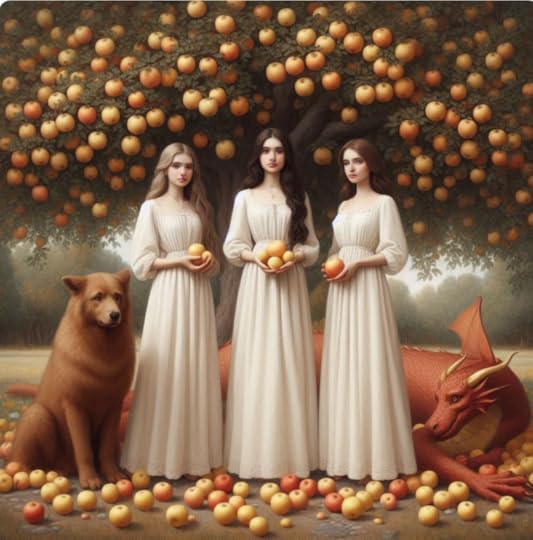

'Gloss' (whose working title at one stage was 'The Girls are Not the Gifts') is the result, which takes the Greek myth of the Hesperides, and transplants it, and its orchard of golden apples tended by three nymphs, to modern-day California, in the west of the US.

Golden Apples is a treatment retreat for young women with eating disorders, but an unconventional one, run by the charismatic Lee, run in a remote valley in an apple farm, the fruit particularly golden Golden Delicious.

The first person narration alternates between three young women who were being treated at Golden Apples: Ari, Eleni and Hesper, as well as a Greek chorus of the three of them. At the time the novel is set, a year later, they are no longer at Golden Apples, each now pursuing their own life:

- Ari lives with her mother who measures and watches closely everything she eats, largely subsisting on a diet of peanut and almond butter. She forms a relationship with a younger girl she babysits, who has a fixation on deep-sea diving, the two ending up exploring a local cave;

- Eleni who works as a waitress for Mitch, whose house she lodges is, and who runs a catering business for wedding and parties, and who seems to also sexually exploit Eleni;

- Hesper who now works in a library, and self-harms by picking at and scratching her skin, and who is haunted by the voice of Lee, who appears to her as a serpent-like dragon.

The first chapter narrated by one of the girls is titled 'four months before the trial' and it's clear that whatever event led the girls to leave Golden Apples has also ended in a criminal case for Lee (or Mr Lotan, an alternative name for the dragon Ladon), one in which the girls are reluctantly required to testify.

The novel's narration switches between different timeframes - recollection of their time at Golden Apples, including the neighbour's dog Hercules who is fond of the orchard's apples; their new lives in the months running up to the trial; and a seemingly foolhardy return they make to Lee's farm on the night before the trial.

At one point Eleni caters a professor's party where his students discuss the myth of the Hesperides:

More than one of the students had brought up the golden apples, but none of them had speculated as to the taste. None of them had wondered if they were bitter or if they were delicious or if they were sweet. None of them had asked what it might have been like to steal one from a tree. It seemed like, for all their talk, they were missing the point. None of them had asked about the project of tending apples that weren't ever meant for eating. Some of the students had talked about the Hesperides, but none of them had asked what sort of girls would be good at doing that.

None of them had asked what it might have been like to watch those golden apples hanging on their branches and want them and not want them all the time. They didn't ask why Hera picked those girls particularly. What had made the Hesperides particularly perfect for the task.


A subtle, powerful and compact novel, which would repay further analysis, not only for the parallels with the classical tales but also for what it has to say about the treatment of young women and the justice system and with a part-mythical carthatic end.

A strong contender for the 2025 Women's Prize.

An impression of Golden Apples, with Hercules the dog and the dragon-serpent Lotan, courtesy of Microsoft Designer.

description
Profile Image for Alan (the Lone Librarian rides again) Teder.
2,709 reviews251 followers
May 11, 2025
The Golden Apples of the Sun*
A review of the Les Fugitives paperback (February 24, 2025).
'You do not have to be good.' - Mary Oliver (used as the book's epigraph on pg. 9).

Stabbing things and cutting things and putting them inside us and mashing them all up into a paste. I'll push you to your limits here, he told us, but it will make you better. It will be for your own good. (pg. 77)

And the trees scratched their branches up against the side of the house and we pulled our rotten-apple-smelling sheets up high over our heads and buried our faces into our musky pillows and said, maybe we don't always have to be so good. (pg. 136)

He said that girls like us were liars, that girls like us didn't deserve all the things he'd done for us. The meals he'd cooked us, the things he'd said, the way he'd worked so hard to get us well. And this is how he was repaid? he asked us, the smudges from the apples glowing golden on his hands. (pg. 149)
- excerpts from Gloss.
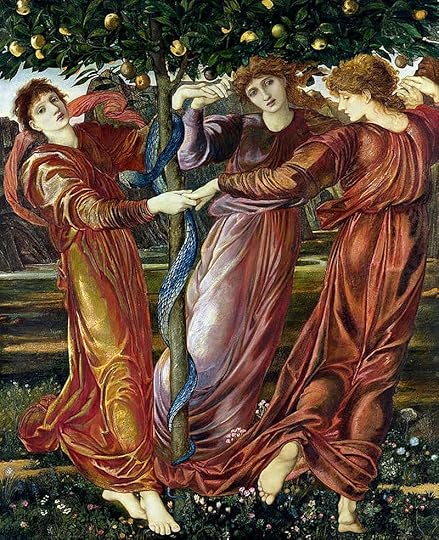
In Greek mythology, the Hesperides are three nymphs who are tasked with guarding the tree of the gods which bears the golden apples of immortality. The orchard has a further guardian in the hundred-headed dragon Ladon. In the myth of the Labours of Hercules, the 11th labour is that of Hercules being tasked with stealing the golden apples.

Kyra Wilder's modern adaptation of the Hesperides mythology has three young women with eating disorders who have entered a farm based treatment facility called Golden Apples. The farm is run by a rather mysterious man named Lee Laton. A nearby neighbour has a dog named Hercules. Lee's treatment procedure involves the preparation of sometimes very elaborate meals which are often "force-fed" to the patients in game/test-like situations. As part of the farm work the patients must constantly polish the apples on the trees, but are admonished to not pick or eat them.


Painting of The Garden of the Hesperides (1870-1873) by Edward Burne-Jones. Image sourced from Wikipedia by Edward Burne-Jones - preraphaelitepaintings.blogspot.com, Public Domain, Link.

Wilder builds a suspenseful, sometimes humorous, sometimes caring, sometimes fearful, story by a plot which has ongoing flashbacks and flashforwards. Many of the chapters are subtitled with the timing of them being hours or weeks or months before "the trial." For the longest time we don't know what the trial is about, so it is left to our imagination. Instead we observe the lives of the three women in a time after they have left the Golden Apples Farm. They are often withdrawn and it is not clear how much they are actually cured. Finally we reach a dual climax of learning what was the original event that triggered the court case and what will happen when it finally comes to trial.

I found Gloss to be a totally engrossing read with its background of classic mythology combined with issues of eating disorders and trauma, but also the obsessions of coveting those things that one cannot have.

I read Gloss as the April 2025 selection from the Republic of Consciousness Book of the Month (BotM) club. Subscriptions to the BotM support the annual Republic of Consciousness Prize for small independent publishers.

Footnote and Soundtrack
* This is the final line from the poem The Song of the Wandering Aengus by W.B. Yeats (1865-1939) originally collected in The Wind Among the Reeds (1899). It was adapted as a folk song by Donovan Leitch (1946-) which you can listen to on YouTube here or on Spotify here. The song appeared on the HMS Donovan album (1971).
The full poem reads as:
I went out to the hazel wood,
Because a fire was in my head,
And cut and peeled a hazel wand,
And hooked a berry to a thread;
And when white moths were on the wing,
And moth-like stars were flickering out,
I dropped the berry in a stream
And caught a little silver trout.

When I had laid it on the floor
I went to blow the fire a-flame,
But something rustled on the floor,
And someone called me by my name:
It had become a glimmering girl
With apple blossom in her hair
Who called me by my name and ran
And faded through the brightening air.

Though I am old with wandering
Through hollow lands and hilly lands,
I will find out where she has gone,
And kiss her lips and take her hands;
And walk among long dappled grass,
And pluck till time and times are done,
The silver apples of the moon,
The golden apples of the sun.

Bonus Track

The mother of the Hesperides was Nyx, the Greek goddess of night. As chance would have it I saw a concert by the ensemble NYX electronic drone choir several months ago in Stratford, Canada and they have a recent self-titled album which you can listen to on Bandcamp here or on Spotify here.
There is an extended performance of the album's Track 3 Bright Tongues by NYX duo which you can see on YouTube here.
Profile Image for Zadie Loft.
33 reviews2 followers
August 18, 2025
A genuinely spectacular ending that made me cry.
222 reviews8 followers
April 14, 2025
hypnotic, challenging, confusing, and heartbreaking at the same time. so many emotions in a book of 179 pages.
Profile Image for Serena.
96 reviews
November 15, 2025
had a hugeeee break in the middle of this but super enjoyed
Profile Image for Ryan McMenamin.
2 reviews1 follower
November 9, 2025
4.5 Stars Rounded Up

(I'll start my review with a brief introduction to the Mythology that inspired the book as I think I would have benefitted from this knowledge)

- Introduction to the Hesperides Mythology that inspired Gloss -

Many are familiar with the story of Hercules, the Greek hero who was instructed by King Eurystheus to perform twelve labours in order to cleanse himself of his past sins. Upon completion of his tasks, he would be granted forgiveness for his previous wrong-doings, and would be transformed from a mortal to a divine being.

Hercules fought long and hard on his quest for redemption and after slaying the Nemean Lion, and defeating the fearsome Hydra, his eleventh labour was to steal golden apples from the Garden of the Hesperides; apples said to grant immortality to anyone who ate them (this setting and the subject of forbidden golden apples are central themes in Wilder’s Gloss).

The garden, which was to be found somewhere in the western edge of the ancient Mediterranean world, belonged to Hera, queen of the gods, and she desperately sought to protect the golden apples from thieves and looters. The tasks of protecting the golden apples were given to the Hesperides, three nymphs (Aegle, Erytheia & Hesperia) rumoured to be either the daughters of Nyx, the goddess of the night, or of Atlas, the giant who held up the sky.

Hera, however, didn’t completely trust the Hesperides, so she also placed a dragon named Ladon, rumoured to have multiple heads, in the garden to not only further protect the apples, but also to keep watch over the Hesperides. Ladon was rumoured to have many heads, with some interpretations suggesting he had as many as 100. There are many interpretations of how Hercules stole the apples, but having an understanding of the myth ahead of reading may help to understand themes and references. Gloss is Kyra Wilder’s contemporary, feminist version of the ancient story.

- Life on the farm -

In Gloss, the ancient mythological gods and heroes are substituted out for contemporary characters, but the golden apples, orchard and mysticism remain.

Gloss orbits around four main characters; Ari, Eleni and Hesper, three women who suffer from severe eating disorders, and Lee Laton, the charismatic individual who lives on a farm suitably named ‘Golden Apples’ which is cut off from civilisation. Laton grows a vast array of fruit and vegetables, including apples which appear to be gold in colour. The farm also functions as a treatment centre for young women dealing with Anorexia, as Lee promises to help them in their recovery by cooking them fresh food, encouraging them to eat, building their confidence within themselves and offering them work in the form of helping on the farm and tending to the apples. There is also a neighbouring dog named Hercules who keeps them all up at night with his constant barking in frustration at being unable to reach the apples.

Right from early on in the novel however, we understand that something has gone wrong on the farm. Each chapter starts with “4 months before the trial”, or “1 week before the trial”, though it isn’t revealed to us exactly what the trial is for until much later on in the story.

The narrative switches between the three perspectives of Ari, Eleni and Hesper, who all no longer live on the farm, but are reflecting on their time living there, on their relationships with each other, with Lee, and the violence they witnessed which eventually leads to the necessity for Lee to stand trial. Each woman still lives with their illnesses, and continues to deal with the struggle of mundane everyday life and tiresome routines since they have left the farm.

- Life after the farm -

Ari now lives at home with her mother, who has taken control of her diet which consists of peanut butter sandwiches on one day, almond butter sandwiches the day after, and so on. She strikes up a friendship with younger girl named Lucy who is obsessed with deep-sea diving. Ari also gets swept up in this fixation with diving, eventually leading to a tense scene in which they explore a local cave together.

Eleni has moved into a house-share, and works for the owner of the house, Mitch, as waitress for his catering business. She seems to be exploited in this arrangement, with many of the guests at the events they cater for being incredibly inappropriate towards her.

Hesper works at her local library, but is haunted by the image and memory of Lee who she regularly has visions of, appearing to her as a small dragon who taunts her as she attempts to move on with her life. She also self-harms by impulsively scratching and damaging her skin.

Ultimately, Lee is presented as a cult-leader figure who maintains a tight grip on each of them as they grapple with whether what happened on the farm was “really that bad”. It’s easy for us as onlookers to see the negative impact on the victims, but this only highlights the influence he has over them. They blindly trust him, assuming they must be getting better because they're gaining weight and are able to take on more tasks around the farm. As the book progresses, Wilder continues to build tension as we move closer to the trial date, revealing anecdotes of unusual behaviour that takes place on the farm.

Lee’s so-called recovery methods turn out to be coercive and deeply damaging and often step across the line of what would be seen as acceptable treatment of these vulnerable individuals. His motives are ambiguous, but it’s clear that his approach is abusive. He deploys methods of manipulation that portray himself as a form of saviour to each of them, reassuring them that he loves them, and playing games with them which always revolve around doing what he says (think of a ‘Simon-Says’ type game, in which the loser must eat a spoonful of cake whilst he watches), and he always seems to know where they are and what they’re doing at any given time. Is the myth of the dragon with 100 heads beginning to sound familiar now?From the outset, he convinces them that his actions are rooted in care, and that anything he might do later on is only because he “knows what’s best for them”, and that they must trust his methods. The story ultimately reaches the climax when Hercules makes his presence known on the farm, and Lee decides that he must act in order to protect himself, and his mystical golden apples.

- My Thoughts -

Throughout Gloss, Wilder displays what can truly be described as a masterclass in tension building - revealing very early on that something does indeed go wrong, but only dangles its true nature out of our reach - like forbidden fruit that we cannot quite touch.

Wilder’s ability to inhabit the inner worlds of her three narrators with such empathy and psychological precision are some of the book’s most impressive and immersive moments. I also admired how the novel avoids easy resolutions, there are no neat redemptions here, only the messy, raw truth of survival.

Themes of violence, entrapment, and helplessness are introduced right from the first chapter, in which the women are driven out in the back of Lee’s van to a field where they witness a heron catching and eating a snake. This scene helps to establish some of the themes that are to follow later, creating a clear sense of foreboding:

“We wondered, craning our necks to see the disappearing heron, when had the snake been dead? It seemed colossally important that we should know. When has it been too late for it to save itself? From the beginning? From the moment the bird snapped his head into the grass? We wondered if that had been why Lee had brought us. To see how it didn’t matter if the snake wriggled, if it tried, or if it didn’t try, to escape.”

Gloss explores abuse, manipulation, and the catastrophic effects these behaviours have on victims. It also examines the legal system’s failure to protect society’s most vulnerable, and presents a modern retelling of a familiar myth that ultimately challenges our understanding of this ancient story.

The story is rich with biblical allusions, mythological undercurrents, vivid characters, and a haunting plot. Wilder’s visceral prose pulls these elements into sharp focus, crafting a novel that’s both captivating and devastating. Wilder holds readers in a vice-like grip for 179 pages, and ends in Greek tragedy-inspired crescendo. This book is hard to put down and leaves a lasting effect long after the final page is turned.

Gloss masterfully blends myth and modernity to deliver a cautionary tale that’s as timeless as it is urgent.
Profile Image for Taina.
745 reviews20 followers
October 4, 2025
Upea, nykyaikaan sijoitettu ja feministinen uudelleenkerronta Kreikan mytologian hesperideistä, nymfeistä, jotka vartioivat Heran kultaisia omenoita puutarhassa. Kirjan alussa Ari, Hesper ja Eleni ovat matkalla hoitolaan, jota ympäröi kaunis puutarha. Vuoden kuluttua kaikki asuvat muualla, jotakin traumaattista on tapahtunut ja oikeudenkäyntiä odotellaan. Jokainen pyrkii eroon hoitolan muistoista omalla tavallaan ja vähitellen myös lukijalle selviää, mitä on tapahtunut. Hoitolan isäntä Lee ja naapurin koira Hercules liittyvät olennaisesti tarinaan. Samalla tarina kertoo nyky-yhteiskunnasta ja sen suhtautumisesta nuoriin naisiin. Pidin erityisesti kirjan maagisesta, epätodellisesta tunnelmasta, joka vei mukanaan. Kauniisti kirjoitettu, tiivis romaani antaa myös lukijan mielikuvitukselle tilaa.
Profile Image for Rozelle.
3 reviews
June 4, 2025
Nothing like I have read before, kept me hooked until the last page.
Profile Image for Fay.
92 reviews18 followers
July 26, 2025
'I was spending a lot of time just soaking and being still. Things were getting slowly better. Like the curved back of a snail. Like I was creeping right along it and going round and round. But the way it spirals I thought, soaking. That kind of shell. Round and round. Going down sometimes and sometimes curling backwards, could all be ways of crawling out.'

This book was poetic and thought-provoking. It discusses big topics like eating disorders and abuse in a way which puts you in a place of understanding what it feels like to experience that, rather than analysing it from the outside. It allows for the complexities and dualities of the three young girls who are experiencing this, and why they feel so stuck in these dynamics which are harming them.

I think the way this story is structured made it more powerful because it lets us understand the girls more and how they had become caught up in the controlling dynamics they lived in. We see all the good things they experienced and how they had begun to associate recovering from their illness with living on the farm with Lee. That makes us see how impossible it felt for them to leave that place or to recover without it.

Each of the three girls finds their own ways of coping or not coping. We see how complicated healing is, and that sometimes getting better requires feeling worse or going backwards before you can achieve that.
Profile Image for W.S. Luk.
450 reviews5 followers
February 22, 2025
"We ate until we weren't girls anymore but just thin skins stretched tight over juice and pulp, waiting for him to tell us to stop."

A multivocal story about three young women being treated for eating disorders at a remote retreat, GLOSS left me somewhat divided. Its prose is spectacularly rich and evocative, particularly in its descriptions of food (to the extent that I wondered if the author had a culinary background; I was pleasantly surprised to see on the back cover that Wilder has worked at a Michelin-starred restaurant), which can be sensual or eerie depending on the context of the scene. These luscious descriptions bolster the novel's commentary on the societal pressures on women to consume, act, and present themselves in narrowly-defined ways, with the increasingly troubling events at the retreat deepening its sense of psychological horror.

That said, while there are many sequences where Wilder's non-linear storytelling and use of multiple perspectives enhance these themes, GLOSS felt overly opaque at times. The complex interplay of timelines and points of view left me occasionally struggling to understand some characters' actions, particularly towards the conclusion.
Profile Image for Fiona.
105 reviews8 followers
May 7, 2025
This book is strange, unsettling and sticky. The author gets inside your head and the prose wraps itself around your brain and clings. Trigger warnings for eating disorders, body dysmorphia, grooming and sexual abuse.
Profile Image for Montio.
7 reviews
December 20, 2025
More apples than at Apple headquarters.

I enjoyed the book as a whole. While the plot is simple yet so nuanced. It is handled with care and intention. The writing is emotionally charged and layered, allowing the story’s quiet moments to carry just as much weight as its more painful ones.


Profile Image for Regina.
68 reviews7 followers
April 17, 2025
An intense, poetic story of trauma, abuse, power structures, eating disorder and addiction.
Profile Image for Rachel Burnett.
10 reviews
May 20, 2025
I savoured the pages of this book, and was reluctant to finish it. It was that incredible. Favourite book of 2025
Profile Image for Annabelle.
184 reviews4 followers
July 2, 2025
zó mooi geschreven maar uiteindelijk bleef het verhaal zelf een beetje achter op de schrijfstijl
Profile Image for Charlotte Fairbairn.
Author 7 books6 followers
July 7, 2025
Some lovely prose but characterisation and plotting too murky for this reader
Profile Image for Anna.
605 reviews40 followers
July 30, 2025
First things first, I really like this! A lot! And I did not expect this to be the case.

For some years now, there has been an increasing number of retellings of Greek myths and legends from a modern, often feminist, perspective. The starting signal for this literary trend was probably Circe by Madeline Miller in 2018. Since then, it has become clear that the genre can be extremely successful. I have read so many of these retellings in recent years that I am starting to tire of them.

However, Gloss — referencing the Greek myth of the Hesperides — is very good. The novel has a lot to say. It is both a psychological thriller and a crime novel, written from the perspective of three young women and reflecting how they see themselves and how society sees them. It is a book about eating disorders as an illness; a text about pleasure, addiction, liberation, and the complexity of mistreatment and abuse.

The short chapters alternate between the perspectives of Ari, Eleni and Hesper. They also appear as a Greek chorus, and the boundaries between them become blurred. The trio spent several intense months on a remote Californian farm belonging to a man named Lee, where they received treatment for anorexia. The farm is called Golden Apples. It soon becomes clear that Lee takes decisions off their hands — he cooks for them and makes them participate in the process of carving, braising, and the pure sensuality of food. Everything glistens, crunches and drips. The prose here is seductive and sensual in a way that I have rarely encountered. And Ari, Hesper and Eleni eat! The only thing that is taboo are the golden apples in the garden – the girls guard and polish them, just as the nymphs in the Hesperides myth should.


Not only do the young women seem to enjoy their dependence on Lee and their being at his mercy, they almost demand it. Yet it is clear from the outset that coercion and fear play an important role in this story. Lee's cruelty and their unconditional desire for his approval are inextricably linked, creating a hypnotic effect. Moreover, the book is not told chronologically, but in short chapters that jump through timeand whose very names hint at the rot that lurks beneath all the pleasure: for the women's lives take place "Four Months Before the Trial", "72 Hours Before the Trial" and "One Year Before the Trial". However, the details of what happened, what it's all about and what caused the three women to deal with their lives and illnesses so differently after their time on the farm remain hidden for a long time. The only thing we immediately realise is that something is wrong - and we wonder when the poison will come to the surface.

We see how the women lose their identity when they are with Lee; they merge into an imagined, perfect type of girl. They lose themselves in the act of eating, so to speak, and ultimately become not even girls, but 'thin skins stretched tight over juice and pulp'. They see themselves as animals, yet assure Lee that they are doing their best to be the best kind of girls. Their hunger, self-sacrifice and the unspoken create an eerie atmosphere. We need an explanation, but will we get one? There is a climax, the moment of rupture, both of individual identity and of the only rule that seems to exist: In the end, the apples are eaten in an act of rebellion whose consequences mark a break in time.

Gloss by Kyra Wilder is an impressive, a sensual book. It treats its characters with respect and successfully explores their complex psychological depths without oversimplifying them. The references to the myth are clear yet subtle, and they expand the reader's understanding of the text. Nothing at Golden Apples Farm is simple or straightforward. And reading about it is a rush not to be missed.
Profile Image for Lauren .
48 reviews
September 3, 2025
Wilder describes disgust and desire as if they are two sides of a coin; these feelings dominate the three Hesperides as they deal with their trauma which we learn about through snippets. Like in the Greek myth, the women protect golden apples which represent human desire and unattainable power. The women’s desires are exposed by Lee, owner of the orchard they protect, who psychologically manipulates them based on their vulnerabilities. I was chilled when they’d occasionally submit to their desires, let their pain control them, fall further into madness. Gloss gives meaningful character to each of the Hesperides and is done in such an elegant way.
Displaying 1 - 24 of 24 reviews

Can't find what you're looking for?

Get help and learn more about the design.