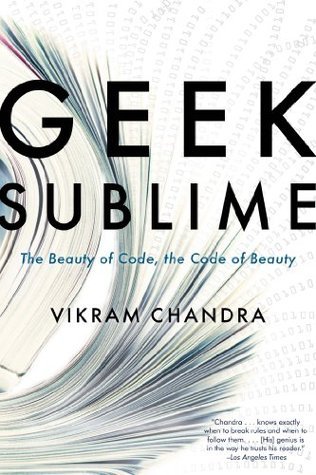
The nonfiction debut from the author of the international bestseller Sacred Games about the surprising overlap between writing and computer coding
Vikram Chandra has been a computer programmer for almost as long as he has been a novelist. In this extraordinary new book, his first work of nonfiction, he searches for the connections between the worlds of art and technology. Coders are obsessed with elegance and style, just as writers are, but do the words mean the same thing to both? Can we ascribe beauty to the craft of writing code?
Exploring such varied topics as logic gates and literary modernism, the machismo of tech geeks, the omnipresence of an “Indian Mafia” in Silicon Valley, and the writings of the eleventh-century Kashmiri thinker Abhinavagupta, Geek Sublime is both an idiosyncratic history of coding and a fascinating meditation on the writer’s art. Part literary essay, part technology story, and part memoir, it is an engrossing, original, and heady book of sweeping ideas.
He completed most of his secondary education at Mayo College, a boarding school in Ajmer, Rajasthan. After a short stay at St. Xavier's College in Mumbai, Vikram came to the United States as an undergraduate student.
In 1984, he graduated from Pomona College (in Claremont, near Los Angeles) with a magna cum laude BA in English, with a concentration in creative writing.
He then attended the Film School at Columbia University in New York. In the Columbia library, by chance, he happened upon the autobiography of Colonel James "Sikander" Skinner, a legendary nineteenth century soldier, born of an Indian mother and a British father. This book was to become the inspiration for Vikram's novel, Red Earth and Pouring Rain. He left film school halfway to begin work on the novel.
Red Earth and Pouring Rain was written over several years at the writing programs at Johns Hopkins University and the University of Houston. Vikram worked with John Barth at Johns Hopkins and with Donald Barthelme at the University of Houston; he obtained an MA at Johns Hopkins and an MFA at the University of Houston.
While writing Red Earth and Pouring Rain, Vikram taught literature and writing, and also worked independently as a computer programmer and software and hardware consultant. His clients included oil companies, non-profit organizations, and the Houston Zoo.
Red Earth and Pouring Rain was published in 1995 by Penguin/India in India; by Faber and Faber in the UK; and by Little, Brown in the United States. The book was received with outstanding critical acclaim. It won the Commonwealth Writers Prize for Best First Book and the David Higham Prize for Fiction.
A collection of short stories, Love and Longing in Bombay, was published in 1997 by Penguin/India in India; by Faber and Faber in the UK; and by Little, Brown in the United States. Love and Longing in Bombay won the Commonwealth Writers Prize for Best Book (Eurasia region); was short-listed for the Guardian Fiction Prize; and was included in "Notable Books of 1997" by the New York Times Book Review, in "Best Books of the Year" by the Independent (London), in "Best Books of the Year" by the Guardian (London), and in "The Ten Best Books of 1997" by Outlook magazine (New Delhi). Two of these stories have been formerly published in the Paris Review and The New Yorker. The story "Dharma" was awarded the Discovery Prize by the Paris Review, and was included in Year's Best Fantasy and Horror (St. Martin's Press, 1998).
A novel, Sacred Games, was published in 2006 by Penguin/India in India; and by Faber and Faber in the UK. It will be published in January 2007 in the United States by HarperCollins.
In June 1997, Vikram was featured in the New Yorker photograph of "India's leading novelists." His work has been translated into eleven languages.
He has co-written Mission Kashmir, an Indian feature film starring Sanjay Dutt, Hrithik Roshan, Preity Zinta, and Jackie Shroff, that was released internationally in late October, 2000.
Vikram's mother, Kamna Chandra, is the writer of several Hindi films including Prem Rog and 1942: A Love Story; she has also written plays for All India Radio and Doordarshan. His sister, Tanuja Chandra, is a director and screenwriter, who has directed several films including Sur and Sangharsh. His other sister Anupama Chopra is a film critic and senior correspondent for India Today; she has written Dilwale Dulhania Le Jayenge, a BFI book about the hugely popular 1995 hit. Her first book, Sholay: The Making of a Classic, won the Swarn Kamal, a national award for the best Indian book on cinema in 1995. Vikram's father, Navin Chandra, is a retired executive.
Vikram Chandra currently divides his time between Mumbai and Berkeley, California, where he teaches creative writing at the University of California. He lives with his wife Melanie Abrams, who is also a novelist.
It hurts me to say this because I've always enjoyed his fiction, but Vikram Chandra's latest book is a mess. Inchoate, rambling and superficial, Geek Sublime reads like a vanity project--like being cornered by some middle-aged Uncle at a family gathering and being subjected to hours of him prattling on about his favorite theories while you anxiously watch the clock and wonder when they'll serve dinner.
Though not a programmer myself, I'm not unsympathetic to the idea that code can be beautiful (though I think of good coders more as chefs or fashion designers than artists), but all Chandra gives us is a lot of wide-eyed claims about the beauty of code, without any real evidence of this beauty. He also gives us a great deal of tedious exposition about language, computers, coding, etc. most of which would not be out of place in your average MOOC, often backed by easy and sweeping generalizations. The end result is a book that may be the best evidence against its own thesis: that the pursuit of coding can turn a writer of engaging fiction into a kind of second-rate Malcolm Gladwell is fairly damning evidence against the geek sublime.
Full disclosure: I stopped reading about half way through chapter 6. Yes, I was that bored.
I'm torn about giving this book such a low rating, because there were parts that really spoke to me: the root of disillusionment with modern day software development; the rampant sexism within the industry; the pain and struggle of the writing process; the parallels between writing programs and writing essays. But there were huge swaths of this book that I thought were unreadable. For example, I read half the chapter on Anandavardhana before giving up because I was bored out of my mind. And when I started the chapter on Abhinavagupta, I could tell right away it was more of the same, so I didn't even bother to try. After that, I routinely skipped over whole boring chunks. Even worse, I had no idea what the hell this book was even about; the author was all over the place. That's what I get for reading a pretentious selection from the 2014 New York Times Notable Books list.
Back when I listed the books on my reading pile, I mentioned "Geek Sublime..." right at the top and said "...Vikram Chandra intrigues me as a writer. I cannot pin him down to any genre..."
He continues that thread of intrigue through this latest work on non-fiction. Amazon (amazingly enough) classifies this under "engineering". Maybe they did not look past "Coding Software" on the title, but even the first few pages would have made it clear it is not! Having said that however, it is nearly impossible to classify this book. You could say it is Vikram's memoir - of growing up in India, moving to the US to study and his early days as a writer while he supported himself by working as a programmer. But you turn a page and it seamlessly transitions into being a history of computers, computer programming and the role of women in the industry. Keep reading and you realise you have moved into the history of the ancient Indian language Sanskrit, even a bit of Indian vs. American culture. He speaks of the beauty of poetry and the workings of logic gates, the dilemma of an Indian programmer in America, gender imbalance in the industry to gender politics of the British Raj in India, of writing being his vocation and coding his obsession. And you come away from the book almost breathless with the combination of persuasive prose and fascinatingly stimulating ideas.
Paul Graham, a programmer and venture capitalist, wrote in 2003 "... of all the different types of people I've known, hackers and painters are among the most alike...".
Chandra quotes this at the start of his book and then takes us on a journey exploring the topic. He talks of programmers wanting elegance and beauty in their code and compares it to the beauty of prose, poetry and language. He explores many lanes and bylanes on this journey. Glimpses of his life in India, life as an Indian programmer in America, history of computers and of Sanskrit, of tantric sexual practice and even the 'hippie capitalism' of the Silicon Valley where "digital overlords combine the social and sexual attitudes of San Francisco bohemianism with a neo-liberal passion for idealized free markets and unchecked profit-making" - the number of topics he researches and describes is mind boggling! His primer of how logic gates work is fascinating and made me spend a good few hours looking up more LEGO logic gates on randomwraith than I probably should have. And who knew that the world's first programmers on the ENIAC machine were all women? It was only as the industry was professionalised that women became marginal. Then again in India, where the general gender gap is dismal, women programmers form over 30% of the industry compared to 21% in America. Did you even know there are computer languages called 'brainfuck' (I kid you not) and 'Malbolge' (designed solely to be the most difficult language to program in)? Snippets of interesting information abound throughout the book on topics as diverse as technology, philosopy, history, programming, linguistics and sociology! Chandra talks a lot about Sanskrit, its logical nature as well as its aesthetic appeal. Panini's 2,500 year old text on Sanskrit grammar with rules of generating words, he says, is "the first known instance of the application of algorithmic thinking to a domain outside of logic and mathematics". It is a language that is so structural and rule bound that is often known as the seedbed of modern high level programming languages. Yet, it is also a language of poetry of exquisite beauty. If Sanskrit can combine rule bound structure with beauty and elegance - can computer code do the same?
The author draws on his own diverse experiences to come to his own conclusion by the end of the book, but read this book for much more than that. Read it for the sweeping ideas it studies and proposes, for the vast amount of information this lets you learn, for its originality and most importantly for its own persuasive and melodic prose - an object of beauty on its own
There are a lot of great insights, quotes and stories in this book regarding programming and writing, art and aesthetics. I also really appreciated his perspective as someone who supported his passion for writing fiction by writing code.
One quibble is that the parts on Indian aesthetic theories felt like they could have been handled better. These chapters caused me to alternate between "YES YES YES!" and "Wait, what?!" I'll need to re-read those sections because I found the ideas fascinating, but featuring too many Sanskrit terms that were defined once before leaving the reader to remember them on later reference. (Define your variables in scope, please!)
Also, for such a good critique of macho/bro tech culture and lack of women in tech in the U.S., I was surprised how few women were cited and used as examples outside of Ada Lovelace, Grace Hopper and the original ENIAC programmers. Even for hypothetical archetypes like "Ted" (I know the Einsteins and Morts were not of his invention, so I can't fault him there).
Overall, I definitely recommend this for lovers of code, literature, poetry, art and aesthetics.
This was a surprise. I read the reviews so long ago that I forgot this is only about coding on the surface.
I love Chandra’s Sacred Games so I was game to read about coding if that’s what he wanted to write about. (He supported himself writing code while he wrote his first book.) And indeed, he is eloquent on the beauty and elegance of well-written programs. But this is a jumping off point for discussion about two things: the brutal, antisocial, hyper-male combativeness of many programmers that make tech companies hell for women and even normal guys, and the similarities and differences between coding and art. (Note, he also spends some time talking about how both hardware and software actually work, to the level of logic gates and machine code, so be prepared; if you don’t grasp it just keep going.)
I’ll only mention, regarding the misogyny, that Chandra provides a solid history of the spreading poison.
But the literary discussion is a rich source of information for western readers. Chandra starts by discussing the structural similarities of coding and Sanskrit. Both are highly prescriptive, with carefully documented and precise rules of grammar and syntax. In fact, there were extensive efforts at one time to adapt Sanskrit to perform the logical tasks that computer programs now take on.
But Chandra chokes on the claims to authority in art stemming from technical expertise from a pioneer in Silicon Valley (I listened and can’t remember the name, although it is very familiar). The meat of the book is how art far exceeds the limitations of precision and specificity through evoking an infinity of feelings, images, associations, etc. He explores how Indian philosophers and literary critics have expounded the theory of how literature works to try to explain this. Perhaps to explain why coding takes him to a no-time no-awareness zone of contentment as he is debugging, while the effort of grasping for the ineffable that good writing evokes is torture.
I listened to this and got the most basic gist of the explanation of traditional Indian literary theory, but I fully intend to actually read it and try to absorb more of what Chandra has so skillfully summarized and delivered in absorbable packets. (no pun intended). I think it will really contribute to my appreciation of both Western and Asian art.
This book was a bit schizophrenic, moving between two different books with little success in making a connection between them. And while I truly enjoyed the chapters regarding coding as design, the parallel story was rather impossible to read.
This is one of the worst books that I have read recently. There are many reasons that I did not like this book:
1. Till the end I did not understand why the author wrote about so many things and how they relate to the main topic of the book which is "the beauty of code" 2. The book is a collection of random blurbs/research that author created over a period of time and then combined them together in a book 3. The book was made further difficult to follow by using sanskrit words in-between. The author expects the reader to remember all the meaning of words and uses them throughout the book after introducing them once
There is a paragraph in the book where the author argues that "poetry does not need to have coherence, meaning and verification because its ultimate goal is to provide pleasure". The author follows this to heart in this book and has made it illegible and incomprehensible for readers hoping that it will generate some pleasure.
It is a weird little book. It is sort of about programming, it is sort of about writing, it is sort of about the nature of art, it is sort of about the sociopolitics of Sanskrit, and the sociopolitics of programmers, especially Indian ones and female ones. If some of those topics interesting you, it's probably worth reading. I picked it up because it was purportedly a book about programming by the guy who wrote Red Earth and Pouring Rain and Sacred Games. Usually anything related programming and fiction comes from deep within the science fiction ghetto so I was curious to see something from a more mainstream author*.
It doesn't quite hang together - as you might be able to tell from the range of topics it kind of jumps around, and I think it wants to get at a satisfying synthesis, but never quite makes it. but it is an interesting journey, and the jumping around is clearly deliberately thematic in an east-west inescapability of the effects of imperialism, but still keeping a cultural identity sort of way.
The previous paragraph also applies to Red Earth and Pouring Rain, which I wholeheartedly recommend if magical realism is your thing. But somehow, despite being non-fiction and only tangentially related, this makes a nice coda to that. It talks a little bit about his process and what he was trying to get at and it tells the origin story of the title. I also liked that it was clearly an intensely quirky personal book. It's really just a guy talking about some stuff he finds interesting and hoping that you are the sort of person who also finds it interesting.
* I have only the vaguest notion of what delineates the mainstream, but in any event here is a glowing review from the Times of Red Earth and Pouring Rainhttp://www.nytimes.com/books/97/10/12...
My first introduction to Chandra was through his novel 'Sacred games', an engrossing crime novel set in the bustling city of Mumbai, India. So when I was naturally intrigued when I heard about his latest non-fiction offering 'Geek sublime', especially after it received glowing reviews in the New York Times, Economist and other publications.
'Geek sublime' is a curious book. Chandra draws upon his experience as a self-taught programmer and muses about the deep and complex relationship between art and computer science. Although seemingly incompatible, these two disciplines have a lot in common, he argues.
He intersperses his discussions of such diverse topics as the Indian mystic Abhinavgupta, structure of logic gates and contemporary state of computer programming in the United States with memories and experiences from his privileged childhood in India, making this book a weird cross between an autobiography and a thesis.
It is a real shame that despite his talents and his dazzling command of complicated subjects this book never really takes off. Chandra seems to lurch from one topic to the next without any sort of unifying theme in mind. This lends the books a disjointed feel.
I will say this though - this book contains the best description of a logic gate I have ever seen, hands down. He deserves an enormous amount of credit for that.
I had an instant connect with what Chandra is trying to do here. He talks about programming, the business of code-writing that practically runs our social media obsessed milieu, and he talks about writing itself, that most enriching and creative of human endeavors. In recounting his making as a writer and his early years as a programmer in the united states, he finds parallels between both the processes, at the same time delving deep into the Indian narrative traditions, unearthing critical theories about writing, especially the texts of Abhinavagupta and Anandavardhana. He ends up serving a cocktail of history, literary theory, and insights on code writing.
Though privileged to be a full time writer, Chandra enjoys both coding and writing:
"Perhaps this is why I have always turned to coding with such relief: I can see cause and effect immediately. Write some code, and it either works or it doesn't. If it doesn't, re-factor - change it, rewrite it, throw it away, and write new code. It either works or it doesn't. Poetry has no success or failure. Poetry waits to manifest".
For me personally, coding is a way to be sure about myself. When a code works it gives a check that things are still under control, that a solution can still be arrived at. Its a good high. Writing on the other hand is like diving into the abyss of the unconscious where my imagination merges with my memories, and I have to emerge out of its vagueness with a coherent story. It is a long, sometimes lazy, sometimes frustrating process, and it needs discipline. Coding, which is a relatively direct process, often challenging but the kind that doesn't keep room for chance or guesswork, disciplines me for writing.
The writer-programmers might cheer the arrival of this book, conceived and written by a man who has been there, done that, and is now trying to merge the two into a seamless confluence.
Vikram Chandra has made a living as a programmer and also written award winning literary fiction. In Geek Sublime he reflects on the writing of fiction and code, their points of connection and departure, drawing on his own experiences and the observations of others. In particular, he makes reference to literary theory, especially that relating to Indian texts, languages, philosophy, mythology and poetry, using it to reflect on ideas of the structure, aesthetics, logic, and the work of text as fiction and code. In the main it’s an interesting read, engaging with ideas little used in the consideration of code, but it is a little to uneven in its analysis, and also lopsided in its treatment of fiction and code, with too much attention paid to the former. Indeed, while there is some engagement with literary theory, there is no attention paid to its equivalent of software studies or critical code studies, though there are some references to computer science views of programming. Nor is there any reference to code poetry, the most obvious example of where code and fiction directly interface, or in thinking about code in relation to storytelling, for example in framing and generating the narrative of games or CGI movies. Overall then, an interesting read that introduces a number of new ideas, but is somewhat uneven and limited in its comparison of writing fiction and code.
Vikram Chandra's novel "Red Earth & Pouring Rain" remains one of my favorite books. I have been known to pull it off the bookcase and read passages aloud to friends from time to time. His new book, which seeks to limn the connections between writing literature and writing code, is thoughtful, often lyrical, and thought-provokingly original. Having read some reviewers that clearly left readers bewildered or annoyed, I decided I wanted to take the book on its own terms, and found the arch of the discussion quite fascinating. I learned a lot about the writing of code, and I learned a lot about the aesthetics and structures of Indian literature. If you think there's no connection, then you don't know that a book on Sanskrit and how it is structured influenced the development of structural linguistics, which in turn influenced the development of computer code. If you're hoping the book is an homage to computer nerds, you'll find the literary discussion hard to contextualize. But tangents are sometimes beautiful things, and Chandra makes a wonderful case for the need to stretch our ideas about narrative continuity.
I've never read anything by Vikram Chandra and I certainly need to fix it, but I found this book that compares the programming languages and writing literature extremely interesting. Not being a programmer myself I must admit, that sometimes I found myself a bit lost on some comparisons, but the author was always quite clear, even when he compares the modern literature, the programming languages and Hindu sacred texts.
Non ho mai letto niente di Vikram Chandra e sicuramente devo rimediare, ma ho trovato questo libro che paragona i linguaggi di programmazione alla letteratura estremamente interessante. Non essendo io una programmatrice a volte ammetto, mi sono ritrovata un po' persa su alcuni paragoni, ma l'autore é stato sempre piuttosto chiaro, anche quando paragona la letteratura moderna, i linguaggi di programmazione e i testi sacri indú.
THANKS TO NETGALLEY AND FABER&FABER FOR THE PREVEIW!
Hmmm, well this is actually an average of 3 for style and 5 for content. The writer's condescending, humblebraggy persona can be quite offputting. I found this disappointing, as I had really enjoyed his fiction. Still, the scope of Chandra's knowledge is truly breathtaking -- from the mechanics of code writing to ancient linguistic codification to Sanskrit literary theory. He understands the tech industry from the inside out, but still has the distance to point out its myths and fallacies. It's the sort of book that's hard to walk away from. I find myself turning over the ideas in my mind. I want to tell everyone I meet about it, beg them to read it. It's a real event of a book; I just wish the authorial persona were a little more relatable.
If you think you will find in this book a discussion of aesthetics as applied to programming, of what was considered beautiful in it and is considered beautiful now, of how values and accents shift with new tools, new people, and, more importantly, why all that happens, this is not the book you are looking for.
Moreover, "code" mentioned in the title is just a pretext for speculations on Indian history, literature, and religion. All the parts about "code" are quite shallow and seem out of place, so I suppose a programmer is not the intended audience.
Instead, it's a very personal contemplation on the author's cultural background and how it relates to his new life of being a writer (mostly) and programmer (somewhat) in the States.
If you like "Hello, world!" and the nature of drama and scandalous Sanskrit poetry and the experience of highly personal writing and ... amazingly well brought together, you should probably read this book.
My own first program in a new computer language usually outputs "Hello, cruel world!". But a world with this book in it is not altogether cruel.
This starts out promisingly enough about art and coding... And then rapidly devolves into a discussion about coding machismo, gender roles, and where India fits into all of this. Frankly, he meanders, contradicts his own points, and doesn't really go anywhere with it. This might be better titled "an Indian coder thinks about things but doesn't really commit to an opinion"
An unexpected pleasure as the author uses linguistics to illuminate the structure of code. For those of you who want to embrace design thinking and see the beauty of code and the coders who write it, this book is for you.
My rating is based on my own enjoyment of the book, not on the quality of the writing, which is very high. As others have said, the book mixes the author's experiences as a programmer and a writer, with quite a bit about the literature of his native India thrown in. There were parts that interested me, parts I found difficult to follow, and parts I skimmed because they didn't interest me enough to put a lot into their reading. That is not to say, however, that those parts wouldn't be highly interesting to other readers. (I did, after all, finish the book, something I don't do with books I dislike.) He included some cool photos of old mainframe computers and early programmers, which were, interestingly, mostly women. In fact, I found the historical section most engaging. Here is snippet of that section: "So, 'an activity originally intended to be performed by low-status, clerical---and more often than not, female---[workers],' Ensmenger tells us: 'was gradually and deliberately transformed into a high-status, scientific, and masculine discipline.'" (page 54). Here is another quote: "One of the hallmarks of a cultural system that is predominant is that it succeeds, to some degree, in making itself invisible, or at least in presenting itself as the inevitable outcome of environmental processes that exist outside of the realm of culture, within nature. The absence of women within the industry is thus often seen as a hard 'scientific' reality rooted in biology, never mind that the very first algorithm designed for execution by a machine was created by Lady Ada Byron, never mind Grace Hopper's creation of the first compiler, and never mind that the culture of the industry may be foreign or actively hostile to women." (page 62) He remarks on the fact that most of Silicon Valley is still male---"brogrammers"---and makes interesting connections between the way females have been treated in this profession and the way Indians are viewed (harkening back to their perception by the British during empire days) and treated. Here is a remark from one female in the business: "In a 2012 Globe and Mail story about Canadian programmers in Silicon Valley, Alec Scott quotes a high-level female Canadian executive who's worked with many of the top companies as saying: 'People ask me, would you encourage your daughter to follow you into tech. My answer is no frickin' way. I would tell a woman going in, you're going to be 40 years old pitching a VC in the Valley, and he's going to pinch your bum. I had that happen to me!...I got demoted [at a tech company] when I got pregnant. We're not making progress in tech. If anything, it's going the other way.'" (page 72) Here's another zinger: "Still, research in countries as varied as Iran, Hong Kong, Mauritius, Taiwan, and Malaysia has yielded results consistent with those found in studies in India, showing that there is nothing about the field of computing that makes it inherently male. Varma's conclusion is blunt: 'The gender imbalance in the United States seems to be specific to the country; it is not a universal phenomenon, as it has been presented in the scholarly literature.'" (page 76) And finally, chew on this: "Silicon Valley may have in reality needed Lanier's salonnieres and the Indian Mafia, but its heroic narrative---from which it draws its ambition, its adventurousness, and its seductiveness---requires lone American cowboys to ride the range. Toward the end of their critique of Californian Ideology, Barbrook and Cameron remark in passing, 'Any attempt to develop hypermedia [innovative forms of knowledge and communications] within Europe will need some of the entrepreneurial zeal and can-do attitude championed by the California New Right.' But it seems to me that you cannot get the can-do attitude and zeal without the ideology, without the shimmering dream of California, without the furious continent-conquering energy, the guns, the massacres, without the consequences---good and bad---of belief. Fictions about history are not just distractions; they move individuals and nations into action, and so they change history itself." (pages 82-83). [This is completely unrelated, but it occurred to me that early professional librarians were a sort of "salonniere", in the eyes of Melvil Dewey, at least. Just a thought.] This is quite an unusual book, and is very well-written. Give it a whirl; you can always pick and choose, as I did. My only real complaint is that there is no index. There are notes and a bibliography, but an index would have been nice. I suppose it is, after all, a sort of extended essay and not a piece of research, so perhaps an index is not warranted, but it would be helpful for going back to re-read topics of especial interest.
I find this a very hard book to rate. It is written by a man who grew up in India and studied fiction writing in the US. He works his way through school and novel writing by making money as a computer programmer. It's an odd combo and is amply reflected in the book. The author's main objective is to discuss the similarities differences between art (particularly fiction writing) and coding. Sort of. It's really a strange amalgam of all the things that made the writer who he is. The first parts of the book deal with a brief autobiography. Then there's a very thorough overview of how computers work and a brief history of computers everywhere and specifically in India. Then he devotes most of a chapter to the change of computer culture. Most of this deals with programming changing from a "woman's" work to the male-dominated even macho field it has become. SO far, I was loving it. Then he got to the Sanskrit. And he lost me. I am not a fan of reading about language and the writing process. Add religion into that, and I'm done. I was tremendously bored with the chapters dealing with Vedic and Tantric practices and philosophies. He comes back around at the end to his supposed central theory about coding and art. It felt a little forced, like he was suddenly aware that he had gone way off track and needed to find a way to resolve the book. Such a promising start but I wish I had skipped most of the second 100 pages because the first 80ish were brilliant
This was a hard one to rate, because it was a hard one to read (or actually, to listen to on audio). Chandra’s stories about his becoming a coder I found quite endearing, as I know many people that followed that same path, myself as well to a point. And the chapters about coding languages and the software industry were entertaining, like articles in an ACM magazine or something like Fast Company. But when he started diving into the inner workings of Sanskrit he really lost me. There are a few chapters, say almost half the book, about the linguistics behind Sanskrit and about Indian philosophy. One section, right after describing coders and coding, jumps right into a reflection on Tantric sex and sex rituals and their relation to Sanskrit. This really was all over the place. One chapter could be magazine-like, the next more appropriate for an academic journal. You can tell where Chandra’s heart is though by what he ended with – a plea to bring Sanskrit back into usage. From the book’s description, I thought this would be more about writing fiction and how it related to coding. It wasn’t much of that, which is too bad – I think Chandra could have written a good book on this topic but missed with this one.
Really interesting on the history of computers & coding and his thoughts on writing and the history and linguistics of Sanskrit, and the autobiographical parts are also very good. I'm sure of interest to others would be the sections on Indian theories of aesthetics but I must confess I skimmed those two chapters.
Geek Sublime: The Beauty of Code, the Code of Beauty by Vikram Chandra A review by Galen Weitkamp
Vikram Chandra is a novelist, a programmer and now an aesthetician. His book, Geek Sublime, explores the aesthetic nature of computer programming, novel writing, poetry and the capacity of language to be beautiful, expressive and moving.
Vikram introduces us to the world of programmers, explaining that among them there are artists who write exquisite code and boors who write ugly, lumbering code; and he explains to the layman the difference. This is nothing new. Programmers have been comparing themselves to painters, writers, composers and architects since the inception of the art of computer programming. “What hackers and painters have in common is that they are both makers,” says computer programmer Paul Graham. But Vikram takes the analysis to a new level.
A layman reading this book will learn about object oriented programming, functional programming and event sourcing. She will learn how they were invented to encourage programmers to write good code. But the reader will also learn the connection to Sanskrit, rasa-dhvani and the aesthetic theories of the tenth century Indian philosopher, mystic and dramatist Abhinavagupta.
Indian literature may be of particular relevance to Vikram Chandra’s quest to describe the beauty of code. Since the fourth century, the Indian grammarian, Panini, established a generative grammar (called the Ashtadhyayi) for classical Sanskrit consisting of 3959 rules, formally equivalent to the types of rules that are used today to define computer languages. Vikram writes
“The systematic, deterministic workings of these rules may remind you of the orderly on-and-off workings of logic gates. The Ashtadhyayi is, of course, an algorithm, a machine that consumes phonemes and morphemes and produces words and sentences. Panini’s machine...is also the first known...application of algorithmic thinking to a domain outside of logic and mathematics.”
“When programmers say what they do is just like what writers do, or gardeners, or painters, the error is that they aren’t claiming enough, the fault is that they are being too humble. To compare code to works of literature may point the programmer toward legibility and elegance, but it says nothing about the ability of code to materialize logic. What programmers want to do in their investigations of the “eloquence” of code, I think, is analogous to what Anandavardhana and Abhinavagupta tried to do with poetic language in the Sanskrit cosmopolis: to understand how the effects of a language can escape language itself...The rasa-dhvani theorists...tried to formalize the processes of literary effect, to investigate how poetry moves across the borders of bodies and selves, and to understand how consciousness uses and is reconstructed by poetry, how poetry expands within the self and allows access to the unfathomably vast, to that which cannot be spoken.”
Vikram shares with the reader those things which drew him to writing and to programming. He sketches the history of computing machines, languages and coding, and he highlights the often overlooked role that women have played in these endeavors.
Writers, programmers, artists and geeks of all kind will find something in this book worth taking away and incorporating as their own.
An unlikely attempt to draw parallels between the languages of code and the code of languages. How does a fiction writer from the subcontinent, who moved to the US to write fiction but decided to earn a living as a programmer and now teaches at US universities, make sense of his world? In a sometimes quite entertaining fashion. (Disclaimer: He has also published a number of fiction novels - I haven't read any of them.)
I opened this book mainly because I'm interested in writing as well as programming. The book did provide some revelations, especially the dhvani-rasa theory and the parallelism between event-sourcing and Buddhist concept of "no-self". "The code of beauty: Anandhavardhana" and "The beauty of code" were the best chapters in this book! Until those chapters, the book was pretty interesting. The chapters after those 2 seemed too high on weed for me.
Started off well and then suddenly the authors ramblings on Indian mysticism took a deeper fall into abyss of Boredom. I failed to understand any correlation between the beauty of code and Indian religious philosophies. The author tried to mild come back in the last chapter but again failed miserably in rekindling my curiosity. Thanks but not thanks. I think he should stick to writing fiction.
Geeky. Subliminal. Delightful. A must read for a wanna-be-better-programmer and wanna-be-better-writer.
Having said all that, it's also quite eclectic, elitist and esoteric. This one is a demanding read, to say the least. In spite of having reasonably respectable background of Sanskrit and Computer Science both, I understood only a not-so-respectable fraction of what the author was trying to say.
I embarked on this book hoping for something along the lines of Hofstadter's Gödel, Escher, Bach. That was a pretty lofty expectation, so I shouldn't be surprised that I was disappointed.
Chandra is a fiction writer who, for a time, supported himself by computer programming and consulting, and he likes to keep his skills up to date by learning a new computer language every year. (With, as he says, about 8,000 languages currently out there, he doesn't have to worry about running out of things to learn.) I had expected that he would weave the threads of fiction writing and coding into a contrast-and-compare of the two activities, teaching us what he had learned from each that helped him in the other. Instead, there are two brief intervals in the book in which he relates some interesting anecdotes from the history of computer science, and explains some of the fundamentals of logic—nothing new to most first-year CS students, but engagingly written—widely separated by long, long discourses about the structure of the Sanskrit language, Indian philosophy, and the history and underpinnings of Indian literature. These latter passages are liberally strewn with Sanskrit (or maybe Hindi?) terms and the names of ancient writers and thinkers, all of which blur together for the Western reader and render most of the book pretty impenetrable. Worse, after spending so much time bringing the reader up to his (admittedly considerable) understanding of the evolution of writing and poetry in Sanskrit, Chandra makes almost no effort to tie that back to the science, or art, or writing computer programs. He draws a couple of tenuous connections but doesn't really explore them. It's almost as if he was writing two different books and got some of the chapters mixed up.
Don't start this book if you're expecting an easy, relaxing, and enlightening read. And brace yourself for more Sanskrit terminology and abstruse Eastern philosophical constructs than you ever expected, unless you're an Indian lit major.