"Allows readers to practically experience firsthand how humans have adapted to and dealt with disease throughout history...necessary and timely...engaging and entertaining. Highly recommended." ―Library Journal, starred "[A] splendid examination...Deeply insightful if unsettling." ―Kirkus
Anti-science, anti-vaccine, anti-reason beliefs seem to be triumphing over common sense today. How did we get here? The Great Shadow brings a huge missing piece to this puzzle—the experience of actually being ill. What did it feel like to be a woman or man struggling with illness in ancient times, in the Middle Ages, in the seventeenth century, or in 1920? And how did that shape our thoughts and convictions?
The Great Shadow uses extensive historical research and first-person accounts to tell a vivid story about sickness and our responses to it, from very ancient times until the last decade. In the process of writing, historian Susan Wise Bauer reveals just how many of our current fads and causes are rooted in the moment-by-moment experience of sickness—from the search for a balanced lifestyle to plug-in air fresheners and bare hardwood floors. We can’t simply shout facts at people who refuse vaccinations, believe that immigrants carry diseases, or insist that God will look out for them during a pandemic. We have to enter with imagination, historical perspective, and empathy into their world. The Great Shadow does just that with page-turning flair.
Susan Wise Bauer is an American author, English instructor of writing and American literature at The College of William and Mary, and founder of Well-Trained Mind Press (formerly Peace Hill Press).
Humanity has always feared illness, and sought remedies for the body's discomfort and dysfunction. In this book, author Susan Wise Bauer traces the progression of our understanding of disease, and the evolution of treatments, cures, and prevention.
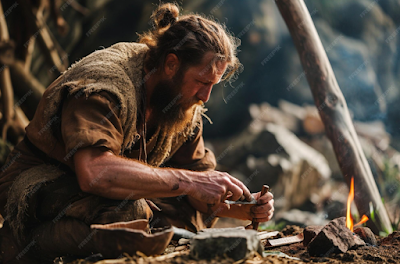
For illustrative purposes, Bauer includes comparisons of paleolithic sufferers with modern patients, which adds a whimsical element to a serious subject.
For example:
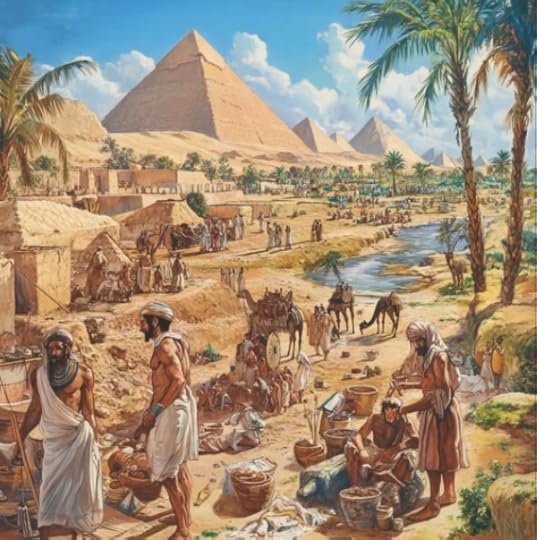
➽ Late fall, 4,000 years ago: Last night you had bad dreams, and were sweating, restless, hot and wretched. This morning, your mouth is dry, your teeth are chattering, and swallowing is painful.
You get an asu (healer) to treat you with herbs and barks and salts stirred into beer to drink; and powdered snakeskins and river clay kneaded into fats to massage your aching limbs.
Because of the nightmares you also need the ashipu (priest), to determine which demons have invaded you and what you did to invite punishment (such as insufficient offerings to the gods). The ashipu will then instruct you to make amends, and perform an incantation to purify you.
➽ Late fall, 2020: You wake up sick, think about who might have infected you during the past week, and hope you don't have Covid.
*****
I'll provide a brief look at the book's contents, but keep in mind Bauer's coverage is MUCH MORE extensive, with NUMEROUS examples.
Over thousands of years, beliefs about the causes of disease have changed: from angry deities, to unbalanced humors (elements that make up the body), to miasmas (bad air), to germs. Naturally, prevention and treatment of illness changed accordingly.
Prehistoric humans had few problems with infectious disease because hunter-gatherer populations were sparse, and transmission from person to person, or by way of the environment, was limited.
When humanity formed settlements, however, and communities became more tightly packed, bacteria prospered in the growing heaps of feces and food scraps; hookworms, roundworms, and other intestinal parasites infected children who played in the dirt; water reservoirs for crops bred mosquitoes, and nurtured parasites that caused amoebic dysentery, dengue fever, schistosomiasis, and so on.
Animals also became a problem. Rodents and birds that nested around homes shed viruses, fungi, and bacteria; and domesticated animals - dogs, sheep, goats, cattle, pigs, horses, chickens, camels, etc. - 'shared' their diseases.
➽ Deities
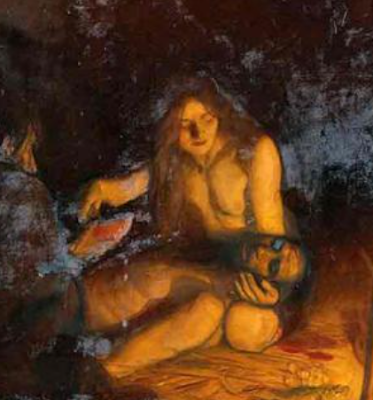
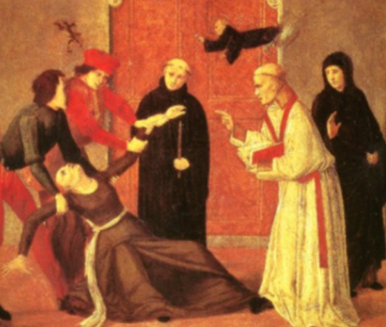
We now understand why people get sick, but thousands of years ago, sickness was a mystery. Diagnostic methods, therefore, relied on various kinds of 'magic.' For instance, one method of diagnosis was 'extaspicy' - the ritual sacrifice of an animal, and the examination of its insides for messages from the gods.
Extaspicy
Other diagnostic tools included reading marks on oracle bones, and interpreting cracks on turtle shells. The answer was always that the sufferer had sinned, offended the gods, and had to make amends to be cured.
➽ Humors
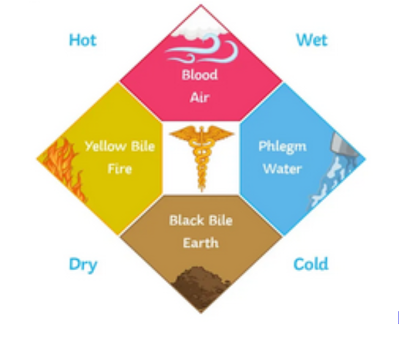
Greek philosophers believed four elements made up the body: flesh, blood, bones, and breath. In the same way, four elements made up the universe: fire, water, earth, and air. In the body, the elements were represented by fluids, or humors, that moved through the tissues and determined health and illness. The humors were yellow bile, blood, phlegm, and black bile.
When the fluids were in equilibrium, people were healthy; when the fluids were unbalanced, people became ill. So, for example, too much phlegm in the head was thought to block the proper flow of air and cause seizures (epilepsy).
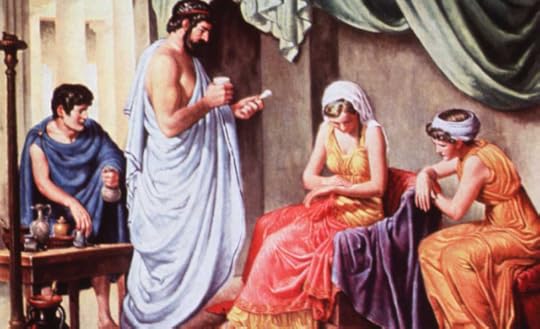
The physician's role was to determine the reason for the imbalance (such as cold weather and winds), and to provide suggestions for a remedy (such as resting near a warm fire).
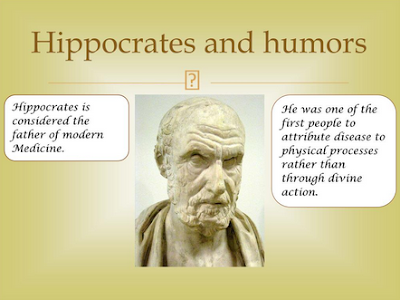
The idea that unbalanced humors cause disease evolved into the Hippocratic model, which lasted for 30 generations. Bauer writes, "For Hippocrates and his followers, the body is naturally healthy. The humors WANT to be in proper proportion. But they are constantly pushed and pulled at by their surroundings, and since each body responds slightly differently to airs, and waters, and places, each body can easily get out of whack in a slightly different way."
The Hippocratic physician diagnosed the surroundings and experiences of the patient (food and drink; humidity and dryness; cold and heat; noise and quiet; and so on), diagnosed the imbalance, and sought to right it. As an illustration, if you got stomach pains, you might be advised to change your diet.
Bauer goes on to an extensive discussion of Hippocratic medicine, and the manner in which it was amended by Galen - who included human anatomy in the diagnoses of illness.
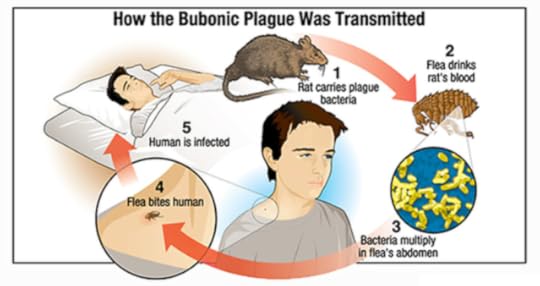
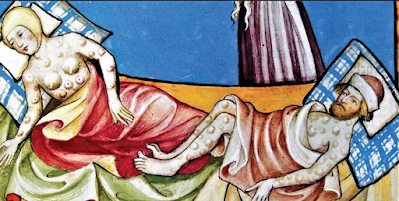
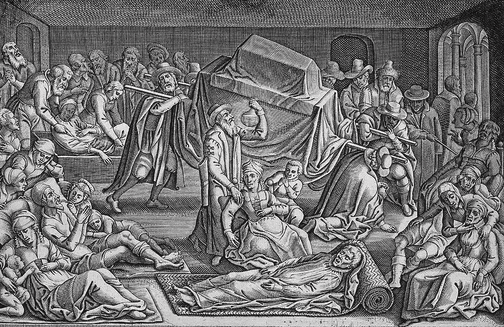
The author also discusses HORRIBLY DEADLY epidemics and pandemics, such as bubonic plague, which broke out repeatedly over the centuries.
The bubonic plague was horrific and deadly
When plague diseases didn't respond to Hippocratic and Galenic methods, people scapegoated those considered 'different' than themselves, especially Jews, who were hunted down and murdered.
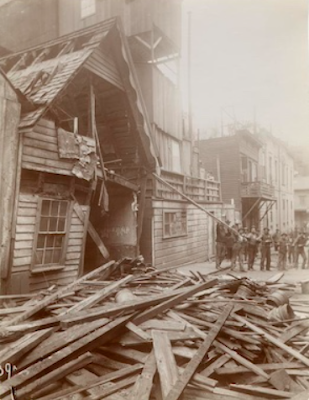
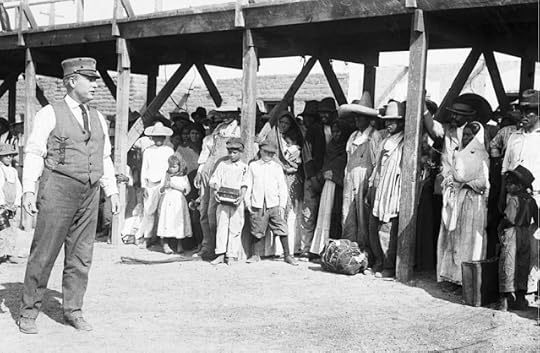
Bauer notes that scapegoating never faded away, and continues into modern times. For example, in 1900, Chinese immigrants were blamed for epidemics of tuberculosis, syphilis, and other diseases; in 1916, Mexicans were blamed for outbreaks of typhus; and in 2018, Donald Trump spread the word that "poor, uneducated, foreign immigrants are a particular threat to White Americans", and he later called the Covid pandemic "the Chinese virus" or the "Kung flu."
Chinatown was destroyed during the epidemics of 1900
Mexicans were forced to take kerosene baths when crossing the border in 1916
➽ Relief (Drugs)
From early times, humans understood that beer, wine, and opium juice made them feel better, so the idea of using substances - like plants, herbs, and vegetables - to relieve symptoms is very old. Our ancestors had no idea how the remedies worked, and paired characteristics of plants with (supposed) cures. For instance, plants that split rock crevices were administered to break up kidney stones.
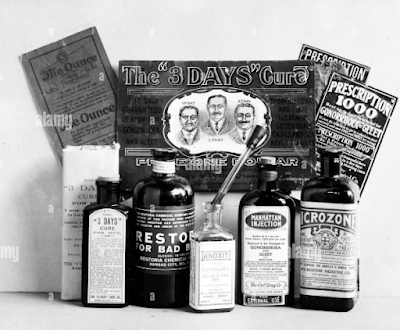
Over time, curative substances, and foods and drinks made from them, VERY SLOWLY evolved into drugs. Unfortunately, the proliferation of drugs also gave rise to quack remedies from hucksters, which persists in modern times (i.e. suggestions to use hydroxychloroquine and chloroquine for Covid).
Quack Medicines
➽ Human Anatomy
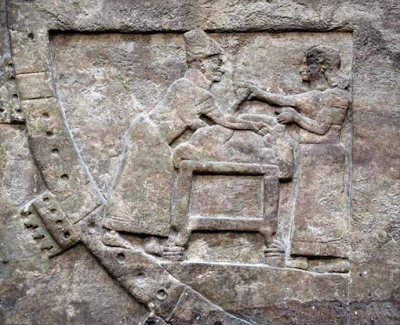
In ancient times, the human body was sacred, and healers would never open a body to diagnose illness, even after death. Over time, enterprising physicians overcame this superstition, did extensive autopsies, and wrote books about human anatomy. This was a big step forward in understanding illness and disease.
➽ Germ Theory
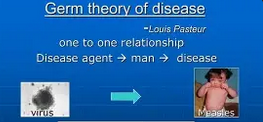
Historically, physicians had no knowledge of germs, but returning epidemics - like smallpox, plague and flu - demonstrated that humors couldn't be blamed, and that 'seeds of disease' spread the scourges. Though MANY people (including doctors) resisted this idea, what came to be known as germ theory slowly gave rise to inoculation and vaccination.
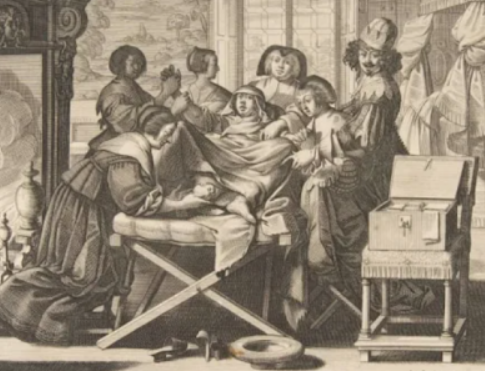
Sadly, failure to acknowledge that germs cause disease led to countless unnecessary deaths, since physicians who refused to wash their hands killed patients, especially when women got puerperal fever (an infection) after childbirth. [The arrogance here is mind-boggling; did the doctors also sit down to dinner with dirty hands that stunk from autopsies‽‽]
Childbirth was deadly in unsanitary conditions
➽ Cleanliness
Once humanity accepted the fact that germs cause disease, cleanliness became an issue. Bauer writes, "The first best response to sickness in the home was to examine the sinks, replace the drainage pipes, install traps to block the miasma [germs] from rising up from the cesspools beneath." Moreover, people eschewed furnishings that were difficult to clean, and assiduously scrubbed their homes.
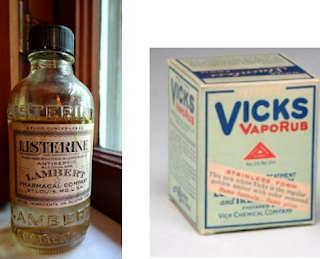
Household cleaners and personal products changed as well, and in the late 1800s - early 1900s, items like Listerine and Vicks VapoRub, which had very strong odors, became popular. Bauer writes, "The American Medical Association found itself obliged to warn the public that too many health products were created 'to smell and to sell', rather than to actually kill germs." The author points out that the addiction to 'germ killers' continues in modern times, as demonstrated by our purchase of all kinds of soaps, disinfectants, and cleaning products.
Fear of germs also led to a 'throwaway culture', and we now use myriad disposable items, such as plastic cups, paper plates, paper towels, styrofoam containers, tissues, plastic wrap, plastic bottles, and on and on.
➽ Antibiotics and Vaccines
Sulfa drugs were the first antibiotics, followed by penicillin, which - since it killed almost all bacteria - was considered a wonder drug. Lamentably, bacteria mutate quickly, and many germs eventually became immune to penicillin.
Other, stronger antibiotics were developed, but bacteria inevitably become immune sooner or later. Thus, we can't count on antibiotics to rescue us from bacterial epidemics, and antibiotics DON'T WORK AT ALL on viruses and other pathogens.
Vaccines can help fill the void, since they stimulate a person's immune system to mount a defense against invasive germs. Bauer discusses the discovery and development of vaccines, and notes that, during the Covid pandemic, some people shunned the Covid vaccine because "they didn't understand the science." A portion of the population also defied government attempts at quarantine and lockdown, perhaps egged on by Donald Trump.
Bauer observes, "In early March, 2024, former president and then-candidate Donald Trump announced, at a campaign rally in Richmond, Virginia, 'I will not give one penny of federal money to any school that has a vaccine mandate." Nevertheless, vaccines are currently our best hope for protection against disease.
Bauer wraps up her narrative by noting that, sooner or later, another pandemic will arrive, and hopefully we'll be ready.
The book is interesting, informative, and understandable. Highly recommended.
Thanks to Netgalley, Susan Wise Bauer, and St. Martin's Press for an ARC of the book.
This is a book written by an academic who grew up in a medical family, which I know from experience means human vulnerability is like a second language for her. She's writing here about how sickness impacts our whole species, like on a universal scale. So far, it's fascinating, and I'm just getting going.
"We could not set the earth free to wander in space, one planet among many, until we were able to abandon our bodies as unique and essentially connected to us, so worthy of honor that they would be reassembled by God Himself at the end of time. First the body became an object; and then, the earth followed suit. Once the physical body was a machine, no longer the absolute image of the divine, then the earth where those bodies lived could become, not the peak of God’s creation, but an object among others." p109
"The passions, in illness, paved the way to psychology, and from there to psychiatry. These fields would offer whole new vistas of help and relief to the sick, provide new strategies and medications that would change lives. And at the same time, the need to control the passions would load an additional burden onto the backs of the sick." p141
Final Review
(thoughts & recs) THE GREAT SHADOW is a pleasure to read. Yes, a book about disease and death was a joy to enjoy. But also, it's a book about disease and death So be sure to adjust your expectations accordingly.
I loved this book and I'm looking forward to Dr. Wise Bauer's next foray into history of medical science.
If this book is your jam, make sure to check out The Viral Underclass by Stephen W. Thrasher.
My Many Favorite Things:
✔️ "Malaria was probably with us from our earliest days on earth.... Not long after came tetanus, possibly sleeping sickness, the swelling and paralysis of trichinosis. But these sicknesses struck individuals, not groups, and came in discrete and isolated instances. They were not epidemic; they did not cluster; they did not move through the small roving bands. ...In this newly sedentary world, though, different illnesses slithered quietly into villages and moved sideways through them . Bacteria prospered, strengthened, and mutated in the growing heaps of feces and food scraps...." p17 I've read more than one history or popular science book that blames modern human problems on our building societies to begin with. We started stressing our environments in order to grow our population and germs started doing the same exact thing.
✔️ "Nicolaus Copernicus did not live to see the reverberations of his newly proposed sun-centered model— which was, in all likelihood, his intention. He knew the many dangers (scientific, philosophical, theological) in challenging the geocentric model.... It would fall to the scientists after him— most notably Johannes Kepler (1596’ s Mysterium Cosmographicum) and Galileo Galilei (Dialogue Concerning the Two Chief World Systems, 1632) to insist that the earth was, actually and in reality, not special. Full acceptance of this truth would take decades of arguments, excommunications, heresy convictions, imprisonments. Our movements through space were duplicated by nine, a score, a hundred, a thousand other planets." p109 I had no idea this is what it took for the sun-centered model to become accepted science! I love this story. It amazes me and makes me very glad to live in contemporary times.
✔️ "Pope Clement’s physician, Gui de Chauliac, records that [black death] was so infectious, “especially in those who were spitting up blood, that not only did one get it from another by living together but also by looking at each other.” Spitting up blood meant pneumonic plague, highly transmissible, so Chauliac is faithfully reporting a real phenomenon." p122 Holy crap I mean, that is scary as heck. And something else I didn't know.
✔️ "...But the greater responsibility lay with the patient. Already struggling with pain, fever, sleeplessness, and lack of appetite, the sufferer had a new task: Remain serene. If you become agitated, you’ll only make yourself worse. Make yourself worse: the responsibility here has been shifted onto the sick person.... This remains with us." p141 Hell yeah it did, it's baked into contemporary culture as one of ableism's many faces.
✔️ "Within a decade, the DPT shot—combined, newly effective (and safe) vaccinations against diphtheria, pertussis, and tetanus in the same dose—had changed our world yet again. The strangling cough, the membrane choking off air, the galvanic convulsions that broke bones: all of them could be prevented. Cases of all three diseases plummeted, and deaths slowed to a trickle." p271 Need a reason to get your vaccines? Read this book!
✔️ "Children lived. And because the survival of all children, not just the wealthy and lucky, was now a real possibility, the conversation about child welfare shifted to become a major item on more aggressive government agendas. ...Once they were saved, they had to be cared for. The rights of the child were a direct outgrowth of our triumph over infectious diseases. The survival of children changed the lives of women too. Women no longer had to give birth to eight children to guarantee that at least one would live to adulthood. Birth rates plummeted." The UN granted rights to children but the US did not. It might explain in part why infant mortality is so high in the US.
Content Notes: illness, animal cruelty, sewage, germs, dental pain, dental surgery, garbage, animal death, just like sooooooo so much violence against animals, animal sacrifice, skin disease, grievous illness, contagious disease, grievous injury, childhood disease, death of children,
Thank you to Susan Wise Bauer, St. Martin's Press, and NetGalley for an accessible digital arc of THE GREAT SHADOW. All views are mine.
I’ve always appreciated books that challenge the way I think, and Susan Wise Bauer succeeds admirably with this wide-ranging exploration of sickness, cures, and humanity’s evolving understanding of illness. This is a densely packed but highly readable examination of how societies have confronted disease—sometimes with remarkable insight and innovation, and at other times with stubborn ignorance in the face of clear evidence. Bauer presents illness not simply as a medical phenomenon, but as a cultural, social, and historical force that has shaped human behavior for centuries.
Bauer begins by guiding the reader through early conceptions of disease, reminding us that ailments we now consider minor—such as coughs, fevers, or infections—were once deadly threats. She traces how illnesses crossed into the human world through food, plants, animals, and environmental exposure, and how scientific inquiry slowly began to unravel these mysteries. For readers without a scientific background, this material is especially eye-opening. Bauer explains complex ideas clearly, making the fundamentals of disease and medical discovery accessible without oversimplifying them.
As understanding grew, so did efforts at prevention. Bauer charts the rise of hygiene, public health initiatives, and medical interventions, showing how new knowledge gradually displaced home remedies and superstition. Yet this progress was not without darker consequences. One of the book’s most thought-provoking sections examines how disease prevention became entangled with politics and social control. Certain groups—particularly Jews, Black communities, and those of lower socio-economic status—were stigmatised and blamed, turning illness into a tool for exclusion rather than compassion. This historical perspective adds significant depth and relevance to the narrative.
In a time when science, vaccines, and rational discourse are often overshadowed by political rhetoric, Bauer deliberately grounds her work in evidence and history rather than polemic. While she does not ignore contemporary debates around health and misinformation, she resists being pulled into partisan commentary, allowing the facts and historical record to speak for themselves. The result is a measured, informative narrative that respects the reader’s intelligence.
Overall, this is an engaging and educational work that balances medical history with social insight. Bauer’s clear pacing, well-supported arguments, and accessible prose make this an excellent read for both casual readers and those eager to dig deeper into the history of disease. I found myself jotting down notes on various illnesses and epidemics to explore further, and I suspect many readers will come away similarly inspired to learn more. A thoughtful, rewarding book that offers plenty to reflect on long after the final page.
Kudos, Madam Bauer, for something well worth my time and effort!
I love when a book is exactly what I am hoping it will be from the title and the cover. This is the case with The Great Shadow by Susan Wise Bauer. The basic premise is quite simple. How does sickness shape our world? The answer is so wide-ranging it could take thousands of books to go into detail. Bauer takes a much less laborious tack.
Bauer sprinkles the narrative with cuts to a specific time and place while discussing what a person would be thinking about an oncoming illness. Sure, you have a cold coming on, and you think the next few days will suck. Hundreds of years ago, you fell asleep with the idea that you may never wake up.
Bauer never takes the long way when she can break a complex concept down into a much easier-to-understand example. Vaccines are pretty political nowadays, but guess what? They were during the American Revolution when George Washington went rogue and had his army inoculated against smallpox. Yes, we cringe when we think about all the people who were bled unnecessarily (and probably to their deaths), but we can't forget that we still use some old remedies today.
I will say that Bauer's book is mostly focused on European and American medicine. It's not that she is discounting any other area, but merely that she can make the points she wants to make without having to cover the whole world. I would call this book targeted but not exhaustive.
You can judge this book by its cover. I recommend you pick it up when you do.
(This book was provided as a review copy by St. Martin's Press.)
The Publisher Says: From alchemy to wellness culture, from antisemitism to disposable plastic, a gripping account of how getting sick has shaped humanity.
Anti-science, anti-vaccine, anti-reason beliefs seem to be triumphing over common sense today. How did we get here? The Great Shadow brings a huge missing piece to this puzzle—the experience of actually being ill. What did it feel like to be a woman or man struggling with illness in ancient times, in the Middle Ages, in the seventeenth century, or in 1920? And how did that shape our thoughts and convictions?
The Great Shadow uses extensive historical research and first-person accounts to tell a vivid story about sickness and our responses to it, from very ancient times until the last decade. In the process of writing, historian Susan Wise Bauer reveals just how many of our current fads and causes are rooted in the moment-by-moment experience of sickness—from the search for a balanced lifestyle to plug-in air fresheners and bare hardwood floors. We can’t simply shout facts at people who refuse vaccinations, believe that immigrants carry diseases, or insist that God will look out for them during a pandemic. We have to enter with imagination, historical perspective, and empathy into their world. The Great Shadow does just that with page-turning flair.
I RECEIVED A DRC FROM THE PUBLISHER VIA NETGALLEY. THANK YOU.
My Review: It is unbelievably apt that this book was contracted for in 2019. I don't think I need to discuss what happened in 2020. What COVID did was to point up the absolutely amazing progress in medical treatment of disease that we've made...vaccines that have saved tens of millions of lives in the past six years developed in months not years...and how ingrained fallacies are in our species...the social distancing farrago is just miasma theory written in Times New Roman. COVID also caused the author to forego doing in-person research in favor of extensive online research. (If, like me, your eyebrows went up at the mere notion of suchlike in a serious work of nonfiction, cool your jets until you've looked through the over 400 notes and citations that make up a literal quarter of the text.)
As a narrative technique, reconstructions of past actions and attitudes work only as well as the author's ability to convey evidence from the records in appropriate prose. It's a technique I think adds some immediacy to history that otherwise is often dry and tedious. I'm happy to say Author Bauer convinced me to follow her as different events were interpreted as diving wrath, moral turpitude, and individual punishment when most twenty-first century people would see the disease process for the impersonal force it is.
It does lend itself, however, to a discontinuity of time. I followed Author Bauer's conceptual links between topics and strands of evidence without much conscious effort, often thinking "...but what about...?" mere words before she addressed the very question I was still formulating. Others might not find that to be their experience. I mention it as information only. You'll resonate with a less linear presentation in your own way. I can't offer a perfect five because even I was occasionally thrown off the scent of the idea being pursued.
I'm here to tell you I want you to read this book, no matter your beliefs about medicine or science. It is not chiding or minatory to people not in the tent with the believers on either side. It is tendentious; it is not disrespectful. Of course I can say that without hesitation because I agree with Author Bauer. I will offer my main evidence in favor of reading it by saying I was highly resistant to her take on social distancing being modern miasma theory until I read her points about the science for and against it. My mind, in the face of cogently presented and logically mustered evidence, changed.
An author who can get in under my well-entrenched, heavily undergirded arrogant illusion of knowledge deserves your treasure and your eyeblinks.
The next time I buy disposable plates, I will be thinking about how history is influencing me.
I initially listened to this book as soon as it was released, then bought a physical copy for another read through because it was just so fascinating. Truly crazy how much of how we live our everyday lives is because of the human relationship to sickness throughout history. So much perspective, so many wild primary source writings. Ask my book club how I tried to read like half the book out loud at our discussion time.
الكتاب ده صادفني وأنا بتعافى من وعكة صحية وكان قراءة مصاحبة مذهلة خلتني أكاد أستمتع بتجربة التعافي القذرة لأنني كنت أفهمها وأفكر فيها كأنها فلسفة أو مشروع دراسي وفكري محايد. أنصح به.
ملحوظة: المؤلفة أشارت بطريقة خاطئة لطريقة انتقال السالمونيلا وقالت أنها تنتقل بالهواء تقريبًا، بينما التايفويد كما تعرف كل فتاة ينتقل عبر ال feco oral route أو المسار البراز فموي.
Writing my review for this book was delayed because I got sick. Tested out clear on all the nastier bugs, just a pernicious cold.
Of course, you say, all that reading about disease made you prone to it.
Ah, I say, you have fallen into the trap the book seeks to teach you to avoid.
This is a book about the history of illness. I am already prone to like a book like this about the invisible intellectual architecture of our world, the ideas that we do not think about yet are the Water that creates what ideas we have. It has its limitations: it is not global, and primarily about the West and Near East; not about injury rather than disease, and less about chronic conditions than about infectious diseases. These are reasonable limitations, and the last is the most interesting, in the sense that part of the thesis here is that the paradigm of infectious disease is vital to the cultural (mis)treatment of chronic conditions.
The style is perfect. A touch melodramatic, it consists of introductory vignettes of people, contemporary and ancient, both trying to reckon with disease before discussing the particularities of that point in history. I complain about history writers trying to make something too sexy, but this is the exception that proves the rule. Illness is so personal, and now so prosaic, that it takes narrative flair to stick the point like it needs to. This is not limited to the fear that is illness in the past, but also that same invisible architecture of the present that radically changes how we live and think about living.
Most of the book is history and it is consistently captivating history, because much of the history is about how the language and ideas around illness from discredited science persists into the contemporary world - the fact we call it a cold, for instance. This matters a lot for how we treat one another and our lives.
Likewise, the book sticks the landing on one of my other persisting complaints in non-fiction writing about the flirting with anti-science thinking. There is a temptation in a book like this to oversell the value of science, and the triumph of it over superstition. But as often as not, it is a triumph of empiricism. It is not the vaunted scientific method at work but a real jumble of following lines of results. Everything is obvious, once you know the answer. This has big effects for how to look at bad ideas about health, medicine, and science, and policy choices in general.
The kinda sorta problem here is that there is a bit of a formal mismatch between the facts and the conclusions. The range of discussion gets briefer the closer the book gets to the contemporary day, to the point that the end feels a bit abrupt. The place where the overall thesis is going is a retake on the Pax Antibiotica and how much that dismal side of that has come to control contemporary life. There is a sort of negative space sense to this in terms of the rest of the reading, that the conclusion is established by how much this was not the case earlier in human history. But the body of the text being primarily about the ways in which the past affects the present thinking, maybe not always negatively but to great extent, feels disconnected.
Still, this is an unreserved recommendation, as that just makes it more like two excellent books, both that could have been expanded on further, and probably with a third in there for the issues skipped in the process. You will not think about the world the same way.
My thanks to the author, Susan Wise Bauer, for writing the book, and to the publisher, St. Martin's Press, for making the ARC available to me.
Susan Wise Bauer's The Great Shadow is a deep dive into how illness has cast a long shadow over what we think, do, believe and even buy. From the alchemical quests of medieval Europe to today's influencer-driven supplement fads, Bauer masterfully traces the threads of human response to disease, blending rigorous scholarship with vivid storytelling that makes centuries-old events feel immediate and personal.
What sets this book apart is Bauer's skill in weaving together distant eras: she juxtaposes the miasma theories and divine punishments of plague-ridden times with the pandemics of our own century, exposing how shame around sickness persists as a cultural undercurrent. Her research shines through in the wealth of primary sources including eyewitness accounts from patient and doctor perspectives, forgotten treatises, and propaganda pamphlets that bring the terror and folly of past outbreaks to life. It's not just history; it's a mirror reflecting our own vulnerabilities.
Particularly powerful is her unflinching examination of racism and scapegoating woven throughout. Time and again, societies pinned plagues on "outsiders" including Jews during the Black Death, immigrants in colonial eras or ethnic minorities in recent crises using disease as a flimsy excuse for violence, expulsion, and murder, utterly divorced from scientific reality. Bauer doesn't shy away from these dark patterns, yet she frames them with nuance, showing how fear exploits division while urging us toward evidence-based empathy.
This book left me both enlightened and unsettled, challenging me to rethink health narratives in politics, media, and daily life. If you're fascinated by the intersections of history, psychology, and public health or just want a scientific and historical lens on today's debates, The Great Shadow is essential reading. Bauer's prose is accessible yet erudite, making complex ideas flow effortlessly.
A fascinating and insightful history into medicine and sickness, I loved The Great Shadow. Susan Wise Bauer takes the reader from the dawn of time to modern-day COVID-19 and discusses (among many other things) the evolution of illnesses themselves, doctoral practice, medicine, and stereotypes associated with sicknesses.
Having been familiar with Bauer's Story of the World books, I was especially intrigued by her inclusion of first-hand accounts here in The Great Shadow . These personal additions were such rich additions to her research and gave the reader a unique look into what it was truly like to experience sickness throughout history.
I highly recommend this one and I can't wait to see what Bauer writes next.
I always Love Books about Medical 🏥 Beliefs. This one like since it talks about how we shape our Beliefs based on actually having illness. It covers several hundred years. Find that Fascinating.
Hope I get an early copy, so can catch up on my Books and Start Reading It.
Susan Wise Bauer is an American writer on faculty at the College of William and Mary. Her 2026 book The Great Shadow is an interesting exploration of the sociological/historical/cultural aspect of being ill, both from the perspective of the ill person and on how society have treated the infirm. As a physician with a longstanding interest in medical history, I’ve read dozens of books so far that have focused on historical understandings and treatments of illnesses (infectious disease, cancer, etc.), but never one told from quite this angle. Definitely an interesting read.
This book covered some fascinating (and grim) history and I'm very glad I read it. It makes me curious what we will learn in the next 10, 25, 50+ years. What do we believe today that will seem archaic or quaint? I was particularly interested in the origins of vaccines, the resistance of (Western) doctors to handwashing and honestly, how recently in our history we have figured almost anything out as it relates to effective medicine (although, I should caveat this by again saying in the "west".)
I add this caveat about Western medicine because this book was painfully Eurocentric (with some American perspective thrown in for good measure.) While the book does describe how vaccines were actually inspired by a method of inoculation that was part of traditional African medicine, that's about as far as it goes in recognizing the evolution of medicine anywhere other than Europe or the United States. As I've been reading this slowly over many months, I've been searching around for non-Eurocentric information and finding examples of how colonization actually disrupted advanced health and sanitation practices in many places outside of Europe. And that doesn't even consider Eastern medicine. All that to say, these omissions led to me talking much of the content of this book with a huge grain of salt.
What ended up hitting me the most about this book was the study of human nature as it pertains to illness. For example, how for so long, European medicine blamed the individual for their illnesses (and how the repercussions of these long-held beliefs still impact us today.) Another related example is how people and institutions have used their fear and ignorance of disease and illness as an excuse for every kind of discrimination. Also the arrogance and hubris of the medical community (doctors in particular as represented in this book) and the needless pain, suffering and death that lead to (especially of women, particularly people who gave birth.) You know, plus ça change . . .
As much as I'm glad I read this book - in addition to the omissions I've discussed, the writing style was sometimes off-putting and in particular the end of the book felt very rushed and disorganized in comparison to the earlier parts of the book. But it's making me want to seek out better books that cover similar content.
I received a digital Advance Reader Copy from NetGalley and St. Martin's Press in exchange for an honest review.
A heartfelt, meaningful look at the way we have failed medicine and medicine has failed us, how it has shaped our society, and how we have wielded fear of it like a scalpel to other the most marginalized among us. Also a beautiful look at how we can rise to the occasion, if we choose, how many times over we have been able to save ourselves and rebuild something better, but never by accident.
I received an advanced copy of the audiobook through Libro.FM and Pop Fiction Bookstore, an independent and woman-owned bookstore in Omaha. Order books (e/audio/print) online from Pop Fiction or your local bookstore at Libro.Fm and Bookshop.org
Aww man. Another book of which I had high expectations turns out to be a disappointment. I found it boring and a slog, and I was irritated by the writing style. So many hyperboles and overall too flourished, like a TED talk or vlog. I just want the facts, it's a non-fiction, not a thriller. The first few chapters are really good though. I know Susan Wise Bauer can write (therefore, 2 stars instead of 1). This just wasn't it. I'll stick to her histories.
This book was incredibly thought-provoking, well-researched, and stylistically interesting. Each chapter tackles a different (fascinating!) historical aspect of humanity’s relationship with disease. I loved the way primary sources were used to add color about how people actually talked and felt about illness and medicine and how the author would use second person and parallels between past and present to build empathy in the reader.
I also especially learning about how the gods changed (from something to consult, like a map, to something to appease) with the spread of illness, how thy Hippocratic method influenced medicine for centuries, how advancements like identifying specific bacteria and attempting to treat them were made, and how understanding of germ theory affected the rise of disposable products. Overall, I thought this book was great and would highly recommend it!
truly such an interesting book, bringing me back to the good old days of ap euro and apush (but in a specific lens— how humans perceived disease)! the sequencing of topics was natural, flowing well and not moving tangentially to the topic at hand. it really made me consider a career in public health, truly… yet another thing to add to my growing confusion of my future…
This book is a great reminder of how horribly mankind has suffered from disease and infections in the past, and how we are far from conquering all that plagues us despite amazing recent advances in antibiotics and vaccines. I particularly like the stories, either reimagined or reconstructed from or taken directly from contemporary accounts, of the sufferings real people went through due to disease. This really humanizes the past and makes me appreciate anew how good we have it now - even just the ability to alleviate pain so we don't die in agony.
I really enjoyed this book: it was well written, well organized, and a page turner (even if a rather depressing one).
I’m a big reader of medical history (it’s a wonder that the human race has survived at the hands of early medical practitioners) at the same time the book disappointed this reader.
The chapters and text while presented chronologically seem to jump around from one subject to another. The writing seemed almost textbook like.
The redeeming value of this book lies in the way this author shows how the current discourse surrounding such issues, as vaccination and ethnic biases concerning disease have been alive since the dawn of medicine.
The Great Shadow: A History of How Sickness Shapes What We Do, Think, Believe, and Buy by Susan Wise Bauer is a remarkably engaging and intellectually rich exploration of illness—not just as a biological phenomenon, but as a force that has quietly shaped nearly every dimension of human life. What makes the book especially compelling is not simply its subject matter, but the way Bauer structures and animates that subject, transforming what could have been a dry medical history into something vivid, almost novelistic in tone.
One of the most fascinating aspects of the book is its structure. Rather than presenting a straightforward chronological survey, Bauer organizes chapters around lived experiences of sickness. She often begins with immersive, almost fictionalized vignettes—placing the reader inside the body and mind of a sufferer in a specific historical moment—before zooming out into broader analysis. This approach gives the book a dual rhythm: intimate and analytical. It is this structure that makes the work so absorbing; the reader is not just learning about illness, but momentarily inhabiting it. Reviewers note that these narrative openings “set the stage for a discussion of broader developments in science and medicine,” making complex historical shifts feel immediate and human.
Thematically, Bauer covers an enormous range of topics, all unified by a central idea: sickness is a “prism” through which humans interpret reality. Early chapters explore ancient and classical understandings of disease, including spiritual explanations and the theory of bodily humors. From there, the book moves into medieval and early modern periods, where epidemics and pandemics reshape societies—not only medically, but morally and politically. Bauer also examines the rise of germ theory, the development of hygiene culture, and the modern obsession with cleanliness and prevention. She even connects illness to consumer behavior, showing how fear of disease influenced everything from household design to the marketing of disinfectants and wellness products.
Among these topics, the discussions of syphilis and the bubonic plague stand out as particularly fascinating. Bauer treats both not merely as medical crises, but as cultural turning points. Syphilis, for instance, emerges as a disease entangled with morality, sexuality, and shame. Its symptoms—often slow, disfiguring, and unpredictable—made it uniquely suited to moral interpretation. Societies didn’t just treat syphilis; they judged it. This duality is what makes it so compelling: the disease functioned as both a biological infection and a social verdict. Bauer’s exploration highlights how fear of syphilis shaped attitudes toward intimacy, gender, and even medical ethics, revealing the deep psychological imprint of disease.
The bubonic plague, on the other hand, represents disease at its most catastrophic and socially destabilizing. Bauer’s treatment of plague outbreaks emphasizes not only their staggering mortality, but also their capacity to fracture societies. When traditional medical frameworks failed, people turned to scapegoating, often targeting marginalized groups—demonstrating how fear of disease can mutate into fear of “the other”. What makes this section so gripping is the way Bauer links these historical reactions to modern patterns of blame and panic. The plague becomes more than an event; it becomes a recurring psychological script.
What deepens the fascination with both syphilis and the plague is Bauer’s insistence that outdated ideas never fully disappear. Even as scientific understanding advances, older beliefs linger beneath the surface, creating contradictions in how we think about illness today. This layering of past and present is one of the book’s most thought-provoking insights. It suggests that our responses to disease—fear, denial, moralization, and even consumer habits—are not purely rational, but historically conditioned.
Ultimately, The Great Shadow succeeds because it reframes sickness as a central driver of human behavior. It shows how illness has shaped religion, politics, social hierarchies, and even everyday choices in ways we rarely recognize. Bauer’s writing is clear, vivid, and deeply empathetic, making complex ideas accessible without oversimplifying them. The result is a book that is not only informative, but genuinely transformative in how it encourages readers to think about the relationship between body, mind, and society.
What lingers most after reading is a sense of continuity: despite centuries of medical progress, our emotional and cultural responses to illness remain strikingly familiar. That realization—both unsettling and fascinating—is what gives Bauer’s work its lasting power.
I didn’t expect a history of disease to be such thoroughly good company, but Susan Wise Bauer’s “The Great Shadow” turned out to be one of those nonfiction books which beautifully balances information density and entertainment. It’s a grand tour through the ways illness has shaped our species — not only our bodies, but our ideas, fears and moral reflexes.
Bauer traces how humans have tried to explain sickness from the days well before humours and miasmas became a thing. Her history is panoramic but peppered with brilliant detail. I especially loved the vignettes that revisit the same disease across centuries; they’re like historical split screens showing how our understanding evolves — and how our blame stays the same. It is sobering that across millennia humans have stayed eerily consistent in always finding a convenient “them” to scapegoat.
In the second half of the book Bauer’s focus leans heavily toward infectious diseases. Granted, germ theory was a quite fundamental development. And I understand that there is only so much one can cram into a book, but while bacteria take centre stage other health stories linger in the wings. There is very limited information about the relationship between food and health. The section on the impact of humanity’s shift from hunter-gatherers to farmers is fascinating, but that was rather a long time ago and much more has happened since. Similarly development of surgery is scarcely touched upon. And the impact of industrialisation in regard to noncommunicable diseases or environmental health hazards are not really mentioned. I’d have loved a chapter on occupational diseases, (air) pollution or what early surgeons actually thought they were doing. Maybe this could be a second book…
And while the writing is fluid and witty, a few of the second person vignettes feel like an odd stylistic detour rather than a portal into empathy. Still, they’re forgivable quirks in an otherwise brilliant, engrossing narrative.
The audiobook narration by Jennifer Pickens is just right — calm, clear, respectful of the text’s intelligence. She never oversells the drama, which allows Bauer’s own sharp observations to land exactly where they should.
Overall, I loved The Great Shadow. It’s an illuminating and humane that deserves a wide audience. I hope many readers—and listeners—find it, because its message feels painfully timely and quietly instructive. Bauer reminds us, with elegance and restraint, that progress in medicine doesn’t necessarily mean progress in compassion. Our cures may have improved; our instincts toward the ill, alas, have not.
Thank you to Macmillan Audio, NetGalley and Susan Wise Bauer for an advance listening copy of this book
Susan Wise Bauer offers a fascinating look at illness throughout human history, charting the path from initial causes and societal chaos to eventual cures. The book expertly examines the myriad ways humans fall ill, the panic that fuels irrational beliefs, and the scientific breakthroughs that lead to treatment. Despite the heavy subject matter, it remains an accessible and enjoyable read that isn’t too dense for the layperson.
However, the narrative structure can feel disjointed. While it initially hints at a linear timeline, the prose frequently jumps back and forth within chapters, which can be disorienting. While some chapters successfully use parallel storytelling to compare historical illnesses with modern counterparts, this consistency isn't maintained throughout. Furthermore, despite the overall scientific tone, the author’s personal political and religious views occasionally bleed into the text through unnecessary commentary and cherry-picked examples, which may detract from the objective experience for some readers.
3.5 stars rounded up to 4
Thanks to NetGalley and St. Martin's Press for an eARC
Highly recommended and entertaining for such a serious subject! This is a fascinating and very well-narrated journey through human civilization focused on our relationship with (and quest to understand) disease. In broad terms: when, how, and why epidemics happened (and keep happening); the rise of disease-fighting medications, followed by the rise of medication-resistant disease; and the various theories over the centuries that work to explain how we can keep ourselves healthy. This book focuses on Western medicine and diseases/plagues/epidemics in Europe and the Americas. The author notes the different paths toward health taken in other parts of the world (like Ayurveda), but to do them justice would require multiple volumes. I was particularly taken with how medical theories translated into health campaigns, which were then reflected in our country's core values, for better and worse. Some of these unfounded/unproven prejudices (and xenophobia) persist to this day. My thanks to the author, publisher, @MacmillanAudio, and #NetGalley for early access to the audiobook #TheGreatShadow for review purposes. Publication date: 27 Jan 2026.
Consider this a scientific book but, the authors decision to write in the narrative was ingenious. She writes about the history of illness, infections and diseases... starting in 5000 BC (which was mind-boggling), ending in todays times. What I liked about it.... 1. The narrative format 2. The unending use of references and credits throughout the book, and 20 pages of reference notes at the end (huge plus in her credibility as an expert) 3. Her use of comparing similar scenarios of an illness between past times and today. 4. And basically covering over 7000 years of how addressing this stuff has advanced (and sometimes not for the better). This isnt a spoiler alert, but at the end she mentions we have recently entered the Third Epidemiologic Transition, which started with ebola and HIV. Which I would never have guessed that, in 7000 years were only in #3!! 5 star ++ for sure
The Great Shadow: A History of How Sickness Shapes What We Do, Think, Believe, and Buy was completely my kind of nonfiction as someone with a science/engineering background and a longtime fascination with immunology, disease spread, and pandemic history. Susan Wise Bauer explores how sickness has shaped human behavior, politics, religion, consumer habits, and wellness culture across centuries, and I found it endlessly interesting. Despite the depth of research, this never felt dry or overly academic. I especially loved the connections between historical disease fears and modern anti-science movements, wellness trends, and public behavior. There were multiple moments where I caught myself thinking, “wow, humanity really keeps repeating itself.” 4.25 stars. Fascinating, accessible, and mildly horrifying in the way all good pandemic history tends to be.
I knew some of this - that people used to believe the causes of disease were the anger of God, then the alignment of the planets, then the balance of humors, then miasmas, before we finally figured out germs. But to see it all presented chronologically was very interesting. There was bleeding over as new ideas were accepted. There were hold outs in the face of evidence - like the doctors who refused to believe their dirty hands were killing people! Bauer sometimes describes how an illness or injury would affect someone now, then compares it to how it would go for someone 500 years ago - yikes. The writing was clear and not too technical. If you like non-fiction, I think you'll find this worth your time.
Always curious I want to know how we got here. This book describes sickness and how we treat it. I have no medical training and as a lay reader I could follow the path. Lots of familiar references, historic and current. Explanations for anti-vax, anti-immigrant,anti-science — all the blame to “others”. Old ideas may still be hardwired…did you tell your kids to wear a hat or you’ll catch cold when we know with certainty that you catch cold from germs? Good stuff in a good format.