"A simple but effective look at a keystone species."—Kirkus Reviews
On the Pacific Coast of North America, sea otters play, dive, and hunt for sea urchins, crabs, abalone, and fish in the lush kelp forests beneath the waves. But there was a time when people hunted the otters almost to extinction. Without sea otters to eat them, an army of hungry sea urchins grew and destroyed entire kelp forests. Fish and other animals that depended on the kelp were lost, too. But when people protected the sea otters with new laws, their numbers began to recover, and so did the kelp forests. Susannah Buhrman-Deever offers a beautifully written account of a trophic cascade, which happens when the removal of a single element affects an entire habitat. Asides that dig deeper are woven throughout Matthew Trueman’s dynamic illustrations, starring a raft of charismatic sea otters. Back matter includes more information about sea otters and kelp forests, including their importance and current status, the effects of the international fur trade on indigenous peoples, and a list of books and websites for readers who wish to continue to explore.
Susannah Buhrman-Deever is a biologist with a PhD in animal behavior from Cornell University. In addition to her academic work and writing, she has developed inquiry-based ecology curricula for children. Predator and Prey is her first book for children. She lives with her family in upstate New York.
A warning about the domino effect that occurs when you remove one part of an ecosystem, If You Take Away the Otter tells the story of what happened when otters were not protected. Clearly explaining the cause and effect, this message can easily be applied to other ecosystems.
With the inclusion of plenty of facts about the otters and their habitat, I would have used this book to research a school project when I was a kid. I doubt I would have borrowed it from the library with my usual reading material as I’ve only become interested in non-fiction as an adult. For those who are seeking further information, there’s a bibliography and details of books and websites at the end of the book.
For me, Matthew Trueman’s illustrations were the star of this book. The otters are absolutely adorable and all of the other sea life pictured are equally realistic. Some younger children may find the pages that depict the people in boats coming to hunt the otters scary, although there is a happy ending.
Thank you so much to NetGalley and Candlewick Press for the opportunity to read this book.
This is a stunningly beautiful conservation picture book for kids. It describes the world of the sea otters and all of the ocean life in their ecosystem, and how foreign hunting nearly wiped them out and destroyed the whole underwater ecosystem. There's a happy ending and lots of information about the many species depicted, along with an important message about messing with the balance of nature and how that hurts us all. The watercolor illustrations are vibrant and gorgeous. Highly recommended, for its educational value and the beautiful illustrations.
I read a temporary digital ARC of this book for review.
This is a great children's books about balancing an ecosystem. This book shows how the hunting of sea otters in the 1800s decimated the ecosystem in the Northern Pacific. With no otters to eat the sea urchins, they ate and destroyed the kelp forests. With no kelp forest, the fish in the area disappeared, with no fish the eagles had nothing to eat, so started eating other birds etc. In 1911, several countries signed a treaty to protect the sea otter and the ecosystem has finally returned to normal. The illustrations of this book were well done, large and colourful that adds to the text. There are also facts about the various living things in this ecosystem. The back of the book as a short synopsis of the story with additional information about what sea kelp does for the world, as well as how the fur traders caused serious problems with the indigenous people. There is also a list of further resources to check out. Overall, a good book for anyone learning about endangered species, and protecting ecosystems. I recommend this book for classrooms, school and public libraries. The publisher generously provided me with a copy of this book upon request. The rating, ideas and opinions shared are my own.
Notable Children’s Books - 2021 Association for Library Service to Children (ALSC) Title: If You Take Away the Otter. Illustrated By: Mathew Trueman Written By: Susannah Buhrman-Deever Recommended for 3rd/4th Grade If You Take Away the Otter, Youtube
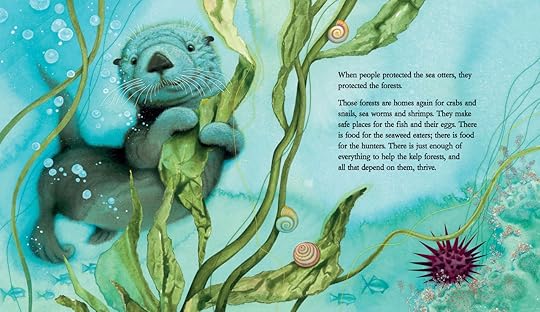
The illustrations are detailed and very specific to what lies beneath the ocean surface. The ocean forests have lush green vegetation, intertwined, and home to many sea creatures. The context matches the descriptions throughout this nonfiction text. New vocabulary is presented in context as well as within the bright, colorful images. Captions are written in a traditional format and are also written sideways to capture the reader’s attention. The ocean water is clear and cold as the sea creatures swim freely. With every sea creature, there are detailed images of the abalones and clams, sea stars, octopuses, feathery sea worms, and swarms of tiny swimming shrimps living in these treeless forests. Each picture brighter and more prominent than the next. I appreciate how illustrator, Mathew Trueman, gives exact meaning in all his descriptions. As the otters dive deep into the ocean forest, they fill their bellies with fish and clams, snails and crabs, and much more. The illustrator also includes the otter’s most dangerous threat. The indigenous people had lived alongside otters for thousands of years. The otters’ facial expressions are so innocent to what’s about to take place. There are many great supports embedded throughout this informational text. With so much new content, vocabulary, captions, and history, the illustrations are an excellent scaffold for students to understand.
A documentary that adopt the «model» of a more common picture story book. Not my favorite type of book. I'm more of a story or documentary, but mixing style like that isn't much for me. I could be very good for some reader, because the blending is very well executed. So if you like that style and subject you should have a look. Personal liking 2/5, potential 4/5, I'm going with the fair 3/5.
I always love children's books with a message that I can fully support. If You Take Away the Otter by Susannah Buhrman-Deever and illustrated by Matthew Trueman is one such fantastic book. Using a real-life example to illustrate the damages that would come about if a single animal is taken from an ecosystem, the author seeks to foster an understanding and appreciation for how all animals affect the world around them. Had it been written in a manner that was a little more accessible for young kids, it would have been perfect.
The best thing that this book has going for it are the absolutely and incredibly gorgeous illustrations that fill its pages. You almost feel as if you are swimming within the waters alongside the creatures that live there. The pictures tell an exceptional story of what happens to an area when otters are hunted and killed, their population decreasing. There's a foreboding that comes to you as you flip through the pages. You feel haunted by the horrors of what has happened. Fortunately, relief returns in the form of the adorable little creatures returning to frolic about as they once did.
Where I think this book fails somewhat, however, is in its prose. None of it is exceptionally engaging to a young mind. In fact, as I imagine a parent reading this book to a child, I can already picture the kids growing bored and moving away in favor of other distractions. I feel like the book would have benefitted immensely from some sort of lyrical presentation. At the very least the information presented should have been done in a manner that allows kids to remain engaged.
I just think that too much was thrown in with the odd expectation that a child would pay attention. And while I love this book in spite of that, I know I would have a difficult time getting my niece to pay attention to it. It's definitely a book I would recommend for older kids, at minimum eight or nine years old.
This book is a warning, one that everyone should heed. It's exceedingly important for young children to be introduced to these truths so that they can grow up into adults who genuinely care for these animals and their plight. I am glad to have read it.
I was provided a free copy of this book via NetGalley in exchange for an honest review.
Sea otters are often the star of picture books about sea animals, perhaps because they are have such sweet faces and seem so playful and friendly. But the sea otter actually plays a key role in maintaining a healthy ecosystem off the Pacific coast of North America. As Susannah Buhrman-Deever explains, there large forests of kelp growing there, providing a home for abalones, clams, sea stars, octopuses and other sea creatures, among them the spiny sea urchin, the enemy and potential destroyer of the kelp forest. Luckily, the otter is a hungry hunter, diving deep into the sea to eat whatever he finds in the kelp, including the sea urchin, maintaining the delicate balance needed for the kelp to thrive. But what if the sea otter disappeared? What would happen to this important ecosystem? At one time, the sea otter was hunted for its thick fur until they almost all gone. When that happened, the spiny sea urchin ate the kelp, causing the underwater forest to collapse. Once the kelp was gone, the other sea creatures no longer had a safe place for their eggs and babies. Fortunately, in 1911, laws were passed to protect the otter from hunters. As the otter population increased, slowly new kelp forests began to grow, providing homes for sea creatures and food for the otters. Buhrman-Deever brilliantly presents this example of the negative impact the loss of one keystone animal can have on the environment in which it lives. It is written on two levels - one in large type gives the basic story, while more detailed facts are presented in smaller type. The kids I shared this book with are young so we stuck to the basic type, and I think because the otters had a happy ending, it generated lots of conversation (more than had the ending be otherwise). The mixed-media illustrations are done in various bright to darker shades of aquamarine depending on the health of the kelp forest. Back matter included more information about kelp forests and otters, a select Bibliography and a list of books and websites for further investigation. This is another excellent informative STEM book for studies on ecosystems and the environment.
This is a superb book that is both interesting and educational and will entertain the reader or listener intellectually as well as visually. We don't normally stop and think about the multitude of good otters bring to our world. We see them as graceful, cute critters, sometimes lazy, and consider it fun to watch them.
But they have been endangered. Now in this children's book we can see just how much our oceans need the otter.
A story is told on each page with text and illustrations. Also tucked away on each page are important points of interest that will drive home the need to protect sea otters for the health of our oceans.
Terrific book.
Disclosure: I was provided a complimentary copy to facilitate a review. Opinions are mine, alone and are freely given.
The illustrations are mixed media (the background of each page seems like watercolor). They were beautiful! The colors of the sea always captivate me.
There is big text for a story-like presentation of what happened to sea otters (and their related ecology) and small text with scientific asides. The back matter is a little redundant, but I appreciated the selected bibliography (which includes a source from First Nations) and additional books and websites for those interested in learning more.
"On the Pacific coast of North America, where the ocean meets the shore, there are forests that have not trees.
These forests are not on land. They are ocean forests, forests of kelp."
Try reading aloud the first page in your teacher "read aloud" voice and you will know this is a MUST READ for your students. "What no trees in a forest? What are forests of kelp? Did you know this?" Then savor Trueman's illustrations--bold, magnificent kelp, "a type of large marine alga or seaweed," that attaches to the rocks on the ocean floor. "Oh, Friends! Let's turn the page to find out more!"
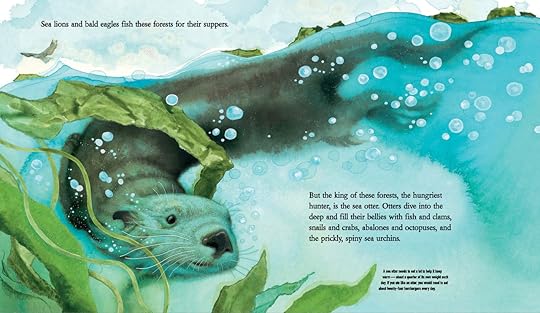
The TRICKY PART is that your students WILL NOT MEET THE SEA OTTER UNTIL the fifth two-page layout. This is purposeful on Buhrman-Deever's part - she's introducing the reader to the food chain. The kelp is home to many animals which are also the food for the sea otter. For younger students, you might notice during the first few pages, "But where are the sea otters?" just to keep them engaged and wondering. And then WATCH THEIR EYES POP when you turn to this layout and read -
"But the kind of these forests, the hungriest hunter, is the sea otter. Otters dive into the deep and fill their bellies with fish and clams, snails and crabs, abalones and octopuses, and the prickly, spiny sea urchins."
I'd love to know what students say when you ask, "Why do you think the author waited until this page to introduce the sea otter?"
From there, the author builds the case that the sea otter is a keystone species that non-indigenous hunters nearly wiped out.
On each page there are additional facts printed in a smaller font. I'd save these for a second read aloud.
The author's note appears to be geared towards the adult or older reader audience (in other words, it may not read aloud easily in k-1, but you might read parts of it to 2nd-3rd. CHECK OUT THE THIRD PARAGRAPH IN THE AUTHOR'S NOTE - The Russian hunters nearly devastated the population of sea otters (as revealed in the book), but this was also "devastating to Indigenous Peoples of the northern Pacific coast." This point makes for interesting additional conversations with your students.
A "keystone species" is "... a species which has a disproportionately large effect on its natural environment relative to its abundance.... Such species are described as playing a critical role in maintaining the structure of an ecological community...". (Thank you Wiki for that succinct definition.) Unless you're especially partial to beavers, the cutest, cuddliest, cleverest keystone species is the Sea Otter. (Insert plush toy here.)
This book works at several different levels, and it gets across the idea of keystone species, and the particular story of Sea Otters, crisply, clearly, and directly. On the chapter book/picture book level we have cheerful, bright and engaging mixed media drawings, (that look like fully painted watercolors), of kelp forests, the animals within, and playful, hungry sea otters. Even the sea urchins look good. These pictures are complemented by a straightforward narrative that seems designed for read-tos. But then, inserted within and around the drawings we get text with a little more detail and elaboration, which seems aimed at slightly older readers.
A necessary part of the otter story is the tale of the over hunting and then the eventual reestablishment of otter populations. I've read this story in dozens of books, and the telling can range from heavy-handed to just mildly incidental. Here, we get a middle of the road approach that laments careless overhunting without trying too hard to assign blame, and then celebrates the protection and reintroduction of otter communities. For a kid's book, this struck me as a decent compromise that gets across the otter story while keeping the focus on why otters are a keystone here on the Monterey Bay. (I expect to see this in the Aquarium's book shop fairly soon.)
So, I thought this was a charming picture book with an important story to tell, a valuable lesson to offer, and a very well presented explanation of an especially important ecological principle. All good. (P.S. Maybe an extra star for drawing a Jewel Top crawling on the kelp.)
(Please note that I received a free advance will-self-destruct-in-x-days Adobe Digital copy of this book without a review requirement, or any influence regarding review content should I choose to post a review. Apart from that I have no connection at all to either the author or the publisher of this book.)
As a human being, I believe we should be aware of the importance of our actions by learning about connections in life no matter how small an act may seem. As a teacher, I encouraged students to look for them often. For example, if I don't plant flowers that encourage bees, will they find other places that are enough food? If I don't water my lawn in my semi-arid climate, am I aware that the grass and those insects that live there will disappear? And what about the birds that eat those insects? These are simple examples, but there are connections to be learned from the youngest age to the oldest in nearly every part of our lives. It's important to know that they exist and our actions count, too. Susannah Buhrman-Deever, with the help of Matthew Trueman's realistic and beautiful illustrations filling the pages, shows how the parts of the kelp forests connect to each other that includes sea otter survival a large part of their healthy existence. There are simple explanations part by part with short facts in smaller text added within the pictures of kelp forests full of varied creatures, along with those sea otters. They are needed especially to keep the sea urchin population smaller. Eagles are also included in this inter-connected system! Buhrman-Deever tells the history of when those important otters nearly disappeared when too many were hunted for their fine pelts in the 18th and 19th centuries. The book offers a clear case of the importance of balanced systems, perhaps would be a mentor text to jump off into research of other things connected, for younger children, a way to show how one action starts a chain and it's not always a positive end.
This is one of those books about the impact humans have on the natural environment that can really open a child up to the idea of environmental stewardship. It reminds me of the work of Nicola Davies, with its nonfiction subtext running through the story, though the regular text is also largely informational. It also brought to mind the books in the If Animals Disappeared series by Lily Williams as well as some of the picture books of Jean Craighead George and Wendell Minor. In all, I don't have an unfavorable comparisons to make. The illustrations are expressive and engaging and the text is well presented. This is an excellent addition to the genre, and I look forward to its publication as well as whatever the author has in store for us next.
This non-fiction picture book tells of the devastating consequences to the shallow ocean environment when the sea otters were hunted almost to extinction by fur traders. When the sea otters disappeared, the sea urchins multiplied and decimated the kelp forests. The author goes on to tell about the government protection of sea otters, the slow return of the otters to their environment, the sea otters' control of the urchins, and the regrowth of the kelp forests. Matthew Trueman contributed the beautiful mixed media (mostly watercolor) paintings in primarily blues, greens, and reddish-browns. The back matter includes an author's note with a few more details; a couple of bibliographies; and a list of websites. For about Kinder -- 3rd grade.
I received an electronic ARC from Candlewick Press through NetGalley. Buhrman-Deever captures the kelp forest environment and clearly explains what happened when otters were hunted almost to extinction. She also brings readers to the current resurgence and rebirth of the kelp forest and its inhabitants. Short information blurbs are added to most pages. Lovely soft water color illustrations bring the scenes to life. Bibliography included at the end. Relatable style to draw readers in to learn more about this portion of the earth.
Lovely book about how all interconnected nature is, the illustrations are stunning. Only negative is there is large and small text, sometimes this overlaps and it’s hard to see a distinction between them and it’s not on all pages, all the text could have been integrated.
On the Pacific Coast of North America, sea otters play, dive, and hunt for sea urchins, crabs, abalone, and fish in the lush kelp forests beneath the waves. But there was a time when people hunted the otters almost to extinction. Without sea otters to eat them, an army of hungry sea urchins grew and destroyed entire kelp forests. Fish and other animals that depended on the kelp were lost, too. But when people protected the sea otters with new laws, their numbers began to recover, and so did the kelp forests. Susannah Buhrman-Deever offers a beautifully written account of a trophic cascade, which happens when the removal of a single element affects an entire habitat. Asides that dig deeper are woven throughout Matthew Trueman’s dynamic illustrations, starring a raft of charismatic sea otters. Back matter includes more information about sea otters and kelp forests, including their importance and current status, the effects of the international fur trade on indigenous peoples, and a list of books and websites for readers who wish to continue to explore.
Out May 2020
32 Pages
MY THOUGHTS:
I received this book in exchange for my honest review.
What a beautiful cover and book jacket. This large 10 x 10 hardcover book is stunning with a wonderful story about life on this planet. The otter is the focus along with its environment. The story tells an important story of how removing one element in the seas can affect an entire eco-system.
A thoughtful approach in a picture book aimed at the youngest of readers but can also be read by early readers, chapter book readers and special needs kids. Full of useful and educational information and a story to invoke conversations and thoughts regarding the future of this planet.
There’s a section at the back that adds more information about the otters and the affects on the fur trade and life for Indigenous people.
An excellent book for my collection that will be introduced to my clients.
When I first saw this book, the art reminded me of We Are Water Protectors. I hoped it reflected Indigenous / First Nations perspectives on protecting nature. The artwork in this nonfiction picturebook is gorgeous and amazing. The text teaches readers how people hunting sea otters badly affected the entire ecosystem in the Pacific Coast of North America. The back of the book teaches more about kelp and sea otters and how the international fur trade affects indigenous peoples.
I would use this book with 1st grade simply as a read aloud and discussion starter. With 2nd grade - 5th grade, I’d use it as part of science in any unit that was about animals, animal and plant interrelations, the ecosystem, or conservation.
I accessed this award-winning book on youtube but to use it in my class, I’d find it at my library in print form to really highlight the illustrations for my students. Especially with students in 3rd and up, I recommend finding a print copy. The animations in the one video might be great for 1st grade, but the beautiful art will better engage older students on its own.
Awards: A Junior Library Guild Selection 2021 ALA/ALSC Notable Children’s Book 2021 NCTE Orbis Pictus Honor Book 2021 Cook Prize Honor 2021 NSTA Outstanding Science Trade Book 2021 Green Earth Book Awards Recommended Read 2020 Best Book for Kids, Chicago Public Library 2020 Evanston Public Library’s 101 Great Book for Kids List 2021 AAAS/Subaru Prize Children’s Science Picture Book Longlist
This is a thoughtfully composed and gorgeously illustrated book about ecosystems, interdependence, and what happens when human action interrupts nature's balance. Starting with a detailed but engaging description of how the ecosystem off the northern Pacific coast functioned for thousands of years, the book then explains how Europeans began to over-hunt sea otters in the mid-1700s, driving them nearly to extinction and devastating the entire ecosystem. The book ends on a more hopeful note by detailing how laws were put in place to protect the sea otters and the ecosystem began to be restored. Informative backmatter, including a selected bibliography, concludes the book.
While If you Take Away the Otter does not leave out or obscure the Indigenous people of the northern Pacific coast and the impact that European exploration and extractive colonialism had on them, I did find it problematic that these Europeans were referred to merely as "new people" in the main text of the book. It would have been more transparent and accurate, and less confusing, to refer to them as "Russian explorers," as the backmatter and smaller "supplemental" notes included in the main text of the book do.
Starting with the importance of kelp forests on the Pacific coast of North America, this book goes on to explain how otters depend on the many species which live in these forests for food. When otters were over-hunted, sea urchins proliferated, causing the kelp forests to deplete and erasing the habitat for many species. The human part in these events is explained nicely: "People do not always understand at first the changes they cause when they take too much." This opens a young reader's mind to the idea that we can change behavior to repair ecological problems. The clear progression of facts, pushed along by the lovely mixed media illustrations, makes for an easily digestible and compelling explanation of the interconnectedness of species. The book's palette is lovely sea blues and greens, and the youngest readers will especially enjoy the otters, which have a lot of personality. The text on each page is the perfect amount for the target audience, with asides in smaller type for those who crave more information. An impressive section of back matter includes an author's note, bibliography and additional resources. Highly recommended.
Summer after summer for more than two decades, their playful antics were a gift. They moved from the river to the shore with lightning speed and agility. Occasionally the dock provided them a resting place. Sometimes the remains of their snacks were seen on the nearby grass. Their place in the ecology of the northern Michigan river world was and is invaluable in the system of environmental checks and balances.
They are among a multitude of living beings whose purpose is not initially known. Fortunately for readers, there are authors and illustrators who seek to inform us of the essential part we all play in the preservation of our planet and its inhabitants. If You Take Away the Otter (Candlewick Press, May 26, 2020) written by Susannah Buhrman-Deever with illustrations by Matthew Trueman is a story of destruction and restoration. It is a reminder of what cannot be ignored.
If You Take Away the Otter by Susannah Buhrman-Deever is a 2021 Orbis Pictus Honor book. This book explains how the sea otters were hunted on the Pacific coast by fur traders, and their numbers were depleted from 300,000 to 2,000 by 1911. The kelp forests changed. Sea urchins took over eating up the kelp forests because there were not enough otters to eat the urchins. Other animals lost their homes and food source because of the loss of the kelp forests. In 1911, the United States, Russia, Japan, and Great Britain signed the International Fur Seal Treaty which stopped non-indigenous sea otter hunting and selling of otter furs. The otter population slowly revived and so have the kelp forests. I think this is a beautifully illustrated picture book to read aloud to primary students. This would be a great book for teachers to use during science when teaching about animal habitats and ecosystems.
I loved this book and it was beautifully illustrated!
I love natural history and have done from a very young age after I used to sit and watch wildlife documentaries with my dad, now I am a mum and have my daughter I am introducing her to the natural world and this is definitely a book I would read to her.
It is well written, the flow of the book is great and I loved the way it was told with the main detail and smaller facts to add detail. The only niggle I had was that the little facts that were added to the pages (which really helped the book in my view) were a little small for me.
It is 4.5 stars from me for this one, rounded up to 5 stars for Goodreads and Amazon - an excellent way to show the impact of people on the natural world and how we can't make the mistakes we did in the past again - very highly recommended!
This lovely nonfiction title discusses the impact of taking the otter out of kelp forests in the ocean. This book could be used in story times as the main narrative is written along the spreads in a large readable format. Additional information such as the definition of a kelp forest is added to the page in smaller fonts. The mixed media illustrations are graphic and bold enticing the reader to look more closely. The title helps to give the reader a cause and effect of what happens when you take one part out of an interconnected web. When you take the otter away from the kelp forests, the urchins overpopulate and overeat the seaweed causing the kelp to die off as well. This means that multiple species no longer have the protection of the water forest. This is a great nonfiction book that can be used with younger readers to help describe the interconnectivity of species in a biome. I would encourage its purchase for most public and elementary school libraries.
If You Take Away the Otter by Susannah Buhrman-Deever is an informational book that gives its reader an age-appropriate detailed look into the cause-and-effect relationship between animals and the environment they inhabit. The concept doesn’t seem as overwhelming when presented in the way Susannah Buhrman-Deever has done. The illustrations are detailed and add to the story in a way that I feel adds effect to the book. I really liked how much additional information the author provides not only about animals but also about plants too. That aspect of the story, I feel, gives the reader a well-rounded experience while reading. At times, I did feel as if the story begins to go off onto a new topic but quickly comes back to the main point. Overall, I believe this is a book that the students who one day are in my classroom will enjoy having in our classroom library.
Ecosystems and environmental sustainability are complex concepts that are important for people of all ages to understand. Even young readers can begin to understand the implications and consequences of ecosystems through reading If You Take Away the Otter! The book presents children with an engaging 'story,' but also includes additional facts for students to explore. The illustrations are vibrant and fill the page, painting the scene for the accompanying text and facts. This book is a great way to introduce complex ideas, but still go about it in a fun and engaging way. I think that one of the reasons I loved this book so much was because I believe that environmental sustainability is so important and should be taught at a young age in order to make changes and try to help our planet and the life that resides on it.
Buhrman-Deever's writing skillfully brings together science and storytelling, making complex ecological concepts understandable for young readers. The narrative is both engaging and educational, encouraging a sense of wonder about nature. The author focuses on the otter as a central character of the story while unfolding with the disappearance of the otter, a seemingly small and inconspicuous creature in the grand scheme of things. "If You Take Away the Otter" serves as an important reminder of the delicate balance of nature and the significance of even the smallest creatures in maintaining ecosystems. It's a book that not only entertains but also sparks curiosity and a sense of responsibility for our environment. A valuable story to add to educate young readers on the consciousness of nature and its balance.
Beautiful large pictures that showcase the animals and habitats the text references, a large, appealing size, and a concise explanation of what a kelp forest is, how it protects and changes the ecology of the shoreline, and how otter population was devastated and the effects this had on the environment -- the urchin explosion leading to the loss of the kelp. I thought it did a great job of telling its story and also telling the story of the wider processes driving the story, making it a more general and universal tale.
The backmatter gives more details and nuance (otters are still in danger in some places, and so is kelp. Climate is also changing), a bibliography, and books and online resources for more information.
"On the Pacific Coast of North America, sea otters play, dive, and hunt for sea urchins, crabs, abalone, and fish in the lush kelp forests beneath the waves. But there was a time when people hunted the otters almost to extinction. Without sea otters to eat them, an army of hungry sea urchins grew and destroyed entire kelp forests. Fish and other animals that depended on the kelp were lost, too. But when people protected the sea otters with new laws, their numbers began to recover, and so did the kelp forests."
Loved everything about this book...the well chosen words, the dynamic illustrations, the further reading suggestions at the end...all of it! An interesting look back at the history of sea otters becoming endangered up to their making a comeback. Well done.