

What do you think?

The Killjoy
A novel in which a careless young student becomes involved with a severely facially scarred man, exposing the obsessive destructive passions that lurk beneath his reserved manner, never realising that she is playing with fire.
— This text refers to the Paperback edition.
— This text refers to the Paperback edition.
189 pages, Hardcover
First published January 1, 1986
About the author
Anne Fine
408 books303 followersThough readers often find themselves inadvertently laughing aloud as they read Anne Fine's novels, as she herself admits, "a lot of my work, even for fairly young readers, raises serious social issues. Growing up is a long and confusing business. I try to show that the battle through the chaos is worthwhile and can, at times, be seen as very funny." In 1994, this unique combination of humour and realism inspired the hit movie MRS. DOUBTFIRE, based on Anne's novel MADAME DOUBTFIRE and starring the late comedic genius Robin Williams.
Anne is best known in her home country, England, as a writer principally for children, but over the years she has also written eight novels for adult readers. Seven of these she describes as black - or sour - comedies, and the first, THE KILLJOY, simply as "dead black". These novels have proved great favourites with reading groups, causing readers to squirm with mingled horror and delight as she peels away the layers in all too familiar family relationships, exposing the tangled threads and conflicts beneath. (It's perhaps not surprising that Anne has openly expressed astonishment at the fact that murder in the domestic setting is not even more common.)
Anne has written more than sixty books for children and young people. Amongst numerous other awards, she is twice winner of both the Carnegie Medal, Britain's most prestigious children's book award, and the Whitbread Award. Twice chosen as Children's Author of the Year in the British Book Awards, Anne Fine was also the first novelist to be honoured as Children's Laureate in the United Kingdom. In 2003, Anne became a Fellow of the Royal Society of Literature and was awarded an OBE. Her work has been translated into forty five languages.
Anne Fine lives in the north of England and has two grown up daughters.
Anne is best known in her home country, England, as a writer principally for children, but over the years she has also written eight novels for adult readers. Seven of these she describes as black - or sour - comedies, and the first, THE KILLJOY, simply as "dead black". These novels have proved great favourites with reading groups, causing readers to squirm with mingled horror and delight as she peels away the layers in all too familiar family relationships, exposing the tangled threads and conflicts beneath. (It's perhaps not surprising that Anne has openly expressed astonishment at the fact that murder in the domestic setting is not even more common.)
Anne has written more than sixty books for children and young people. Amongst numerous other awards, she is twice winner of both the Carnegie Medal, Britain's most prestigious children's book award, and the Whitbread Award. Twice chosen as Children's Author of the Year in the British Book Awards, Anne Fine was also the first novelist to be honoured as Children's Laureate in the United Kingdom. In 2003, Anne became a Fellow of the Royal Society of Literature and was awarded an OBE. Her work has been translated into forty five languages.
Anne Fine lives in the north of England and has two grown up daughters.
Ratings & Reviews
Friends & Following
Create a free account to discover what your friends think of this book!
Community Reviews
Displaying 1 - 30 of 47 reviews

January 16, 2020
Ian Laidlaw is a professor of politics at a Scottish university. In his own words, he is 'a quiet man, a deliberate man. I think before I speak and I don't speak often.' His staid marriage to a meek woman ended when she met someone else, and he has been alone ever since. His view of himself is shaped almost entirely by one thing: his facial scars. Having been attacked by a dog as a child, he has significant scarring on one side of his face. We only have Ian's word for how bad the damage is, and he certainly wants us to know it's bad: 'repellent', 'vile', 'a monster'. 'Nobody treats a man as disfigured as I am as if he were human.'
The book opens with a seemingly innocuous incident. During a tutorial, one of Ian's students, Alicia Davie, laughs at him. The cause is seemingly his repeated use of the phrase 'quite so'. One might imagine that Ian would see this mockery as another example of his otherness, more evidence that the world sees him as less than human. Instead, he feels unexpectedly delighted. 'She'd made me feel not just good but real.' He becomes obsessed with Alicia, and soon devises a reason to invite her to his flat. This strange entanglement develops into an affair, and the affair turns into a sadomasochistic relationship.
The generational schism between Ian, born before the start of the Second World War, and Alicia, a child of the 1960s, is immense. 'Difference in age,' says Ian, 'is the most significant of inequalities.' The students of the 1980s are 'a new species entirely', 'reared by revolutionaries'. When Ian first sees Alicia's messy student lodgings, his disgust verges on hysterical – 'I felt more than simply upset, I felt sickened'. When Alicia asks where Ian got his scars, he tells her 'Passchendaele', and (in his assessment) she believes him. He is ashamed of his involvement with her, ashamed of her poor manners and bad habits, her ignorance and indolence; but he is also sexually obsessed. There's a lot of sex in this book, yet much of it is described in vague, evasive terms. This makes perfect sense: the priggish Ian would of course find it abhorrent to talk in detail about what he does in bed. It also underscores the more sinister aspects of the novel, obscuring the truth.
For it is clear almost immediately that Ian's narrative is a confession. In the first chapter, he ominously refers to 'what you saw up in my flat', and he is, as occasional asides prove, speaking to a police officer. He takes his time in the telling, the better for Fine to elucidate his character. This is a man who thinks he knows other people, and indeed himself, far better than he truly does. With precious little experience of relationships (of any kind), he fancies himself an expert on human behaviour. In a different story, this naivety might be poignant. Not here, for 'the killjoy' is a truly monstrous creation. Alicia, meanwhile, has no voice in Ian's account, remaining as enigmatic to the reader as she is to him, and subject to his (likely highly inaccurate) assumptions.
As with many such unreliable narratives, the question of what has been left out – and it seems certain much has, since parts of Ian's story make little sense otherwise – chills the blood. I raced through the second half of the book in a rhapsody of terror. I felt like I was driving a car at high speed towards a brick wall.
Many years ago, Fine's YA thriller The Tulip Touch was one of my childhood favourites. I didn't read this book because of that, though; I didn't even know she had written any adult novels until I chanced across a copy of this in a second-hand bookshop. The Tulip Touch entranced 12-year-old me because it was exquisitely horrible, at times quite terrifying (I have often thought that it was instrumental in forming my reading preferences), and The Killjoy had much the same effect on me as an adult. It's an exhilarating, awful story, told in riveting style.
TinyLetter
The book opens with a seemingly innocuous incident. During a tutorial, one of Ian's students, Alicia Davie, laughs at him. The cause is seemingly his repeated use of the phrase 'quite so'. One might imagine that Ian would see this mockery as another example of his otherness, more evidence that the world sees him as less than human. Instead, he feels unexpectedly delighted. 'She'd made me feel not just good but real.' He becomes obsessed with Alicia, and soon devises a reason to invite her to his flat. This strange entanglement develops into an affair, and the affair turns into a sadomasochistic relationship.
The generational schism between Ian, born before the start of the Second World War, and Alicia, a child of the 1960s, is immense. 'Difference in age,' says Ian, 'is the most significant of inequalities.' The students of the 1980s are 'a new species entirely', 'reared by revolutionaries'. When Ian first sees Alicia's messy student lodgings, his disgust verges on hysterical – 'I felt more than simply upset, I felt sickened'. When Alicia asks where Ian got his scars, he tells her 'Passchendaele', and (in his assessment) she believes him. He is ashamed of his involvement with her, ashamed of her poor manners and bad habits, her ignorance and indolence; but he is also sexually obsessed. There's a lot of sex in this book, yet much of it is described in vague, evasive terms. This makes perfect sense: the priggish Ian would of course find it abhorrent to talk in detail about what he does in bed. It also underscores the more sinister aspects of the novel, obscuring the truth.
For it is clear almost immediately that Ian's narrative is a confession. In the first chapter, he ominously refers to 'what you saw up in my flat', and he is, as occasional asides prove, speaking to a police officer. He takes his time in the telling, the better for Fine to elucidate his character. This is a man who thinks he knows other people, and indeed himself, far better than he truly does. With precious little experience of relationships (of any kind), he fancies himself an expert on human behaviour. In a different story, this naivety might be poignant. Not here, for 'the killjoy' is a truly monstrous creation. Alicia, meanwhile, has no voice in Ian's account, remaining as enigmatic to the reader as she is to him, and subject to his (likely highly inaccurate) assumptions.
As with many such unreliable narratives, the question of what has been left out – and it seems certain much has, since parts of Ian's story make little sense otherwise – chills the blood. I raced through the second half of the book in a rhapsody of terror. I felt like I was driving a car at high speed towards a brick wall.
Many years ago, Fine's YA thriller The Tulip Touch was one of my childhood favourites. I didn't read this book because of that, though; I didn't even know she had written any adult novels until I chanced across a copy of this in a second-hand bookshop. The Tulip Touch entranced 12-year-old me because it was exquisitely horrible, at times quite terrifying (I have often thought that it was instrumental in forming my reading preferences), and The Killjoy had much the same effect on me as an adult. It's an exhilarating, awful story, told in riveting style.
TinyLetter

March 18, 2014
***NO SPOILERS***
The Killjoy is a basic story about two people: a sadist and his victim—or, as the narrator would have readers believe, a lonely professor with a heartbreaking backstory and his spoiled-brat, selfish, nymphomaniac student-turned-girlfriend. This is a straightforward character examination, the story of a successful man and the choice that led to his downfall—but readers also have to enter the mind of a sadist, with all its delusions and perversions.
Structured in flashback form, this weird story opens with Professor Ian Laidlaw addressing “you,” which is directed at a police interrogator. From the beginning it’s obvious this professor isn’t an impartial narrator. He plays upon the reader’s sympathies. He constantly shifts blame. He downplays. He’s clinically delusional. This disturbed point of view carries the story in a voice that’s convincingly professorial, a trait that somehow makes everything more unnerving.
As a literary thriller The Killjoy is sometimes self-reflective, and its subject, along with some graphic and painful scenes, makes it a decidedly adult novel. Anne Fine’s stilted, overwrought writing style, though, is a drag. Every modern thriller writer, literary and not, could easily breathe so much more life and vivacity into this book’s premise. They also probably wouldn’t think twice about giving the female student a voice—a good first step toward enlivening the story. The Killjoy is nearly 200 pages of “he said.” Fine was trying to do something specific by muting the student, but hearing only from the professor flattens the story. It’s also simply a terrible look, no matter that the book was published in the 1980s.
The Killjoy is a basic story about two people: a sadist and his victim—or, as the narrator would have readers believe, a lonely professor with a heartbreaking backstory and his spoiled-brat, selfish, nymphomaniac student-turned-girlfriend. This is a straightforward character examination, the story of a successful man and the choice that led to his downfall—but readers also have to enter the mind of a sadist, with all its delusions and perversions.
Structured in flashback form, this weird story opens with Professor Ian Laidlaw addressing “you,” which is directed at a police interrogator. From the beginning it’s obvious this professor isn’t an impartial narrator. He plays upon the reader’s sympathies. He constantly shifts blame. He downplays. He’s clinically delusional. This disturbed point of view carries the story in a voice that’s convincingly professorial, a trait that somehow makes everything more unnerving.
As a literary thriller The Killjoy is sometimes self-reflective, and its subject, along with some graphic and painful scenes, makes it a decidedly adult novel. Anne Fine’s stilted, overwrought writing style, though, is a drag. Every modern thriller writer, literary and not, could easily breathe so much more life and vivacity into this book’s premise. They also probably wouldn’t think twice about giving the female student a voice—a good first step toward enlivening the story. The Killjoy is nearly 200 pages of “he said.” Fine was trying to do something specific by muting the student, but hearing only from the professor flattens the story. It’s also simply a terrible look, no matter that the book was published in the 1980s.

October 24, 2014
The Killjoy – Anne Fine
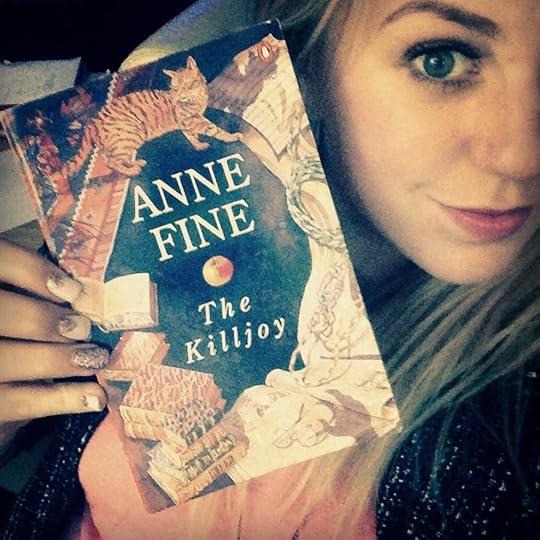
I was lucky enough to be selected as a winner of this book as part of a Goodreads First Reads giveaway, and would like to start with a big thank you to Anne Fine for sending a copy!
The Killjoy tells the story of hideously disfigured Ian Laidlaw who has lived a life full of distant courtesies and pleasantries from people trying to hide their pity, disgust or shock at his facial scars. After one of his young students, Alicia, breaks the rules by laughing in his face and blatantly acknowledging his scarring, Ian finds himself intrigued by the young girl. They begin an affair which gradually develops into something obsessive and sadomasochistic, and neither realise that they’re playing with fire…
We are told the story through Ian’s eyes, and from the first sentence he is addressing ‘you’, which soon becomes apparent that it is directed at some sort of investigator. It’s a cleverly crafted narration and Anne Fine has done a fabulous job of getting into and progressively exposing the disturbed mind of a male narrator who hides behind a successful functional façade. It was so easy to forget that this book was written by a female, so massive credit to Anne Fine.
Her writing is so clever and the protagonists convincing decorum and professionalism are upheld throughout the full thing, making his hidden personality even more weird and disconcerting. The tale develops subtly, uncovering more and more disturbing, and sometimes touching, facets along the way. Things really do start to become weird, dark and sinister and may even make some readers uncomfortable (whilst still keeping them absorbed!).

An interesting thing about this book is that it’s so character focused rather than action based, and most of the thrills come simply from delving into the minds of the two main characters, Ian and Alicia.
The only downfall of this book is that there are some really lengthy paragraphs of exposition/background information throughout the story which may bore the reader (I wasn't a fan of them personally!) or cause them to lose track a bit, but they add to the depth of the narrators character and so it would have been a great shame to take them out!
This book is definitely for adults only and may not be for the faint-hearted due to some of the subject matter, but Anne Fine does a fabulous job creating some graphic and painful scenes without crossing the line and whilst keeping the reader engrossed. It’s a great short story and is perfect for anyone who enjoys a dark psychological thriller.
I was lucky enough to be selected as a winner of this book as part of a Goodreads First Reads giveaway, and would like to start with a big thank you to Anne Fine for sending a copy!
The Killjoy tells the story of hideously disfigured Ian Laidlaw who has lived a life full of distant courtesies and pleasantries from people trying to hide their pity, disgust or shock at his facial scars. After one of his young students, Alicia, breaks the rules by laughing in his face and blatantly acknowledging his scarring, Ian finds himself intrigued by the young girl. They begin an affair which gradually develops into something obsessive and sadomasochistic, and neither realise that they’re playing with fire…
“ ‘Oh, you are so ugly,’ she’d whisper as her body twisted against the rising pressure of mine.”
We are told the story through Ian’s eyes, and from the first sentence he is addressing ‘you’, which soon becomes apparent that it is directed at some sort of investigator. It’s a cleverly crafted narration and Anne Fine has done a fabulous job of getting into and progressively exposing the disturbed mind of a male narrator who hides behind a successful functional façade. It was so easy to forget that this book was written by a female, so massive credit to Anne Fine.
Her writing is so clever and the protagonists convincing decorum and professionalism are upheld throughout the full thing, making his hidden personality even more weird and disconcerting. The tale develops subtly, uncovering more and more disturbing, and sometimes touching, facets along the way. Things really do start to become weird, dark and sinister and may even make some readers uncomfortable (whilst still keeping them absorbed!).
An interesting thing about this book is that it’s so character focused rather than action based, and most of the thrills come simply from delving into the minds of the two main characters, Ian and Alicia.
The only downfall of this book is that there are some really lengthy paragraphs of exposition/background information throughout the story which may bore the reader (I wasn't a fan of them personally!) or cause them to lose track a bit, but they add to the depth of the narrators character and so it would have been a great shame to take them out!
This book is definitely for adults only and may not be for the faint-hearted due to some of the subject matter, but Anne Fine does a fabulous job creating some graphic and painful scenes without crossing the line and whilst keeping the reader engrossed. It’s a great short story and is perfect for anyone who enjoys a dark psychological thriller.

September 26, 2018
"The Killjoy," by Anne Fine, is an adult novel that was published in 1986. It is the most toxically ableist and misogynistic book I have ever read. The ableism in this book is far, far beyond the ableism in the uber-popular adult novel, "Me Before You," with its "live boldly, unless you're disabled, and then we will support your choice to commit suicide" message. That was horrible. But this novel is much, much worse. "The Killjoy" presents physical deformity, and by extension, all disability and physical difference, as an outward sign of internal evil, and the book punishes women who engage in "loveless sex" (sex for the sheer sake of orgasm) with severe physical abuse and death.
I read a hardback first edition of "The Killjoy," and this copy is signed "with *very* best love" by the author to my friend Mary, who asked me to read it. Mary is good friends with Anne Fine, and Mary believed I would enjoy this novel.
Anne Fine is quite famous in certain social circles. She has done well for herself. Her YA novel, "Madame Doubtfire," published in 1987, was turned into the film "Mrs. Doubtfire" starring Robin Williams. Anne Fine has won many, many prestigious awards. The vast majority of her work is written for children of varying age groups, but she has a number of adult novels as well. "The Killjoy" was her first published work for adults.
Here is some data I can share with you about Anne Fine, which comes from her author bio on the book jacket and her Wikipedia page. This author is:
1. Able-bodied
2. Neurotypical
3. White
4. Cisgender
5. Heterosexual
6. Upper-middle class
7. Has no physical deformities or illnesses
8. Attended university
9. Gave birth to two able-bodied, neurotypical children while married
10. Began her writing career after the birth of her first child
11. Does not know anyone who is physically disabled or facially scarred in real life
"The Killjoy" is written with a strong awareness that literature has a long, long history of featuring deformed and disabled protagonists as monsters. In clear adherence of that literary tradition, the physically "monstrous" protagonist of this novel is evil inside and out. He is completely morally depraved, and that moral depravity is marked on his face as a warning to all the people he encounters to keep their distance or suffer the consequences of his contagion, extreme violence, and death at his hands.
This protagonist has a name, and you can find his name in the book description. I refuse to use it, because this book is so ableist that he was never a human being. He was only ever a story trope: the trope of the Evil Deformed Beast who menaces polite, able-bodied, physically-undamaged society. Since the protagonist refers to himself more than once as a "Beast," that is what I will call him in this review.
The Beast is able-bodied and described more than once as a handsome man, if a person only looks at one half of his face: the side that is physically perfect. The other half is mottled with scar tissue. That scar tissue does not impair his vision, hearing, or breathing at all, and his nose is undamaged. His hairline is unaffected. But the scar tissue on his cheek and jaw make him "ugly," and that "ugliness" is referred to over and over again in the narrative. At the beginning of the novel, the protagonist begins narrating his tale to an unseen character as well as to the reader, and states that he acquired the scar tissue at age five, after being mauled by a dog.
By the end of the book, the reader learns that the Beast is speaking to a police officer who has come to arrest him, and the Beast admits that the dog mauled him because he had been "tormenting" the dog for days. "The Killjoy" upholds the belief that animals only attack people when they are provoked or mistreated, and that anyone who has ever been attacked by an animal deserved to be bitten, mauled, kicked, or otherwise harmed by that animal.
That alone is psychologically painful to me. Not all animal attacks are provoked. I have witnessed dogs, for instance, run up to people and tear into them -- adults and small children alike. These were not people who were invading the attacking dog's space, hurting their owners or anyone else, or tormenting the animal at all. These were not rabid dogs, either, but beloved domestic pets. Animals do not attack people because they sense "the inner moral depravity" or "the inner evil" of a person. And yet I frequently encounter that belief system in people I meet, and it is on full display in "The Killjoy."
My sister was attacked by a stranger's pet dog while walking down the street in broad daylight. A child I taught in first grade was attacked by a neighbor's dog at age 4 -- the child had been sitting on his own porch playing with toys when the neighbor first brought the dog to her house. There was no history between the dog or the child, but the dog dashed onto the child's porch and attacked him.
I have suffered many arguments with people who try to insist that my sister must be morally depraved and that this 4-year-old child must have been morally depraved to warrant such vicious attacks from a dog, attacks that left both of them scarred and forever scared to be around barking dogs.
It is obvious to me that Anne Fine must agree with these people that dogs only attack their tormentors and the morally depraved, because she could never have written "The Killjoy" without believing such things herself.
The Beast in this book is born bad, and he was also born to a physically beautiful, handsome body. At age five, he enjoys tormenting a dog, and the dog mauls his face, marking him with a physical deformity to warn people of the evil that lurks inside of him.
The Beast is completely able-bodied and neurotypical, free of disease and all ailments but for the scars on his face, and he is able to have a typical, independent modern life: he graduates high school and college, gets a good job teaching at the university, and he marries a young woman when he is still a young man himself, age 19 or 20 or so. But he is seething with anger that his facial scarring kept him from having sex before marriage. He resents that he was still a virgin when he got married. He feels deprived of an active sex life before marriage (and perhaps illicit affairs after marriage, as well, given what an asshole he is) because his facial scarring, in his view, drives women away.
The Beast takes care to describe his active, but very dull sex life with his wife, who stayed married to him for sixteen years. The Beast says that his wife "willed herself not to see the ugly side of me," and that they were only "half married" because his wife ignored his ugliness and refused to dwell on it (page 16). Then she divorced him and married a richer man, a work colleague of the Beast's who has published acclaimed books in their field of study. By the time the story begins, the Beast has been single again for some time. He is 49 years old, and he is a valued college professor who is the head of his department. He teaches political science and government. The year is 1983 or 1984.
And then into his classroom one day arrives a teenage girl who is sexually liberated. Armed with birth control and no fear of sexually transmitted diseases, this character is no longer a human being, either. She is a fantasy porn star, a college freshman with no morals and an endless sexual appetite. This teenage girl knows far more about sexual pleasure and pleasing men sexually than the Beast has ever dreamed of, and because she is a young woman with an unchecked sexual appetite, she has the basest of instincts regarding sex.
Behold: the Manic Pixie Dream Slut.
The Manic Pixie Dream Slut, or the MPDS for short, is the first person to gaze upon the Beast and realize that he is "a man," by which the Beast means: he is a sexual predator with the power to rape her. This is how the narrative frames manhood, and what it means to be a full man. Men not only possess sexual prowess, but the threat of rape. Enjoying her fear, the Beast stalks the MPDS after class to the street she lives on. He threatens to rape her. He also shakes her, yells at her, bruises her wrists, and throws her library books into a wet gutter, ruining them.
Rape is a turn-on for the MPDS. So is being physically bound and beaten. Apparently, a woman who is sexually liberated seeks to be tied up, beaten, and raped in order to achieve orgasm. She also wants to have sex with "a hideous animal," tying female sexuality to bestiality and necrophilia, because the word "ghoul" and "corpse" are also used to describe the Beast's facial appearance.
Because the MPDS has been awakened to her own sexual pleasure, and can have sex without love or marriage, the MPDS knows she needs someone who is "ugly" in order to get her off. The Beast does not rape her on their first encounter alone, but he does ruin her books. He writes a check to pay for her ruined library books, and tells the MPDS to come to his house to pick it up. She does. She has dinner with him. Then she leads him into his bedroom, strips off his clothes, and proceeds to give him sexual pleasure. The MPDS is sexually bold and knowledgeable, to the point that the Beast claims that she basically "raped him," because she ignored all of his protests that he was old enough to be her father, and instead forced him to lie back on his bed and enjoy her attentions.
In the narrative worldview of this novel, Sluts are Whores, and Whores deserve death, because this novel begins after the MPDS has been murdered. But at this earlier point in the narrative, after this first sexual encounter, the Beast and the MPDS begin to have a secret love affair, which takes up the bulk of the pages in this novel. As their love affair stretches into weeks and then months, the Beast changes from passive recipient of pleasure into sexual sadist. The Beast admits that he frequently slaps and hits the MPDS while they have sex. He frequently takes off his belt and lashes her. He ties her up. He lashes her until she screams in agony.
When the Beast fears that the MPDS will go home for the summer, and possibly end their affair, he beats her especially hard, leaves her tied up for a time and goes to a pub for a drink. Then he returns to his bedroom, lashes her again with a belt, and then suffocates her to death with a pillow. He leaves her corpse on the bed, closes the door to the room, and spends the night on the couch. He says that he sleeps very well that night, and awakes to the sound of the MPDS's cat meowing for food. He gets up, takes the cat into the bathroom, and drowns the cat in the tub. Then he puts the cat in a trash bag and dumps it into a garbage container outside.
Days pass. The corpse rots and the odor is reported to the police. The police come for the Beast, and they find him in his university office. The police are extremely polite to him because of his facial deformity. The Beast hates their cold politeness and sneers at their deferential behavior. He tells the reader and the police that only the MPDS saw the truth, the truth that people with scars and deformities are monsters inside and out:
"No one ever guessed, before her. No one. Why should they? No one begins to try to guess at what's behind deformities and scars. We people are a race apart. It is the fault of people like you. You keep us that way, after all. You stay behind your bulwarks of unfailing politeness. You don't engage. And so we are habitually permitted, encouraged one might even say, to use our various hideous blemishes as scapegoats to save ourselves from having to admit to other weaknesses. What other weaknesses? Who knows? Shallowness? Spite? All manner of emotional disablement. All sorts of failings." (page 183)
Since there are only 189 pages in this book, this announcement is part of the final statement linking physical deformity with moral depravity.
The Beast goes on to state of the MPDS, speaking of their love affair and the night that he killed her:
"She'd let the ugly side of me loose. I beat down on the cringing and whimpering [the crying body of the MPDS, as she weeps on the bed as the Beast lashes her with his belt], and felt the stiff, stiff gristle of scar tissue [on his face] giving, as muscles I hadn't even known my face possessed began to stir. I was, I realized in some shock, grinning. Whole at last, I was thinking. Whole at last. What won't I now be free to show her? And it was anger. Bursting from me, the adder ready for release after a wait of over forty years. Anger, the gift I gave her, felt with a force I never could have believed would be mine. [...] I let it go. I felt as if I were exploding, as if the meretricious little bitch had somehow sprung some secret catch in me, exposing my core as I now raised a sweat exposing hers, laying bare all that lay hidden for years under the cover of my scar patch just as I now laid bare for her all that lay hidden under that soft, red and bloody puddle of skin." (page 184)
[Side note 1: "bloody puddle" = her skin has been split open by the lashes from his belt]
(Side note 2: the word 'meretricious' means "apparently attractive but having in reality no value or integrity" -- this is how the Beast views the pretty college freshman who gave him the sexual pleasure he was delighted to receive. The term 'meretricious' also has an archaic meaning: "relating to or characteristic of a prostitute." Since the MPDS did not ask for money in return for the sexual pleasure she gave the Beast, and allowed him to physically assault her over and over again, she was viewed as being even lower than a prostitute in this text, another reason that the Beast does what he does to her.)
The Beast goes on to kill her, and continues his narration of the physical violence he delivered to her before death to the officer:
"I will not tell you all I did to her [before she died]. I doubt if she, if she were here, would want it told. I have no reason to confess 'the worst' to you. [...] I loved her and I killed her. That should be clear enough." (page 184)
The Beast then goes on to tell the police officer that if the officer wants to understand the Beast's level of physical and sexual violence, the officer should "ask his wife," because the female sexual mind will "come up with some explanation for all I felt and all I did. But stay away from me with your facile conclusions. I'm a whole man, and will not be diminished by any glib psychology of yours. I loved her and I killed her." (page 184)
Because this is an ableist text in all ways, the novel closes with the cure-or-kill ending that frequently connects to the logic of eugenics, where disabled people who cannot be cured represent a soon-to-be eradicated group whose promised erasure -- whether in death or being locked up out of sight -- will better society. As the Beast states:
"The affair, I knew from the start, could not end in marriage; and if not in marriage, then what else can an affair ever end in, except pain and disaster, loss and tears? Life is no fairy tale, and this was not a story of Beauty and Beast, with their eventual triumph over ugliness. [...] How happy and relieved I was, standing and staring through this window here [his office window at the university], to see you and your henchmen [the police] walk this way across the lawns, and know that it was over, all over. [...] Can we go now? I'm very tired."
Those are the final lines of the book. (pages 188-189)
The Beast is "happy and relieved" to be taken to prison for murder. Why? Because there was no cure for his facial scars, no cure for his internal and external ugliness. The Beast will now be locked up out of sight, and possibly executed, for the crime of murder.
Here, then, is the overt messaging in this book:
1. Women achieve sexual pleasure and orgasm through violence
2. Men who are not violent with their female lovers never give their lovers an orgasm
3. Women who are sexually liberated, and seek out sex for pleasure alone, are depraved whores
4. Depraved whores are garbage who are frequently killed
5. People with scars and deformities are angry, internally ugly, and evil
6. Able-bodied men with facial scarring are all assumed to be impotent, which adds to their anger
7. Getting close to people with scars and deformities might result in death
8. Ugly people should be killed or locked up to protect society
9. Ugly people are happy and relieved to be killed or locked up
10. Animals only attack evil people
*****
As I finished typing that list, I thought it important to note that this book is *not* written as satire.
On the book jacket, the publisher wrote: "In 'The Killjoy,' Anne Fine has created an unforgettable portrait of a life scarred beyond redemption. This is a disturbing, thought-provoking and utterly compelling novel."
Please allow me to clarify, and rephrase that blurb so it's more accurate: "In 'The Killjoy,' Anne Fine has created an ableist thought experiment about the inner life of a facially scarred man. This novel is a eugenics narrative that also hates women, and especially hates sexually liberated women who have sex for pleasure rather than love, marriage, and procreation."
If you enjoy eugenics narratives, which support killing or locking up people with any deformity or disability that cannot be cured, then this book is for you.
If you are a disabilities studies scholar, then you probably already know this book exists, and what a Hate Fest it is.
I do not recommend this book to anyone to read. I would actually recommend people just stay away from this book. It is the most toxically ableist novel I have ever read.
One star.
And all the f*ck you's I can ever give to ableism and eugenics, I scream them all at this book.
I read a hardback first edition of "The Killjoy," and this copy is signed "with *very* best love" by the author to my friend Mary, who asked me to read it. Mary is good friends with Anne Fine, and Mary believed I would enjoy this novel.
Anne Fine is quite famous in certain social circles. She has done well for herself. Her YA novel, "Madame Doubtfire," published in 1987, was turned into the film "Mrs. Doubtfire" starring Robin Williams. Anne Fine has won many, many prestigious awards. The vast majority of her work is written for children of varying age groups, but she has a number of adult novels as well. "The Killjoy" was her first published work for adults.
Here is some data I can share with you about Anne Fine, which comes from her author bio on the book jacket and her Wikipedia page. This author is:
1. Able-bodied
2. Neurotypical
3. White
4. Cisgender
5. Heterosexual
6. Upper-middle class
7. Has no physical deformities or illnesses
8. Attended university
9. Gave birth to two able-bodied, neurotypical children while married
10. Began her writing career after the birth of her first child
11. Does not know anyone who is physically disabled or facially scarred in real life
"The Killjoy" is written with a strong awareness that literature has a long, long history of featuring deformed and disabled protagonists as monsters. In clear adherence of that literary tradition, the physically "monstrous" protagonist of this novel is evil inside and out. He is completely morally depraved, and that moral depravity is marked on his face as a warning to all the people he encounters to keep their distance or suffer the consequences of his contagion, extreme violence, and death at his hands.
This protagonist has a name, and you can find his name in the book description. I refuse to use it, because this book is so ableist that he was never a human being. He was only ever a story trope: the trope of the Evil Deformed Beast who menaces polite, able-bodied, physically-undamaged society. Since the protagonist refers to himself more than once as a "Beast," that is what I will call him in this review.
The Beast is able-bodied and described more than once as a handsome man, if a person only looks at one half of his face: the side that is physically perfect. The other half is mottled with scar tissue. That scar tissue does not impair his vision, hearing, or breathing at all, and his nose is undamaged. His hairline is unaffected. But the scar tissue on his cheek and jaw make him "ugly," and that "ugliness" is referred to over and over again in the narrative. At the beginning of the novel, the protagonist begins narrating his tale to an unseen character as well as to the reader, and states that he acquired the scar tissue at age five, after being mauled by a dog.
By the end of the book, the reader learns that the Beast is speaking to a police officer who has come to arrest him, and the Beast admits that the dog mauled him because he had been "tormenting" the dog for days. "The Killjoy" upholds the belief that animals only attack people when they are provoked or mistreated, and that anyone who has ever been attacked by an animal deserved to be bitten, mauled, kicked, or otherwise harmed by that animal.
That alone is psychologically painful to me. Not all animal attacks are provoked. I have witnessed dogs, for instance, run up to people and tear into them -- adults and small children alike. These were not people who were invading the attacking dog's space, hurting their owners or anyone else, or tormenting the animal at all. These were not rabid dogs, either, but beloved domestic pets. Animals do not attack people because they sense "the inner moral depravity" or "the inner evil" of a person. And yet I frequently encounter that belief system in people I meet, and it is on full display in "The Killjoy."
My sister was attacked by a stranger's pet dog while walking down the street in broad daylight. A child I taught in first grade was attacked by a neighbor's dog at age 4 -- the child had been sitting on his own porch playing with toys when the neighbor first brought the dog to her house. There was no history between the dog or the child, but the dog dashed onto the child's porch and attacked him.
I have suffered many arguments with people who try to insist that my sister must be morally depraved and that this 4-year-old child must have been morally depraved to warrant such vicious attacks from a dog, attacks that left both of them scarred and forever scared to be around barking dogs.
It is obvious to me that Anne Fine must agree with these people that dogs only attack their tormentors and the morally depraved, because she could never have written "The Killjoy" without believing such things herself.
The Beast in this book is born bad, and he was also born to a physically beautiful, handsome body. At age five, he enjoys tormenting a dog, and the dog mauls his face, marking him with a physical deformity to warn people of the evil that lurks inside of him.
The Beast is completely able-bodied and neurotypical, free of disease and all ailments but for the scars on his face, and he is able to have a typical, independent modern life: he graduates high school and college, gets a good job teaching at the university, and he marries a young woman when he is still a young man himself, age 19 or 20 or so. But he is seething with anger that his facial scarring kept him from having sex before marriage. He resents that he was still a virgin when he got married. He feels deprived of an active sex life before marriage (and perhaps illicit affairs after marriage, as well, given what an asshole he is) because his facial scarring, in his view, drives women away.
The Beast takes care to describe his active, but very dull sex life with his wife, who stayed married to him for sixteen years. The Beast says that his wife "willed herself not to see the ugly side of me," and that they were only "half married" because his wife ignored his ugliness and refused to dwell on it (page 16). Then she divorced him and married a richer man, a work colleague of the Beast's who has published acclaimed books in their field of study. By the time the story begins, the Beast has been single again for some time. He is 49 years old, and he is a valued college professor who is the head of his department. He teaches political science and government. The year is 1983 or 1984.
And then into his classroom one day arrives a teenage girl who is sexually liberated. Armed with birth control and no fear of sexually transmitted diseases, this character is no longer a human being, either. She is a fantasy porn star, a college freshman with no morals and an endless sexual appetite. This teenage girl knows far more about sexual pleasure and pleasing men sexually than the Beast has ever dreamed of, and because she is a young woman with an unchecked sexual appetite, she has the basest of instincts regarding sex.
Behold: the Manic Pixie Dream Slut.
The Manic Pixie Dream Slut, or the MPDS for short, is the first person to gaze upon the Beast and realize that he is "a man," by which the Beast means: he is a sexual predator with the power to rape her. This is how the narrative frames manhood, and what it means to be a full man. Men not only possess sexual prowess, but the threat of rape. Enjoying her fear, the Beast stalks the MPDS after class to the street she lives on. He threatens to rape her. He also shakes her, yells at her, bruises her wrists, and throws her library books into a wet gutter, ruining them.
Rape is a turn-on for the MPDS. So is being physically bound and beaten. Apparently, a woman who is sexually liberated seeks to be tied up, beaten, and raped in order to achieve orgasm. She also wants to have sex with "a hideous animal," tying female sexuality to bestiality and necrophilia, because the word "ghoul" and "corpse" are also used to describe the Beast's facial appearance.
Because the MPDS has been awakened to her own sexual pleasure, and can have sex without love or marriage, the MPDS knows she needs someone who is "ugly" in order to get her off. The Beast does not rape her on their first encounter alone, but he does ruin her books. He writes a check to pay for her ruined library books, and tells the MPDS to come to his house to pick it up. She does. She has dinner with him. Then she leads him into his bedroom, strips off his clothes, and proceeds to give him sexual pleasure. The MPDS is sexually bold and knowledgeable, to the point that the Beast claims that she basically "raped him," because she ignored all of his protests that he was old enough to be her father, and instead forced him to lie back on his bed and enjoy her attentions.
In the narrative worldview of this novel, Sluts are Whores, and Whores deserve death, because this novel begins after the MPDS has been murdered. But at this earlier point in the narrative, after this first sexual encounter, the Beast and the MPDS begin to have a secret love affair, which takes up the bulk of the pages in this novel. As their love affair stretches into weeks and then months, the Beast changes from passive recipient of pleasure into sexual sadist. The Beast admits that he frequently slaps and hits the MPDS while they have sex. He frequently takes off his belt and lashes her. He ties her up. He lashes her until she screams in agony.
When the Beast fears that the MPDS will go home for the summer, and possibly end their affair, he beats her especially hard, leaves her tied up for a time and goes to a pub for a drink. Then he returns to his bedroom, lashes her again with a belt, and then suffocates her to death with a pillow. He leaves her corpse on the bed, closes the door to the room, and spends the night on the couch. He says that he sleeps very well that night, and awakes to the sound of the MPDS's cat meowing for food. He gets up, takes the cat into the bathroom, and drowns the cat in the tub. Then he puts the cat in a trash bag and dumps it into a garbage container outside.
Days pass. The corpse rots and the odor is reported to the police. The police come for the Beast, and they find him in his university office. The police are extremely polite to him because of his facial deformity. The Beast hates their cold politeness and sneers at their deferential behavior. He tells the reader and the police that only the MPDS saw the truth, the truth that people with scars and deformities are monsters inside and out:
"No one ever guessed, before her. No one. Why should they? No one begins to try to guess at what's behind deformities and scars. We people are a race apart. It is the fault of people like you. You keep us that way, after all. You stay behind your bulwarks of unfailing politeness. You don't engage. And so we are habitually permitted, encouraged one might even say, to use our various hideous blemishes as scapegoats to save ourselves from having to admit to other weaknesses. What other weaknesses? Who knows? Shallowness? Spite? All manner of emotional disablement. All sorts of failings." (page 183)
Since there are only 189 pages in this book, this announcement is part of the final statement linking physical deformity with moral depravity.
The Beast goes on to state of the MPDS, speaking of their love affair and the night that he killed her:
"She'd let the ugly side of me loose. I beat down on the cringing and whimpering [the crying body of the MPDS, as she weeps on the bed as the Beast lashes her with his belt], and felt the stiff, stiff gristle of scar tissue [on his face] giving, as muscles I hadn't even known my face possessed began to stir. I was, I realized in some shock, grinning. Whole at last, I was thinking. Whole at last. What won't I now be free to show her? And it was anger. Bursting from me, the adder ready for release after a wait of over forty years. Anger, the gift I gave her, felt with a force I never could have believed would be mine. [...] I let it go. I felt as if I were exploding, as if the meretricious little bitch had somehow sprung some secret catch in me, exposing my core as I now raised a sweat exposing hers, laying bare all that lay hidden for years under the cover of my scar patch just as I now laid bare for her all that lay hidden under that soft, red and bloody puddle of skin." (page 184)
[Side note 1: "bloody puddle" = her skin has been split open by the lashes from his belt]
(Side note 2: the word 'meretricious' means "apparently attractive but having in reality no value or integrity" -- this is how the Beast views the pretty college freshman who gave him the sexual pleasure he was delighted to receive. The term 'meretricious' also has an archaic meaning: "relating to or characteristic of a prostitute." Since the MPDS did not ask for money in return for the sexual pleasure she gave the Beast, and allowed him to physically assault her over and over again, she was viewed as being even lower than a prostitute in this text, another reason that the Beast does what he does to her.)
The Beast goes on to kill her, and continues his narration of the physical violence he delivered to her before death to the officer:
"I will not tell you all I did to her [before she died]. I doubt if she, if she were here, would want it told. I have no reason to confess 'the worst' to you. [...] I loved her and I killed her. That should be clear enough." (page 184)
The Beast then goes on to tell the police officer that if the officer wants to understand the Beast's level of physical and sexual violence, the officer should "ask his wife," because the female sexual mind will "come up with some explanation for all I felt and all I did. But stay away from me with your facile conclusions. I'm a whole man, and will not be diminished by any glib psychology of yours. I loved her and I killed her." (page 184)
Because this is an ableist text in all ways, the novel closes with the cure-or-kill ending that frequently connects to the logic of eugenics, where disabled people who cannot be cured represent a soon-to-be eradicated group whose promised erasure -- whether in death or being locked up out of sight -- will better society. As the Beast states:
"The affair, I knew from the start, could not end in marriage; and if not in marriage, then what else can an affair ever end in, except pain and disaster, loss and tears? Life is no fairy tale, and this was not a story of Beauty and Beast, with their eventual triumph over ugliness. [...] How happy and relieved I was, standing and staring through this window here [his office window at the university], to see you and your henchmen [the police] walk this way across the lawns, and know that it was over, all over. [...] Can we go now? I'm very tired."
Those are the final lines of the book. (pages 188-189)
The Beast is "happy and relieved" to be taken to prison for murder. Why? Because there was no cure for his facial scars, no cure for his internal and external ugliness. The Beast will now be locked up out of sight, and possibly executed, for the crime of murder.
Here, then, is the overt messaging in this book:
1. Women achieve sexual pleasure and orgasm through violence
2. Men who are not violent with their female lovers never give their lovers an orgasm
3. Women who are sexually liberated, and seek out sex for pleasure alone, are depraved whores
4. Depraved whores are garbage who are frequently killed
5. People with scars and deformities are angry, internally ugly, and evil
6. Able-bodied men with facial scarring are all assumed to be impotent, which adds to their anger
7. Getting close to people with scars and deformities might result in death
8. Ugly people should be killed or locked up to protect society
9. Ugly people are happy and relieved to be killed or locked up
10. Animals only attack evil people
*****
As I finished typing that list, I thought it important to note that this book is *not* written as satire.
On the book jacket, the publisher wrote: "In 'The Killjoy,' Anne Fine has created an unforgettable portrait of a life scarred beyond redemption. This is a disturbing, thought-provoking and utterly compelling novel."
Please allow me to clarify, and rephrase that blurb so it's more accurate: "In 'The Killjoy,' Anne Fine has created an ableist thought experiment about the inner life of a facially scarred man. This novel is a eugenics narrative that also hates women, and especially hates sexually liberated women who have sex for pleasure rather than love, marriage, and procreation."
If you enjoy eugenics narratives, which support killing or locking up people with any deformity or disability that cannot be cured, then this book is for you.
If you are a disabilities studies scholar, then you probably already know this book exists, and what a Hate Fest it is.
I do not recommend this book to anyone to read. I would actually recommend people just stay away from this book. It is the most toxically ableist novel I have ever read.
One star.
And all the f*ck you's I can ever give to ableism and eugenics, I scream them all at this book.
May 12, 2022
deformed man thinks ugliness is his worst trait when in fact it is his entire personality... lol. i did enjoy reading about the unique set of motivations that both characters had for entering into the relationship.

August 20, 2007
This book is amazing. Brutal. Uncomfortable.
Strangely, shamefully pleasurable.
Strangely, shamefully pleasurable.

March 25, 2008
Anne Fine writes disturbing books for adults! This book still bothers me three years later...

January 10, 2025
An extremely disturbing read. Had the narrator’s voice not used such overly complex vocabulary and unnecessary detail I would have rated this book higher, however I found this a difficult book to focus on and had to persevere to follow the plot at times.

March 3, 2018
Read some other reviews and really can't see what the fuss is all about.
Firstly, it's incredibly overwritten for the format. The protagonist is narrating the story as he relays it to another character, whom you soon realise is a police officer. Given then that the entire narrative is in the form of an interview, the writing style seems completely out of place. It felt like the author had swallowed a thesaurus. I found it irritating.
Second gripe - the characterisation was downright bizarre. I genuinely could not understand the motivations of either character. I mean I get it - Ian is a closet sadist and Alicia is a selfish narcissist with a fascination for the macabre. But still, why the hell did that all happen? Just because she doesn't react in the same way as most people react to his disfigured face?
The story didn't flow for me. It seemed like it was being made up as it went along. It managed to be predictable and entirely jarring at the same time.
Plus points - it's short and easy to read.
Firstly, it's incredibly overwritten for the format. The protagonist is narrating the story as he relays it to another character, whom you soon realise is a police officer. Given then that the entire narrative is in the form of an interview, the writing style seems completely out of place. It felt like the author had swallowed a thesaurus. I found it irritating.
Second gripe - the characterisation was downright bizarre. I genuinely could not understand the motivations of either character. I mean I get it - Ian is a closet sadist and Alicia is a selfish narcissist with a fascination for the macabre. But still, why the hell did that all happen? Just because she doesn't react in the same way as most people react to his disfigured face?
The story didn't flow for me. It seemed like it was being made up as it went along. It managed to be predictable and entirely jarring at the same time.
Plus points - it's short and easy to read.

May 2, 2010
Disturbing read. Ian is a deformed college lecturer who has had enough of forced niceness and pity from everyone around him. When his student Alicia laughs in his face, he suddenly feels more normal than he has in years. His obsession with her turns into a brutal and disturbing affair.
This is the kind of book that makes you want to take a shower after you read it to scrub the dirt off yourself. It was a nasty and dark story that I did not enjoy at all.
This is the kind of book that makes you want to take a shower after you read it to scrub the dirt off yourself. It was a nasty and dark story that I did not enjoy at all.

May 27, 2023
Fuck this book.
July 11, 2024
An intimate look into a man's innermost thoughts making an uncomfortable read. Hideously scarred Ian's monologue is chilling at times. The writing is clever and makes you want to turn the page.

November 1, 2024
A random, really enjoyable read. It’s dark, strange, and suspenseful. The writing is intricate and overly detailed - which might not be for everyone, but I liked - but the plot & cast of characters is quite simple.
Overall: A really nice surprise and one I thoroughly enjoyed!
Overall: A really nice surprise and one I thoroughly enjoyed!

July 9, 2024
I used to read Anne Fine as a child but this is my first experience of her adult books. I found this story so intriguing and the narrative very interesting. A dark underated book
May 4, 2020
Before this I'd only come across Anne Fine as a children's author, so this showed me a whole other side of one of my favourite writers.
I don't know that I can say I really liked this, exactly - but damn if this isn't a well-written disturbing story of a lecturer/student relationship gone wrong. In some ways it reminded me of Lolita. Should I be concerned I was so hooked on the storytelling that I devoured it in basically an evening? Probably.
I don't know that I can say I really liked this, exactly - but damn if this isn't a well-written disturbing story of a lecturer/student relationship gone wrong. In some ways it reminded me of Lolita. Should I be concerned I was so hooked on the storytelling that I devoured it in basically an evening? Probably.

February 21, 2014
I was totally absorbed in this book . Don`t know about " enjoyed " but fascinated by it !
November 20, 2019
i dont recommend this book to anyone.
i feel like if i had read this at 16 i would have really empathised with alistair and i would have demonised alicia but now im just like..... alistair pls rot!!!!
alicia did remind me of my current flatmate tho but like... unlike alistair i wont kill her ill just actually communicate like a proper adult
i feel like if i had read this at 16 i would have really empathised with alistair and i would have demonised alicia but now im just like..... alistair pls rot!!!!
alicia did remind me of my current flatmate tho but like... unlike alistair i wont kill her ill just actually communicate like a proper adult
November 7, 2021
Anne Fine's terrifying exposure of a depraved man would work very well as a monologue on the stage.
We are introduced to a normal, regular guy named Ian, except a side of his face is terribly disfigured, and perhaps his soul. He falls for one of his students, and we see his, and our, obsession grow. What will he do to keep her close? How far will he go until it spins out of control?
I was on the edge of my seat until about 3/4 of the way in to the book when predictability struck, but then again I think it was meant to be known from the very start and I wasn't very aware.
We are introduced to a normal, regular guy named Ian, except a side of his face is terribly disfigured, and perhaps his soul. He falls for one of his students, and we see his, and our, obsession grow. What will he do to keep her close? How far will he go until it spins out of control?
I was on the edge of my seat until about 3/4 of the way in to the book when predictability struck, but then again I think it was meant to be known from the very start and I wasn't very aware.
Read
June 21, 2026Recently divorced, 49 year old Ian Ladilaw teaches Comp. Government II. Alicia Davie is a student in one of his classes.
She acknowledges what most politely ignore, and he is facinated with her references to the scar that covers most of the left/right side of his face.
Ian is intrigued so sets up an 'unexpected' encounter, manufacturing a situation where he owes Alicia replacement copies of library books. He invites her to his home to collect them, extends the invitation to include a meal, then she seduces him against his protestations (if we can believe that since the entire narrative is his).
Thus starts an increasingly S & M type folie à deux.
He inflicts physical pain and she serves emotional cruelty ("oh, you are so ugly ... you look just like a rotting corpse").
Her happy normal childhood vs his lonely one.
She had a sister, indulgent parents, and a large friend group.
He, an only child, was mauled by a neighbour's dog (who he admits to taunting) and his extensive scars means his mother almost hid him away with shame.
At first our sympathies are more with him as she manipulates her way into his bed and his [secret] life.
Then our sympathies switch to her as bondage sessions are crafted to his obsession with finding out about her past, both distant and recent.
Ultimately, neither evoke feelings of sympathy.
He bores of her and wants his solitary life back so plans the ultimate humiliation in the hope that she will pack her bags and leave with her cat. To exaggerate the humiliation and demonstrate his new found freedom, he illustrates the metaphorical with the literal - leaving her tied to the bed while he leaves the flat to regain his Sunday routine.
No spoilers here so if you're interested in the ending, find yourself a copy, or Google a review
Touted as a dark psychological thriller, in the literary fiction genre, I felt the book fell flat. No emotion, little suspense, and ultimately a little grubby
She acknowledges what most politely ignore, and he is facinated with her references to the scar that covers most of the left/right side of his face.
Ian is intrigued so sets up an 'unexpected' encounter, manufacturing a situation where he owes Alicia replacement copies of library books. He invites her to his home to collect them, extends the invitation to include a meal, then she seduces him against his protestations (if we can believe that since the entire narrative is his).
Thus starts an increasingly S & M type folie à deux.
He inflicts physical pain and she serves emotional cruelty ("oh, you are so ugly ... you look just like a rotting corpse").
Her happy normal childhood vs his lonely one.
She had a sister, indulgent parents, and a large friend group.
He, an only child, was mauled by a neighbour's dog (who he admits to taunting) and his extensive scars means his mother almost hid him away with shame.
At first our sympathies are more with him as she manipulates her way into his bed and his [secret] life.
Then our sympathies switch to her as bondage sessions are crafted to his obsession with finding out about her past, both distant and recent.
Ultimately, neither evoke feelings of sympathy.
He bores of her and wants his solitary life back so plans the ultimate humiliation in the hope that she will pack her bags and leave with her cat. To exaggerate the humiliation and demonstrate his new found freedom, he illustrates the metaphorical with the literal - leaving her tied to the bed while he leaves the flat to regain his Sunday routine.
No spoilers here so if you're interested in the ending, find yourself a copy, or Google a review
Touted as a dark psychological thriller, in the literary fiction genre, I felt the book fell flat. No emotion, little suspense, and ultimately a little grubby

June 29, 2026
This novel's ever-darkening narrative about a disfigured professor's relationship with a student did carry me through to the bitter end, but, although the narrator's self-justifying version of events was skilfully written, it was over-wordy, the characters seemed like tropes rather than real people, and the whole thing was nastily misogynist and ableist.

June 7, 2019
I still have 10 more pages to go, but Anne Fine is such a powerful writer, I don't know if I have it in me to read to the end. I am dreading it so much.
Fine's voice is as fine as a well honed blade and the fact that she can turn it around and also write for children is amazing. Hats down.
Fine's voice is as fine as a well honed blade and the fact that she can turn it around and also write for children is amazing. Hats down.
October 25, 2024
Morbid och ångestfylld skildring av förbjuden kärlek. Vindlande passager med huvudkaraktärens tankegångar som bidrar väl till bokens allmänna känsla; till ytan en relationsroman, men där under en djupare skildring av intensiv lusta och livets absurditet.
June 7, 2026
One of those books described as a "tour de force" when the author gives a bravura performance, here the creation of a narrator's mind and viewpoint, warts (or indeed scars) and all. Despite the books brevity, it's all a bit much, and the end is truly unpleasant.
October 1, 2018
So disturbing.
August 12, 2020
Ich kann nur über die deutsche Übersetzung sprechen, aber die hat mich in den Bann gezogen. Für mich ein echtes Leseerlebnis.

December 17, 2020
Not what I was expecting/hoping for. Kind of seedy and pointless.
Read
August 21, 2023I don’t feel able to give star rating for this. I detested the subject matter but admired the skill of the writing.
October 7, 2023
Nope!

April 5, 2024
Despite the rather dubious moral of the narrator I enjoyed this.

July 15, 2024
Well written, but extremely grim and disturbing.
Displaying 1 - 30 of 47 reviews