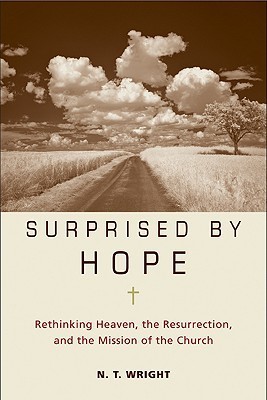
In Surprised by Rethinking Heaven, the Resurrection, and the Mission of the Church , top-selling author and Anglican bishop, N.T. Wright tackles the biblical question of what happens after we die and shows how most Christians get it wrong. We do not “go to” heaven; we are resurrected and heaven comes down to earth--a difference that makes all of the difference to how we live on earth. Following N.T. Wright’s resonant exploration of a life of faith in Simply Christian , the award-winning author whom Newsweek calls “the world’s leading New Testament scholar” takes on one of life’s most controversial topics, a matter of life, death, spirituality, and survival for everyone living in the world today.
N. T. Wright is the former Bishop of Durham in the Church of England (2003-2010) and one of the world's leading Bible scholars. He is now serving as the chair of New Testament and Early Christianity at the School of Divinity at the University of St. Andrews. He has been featured on ABC News, Dateline NBC, The Colbert Report, and Fresh Air, and he has taught New Testament studies at Cambridge, McGill, and Oxford universities. Wright is the award-winning author of Surprised by Hope, Simply Christian, The Last Word, The Challenge of Jesus, The Meaning of Jesus (coauthored with Marcus Borg), as well as the much heralded series Christian Origins and the Question of God.
Would you be surprised if someone said that Christianity does not teach that the soul goes to heaven when a Christian dies? In "Surprised By Hope," N.T. Wright tries to set non-Christians, but especially uninformed Christians, straight about what orthodox Christianity really teaches about life after death (or, more accurately, "life after life after death.")
The modern popular notions of heaven, the soul, and the "after life" often shared by Christians and non-Christians alike do not find their roots so much in Judaism, the Bible, or the writings of the early church fathers as they do in Gnosticism, Greek philosophy (particularly Platonic thinking) and pantheism. "At least since the Middle Ages," writes Bishop Wright, "the influence of Greek philosophy has been very marked, resulting in a future expectation that bears far more resemblance to Plato's vision of souls entering into disembodied bliss than to the biblical picture of new heavens and new earth."
Unfortunately, this view of the after life treats creation as "mere embroidery around the edges," and it fails to substantiate the Christian hope that Christ defeated death. A soul leaving the body and going to heaven would not mean the defeat of death at all, but would only be a description of "death seen from another angle." Orthodox Christianity, however, teaches that Christ is the "first fruits" of the tomb and that we shall all be resurrected and transformed, the recipients of new, incorruptible, individual physical bodies, that, like the new earth, are not subject to decay. Heaven will come to earth and unite with earth, so that there is a "new heaven and a new earth." In other words, when we Christians sing, "this earth is not my home, I'm just a' passing through," we don't quite have it right. In a sense, this world is indeed our home, this good creation, but it is incomplete, and it will be transformed, liberated from the slavery of sin and the death of decay.
"It is not we who go to heaven," explains Bishop Wright, "it is heaven that comes to earth…This is the ultimate rejection of all types of Gnosticism, of every world view that see the final goal as the separation of the world from God, of the physical form the spiritual, of earth from heaven…And it is the final accomplishment of God's great design, to defeat and abolish death forever, which can only mean the rescue of creation from its present plight of decay."
What then IS heaven? Wright's not overly clear about that. On the one hand, he describes heaven as "a temporary stage on the way to the eventual resurrection" (not wholly unlike the Jewish Sheol). When Christ speaks of the "many mansions" that are in his Father's house, He uses the word that means temporary lodging. This is how Christ can tell the thief on the cross that he will be "in Paradise" with Him "tonight." (But in what form? Surely not, like Christ, in a transformed body, if the resurrection hasn't occurred. But surely not as a disembodied soul, if Wright is right about that not being the right view of the afterlife. Wright borrows and revises a contemporary metaphor from Polkinghorne to attempt to explain this intermediate state: "God will download our software onto his hardware until the time when he gives us new hardware to run the software again." But it is hard to see how the idea of "software" is all that different from an idea of a "disembodied soul," which may explain why, despite the lack of talk of disembodied immortal souls in the Bible and the focus instead on the resurrection, it is so easy for Christians to slip into such talk.) So heaven is a stage; but, then, on the other hand, Wright also describes it as a dimension: "Basically heaven and earth in the biblical cosmology are not two different locations within the same continuum of space or matter." Nor are they "a nonphysical world contrasted with a physical one." Rather, "they are two different dimensions of God's good creation." They are different KINDS of space, matter, and (perhaps) time, but they are not two different "places." Heaven is not "up." Heaven is all around. Eventually, these two dimensions, earth and heaven, will be visibly united once and for all. So which is it? A stage or a dimension? Somehow both? His arguments lack clarity on this point.
Why does Wright feel compelled to set the record straight and make a distinction between the orthodox and popular Christian beliefs? One, because he thinks the orthodox belief is not so much disbelieved as unknown, and, second, because he believes that what we believe happens after we die affects how we live here and now. If this body is only a shell that will be one day be shed for a formless existence, if the earth is a thing we will one day leave entirely behind, if death is not an enemy to be defeated but only a gentle ushering away of our souls, then things like sexual licentiousness, euthanasia, exploitation of the poor, and unrestrained environmental exploitation become much easier to justify to ourselves. The "soul" mentioned in the Bible, he insists, was never meant to refer to some separate, nonphyscial part of us, but to the WHOLE person.
Of course, different denominations have different ideas of what constitutes orthodoxy. Wright's view of the after life will not seem orthodox to Catholics, because he utterly dismisses the idea of purgatory; nor will it seem orthodox to many evangelicals, because he utterly dismisses the idea of the rapture. Normally, he sticks to critiquing ideas rather than groups, but sometimes he slips to critiquing groups, and that is unpleasant.
As for the mission of the church in the light of "life after life after death," Wright takes a middle ground between the liberal's social gospel efforts to create heaven on earth and the fundamentalist's insistence that because the kingdom is not of this world, we should concentrate only on "saving souls." He speaks not of building the kingdom, as though we could, but rather building FOR the kingdom. While I find this middle-ground inviting in general and agree that Christians should work for good in the world, Wright seems to think all conservative opposition to liberal social policy is opposition to the idea that we should bother trying. This is simply not true; more often, it is opposition to the idea that liberal social policy is the best means to succeed.
The two causes about which he is most passionate are ecology and remission of Third World Debt. In his passion for them, he overlooks the possibility that while Christians may agree that we should work for justice and the alleviation of poverty and the conservation of God's creation, they may yet disagree on the best political method for doing so. Wright does not seem to acknowledge this and paints these issues in moral black and white, simply equating a refusal to remit Third World Debt with slavery and the Holocaust. He speaks of refusal to ratify Kyoto as though it had only to do with American desire to greedily maintain prosperity, and as though there were no other issues (such as national sovereignty and potential increased poverty in the developing world) at stake.
There are serious trade-offs involved in political decisions, and these trade-offs, more than apathy, are the reason for the conservative focus on the individual life in Christ rather than on the transformation of society through political change. He dismisses all this complexity with a flick of the wrist, saying, well, of course slavery was complex too. He says, in effect, "X is right (or wrong) so do (or stop) it now, and damn the consequences." But even with regard to slavery, moral people could agree it was wrong without agreeing on the best and least harmful path to abolishing it. Not all abolitionists were John Browns. Wright has no patience for discussions of political and economic trade-offs in matters of ecology and redistribution of wealth and sees them only as excuses of the morally weak or greedy. For this reason and others I do not have space for here, the third section of the book, on the mission of the church, was less edifying to me than the rest.
There are two things I really like about Wright:
(1) He makes me think and see things from a different perspective; he challenges me theologically, whereas most modern Christian books seem like a rehashing of the things I've heard before. This book, in particular, has made me much more conscious about how I talk about heaven and the great Christian hope with my children. It has been natural for me to speak to them of heaven as a place the soul goes to, not because I do not believe in the bodily resurrection and the ultimate transformation and wedding of heaven and earth, but because the explanation is simpler to relate to a child, and because this vocabulary of the afterlife is so common in the culture that surrounds me that it is hard not to absorb it.
(2) He reminds me of what I like most about Anglicanism—that it really does strive to provide a via media between Catholicism and Evangelical Protestantism, between tradition and modernity, between the liberal and the conservative, etc.
There are two things I really dislike about Wright:
(1)He sometimes mistakes being right about a moral issue with being right about the best social/political means for dealing with that moral issue. If X is absolutely wrong, then his opinion of how to stop X is absolutely right.
(2)His writing style is sometimes tedious. He tends to tell you what he is going to tell you later, only to tell you, "but I won't say anything more about that now." He also tends to start telling you something only to say, "but I've written another books that talks about that." He raises questions with one idea that he does not explain until later, if he explains them at all. In other words, his writing is poorly structured. This book seemed really to be two books cobbled together into one and underdeveloped in the first half.
Okay, I've got about a chapter of this book to go, but I'm thinking so many thoughts, it's stressing me out. So I'm going to write this review a bit prematurely. I promise if I change my mind on anything, I'll come back and revise so as not to be unfair.
Back story: I decided to pick up this book after reading a Facebook treatise (I know, LOL. But I don't know what else to call it) on the gospel that used Wright's book as its inspiration. To be honest, I didn't like the treatise much. It bothered me. But I'd heard wonderful things about Wright, so I thought I'd let the man speak for himself rather than taking his ideas second hand from one of his adoring fans. My attitude at the outset was a bit skeptical but overall very curious as to how Wright would make his arguments and whether or not he could win me over (because I am sooo important. Heh.)
Things I liked: To begin with, Wright's style is accessible, which I, as a reluctant reader of nonfiction, very much appreciate. I also think he builds a good case for the bodily resurrection of the saints in the life after life after death. I guess I always believed in the resurrection of the body and the life everlasting, but I didn't really give it much thought. I do now. I had some issues with Wright's lordship emphasis for the gospel (which I will get into anon), but I also thought it brought a fresh perspective to kingdom living. There is a certain motivating power in behaving as a citizen of God's kingdom here and now. It feels more active and purposeful than merely sitting around waiting to be taken to heaven after death. So much of the gospel, I think, can lend itself to fatalism, and looking at the Christian life this way can curb that impulse.
Things I didn't like: This section will be longer, not because I hated most of the book, but because I feel my criticisms warrant more explanation than my accolades, which strike me as pretty self-explanatory.
This might sound odd, but I question some of Wright's readings of Scripture. Unlike him, I am only a layman and not anywhere near being an expert in first-century Judaism or theology, but I think sometimes being an expert in a particular area can hurt one's understanding as much as help. Is this my ignorance talking? Perhaps. But I can't help but wonder if Wright's education may at points get in the way of common sense. For instance, Wright claims that Jesus didn't teach very much on hell, and when He referred to hell He was making a political statement, saying that if you stand up to the Romans you will be decimated like "gehenna," which the Bible translates as "hell." Having read over the passages where Jesus refers to gehenna, like when He states that's it's better to cut off your hand if it causes you to sin than to be thrown with hands into hell, I find it difficult to read politics into that, and I couldn't find the politics in any of the other verses either.
Similarly, Wright discounts the rapture by reinterpreting the the passage in 1 Thessalonians 4 where the living believers are caught up into the air to meet the Lord as a mixture of three metaphors he claims Jews of the day would have understood as clearly metaphorical: 1. the people of a city going outside the city to meet the visiting emperor (meeting in the air=metaphor for the excitement with which Christians will react to Jesus' return), 2. the emperor coming to visit his provinces (Jesus coming down from heaven is a metaphor for Him appearing on the earth) and 3. the establishment of kingdoms as extensions of the empire (we're not going to be with Jesus, He's coming here). At least, I think those were the metaphors. My memory is fuzzy so don't quote me. Now, Wright may be correct in discrediting rapture theology (I've always believed in a rapture, but it's not a belief I hold to very tightly), but am I really to believe that first-century Jews would have naturally dissected Paul's passage the way Wright has? Were they all geniuses? Dang. I'm an expert in my own culture, but if someone told me Jesus was going to drive up with a retinue of angels and give a speech to be broadcast to the whole world, I'd take it literally. Now in a thousand years someone like Wright might come along to explain that a 21st-century American would understand it was all metaphorical and that Jesus' retinue was symbolic of His stature, like a rap artist or the president, and the broadcast speech was symbolic of His great renown. This neo-Wright might be right on in his assessment of the prophecy, but he would be dead wrong in his assessment of my understanding of the prophecy. Does that make sense? Just because I know about the trappings of celebrity doesn't mean I necessarily apply this knowledge to everything I read or hear. I am aware of the war on terrorism, just as I'm sure the Jews were aware of the workings of the Roman empire, but it would be a mistake to link everything I write and say back to the war on terror, and I should think the same would go for the Jews. I could be wrong, though.
Seeing the Bible through Wright's eyes, it seems ridiculous to try to read the Scriptures if you're anything but a 1st-century Jew. For example, Wright is adamant that the Son of Man passage in Matthew 24 is not a reference to Jesus' return but to His resurrection, and Jesus is drawing heavily from Daniel in a way that sounds like the judgment but is really not, so everyone who thinks Jesus is speaking about the second coming is wrong. Um...how was I ever supposed to get that? Was the Bible written solely for 1st-century Jews, or did God have some provision made for the rest of us? If the Jews did understand that passage to be about the resurrection and not the second coming, does that necessarily mean they're right? That's the kicker for me. Wright prioritizes (what he imagines to be) early Christian and Jewish interpretations of the text, but I'm not convinced that they got everything right. After all, they didn't recognize the Messiah when He came. And that's not a dig. I probably wouldn't have recognized Him either. All it means is that even though the Scriptures were written for them in their language, their interpretations were still proven to be flawed. This could still be the case for 1st-century Christians and Jews. This is not to say that historical context and early interpretations aren't valuable. They are invaluable. It's just that even if you could know for a certainty what all the early Christians believed and taught one another, that's no guarantee that those interpretations are perfect. That's all I'm saying.
The second thing I had an issue with was Wright's cynicism. That's right, I said it. Cynicism. Not that he's always cynical. Overall, he seems like a pretty hopeful and grounded guy. But his straw man of North American fundamentalism is kind of disgusting. Now, I don't really consider myself to be a fundamentalist or even super conservative, although I suppose those terms are all subjective. However, I know quite a bit about North American Christian fundamentalism, and whatever problems I have with it, I have never believed, as Wright apparently does, that conservative Christians cling to a fatalist gospel so that they can create acid rain and get rich without having to worry about making the world better or caring about the poor. That's ridiculous. Why Wright attributes to their beliefs all kinds of ugly motives is beyond me. Maybe one of them ran over his puppy. I agree with him that Christian fundamentalists probably tend to believe in a fatalist sort of gospel, but for the love of Pete, it isn't like they're twisting and warping the Bible to get there, looking for any way they can hang on to their selfishness and avoid helping others. The Bible, read literally, is clear that this earth as we know it is temporary and that conditions will deteriorate and keep deteriorating until Jesus returns and sets everything right. The implications of this are that there is very little impetus to improve the world since it's all gonna burn. Instead, they see the emphasis as saving souls (a term I'm sure Wright dislikes) because the souls will last while possessions, bodies, sicknesses and injustices won't. That's not evil; that's logical. Wright can attack their interpretation of the gospel (which he does) but I don't see the point of not extending good faith to these believers. They're just working off of what they understand, not being immersed in first-century Christianity, and, in my opinion at least, they're interpretation of the Bible is reasonable, if not immaculate.
My final issue with Wright's book is that it leaves me more confused than enlightened concerning the gospel. Maybe this is unavoidable, but I find it incredibly frustrating. Why did Jesus die? What exactly was accomplished on the cross? This is the heart of the gospel, but it seems there is little consensus among Christians. Some preachers emphasize that Jesus drank the cup of God's wrath meant for us. He took our sin, we got His righteousness, thereby making it possible for us to have a right relationship with God. This, they claim, is the end of salvation. Others say that Jesus died to free us from the bondage of sin. He rescued us from ourselves. Still others note that Jesus was setting an example of sacrifice that urges all Christians to give up their lives for the good of those in the world. Wright seems to suggest that personal salvation is not the end at all but a means by which God looks to redeem all of creation.
I honestly don't know where I stand on all this. What was it Jesus came to do? I've always believed He came to save sinners--to tear the veil and do for us what we could not do for ourselves. I've heard it said, though, that this take on salvation is very selfish, and that's a hard thing to hear. It's true that my personal decision to accept Jesus' sacrifice for me does not necessitate my campaigning for justice or helping the poor. I might do those things, but they would not be considered an integral part of the gospel. So I see why Wright and others are frustrated that the gospel is too internal and too small. It might help me personally, but it doesn't help the world. I understand their feelings, but I don't know if I can agree with their "fix."
Wright envisions the kingdom of heaven as an alternative mode of existence where Christians live as though God is their king and work to see His will done by reforming the structures that oppress people. That's a powerful image and a seductive one, but part of me can't help but wonder if the kingdom of heaven isn't even more different from the kingdoms of this world than Wright thinks it is. Wright is enamored of an external outworking of the kingdom, but in my mind I replay Jesus' words that the kingdom of heaven is within you. This is not to say that we aren't to live out the kingdom in whatever ways we're called to, but I don't think the kingdom of heaven is composed of political structures or organizations. The kingdom of heaven strikes me as being not so much about God's rule over the injustices of the world, but about God's rule in my own heart. Maybe that's a small gospel, but looking at the whole counsel of Scripture, as I understand it, it fits.
Wright jumps through all kinds of hoops to prove that the world to come will be material and we will have bodies so we therefore should be focused on the conditions of this world because material things matter. He doesn't seem to like talk of the soul because it induces people to look to the future world without caring for this one. I get the drawbacks, but just because you don't like the implications of a doctrine doesn't mean the doctrine isn't true. When Jesus tells us to cut off our hands or pluck out our eyes if they cause us to sin, I think we can draw from that that the soul is of greater import than our bodies. In addition, Wright never addresses the scriptures that describe the earth being worn out like a garment or passing away. Wright insists that God will redeem the earth, not throw it out, but the emphasis in the Bible seems to be on the transitory nature of earthly things and how we need to dedicate ourselves to things of eternal value and substance. This is why I think Wright might be a bit off when he writes that Jesus saved us so that we could dedicate ourselves to stewardship over the earth. The earth won't last. God's priorities don't seem to involve our trying to redeem the world until He can do it for reals. After all, the great commission was about making disciples and baptizing and teaching people, not about planting trees or lobbying governments or even redistributing wealth. Purveyors of the social gospel often seem astounded and saddened that so many Christians seem uninterested in social justice, but social justice, while a worthy goal, does not appear to be the aim of the gospel. Jesus did not address the unjust political structures of his time, instead He assured those who mourn that they would be comforted and that wrongs would one day be redressed. He didn't try to overthrow Caesar but encouraged people to obey their governments. The apostles weren't about writing petitions for refugees or reforming the economic system or protesting wars. They were about saving souls. Peter writes that the Lord isn't slow in keeping His promises, but He is patiently waiting. And Lord isn't waiting for people to redeem the world and make it better; He's waiting for people to come to repentance.
So in a nutshell I fear that Wright has confused the gospel message with something else. I too am kind of sorry that a gospel that emphasizes personal repentance, patient bearing of suffering, evangelism and holding on to the hope of a new heaven and new earth to replace this broken planet does not often lead to bettering conditions for people here and now. But tacking on a social motivation to the cross strikes me as irresponsible. Just because the gospel doesn't do all you wish it would doesn't give you the right to change it. Now if you want to say that social justice is a good method for evangelism, that's fine. Or that behaving as citizens of heaven necessitates that we love others and show our love in tangible ways, that's fine too. But it's not the gospel. We don't seek social justice for its own sake because that doesn't make any sense. Why labor just to make this earth a more comfortable place from which people can go on to hell? We should live out the kingdom of heaven as a witness of God's love and as a sign pointing to the full expression of the kingdom to come, but the goal in mind is always the salvation of souls. If that means people aren't as focused on ecology or relieving third world debt as Wright would like, well...the priorities are different. (Although people can be called to environmentalism and debt relief as well as evangelism. Those are just two different ways of showing God's love and provision for us to the world. God is great and multifaceted. It takes the whole varied lot of us to begin to reflect Him and His will accurately) It doesn't mean we get to pollute or ignore suffering with impunity, but it means we need to see these things as God sees them. Focusing the Christian life on the here and now runs counter to an awful lot of Scripture, and while it may do some temporary good, if we can't get an eternal perspective all that good work will mean very little when all is said and done.
I don’t have time to review this properly and I don’t agree 100% with the last third of the book, but what an encouraging Easter season read for me. A lifetime of Bible reading came into focus.
I've been eager to read this. But no way was I spending money on it - had to wait for the library to suck in a copy. Whew! Saved $35.00.
I just started reading John MacArthur's The Second Coming. Basically it has all the issues N.T. tries to deal with except MacArthur isn't a social liberal tree-hugging Nutter.
I've suffered through my third N.T. Wright book. I'm still trying to figure out what exactly is wrong with this guy. He seems to be on the right track --- but then his train does a Wobbly Charlie off into the farmlands, and everyone is having so much fun on the caboose "cheering" they fail to see that nobody is driving the train to a Biblical destination anymore.
So is N.T. a serious trustworthy traditional Bible scholar? Maybe, sort of, kinda... The back of this book is fodder for liberal "What else does Harper One publishing ever put out?" propaganda. WE have Rob Bell fully supporting this effort, as well as those from the United Methodist church applauding. It seems even Richard Foster and Dallas Willard (who aren't often liked, and may not tolerate each other) are supporting this book. Yep, N.T. sure brings all the liberals together under one blanket. Lets keep them in the closet for now maybe.
So Yes, this is what happens when people wander off from Romans based Calvinism and yet desperately try to make sense of secular academia and the Bible. I've learned that you really can't argue Biblical theology with atheists while being any kind of arminian-type liberal believer. (arminian's assume that salvation is basically up to us and our amazing power to accept or reject God's desperate begging for our souls into His Kingdom.) So a book like this is comically what results. And atheists quickly notice that little of Arminian theology seems to agree with the Bible as a whole. That's why i've never seen a liberal christian have any kind of meaningful debate with an atheist or Muslim.
I didn't really take any notes while reading this. I was hoping the issues would be obvious enough to deal with later. But like my wife wisely said "N.T. probably stands for NOT THOROUGH." Indeed, for every point N.T. addressed I came up with about 10 Bible verses that he seriously needs to address --- and he seldom does. He just assumes we are easily agreeing with his thoughts. BUT NOPE, I definitely need more convincing. N.T.'s mocking and belittling of conservative Calvinism does not equal truth necessarily. (Yes N.T. - I still believe in the rapture. You've proven nothing) The obvious issue with N.T. is that he doesn't often show the complete Bible verses that deal with his points. Sometimes when he does dare to show some, they are from some - slightly off -translation that he doesn't bother to state. Notice that MacArthur and Sproul seem to find it essential to show entire Biblical paragraphs and their sources at all times, on almost every page. So what exactly is N.T. hiding? Why so sneaky?
The first major problem with this book is the subtitle: Rethinking Heaven, the Resurrection, and the mission of the Church.
Ummmh? Why are we rethinking it N.T.? Are you about to tell us something that 2000 years of Bible scholars failed to notice? Or just drag us back to gnostic land? The answer: Kind of. But like all of N.T.'s books - it's messy.
N.T. seems to think that all current Christian church-goers ACTUALLY BELIEVE that us Saints end up in Never Never Land floating on clouds eating creme-cheese in spirit GHOST bodies. (maybe those who haven't bothered to open a Bible, or get their spirituality from food commercials resemble N.T.'s strawmen). But as the Bible clearly says:
Revelation 21:1 Then I saw a new heaven and a new earth, for the first heaven and the first earth had passed away, and the sea was no more.
But N.T. just doesn't want to let go of those old trees. He's hugging them pretty tightly. I'm just not sure why? Our God can easily create nature (only takes a day or two according to the trustworthy Genesis account --- I still have no idea if N.T. trusts any of Genesis? Maybe that's in another book. I sure hope he does.)
So here's where the challenges begin. N.T. states: ( page 18 ) "...there is very little in the Bible about going to heaven when you die and not a lot about a postmortem hell either."
Ummmh? There's definitely enough info N.T.. Enough for you to mangle and get Rob Bell all socially excited. The problem is that N.T. is very good at liberally dismissing verses that he doesn't agree with. He just moves them over to the parables and metaphors section. Many modern Bible enthusiasts have no problem with doing this to about 95% of God's Word. But as we know: Scripture interprets scripture. So be careful about mucking about with your personal agenda.
N.T. tries to change (or perhaps clarify) everyone's thinking on Heaven, Hell, Souls, and sin nature. He desperately tries to stir it all up - but when it settles: i'm back to the historic foundation on all of those issues. Not necessarily the Hollywood understanding of a few lazy churches - but definitely something a bit more Biblically sound than the Vatican.
Mr. Wright has many pet agendas while dealing with these endtimes type issues. N.T. Mocks the Left Behind series and a Biblical Millennium----- yet he hasn't given us anything more Biblical yet. Other than his exhaustive Eco-opinion of course. Boy will he be shocked if the rapture or tribulation happens around him - neither of those he believes in of course. Now the rapture is a somewhat hidden future prophecy (we can forgive people for being hesitant on that issue) but the Millennium is right there in front of us. Very dangerous and misleading to simply dismiss for the liberal green cause.
Revelation 20 ...but they will be priests of God and of Christ, and they will reign with him for a thousand years. 7And when the thousand years are ended, Satan will be released from his prison 8and will come out to deceive the nations that are at the four corners of the earth, Gog and Magog, to gather them for battle; their number is like the sand of the sea. 9And they marched up over the broad plain of the earth and surrounded the camp of the saints and the beloved city, but fire came down from heaven and consumed them
I do understand that the Bible needs to be read very carefully. AS A WHOLE. And that we need to see how everything fits systematically. AND that nothing gets swept under the rug. It's mind numbing waiting for N.T. To get to his point sometimes: which always seems to be - "paul speak... richly metaphorical..." Basically anything N.T. doesn't like gets put in the RICH METAPHOR box. All I know is that God puts things in the Bible for very specific reasons. WE can't assume certain things get promoted or prioritized above others necessarily. Lately i've even seen people turn JESUS into a metaphor. (how long till N.T. possibly embraces this liberal concept? Hopefully never. But it always starts with Hell, the demons, then Satan, then Sin, then God's sovereignty, then our nature... then heaven. Eventually we become our own gods. Just ask Rob Bell.)
N.T. Seems to insist that this earthly dwelling is God's good intent. It's just dirt and matter N.T. - stop hugging all those trees. Which leads me to my main concern with this entire book: What is N.T.'s relationship with his God and Savior? I didn't get much info about having a deep loving relationship with the King of Kings. Mostly I heard N.T. complaining about our appreciation of nature and God's universe. I almost think N.T.'s Jesus died for this dirt and functioning universe. N.T. Seems to downplay the essential need for a relationship with Jesus. Kind of like Jesus telling the thief on the cross; "look, I'm glad we met and all - but you really need to focus on getting off this bit of wood, using your last few bits of breath to plant some shrubs at the base, maybe do some art, leave the world better than you found it." I'll have to go find another book where N.T. tells us about His personal Jesus.
N.T. Thinks people are generally good and just need à Jesus pep talk... then Jesus will physically return as our unanimous King with great applause from enlightened humanity. This of course means no Calvinism for him. If only God would have done this then we could have avoided that whole Flood incident. By the end of the book I was seriously wondering what N.T.'s Jesus died for? To redeem creation it seems. But the Bible says:
Luke 11 27As he said these things, a woman in the crowd raised her voice and said to him, “Blessed is the womb that bore you, and the breasts at which you nursed!” 28But he said, “Blessed rather are those who hear the word of God and keep it!”
Which goes with Luke 10 19See, I have given you authority to tread on snakes and scorpions, and over all the power of the enemy. Nothing will harm you. 20Nevertheless, do not rejoice that the spirits submit to you, but rejoice that your names are written in heaven.” 21At that time, Jesus rejoiced in the Holy Spirit and declared, “I praise You, Father, Lord of heaven and earth, because You have hidden these things from the wise and learned, and revealed them to little children.
That sounds rather Calvinistic doesn't it. Seems to say that treading on these earthly enemies is not as important as having your names recorded eternally in heaven. YES, these understandings are often hidden from the world's wise and learned (makes me nervous for N.T. and all of his scholarly wisdom and education... Maybe?)
There's so much in this book that needs to be commented on, but I doubt many care. But like a few have said: "after reading stuff like this - I have more questions than answers". Personally I don't. But if that's the damage N.T. is doing to Christianity then he needs to learn to be more clear. Maybe write some shorter books that get to the point much earlier.
To sum it up: N.T. thinks that heaven is simply on this Earth - eventually. Sin and all evil will mostly just fade away with God's goodness slowly taking over. Those dead saints will one day magically appear with their bodies intact to live eternally in a rather normal state - similar to Jesus after His resurrection. The Church is mostly to share the message and do lots of Gospel social goodness that will touch the cold hearts of mankind and bring about God's Holiness --- eventually. Somehow. And hell and judgement are... ummmh? Obviously not what the Bible clearly says. God can't be that mean and PURE (what will the atheists think?)
Far as I can tell: that is what N.T. Wright insists is Biblically and theologically correct. (like I said, his books are long winded and messy, and often sneaky.)
Just to be clear, here's what I think: We will have a new heaven and a new earth. It may be very different from what we now experience. The future city of New Jerusalem will function on a different geographic reality than we know now. God is GOD after all: Jesus deserves a Kingdom like we've never seen or comprehended. But the sin of mankind requires a NEW nature, and the righteousness of Christ is enough to satisfy the wrath of God towards spiritual rebellion - yes, Hell is for all those who have no covering for their sin nature. It's not mean to be placed there - but patient and fully just in allowing people to eternally embrace their sin nature. God indeed saved His elect for His good purpose and glory. Dead people do not embrace Christ - Only a loving God could reach down and save dead sinners by the giving of faith. WE will have NEW bodies and NEW NATURES. I'm not sure N.T. fully embraces this doctrine. To save creation is an instant act of God. Not a thing that we can do slowly. The church isn't here to do other than spread God's message and tend to those who hear it and CAN hear it.
I really wish N.T. would save me all this reading and just write a short pamphlet of what he actually believes. Other theologians seem to have much less of an issue getting to the point and being clear. Reminds me of the simple message of God: "Don't eat the freakin' apple or you'll die! Trust me." Of course Satan then comes along with a nice liberal speech about surely NOT dying but REALLY living a fuller existence in the here and now... Hmmm?
One of the more thought provoking books I have ever read from a theological standpoint.
In every field where I have really dug deep (theology, economics, politics), there are certain issues and debates for which I simply say: “really incredible geniuses fall on both sides of this; I have some inclinations, but at the end of the day, I don’t know that much”. This book revolved around that category of ideas.
Wright challenges the whole post-reformation Western protestant paradigm, from its emphasis on substitutionary atonement to its notions of heaven and hell. In some cases, he claims mainstream protestants believe lies, and in more cases, he simply claims they have misplaced their emphases.
I am years (probably decades) away from having strong opinions on most of what this book claims, but I do agree with Wright on three points right out of the gate:
1. We have grossly underemphasized the resurrection and ascension, thus failing to apply their implications to our understanding of the Christian mission 2. Our typical notion of heaven and hell is not based on the Bible and should be replaced with a lexicon that includes “New Creation”, “Kingdom of God”, etc. 3. Generally speaking, though the reformation and enlightenment both provided vital corrections to erroneous thinking, they both drastically overcorrected in certain ways, and we stand to benefit from backtracking to pick up some of the bits we might have lost.
At the end of the day, I’ll probably never escape the Piper/Platt/Chandler roots that formed high school Brice’s beliefs about God, but this book provided an incredibly helpful perspective nonetheless.
In Fear and Trembling, Soren Kierkegaard makes an observation about the story of Abraham and Issac that has stuck with me since. He says that Abraham believed God's promises were for this world. In other words, when God asked Abraham to sacrifice Isaac, Abraham was willing not just because he knew someday they would "be together in heaven". He was willing because he believed God would do something here on earth with Isaac, whether it was make a provision somehow or as the writer of Hebrews says that Abraham considered that God could "raise him from the dead". Again, he believed it was going to be something in the here and now, something physical. In the exact words of Kierkegaard, "Yet Abraham believed, and believed FOR THIS LIFE. Yea, if his faith had been only for a future life, he surely would have cast everything away in order to hasten out of this world to which he did not belong. But Abraham’s faith was not of this sort, if there be such a faith; for really this is not faith but the furthest possibility of faith which has a presentiment of its object at the extremest limit of the horizon, yet is separated from it by a yawning abyss within which despair carries on its game.”
However, that kind of hope is something difficult to reconcile with traditional teachings on eschatology. And that is what Wright spends this book dismantling.
There are two main thoughts that particularly struck me as relevant: the terminology we use today in describing souls and going to heaven as well as what it actually means when the New Testament talks about mortality and immortality.
First, the assumption of the Western world that we all have a soul, that it needs to be saved, and that it will "go to heaven" is terminology that is not supported by the New Testament. The roots of this kind of thought are found in Plato, who believed in a disembodied soul, that the earth and the earthly body were "bad" and must be shed so that the soul could be free and pure. This kind of terminology at first glance seems to meld well with New Testament teachings, but after Wright's treatment, does not stand the test. Wright says that the word "soul", rarely used in the New Testament would actually, by inference of underlying Greek and Hebrew words, more closely resemble what we would rather call the "whole", or "whole person" or personality. I have not studied Greek or Hebrew so I cannot really argue with him here. But, if his other points in the book are supported successfully, then this is indeed an issue that is, at best, "semi-Christian informal traditions that now need to be reexamined in the clear light of Scripture".
Concerning the "flesh" that must be put off; God pronounced His creation to be "good". That includes our flesh, or physical life. Here I quote Wright: "Evil does not consist in being transient, made to decay. There is nothing wrong with the tree dropping its leaves in the autumn. There is nothing wrong with the sunset fading away into darkness. Evil consists in none of those things. Indeed, it is precisely the transience of the good creation that serves as a pointer to its larger purpose. Transience acts as a God-given signpost pointing not from the material world to a non-material, but from the world as it is to the world as it meant one day to be.
Second, what does Paul mean when he talks about the perishable putting on the imperishable? Or the mortal putting on immortality? What does he mean when he talks about the physical body versus the spiritual? Wright's point here illuminating. Paul is not talking about the material of which they are made, but rather the power or energy that animates them! This is a really significant distinction.
These two thoughts are really foundational for leading into the main thesis of the book, that the resurrection of Jesus is an important event, not because he defeated death and therefore everyone who believes in Him will now go to heaven. It is important because it is a signpost for what God is going to do in our world, indeed, what He has already begun. His kingdom has already come and His plans for the future are NOT to destroy the world, but to transform it, as He transformed Jesus's own body. "His kingdom come on earth as it is in heaven" is not a phrase to symbolize a metaphysically immaterial kingdom, but a literally physical one, although we don't see it in it's completed form yet. This is radically different from what the masses believe is going to happen.
This also addresses a deep apathy within the church as a whole to work for something other than "saving souls". That is so important. But there is so much more to it than that. However, a lot of people have the mindset "What is the point of doing anything? The world is going to be destroyed anyway. There is no point in taking care of it." But if what Wright is saying is true, then we would not simply be "oiling a machine that is about to roll off a cliff".
Now, there are still some unsolved mysteries. Some problem verses. And also, the question of how all of this fits with the Book of Revelation. I searched around and see that he has only written one book on Revelation, Revelation for Everyone, a commentary. I read some reviews and it seems he is a partial preterist. Fascinating. Going to have to check it out.
A few notes on his writing:
1) He is repetitive. I don't remember this from reading Evil and the Justice of God . But I think the points he makes are incredibly important so I guess I forgive him.
2) He often says, "this point brings up such and such question....but more on that later". Not the best writing technique, I suppose, and a bit annoying. However, the more I thought about it, the more I realized why he was doing that. At certain points it was logical for such and such question to pop up, but not logical to answer at that point before other foundations of thought had been laid. So, forgiven again. And he really did come back to it.
Wright gives SO much to think about in this book, and challenges SO many assumptions. If I were to go through them all, I would literally be re-writing the book. I confess to feeling particularly lazy to do that right now. And of course I won't go into all the ways this book affected me personally. For whatever my opinion is worth, I do think every Christian should read this, even if they give it careful thought and disagree.
I have a new favorite author/theologian in N.T. Wright, author of Surprised by Hope. He knows how to communicate lofty, theological concepts in a way that both makes sense and engages the reader to think. So much of what we think about theology is tainted by our church and political.
The mistake that many are making these days is they are re-INVENTING and re-DEFINING theology. Some people are taking the party's theological line without thinking about it at all. Re-THINKING is absolutely healthy and necessary.
Wright doesn't get too complicated. He looks at one topic: "thy Kingdom come, thy will be done on heaven as on earth." He looks at that phrase in the Lord's Prayer in light of Heaven, the Resurrection, and the Mission of the Church.
By the time you get done reading the book, you actually feel hopeful - like God wants to do great things with your life and that He wants to develop your gifts for eternal kingdom work and application. How cool is that?
I've been thinking of heaven lots since Josh died. When he died, I KNEW that there was more to the resurrection and heaven then I had thought before, and with longing I've been thinking lots about it. NT Wright offers a richer, more biblical picture of the resurrection than I'd ever considered, and it is a picture that gives me much more hope!
Each chapter was earth-shattering - in page after page, Wright shatters our view of "escaping" to heaven and instead focuses on the reality of the Resurrection for the kingdom here on earth. Hard to think of a book that shaped me recently as much as this one.
I read this book as part of my Lent practice this year and have never been more excited to celebrate the Resurrection!!! I had a hard time, but I managed to pick out a few favorite quotes.
"Redemption is not simply making creation a bit better as the optimistic evolutionist would try to suggest. Nor is it rescuing spirits and souls from an evil material world, as the Gnostic would want to say. It is the remaking of creation, having dealt with the evil that is defacing and distorting it." pg 97
"Part of Christian belief is to find out what's true about Jesus and let that challenge our culture." pg. 111
"Salvation, then, is not "going to heaven" but "being raised to life in God's new heaven and new earth"." pg. 198
" He [God] did not want to rescue humans from creation any more than He wanted to rescue Israel from the Gentiles. He wanted to rescue Israel in order that Israel might be a light to the Gentiles, and He wanted thereby to rescue humans in order that humans might be his rescuing stewards over creation." pg 202
"You are not oiling the wheels of a machine that's about to roll over a cliff. . . You are not planting roses in a garden that's about to be dug up for a building site. You are - strange though it may seem, almost as hard to believe as the resurrection itself- accomplishing something that will become in due course part of God's new world. Every act of love, gratitude, and kindness; every work of art or music inspired by the love of God and delight in the beauty of his creation; every minute spent teaching a severely handicapped child to read or to walk; every act of care and nurture of comfort and support, for one's fellow human beings . . . and makes the name of Jesus honored in the world - all of this will find it's way, through the resurrecting power of God into the new creation that God will one day make." pg. 208
At risk of sounding hyperbolic, let me start this review by saying that Surprised by Hope is not only one of the best books I've ever read, it's also among the most important. Let me also say that anyone considering reading Rob Bell's latest, Love Wins, should skip that book and read this instead. Surprised By Hope is much better written, contains all of the good theology present in Love Wins (or more accurately, Love Wins contains Surprised By Hope's theology) and avoids and corrects the major theological errors in Bell's book.
In this book, Wright reexamines our view of eternity in light of biblical teaching. His basic argument is this. Our final destination is not a disembodied existence in some alternate dimension called Heaven, but the merger of Heaven and Earth which happens at the second coming. Our hope is in the resurrection of the dead and the renewal of creation, not in an evacuation plan that leaves this world behind.
The argument is far more complex than that, but even in that brief description you can see that this is a book that will get under some people's skin. Wright goes after and dismantles Left Behind eschatology, including the rapture (an unbiblical concept based on a complete misreading of 1 Thessalonians 4:17). This will be disruptive for many, but hopefully those in that camp will at least give Wright's arguments the consideration they deserve. He's not trying to reinvent Scripture but instead is holding our traditional views and doctrines up to the light of Scripture. His goal is a more biblical view, not an abandonment of biblical teaching.
The book is divided into three parts. In the first, he goes back to Jewish world Jesus was apart of. He shows how Judaism's hope was not focused on a disembodied Heaven but on the resurrection of the dead. Jesus was, as it says in 1 Corinthians 15, the firstfruits of that resurrection. Therefore, the bodily resurrection of Jesus is not a secondary issue, it is everything. If we lose it, we lose Christianity. This section also includes one of the best apologetic defenses of the resurrection I've come across.
The second part looks at the implication of the resurrection, both of Jesus and the promised resurrection of the dead, on our views of eternity and eschatology. It's here that Wright discusses the theology outlined above. His writing about the new creation and where our hope as Christians truly lies is deeply moving. More than once I found myself close to tears reading his words. The hope of the Gospel is better than what we've been taught.
It's a similar theme to what's encountered in John Eldredge's work, and I'd recommend this book especially to fans of Eldredge. For as much as I appreciate his work, it does lack the intellectual depth and theological rigor found in Wright. Eldredge goes for the heart, Wright more for the head and both wind up with an incredibly moving and powerful view of what life in Christ is truly all about.
In the final section, Wright examines what the church's mission should be for today in light of this theology. He argues that the church's job is not simply to sit around and wait for Heaven but to help bring about the new creation here and now, not as a replacement for what's to come but in anticipation of it. Wright argues that our focus should be on three things: justice, beauty and evangelism. We're too fight injustice in this world, create art and beauty that neither denies evil nor succumbs to it but instead reflects the hope of our faith, and proclaim the Gospel that Jesus is king and that all are called to obediently follow him.
Reading other reviews, I've noticed some are particularly harsh on Wright in this section because of his focus on justice. Let me say first that I am very conservative politically. Wright and I would likely not see eye to eye on many political issues. I don't fully agree with everything he says in his section on justice, but I do 100% agree with his theological point behind what he says. We are called as Christians to fight injustice, to confront systems of corruption and oppression and to care for those who have no voice. Wright emphasizes economic injustice above all else. I think we must also include things such as the 4,000 babies aborted everyday in the US. However, we both agree that Christians are called to fight injustice. I find it unfortunate that many of my fellow conservatives have been so shortsighted in analyzing this section of the book.
Surprised By Hope is a life changing read. I cannot recommend this book enough. I believe it desperately needs to be read, understood and put into practice by the western church. It will be to our shame should we fail to listen to Wright's critiques of our beliefs and actions.
Let’s say you’re a Christian reader—not the type who reads heavyweight theology. You might read a couple of pages of Grudem from time to time. You read Rick Warren with your church, toughed through Tim Keller after you heard your pastor quote him a few times, and even picked up Platt when you heard someone tell you that you were called to the mission field … along with every other Christian you know and don’t know. You spend each day proud that you’re not of this world, and that you’re just passing through. You live a content life knowing that everything’s all right between “you and Jesus.” You finally feel comfortable telling the tract hoards that your response to Jesus, if you died tonight and He asked “Why should I let you through the pearly gates of My heaven?” would be “Only by Your blood!” You’ve stopped smoking, drinking, cussing, and listening to secular music because you know Jesus might turn you away if you were to arrive at His gates flicking a cigarette, swigging from a dark brown bottle, and, with your usual curled upper-lip and slight squint, offering the cherubim and seraphim a confident yet playful “What’s up, bitches?”—all while the sorcery of that worldly vixen Taylor Swift flows through that one earbud hanging from your head. If this is you, you might find SURPRISED BY HOPE a challenging and insightful read. Wright won’t convince you that all your moral decisions (as mentioned above), regardless of your sincerity, will not get you to heaven. He’s not another rank-and-file member of the tract hoard … extended edition. Wright’s book just might pull the floor from beneath your feet and convince you to stop alienating and victimizing yourself in this world—a world in which you’ve been convinced does not apply to you because of your status as a “citizen of heaven.” He might convince you that Jesus has saved you FOR the world and set you apart to bring forth His Kingdom by valuing it as a the stage on which the last three acts will unfold. He might bother you when his idea of “heaven” doesn’t align with the alto part of that hymn you like so much. He might make you question that image of the Jigsaw God you used to and still worry about (before you decided to stop watching horror movies like the SAW franchise). He might even convince you to ask the same questions Rob Bell is asking—the ones your pastor told you not to read as part of his well-meaning duty to protect his flock from the goats prancing bleating the shofar around the Walls of Orthodoxy. But if you’re the scholarly pastor or the arm-chair theologian, you should probably skip out on this one (unless you want to steal some great analogies to share with your congregation or Sunday School class) and read Wright’s unfinished magnum opus Christian Origins and the question of God Series, which includes THE NEW TESTAMENT AND THE PEOPLE OF GOD, JESUS AND THE VICTORY OF GOD and THE RESURRECTION OF THE SON OF GOD. You should skip SURPRISED and go for the more detailed, footnoted arguments of the same information—as a matter of fact, most of what you’ll find in SURPRISED was taken straight from these three books—so if you’re the type to critically evaluate, I say go for the depth and get Wright’s series instead.
A glorious golden fusillade of truth—one of the most lavishly, unapologetically wonderful outpourings of Christian reality you will ever read. However, the marketing is perhaps a bit misleading. Everyone knows it for Wright's "provocative" thesis that being a Christian isn't about going to heaven when you die. But primarily the book is a series of irrefutable apologetics against a whole host of watered-down iterations of the faith: squishy liberalism, individual-centered evangelicalism, universalism, millennialism, and each and every form of Platonic Gnosticism that has infected the church. All that Wright really does is restate classic dogmatics in light of what has happened to the faith in the West in the past few hundred years. His biblical interpretation is full of so much common sense and plain reading of the text that you may wonder why it sounds so new to you. But his greatest achievement is his restoration of the primary of the Resurrection to the Christian hope. If you're intimidated by the denseness of Schmemann's For the Life of the World, this is a fantastic alternative as an introduction to sacramental theology.
Some random notes and criticisms:
- Wright sounds a LOT like James K.A. Smith, both in his emphases and in his rather circular, repetitive style. Surely there was some mutual influence there. But this book really could have been about 50 pages shorter if all the repetition was cut out. He says "space does not permit me to discuss this in full" or something along those lines far too many times, but why not cut out some of that rambling to make room for it? - As a Lutheran, I'm bound to get a bit squeamish whenever Wright opines that Paul's main goal was not to discuss individual justification. But this is not to deny that this theme is present. It must be seen within the overarching telos of Christ's mission: to restore the creation for His glory and to redeem His Church for the enjoyment of Him forever. Justification is a necessary baseline for this, but it can't stop there. - Some lines really reminded me of Lewis's gift for capturing the essence of a particular truth in aphorism. The last chapter in particular is full of such splendid quotable nuggets. - Though the book is very well written, Wright has a few habits that annoy me. He's certainly not the most humble biblical scholar around, and his tone is full of needless pomposity whenever he's exegeting Paul (I frequently listen to his podcast and struggled to rid my mind of his thunderous teaching-master voice). He also takes too many jabs at "North American doctrines" without really explaining what he means. - It's also a bit disappointing that the book doesn't totally read as the layman's guide that it should. There are many references with which the average reader would be totally lost (sad as that may be) and Wright has the annoying habit of overusing "of course" for things that even educated readers may not be aware of (i.e. "Of course, Wittgenstein was a Jew. ???) - The prospective reader is probably aware that Wright has a few opinions that might be considered borderline theologically progressive. Thankfully, none of them make their way into this one.
An invitation to see a bigger purpose for humanity and the church and to see God’s story through eternity! Such an important encouragement and challenge of the ways we limit our understanding of the power of the resurrection and what that means for our bodies, our lives, and the world.
it’s so difficult for me to read a book that has the potential to teach me something about my faith, or grow me spiritually, and instead i hate it and it makes me mad. :(
the older i get, the more i realize that i hold a looser view of many theological points that many of the people i grew up around would consider “essentials” of the faith. i have had family members look me in the eye and admit that they doubt my faith because i believe differently than them, or belong to a different denomination. in holding more loosely to some of these views (or in some cases, holding a more liberal view altogether), i find that the constant dissension and combativeness i experienced with people who were still Christians, but looked differently than me, has lessened. i appreciate multiple interpretations of the same passage; i can see how each person would arrive at a different conclusion, and i am much more comfortable “not knowing” than i used to be. so one thing that frustrated me about this book is how N T Wright clearly has a great dislike for many aspects of Western Christianity. perhaps that irks me because Western Christianity is all i know, but he certainly implies (and at times outright states) that he thinks his church/denomination is the one that “gets it right,” and he wishes other churches/denominations would join them in the correct way to do things. i just do not like that (especially when he posits that we should pray with the saints, for them to experience God’s joy in heaven….which to me seems dumb because why would i pray for something that’s obviously happening? not sure about that one my guy.).
N T Wright’s writing is abysmal at times. the first third of the book is nigh incomprehensible—extremely dense, not well-explained, and seemingly unnecessary. as i said to a friend, the first section could be summed up as follows: “yo, the resurrection of Jesus actually happened, and is like, really important, fam.” except it’s 100 pages of five dollar words which somehow manage to be both vague and complicated.
he also has this annoying habit of saying “but i’ve written another book on that, so i won’t go into detail here.” or, “this subject deserves more thought, but to do so would not make sense in this book, so i just won’t say anything about it right now.” like bro. i ain’t reading all those extra books. just give me a quick summary.
another thing that annoyed me was that he often references scripture in the broad—he’ll mention a chapter, perhaps even a whole book of the Bible, and maybe even summarize a verse, but he won’t put the actual verse in the text. yeah, i could go look it up, but i find it important to cite one’s sources. i wanna see exactly how he arrived at a point, not just take his word for what the text says. don’t be shy, N T Wright. print the verse in the book.
sometimes he seems like he’s reaching to make a point. he’s super passionate about social justice—which is good—but his reasoning is connected to the resurrection, and wanting the earth to be a better place for the “life after life after death.” i agree that it’s our responsibility to take care of the underprivileged / be passionate about social justice, but i believe it’s because it’s the right thing to do…? and it seems pretty clear that those things were a priority for Jesus, so they should be for us as well. i don’t think it really has anything to do with the resurrection. same with taking care of the earth / nature—he believes it’s because the earth won’t be destroyed and made new, but just revitalized, so we should be good stewards. i believe in the same thing because IT’S THE RIGHT THING TO DO? we only have one planet after all and i don’t think waste and destruction is okay.
all i can say is, i guess i should be thinking about the resurrection more. there’s a lot i didn’t enjoy about this book (clearly). i could keep going, but i won’t, lest i go on and on unnecessarily—like N T Wright.
Salvation has been effectively reduced to a rescue from sin to eternal life in heaven. Emphasis lies on evading hell and trusting in Jesus to bring one into the kingdom of God when he returns.
This is a diminished and incomplete view of salvation, leaving Christians with no hope for their bodies or creation and a present hope entirely reliant on what God will do in the future. The New Testament goes much further.
To begin with, salvation is not just a future reality. Second, Christ’s resurrection from the dead is the firstfruits of many more to come, namely, the resurrection we believers may look forward to, the glorification and redemption of our own mortal bodies. The same Spirit who raised Christ Jesus from the dead will give life to our bodies too. This is most fully appreciated against pre-Christian Jewish eschatology, which (not without exception) expected a resurrection of the dead on the last day. What the Jews thought God would to for humanity in the future, He did in the middle of history in Jesus Christ. This gives a greater hope for the Christian. If Christ’s resurrection symbolizes the victory He has over death, then our resurrection is the manifestation of that power. A bodiless existence in heaven can hardly be a victory over death for the physical. God’s victory over death is totally comprehensive. In fact, it’s not just our bodies that expect a future restoration, but all of creation. God will make all things new. Furthermore, rather than living with Christ in heaven as bodiless souls, we will reign in the new creation as God’s image-bearers, as we were meant to from the beginning, in our resurrected bodies.
There is much more that could be said about the kingdom of God, new creation, and how the resurrection affects our lives today, but for that you ought to just read the book!
Wow... this book has lived up to its title, for me. Somehow N.T. Wright has stripped Christianity of all the useless trimmings that people have added to it over the centuries, and brought it all down to WHAT THE BIBLE ACTUALLY SAYS. And guess what - IT'S SO MUCH BETTER. It's not about "feelings," it's not about "going to heaven when we die," and it's certainly not about hating this world and everything that isn't 100% "Christian" in it - it's about building something. It's about the resurrection and redemption of EVERYTHING, not just ourselves. I think if every Christian read this book, thought about what N.T. Wright is saying with an open mind, and stopped looking at the Bible through denomination-coloured glasses, we could make this world a beautiful place for Christ to return to. Because that's what He said He'd do, right? Return? Shouldn't we be preparing a red carpet of some sort rather than bickering amongst ourselves about things that don't even matter?
I LOVE THIS BOOK. Can I give it 10 stars? I'm giving it 10 stars. Life-changing stuff.
Uh, like WOW. If you're not into theology because you think it will be dry and boring, try NT Wright. Not that it isn't a bit of a challenge, but with some concentration, you will be richly rewarded. He opened up things I have believed in and about all my life, yet put such a fresh perspective on it for me. Changed my perception on many things. I need to follow this up with a discussion group - to help get it more into my living, breathing, everyday life, and to add the dimension of acting on it, not just absorbing the ideas and then doing nothing with it - just adding to my knowledge.
Game changer. His escatology is beautiful and hopeful and make me excited to share the gospel. Heaven and earth are meant to be one. That's the transition Jesus started when he died and will finish when he returns. And we get to partner in that work.
2nd reading: still 5 stars. Just completely changes your framework from Christianity as fire insurance to redemption.
Basically, Wright thinks it’s really important that the western church leave behind the false idea that heaven is our final hope and that we just need to wait while this world goes up in destruction so that we can be with God in heaven. Instead, Jesus’ bodily resurrection opens up the door to new creation now, which points as a signpost to God’s eventual renewing of the whole earth— heaven coming down to earth. He wants (I think appropriately so) for Christians to live in a “realized eschatology”— live in light of the new creation inaugurated with Jesus Christ.
This book was great, also a bit exasperating. The wheat here far out weighs the chaff. Wright’s conversations about bodily resurrection are awesome. His demonstration of the importance of the renewal of the whole earth as fuel for living with the Kingdom in mind today was excellent. I even loved reading what he had to say about hell, a very welcome perspective.
Yet some elements of this book are just a little odd to me.
Wright’s understanding of how first century Jews would have understood some texts is sometimes a little odd. I don’t mean to say that the Jewish perspective doesn’t massively enrich us today, moreso that I’m not confident he always correctly identifies their specific perspective. Not always. Only sometimes. As in, would first century Christians— those glorious, often uneducated, messy, socially rejected, poor, and wonderfully redeemed, made-new brothers and sisters— have really caught the 4+ layers of nuanced metaphor in some passages that Wright believes they would clearly see?? I dunno. I’m not saying they necessarily wouldn’t. I’m just saying maybe I’d be surprised if they did, and maybe I’m skeptical it played out like that.
Also, there are times that I don’t know who this book is meant for. It sometimes feels like a more academic entry, though Wright is obviously holding back (dude knows his stuff!!). He seems to want to really take the theme of resurrection and realized eschatology and to unpack what it means. But it’s not academic. And yet it doesn’t feel all too pastoral.
I would think a pastoral book on this topic for laymen would offer the correctives that Wright brings, but would ultimately go to great lengths to remind the reader that our hope is NOT just a new creation or a resurrected body, but it’s rather being with God. All those things are wonderful gifts from a generous God, and they’re gifts we should absolutely glory in. But in the end they’re just gifts. The real treat is the giver— God himself, who in Jesus inaugurated a plan for the fullness of time. Immanuel— God with us.
Anyways. This review probably makes it seem like I dislike the book. That’s not true. I rather enjoyed it. I guess the things that give me pause just took longer to explain. I don’t know if I’d recommend this to everyone, this felt kind of unfocused. I’m certain, though, that anyone who reads this will be challenged and enlightened.
Each year, it seems I read one book that drastically alters the way I read the Bible and perceive the truth of the Christian faith. This is 2023's mind-blowing read.
Tom Wright argues two key truths that have been missing from the way we teach and live our faith. Firstly, that the hope we await is a bodily resurrection; we are not waiting to be taken up into a Platonic, spiritual heaven, but instead we await a second physical reality. And secondly, we are not awaiting a trip to Heaven at all, but Heaven coming to us. Though those who 'sleep in Christ' now are there, they too will return with him.
The second radical aspect that has been missing is the direct implication of this: that all we do here on earth will not be destroyed, nor will God start over; instead, He will renew Creation. This means that what we do here matters; the work we do for Christ will be encompassed within the New Creation. Therefore, the work of the Church is not merely to evangelise; it's to live as the Community of the inaugurated Kingdom, furthering God's work on earth (only by His grace!) and waiting for life after life after death. We are saved to a vocation. What a wonderful truth - and what a drastic claim in the face of what we would consider the 'fundamental truths' of Christianity!
After 20 years of feeling that I had a decent idea of what happened to us after we die, this book left me reeling. I realized that almost all of my ideas of heaven and unity with God were based, not on the Bible, but on cultural conceptions. This book helped me understand the Biblical statement on what happens beyond the grave, and that in turn gives me a new hope. I hope this hope changes the way I approach this world, not just the way I perceive the life to come.
Another fascinating angle to this book is the discussion of worldview. This, more than any other Christian book I've read, openly discusses the influence and importance of our worldviews. The analysis is academic, but accessible to all readers. I hadn't realized how deeply set my assumptions were, not in the Bible, but in my culture. I need to relearn the Biblical interpretation of reality.
I gave it a try but could not make it through this one. Wright takes too long to get to his point. Becoming Worldly Saints is a better book, on approximately the same topic.
A very good, food for thought read that challenges your preconceived beliefs and makes you question "how did I come to believe that and were my beliefs grounded in scripture?" N.T. Wright at his best.
You’ll never think of heaven the same way again after reading this! But, it’s so very hopeful and a great course correction for getting back to the heart of Christian faith. Highly recommend.
Wright's Surprised by Hope is one of the most clarifying and theologically bracing books a Christian can read on the subjects of resurrection, eschatology, and Christian life. Wright, the Bishop of Durham turned prolific New Testament scholar, dismantles centuries of accumulated Platonic distortion and replaces it with a robustly biblical vision. Frankly, more surprising and more exciting than the thin gruel of "going to heaven when you die" that passes for Christian hope in most pews.
The heart of the book is a recovery of what Wright calls "life after life after death." The intermediate state of the soul with God between death and resurrection is real, but it is emphatically not the destination. The destination is bodily resurrection into the new creation, the renewal and transformation of the present cosmos, not its abandonment. Wright marshals the New Testament with characteristic precision: Paul in 1 Corinthians 15, the resurrection appearances in the Gospels, the "new heavens and new earth" language of Revelation and Isaiah, all of it points to a God who redeems and transforms rather than discards.
This is positive eschatology in the truest sense. Creation is not a holding pen for souls waiting to escape; it is the theater of God's redemptive purposes, groaning toward glorification. The resurrection of Jesus is not a proof-of-afterlife miracle standing alone; it is the first installment of the new creation breaking into the old. Christian hope, then, is not evacuation; it is anticipation of a world made right.
This eschatological reframe has direct ethical consequences, and Wright presses them hard. If God is going to renew the creation rather than incinerate it, then what Christians do in and with the physical world now genuinely matters. Work, art, justice, care for the poor, beauty, these are not distractions from the "real" spiritual business of soul-saving. They are acts of anticipation, small foretastes of the coming kingdom, contributions to what God will ultimately complete. Wright is careful not to collapse into a social gospel; he insists the resurrection is the foundation, not political activism. But the directional thrust is clear and salutary: a Christianity that ignores the body, scorns creation, and retreats from culture has been infected by Gnosticism, not formed by the New Testament. The Christian vocation is to be "resurrection people" who live in the present order as though the future has already broken in because, in Christ, it has.
Wright's treatment of the sacraments flows naturally from his broader argument. Baptism and the Eucharist are not merely memorial ceremonies or spiritual hygiene; they are enacted declarations of the new creation. Baptism signifies dying and rising with Christ a bodily, material act that marks the participant as belonging to the age to come. The Lord's Supper is the place where the church meets the risen Lord in the breaking of bread, a meal that is simultaneously backward-looking (to the cross), present-tense (communion with the risen Christ), and forward-looking (the marriage supper of the Lamb).
Wright resists both bare memorialism and a rigid scholastic transubstantiation, landing in a sacramental realism that trusts the physical elements to bear genuine spiritual weight without requiring a particular philosophical mechanism to explain how. His approach is characteristically Anglican in the best sense, grounded, liturgically serious, open-handed on metaphysics, and deeply christological.
Surprised by Hope is, at its core, an argument that Christians have been telling themselves a diminished story. Wright's corrective is not innovation but excavation, digging back to the first century to recover what the apostles actually meant when they said "Jesus is risen." The result is a vision of hope that is larger, earthier, and more demanding than anything that fits on a bumper sticker.