Philippe d’Orléans, the regent of France, has a gangrenous heart–the result of a life of debauchery, alcohol, power, and flattery. One morning in 1721, he has a brilliant idea to further appease his thirst for power: he decides to marry eleven-year-old Louis the XV to the daughter of Philippe V of Spain, who is only four. This, Orléans hopes, will tie his kingdom to Spain’s. But it could also have a more duplicitous effect: were Louis XV to die without begetting an heir–the likeliness of which is greatly increased by having a child—Orléans himself would finally be king. In exchange, Orléans tosses his own daughter into the bargain, the 12-year-old Mlle de Montpensier, who will marry the Prince of Asturias, the inheritor of the Spanish throne.
The Spanish court enthusiastically agrees and arrangements are quickly made. The two nations trade their princesses in a grand ceremony in 1722, making bonds that should end the historical conflict between them. Of course, nothing turns out as expected. In a novel that reads like a fairy tale, Chantal Thomas chronicles a time in French history when children were not children, but pawns in an adult’s game.
Chantal Thomas (born 1945 in Lyon) is a French writer and historian. Her 2002 book, Farewell, My Queen, won the Prix Femina and was adapted into a 2012 film starring Diane Kruger and Léa Seydoux.
Thomas was born in Lyon in 1945, and was raised in Arcachon, Bordeaux, and Paris. Her life has included teaching jobs at American and French universities (such as Yale and Princeton) as well as a publishing career. She has published nineteen works, including essays on the Marquis de Sade, Casanova, and Marie Antoinette.
In 2002, Thomas published Les adieux à la reine (Farewell, My Queen). The novel gave a fictional account of the final days of Marie Antoinette in power through the perspective of one of her servants. It won the Prix Femina in 2002, and was later adapted into the 2012 film Farewell, My Queen. The film stars Diane Kruger as the titular queen and Léa Seydoux as her servant Sidonie Laborde. Thomas co-wrote the screenplay,and it opened the 62nd Berlin International Film Festival. Helen Falconer of The Guardian called the work "a well written slice of history" with "evocative, observant prose," but criticized it for creating a narrator who "merely provides us with a pair of eyes to see through rather than capturing our interest in her own right." While disagreeing in its classification as a novel, Falconer did however add that Farewell, My Queen "generates in the reader a real sense of being a fly on the wall, eavesdropping on the affairs of the great and the not so good."
Thomas is currently the director of research at the French National Centre for Scientific Research.
A friend of mine recommended me the film L’échange des princesses but when I realized it had been based on a book, I opted for the latter.
The exchange or princesses. This is the account of a symmetrical hymenean and political arrangement whereby a French princess, Louise Élisabeth d’Orléans (born 1709), was to marry the heir of the Spanish throne, Don Luis (born 1707), and eventually become the Queen of Spain – while a Spanish Infanta, the half-sister of the Spanish heir, Mariana Victoria (born 1718), was to marry the young king of France Louis XV (born 1710). This marvellous and perfectly balanced arrangement was concocted during the Summer of 1721 by the scheming Regent of France, Philippe II d’Orléans. It was accomplished formally in January 1722 and the four royals were aged as follows: Don Luis, fifteen; Louise Élisabeth, thirteen; Louis, eleven; Mariana Victoria, five.
Don Luis de Borbón y Saboya.
Louise Élisabeth d’Orléans
Louis XV de France
Mariana Victoria de Borbón y Farnese
By offering the throne of France –though this was not for him to offer – as a bait to the Spanish monarchs, the French Regent would place his own daughter in the future throne of Spain and continue to hold control of the young French king. We have to remember that these two royal families were cousins on a double count: Bourbons and Savoys. Felipe V of Spain was the uncle of Louis XV and the mothers of Don Luis and Louis were sisters: Marie Luise and Marie Adelaide of Savoy.
The account finishes about four years later, in May 1725, when the plan of the Regent crumbles. Even though Louise Élisabeth became Queen of Spain when Felipe V abdicated in favour of her husband, she relinquished the throne X months later when her husband died unexpectedly. She was packed and sent back to France. Another death interrupted the Regent’s perfect plan: his own. The circle of power of the Orléans was substituted by the Duke of Borbon and as the young Louis XV had not taken too much interest in his young, doll-playing wife, this marriage was dissolved. She was packed and sent back to Spain.
At least the symmetry was maintained.
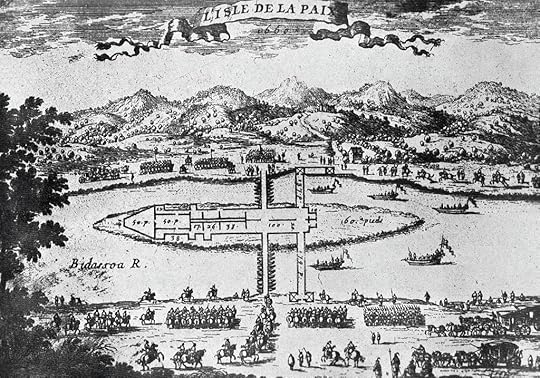
Between the design of the plan and its collapse we visit in alternating rhythm the two courts and their palaces: Louvre, Versailles (with the ‘cour des cerfs’ that Louis XV designed), Meudon, Fontainebleau, and the Alcázar (it burnt in 1734), el Retiro, el Escorial, and the new La Granja. The opening and closing acts take place in the singular Pheasant Island in the middle of the Bidasoa river, island under the joint sovereignty of France and Spain .
The visits to these courts are highly entertaining. They both competed in eccentricity. In Spain we have a morose and pious king who does not like to reign, even if a nasty war that lasted thirteen years and caused two million deaths had been undertaken for him to get that throne. His second wife, the indomitable Elisabeth Farnese, who is hated by all and refuses to kiss the hand of his stepson, the heir, causing him a great upset. The young French king, escorted by death, has develop a strange way of dealing with fear, enjoying when it becomes a spectacle. The little Mariana Victoria lives in her world of dolls and puppets but the prize for the greatest quirkiness goes to Louise Élisabeth, who will bathe quasi naked in one of the palace fountains and who will spend hours washing and washing handkerchiefs.
At the beginning I thought the main interest for me laid in the historical episode and thought that this would be an average read for me, but gradually Chantal Thomas, with a tone that wavers between irony and delicacy of observation held my attention. It must be difficult not to be judgmental when portraying environments that are so aberrant to our current viewpoints. This was then an enjoyable read. I may still look for the film.
This read confused, and then it didn't. But overall it seems bizarre regardless. Not just in the reality of the history, but in the method of its telling. It has rather an identity crisis in its very form. And because of that weird mixture of narrator voice to historic detail encompassed in sections of 21st century sarcastic rant upon early 18th century sensibilities? It just created the effect of a strange, weird, bizarre combo. But it was a combo that made its point. I'm just not sure that point is valid in this form. Described as historical fiction; well, I am not so sure.
Yes, the fiction was just that, true- most of this was pure surmise. But it still became like a portrait of impressionist imagination placed in a non-fiction framework of reference that is stark modern. Something is way "off" but certain angles for the view may be "ok".
So why did I give it 3 stars? Well, up until the 1/2 way point, I would have given it 2. But somehow the outcomes for those princesses, and the formal reveals to their last travels? It certainly made a point. So I rounded it up, instead of down. 2.5 star would be the exact measure.
The style of disdain in tone, that I give a 1 star. I'm not a fan of such bias intruding upon the historical in any form fiction or not. This is not a psychological treatise submission, but marketed as fiction, a tale.
This would not be a book I would recommend to anyone trying to understand politico or the history of such alliances in Europe. Nor would I recommend it for pleasure reading either. It's translated to English from French, but I don't believe that would make much difference in this strange slant to "eyes" or narrator. This book defines little girls in the 1722-25 period in 2010-2015 context to girlhood and childhood. And because it does, I am surprised at myself for giving it that 3rd star. I hope my natural red flags to unfair comparisons for such cross era judgments aren't going half staff on me.
The author’s careful attention to detail and the amount of research she did is very evident right off the bat. The lush descriptions of Georgian court life and the extravagant world of the nobility comes to vivid reality. I could almost hear the rustle of silk and clink of jewels in real life.
I really enjoyed the subject matter explored in the book. Not only the lives of royals in the Georgian era, always a fascinating subject of historical fiction lovers. The way that royal children were utilized as commodities to obtain peace and power was also an enthralling subject. The author does a great job of making the reader feel for these youngsters as they’re thrust into a world they’re not prepared for and roles that seem daunting.
Yet, I think this book has a severe identity crisis that kills the work overall. At times this book would read as a historical fiction and at others it would read as a non-fiction. Alternately, the reader would get into the character’s heads and explore their motivations. And then the next paragraph we would be given dates, facts, and figures interspersed with snatches of primary material. More than once I was thrown from the narrative as we flip flopped from book style to book style so that by the end, I just really wanted the book to be over with.
So while there is some interesting material explored within and in vibrant, life-like detail, this book ultimately fails for me as its flipping between book styles. I actually finished the book in disgust, wishing it would make up its mind on fiction or non-fiction. So maybe read if you’re really hard up for reading material, but I wouldn’t go out of your way to find this one.
Note: Book received for free from publisher via NetGalley in exchange for an honest review.
I recently started writing full time, and one of the really sad side effects is that I can't seem to enjoy historical fiction any more (my genre and I find myself too analytical when reading it). It really sucks and I'm hoping it's just a phase I'm going through.
All this to say, I knew I had to make an exception for The Exchange of Princesses, as it deals with Louis XV (my main man) and is about an incident in his life I'd heard of and was curious to know more about.
I loved this book and for the first time in a long time I had something to read at bedtime that I was actually looking forward to! It is such an original book, the prose is crackling and electric and unexpected and funny and sweet, I just devoured it and fell completely in love. I read another review of this book in the HNS, and they compared it to a work of art - I agree. Merci, Chantal!
Être une princesse d'antan signifierait beaucoup de choses. Elles devaient épouser des monarches régnants pour assurer la paix entre le pays d'accueil et la patrie de le jeune épouse. Elles devaient, dans la pluspart des cas, donner naiisance à un héritier mâle, pour assurer la continuité du règne. Elles devaient, par contre, supporter très souvent les infidélités de son conjoint royal et se taire. Fréquemment, on les expédiait à l'étranger trop jeunes et au nom de la consommation du mariage, elle étaient bon et bien violées, car l'âge de nubilité d'autrefois, c'était les treize ans accomplies. En plus, elles devaient oublier leur langue, ne jamais revoir leur patrie, y renvoyer les personnages et domestiques qui leur rappelaient un brin de nostalgie du pays où elles avaient été nées (sauf le confesseur, car on ne badine pas avec son salut qui doit être fait dans la bonne et due forme!!). Il n'y a dans ce programme rien d'appétissant qui pourrait inciter n'importe qui à se jeter dans les bras de leurs augustes maris. Et pourtant… Le sujet de ce livre mi-documentaire, mi-roman, est justement tel. Anne Marie Victoire de Bourbon (branche cadette, devenue héritière de l'Espagne et la plupart de son empire colonial après l'extinction des Habsbourg de Madrid), infante d'Espagne et Louise Élisabeth d'Orléans, Mlle de Montpensier et fille de Philippe d'Orléans, fils de la Palatine et neveux de Louis XIV qui s'en méfiait, étaient considérées comme des pions de la paix entre les deux pays. On n'épargnait rien et les questions du protocole étaient nombreuses, compliquées et presque sans solution. L'Espagnole devenait l'infante-Reine de France, tandis que son homologue la princesse d'Asturies et plus tard, la reine d'Espagne. Les jeux étaient alors faits. C'était cela au moins que tout le monde a pensé. Mais la vie joue selon ses propres règles et non pas selon ceux des humains… Il suffit de dire que les deux étaient en sortaient brisées. Et que les deux parties de la même famille se haïssaient plus que jamais... La curiosité de ce livre est son style. Chantal Thomas utilise les documents historiques des archives, des lettres, pour la plupart inédites et pour le reste, son imagination d'écrivain. Cette dernière a parfois été franchement gauche et maladroite. C'est bien comprhénsible, car sans cela, le livre, d'une longueur de quelques 330 pages, serait encore plus court. Je le recommande quand même, parce qu'il introduit le lecteur à la période de la Régence et des premières années du règne de Louis XV, une époque qui échappe souvent et aux auteurs, aux historiens et aux lecteurs.
Je suis encore loin d'avoir fini ce livre, mais je tiens à faire quelques remarques sur des points très agaçants. Même si le livre est plutôt bon, il fait des erreurs bêtes : * Que l'auteur arrête de parler de crinolines à tout bout de champ ! Elles n'arriveront pas avant 1842. En 1721, les femmes ont des paniers. * Le Régent, parfaitement au point sur l'Histoire de France, sait qu'avant lui il y a eu déjà 6 Philippe à régner sur la France. * Avoir les mêmes arrières-grands-parents ne fait pas de vous des cousins germains (1er degré) mais des cousins issu de germains (2e degré).
Cela me fait grincer des dents.
30/12/14
Maintenant que j'ai terminé, je mets tout de même trois étoiles à ce livre malgré ces défauts. L'auteur se plonge bien derrière la grande Histoire pour tenter une interprétation des émotions des personnages, et on sent qu'elle a pour eux une grande sympathie.
Dommage que le livre reste assez superficiel sur de nombreux points et qu'on y ait pas vérifié certains détails.
I found this one to be interesting in the story itself -- two princesses from France and Spain who are to marry either the King or Prince of neighbouring countries. After an ceremonial exchange on the borders, they struggle to adapt to new countries and customs. The French Princess, Louise, Mlle de Montpensier, is unruly, spoiled and impossible, while her opposite, Infanta Mariana, charms everyone, acts appropriately, and falls in love with her spouse, Louis XV, at once. Given that Mariana is just seven, no one is really expecting much of her. Louise on the other hand, is bored, capricious and sexually adventurous while waiting for her husband, Luis, to get the hint. Sadly, the book is told in very brief chapters, and while the research is very good, there's just not enough substance here to really satisfy. Just three stars from me. Only somewhat recommended.
Suite à la mort de Louis XIV, c’est à Louis XV, son arrière-petit-fils, de monter sur le trône. Mais ce dernier est alors trop jeune pour gouverner. La Régence revient donc à Philippe d’Orléans. Celui-ci aime la position de pouvoir qu’il occupe et ne tient pas à ce que cela s’arrête. Si Louis XV meurt sans héritier, c’est au Régent que reviendra le pouvoir. À partir de ce constat, il va mettre en place un plan « diabolique ». Il propose un mariage entre Louis XV, onze ans, et l’Infante Maria Anna Victoria, 3 ans. La menace d’un héritier est donc repoussée pour quelques années. En outre, le Régent place ses espoirs en la santé fragile du Roi. Mais ce mariage arrangé ne lui suffit pas, il tient également à marier l’une de ses filles, Mademoiselle de Montpensier, à l’héritier d’Espagne afin de renforcer son propre pouvoir. L’échange s’effectue en 1722, mais rien ne se passe comme prévu et voilà que quelques années plus tard l’échange se fait en sens inverse.
Difficile de mettre ce livre dans une « case »… c’est un roman historique, certes, mais il prend plus l’apparence de ce que j’appelle une biographie romancée. Le récit à la troisième personne y contribue. L’auteur nous guide à travers l’Histoire et l’histoire. On observe les faits, les événements, et l’auteur étaye ses dires d’extraits de correspondances authentiques. Ce qui rajoute beaucoup de crédibilité à l’ensemble. Après ce n’est pas non plus une biographie au sens stricte du terme, car ce livre revient "seulement" sur quatre ans de quatre personnages principaux : le Roi, deux princesses et l’héritier d’Espagne. Quatre ans d’une grande importance.
J’ai eu du mal au tout début avec le style de l’auteur. Sa façon d’écrire me donne l’impression de suivre le fil de sa pensée. Lorsque l’on ne s’y attend pas, c’est surprenant et donne une impression de confusion, mais on s’y fait très vite. Les chapitres alternent entre ce qui se passe à la cour de France et à la cour d’Espagne. Il m’a semblé que le plus souvent on suivait l’Infante au détriment de Mademoiselle de Montpensier, mais peut-être est-ce parce qu’il y a plus de choses à dire sur « l’histoire d’amour » entre Maria Anna Victoria et Louis XV.
Justement, parlons de l’Infante. J’ai vraiment eu beaucoup de mal avec ses comportements. Elle a trois ans, au début, mais elle se comporte comme une adolescente voire même une adulte. Elle est éperdument amoureuse du roi, à trois ans… Elle offre sa souffrance à Dieu pour expier les pêchés de son père. C’est perturbant et peu crédible à notre époque, mais sachant que l’éducation n’était pas la même et que les enfants, étant vus comme des adultes inachevés, n’avaient pas d’enfance à proprement parler, c’est plausible bien que surprenant. Malgré tout, cela reste une enfant charmante et charmeuse, à qui on s’attache assez vite. On ne peut s'empêcher d'avoir de la peine pour elle, lorsqu'elle découvre les vicissitudes de la cour du Roi de France : un jour elle est adulée, le lendemain elle n'existe presque plus...
Mademoiselle de Montpensier, quant à elle, est propulsée dans une cour étrangère dont elle ne sait rien, dans une famille qui l’accueille avec froideur et dans le lit d’un jeune homme empressé mais ignorant. La pression qu’elle subit de toutes parts lui fait perdre à moitié la tête mais n’émousse pas son esprit de rébellion et sa résistance. J’ai aimé sa combattivité, même si, à cette époque, elle ne sied guère à une dame. Car, bien entendu, une femme doit être docile et soumise à son mari (ou encore son père/son frère etc.). Même quand le mariage a été arrangé, ce qui implique - la plupart du temps - qu'on a donc été échangé comme une vulgaire marchandise.
Au final, ce livre a été une excellente découverte et m’a permis d’apprendre beaucoup de choses. L’auteur maîtrise le sujet et le traite avec beaucoup de rigueur et de clarté. Ce roman se dévore tant il est passionnant.
Before beginning, I wanted to note I received this review from the publisher, The Other Press, which has no effect on my review. This book is set to be released in the United States on July 7, 2015. This does not affect my opinion or review...
The Exchange of Princesses is a historical fiction by Chantal Thomas set in France and Spain, 1720s. The main characters of focus include: Louis XV (to become King of France) and Luis I (to become King of Spain); and the princesses Mariana Victoria de Borbón (to become the Queen-infanta of France) and Louise Élisabeth d’Orléans (to become Queen of Spain).
The story is one of: politics, scandal, love, hope, passiveness, deceit, and a touch of disease thrown in during this tumultuous time of history in the two countries. The Exchange of Princesses started off so politically with the marrying off of children (the two princesses; one of whom was only four years old) and the crossing of the border between France and Spain to exchange the two of them.
Overall, I very much enjoyed this book. The writing style took me a moment to adjust to, but once I did I found it difficult to put the book down. It was a tale of politics and arrangements, differences in emotions and in how things can be unpredictable and be changed.
A full review will be posted 3/19/15 at playingjokers.com.
I received an ARC of this book in exchange for an honest review.
While the book description was intriguing, I was baffled by the writing style(s) more than once. Historical fiction is one thing, non fiction another. And while a mix of these is ultimately inevitable in much historical fiction, this book seemed to miss the mark in regard to this mix. Although the research is obviously meticulous, and the lives of the royal children being used as barter in order to gain power explored well, I cannot recommend this book. This is only my opinion.
Bien qu’on se doute que Marie Leszczynka n’était pas un premier choix comme épouse de Louis XV et Reine de France, j’ignorais totalement que le successeur de Louis XIV avait été fiancé pendant quatre ans à une petite infante espagnole. C’est pourtant cette étrange histoire que raconte Chantal Thomas dans L’échange des princesses. Comment l’idée vint au Régent, pour tenter de conserver la gérance du royaume le plus longtemps possible, de marier le jeune Roi à une petite fille. Comment il osa imaginer de proposer sa propre fille, Louise-Élisabeth, en échange au prince des Asturies. Comment le duc de Saint-Simon intrigua pour être ambassadeur extraordinaire auprès du Roi d’Espagne et lui présenter cette requête. Comment se déroula "l’échange des princesses". Et ce qu’il advint de chacune de ces enfants dans des Cours qui leur étaient totalement étrangères.
En 1721, Marie-Anne-Victoire, infante d’Espagne, a quatre ans lorsqu’elle part pour la France en qualité d’Infante-Reine, appellation qui ne fut jamais utilisée que pour elle. Louise-Élisabeth, dite Mademoiselle de Montpensier, est âgée de douze ans. Si l’éducation de Marie-Anne-Victoire fut rigoureuse, à l’image de la Cour d’Espagne, celle de Louise-Élisabeth fut quasiment inexistante. Leur destin, aussi différent que possible par leur âge et leur environnement familial, offre pourtant une singulière symétrie : quatre années de solitude, que l’auteur déroule devant nos yeux en alternant les chapitres sur les deux princesses. La petite Infante doit faire face à la froideur, puis l’indifférence de Louis XV (de huit ans son aîné) ; Louise-Élisabeth, livrée à elle-même malgré l’affection de son mari, multiplie les caprices, les coups d’éclat, et se rapproche dangereusement de la folie. Elle devint pourtant Reine d’Espagne lorsque Philippe V décida de remettre la Couronne entre les mains de son fils. Mais ce dernier fut incapable de gouverner par lui-même et l’ombre du couple royal, mené d’une main de fer par la seconde épouse de Philippe V, Élisabeth Farnèse, plana longtemps sur les deux adolescents.
Philippe V étant le petit-fils de Louis XIV et l’oncle de Louis XV, les quatre enfants étaient cousins germains. Mais les liens familiaux ne comptèrent pour rien dans ces alliances, qui sacrifièrent sans ménagement deux princesses à la raison d’État. L’auteur a cependant choisi une narration à double niveau : l’un relate les faits et s’en tient là. On se croit d’abord dans les Mémoires de Saint-Simon, puis dans les nouvelles à la main qui tenaient compte jour après jour des déplacements, paroles et attitudes des princes. L’autre tente de percer l’intimité des princesses, le coffre à poupées de la petite infante, ses envies de plaire au Roi, les lubies de Louise-Élisabeth, ses rapports orageux avec son mari. Mais le contraste qui en résulte est trop fort et aucun de ces deux choix narratifs ne m’a convaincue.
The Exchange of Princesses, Chantal Thomas Fascinating and unbelievable story based on true events. In 1721 two young princesses, one from Spain and one from France, are exchanged so that they can each marry the future kings of those counties. The agreement is made to end the on-going hostilities between the two countries. At the time of the exchange the Spanish princess is 3 and the French princess is 12. Both must leave their homes and travel to the other country to marry thier new husband. The French King to be is 11 and the Spanish heir to the thrown is 14. A huge event at the time, much about the lives of the princesses and their spouses was reported on in the press, and many letters traveled back and fourth between the courts and those caring for and representing the princesses.Thomas uses portions of letters and pieces from the press reports to enhance the telling of this absurd, sad and ridiculous tale. The book highlights how little the young kings did to rule their country, how little they seemed to care about their roles, and how others made most of the decisions. The novel also details the ugly fighting and constant intrigue at court among the royalty, especially in France, to be the ones in control of the kings. It also emphasizes that even though the children were allowed to be children to some degree, they were also required to behave as adults in so many ways. Of course, nothing works out the way it was supposed to. Extremely well written and totally engaging
Ce roman raconte les quelques années où Louise Élisabeth d'Orléans est devenue reine d'Espagne et Marie Anne Victoire d'Espagne l'Infante-Reine. Nous observons donc les signatures de contrats ayant mené à cet échange et les événements l'ayant ponctué jusqu'aux retours des princesses dans leurs pays respectifs.
Conté à la manière d'un récit presque journalistique d'époque, Chantal Thomas nous transporte dans ce XVIIIe siècle fourbe et politiquement ambitieux. On rencontre des personnages clés de la Cour de France et d'Espagne et nous découvrons dans quel but cet échange a eu lieu.
Si le côté historique est parfaitement effectué, sans aucun détail inutile et totalement efficace, la caractérisation des personnages a été plus difficile. Je n'avais aucune pitié pour quique ce soit, et l'aspect romancé aurait pu être travaillé davantage, car il n'y a presque aucun dialogue et nous assistons à une leçon plus qu'une fiction. Le personnage autant de Louise Élisabeth qui dévore et vomit, qui se déshabille en pleine cour, m'a plus choqué que touchée. Le seule personnage auquel il était plus facile de s'attacher était évidemment la petite Infante-Reine.
À lire si vous aimez la période de la Régence sans les excès du duc d'Orléans. À éviter si vous ne voulez pas avoir l'impression de lire un manuel scolaire.
Unhappy life to be a Royal, maybe not as bad as being a starving peasant, but certainly a life that could chew you up and spit you out without sympathy. The Spanish princess is only 3 years old when she is sent to France to marry the eleven year old King of France. He is well-mannered but incredibly embarrassed by his baby bride. She is a very charming child but the King is not taken with her and the court eventually grows tired of baby games. The French princess is a lonely, neglected and strange twelve year old sent to marry the Spanish prince, next in line to the throne. Although he is a bit of an oddball as well they don't share interests and the princess is not too well tethered to reality. Fascinating historical fiction. Recommended.
Drame historique où les filles de la haute noblesse servent de monnaies de négociation géopolitique. Sur fond de fin de la guerre d’Espagne, Louise Elisabeth, fille du Régent est mariée au Prince des Asturies, Marie Anne est promise au futur Roi de France Louis XV, petit fils de Louis XIV, et est envoyée avec ses poupées à la Cour, elle est alors âgée de 4 ans.. Les portraits psychologiques sont assez fins, on croise avec plaisir la Princesse Palatine et l’on s’affligent devant la raison d’Etat et des mœurs de la Cour. Deux parcours broyés par l’Histoire.
J'ai eu beaucoup de mal à rentrer dans ce livre. Les citations extraits des lettres véritables échangées entre les personnages principaux n'étaient pas agréables à lire car l'auteur a gardé l'orthographe d'origine et ces extraits me donnaient l'impression de lire un compte-rendu historique. L'histoire était intéressante mais je suis restée sur ma soif, on ne rentre pas assez dans la psychologie des personnages. J'ai préférée 'Les Adieux à la Reine'.
The Exchange of Princesses (Paperback) by Chantal Thomas - translated from the French by John Cullen
Philippe d’Orléans is the regent of France. King Louis XV is 11 and he will not be of age until he's 13. The regent has been plotting on how to hang on to power or perhaps even take the throne for himself when he comes up with the brilliant idea of two royal marriages. He will marry his daughter, 12 y/o Louise Élisabeth d'Orléans, to 11 y/o Luis de Asturias who is the heir of Philip V of France, and in exchange he will arrange for King Louis XV to marry 3 y/o Mariana Victoria de Borbón, the Infanta of Spain. Since they are all descendants of King Louis XIV, a dispensation is made for the cousins to marry.
The Spanish court enthusiastically agrees and arrangements are quickly made. The two nations traded their princesses in a grand ceremony in 1722, making bonds that should end the historical conflict between them. Of course, nothing turns out as expected. In a novel that reads like a children's book, Chantal Thomas chronicles a time in French history when children were not children, but pawns in an adult’s game.
The book is narrated from the universal point of view, shifting third-person points of view without rhyme or reason. The plot is very boring. Life in court is not all that exciting, since we're talking about children's points of view. Mariana Victoria is more concerned with playing with her 375 dolls and adoring her future husband from afar than with life at the court. The author makes the 3 y/o go between being a child and acting like a grown-up - not believable. She also makes Louise Élisabeth act younger than the three-year-old princess. She refuses to blend in and is constantly suffering from ill health, or engaging in obscene acts with her ladies of the court. The characters are flat and boring. I never cared for any of them. There is a page at the end of the book titled "Principal characters." I would read that and skip the book.
This book examines a fascinating and often-overlooked segment of history, so I did find it very engaging. However, the writing style kept it from actually being a good book.
I'm inclined to be lenient about the prose, since it was translated, causing much of the author's original voice to be lost.
However, the narrative and tone is just so frantically confusing. One second, the author is writing a charming historic fiction, detailing characters' imagined thoughts and motives. The next second, it's an academic biography carefully copying historic letters and noting the letter's handwriting and paper type. There's even a few bits that slide into magical realism, as the dolls of Mariana chat about their thoughts while stored in a trunk, and at one point the author abandons history altogether to talk about how a castle is a tourist attraction in modern times.
Altogether, there was a very good story somewhere inside the facts Thomas describes, but she mangled it all for no good reason.
#histoire #318 pages http://vie-quotidienne-de-flaure.blog... = 9/10 En 1721, la France et l'Espagne veulent se rapprocher ... J'ai beaucoup aimé ce livre, qui est bien sûr un roman, mais qui nous permet de découvrir quelques années d'histoire. Les chapitres sont émaillés de courriers ou billets authentiques. Ce sont les vies des jeunes princesses qui cheminent dans ce livre. Les enfants sont pris en otage par les adultes et leur soif de pouvoir. On s'attache à l'infante qui fait fondre les courtisans mais laisse indifférent le futur roi. On suit les deux couples vers leur destiné. On connait un peu mieux l'entourage de ces enfants et les manigances qui se jouent. En conclusion, comme tout a échoué, ce sont des enfances gâchées dont Mademoiselle de Montpensier ne se remettra jamais.
The subject matter itself is an interesting one, the two children swapped from their respective courts destined for a glittering future as Queens, neither of which actually happens. I really did feel for both of the poor girls, though particularly for Mariana Victoria who wasn't even four yet when she got sent off from her parents.
The style of writing leaves something to be desired though. It's odd mixing the 18th century court formality with what seems like very modern thoughts and sensibilities, and the disjointedness of multiple points of view kept distracting me. It was also a great deal more vulgar than I was expecting it to be, which seemed slightly out of place.
Le fait historique est intéressant et très certainement dérangeant pour les protagonistes principaux, néanmoins cela reste du domaine de l'anecdotique au regard de la grande histoire. Et c'est tout le problème : Meubler un récit de plus de 300 pages sur une quasi anecdote... Et dont la principale protagoniste est dans la petite enfance. L'imbécilité d'un régent ne valait certainement pas cet étalage de détails sur les déboires d'une petite princesse de cinq ans, de ses jeux à son "grand amour": parce que oui, même dans le cas d'une petite fille de 3ans et demi on vous ajoute une histoire d'amour contrariée... Euh, faut-il vraiment en dire plus? Un récit trop long au regard du sujet abordé.
Une histoire fascinante mais une écriture crue, dépourvue de toute élégance littéraire. L’histoire est trop proche de la réalité pour se permettre de romancer autant, et trop romancée pour se présenter comme la réalité. Chaque personnage est détestable et le tableau peint, quoique innovant et fascinant, est morbide à souhait. L’auteure nous tient en main, nous partage sa version de l’histoire, mais l’expérience n’est décidément pas plaisante.
Chantal Thomas relate dans ce livre l'échange de Melle de Montpensier, fille du régent Philippe d'Orléans, promise à l'infant d'Espagne contre l'infante Marie Anne Victoire,âgée de 4 ans et promise au roi Louis XV. Avec beaucoup d'ironie, Chantal Thomas parvient à retracer l'effroyable histoire de ces deux enfants et à montrer l’extravagance et la cruauté des vies dans les cours françaises et espagnoles.
This could have made a great plot for a fiction novel. But it was not fiction, it was history. That is what makes it such a sad story.
It is an interesting story but I CANNOT recommend it because of explicit content that truly did not need to be described. (The fact that the author described explicit content involving youth only made it worse.) Very disappointed in the author for choosing to include that when a simple fact would have sufficed.
C'était sympa mais sans plus, je n'ai pas du tout aimé le style d'écriture, il n'y a aucune narration c'est juste une succession de faits. J'ai trouvé qu'il y avait aussi pas mal de longueur et que la fin était assez expéditive. En revanche j'ai aimé le personnage de Louise Elisabeth et le déroulé chronologique des évènements, je n'était pas perdue dans le récit.
I wanted to like it bc this time period of history and the 2 princess and 2 princes have interesting stories, but could not. It just does not flow properly and gets boring quickly. I had to take breaks and read other books and come back than read a little bit of this book and take a break again