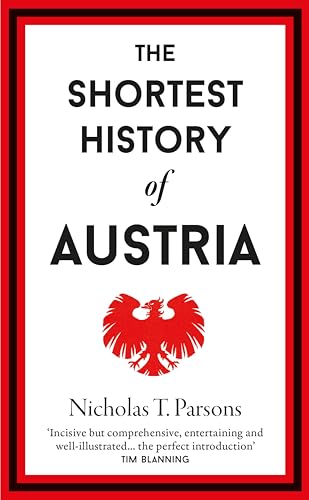
'Incisive but comprehensive, entertaining and well-illustrated, this is the perfect introduction to what was once a huge empire and is now a small but (undeservedly) very lucky country' TIM BLANNING Austria is a small country with a glorious history but a troubled past. It sits at the crossroads of central the furthest the Ottomans reached in the seventeenth century, a back-channel between east and west during the Cold War, and today a member of the European Union with its neutrality challenged by the Russian invasion of Ukraine. In The Shortest History of Austria, Nicholas T. Parsons expertly tells the story of Austria from its origins at the outer reaches of the Roman Empire to its dominance of central Europe under the Habsburgs, and from the rebuilding of the republic after the devastation of World War II to the political tensions of today. As he ranges from the Romans to the Reformation, from the assassination of Archduke Franz Ferdinand to the Anschluss, and from Mozart to Gustav Klimt to Harry Lime, Parsons reveals the drama of Austria's history – and the crucial role the country has played in the story of Europe.
I mean I guess you get what what you pay for; it definitely is the *shortest* history of Austria. I understand the brief for these books, but this had so many glossings over, circling backs, mixed chronologies, and unclear characters, that I doubt I'll pick up another book in the series. It definitely had its moments, and it was an interesting cursory view of the history, but I felt a few more pages and a more rigorous editor and it would be less infuriating.
It was also remarkable how much Parsons' personal politics came through. Of course the Habsburgs are integral to the history of Austria, but the vast majority of the book is little more than a family chronicle, with slight sojourns to famous artists but very little about the lives of Austrian people. Not to mention how he brushes off Waldheim's Nazi links or his conflation of "Palestinian or Islamist terror attacks". I promise I'm not an angry Leftie, and can happily read differing politics, but for an introductory history like this, I would like a sense of neutrality, and less of Parsons' often sneering opinions coming through.
also I don't want Nazi links brushed off I don't think that's too much to ask
I've discussed this at some length with my partner and I believe that, in principle, the existence of "The Shortest History of [ ]" books in and of themselves is great, as it's profoundly important to make history more accessible, and their school-book structure tends to make these books quite the page turners, the broad-strokes episodes they run through providing some connecting tissue for dimly remembered kings and emperors you learnt about in school while perhaps also giving you an incentive to further research individuals and events that get name-dropped and that you might be less familiar with.
I say this to stress that my problem is not with the existence of this type of "shortest history" book in and of itself, but with the ideology that this is done in service of, at the very least in the case of Nicholas T. Parsons's The Shortest History of Austria (although a cursory look through Goodreads seems to indicate that The Shortest History of Germany from the same publisher is likewise distorted by the author's political views). The fact that many a target reader of this book (by which I imagine the Waterstones café pensioner crowd) could easily walk away from reading this without noticing any ideology in the first place is a testament to the fairly devious way in which the author treats his liberal-capitalist bourgeois interpretation of history as factual truth, a theme that may be less clear in the earlier chapters on Austria under the Romans, the Franks, and the Habsburgs, as we are taught (falsely, of course) to treat this kind of long bygone history as the stuff of legend and fanciful stories but more or less fully removed from present political circumstances. However, the way the book covers Austria's 20th-century history and in particular post-war events should expose, to the reader familiar with Austrian history, the strong conservative bias in this history. Which is of course all the more of a glaring defect in a book deliberately marketing itself for a readership lacking that sort of familiarity.
Let's begin with the book's treatment of antisemitism, which, in the classic manner of a Christian European historian, is treated as an "unfortunate tragedy". Thus, when Parsons talks about someone like the 15th-century Habsburg ruler Albrecht II of Germany, he frames him as an "energetic" and "firm-handed" reformer whose rule is sadly "marred" by the fact that he directly ordered the ethnic cleansing of all Jews in Vienna, which is then swiftly contextualised as, ah, but everyone did in those days. How are we ever to have a proper historical understanding of the causes of the Holocaust without recognising that the still-celebrated late medieval European monarchs, Albrecht in Austria/Germany, Edward I in England, Louis IX in France, Isabel I and Ferran II in Spain, directly created the ideology and precedent that the Nazis would follow? The fact that many of the early Habsburgs and their predecessors, the Babenbergs, were enthusiastic participants in the Crusades, whose millenarian ideology has provided the ideological foundation for the majority of Western genocides, both in Europe and in the New World, is hardly worth a mention for Parsons.
And while it's unfair to criticise a book deliberately aiming for brevity for the things it leaves out, the picture that emerges as Parsons covers the end of the Habsburg monarchy and the interwar period is one of ever-increasing progress for an ever-larger section of the populace that's only hampered by radicals on the left and right, a picture that fully erases the responsibility of Austria's rich history of labour organisation and workers protests in bringing about this raising of living standards. That, in lumping together fascists and socialists/Communists in such an unserious horseshoe-theory way, he directly replicates the obstinacy that centrist parties in interwar Austria and Germany showed in ignoring the claims made by true leftist parties on behalf of the populace (something that, as we know, led to a political landscape so irreparably divided as to make it all the easier for the Nazis to steamroll all the opposition) seems lost on Parsons.
Unsurprisingly, his dogged anti-communism extends to his treatment of the Soviet Union, which Parsons manages to disparage even when discussing the liberation of Austria, which for him is a "liberation" only under quotation marks when it concerns the Red Army, echoing the consistent Western narrative that the war was won by the US (with a little help from Britain and France) when it was the Soviet Union who lost by far the largest amount of its population in order to defeat Nazism. Even when excluding famine and disease, i.e. when focussing solely on war crimes and deaths directly caused by warfare, the civilian death toll in the territories of the Soviet Union is nearly double that of all the Jewish victims of the Holocaust and the amount of killed Red Army soldiers (who did not deserve to lose their lives any more simply because they had the misfortune of being soldiers) further doubling that figure to arrive at an astronomical, catalysmic death toll of over 26 million. That the Red Army likewise engaged in war crimes of its own, in particular through the mass rape of Austrian and German women, is a well-documented fact, but a critical assessment should have room to acknowledge this alongside the sheer enormity of the Soviet sacrifice, rather than wasting ink with snide comments about "self-congratulatory liberation monuments".
Elsewhere, Parsons justifies Metternich's police state based on censorship and bourgeois order by smugly asserting that, after all, "there were plenty of trigger-happy radicals around", not considering that perhaps the reason those "trigger-happy radicals" were around in the first place was because Metternich, like so many other autocratic European rulers of the first half of the 19th century, stubbornly wielded all the powers of the modern nation state to extinguish the ideas of democracy, liberty, and equality that the French Revolution had brought to the fore. In the expected trivialising fashion of 20th-century historians, he also plays down the Austrian annexation of Bosnia in 1878 as mere geopolitical strategising and not as the beginning of forty years of violent colonising and "civilising" efforts directed against a majority-Muslim people that all Habsburg leaders of the time openly described as lesser and unworthy.
The overall context of 19th-century imperialism and colonialism is barely acknowledged at all, and while it is true that the Austro-Hungarian Empire (more out of incompetence and of being preoccpuied elsewhere than humanitarian goodwill) was a comparatively minor player in the Scramble for Africa and the major European powers' other violent colonial efforts in the decades leading up to World War I, a more honest history should have at least mentioned the Habsburgs' attempts to colonise the Nicobar Islands and parts of Mozambique, the very real Austrian participation in the Eight-Nation Alliance that made Qing China rife for imperialist exploitation in the wake of the foiled Boxer Rebellion (from which Austria-Hungary obtained a lucrative trade concession in the major Chinese port city of Tianjin that it maintained until the end of World War I), or the far more wide-ranging economic profiteering that the empire had been engaged in since the start of the 18th century through various trading companies modelled on the Dutch East India Company. The reader will likewise be looking in vain for any mention of the Austrian military having been the first in history to make use of aerial bombardment against the population of Venice as part of the revolutions of 1848/49 or its having employed near-genocidal tactics against the Serbs during the three-year-long Austrian occupation of parts of that country in retaliation for the assassination of Franz Ferdinand.
As regards Austria's most shameful and violent years, the book remains fairly orthodox and facts-based, acknowledging the pro-Nazi sentiment widely held by the Gentile Austrian population around the time of the Anschluss, although Parsons fairly quickly skips over the period of Austria as an independent fascist state between 1932 and 1938, emphasising the Ständestaat's anti-Nazi credentials without dwelling on the way its elimination of democratic structures and civil society and its corporate-dictated implementation of harsh austerity policies directly paved the way for Hitler's easy, non-violent takeover of his native country in 1938. Whether or not the book should have gone into more detail on the war crimes committed by Austrians in Austria (be it Hans Asperger's medical killing of disabled adults and children at Vienna's Am Spiegelgrund clinic, the mass extermination of Jews and other prisoners just outside of Linz at Mauthausen concentration camp, the overrepresentation of Austrians in statistics of individual Nazi perpetrators, or Austrian Catholic priests' subsequent actions to aid war criminals in escaping to South America via the so-called "rat lines") may be debatable, since I suppose this is the sort of "respectable" book that wouldn't want to offend its readership with too drastic an account of the violence committed and tolerated by many Austrians during World War II, but what's quite clear is how callously Parsons waves away Austria's minimal efforts at "denazification" post-1945. That perpetrators were swiftly amnestied and reintegrated into society is matter-of-factly explained with reference to "strategic shortages in vital professions", while the later furore surrounding UN Secretary General and President of Austria Kurt Waldheim, a former Wehrmacht intelligence officer with detailed knowledge of atrocities committed (quote author!) is dismissed as "slightly bizarre", since Waldheim himself "had not committed any crimes" - which, I assume, is said in reference to the fact that he didn't personally kill anyone, a frankly alarming interpretation of responsibility in the case of genocide and one by which Hitler and most of the Nazi top brass, who never personally killed anyone other than in some cases themselves, could theoretically be absolved of any guilt as well.
While the comparatively uneventful neutrality of Austria since 1945 should, you'd think, make for relatively uncontroversial history, the opposite is the case in Parsons's book, and in many ways I think that this last portion of the book might be its most damaging and offensive one for how it affirms the country's political status quo, directly reproducing the narrative of Austria's conservative establishment press. The mass privatisations of previously state-owned industry and services in the 1990s and early 2000s and the direct deteriorating effects this has had on quality standards, average income levels, and the state's ability to effectively respond to economic crisis are waved away as having been "ill-received by vested interests but [as having] reflected the changed global economic conditions".
Meanwhile, he dwells on the numbers of refugees and migrants arriving in Austria since 2015 and finds it somehow necessary to mention that 60 per cent of children born in Vienna - a deeply multicultural city for all of the later Habsburg and early republican period - are now born to migrant families, which is only true if you think of "migrant status" as something innate and racial and therefore eternal, which, in case Parsons forgot the content of what he was writing about three chapters earlier, is exactly what the Nazis were doing. On top of that, Parsons reiterates the persistent racist dog whistle of "welcome-clappers" having greeted migrants and refugees at train stations throughout 2015, as if it was anything other than basic human decency to go and help traumatised and impoverished people at the end of their arduous journeys from wartorn countries.
Apart from this, the book (published in 2025!) just casually drops the r-word to describe a developmentally disabled emperor, authoritatively proclaims that Austria might need to rethink its neutrality and at the very least ramp up its military spending, and persistently, reflexively dismisses any discussion of corruption in Austria as a "both sides" issue, when any statistic or cursory awareness of Austrian politics will tell you that the frequency and scale of corruption scandals is heavily slanted in favour of governments that have featured the People's Party and the Freedom Party. As for the current Austrian government, Parsons offers his expert fiscal advice: "with the Socialists in charge of the Finance Ministry, it is not clear that the necessary amount of belt-tightening on the welfare state will be made". And while this is a minor quibble and fairly common with English-language discussions of Austrian and German politics, referring to the main centre-left party of either country as "socialist" is not only a mistranslation - either party having officially been called the social democratic party of its country for the better part of a century now - but profoundly (and in this case, I suspect, deliberately) misleading in regards to the deeply centrist political ideology espoused by these parties and their historical rejection of all things socialist.
For the Habsburg chapters in Austrian history, I would instead recommend Martin Rady's far more informative and objective The Habsburgs. For the extent of Austrian participation in the Holocaust, Michael Mann's The Dark Side of Democracy is essential. For post-1945 politics, even Wikipedia will leave you more reliably informed than this.
Normally a lover of this series and I absolutely adored Rady’s The Habsburgs: the rise and fall of a world power, but my gosh this felt like a slog. Real key moments seem totally rushed over (would’ve loved to have known more about Matthias Corvinus’ invasion or the siege of Vienna by the Turks but these were completely glossed over in a few sentences) with other parts going into such depth that it slows everything down completely.
I agree with some of the other reviews of this book. It was quite interesting in places and I did learn some things but it was such an unncessary slog to get through.
It also became hyper-politcal at one point.
Not something I'd read again. I have also read the German edition and I find they don't work for me.
worst book in the series so far. its a very disjointed history. no themes, just randomly jumping around from topic to topic. wouldn't recommend this one.
Barely readable. The writing is all over the place, jumping across centuries in the same paragraph. In quite a few cases the accompanying boxes break the flow.
The author has set himself quite a challenge to cover the whole of Austria‘s complicated history in so short to book. Unfortunately, the gamble does not quite pay off and it is not entirely clear who this book has been written for. For those with good prior knowledge, there will be little new material here. However, complete beginners may find themselves somewhat lost as the explanations are brief and complex histories are skated over. By contrast, the author expands on some of Austria‘s cultural history in ways which seem to assume considerable prior knowledge. The closer the coverage comes to the present day, the more it expands, so that we hear rather more on individual modern scandals than on the whole reigns of earlier emperors. On balance there are better introductions to Austrian history, especially the Concise History of Austria by Steven Beller.
I had just arrived at the Mayr Clinic with my daughter and had just finished a book. The clinic had a charming "library" in one of its rooms that soon became a favorite hang-out and I have a habit of reading histories of the places I travel to. I first went to Austria in 1968, actually Vienna was the first European capital I visited on that, myself first trip to Europe. I have read countless histories of the Hapsburgs, the Holy Roman Empire, etc. but never a straight history of the country itself. This was thorough, enjoyable and well written, and SHORT. I manages to get through it in less than a week!
Does what it says on the tin. I’ve noted the criticisms of the political leanings of the author, and whilst there’s much to debate here, I’ve felt that I’ve learnt enough about a holiday destination that I’m not bound to wonder who all the statues depict! I like this series, and feel able to critically reflect on some of it’s shortcomings so could look elsewhere for a different perspective if I wanted to do a deeper dive.
A concise, informative, and highly readable history of Austria. I didn't notice any political leanings, so I'd like to offset the other reviewers who apparently expected a hagiography on communism.