Norikazu Kawashima (川島のりかず, Kawashima Norikazu , 1950 -2018) was a Japanese cartoonist. He was active in the 80's and is best known as the author of the horror manga Her Frankenstein (1986).
In this weird but compelling horror story, an emotionally disturbed man is not coping well with his childhood trauma. He remembers being bullied at home and at school and the girl who befriends him. Unfortunately, her own troubled, spiteful and manipulative personality and her obsession with Frankenstein's monster keep this from becoming a feel-good story.
FOR REFERENCE:
Contents [2024 English Edition]: Her Frankenstein / Kawashima Norikazu -- Kawashima Norikazu and the Ecstatic Demise of Classic Horror Manga / Kawakatsu Tokushige -- The Best of Kawashima Norikazu / Midori no Gosunkugi
Un manga de terror con un estilo muy clásico. Kawashima es un autor reverenciado por Junji Ito y no me extraña porque la influencia es palpable. Pese a que es un manga bastante vintage el dibujo es una pasada. La historia también tiene lo suyo y trata de la relación de un niño que conoce a una joven rica que esta enferma y no va a la escuela. Los dos tienen una amistad que dista de ser sana ya que ella lo utiliza para disfrutarlo de Frankestein y hacer trastadas. Cuando el niño se haga mayor y trabaje en Tokio empezará a ver una extraña presencia que le sigue a todas partes.
this read like a 70s horror flick which definitely worked in its favor. I also love when older works have essays at the end that contextualize the story + creator, and this one includes a ton of covers of Kawashima Norikazu's other manga which was a treat to see! Hopefully this leads to more of his work being localized, or at least more obscure old horror manga getting a chance in the USA, because I will definitely keep buying them if they're available.
Her Frankenstein centers on the complex relationship between a wealthy but ailing girl, Kimiko, who befriends a wimpy little kid named Tetsuo. Eager to please the prickly Kimiko, Tetsuo plays along with her whims which includes dressing up as a "Frankenstein" (basically the design of Frankenstein's monster from Mary Shelley's classic novel) and serving as her enforcer and bullying the other kids in their quaint countryside neighborhood. Without his Frankenstein mask, Tetsuo reverts to his meek and feeble persona and so he soon begins to develop a highly dependent relationship on his alternate persona. Years later, the trauma of his Frankenstein persona has been buried deep and Tetsuo lives his days as an everyman worker in the city. But the horrors of his Frankenstein persona percolate deep within him, and that serves as the primary driving force of this story.
The story moves along at a brisk pace, diving back to the lengthy flashback of Tetsuo's youth effortlessly while still carrying the main story forward with ease. Thematically, Norikazu is tapping into ideas of male insecurity and emasculation while using standard psycho-horror tropes of delusions and nightmarish hallucinations. Diving deeper yet, Her Frankenstein provides a vivid reflection of a society with no place for vulnerable men due to the innate toxic masculinity and patriarchal norms. It doesn't deliver too strong on these ideas beyond a surface level exploration, but it's definitely there to an extent.
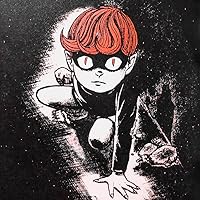
Norikazu's artwork is on par with the efforts of early horror manga contributors - simple in style but effective for the storytelling. It's playful when needed, which is a bit rare for a fairly dark tale like this, but it's there in a way that feels congruent with masters of the form like Tezuka or Umezz. This isn't a particularly memorable tale by any means, but it's entertaining enough and has some intriguing history to it as described by Ryan Holmberg's accompanying essay. For a first release in their new SMUDGE imprint, Living the Line is continuing to put out nice reclamation projects that are worth checking out.
I kind of found the author more interesting that the story itself, considering he at certain point went and burnt all his artwork and abandoned Tokyo, never to be heard of again.
As for the manga itself, there was some intriguing ideas there, but I didn't really connected with the characters, and the whole story felt a little bit flat, and probably something that didn't need so many pages to be told.
I enjoyed more the flashbacks than the present time plotline, and the art wasn't really outstanding either.
Phenomenal- a truly demented and haunting horror comic that doesn’t rely on gore or body horror just absolutely disturbed people.
A wimp befriends a handicapped girl who has her own emotional issues and they exasperate each others mental illnesses until he truly becomes Her Frankenstein. One of the best horror manga I have ever read.
this stripped-to-the-bones book by Kawashima Norikazu is a kind of liminal work, somewhere between Tezuka and Ito, and it succeeds despite far less gore than in KN's other manga efforts. Here is a complete loser of a salaryman, dreaming only of being dominated by awful women while surrounded by terrible relatives and a disappointed wife, whose life as a free man ends while wearing a stupid Frankenstein's monster mask and beating up little kids (as bang finish which is also redolent of union leader Harry's collapse in the "Strike" chapter of Hubert Selby Jr's Last Exit to Brooklyn).
a quick read, but recommended to fans of graphic literature for the solid story, interesting illustrations, and always-excellent Ryan Holmberg essay.
Beautifully eerie in parts, but uneven overall. The gothic vibe is strong, yet the pacing drags and the characters feel underdeveloped. Ambitious, but it never fully delivers on its haunting promise.
3.5 in addition to the compelling story and really neat and creepy art, the backstory of this book, author, and genre was really interesting to learn about!
I think we're past the worst of 'Frankenstein is the scientist, not the creature' - apart from anything else, why wouldn't he take his father's name? But at the heart of this eighties horror manga is the greater threat of people entirely missing the point of the story: "You're Frankenstein, you're not supposed to have any feelings", indeed.
A man losing the plot after the death of the boss he saw as a surrogate parent thinks back to his childhood, not that he was much happier then, scorned as a wimp by his parents. From which he found refuge by wearing a Frankenstein (as in the creature) mask and playing the pet monster to a beautiful, bitter girl. An afterword makes much of Kawashima as an underappreciated master working in a particular expiring eddy of the manga market, now praised by the likes of Junji Ito. And I can't deny there's a power to this that got under my skin, even though the art mostly wasn't a style I normally go for and I'd struggle to put my finger on any particular substance to it. Thematically, anyway - I suppose psychodrama spine-chill is substance too.
Rare and obscure forgotten manga (horror or romance or both together❤) is my jam. Man the back story of the author itself is interesting, dude pumped out a bunch of work went mostly unnoticed then said f-it burned all the originals and jumped ship to do anything else and then right after that, horror manga became popular again. That sucks. But I got giddy for this I've missed just seeing rare forgotten stuff that makes others go "huh? Never heard of that" I don't got many like that but I treasure them when I do. ("Bride of Deimos" being my all time favorite to blab about and when asked about where to find it I get to say "thats the fun part you don't its out of print". Then oh so how does it end? And they get to suffer the same fate as me. "Idk it was never finished. Welcome to my suffering") Anywho, I hope more of this artists work are found, reprinted and with the mercy of God translated and printed in English. 🙏 after so long hopefully it will find the audience it deserves. My god some of the names and covers are awesome!! Some of his other works are talked about in the back after the story, which i greatly enjoyed to learn about. I hope we get them!
As a casual fan of horror literature, I have read only a few amount of horror mangas. Amongst the mangakas that I enjoy reading from are Junji Ito (a personal favorite), Kazuo Umezu, Hitoshi Iwaaki, Mokumokuren, and Osamu Tezuka (I love Tezuka's sci-fi and historical works as well). Kawashima Norikazu is not a name I've heard of in the horror manga scene as a non-Japanese reader. I have never heard people recommend his mangas, and frankly speaking, I had zero expectations of this manga when I first started this book. However, reading Her Frankenstein made me regret not knowing Kawashima earlier. I am pleasantly surprised by this manga and thoroughly enjoyed this one.
Her Frankenstein revolves around Tetsuo, a salaryman who is haunted by a supernatural entity in the form of a girl. As the hauntings become increasingly disturbing and frequent, Tetsuo decided to meet a psychologist to help him sort out through his "delusions". It is then that readers are introduced to who Tetsuo is: a man frustrated by the loveless society that rejects him and casts him as a failure.
Tetsuo grew up isolated and alienated. As a kid in his village, he was the victim of verbal and physical violence from the other children. His parents knew of this fact, yet instead of comforting him or confronting the children themselves, they push him to "become a man" and to not be "a crybaby". This idea of toxic masculinity, where men are expected to suppress their emotions and fight back with their fists, is one of the core elements of this story. He is considered a wimp not only by the other kids, but also by his family.
Enter Kimiko, a girl whose health problems cause her to limit her activities in her daily life. Kimiko is abrasive, arrogant, and prideful, yet strangely enough, Tetsuo becomes infatuated with her (most probably due to his feelings of alienation and his desire for meaningful bonds). Because of his adoration for Kimiko, Tetsuo was at her every beck and call, obeying every selfish demand of Kimiko, and it is through her that Tetsuo became corrupted with violence. Violence escalates and horrors ensue, leading to a psychedelic and grotesque ending.
Her Frankenstein reminds me of Junji Ito, in the sense that his works often blend the psychological with the supernatural. Her Frankenstein is a tale of neglect, violence, and toxic masculinity and how they shape the way men think. Her Frankenstein is also a story of alienation and isolation, of how the struggles of men are often put aside by men and women alike.
Kawashima's dramatic and suspenseful art style fits the horror genre so well, and the emotions of the characters are conveyed perfectly. Kawashima is such a good storyteller, as he uses a scarce amount of dialogue to portray a much deeper — and darker — tale. I would definitely recommend this manga to lovers of Junji Ito's mangas as well as horror lovers.
Many thanks to Edelweiss and Living the Line for the e-ARC. 3.75 ⭐
Utsugi Tetsuo has started to see a young woman, every where he goes, and he knows he is either being haunted or losing his mind. He can never see her face, though, which is the most terrifying part of these visions. Trying to find some reasonable explanation for these sightings, he turns to a doctor who is certain that not only does Tetsuo know who this girl is, he is purposefully blocking out her face, afraid of the answer. He encourages Tetsuo to focus on her face, certain if he does, the hauntings will end. However, instead of stopping the hauntings once he realizes who this young woman in memories he had long repressed rise again and Tetsuo descends into madness.
This was good. This was excellent, and to truly appreciate it, if you have the English translation, you must read Kawakatsu Tokushige's essay in the back of the manga. I highly recommend reading it *after* you've read the manga, though.
On to the review
This was such an interesting conversation on abuse cycles but also how men are supposed to be "men." Men don't cry when attacked by bullies they stand up for themselves, and that point is driven brutally home by Tetsuo's father. As Tetsuo feels he is being driven away from his parents by his newborn little brother, he meets the beautiful and twisted Kiriko who perpetuates a circle of violence he has already lived in his whole life. His need to impress anyone who shows even the slightest interest in him overrides all morals he once held as he becomes Kiriko's Frankenstein. She makes him powerful once he places the Frankenstein mask on his face. He's no longer a weak child who can't even stand up for himself he is a Man who can inflect fear upon anyone. The fact that those Frankenstein attacks are small children should not be disregarded.
Today, we'd call Tetsuo an incel and quite frankly, I don't really think that's very far from the truth. He is so dedicated to proving himself to the women around him as a Man that he loses himself in the process time and again until he utter destroys himself. The ending especially drives this point home.
Highly recommend if you are into horror manga, especially a fan of Junji Ito, and whole in the comment he contributes to the essay at the end doesn't flat say it, I find it almost impossible that Kawashima's work wasn't an influence on his own. So if you like Ito, it would be almost criminal for you not to read this. I am most certainly now dedicated to hunting down any other translations of Kawashima's work as this was simply stunning.
I got a big stack of manga from the library since it was, in my adolescence, my very favorite thing to read and, at the very least, provides something to keep me off the net when the relatively short fuse my stimulants give me for reading unbroken prose wears down. Anyhows, I was surprised to find the local library to have something like this, which is my very favorite style: horror with cartoonish illustrations. I was surprised that this was 1986 since it's such a 60s looking style but it makes sense that it was a late work by an artist of that era. This has absolutely nothing to do with Mary Shelley's Frankenstein and not much to do with James Wales' outside of borrowing its imagery. It's a lot of fun to read but I will gripe a bit that the translation seems to be treating it in too ironic a manner, overusing profanity and making characters speak in very blunt ways. Would prefer it translated without that approach but it's still tons of fun to read.
I feel like in today's world, Tetsuo might have had a more fulfilling life through roleplaying and getting an online dom. Maybe even identify as a kin type and run an unhinged character blog like the Muppet Joker.
However, that was not his world back then. So we get tragedy, which is best summed up by Junji Ito as a man losing himself trying to overcome his own weaknesses. A tale of the dark places we can go when we feel unappreciated and unnoticed.
The art is very good, expressive and creepy as needed while still keeping the story relatively grounded. Largely, this is a horror story you could imagine hearing about on the news or in a true crime podcast, it's not implausible or reliant on anything supernatural (aside from a hallucinated ghost).
Que increíbles que están estos rescates de Living the Line, la verdad que le doy cuatro estrellas por eso. La historia diría que está más cerca de tres. Está buena, pero esperaba algo un poco más deforme.
Lo que encontramos es una historia muy sólida de "el pasado te persigue", pero con muy buena narrativa, sin ser una sucesión de hechos mosntruosos como suele pasar con estos mangas de terror. Diría que se parece más a algo que podría haber hecho Tezuka en su última etapa que un manga de terror clásico.
Lo más interesante es el estilo de Kawashima. Muy delicado, casi de Shojo, pero para una historia bastante siniestra. Me llama la atención que sea de los 80, hubiera tirado 70s sin dudarlo.
Excelente también el essay sobre el autor, la línea Smudge la está rompiendo.
An excellent debut of the Smudge line from Living the Line, this is a horror manga that relies on story and psychological horror and not just drawing ugly monsters/demons wrapped around a thin plot. The art style is more traditional shonen but with a strong gekiga influence. Little bits of background are included visually in a way that you know more about the antagonist more than the protagonist does. I thoroughly enjoyed this story. The physical book is high quality and the printing is top shelf.
So you've decided to read something crazy. Come on in.
Warped, violent, and weirdly 80s.
The strangest thing to me was the nearly psychoanalytical vibe of the whole thing.
Overall, it made me think of 50s pulp and noir stuff. The framing device of the older person looking back. The tightly compressed story that gets deeply weird. The psychological underpinnings of the whole thing. It was all very pulp for me - honestly in the best way. Like a Black Mask story or an Outer Limits episode.
Deep cut reading for shelving in specialized collections.
This is just the right blend of psychological horror and schlock, drawing from the 1930s monster movie Frankenstein rather than Mary Shelley's novel. It details Tetsuo's decline as he is pulled back into the mindset of the neglected little boy he was when a girl had him don a Frankenstein mask and become her monster, and it is absolutely darkly fascinating. If you like Junji Ito and Kazuo Umezz, check this one out.
A perfectly constructed horror story of the psychological fantasy of power and monstrosity by the weak and effeminized. The way past and present, dream and reality are weaved together is so seamless and effective, and the panel-to-panel and page-to-page storytelling is phenomenal. So many great little moments revealed in the flip of a page or the contrast of two facing pages.
Really excited to see more classic horror manga published by Smudge.
Not anything amazing, but it's certainly unique and an interesting piece to have in my collection. I've never heard of this mangaka before, and it looks like none of his other work has been translated. Hopefully, this sells well and we can get some more old-school horror!
As an aside, the translation is a bit off-kilter with its use of expletives. I can't speak to the accuracy, but it feels strange in comparison to other manga I've read in the same genre.
After I had read a short version of Shiver by Kawashima, I searched the library for other manga by this writer. All they had available was this manga.
I'm not a big fan of psychological horror, so I did not enjoy this as much as Shiver. The main character is a young man, whose disturbing childhood effects badly. He feels unloved by his parents. He is bullied by other children. He befriends a rather bitter and disturbed teenager(?) that has him playing out her monstrous fantasies.
I dove into Her Frankenstein and found it to be a fun read. The swear words caught me off guard at first, but I quickly adjusted to the tone. By the end, I have to say—Kimiko got what she deserved. I especially loved the art style; it’s what drew me in from the start. If you’re a fan of Orochi by Kazuo Umezu, you’ll probably enjoy this one too.
The art is dated. Very 80's. The story was strange, not scary, just strange. So if you like strange than this is for you. I don't have anything good to say about it. I tried it, but really didn't like it.