The Society of Illustrators Original Art Exhibit 2015 2015 NAACP Image Award―Outstanding Literary Work, Children New York Public Library's 100 Titles for Reading and Sharing Notable Social Studies Trade Books for Young People 2016―CBC/NCSS
STARRED REVIEW! "Weatherford writes in the present tense with intensity, carefully choosing words that concisely evoke the man. Parks' photography gave a powerful and memorable face to racism in America; this book gives him to young readers."― Kirkus Reviews starred review
"This is a promising vehicle for introducing young children to the power of photography as an agent for social change, and it may make them aware of contemporary victims of injustice in need of an advocate with a camera."― The Bulletin of the Center for Children's Books
The story of a self-taught photographer who used his camera to take a stand against racism in America. His white teacher tells her all-black class, You'll all wind up porters and waiters. What did she know? Gordon Parks is most famous for being the first black director in Hollywood. But before he made movies and wrote books, he was a poor African American looking for work. When he bought a camera, his life changed forever. He taught himself how to take pictures and before long, people noticed. His success as a fashion photographer landed him a job working for the government. In Washington DC, Gordon went looking for a subject, but what he found was segregation. He and others were treated differently because of the color of their skin. Gordon wanted to take a stand against the racism he observed. With his camera in hand, he found a way. Told through lyrical verse and atmospheric art, this is the story of how, with a single photograph, a self-taught artist got America to take notice.
Carole Boston Weatherford is a children's book author and poet who mines the past for family stories, traditions, and struggles. A number of CAROLE's books tell the stories of African-American historical figures such as Harriet Tubman, Jesse Owens, and Billie Holiday. Other books recount historical events such as the Greensboro Sit-ins and the bombing of the Sixteenth Street Baptist Church in Birmingham. CAROLE's books have received a wide variety of awards, including a Caldecott Honour for “Moses: When Harriet Tubman Led Her People To Freedom”.
Very short biography on Gordon Parks, self taught African-American photographer, written by Carole Boston Weatherford and illustrated by Jamey Christoph. .
The book really covered Parks as a photographer. However, he was multi-talented.
Parks was also a musician and music composer. ...film director (Shaft). ...writer (The Learning Tree).
I encourage additional exploration into this talented American.
I remember taking a history of photography course in college, and, unsurprisingly, learned only of white, male photographers. So this beautifully illustrated book for kids was a light, brief and good introduction to a photographer who was years ahead of his time in terms of his use of stunning images paired with social and cultural commentary. That’s not to say that he didn’t also have a long and successful career photographing other subjects, writing and even making a movie (anyone heard of Shaft?) I think I need to find out more about Gordon Parks now.
Age: Preschool-Kindergarten Nonfiction: Bio Art: Photography
A brief biography on an iconic photographer with simple--but heavy--text that it is hard to pin down the audience--maybe early readers? This is unfortunate because detail is sparse, leaving out interesting information like what Gordon's American Gothic is parodying. The artwork is wonderful but it doesn't make up for the confusing audience, the lack of biography, and a big flub regarding the death of Gordon's mother. In the first few pages, Weatherford writes that Gordon is 14 when his mother dies but in the supplementary material, Weatherford writes that Gordon is 15. Just to clear the waters, Gordon was 14 when she died.
Uplifting! I've heard of Mr. Parks, but I didn't know much about him. He didn't give into the pressures of society, he rose up and became one of the most influential people of our time. While it shows what some people did to rise above during segregation, this gave very little insight on a bigger picture. There were huge time lapse gaps between the pages and sparse information. Don't think this is a good starting point for new learners of Parks, but a step in a decent direction.
This review was originally written for The Baby Bookworm. Visit us for new picture books reviews daily!
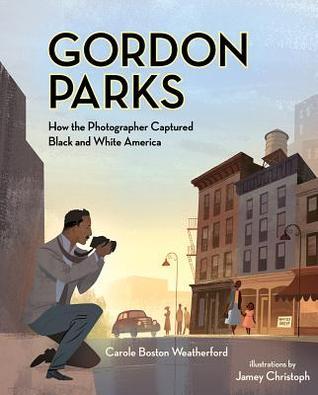
Hello, friends! Our book today is Gordon Parks: How The Photographer Captured Black And White America, written by Carole Boston Weatherford and illustrated by Jamey Christoph.
Gordon Parks nearly left this world as swiftly as he came into it; the doctor who delivered him saved him from stillbirth. And while his entrance into life was dramatic, being born into the US in 1912 limited his prospects – his white teacher memorably told her all-black classroom that they would be “nothing but waiters and porters”. Gordon was not satisfied with the status quo. Seeing a moving photo essay on Dust Bowl migrants, he bought a camera for $7.50 – the best purchase he ever made. From there, Gordon’s talent was obvious, and he was hired by magazines, companies, and the US government. Gordon used his work to document the unfair treatment of black Americans. He would go in to write books, compose music, and direct films – and it all started with a $7.50 camera and a talent that could not be denied.
Very interesting! Parks is someone who feels like he should be a household name, but is often overlooked in the discussion of great photographers (I encourage you to check out his work, he was astoundingly ahead of his time). While he is possibly best-known for his film Shaft, I like that this story focuses on his early life and work, showing how he overcame prejudice to follow his dreams and abilities, then turned around to use to that opportunity to bring awareness to the struggles of others. The text is great, moving swiftly while still exploring what Gordon’s life and work was like. The art is wonderful too, creating defined, vibrant characters and environments while also interpreting Park’s photos for young readers. As I mentioned, there is a stillbirth shown on the first page, and while Parks survives, it may take some explaining for younger bookworms. The length is fine, and JJ really liked this one. We recommend it, and it’s Baby Bookworm approved!
Gordon Parks was born in Fort Scott, Kansas, the youngest of fifteen children. As a boy, his white teacher told her class of black children they would all grow up to be waiters and porters. When Gordon’s mother died, he moved to Minneapolis to live with his sister, where he actually did work as a waiter and porter. Photos in a magazine gave him the idea to buy a used camera and try his hand at photography. Gordon’s photos were so good he landed a job as a government photographer in Washington, DC. He took his camera with him all over the city. His photos exposed the poverty and racism that black people endured. Gordon went on to work as a photographer for Vogue and Life magazines. Throughout his long life, Gordon Parks achieved fame as a novelist, filmmaker, and composer.
Weatherford’s use of present tense draws readers into the story of Gordon Parks’ vast and remarkable career. Christoph’s illustrations mimic the style and humanity of Parks’ photographs. Four samples of Parks’ famous photos are included at the end, along with a more detailed biography. “Gordon Parks: How the Photographer Captured Black and White America” introduces readers to a true American Renaissance man.
This picture book biography of the Renaissance man who successfully broke through many racial boundaries is a good introduction for young readers but it's unfortunately lacking in suggestions for further reading or web sites where readers could see examples of Parks's photography. And how about a bibliography or some source notes for the text?
I'm honestly a big fan of everything I've read from Carole Boston Weatherford (which is most of her major releases, but I would be thrilled to read even more from her) so I knew going in that this would be a good one. This picture book biography tells the story of the life and work of iconic photographer Gordon Parks, who was self-taught and went on to photograph for the government, Life, and Vogue. The illustrations are lovely and the story is interesting and laid out simply. It's a solid picture book biography all around and I would definitely recommend it!
Although I haven't read many biographies in my life, Gordon Parks: How the Photographer Captured Black and White America by award winning author Carole Boston Weatherford is one I will definitely remember. This biography is recommended for grades K-3 and will teach students about overcoming the odds and following your dreams. If you are looking for a book that will uplift your student's spirits as well as give them insight into segregation and an introduction into the civil rights movement, then Gordon Parks: How the Photographer Captured Black and White America is for you.
Gordon Parks: How the Photographer Captured Black and White America tells the story of a young African American boy who was told by his white teacher that he would more or less amount to nothing. Through out his adolescents and young life, Gordon Parks struggles with the death of his mother and poverty. At the age of twenty five, Gordon's life changes for the better when he decides to buy a camera, and starts a new career as a photographer. Gordon eventually lands a job as a government photographer and this is when he really makes a difference in the world. Frustrated with the segregation in America in the 1940's, Gordon decides to start capturing it. He photographs a cleaning lady, Ella Watson who struggles on a daily basis with income and the raising of five children. Through these photographs, he is able to show the segregation and inequality going on in America. Although his photographs of Ella Watson are one of his biggest achievements, Gordon Parks also became a film director, author, musician, and poet. No matter your age, race, or gender, Gordon Parks shows us that you can do anything you set you mind to.
Gordon Parks: How the Photographer Captured Black and White America is a great multicultural book that will teach our current generation of students topics that they may have never encountered such as segregation and inequality. Through the text and illustrations, students will be able to understand and see the struggles Gordon went through as an African American man living at a time when African Americans were not allowed in certain establishments and were often treated unequal to whites.
From reading about Gordon's life, students will hopefully be inspired with his ability to overcome struggles and defy the naysayers. Whatever big or small the problem may be, I believe Gordon's story can influence students to overcome their obstacles and to dream big.
Carole Boston Weatherford is an award winning author, who has written many other inspirational children books which can be viewed at https://cbweatherford.com/
I must have seen this listed in one of the best of 2015 lists and they were right, it's special. It's lovely and inspirational, about a man who started with nothing and worked his way to the top of his field. I'd be surprised if most people who aren't already familiar with his work don't quickly look him up after reading this to see his real photos, as nice as the art in the book is. It made me aware again, as I so often am, how lucky we are to be able to access so much with a few clicks of a mouse. There his work is in HD, it's amazing. Check out the Ali pictures on the website for his foundation, they're just super.
But what really stood out for me about this book was the honest and straightforward language about how African Americans were treated when Parks was young and when he was launching his career. Usually books, especially books for kids, try to soften things. I don't know who they think they're trying to protect, my best guess is that they don't want to offend white readers by being to blunt about how awful things were, like somehow the children will be too upset by honesty or parents will be offended by the truth somehow. But this book was honest in a simple and clear way that just worked beautifully. For example, when he was a kid his white teacher told the all-black class that they'd all wind up porters and waiters, but he thought, "What did she know?" When he got older and went to Washington he saw whites-only signs in shop windows and learned firsthand that even if there was no sign, it didn't mean that a black man would be served. Simple language that didn't dance around the systemic racism that shaped his life and the lives of the people he chose to photograph. The author told his story with a clarity and purity that was just lovely. It was appropriate for kids but spoke to me as an adult as well. It was his story, it was personal, and yet universal. His art was beautiful and this book was a great way to honor him and introduce his work and his story to a new generation.
Most folks wouldn't have expected Gordon Parks to amount to much of anything. Certainly his teachers didn't. After all, he was poor, black, and born during an era when African Americans often worked in jobs in which they were overworked and underpaid. A serendipitous purchase of a camera leads Parks to a career as a photographer. The self-taught man lets his photos do the talking for him as he transitions from shots of models for the fashion industry to those of everyday individuals trying to eke out a living. Most notable was his "American Gothic," a stunning image of Ella Watson, a cleaning woman that he posed, broom in hand, in front of the American flag. Readers won't be able to miss the conflicting message of hope for the future juxtaposed against the stark reality of the daily lives of many like his subject, the hard-working Watson. The text is as engaging and lively as the illustrations that fill the picture book's pages. How grateful many of us are for those who, like Parks, recorded the nation's civil rights struggles and the inequity that existed in the land. It's a treat to have this man's journey shared, even if in such brief a fashion. Interested readers can learn more from the back matter.
Readers are introduced to the formative influences and groundbreaking work of photographer Gordon Parks in this picture book bio.
His work exposed the country to the unfairness of segregation. The tone and depth of the text is well suited to its intended audience and the digital artwork is full of drama and emotion.
A two page spread provides a little more detail about Parks' life and includes some of his photos. An author's note rounds out the back matter.
Highly recommended for grades 3-5+, especially for use in the classroom, during Black History month celebrations/observances, and art history discussions.
Great man, great subject matter, story & theme, I just didn't get drawn into appreciating his life's accomplishments with author's prose or storytelling. Somehow his story felt too diluted & more vague the way she told it- I missed having more specifics of his life. The authors note in the back was more interesting. Why does the story say Ella Watson supported 5 children on her salary but authors note has it different- wasn't her real story enough to convey? Why fictionalize when real life is compelling enough?
I really liked this book, both the story and the wonderful illustrations. I'm ashamed to admit I knew nothing about Parks or his work. Like another reviewer, I was disappointed in not seeing any sources or bibliography included and that is a problem. Perhaps there really is nothing available for young readers but some sources should have been listed. I would have especially liked a recommended book or site showing his work.
A short, easy-to-read biography that's perfect for students in 1st and 2nd grade. African-American photographer Gordon Parks made a name for himself during the Great Depression. His powerful photographs capture segregation and the black working class of Washington DC. Author includes notes and a more formal biography; no source notes or suggested readings.
I'm just going to say it...Carole Boston Weatherford is a national treasure. I love everything about this. It's gorgeous, I love how the illustrations capture him and what he was doing. I love how the story focuses on this specific aspect of his story while still including details about all the things he was and did, I love the power and resilience of him and the people whose images he captured. Stunning book all around.
Gordon Parks had a rough beginning to his life from being born almost stillborn to losing his mother at age 14. He was told by his white teacher that he and the rest of his all-black class would end up as either porters or waiters. Parks did do those jobs, but then he purchased a used camera and everything changed. He started photographing models and then turned his camera towards the struggling families in Chicago and Washington DC. He is pointed towards one specific subject who will create his most famous image, American Gothic, the picture of an African-American cleaning woman standing in front of the American flag with her mop in hand. Parks managed to show racism with a clarity thanks to just picking up a camera at first.
Weatherford keeps this book very friendly with a minimal amount of text in the bulk of the book. She does include an author’s note at the end that fills in more of the extensive career of Parks as a film director and Renaissance man. The focus here in this picture book biography is Parks’ photographic work and the impact he had on exposing racism and poverty in the inner city, showing hard working people who were still in poverty. Make sure to turn to the end of the book to see his photographs and their intense message.
Christoph’s illustrations are stellar. Using a subtle color palette, the images echo the photographs that Park took, but not too closely. Instead they build upon them, showing Parks taking the images and embracing the dark beauty of the back streets of urban spaces. He also beautifully captures emotions and the humanity of Parks’ subjects that also shines in his photographs.
An important picture book biography, this book shows how one person can make a difference and have a voice. Appropriate for ages 7-9.
Genre - picture book, nonfiction, biography (ebook - Overdrive) Interest level - K - 3 Reading level - 5-8 Brief summary - Gordon Parks grows up the fifteenth child of an itinerant farmer. When he is fifteen, his mother dies and he moves to the city to live with his sister. After briefly attending school, he lives out on his own and takes a series of jobs to support himself . Gordon purchases a camera from a pawn shop, and becomes a self taught photographer. Among his many accomplishments, he is known for documenting the economic disparity that exists in America depending on one's race. Genre/Subgenre- " biography often bridges the gap between historical fiction, and nonfiction books." (Huck, page 287). In this picture book about Gordon Parks (photographer and Hollywood director), the story line tells not only the story of his life, but also of overcoming difficult odds. Many biographies were written about familiar figures, "now the range of topics is much broader including artists and intellectuals" (Huck, 289). Gordon Parks may not be well known to today's students, but he is an important figure in the civil rights movement, and should be a part of those discussions. Intended audience- It will be up to the teachers to frame what they want children to take from this book, a story of overcoming challenges, or an important Civil Rights figure. This determination will largely depend on the students ages, and the curriculum being explored. Awards - Reviews - SLJ, Booklist, Kirkus, Publisher's Weekly. http://www.barnesandnoble.com/w/gordo...
Plot: Gordon Parks was in an all-black school when his white teacher told him that they would all be waiters and porters. After having several jobs, including a waiter and porter, he buys a camera and trains himself on how to use it. He captures life until someone tells him to go to the city. There he realizes that there are enough pictures of white people, and take it upon himself to show the struggle colored people face. He meets a woman named Ella Watson, who becomes the subject of his photography. After following her around and taking pictures, he is featured in several magazines and newspapers. He was able to give a voice to someone who would not have otherwise had one.
Criteria: I chose theme for this book. This book touches on the topic of racism. By looking at the life of one photographer, we are able to see the impact on colored people this racism had. By gaining this insight, we are more educated on the types of things people had to overcome, and the unfairness of it all.
Response: Because this book is aimed at 4-8 students, I would have my students look at segregation. I would pair this book with a poetry book relating to segregation and equal rights for everyone. By doing this, my students are getting exposure to segregation through two forms of literature. I would also have my students complete a bio-pyramid in order to closely look at the text. They would also be able to use this to help them in a summarization activity.
Brief, perhaps too brief, biography of an artist. The focus (pun unintended) is on Gordon Parks' photography but there is mention of other fields (music, movies, writing) that Parks would do later in life. The story of Parks' life seems to move quickly and jump over facts -- why he was on his own shortly after moving to Minneapolis, and he arrives in Chicago only to seemingly leave immediately for Washington D.C. The line about "He can see that blacks have it harder than whites" seems rather surprising--I would think a black man would know this. The ending is odd too--the story moves to the cleaning woman Ella Watson, rather than ending with lines about Parks.
The artwork is well done, warm colors, sometimes more muted. No info on the medium though. No bibliography or resource notes either.
I'm a little stuck on the intended audience. It seems early elementary but there's not enough context to understand the information presented. Even if the text included dates, which it doesn't, an adult will likely be needed to help explain. The author's note at the end provides more, but again, it will take an adult to read and share the information. This would be a better book with more text and information for 4-6 graders, while still being heavily illustrated.
This book displays how segregation impacts both separated communities and the large community as a whole. Gordon Parks captures both Black and White America through his photography and displays the inequality that came with segregation. While this book centers around the civil rights movement it is an uplifting book for all readers ultimately showing that you can do anything you set your mind to. He portrays communities through his art and makes a statement. His most powerful image shows Ella Watson, a cleaning woman posed in front of an American flag with a broom in hand. This would be a great mentor text to incorporate art and community into the classroom and get students thinking about the communities they come from. This book displaying Gordon Parks's career can be used as a mentor text for students to find pictures to bring in that show their ancestors representing a community that they belong to, whether that be a a grandfather who fought in World War II, a relative who marched in a protest or any other example of a member of their family representing a community they identified with. This activity shows the power of historical images and draws students to think about the different communities our class comes from to create our one class community.
I grew up seeing the photographs of Gordon Parks, and have read his book for young adults, The Learning Tree, but didn't know very much of his background until reading this book. He was born in poverty, but this obviously gifted man saw a magazine feature about migrant workers and bought a used camera. Self taught, his work was soon noticed and began his success taking portrait photos. Later, he took advice given from a boss to find "his" subject, and that became racism after he moved to Washington D.C. and observed the divide between the lives of blacks and whites in our capitol. Later in life he also composed music, wrote books and directed several movies. I enjoyed that the illustrator used darker colors to emphasize the important parts of the content of each page, with lighter colors offering the hint of the background. He also drew photographs by Parks, wonderful to identify some that I recognized, but drawn instead of showing the actual photo. It's an inspiring brief story of this important artist in our history.
His white teacher tells her all-black class, You'll all wind up porters and waiters. What did she know? Gordon Parks is most famous for being the first black director in Hollywood. But before he made movies and wrote books, he was a poor African American looking for work. When he bought a camera, his life changed forever. He taught himself how to take pictures and before long, people noticed. His success as a fashion photographer landed him a job working for the government. In Washington DC, Gordon went looking for a subject, but what he found was segregation. He and others were treated differently because of the color of their skin. Gordon wanted to take a stand against the racism he observed. With his camera in hand, he found a way. Told through lyrical verse and atmospheric art, this is the story of how, with a single photograph, a self-taught artist got America to take notice. Subject: African American photographers -- Biography -- Juvenile literature. Photographers -- United States -- Biography -- Juvenile literature Photographers Subject: Parks, Gordon, 1912-2006
The pictures were great but I found the text to be disjointed. It was easier to read the biographical note at the end, then the body of the work. I was disappointed because I love Gordon Parks as a photographer and was looking forward to sharing his story with my students.
This book shows the life of the famous African American photographer, Gordon Parks, as he finds himself through his dreams. Gordon follows his dreams of becoming a famous photographer, all the while showing the social issues of segregation and racism in America. By photographing everyday life of African Americans, Gordon is able to become famous through his photographs, and show America all of the negatives of segregation of the time.
Classroom Connections: This book would be wonderful as a diverse choice of children's literature. It could be used in several text sets, and would be beneficial in teaching concepts of biographies to younger readers, due to its simple and easy to read pages. This would provide students with an introduction on biographies and what is expected of them. This book would also be useful when looking at segregation in America, because of how it highlights the unfair disadvantages that African Americans face through the use of pictures.