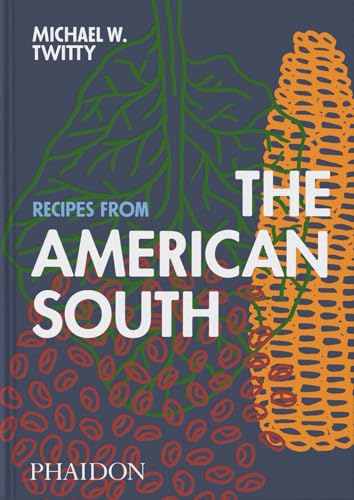
In the introduction to this groundbreaking recipe collection, acclaimed historian Michael W. Twitty declares, ‘No one state or area can give you the breadth of the Southern story or fully set the Southern table.’ To answer this, Recipes from the American South journeys from the Louisiana Bayou to the Chesapeake Bay, showcasing more than 260 of the region’s most beloved dishes.
Across more than 400 pages, Twitty explores the broad culinary sweep that Southern history and its many cultures represent. Recipes for breads and biscuits, mains and sides, stews, sauces, and sweets feature insightful headnotes and clear, step-by-step instructions. Home cooks will discover both iconic dishes and lesser-known specialties: Chicken and Dumplings, She-crab Soup, Red Eye Gravy, Benne Seed Wafers, Hummingbird Cake, and Mint Juleps appear alongside Shrimp Pilau, Chorizo Dirty Rice, Sumac Lemonade, and Cajun Pig’s Ears Pastry.
A masterful storyteller, Twitty enriches his extensive recipe collection with lyrical, deeply researched essays that celebrate the region’s “multicultural gumbo” of influences from immigrants from across the globe. Vibrant food photography adds further color to the fascinating narrative.
Michael W. Twitty is a food writer, independent scholar, culinary historian, and historical interpreter personally charged with preparing, preserving and promoting African American foodways and its parent traditions in Africa and her Diaspora and its legacy in the food culture of the American South. He is also a Judaic studies teacher from the Washington D.C. Metropolitan area and his interests include food culture, food history, Jewish cultural issues, African American history and cultural politics.
Michael created Afroculinaria, the first blog devoted to African American historic foodways and their legacy. He appeared on Bizarre Foods America with Andrew Zimmerman, Many Rivers to Cross with Henry Louis Gates, and lectured to more than 200 groups including Yale, Oxford and Carnegie Mellon Universities, the Smithsonian Institution, Colonial Williamsburg, and spoken around the world from the MAD Symposium in Copenhagen to the Barbican Theatre in London to Jerusalem's Jewish Film Festival on culinary justice and the African American impact on Southern foodways and the complexities of his identity as a gay, African American, Jewish man. He was recently named one of 50 people changing the South by Southern Living and one of the Five Cheftavists to Watch, as well a TED Fellow.
If you’ve experienced old school Southern foods, you know these recipes are the real deal. Just as good is the history Michael shares. This book along with his book The Cooking Gene belong on your bookshelf. Then, take a few days and have some fun cooking. (Many thanks to my son for this book!)
If you are looking for the definitive cookbook for Southern recipes with no frills, this is your book.
While we often categorize all things Southern by drawls and geographic locations, Twitty maintains the South is much harder to define, especially when talking about food. Southern food is a compendium and mash-up of indigenous, West Central African cultures beyond just European influences. This “multicultural gumbo” (8) must also recognize the influence of immigrants from East Asia and Latin America.
"Southern Food is a product of fortunate collisions, cooperation, and sometimes chaos or confusion. Was “Sally Lune” an English corruption of the French soleil lune? Is “barbecue” French, Taíno, or Hausa? Is the datil pepper Minorcan or Mandinka? Can a collard green fill an empanada, be stir-fried, go into a spring roll or be stuffed for Jewish Sukkot? Is Brunswick stew Virginian, Carolinian, or Georgian? How do we make room for okra soup, gumbo, jambalaya, Hoppin’ John and red beans and rice? (8)"
The South is a conundrum to define with all its influences.
I would classify the recipes in this book as definitive but basic. The bread section has every recipe one would need if trying to replicate Southern hospitality–yeast rolls for Sunday dinner to cathead biscuits for an easy side for supper. But, if you find yourself off the grid, there is a recipe for ashcakes.
The vegetable recipes are basic and unadorned but again pretty comprehensive. One would not go wrong taking any of these recipes to a church potluck.
Twitty sprinkles essays in his distinctive style throughout the book—treatises on “My Mother’s Flour,” “Mother Corn,” “Rice, the Queen of the Table,” “To Raise and to Hunt,” “Creole or Cajun?”, “The Southern Way with Beverages."
The recipes if loved in the side section were Texas Caviar (87)—the history of it being invented at the Houston Country Club. The recipe here does NOT use a bottle of Kraft Italian dressing; Sephardic Pink Salas (102), Rice Salad (103); and Virginia Fried Apples (116) which includes Kitchen Pepper.
The One Pot section is full of hearty stews and some “elevated” seafood soups. There is a recipe for turtle soup (that one could substitute chicken thighs for snapping turtle). With all the seafood included in the One Pot recipes plus the Fish & Shellfish section itself, there are a ton of seafood recipes in this book.
The Poultry, Meat & Game section begins with a short essay about the preserving of meat in the south–smoking, curing and drying it. Most of the recipes here are those that would be in the center of a Sunday table—smothered pork chops, fried chicken, brisket, roast beef, etc. But, there are also those down home recipes for pigs feet and ox tail. Game recipes include roasted duck, roasted and barbecued quail, fried and stewed rabbit, venison stew, and possum with sweet potatoes.
My favorite section was Sauces, Seasonings & Pickles. Twitty includes stock recipes like pork stock, Grandma’s Stock, and pot likker. There are lots of “gravy” recipes here. Lots and lots of gravy recipes. I had never heard of Vidalia Onion Gravy (268) but it sounds delicious. Twitty recommends serving it on rice or pork chops or as a side with fried chicken. There are thirteen BBQ sauce recipes and four dry rub recipes. Pickles include everything from peaches to chow chow. A pimento cheese recipe is thrown into this mix as well.
Desserts, Pies & Sweets was another favorite section. Again, these are all church dinner worthy: Mississippi Mud Cake, Molasses Cake, Lane Cake, and Hummingbird Cake. There’s even a King Cake recipe. All the traditional pies are included as well: pumpkin, pecan, sweet potato, chess, Key lime. Pralines and sorghum taffy are the candy offerings. Twitty includes a few sweet preserve recipes here for fig preserves and peach butter.
True Southern beverages round out the book: lemonades, mint juleps, sweet tea. Persimmon Beer and Scuppernong Wine recipes are also included.
This is a massive tome of recipes. While there are some photos, most of the 431 pages are dedicated to recipes. I say this often when reviewing, but do not skip the essays. You will miss a log of history if you do. Twitty is so knowledgeable and I love his writing style.
Does the term conjure up a list of comfort foods: Fried chicken, barbecue, shrimp and grits, collard greens, cornbread, biscuits, mac and cheese? Or more stereotypical movie fare: Gumbo, fried green tomatoes, peach cobbler, pecan pie and mint juleps?
Neither of these lists is wrong, nor are they representative of the American South as a whole, according to culinary historian and James Beard Award-winning author Michael W. Twitty, who delves into the history of Southern cuisine in his newly-released cookbook, "Recipes from The American South."
For this volume of 250-plus recipes, Twitty defines the American South as "stretching from the Chesapeake Bay region to the Bluegrass country over the Mississippi River Valley and over to the Ozarks, the Southern plains west to Texas Hill Country and the Deep East, southward toward the coast of the Gulf of Mexico." He also includes the U.S. Census Bureau's designation of Delaware, Maryland, Missouri, West Virginia and Oklahoma as part of the South — not just by the borders of the Confederacy — because, he writes, the "definition and redefinition of Southern identity related to its confederate past isn't sufficient ... The largest culinary region of America doesn't stop at the Mason-Dixon Line or the Ohio River or St. Louis, Mo., which bills itself as the gateway to the American West." The culinary history of the American South, he writes, can only be defined if the region and its history are broad and inclusive. That defining it by such a narrow definition, the borders of the Confederacy, "leaves out so many other essential populations, including Southern women, Native people, enslaved West and Central Africans and non-European immigrants — a profound story of human migration in and out of the South that began 13,000 years ago."
Recipes From the American South. Michael Twitty. Phaidon Press, 2025. 432 pages.
This book is a must-have addition to any cookbook or southern history or southern food library. It's the southern version of Julia Child's Mastering the Art of French Cooking in terms of scope and importance. Michael Twitty has become one of America's greatest culinary historians. He started out as a re-enactor, researching and demonstrating the foods and foodways of the American South that resulted from the blending of West African, Caribbean, Native American, and European cultures that resulted from the African diaspora and slavery. His work illustrates both the importance of food history and the power of food to cross boundaries, erase differences, and unite people. However, the region is vast, and even southern food is not monolithic. Twitty presents 260 recipes that cover the entire breadth of southern cuisine. The recipes are tested and prove, the photos are beautiful, and there are short histories of each dish. Cooks will discover familiar recipes for dishes that their families have made for generations, but they will also discover new recipes and learn things about the old and the new in the process. I've made some of the recipes and I will be making more, and the book has already become a first reference for me. It is definitely a classic that should be on any southern cook's shelf.
Truly terrific book. Not just recipes but food history. A history of everyone who contributed to southern cooking. Even if you ignore the recipes, read the introduction.
I really do wish the book had maps. Especially when in the glossary it talks about different places but doesn't show us where they are. He also talks about what it means to call the place part of the south in the introduction and that it doesn't fit with what a lot of people consider "the south". So maps would be especially useful.
I also have to say that there are some errors in the book. A few formatting issues with recipes but the worst one is the recipe for poundcake. Eggs are mentioned in the introduction and eggs are mentioned in the directions but they are not listed in the ingredients. So you have no way of knowing how many eggs to include in the recipe.
Overall though, this book is very much worth having, especially if you want to make the recipes but, frankly, even if you don't. It's worth it just for the history.
Michael Twitty is a food historian who specializes in the food of the American South and the cultures that helped create what we know as American Southern food. In this book he has created a comprehensive cookbook that features Southern recipes you may recognize, as well as, ones you may not that highlight some of the other cultures that helped create Southern food as we know it today. The recipes are organized by typical categories and throughout the book there are some essays about particular topics - the southern garden, rice, storing preserves, etc. There were several recipes I'd like to try and overall I am impressed at the scope of this cookbook and the diversity of the recipes. Even if you're from the South, you will still find something new here.