

What do you think?

Guard of Honor
James Gould Cozzens was one of America's most famous writers after the Second World War. His Pulitzer Prize-winning novel GUARD OF HONOR balances a vast cast of intricately enmeshed characters as they react over the course of three tense days to a racial incident on a U.S. Air Force training base in Florida in 1942.
575 pages, Leather Bound
First published January 1, 1948
About the author
James Gould Cozzens
40 books27 followersPulitzer Prize for Fiction for Guard of Honor in 1949
Ratings & Reviews
Friends & Following
Create a free account to discover what your friends think of this book!
Community Reviews
Displaying 1 - 30 of 84 reviews
October 29, 2013
So here we have the 631-page novel that won the Pulitzer in 1949, yet when I went Davis Kidd bookstore in West Nashville to purchase it, I was amazed to discover that not only did Davis Kidd not carry the novel, it had been out of print for years. Initially, I decided that was all I needed to know: no one publishes the novel because no one buys the novel because no one reads the novel because it’s not any good. Next. And yet, I felt remiss that I had committed myself to reading all the Pulitzers in fiction, and here I was already skipping the second work in the series.
I was also a little puzzled as to how a once-critically-acclaimed novel, if not a popular one, could fall so out of disfavor that it wasn’t even worth printing. It seems that the Pulitzer Board would guarantee at least a paltry printing each year, enough to keep up with the demands of literary scholars, if no one else. The sales clerk at Davis Kidd countered: “Lots good novels are no longer in print.”
My question: “If these novels are so good, why are they out of print?” I mean, really: Who’s definition of good are we talking about, certainly not the publisher’s? Since I would never attempt to measure the worth of a novel based solely on its popularity, perhaps we can strike a happy a medium and safely theorize “Many novels that were once considered good are no longer marketable.”
While it’s clear that the Pulitzer Board of 1949 thought Guard of Honor was not only a good book, but a distinguished book of American fiction, and while it’s clear that posterity vehemently disagrees, it’s not clear, on the surface, as to why. To this purpose, I bought a used, 1976-edition copy of the novel and went about the monotonous task of slogging my way through it. I say monotonous because there is very little tension to motivate the reader to keep reading. I found myself constantly drifting, digressing into my own thoughts and troubles, re-reading paragraphs, if not pages.
Added to the monotony is Cozzens’s somewhat challenging writing-style. This isn’t the type of book someone sits back to passively enjoy. Rather, the reader must constantly study and re-read sentences to ascertain, say, what part of which abstract idea the pronoun “this” refers to. In his life, Cozzens was known for his reclusive lifestyle. In his writing, his rhetorical questions, double negatives, disorienting descriptions, esoteric words, and equivocal pronouns lead me to believe that he wants to hide even from his readers. “Dig deep, dig deeper, if you want to find the story,” he seems to be saying. “It’s here if you’ll do the work to sort it out.”
Don’t get me wrong, there are plenty of writers whose writing-style is dense and challenging and can only be fully appreciated through dissection, analysis, and discussion. William Faulkner comes to mind. But the difference between Faulkner and Cozzens is that with Faulkner, there’s a huge payoff for your drilling. With Cozzens, I find no water at the bottom of the well.
The entire “action” of the novel, if that’s what you want to call it, takes place over a three-day period. Accordingly, the novel is divided not into chapters, but into three large sections aptly named: Thursday, Friday, and Saturday. Judging from the memorandums that appear throughout the story, the days in question are September 2nd, 3rd, and 4th of 1943.
The setting is a fictional United States Army Airforce base in central Florida. The main character is, well—there is no main character. That’s another problem. Rather than anchoring the reader in the lives of a few central characters, Cozzens attempts to sweep us away with an unending and homogenous flow of professional white males. I suppose this is all well and good if you can identify with the nuanced dilemmas of such a disenfranchised segment of the American populace.
In the interest of full disclosure I am a professional, white, male, veteran of the United States Army, and if anyone could identify with the litany of characters Cozzens presents in Guard of Honor, he should be, resoundingly, me. However, even I find myself drowning in all the officers and gentlemen. If you dare to cross this river, here are some of the names you will have to navigate: Lieutenant Phillips, Lieutenant Werthauer, Lieutenant Edsell, Lieutenant Anderson, Lieutenant Pettie, Lieutenant Kashkin, Lieutenant Carter, Captain Andrews, Captain Vaughn, Captain Dyer, Captain Raimondi, Captain Hicks, Captain Burton, Captain Collins, Captain Dobie, Captain Duchemin, Captain Wiley, General Baxter, General Beal, General Nichols, Colonel Ross, Colonel Woodman, Colonel Mowbray, Colonel Van Pelt, Colonel Schermerhorn, Colonel Jobson, Colonel Folsom, Colonel Coulthard, Major McCreery, Major Whitney, Major Beaudry, Major Blake, Major McIlmoyle, Major Pound, Major Tietam, Major Sears, Master Sergeant Pellerino, Sergeant Olmstead, Sergeant Brooks, Sergeant McCabe, Lieutenant Colonel Howden, Lieutenant Colonel Carricker, Mr. Bullen, Mr. Botwinick, Mr. James, and Mr. Lovewell.
The greatest problem that these men seem to have is deciding who actually out-ranks whom, since many of the officers presented are from the reserves and have achieved prestige and influence in their civilian lives, if not their military ones. As an almost ancillary point, these professional white males are also trying to cope with the suspicion that black people should have the same rights as white people. My God, what if it’s true?! Indeed, if there is an explanation for Guard of Honor winning the Pulitzer, it might be due to its use of civil rights as a medium for exploring the relative rank, talent, morality, and intelligence of professional white males.
There are three main events that happen in 600-plus pages of narrative. The first is the incidence of Lieutenant Colonel “Benny” Carricker punching Lieutenant Willis, who is an African-American pilot. This sets up event two, wherein other African-American pilots protest the use of segregated officer clubs, and the leadership debates appropriate action. Finally, during day three, there is a mass training exercise in which seven equipment-laden soldiers accidentally parachute into a lake, sink to the bottom, and drown. The last incident, incidentally, has nothing to do with anything. The first incident is charming enough. But the second, and here’s the point, is based upon an actual historical event that is widely regarded by civil rights historians as the catalyst that brought about the end segregation within the armed forces.
On April 5, 1945 at Freeman Air Field near Seymour, Indiana, African-American officers of the 477th Bombardment Group attempted to integrate with an all-white officer club. Although Army Regulation 210-10 formally disallowed segregation, authorities arrested sixty-one African-Americans, three of which were ultimately court-martialed. Later, after the commanding officer issued Base Regulation 85-2 (which maintained the status-quo segregation on technicalities) 101 more officers were arrested for refusing to sign a statement that they had read and understood the regulation. Not until 1995 did the Air Force begin the process of removing letters of reprimand from the permanent files of members of the 477th Bombardment Group.
If Cozzens demonstrates innovation—thereby creating literature—it’s in his willingness to explore and bring attention to such a controversial subject at the time. He also deftly categorizes different types of officers along with the merits of their ideas, the saliency of their minds, and the motivation of their actions and words. Colonel Norman Ross, a trenchant observer and thinker whose point-of-view we see more than any other character, and who is also a judge in his civilian life, is expertly contrasted with Colonel Mowbray, a man who, while an earnest and experienced military professional, has more power than intelligence, and therefore lacks the precision of thought and soundness of judgment that his position sometimes requires.
No matter how much the occasional paragraph delights us—some remark about intelligence, some paring of first impression from final conclusion—it isn’t enough to sustain the reader. When compared to the amount of energy required digest this novel, the rewards of Guard of Honor are insufficient at best, and a defamation to the Pulitzer Prize, indeed to literature itself, at worst.
To Cozzens’s credit, he also wrote By Love Possessed, a novel that won the Howell’s Medal of the American Academy of Arts and Letters and topped The New York Time’s best seller list for several months in 1957. I haven’t read it, but if it’s still in print, I suspect your time is better spent there
I was also a little puzzled as to how a once-critically-acclaimed novel, if not a popular one, could fall so out of disfavor that it wasn’t even worth printing. It seems that the Pulitzer Board would guarantee at least a paltry printing each year, enough to keep up with the demands of literary scholars, if no one else. The sales clerk at Davis Kidd countered: “Lots good novels are no longer in print.”
My question: “If these novels are so good, why are they out of print?” I mean, really: Who’s definition of good are we talking about, certainly not the publisher’s? Since I would never attempt to measure the worth of a novel based solely on its popularity, perhaps we can strike a happy a medium and safely theorize “Many novels that were once considered good are no longer marketable.”
While it’s clear that the Pulitzer Board of 1949 thought Guard of Honor was not only a good book, but a distinguished book of American fiction, and while it’s clear that posterity vehemently disagrees, it’s not clear, on the surface, as to why. To this purpose, I bought a used, 1976-edition copy of the novel and went about the monotonous task of slogging my way through it. I say monotonous because there is very little tension to motivate the reader to keep reading. I found myself constantly drifting, digressing into my own thoughts and troubles, re-reading paragraphs, if not pages.
Added to the monotony is Cozzens’s somewhat challenging writing-style. This isn’t the type of book someone sits back to passively enjoy. Rather, the reader must constantly study and re-read sentences to ascertain, say, what part of which abstract idea the pronoun “this” refers to. In his life, Cozzens was known for his reclusive lifestyle. In his writing, his rhetorical questions, double negatives, disorienting descriptions, esoteric words, and equivocal pronouns lead me to believe that he wants to hide even from his readers. “Dig deep, dig deeper, if you want to find the story,” he seems to be saying. “It’s here if you’ll do the work to sort it out.”
Don’t get me wrong, there are plenty of writers whose writing-style is dense and challenging and can only be fully appreciated through dissection, analysis, and discussion. William Faulkner comes to mind. But the difference between Faulkner and Cozzens is that with Faulkner, there’s a huge payoff for your drilling. With Cozzens, I find no water at the bottom of the well.
The entire “action” of the novel, if that’s what you want to call it, takes place over a three-day period. Accordingly, the novel is divided not into chapters, but into three large sections aptly named: Thursday, Friday, and Saturday. Judging from the memorandums that appear throughout the story, the days in question are September 2nd, 3rd, and 4th of 1943.
The setting is a fictional United States Army Airforce base in central Florida. The main character is, well—there is no main character. That’s another problem. Rather than anchoring the reader in the lives of a few central characters, Cozzens attempts to sweep us away with an unending and homogenous flow of professional white males. I suppose this is all well and good if you can identify with the nuanced dilemmas of such a disenfranchised segment of the American populace.
In the interest of full disclosure I am a professional, white, male, veteran of the United States Army, and if anyone could identify with the litany of characters Cozzens presents in Guard of Honor, he should be, resoundingly, me. However, even I find myself drowning in all the officers and gentlemen. If you dare to cross this river, here are some of the names you will have to navigate: Lieutenant Phillips, Lieutenant Werthauer, Lieutenant Edsell, Lieutenant Anderson, Lieutenant Pettie, Lieutenant Kashkin, Lieutenant Carter, Captain Andrews, Captain Vaughn, Captain Dyer, Captain Raimondi, Captain Hicks, Captain Burton, Captain Collins, Captain Dobie, Captain Duchemin, Captain Wiley, General Baxter, General Beal, General Nichols, Colonel Ross, Colonel Woodman, Colonel Mowbray, Colonel Van Pelt, Colonel Schermerhorn, Colonel Jobson, Colonel Folsom, Colonel Coulthard, Major McCreery, Major Whitney, Major Beaudry, Major Blake, Major McIlmoyle, Major Pound, Major Tietam, Major Sears, Master Sergeant Pellerino, Sergeant Olmstead, Sergeant Brooks, Sergeant McCabe, Lieutenant Colonel Howden, Lieutenant Colonel Carricker, Mr. Bullen, Mr. Botwinick, Mr. James, and Mr. Lovewell.
The greatest problem that these men seem to have is deciding who actually out-ranks whom, since many of the officers presented are from the reserves and have achieved prestige and influence in their civilian lives, if not their military ones. As an almost ancillary point, these professional white males are also trying to cope with the suspicion that black people should have the same rights as white people. My God, what if it’s true?! Indeed, if there is an explanation for Guard of Honor winning the Pulitzer, it might be due to its use of civil rights as a medium for exploring the relative rank, talent, morality, and intelligence of professional white males.
There are three main events that happen in 600-plus pages of narrative. The first is the incidence of Lieutenant Colonel “Benny” Carricker punching Lieutenant Willis, who is an African-American pilot. This sets up event two, wherein other African-American pilots protest the use of segregated officer clubs, and the leadership debates appropriate action. Finally, during day three, there is a mass training exercise in which seven equipment-laden soldiers accidentally parachute into a lake, sink to the bottom, and drown. The last incident, incidentally, has nothing to do with anything. The first incident is charming enough. But the second, and here’s the point, is based upon an actual historical event that is widely regarded by civil rights historians as the catalyst that brought about the end segregation within the armed forces.
On April 5, 1945 at Freeman Air Field near Seymour, Indiana, African-American officers of the 477th Bombardment Group attempted to integrate with an all-white officer club. Although Army Regulation 210-10 formally disallowed segregation, authorities arrested sixty-one African-Americans, three of which were ultimately court-martialed. Later, after the commanding officer issued Base Regulation 85-2 (which maintained the status-quo segregation on technicalities) 101 more officers were arrested for refusing to sign a statement that they had read and understood the regulation. Not until 1995 did the Air Force begin the process of removing letters of reprimand from the permanent files of members of the 477th Bombardment Group.
If Cozzens demonstrates innovation—thereby creating literature—it’s in his willingness to explore and bring attention to such a controversial subject at the time. He also deftly categorizes different types of officers along with the merits of their ideas, the saliency of their minds, and the motivation of their actions and words. Colonel Norman Ross, a trenchant observer and thinker whose point-of-view we see more than any other character, and who is also a judge in his civilian life, is expertly contrasted with Colonel Mowbray, a man who, while an earnest and experienced military professional, has more power than intelligence, and therefore lacks the precision of thought and soundness of judgment that his position sometimes requires.
No matter how much the occasional paragraph delights us—some remark about intelligence, some paring of first impression from final conclusion—it isn’t enough to sustain the reader. When compared to the amount of energy required digest this novel, the rewards of Guard of Honor are insufficient at best, and a defamation to the Pulitzer Prize, indeed to literature itself, at worst.
To Cozzens’s credit, he also wrote By Love Possessed, a novel that won the Howell’s Medal of the American Academy of Arts and Letters and topped The New York Time’s best seller list for several months in 1957. I haven’t read it, but if it’s still in print, I suspect your time is better spent there

October 9, 2021
I know that some readers adored this story about WWII on an airbase in Florida, ostensibly addressing racism, but without using a black voice. There are multiple perspectives here and a myriad of characters - some of which are referred to alternatively by names and nicknames, so it is not always evident to keep it all straight. I lost interest in the story several times (which explains why something not all that long took me three weeks to finish). It got a little more interesting at the end (I had to go back and reread some earlier sections which I had slept through to make sense of it), but I did not see all that much evolution in the characters and the racism and sexism threw me off. And it is EXTREMELY long.
I can't honestly say that the offerings from Pearl Buck (Peony), Truman Capote (Other Voices, Other Rooms), Willa Cather (The Old Beauty, and others (posthumous), or Norman Mailer (The Naked and the Dead) were any better having not read them yet. However, even if it was not his strongest book, I would likely have preferred Faulkner's Intruder in the Dust for the 1949 Pulitzer over this one.
All that being said, there was some good writing.
This one is typical of the rambling, introspective prose of Cozzens:
"In this joking relation were elements of complacence, and other elements of sentimental or self-interested reminiscence, the mind's flat lie about the past; but also, ingenuously full-hearted, wistfully it gathered a true tenderness around the more or less distorted facts. Unmixed with anything but sadness, fond feelings could live there, secure from the minute by minute test of verifiable truth and observable fact, unspoiled by the moving instant's irritabilities of sense, the separate dis-
comforts, the incompatible wishes that greatly moderated, in any present, men's appreciations of one another, let alone of their women." (pp. 505)
The central tragedy in the book is described with terrifying realism:
"From the shed by the lake, the sound of the siren went wailing up. Nathaniel Hicks felt his throat contract to gasp air in, and then contract more, as though to use the air to shout; but nothing came. In his eye sockets, across his eyeballs he felt stabbing twinges like the pain of too much light - perhaps a spraining of the muscles caught at cross-purposes attempting to maintain one focus while irresistibly drawn to assume another. This ache of the overpressed eyes merged distractingly with the insufferable demands the eyes made on the mind, the impossible work of anatomizing into instants, enough instants to hold, one instant to one perception, the tumultuous few seconds with their multiple movements above and on the lake's surface, suddenly begun, suddenly all gone." (pp. 540)
I liked this passage as well:
"The portentous truth appeared by intimation, full of comfort though so melancholy, touched with despair yet supportable, that nothing, not the best you might hope, not the worst you might fear, would ever be very much, would ever be very anything. Seen in this light, all other feelings must weaken, become more temperate-really, more indifferent. Since that was how it was, measures more moderate-really, more disinterested--suggested themselves." (pp. 570)
This passage is where the book's title comes from:
"Colonel Ross, not without grandiloquence, said: 'It does us good. Ceremony is for us. The guard, or as I think we now prefer to call it, escort of honor is a suitable mark of our regret for mortality and our respect for service--we hope, good; but if bad or indifferent, at least, long. When you are as old as I am you will realize that it ought to get a man something. For our sake, not his. Not much; but something. Something people can see." (pp. 594)
My list of Pulitzer winners (nearly finished all of them!):
here
I can't honestly say that the offerings from Pearl Buck (Peony), Truman Capote (Other Voices, Other Rooms), Willa Cather (The Old Beauty, and others (posthumous), or Norman Mailer (The Naked and the Dead) were any better having not read them yet. However, even if it was not his strongest book, I would likely have preferred Faulkner's Intruder in the Dust for the 1949 Pulitzer over this one.
All that being said, there was some good writing.
This one is typical of the rambling, introspective prose of Cozzens:
"In this joking relation were elements of complacence, and other elements of sentimental or self-interested reminiscence, the mind's flat lie about the past; but also, ingenuously full-hearted, wistfully it gathered a true tenderness around the more or less distorted facts. Unmixed with anything but sadness, fond feelings could live there, secure from the minute by minute test of verifiable truth and observable fact, unspoiled by the moving instant's irritabilities of sense, the separate dis-
comforts, the incompatible wishes that greatly moderated, in any present, men's appreciations of one another, let alone of their women." (pp. 505)
The central tragedy in the book is described with terrifying realism:
"From the shed by the lake, the sound of the siren went wailing up. Nathaniel Hicks felt his throat contract to gasp air in, and then contract more, as though to use the air to shout; but nothing came. In his eye sockets, across his eyeballs he felt stabbing twinges like the pain of too much light - perhaps a spraining of the muscles caught at cross-purposes attempting to maintain one focus while irresistibly drawn to assume another. This ache of the overpressed eyes merged distractingly with the insufferable demands the eyes made on the mind, the impossible work of anatomizing into instants, enough instants to hold, one instant to one perception, the tumultuous few seconds with their multiple movements above and on the lake's surface, suddenly begun, suddenly all gone." (pp. 540)
I liked this passage as well:
"The portentous truth appeared by intimation, full of comfort though so melancholy, touched with despair yet supportable, that nothing, not the best you might hope, not the worst you might fear, would ever be very much, would ever be very anything. Seen in this light, all other feelings must weaken, become more temperate-really, more indifferent. Since that was how it was, measures more moderate-really, more disinterested--suggested themselves." (pp. 570)
This passage is where the book's title comes from:
"Colonel Ross, not without grandiloquence, said: 'It does us good. Ceremony is for us. The guard, or as I think we now prefer to call it, escort of honor is a suitable mark of our regret for mortality and our respect for service--we hope, good; but if bad or indifferent, at least, long. When you are as old as I am you will realize that it ought to get a man something. For our sake, not his. Not much; but something. Something people can see." (pp. 594)
My list of Pulitzer winners (nearly finished all of them!):
here

January 16, 2009
James Gould Cozzens is an author who has been unjustly neglected both during the latter years of his life and in the three decades since his death. Of his often critically-acclaimed novels this one, published in 1948, stands alone, on its own merits. I believe that I first learned about this novel from reading Noel Perrin the Dartmouth professor and book reviewer who praised the author and this novel in particular as deserving more popular notice as worthy to stand beside Melville's novels in the American canon.
Cozzens' achievement in creating this war novel is evidenced by the setting, a Florida Air Base, but more importantly in doing this he has brought into sharp relief against the background of boredom and frustration and disappointment which most of the officers assigned there felt, the minor dramas of human lives, loves, hates, jealousies; the competitive spirit leveled at minor goals; and the interrelation of men, whose ranks are more or less the accident of the chance of war. General Beal, younger than most of his staff though already the commanding officer, is portrayed as vital figure who is torn by his friendship for a difficult junior officer, eternally in hot water, disturbed profoundly by the necessity of playing off local prejudices against the directives from Washington, attempting to be human and at the same time the martinet military procedure demanded.
The major issues that dominate and motivate the story include the problem of the Negro officers and the officers club; the disaster attendant on the trials of parachute jumping -- and the question of blame. Most of the story is told from the perspective of Nathaniel Hicks who, in private life, has a significant role in the media world of magazines. The tensions of civilian life are brought home through his own affair with a WAC Lieutenant. Character after character comes clear- small bits as well as large. In creating this world Cozzens reminds me of the breadth and depth found in the novels of George Eliot.
There is an implicit message of humaneness in the whole the kind of drama Command Decision provided -- against a setting that is infinitely less provocative of dramatic treatment. Cozzens has written a long book with many subplots; one that can be difficult at times. But the power of his prose and the resulting enjoyment of this great war novel builds as minor incident is piled on minor incident to create an unforgettable pattern. Rather than romanticizing his story, Cozzens' writing is taut and realistic, but at the same time exhibits an expansive warmth -- an unusual combination which makes for a favorable impression and an enjoyable read.
Cozzens' achievement in creating this war novel is evidenced by the setting, a Florida Air Base, but more importantly in doing this he has brought into sharp relief against the background of boredom and frustration and disappointment which most of the officers assigned there felt, the minor dramas of human lives, loves, hates, jealousies; the competitive spirit leveled at minor goals; and the interrelation of men, whose ranks are more or less the accident of the chance of war. General Beal, younger than most of his staff though already the commanding officer, is portrayed as vital figure who is torn by his friendship for a difficult junior officer, eternally in hot water, disturbed profoundly by the necessity of playing off local prejudices against the directives from Washington, attempting to be human and at the same time the martinet military procedure demanded.
The major issues that dominate and motivate the story include the problem of the Negro officers and the officers club; the disaster attendant on the trials of parachute jumping -- and the question of blame. Most of the story is told from the perspective of Nathaniel Hicks who, in private life, has a significant role in the media world of magazines. The tensions of civilian life are brought home through his own affair with a WAC Lieutenant. Character after character comes clear- small bits as well as large. In creating this world Cozzens reminds me of the breadth and depth found in the novels of George Eliot.
There is an implicit message of humaneness in the whole the kind of drama Command Decision provided -- against a setting that is infinitely less provocative of dramatic treatment. Cozzens has written a long book with many subplots; one that can be difficult at times. But the power of his prose and the resulting enjoyment of this great war novel builds as minor incident is piled on minor incident to create an unforgettable pattern. Rather than romanticizing his story, Cozzens' writing is taut and realistic, but at the same time exhibits an expansive warmth -- an unusual combination which makes for a favorable impression and an enjoyable read.
April 16, 2014
What an amazing author and what a fascinating story. 631 pages describe the events of some 20+ characters over a period of three days at an Army Air Force base called Ocanara, in Florida, USA during September 1943. All of the characters are linked through the base and the detailed prose is just so satisfying to read as the story moves from one person to another, to their backgrounds, their families, their current problems, their interactions, their weaknesses and strengths, and so many events occur in just those three days. A totally plausible and wonderful book which I would have been very happy to have had 1000 pages to read.

August 28, 2010
There were about 10 pages in this 600+ book that I didn't hate. And I was stoned when I read those, so feel free to draw your own conclusions.
To start with, it's about WWII and constantly uses military terms that I am completely unfamiliar with. There's no explanation, no handy key like there is in the beginning of The Caine Mutiny. I started out looking them all up, but when it became clear that I'd be stopping once a page to do so, I gave up. Besides, the book was written in the '50s. People did not have Wikipedia then, what the fuck were they expected to do!
Cozzens decided to further confuse the reader by having about 20 central characters, none of which could be considered a main character. The narrative switched perspectives every 5-20 pages. Normally that's OK with me, so long as it's done well, but the problem was that the characters were impossible to keep straight. Sometimes they were referred to by rank, sometimes last name, sometimes first name and many of them had nicknames as well. I suspect there were actually several men affectionately called, "Judge," but I'm not sure.
There was also not much going on. The story took place over three days. There were four main events, one dealing with race relations and another involved the death of 7 people, but the total pages used to actually tell those stories was less than 10% of the book. It was just mindless description after mindless dialogue, with characters you couldn't keep straight, let alone give two shits about.
I spent most of this book thinking to myself, "Wait, who was that guy who committed suicide?", which was an event that took place in the first 40 page. I never did figure it out.
I would give this 1 star, but Cozzens appears to be extremely gifted and he does have a strong and distinctive voice. I just don't speak his language.
To start with, it's about WWII and constantly uses military terms that I am completely unfamiliar with. There's no explanation, no handy key like there is in the beginning of The Caine Mutiny. I started out looking them all up, but when it became clear that I'd be stopping once a page to do so, I gave up. Besides, the book was written in the '50s. People did not have Wikipedia then, what the fuck were they expected to do!
Cozzens decided to further confuse the reader by having about 20 central characters, none of which could be considered a main character. The narrative switched perspectives every 5-20 pages. Normally that's OK with me, so long as it's done well, but the problem was that the characters were impossible to keep straight. Sometimes they were referred to by rank, sometimes last name, sometimes first name and many of them had nicknames as well. I suspect there were actually several men affectionately called, "Judge," but I'm not sure.
There was also not much going on. The story took place over three days. There were four main events, one dealing with race relations and another involved the death of 7 people, but the total pages used to actually tell those stories was less than 10% of the book. It was just mindless description after mindless dialogue, with characters you couldn't keep straight, let alone give two shits about.
I spent most of this book thinking to myself, "Wait, who was that guy who committed suicide?", which was an event that took place in the first 40 page. I never did figure it out.
I would give this 1 star, but Cozzens appears to be extremely gifted and he does have a strong and distinctive voice. I just don't speak his language.

March 6, 2021
PULITZER PRIZE WINNER: 1949
===
1.5 rounded up
JFC what a fucking SLOG. I am heartily sick of reading about books about war--apparently it's the best way to win the goddamn Pulitzer Prize. This one had the surprising merit of actually having female characters that sort of played a role, but not really. I mean, obvi lots of the casual racism and sexism one would expect from a book written at this time and covering this subject matter, but ye gads, this was boring as fuck. I legit could not keep the names of all the generic white male characters straight and I was so uninterested in basically everything that was happening I have no real idea what the point of it all was. There were WAY too many "primary" characters, to the point where the whole narrative lost focus. And then, the one character who I was actually liking, I almost DNF'd this a bunch of times, and I honestly feel no better for having read it. Disappointing.
===
1.5 rounded up
JFC what a fucking SLOG. I am heartily sick of reading about books about war--apparently it's the best way to win the goddamn Pulitzer Prize. This one had the surprising merit of actually having female characters that sort of played a role, but not really. I mean, obvi lots of the casual racism and sexism one would expect from a book written at this time and covering this subject matter, but ye gads, this was boring as fuck. I legit could not keep the names of all the generic white male characters straight and I was so uninterested in basically everything that was happening I have no real idea what the point of it all was. There were WAY too many "primary" characters, to the point where the whole narrative lost focus. And then, the one character who I was actually liking, I almost DNF'd this a bunch of times, and I honestly feel no better for having read it. Disappointing.

September 7, 2013
Like plunging into an Olympic-sized swimming pool on a hot day. The prose is confident and polished, measured, & self-assured. Every page fairly glides by like a wave. Hilarious moments in every chapter and that formidable attention to human detail that marks the experienced, professional, mid-Twentieth-Century author. Gozzens has a superb eye.
It's everything a novel should be in that the focus is on human behavior, customs, habits, morals. I'm enjoying it as I did a similar Pulitzer winner, 'Andersonville'. The same sweep and breadth in storytelling scope, yet everything hinges (as does real life) on the tiniest remark or expression by the characters.
Everyone in the book is extremely affable and engaging, it is a story of good men and bad men, strong men and weak men--how they all coordinate with each other under pressure; what they think and feel about one another. You hate to have to stop turning pages--and when you return to the covers after a break, it is with anticipation. Cracking good novel in a league with anything by James Jones.
No terse or laconic Hemingway style writing here. 500 pages still to go!
It's everything a novel should be in that the focus is on human behavior, customs, habits, morals. I'm enjoying it as I did a similar Pulitzer winner, 'Andersonville'. The same sweep and breadth in storytelling scope, yet everything hinges (as does real life) on the tiniest remark or expression by the characters.
Everyone in the book is extremely affable and engaging, it is a story of good men and bad men, strong men and weak men--how they all coordinate with each other under pressure; what they think and feel about one another. You hate to have to stop turning pages--and when you return to the covers after a break, it is with anticipation. Cracking good novel in a league with anything by James Jones.
No terse or laconic Hemingway style writing here. 500 pages still to go!

December 16, 2019
Rich psychological and ethical study. Wow!

October 18, 2017
I don't know how much I have to say about this book. I liked it, it was a little bit dated, the ending was a little bit disappointing. I'm not sure the day is coming when it will be recognized as better than any of the WWII books, as asserted on the back cover. I liked this angle of looking at the war, and not a bad book, but not spectacular.

May 24, 2021
This Pulitzer winner from the late 1940s is long and dense, with tons of characters, and a time span of only three days for its 600+ pages. And it's (technically) a war book. Not a lot going for it, really, in the way of making me interested. But honestly it's not half bad - there were some long slogs, but when it was interesting, it was very nearly a treat. A Moby Dick minus the whale? Sort of. The writing is good, although not quite Melville good, so not quite good enough to keep me from getting frustrated with those slog sections. It would probably help if I were more interested in the intricacies of military admin, or, to be honest, military issues in general. Interesting (and possibly important) for its place in literary history and the history of race relations in the military. If this sort of thing interests you, chances are you'll have more patience for it than I did.

October 21, 2009
What is there to write to write about a 800 page book written over 3 days based at a WWII Stateside Air force Base? First off, the detail in this book is incredible as you'd expect it to be (see above sentence). I really didn't get into the book for the first 500 pages, but looking back see why there's so much detail. The book has about a dozen major characters and the book bounces back and forth to each, it's one that you may want to keep a chart in your book of who everyone is to keep from getting confused. The meat of the book is several situations that arise at the Air Force Base and who the main character, a young general, handles those situations.

January 5, 2019
Guard Of Honor won the Pulitzer Prize in 1949. The story takes place over 3 days in 1943 on a military base in Florida and details several challenging events that test the military leadership of the base. There are many characters in the book which makes the story difficult to follow at times. If you like WWII novels I would recommend All the Light We Cannot See, 2015 Pulitzer winner, or The Caine Mutiny, 1952 Pulitzer winner. I give Guard on Honor 3 stars.
August 9, 2015
I'm a fan of James Cozzens. His fan club has probably about 3 people, but more should join. His books are realistic portrayals of the moral and practical dilemmas of professional men in the mid-20th century. They are the kind of book that one can read a chapter or two, go back a week or so later. At the end, there is a sense that one has experienced something, and understands more about the world.
These are stories that take place in the real world. There are also interesting stories about the struggles of women, black people, and Jews, all of whom faced and still face, discrimination. He reports on the problems these groups had and, like all of his writing, he tries to show as it really happened. Some people accused him of anti-Semitism, or anti-feminism, but I think that he was neither, based on having read 4 of his books. He does portray characters that hold these views, but his protagonists do not.
These are stories that take place in the real world. There are also interesting stories about the struggles of women, black people, and Jews, all of whom faced and still face, discrimination. He reports on the problems these groups had and, like all of his writing, he tries to show as it really happened. Some people accused him of anti-Semitism, or anti-feminism, but I think that he was neither, based on having read 4 of his books. He does portray characters that hold these views, but his protagonists do not.

May 23, 2026
I'm working my way through reading the Pulitzer Prize winners for fiction. Were it not for that, I would never have encountered this book. And because it's just one book in a long, ongoing project, I probably won't ever read it again. But I feel like I should. Reading Guard of Honor one time feels like peeking through the door of a room in which a group of people is performing a strange ritual of some sort, staying for just a few minutes, and then leaving again. You may have seen something, but what have you really understood?
The novel takes place in 1943, and most of the action occurs on a fictional Air Force base in central Florida. The war is on overseas, but this book deals with the war effort at home - logistics, supply lines, training, and command. This is not a war novel in the sense of it being about fighting and killing. It is however a war novel in that it explores how the pressures of war force people to think differently than they otherwise would, making choices that might seem unthinkable during a time of peace.
The action of the novel takes place over three days, and starts with a flight back to the Ocanara Army Air Base from Sellers Field in Mississippi. This section sets up the major characters, which include Major General Ira "Bus" Beal, the commander of Ocanara; Colonel Norman Ross, his Air Inspector and confidante; Captain Nathaniel Hicks, a former magazine editor working in the reports section of the AAF; and Lieutenant Amanda Turck, a young divorcee in the WAC whose job includes tracking sensitive documents. At the end of the flight, in the midst of a storm, the AT-7 piloted by Beal almost collides with a B-26 that is also trying to land at Ocanara. This leads to a confrontation between Beals' co-pilot, Lieutenant Benny Carricker, and the pilot in charge of the B-26. Benny punches the other officer, who happens to be Black, in the face, sending him to the infirmary. Beal has Carricker arrested, but then thinks better of it the next day.
However, when you're the commander of an Air Force Base, and one of the youngest generals in the service, it can be hard to walk back a command decision. Beal and Ross must work through regulations, egos, and bureaucracy to determine what can be done to save face and make amends. Meanwhile, simmering tensions on the Base between white and Black officers lead to a protest and further confrontations. The military officers include those from the South and those from the North, meaning that opinions differ wildly on how to deal with those tensions. And the career military men have different points of view than those who were drafted or volunteered for wartime service only.
Cozzens books has an immense cast of characters and at times I had a hard time tracking them all, especially since half of them seem to have the rank of Colonel and are called by their rank instead of their names. Similarly, his storyline is intricate and subtle, capturing all of the "hidden curriculum" of military service, power structures, and personal egos. His point seems to be that decisions - even seemingly obvious and moral ones - are not without complexity. Individual desires come into play, as do politics, beliefs, and values - but eventually the practical needs of the AAF will override everything. What is right for the war effort? Eventually, Beals will call for help from higher up the chain of command, which muddies the waters still further as no one in Washington, DC has time to deal with a matter of base discipline, especially when there is a war on.
Guard of Honor is written in a spare, almost documentary style. It's unsentimental in the extreme, preferring to tackle even the most sensitive issues in a direct, pragmatic way. This adds to the feeling of authenticity (Cozzens served in the military during this time period, so the book is based on his observations and the copious notes he took) but also makes it unromantic. There is no flying poetry to be found (no pun intended). Nor does he make many allowances for those of his readers who may be unfamiliar with military terminology or protocols. As a reader, you have to figure things out from context.
The book resolves itself only after another tragic incident occurs (no spoilers). I didn't love the inclusion of this incident, because it felt a bit like Cozzens was pulling a rabbit out of his hat in an effort to tie off loose ends. On the other hand, one could argue that the tragedy showcases how the military style of decision making can sometimes lead to terrible outcomes. Military leaders (or leaders of any sort) must make decisions and stand by them, even when the consequences are less than optimal. Waffling or backtracking is not a part of the leadership handbook here.
I read another review of this book (not on Goodreads) that says this novel is in part a book about how there are adults and children in any organization, and the children are not always the younger ones - they are simply those who have not matured psychologically or emotionally. The novel deals with the complexity of navigating a situation where a 20-something like Lieutenant Turck can be more mature than someone above her in the chain of command. How do good decisions get made when the best and the brightest may not be the ones with the power? And who has to clean up the mess when a 60-year-old "child" does the wrong or misguided thing?
Guard of Honor proved to be a fascinating and complicated book. I don't know if I liked it or not, but it certainly gives one a lot to consider. And I do think a second run at it might be even more instructive. I don't know that it would ever be a moving book, emotionally speaking. But I don't think that that is what Cozzens is going for. Rather, I think he hopes we will have empathy for the complexities of military command structures, and appreciate both the good and the bad things that derive from their necessity.
The novel takes place in 1943, and most of the action occurs on a fictional Air Force base in central Florida. The war is on overseas, but this book deals with the war effort at home - logistics, supply lines, training, and command. This is not a war novel in the sense of it being about fighting and killing. It is however a war novel in that it explores how the pressures of war force people to think differently than they otherwise would, making choices that might seem unthinkable during a time of peace.
The action of the novel takes place over three days, and starts with a flight back to the Ocanara Army Air Base from Sellers Field in Mississippi. This section sets up the major characters, which include Major General Ira "Bus" Beal, the commander of Ocanara; Colonel Norman Ross, his Air Inspector and confidante; Captain Nathaniel Hicks, a former magazine editor working in the reports section of the AAF; and Lieutenant Amanda Turck, a young divorcee in the WAC whose job includes tracking sensitive documents. At the end of the flight, in the midst of a storm, the AT-7 piloted by Beal almost collides with a B-26 that is also trying to land at Ocanara. This leads to a confrontation between Beals' co-pilot, Lieutenant Benny Carricker, and the pilot in charge of the B-26. Benny punches the other officer, who happens to be Black, in the face, sending him to the infirmary. Beal has Carricker arrested, but then thinks better of it the next day.
However, when you're the commander of an Air Force Base, and one of the youngest generals in the service, it can be hard to walk back a command decision. Beal and Ross must work through regulations, egos, and bureaucracy to determine what can be done to save face and make amends. Meanwhile, simmering tensions on the Base between white and Black officers lead to a protest and further confrontations. The military officers include those from the South and those from the North, meaning that opinions differ wildly on how to deal with those tensions. And the career military men have different points of view than those who were drafted or volunteered for wartime service only.
Cozzens books has an immense cast of characters and at times I had a hard time tracking them all, especially since half of them seem to have the rank of Colonel and are called by their rank instead of their names. Similarly, his storyline is intricate and subtle, capturing all of the "hidden curriculum" of military service, power structures, and personal egos. His point seems to be that decisions - even seemingly obvious and moral ones - are not without complexity. Individual desires come into play, as do politics, beliefs, and values - but eventually the practical needs of the AAF will override everything. What is right for the war effort? Eventually, Beals will call for help from higher up the chain of command, which muddies the waters still further as no one in Washington, DC has time to deal with a matter of base discipline, especially when there is a war on.
Guard of Honor is written in a spare, almost documentary style. It's unsentimental in the extreme, preferring to tackle even the most sensitive issues in a direct, pragmatic way. This adds to the feeling of authenticity (Cozzens served in the military during this time period, so the book is based on his observations and the copious notes he took) but also makes it unromantic. There is no flying poetry to be found (no pun intended). Nor does he make many allowances for those of his readers who may be unfamiliar with military terminology or protocols. As a reader, you have to figure things out from context.
The book resolves itself only after another tragic incident occurs (no spoilers). I didn't love the inclusion of this incident, because it felt a bit like Cozzens was pulling a rabbit out of his hat in an effort to tie off loose ends. On the other hand, one could argue that the tragedy showcases how the military style of decision making can sometimes lead to terrible outcomes. Military leaders (or leaders of any sort) must make decisions and stand by them, even when the consequences are less than optimal. Waffling or backtracking is not a part of the leadership handbook here.
I read another review of this book (not on Goodreads) that says this novel is in part a book about how there are adults and children in any organization, and the children are not always the younger ones - they are simply those who have not matured psychologically or emotionally. The novel deals with the complexity of navigating a situation where a 20-something like Lieutenant Turck can be more mature than someone above her in the chain of command. How do good decisions get made when the best and the brightest may not be the ones with the power? And who has to clean up the mess when a 60-year-old "child" does the wrong or misguided thing?
Guard of Honor proved to be a fascinating and complicated book. I don't know if I liked it or not, but it certainly gives one a lot to consider. And I do think a second run at it might be even more instructive. I don't know that it would ever be a moving book, emotionally speaking. But I don't think that that is what Cozzens is going for. Rather, I think he hopes we will have empathy for the complexities of military command structures, and appreciate both the good and the bad things that derive from their necessity.

March 11, 2008
Pulitzer Price Winner read as part of my law school “Law and Literature” class highlighting the period of World War II. This novel is very much a man’s man novel with as frank a depiction of life on a base during war time as I have ever read. Very adult and very dense with more character development than plot.
Set at a Florida air base in the later stages of World War II, a group of black pilots arrives to be trained as part of an experiment in integration. The characters in the novel are complex and interesting and have various opinions about the experiment, but mostly they are concerned with their own interests. The novel really isn’t about World War II, nor is it about corruption in a birthday party, nor is it about race relations.
Not as memorable as others in the World War II genre, and certainly not for everyone, but all in all I found it to be enjoyable.
Set at a Florida air base in the later stages of World War II, a group of black pilots arrives to be trained as part of an experiment in integration. The characters in the novel are complex and interesting and have various opinions about the experiment, but mostly they are concerned with their own interests. The novel really isn’t about World War II, nor is it about corruption in a birthday party, nor is it about race relations.
Not as memorable as others in the World War II genre, and certainly not for everyone, but all in all I found it to be enjoyable.

February 28, 2014
I tried, I really tried to like this book, and there were several moments where I really did enjoy myself, and then I would find that my mind was drifting away for the umpteenth time as a litany of characters I really should have had a mental picture of by page 300 droned endlessly about technical army information a civilian would never really be interested in. Honestly, I barely had any idea who anyone was, which made me singularly unable to care about any of them.
I even read a review here to see if anything interesting or mind blowing happened at the end of this book that would make it worth slogging through, (I hate spoilers as a general rule), but apparently it does not. Life's too short, read elsewhere.
I even read a review here to see if anything interesting or mind blowing happened at the end of this book that would make it worth slogging through, (I hate spoilers as a general rule), but apparently it does not. Life's too short, read elsewhere.

October 22, 2019
It is an intellectual and cultural scandal that this American masterpiece has been forgotten. This a brilliant, richly detailed, profoundly thought out, account of three days of crisis at an American Army Air Force base in Florida at the height of World war 2.It is more than a the best American novel about World War 2. it is a profound exploration of The American paradox-race- and of our national character. Cozzens brilliantly weaves at least 80 fully realized characters into an incredibly tense, suspenseful, narrative. This must be reprinted in a Library of America edition. In addition, it would make a superb Netflix film.

July 19, 2018
Guard of Honor, a 1949 Pulitzer Prize winner by James Gould Cozzens is a wonderful, leisurely read! It is social commentary set on an Air Force base in World War II. With subtly and nuanced observations, it looks at racism, gender roles, and personality differences. I reflected on the challenge and resulting absurdities of trying to bring so many civilians into military organization to fight a war. The novel's detail about everything military from policies to airplanes provide the reader with an experience paralleling a civilian's on joining the military. This is an overlooked gem.

January 11, 2009
A much ignored, and I think unjustly so, book. One reason for the lack of recognition is its conservatism. I think it the best of WW II fiction. It is pragmatic, but honest, and just plain good reading.
November 25, 2015
If you're going to write a book about war then shouldn't there be some action? Or if you're going to build a long book on straight dialogue then shouldn't the dialogue be witty or interesting? How about if you're going to include this many characters that they be the least bit engaging? But no.
August 12, 2009
blech. I didn't care about anyone in this book. I repeat, blech.

June 7, 2013
Mostly dry and boring. Hated it!

August 5, 2018
Took me a little more than two weeks to get through this Pulitzer winner. Partly, that was because it was over 600 pages long, partly it was because it was less plot driven and more heavily character driven and heavily descriptive of the most minute details. In the end, you are left with the sense that you really got nothing for the effort. The writing was decent, but there really wasn’t much in the way of transformative moments or events. Stuff just kinda happened and the officers just kinda muddled through. You are always expecting some watershed moment or some defining event that just never really materializes. Instead you just get little bits of stuff that add up to the usual problems and mistakes and interactions of a weekend on a military training base.
You want Carricker to get disciplined. You want the black soldiers to stick with their protest against the segregation they face, you want Edsell to have his defiant do-gooder resentments come back and bite him on his rear, you want Mowbray to be held accountable for his incompetent leadership, you want Gen. Beal to be a more engaged leader, etc. But you get nothing in terms of what you want and expect. Nothing changes. And all you are left with is a bunch of nice words on a page and much more knowledge about the technical details of military rank, base life, and aircraft design.
Pulitzer worthy? No, I’d say not. Decent writing, sure. But it lacks substance. To me, it’s no wonder it’s out of print.
You want Carricker to get disciplined. You want the black soldiers to stick with their protest against the segregation they face, you want Edsell to have his defiant do-gooder resentments come back and bite him on his rear, you want Mowbray to be held accountable for his incompetent leadership, you want Gen. Beal to be a more engaged leader, etc. But you get nothing in terms of what you want and expect. Nothing changes. And all you are left with is a bunch of nice words on a page and much more knowledge about the technical details of military rank, base life, and aircraft design.
Pulitzer worthy? No, I’d say not. Decent writing, sure. But it lacks substance. To me, it’s no wonder it’s out of print.

November 26, 2022
“A lot of things you don’t know about happen every day in the South. And a lot of things you don’t know about happen every day in the Army.”
This book, Guard of Honor, might be one of the most disliked Pulitzer winners, but it is actually quite good and in my view fully deserving of that award. Sure, it is long, slow, and crowded with characters who can be hard to tell apart, but so is real life, and providing a glimpse into real life at an Army Air Base in the middle of World War II is the author’s goal. The book puts me in mind of a Robert Altman or early Paul Thomas Anderson film—a little tough to get into, maybe, but also incredibly rewarding once you begin to understand the characters’ unique motivations and true relations to one another. In the end, I think Guard of Honor does an even better job at revealing and satirizing the bureaucracy that runs modern warfare than A Bell for Adano and Tales of the South Pacific (also Pulitzer winners) do. I’m not saying it is a better overall book than those other two, only that it is a worthwhile and in its unique way even an entertaining addition to the large corpus of WWII literature by US writers.
This book, Guard of Honor, might be one of the most disliked Pulitzer winners, but it is actually quite good and in my view fully deserving of that award. Sure, it is long, slow, and crowded with characters who can be hard to tell apart, but so is real life, and providing a glimpse into real life at an Army Air Base in the middle of World War II is the author’s goal. The book puts me in mind of a Robert Altman or early Paul Thomas Anderson film—a little tough to get into, maybe, but also incredibly rewarding once you begin to understand the characters’ unique motivations and true relations to one another. In the end, I think Guard of Honor does an even better job at revealing and satirizing the bureaucracy that runs modern warfare than A Bell for Adano and Tales of the South Pacific (also Pulitzer winners) do. I’m not saying it is a better overall book than those other two, only that it is a worthwhile and in its unique way even an entertaining addition to the large corpus of WWII literature by US writers.

January 4, 2026
Pulitzer Prize winner 1949. I see how the book would be really liked by members of the US Army air corps, if there is still such a thing, and members of the United Masochists Club since self-flagellation has been outlawed and hair shirts are no longer in fashion. It violates, and I mean REALLY violates one of Elmore Leonard’s 10 rules of writing: “Leave out the parts readers tend to skip over.”
The action that is germane to the plot was literally no more than 50 or, stretching it, 100 pages. The rest is filler, endless conversations having nothing to do with the two main events of the book. Lots and lots and lots of discussion as to repercussions and planning by a gigantic cast of captains, colonels, majors, and even a few generals. Plenty of conversation as to whether black airman should be considered part of the human race. A few women, WACs and nurses, who were treated to all the oafish sexism of 1948.
The whole thing was just too too too too too too too effing much.
The action that is germane to the plot was literally no more than 50 or, stretching it, 100 pages. The rest is filler, endless conversations having nothing to do with the two main events of the book. Lots and lots and lots of discussion as to repercussions and planning by a gigantic cast of captains, colonels, majors, and even a few generals. Plenty of conversation as to whether black airman should be considered part of the human race. A few women, WACs and nurses, who were treated to all the oafish sexism of 1948.
The whole thing was just too too too too too too too effing much.

December 31, 2025
An interesting, engaging, though overly long, character based historical fiction novel with a number of characters who react to incidents over the course of three days in September 1943 on a US Army airbase in Florida. There is the issue of Negro officers and the officers club, the tragic parachute jumping trials, the ace pilot who continually causes problems for C.O., General Beal, and Nathaniel Hicks adventures with the WAC, Lieutenant Turck.
The novel explores how individuals confront and cope to given circumstances, striving to uphold honorable ideals.
This book was first published in 1948 and won the 1949 Pulitzer Prize for fiction.
The novel explores how individuals confront and cope to given circumstances, striving to uphold honorable ideals.
This book was first published in 1948 and won the 1949 Pulitzer Prize for fiction.

June 27, 2026
Who Gets to Finish What Happened?
James Gould Cozzens’s “Guard of Honor” is a severe war novel about race, command, and the official life of damage.
By Demetris Papadimitropoulos | June 27th, 2026
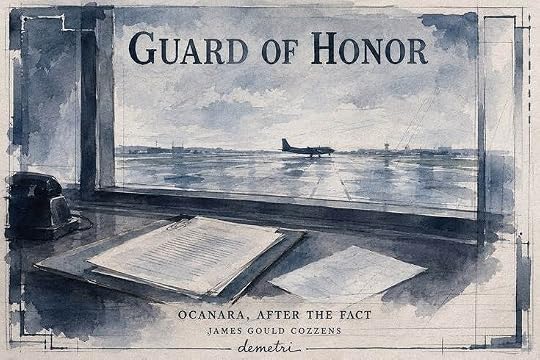
“Ocanara, After the Fact” – A command-room view across desk, file, runway, and distant aircraft, where “Guard of Honor” becomes a study of how damage leaves the airfield and enters the record.
Disaster in James Gould Cozzens’s “Guard of Honor” rarely has the courtesy to arrive alone. It comes escorted by rank, weather, procedure, gossip, resentment, ceremony, and men who have been given just enough authority to make their evasions costly. This is a war novel with planes, medals, uniforms, salutes, few battlefield scenes, and many consequences that arrive by phone, report, release, and file. Its sharpest fire is exchanged in cockpits, control towers, clubs, hospital rooms, rain-slick ramps, and sentences that know far too much about how a command digests what it cannot honestly swallow.
Everything begins in suspension. General Ira Beal, young, decorated, and ambitious without seeming crudely ambitious, is flying home to Ocanara Army Air Base with a small manifest of wartime America aboard: Colonel Norman Ross, dry as a legal brief left in sunlight; Lieutenant Colonel Benny Carricker, scarred by combat and spoiled by proximity to glory; Captain Nathaniel Hicks, a civilian editor retrained into a man of reports; Lieutenant Amanda Turck of the WAC; Sergeant Pellerino; and T/5 Mortimer McIntyre, a Black enlisted man experiencing flight for the first time. The plane appears almost still in the air. Below it, the base waits to turn motion into consequence.
Much of “Guard of Honor” turns on a single blow. After a dangerous near-collision on landing, Carricker, furious and humiliated, strikes Lieutenant Stanley Willis, a Black pilot whose B-26 has been involved in the incident. Beal immediately places Carricker under arrest, but nothing about the act remains simple. The assault becomes a disciplinary matter, a racial crisis, a charge waiting for language, a press hazard, a test of command, and an occasion for every officer nearby to discover how quickly principle begins asking for a stenographer.
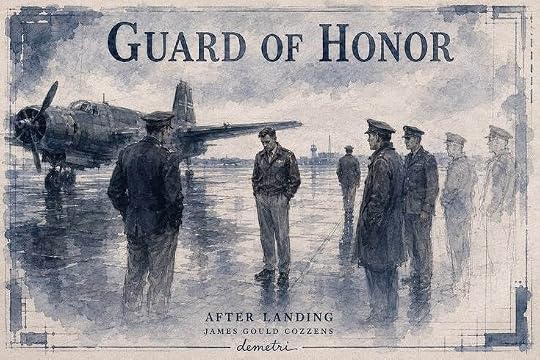
“After Landing” – On the rain-darkened ramp after Carricker’s blow, distance and posture do the moral work as violence begins its passage into command, language, and file.
Even that summary makes the book sound more streamlined than it is. Cozzens’s method is not to isolate an event but to show Ocanara’s air changing around it: phones, ramps, tower glass, mess halls, offices, wives’ circles, staff cars, and files all beginning to tremble. Colonel Woodman, an officer at Sellers Field, kills himself. Willis’s father arrives with documents, photographs, certificates, and paternal alarm, as though proof of excellence might yet compel decency from a structure designed to admire service while managing humiliation. General Nichols appears. Ocanara dresses itself for ceremony. Then, during a parachute demonstration, men fall into Lake Lalage and drown. Another question rises from the water: after preventable damage, who gets to finish what happened?
The three days act like a tightening device. “Thursday” puts a bruise where command wants a clean face. “Friday” sends that bruise through phones, offices, salutes, memoranda, gossip, domestic spaces, and publicity. “Saturday” tries to repair it with spectacle, honor, and sentences polished for release, only to produce a larger calamity. The days do not hold the plot. They squeeze it. Carricker’s blow becomes first action, then problem, then file.
Ross is the book’s most exact reader of rooms. He is not its hero exactly, because “hero” is too clean a word for a man whose wisdom consists partly in knowing how little purity survives contact with command. Beal’s Air Inspector and a judge in civilian life, Ross observes with the patient gloom of someone who has seen human motives enter evidence badly dressed. He gives the novel much of its gravity. He understands procedure as splint and screen. He can see why institutions require form, and he can see how form becomes a handsome little coffin for truth.
In one light, “Guard of Honor” is a grave novel of military command; in another, it is stranger and more lasting, a novel about who gets to finish an event after it happens. Carricker’s blow is one fact that must survive the office. But what kind of fact is it? An ugly temperamental lapse? A racial outrage? A scandal to be contained? A sign of combat damage? A threat to Beal’s command? The Lake Lalage deaths produce the same contest in colder water: accident, failure of foresight, missing memo, recoverable oversight, indictment. Cozzens’s answer is not a slogan. It is a staff meeting with casualties.
Paperwork, in this novel, is not comic clutter. It is where conscience goes to be routed. Memos, directives, inspection notes, reports, press releases, manuals, office instructions, initials, and missing documents carry as much charge as aircraft. Cozzens has an almost indecent gift for making a memorandum feel like an exhibit with a fuse, half weapon, half relic. In a lesser book, bureaucracy would be the enemy of feeling. Here, grief becomes language, shame goes into routing, responsibility into phrasing, panic into procedure.
A Cozzens sentence often behaves like a command channel. It admits a fact, checks its rank, attaches weather, biography, precedent, and possible blame, then sends it onward with instructions. A plane must be a machine, an emblem of rank, a logistical resource, a danger, a social compartment, and a clue to character. A conversation carries service history, class inference, military habit, local weather, and the possibility of future damage. The sentences do not rush toward revelation. They convene it, call witnesses, ask for clarifying documents, then allow one dry eyebrow to rise.
Perhaps this sounds forbidding, and at times it is. The prose can be dense enough to require its own landing clearance. Yet the density has purpose. Cozzens is not decorating his scenes with research; he is showing how people inside a uniformed apparatus think, misthink, speak, rank, and protect themselves. His diction is full of aircraft models, post regulations, mess halls, staff sections, salutes, field manuals, and communications traffic. That vocabulary decides who can be blamed, pitied, protected, or quietly made to disappear.
Among novels of military pressure, “Guard of Honor” sits near Herman Wouk’s “The Caine Mutiny,” James Jones’s “From Here to Eternity,” and Robert Penn Warren’s “All the King’s Men,” though each comparison breaks just where Cozzens becomes most himself. Wouk gives command a cleaner dramatic hinge; Jones is more bodily, erotic, and enlisted; Warren is more lyrical and politically fevered. Cozzens is cooler, more procedural, more interested in rooms where power pauses to choose an adjective.
During the ceremony in which Willis receives the Distinguished Flying Cross while still visibly injured, the novel reaches one of its most graceful scenes, graceful in exactly the wrong way. The honor is real; his achievement is real; his father’s pride and anguish are real. Yet the ceremony is also useful to command. It repairs appearances, steadies the base, and turns an injured Black officer into an emblem that white authority can display without fully answering for the injury. The scene would be easier if it were merely noble or merely cynical. It refuses the easier lie.
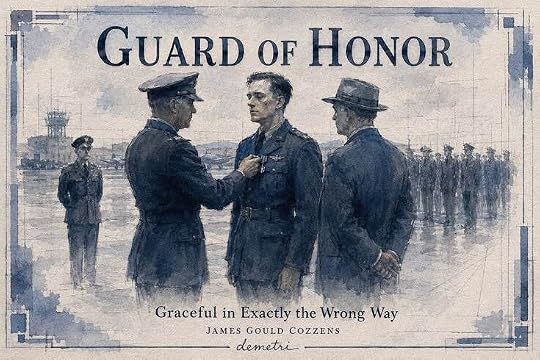
“Graceful in Exactly the Wrong Way” – Willis’s medal ceremony holds genuine honor and institutional usefulness in the same formal light, making public dignity feel both necessary and compromised.
In the world of “Guard of Honor,” the file folder has voltage without thunder. The handling of a crisis is not the dull portion after the drama; it is the drama after the blow has landed. Carricker hits Willis, but the account of the blow is made afterward by Beal, Ross, Nichols, Collins, Edsell, Mr. Willis, the Black press, the military hierarchy, and the paper trail. Men drown in Lake Lalage, but the deaths become legible through the rescue effort, the missing or destroyed memorandum, Botwinick’s alarming usefulness, the language of release, and the strain on Beal’s face. Consequence is not simply what happens. It is what the record will permit tomorrow.
My rating is 89/100, which becomes a Goodreads-compatible 4/5 stars on the agreed scale. The number fits: stern, crowded, superbly awake, just below the threshold of complete greatness. Even its slow corridors are swept and wired; there are few slack passages. But its brilliance has costs. Cozzens is so gifted at understanding command consciousness that he sometimes over-trusts the authority of his own omniscience. People can feel classified before they quite have time to breathe.
Inside the officers’ rooms where Willis’s injury is explained, managed, and made useful, the novel is both sharpest and most vulnerable. “Guard of Honor” is powerful because it studies a white command structure trying to process Black excellence and Black harm without surrendering control of the story. But that design means Willis, McIntyre, Mr. Willis, and the Black troops rarely receive the same room to think on the page as Ross, Beal, Hicks, Nichols, Carricker, and the officers managing the crisis. That is not a bookkeeping objection from the ethics desk. The novel sees racial humiliation clearly enough to make it central, but its rooms of explanation are still mostly reserved for those administering the wound.
That mediation does not make the novel unserious about race; it makes its seriousness uncomfortable in the exact place it is most intelligent. Mr. Willis comes armed with the respectable paperwork of American aspiration: his son’s achievements, recommendations, proof that Stanley Willis has earned what the country keeps making conditional. The pathos is not that the papers mean nothing. It is that they mean something, but not enough. Cozzens is alert to that cruelty. Yet the novel often turns Black suffering into a test of white command, white tact, white shame, and white procedural skill. The result convinces as an anatomy of the institution and remains incomplete as an allotment of human air.
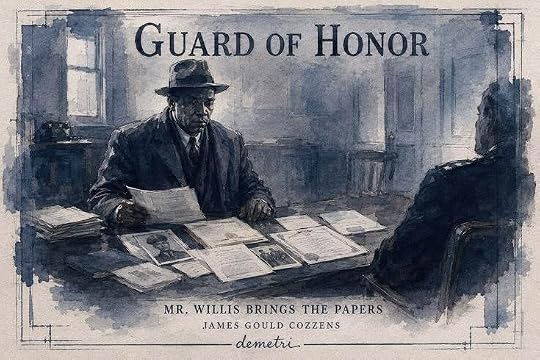
“Mr. Willis Brings the Papers” – In a cold military office, a father’s documents glow against the blue-gray room, carrying proof, dignity, alarm, and the terrible insufficiency of having earned everything.
Ross’s late reflections on honor give the title its ache and its accusation. A guard of honor is an arrangement, a tribute, a performance, a form through which the living tell themselves they have not abandoned the dead. Cozzens neither sneers at this nor lets it off cleanly. Ceremony can console, discipline, dignify, and conceal. It can turn grief into usable shape. It can also cover the hole where accountability should have been standing. The title becomes less a badge than a question: guard whose honor, from whom, and at what cost?
One pleasure here is Cozzens’s ear for dignity under maintenance. He is sharp on men who believe themselves practical while behaving theatrically, on officers whose self-command requires constant minor repair, on official phrases that sit on chaos like a napkin on spilled liquor. His wit is not kind exactly, but it is companionable. He knows that absurdity is one of the ways institutions remain human, and also one of the ways they avoid becoming humane.
Plot, if one comes looking for it in the usual place, is not the book’s strongest lure. Anyone waiting for it to sprint down the runway may grow impatient. Cozzens delays information by embedding it in systems. He organizes attention hierarchically, then lets interruptions reveal where truth is leaking through. A phone call, a staff paper, a WAC operator’s competence, a flight pattern, a hospital delay, a social visit, a phrase in a press release – each may become important because the base itself is the protagonist, with excellent filing habits and windows that do not quite open.
Once the reader adjusts to that pace, the slowness starts doing its own work. The book gathers weight rather than speed. Motifs return altered: flight as mastery and danger; water as landscape and grave; paper as nuisance and evidence; ceremony as dignity and screen; rank as order and insulation. By the final third, Ocanara feels less like a setting than a climate. Heat, rain, lake water, aircraft noise, office air, and service diction all belong to the same atmosphere. The base breathes through switchboards, blinks from tower glass, misfiles, salutes, and keeps the lights on.
Under orders, under ceremony, under all that careful official speech, “Guard of Honor” is about necessary work done too late by imperfect people. Beal is not pure; Ross is not innocent; Carricker is not merely a brute; Nichols is not merely a superior officer; Botwinick’s alarming usefulness has its own ethical weather. The novel withholds both consolations: simple corruption and simple virtue. Again and again, decent systems are staffed by compromised people, and compromised systems depend on moments of real decency to keep functioning.
Lake Lalage bares the design. The military display meant to affirm order has produced death. The subsequent handling of that death requires exactly the tools that failed to prevent it: orders, reports, records, command judgment, public language, private calculation. Cozzens’s bleakest insight is that there may be no way out of this loop. The memo after the drowning is still a memo. The cure arrives wearing the same uniform as the illness.
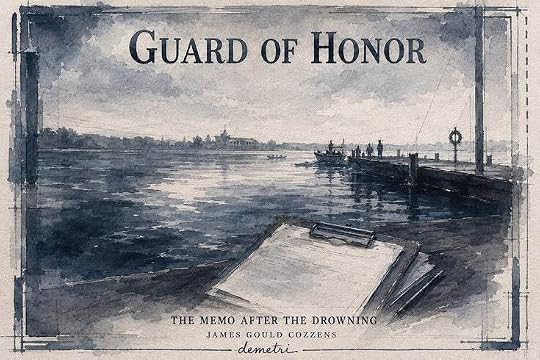
“The Memo After the Drowning” – Lake Lalage becomes water, absence, and paperwork at once, where preventable death meets the memo that arrives too late and still must be filed.
Omniscience, here, has its own temptation. The narrative voice is so capable, so worldly, so furnished with explanations, that mystery sometimes has to squeeze past the furniture. Cozzens’s habit of defining people by professional function is frequently brilliant, but it can harden into classification. Pilots behave like pilots; public-relations men like public-relations men; judges like judges; editors like editors; wives like the wives of certain officers in certain rooms at certain hours. The classifications can be delicious; they can also feel like doors closing with professional quiet.
Still, what remains after the heaviness is not a file but a feeling: the strange sadness of systems that can honor men better after failing them than before. “Guard of Honor” does not end by purifying Beal, redeeming Carricker, solving racism, or restoring balance to Ocanara. It ends with survival, exhaustion, partial understanding, and the knowledge that someone will always have to pick up after damage. The final movement looks upward, toward a departing plane and the lights fading among the stars. Below, the base remains – lit, staffed, compromised, awake – still arranging its honors, still guarding what it can, still unable to say exactly what it has lost.
Compositional Thumbnail Sheet – Early thumbnail studies mapping the image’s moral architecture: desk, window, runway, plane, file, and border arranged before atmosphere enters.
Cover-Palette Color Swatch Sheet – A disciplined blue-gray palette study drawn from the cover art, testing how slate, mist, charcoal, navy-black, and off-white can carry command, weather, and aftermath.
Faint Pencil Underdrawing – The image at its most skeletal, with graphite lines establishing the desk, window, runway perspective, text placement, and unfinished document-like frame.
Watercolor Border Study – A border experiment where file margins, runway lines, official forms, and broken plate edges begin to merge into the image’s procedural frame.
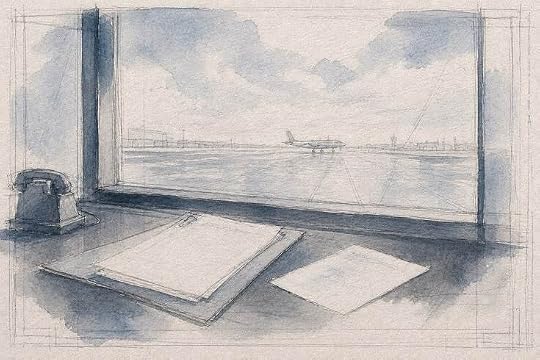
Pencil-Plus-First-Wash Stage – The first wash stage, where pale sky, wet tarmac, office shadow, and preserved paper white begin turning the drawing into Ocanara’s atmosphere.
Lettering and Plate-Design Study – A typography and placement study integrating “Guard of Honor,” “Ocanara, After the Fact,” “James Gould Cozzens,” and “demetri” into the watercolor as part of the plate itself.
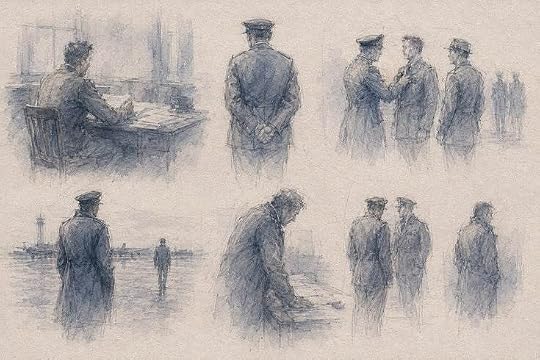
Character Anatomical / Figure-Posture Study – A restrained graphite-and-wash study of posture under command, testing how bodies can suggest authority, restraint, vulnerability, and distance without becoming portraiture.
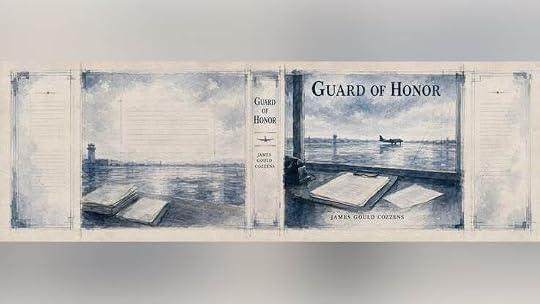
Full Dust Jacket Study – A full watercolor dust jacket concept for “Guard of Honor,” expanding the office-window runway image across front cover, spine, back cover, and flaps as a cool blue-gray book-object study.
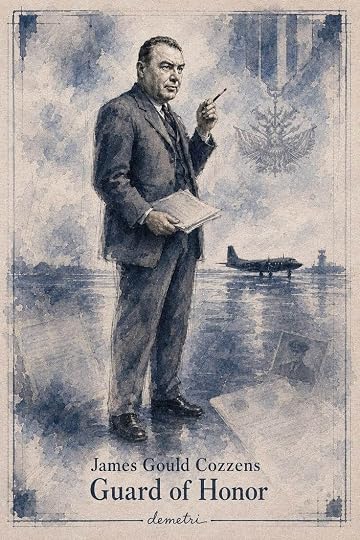
Author Portrait Study – A literary watercolor portrait study of James Gould Cozzens, using the “Guard of Honor” palette, runway imagery, papers, and archival borders to connect author, book, and review.
All watercolor illustrations by Demetris Papadimitropoulos.
Watercolors are done on 140lb vellum and then scanned into the computer using an Epson scanner. From there, they are finalized in Procreate. All art and opinions are my own.
James Gould Cozzens’s “Guard of Honor” is a severe war novel about race, command, and the official life of damage.
By Demetris Papadimitropoulos | June 27th, 2026
“Ocanara, After the Fact” – A command-room view across desk, file, runway, and distant aircraft, where “Guard of Honor” becomes a study of how damage leaves the airfield and enters the record.
Disaster in James Gould Cozzens’s “Guard of Honor” rarely has the courtesy to arrive alone. It comes escorted by rank, weather, procedure, gossip, resentment, ceremony, and men who have been given just enough authority to make their evasions costly. This is a war novel with planes, medals, uniforms, salutes, few battlefield scenes, and many consequences that arrive by phone, report, release, and file. Its sharpest fire is exchanged in cockpits, control towers, clubs, hospital rooms, rain-slick ramps, and sentences that know far too much about how a command digests what it cannot honestly swallow.
Everything begins in suspension. General Ira Beal, young, decorated, and ambitious without seeming crudely ambitious, is flying home to Ocanara Army Air Base with a small manifest of wartime America aboard: Colonel Norman Ross, dry as a legal brief left in sunlight; Lieutenant Colonel Benny Carricker, scarred by combat and spoiled by proximity to glory; Captain Nathaniel Hicks, a civilian editor retrained into a man of reports; Lieutenant Amanda Turck of the WAC; Sergeant Pellerino; and T/5 Mortimer McIntyre, a Black enlisted man experiencing flight for the first time. The plane appears almost still in the air. Below it, the base waits to turn motion into consequence.
Much of “Guard of Honor” turns on a single blow. After a dangerous near-collision on landing, Carricker, furious and humiliated, strikes Lieutenant Stanley Willis, a Black pilot whose B-26 has been involved in the incident. Beal immediately places Carricker under arrest, but nothing about the act remains simple. The assault becomes a disciplinary matter, a racial crisis, a charge waiting for language, a press hazard, a test of command, and an occasion for every officer nearby to discover how quickly principle begins asking for a stenographer.
“After Landing” – On the rain-darkened ramp after Carricker’s blow, distance and posture do the moral work as violence begins its passage into command, language, and file.
Even that summary makes the book sound more streamlined than it is. Cozzens’s method is not to isolate an event but to show Ocanara’s air changing around it: phones, ramps, tower glass, mess halls, offices, wives’ circles, staff cars, and files all beginning to tremble. Colonel Woodman, an officer at Sellers Field, kills himself. Willis’s father arrives with documents, photographs, certificates, and paternal alarm, as though proof of excellence might yet compel decency from a structure designed to admire service while managing humiliation. General Nichols appears. Ocanara dresses itself for ceremony. Then, during a parachute demonstration, men fall into Lake Lalage and drown. Another question rises from the water: after preventable damage, who gets to finish what happened?
The three days act like a tightening device. “Thursday” puts a bruise where command wants a clean face. “Friday” sends that bruise through phones, offices, salutes, memoranda, gossip, domestic spaces, and publicity. “Saturday” tries to repair it with spectacle, honor, and sentences polished for release, only to produce a larger calamity. The days do not hold the plot. They squeeze it. Carricker’s blow becomes first action, then problem, then file.
Ross is the book’s most exact reader of rooms. He is not its hero exactly, because “hero” is too clean a word for a man whose wisdom consists partly in knowing how little purity survives contact with command. Beal’s Air Inspector and a judge in civilian life, Ross observes with the patient gloom of someone who has seen human motives enter evidence badly dressed. He gives the novel much of its gravity. He understands procedure as splint and screen. He can see why institutions require form, and he can see how form becomes a handsome little coffin for truth.
In one light, “Guard of Honor” is a grave novel of military command; in another, it is stranger and more lasting, a novel about who gets to finish an event after it happens. Carricker’s blow is one fact that must survive the office. But what kind of fact is it? An ugly temperamental lapse? A racial outrage? A scandal to be contained? A sign of combat damage? A threat to Beal’s command? The Lake Lalage deaths produce the same contest in colder water: accident, failure of foresight, missing memo, recoverable oversight, indictment. Cozzens’s answer is not a slogan. It is a staff meeting with casualties.
Paperwork, in this novel, is not comic clutter. It is where conscience goes to be routed. Memos, directives, inspection notes, reports, press releases, manuals, office instructions, initials, and missing documents carry as much charge as aircraft. Cozzens has an almost indecent gift for making a memorandum feel like an exhibit with a fuse, half weapon, half relic. In a lesser book, bureaucracy would be the enemy of feeling. Here, grief becomes language, shame goes into routing, responsibility into phrasing, panic into procedure.
A Cozzens sentence often behaves like a command channel. It admits a fact, checks its rank, attaches weather, biography, precedent, and possible blame, then sends it onward with instructions. A plane must be a machine, an emblem of rank, a logistical resource, a danger, a social compartment, and a clue to character. A conversation carries service history, class inference, military habit, local weather, and the possibility of future damage. The sentences do not rush toward revelation. They convene it, call witnesses, ask for clarifying documents, then allow one dry eyebrow to rise.
Perhaps this sounds forbidding, and at times it is. The prose can be dense enough to require its own landing clearance. Yet the density has purpose. Cozzens is not decorating his scenes with research; he is showing how people inside a uniformed apparatus think, misthink, speak, rank, and protect themselves. His diction is full of aircraft models, post regulations, mess halls, staff sections, salutes, field manuals, and communications traffic. That vocabulary decides who can be blamed, pitied, protected, or quietly made to disappear.
Among novels of military pressure, “Guard of Honor” sits near Herman Wouk’s “The Caine Mutiny,” James Jones’s “From Here to Eternity,” and Robert Penn Warren’s “All the King’s Men,” though each comparison breaks just where Cozzens becomes most himself. Wouk gives command a cleaner dramatic hinge; Jones is more bodily, erotic, and enlisted; Warren is more lyrical and politically fevered. Cozzens is cooler, more procedural, more interested in rooms where power pauses to choose an adjective.
During the ceremony in which Willis receives the Distinguished Flying Cross while still visibly injured, the novel reaches one of its most graceful scenes, graceful in exactly the wrong way. The honor is real; his achievement is real; his father’s pride and anguish are real. Yet the ceremony is also useful to command. It repairs appearances, steadies the base, and turns an injured Black officer into an emblem that white authority can display without fully answering for the injury. The scene would be easier if it were merely noble or merely cynical. It refuses the easier lie.
“Graceful in Exactly the Wrong Way” – Willis’s medal ceremony holds genuine honor and institutional usefulness in the same formal light, making public dignity feel both necessary and compromised.
In the world of “Guard of Honor,” the file folder has voltage without thunder. The handling of a crisis is not the dull portion after the drama; it is the drama after the blow has landed. Carricker hits Willis, but the account of the blow is made afterward by Beal, Ross, Nichols, Collins, Edsell, Mr. Willis, the Black press, the military hierarchy, and the paper trail. Men drown in Lake Lalage, but the deaths become legible through the rescue effort, the missing or destroyed memorandum, Botwinick’s alarming usefulness, the language of release, and the strain on Beal’s face. Consequence is not simply what happens. It is what the record will permit tomorrow.
My rating is 89/100, which becomes a Goodreads-compatible 4/5 stars on the agreed scale. The number fits: stern, crowded, superbly awake, just below the threshold of complete greatness. Even its slow corridors are swept and wired; there are few slack passages. But its brilliance has costs. Cozzens is so gifted at understanding command consciousness that he sometimes over-trusts the authority of his own omniscience. People can feel classified before they quite have time to breathe.
Inside the officers’ rooms where Willis’s injury is explained, managed, and made useful, the novel is both sharpest and most vulnerable. “Guard of Honor” is powerful because it studies a white command structure trying to process Black excellence and Black harm without surrendering control of the story. But that design means Willis, McIntyre, Mr. Willis, and the Black troops rarely receive the same room to think on the page as Ross, Beal, Hicks, Nichols, Carricker, and the officers managing the crisis. That is not a bookkeeping objection from the ethics desk. The novel sees racial humiliation clearly enough to make it central, but its rooms of explanation are still mostly reserved for those administering the wound.
That mediation does not make the novel unserious about race; it makes its seriousness uncomfortable in the exact place it is most intelligent. Mr. Willis comes armed with the respectable paperwork of American aspiration: his son’s achievements, recommendations, proof that Stanley Willis has earned what the country keeps making conditional. The pathos is not that the papers mean nothing. It is that they mean something, but not enough. Cozzens is alert to that cruelty. Yet the novel often turns Black suffering into a test of white command, white tact, white shame, and white procedural skill. The result convinces as an anatomy of the institution and remains incomplete as an allotment of human air.
“Mr. Willis Brings the Papers” – In a cold military office, a father’s documents glow against the blue-gray room, carrying proof, dignity, alarm, and the terrible insufficiency of having earned everything.
Ross’s late reflections on honor give the title its ache and its accusation. A guard of honor is an arrangement, a tribute, a performance, a form through which the living tell themselves they have not abandoned the dead. Cozzens neither sneers at this nor lets it off cleanly. Ceremony can console, discipline, dignify, and conceal. It can turn grief into usable shape. It can also cover the hole where accountability should have been standing. The title becomes less a badge than a question: guard whose honor, from whom, and at what cost?
One pleasure here is Cozzens’s ear for dignity under maintenance. He is sharp on men who believe themselves practical while behaving theatrically, on officers whose self-command requires constant minor repair, on official phrases that sit on chaos like a napkin on spilled liquor. His wit is not kind exactly, but it is companionable. He knows that absurdity is one of the ways institutions remain human, and also one of the ways they avoid becoming humane.
Plot, if one comes looking for it in the usual place, is not the book’s strongest lure. Anyone waiting for it to sprint down the runway may grow impatient. Cozzens delays information by embedding it in systems. He organizes attention hierarchically, then lets interruptions reveal where truth is leaking through. A phone call, a staff paper, a WAC operator’s competence, a flight pattern, a hospital delay, a social visit, a phrase in a press release – each may become important because the base itself is the protagonist, with excellent filing habits and windows that do not quite open.
Once the reader adjusts to that pace, the slowness starts doing its own work. The book gathers weight rather than speed. Motifs return altered: flight as mastery and danger; water as landscape and grave; paper as nuisance and evidence; ceremony as dignity and screen; rank as order and insulation. By the final third, Ocanara feels less like a setting than a climate. Heat, rain, lake water, aircraft noise, office air, and service diction all belong to the same atmosphere. The base breathes through switchboards, blinks from tower glass, misfiles, salutes, and keeps the lights on.
Under orders, under ceremony, under all that careful official speech, “Guard of Honor” is about necessary work done too late by imperfect people. Beal is not pure; Ross is not innocent; Carricker is not merely a brute; Nichols is not merely a superior officer; Botwinick’s alarming usefulness has its own ethical weather. The novel withholds both consolations: simple corruption and simple virtue. Again and again, decent systems are staffed by compromised people, and compromised systems depend on moments of real decency to keep functioning.
Lake Lalage bares the design. The military display meant to affirm order has produced death. The subsequent handling of that death requires exactly the tools that failed to prevent it: orders, reports, records, command judgment, public language, private calculation. Cozzens’s bleakest insight is that there may be no way out of this loop. The memo after the drowning is still a memo. The cure arrives wearing the same uniform as the illness.
“The Memo After the Drowning” – Lake Lalage becomes water, absence, and paperwork at once, where preventable death meets the memo that arrives too late and still must be filed.
Omniscience, here, has its own temptation. The narrative voice is so capable, so worldly, so furnished with explanations, that mystery sometimes has to squeeze past the furniture. Cozzens’s habit of defining people by professional function is frequently brilliant, but it can harden into classification. Pilots behave like pilots; public-relations men like public-relations men; judges like judges; editors like editors; wives like the wives of certain officers in certain rooms at certain hours. The classifications can be delicious; they can also feel like doors closing with professional quiet.
Still, what remains after the heaviness is not a file but a feeling: the strange sadness of systems that can honor men better after failing them than before. “Guard of Honor” does not end by purifying Beal, redeeming Carricker, solving racism, or restoring balance to Ocanara. It ends with survival, exhaustion, partial understanding, and the knowledge that someone will always have to pick up after damage. The final movement looks upward, toward a departing plane and the lights fading among the stars. Below, the base remains – lit, staffed, compromised, awake – still arranging its honors, still guarding what it can, still unable to say exactly what it has lost.
Compositional Thumbnail Sheet – Early thumbnail studies mapping the image’s moral architecture: desk, window, runway, plane, file, and border arranged before atmosphere enters.
Cover-Palette Color Swatch Sheet – A disciplined blue-gray palette study drawn from the cover art, testing how slate, mist, charcoal, navy-black, and off-white can carry command, weather, and aftermath.
Faint Pencil Underdrawing – The image at its most skeletal, with graphite lines establishing the desk, window, runway perspective, text placement, and unfinished document-like frame.
Watercolor Border Study – A border experiment where file margins, runway lines, official forms, and broken plate edges begin to merge into the image’s procedural frame.
Pencil-Plus-First-Wash Stage – The first wash stage, where pale sky, wet tarmac, office shadow, and preserved paper white begin turning the drawing into Ocanara’s atmosphere.
Lettering and Plate-Design Study – A typography and placement study integrating “Guard of Honor,” “Ocanara, After the Fact,” “James Gould Cozzens,” and “demetri” into the watercolor as part of the plate itself.
Character Anatomical / Figure-Posture Study – A restrained graphite-and-wash study of posture under command, testing how bodies can suggest authority, restraint, vulnerability, and distance without becoming portraiture.
Full Dust Jacket Study – A full watercolor dust jacket concept for “Guard of Honor,” expanding the office-window runway image across front cover, spine, back cover, and flaps as a cool blue-gray book-object study.
Author Portrait Study – A literary watercolor portrait study of James Gould Cozzens, using the “Guard of Honor” palette, runway imagery, papers, and archival borders to connect author, book, and review.
All watercolor illustrations by Demetris Papadimitropoulos.
Watercolors are done on 140lb vellum and then scanned into the computer using an Epson scanner. From there, they are finalized in Procreate. All art and opinions are my own.

September 6, 2020
Incredible travel to a pivotal moment in American history. Essential reading.
October 14, 2025
Guard of Honor by James Gould Cozzens
10 out of 10
This magical, marvelous, fantastic Magnus opus, published in 1948, winner of The Pulitzer Prize, could have been missed by this foolish reader, who is not keen on learning about the Army Air Force, which is where the narrative takes place, and is always reluctant to engage with a work that passes six hundred pages, unless it is overwhelming.
Guard of Honor, just like The Caine Mutiny - reviewed at realini.blogspot.com - another masterpiece that I nearly skipped over, is breathtaking and able to overcome the handicap of being mostly about one aspect in life that some reject, seeing as I have learned that the military is just about obeying orders and one character in the book confirms that.
All the events, love affairs, fights, the protest that almost becomes a mutiny, the death of seven parachutist sand everything else, happens during two days, starting with the flight on which we have most of the key characters, General Ira 'Bus' Beal, Captain Nathaniel Hicks, Lieutenant Amanda Turck, personages that almost die in a crash, when at the landing, another plane just flies in, placing in terrible danger the protagonists of the story.
Lieutenant Colonel Benny Carricker may have sparked a revolt, when he punches the pilot that had made a mistake in landing, who is an African American - throughout the book, they are referenced to as Negroes though, since this was another age, albeit only some seventy years ago - about to be awarded a medal for his valor, saving three airplanes that would be many hundreds of millions, perhaps over a billion today, and named commander of a bomb squad of African American personnel.
This chef d'oeuvre is extraordinarily complex, but one of the main themes is that of racism, for although the punch thrown by Benny, which would cause some damage, was not initially a racist act, it fits into a pattern, for black officers are not given access to the club where they should be permitted, according to Army regulations, but because this base is in central Florida, it was considered wiser to have a segregation of venues.
In civilian life, America was a racist country, at least in the Southern states - that incidentally vote with Trump today - and provisions were made in the official military regulations to ensure equal rights for the minorities that would die for their country, but also take care of local sensitivity where necessary.
Ergo, on bases that are placed in the South, commanding officers were allowed the freedom to adapt some of the rules and at the Ocanara Army Air Base they had this separation, that infuriated the African American personnel, especially after the incident at the air field, which was interpreted as being a racist attack, although it was not.
Nevertheless, many officers at this base and elsewhere are racist, grown in an atmosphere where they are told from birth that they are the superior race and that the minority is simply not equal to them and hence they act with abominable, white supremacist attitude when some African American officers try to access the Club for...officers.
Arrests are made, because the military police representative has been prevented from doing his job and it becomes a complex, almost insurmountable situation, given that Bus, colonel Norman Ross aka the Judge and some others are not racists, understand the situation perfectly, but are faced with a conundrum...how to keep the majority in fighting spirit, ready for battle, when it does not want to mix with other races...not at that moment in time.
Mixed in this conflict, we have a phenomenal fresco with human emotions, Nathaniel Hicks becomes involved with Amanda Turck, Benny and Edsel cause a lot of trouble, although the latter defends the case of the African American community on the base, he appears to be less than perfect otherwise, a rather flawed character, interested in making a commotion and become the center of attention by any means.
Guard of Honor is a glorious, outstanding masterpiece.
10 out of 10
This magical, marvelous, fantastic Magnus opus, published in 1948, winner of The Pulitzer Prize, could have been missed by this foolish reader, who is not keen on learning about the Army Air Force, which is where the narrative takes place, and is always reluctant to engage with a work that passes six hundred pages, unless it is overwhelming.
Guard of Honor, just like The Caine Mutiny - reviewed at realini.blogspot.com - another masterpiece that I nearly skipped over, is breathtaking and able to overcome the handicap of being mostly about one aspect in life that some reject, seeing as I have learned that the military is just about obeying orders and one character in the book confirms that.
All the events, love affairs, fights, the protest that almost becomes a mutiny, the death of seven parachutist sand everything else, happens during two days, starting with the flight on which we have most of the key characters, General Ira 'Bus' Beal, Captain Nathaniel Hicks, Lieutenant Amanda Turck, personages that almost die in a crash, when at the landing, another plane just flies in, placing in terrible danger the protagonists of the story.
Lieutenant Colonel Benny Carricker may have sparked a revolt, when he punches the pilot that had made a mistake in landing, who is an African American - throughout the book, they are referenced to as Negroes though, since this was another age, albeit only some seventy years ago - about to be awarded a medal for his valor, saving three airplanes that would be many hundreds of millions, perhaps over a billion today, and named commander of a bomb squad of African American personnel.
This chef d'oeuvre is extraordinarily complex, but one of the main themes is that of racism, for although the punch thrown by Benny, which would cause some damage, was not initially a racist act, it fits into a pattern, for black officers are not given access to the club where they should be permitted, according to Army regulations, but because this base is in central Florida, it was considered wiser to have a segregation of venues.
In civilian life, America was a racist country, at least in the Southern states - that incidentally vote with Trump today - and provisions were made in the official military regulations to ensure equal rights for the minorities that would die for their country, but also take care of local sensitivity where necessary.
Ergo, on bases that are placed in the South, commanding officers were allowed the freedom to adapt some of the rules and at the Ocanara Army Air Base they had this separation, that infuriated the African American personnel, especially after the incident at the air field, which was interpreted as being a racist attack, although it was not.
Nevertheless, many officers at this base and elsewhere are racist, grown in an atmosphere where they are told from birth that they are the superior race and that the minority is simply not equal to them and hence they act with abominable, white supremacist attitude when some African American officers try to access the Club for...officers.
Arrests are made, because the military police representative has been prevented from doing his job and it becomes a complex, almost insurmountable situation, given that Bus, colonel Norman Ross aka the Judge and some others are not racists, understand the situation perfectly, but are faced with a conundrum...how to keep the majority in fighting spirit, ready for battle, when it does not want to mix with other races...not at that moment in time.
Mixed in this conflict, we have a phenomenal fresco with human emotions, Nathaniel Hicks becomes involved with Amanda Turck, Benny and Edsel cause a lot of trouble, although the latter defends the case of the African American community on the base, he appears to be less than perfect otherwise, a rather flawed character, interested in making a commotion and become the center of attention by any means.
Guard of Honor is a glorious, outstanding masterpiece.

August 9, 2022
Even though the reviews point out the story about racism in the book, it is only one facet of the story, and one will be disappointed if that is what they expect of the novel. It is a multifaceted story with several characters weaving in and out of the storyline. The story itself centers on a weekend on which several crises occur and how the high command handles them. It is robust reading at best, and the changing point of view is not for the faint of heart. The author successfully tells the story with the various characters, either by what they were thinking or saying or by what others were thinking about them. It is difficult to read because of those above and the inherent goings-on of a military base in Florida during World War II.
While he talked, Captain Wiley, more and more restive, perhaps saw the fighter swarm, his preferred familiars, old squadronmates of his, coming off the runways at a hundred miles an hour; in thunder, airborne. The earth fell down under them; the winds aloft gave way. Not long after, the watchful far-off foe would note some specks on the sky. Stout he might be, skilled, sure of himself; but the man was not born yet who, seeing that sight, kept at that moment spit enough to swallow. He hadn't long to wait. On the heart's diastole, those coming fighters might look a mile off, and on the systole following, here they were.
The coming fighters had no waiting around to do, either. For God and country, for flying pay, for heart-in-mouth fun with death, for the hell of it, and in the excited hope to kill, they gave the incomparable two-thousand horsepower engines a good, swift, water-injection kick in the pants. To the expeditious brain, the expert eye said: now! A finger touch, light as the destroying angel's, broke simultaneous flame out all their guns. Behind this storm of lead, hand in experienced hand, they
bored in--once more unto the breach, dear friends, once more!
Displaying 1 - 30 of 84 reviews