

What do you think?

On Liberty
On 11 September 2001, our world changed. The West's response to 9/11 has morphed into a period of exception. Governments have decided that the rule of law and human rights are often too costly. In On Liberty, Shami Chakrabarti - who joined Liberty, the UK's leading civil rights organization, on 10 September 2001 - explores why our fundamental rights and freedoms are indispensable. She shows, too, the unprecedented pressures those rights are under today. Drawing on her own work in high-profile campaigns, from privacy laws to anti-terror legislation, Chakrabarti shows the threats to our democratic institutions and why our rights are paramount in upholding democracy.
208 pages, Hardcover
First published October 2, 2014
Ratings & Reviews
Friends & Following
Create a free account to discover what your friends think of this book!
Community Reviews
Displaying 1 - 30 of 66 reviews

October 12, 2014
I HAVE COME TO LOOK MOURNFULLY AT YOU FOR MINUTES ON END
Shami Chakrabarti is a tiny woman, it’s hard to tell from the tv screen but I’d say about 8 or 9 inches tall, maybe 10, and she is intensely irritating, she’s the Tinkerbell of Human Rights, always zooming and buzzing around and chucking the dust of moral obligation in your face – that sounds like fun, but she has no sense of humour, so imagine a glowering Tinkerbell with a copy of the European Convention on Human Rights under her arm.
In this book she is writing about some of the most gripping and fearful events of the past 15 years, and many exciting legal battles, but she does it in the dullest way possible. Which makes this a very worthy, lawyerly, and almost completely dispiriting read.
For non-British readers, Shami is the boss of Liberty, The Organisation Formerly Known As the Council for Civil Liberties & is perpetually locked in battle with the British Government who – whether Conservative or Labour – are constantly trying to degrade British citizen’s liberties, privacy and personal integrity in the name of security and the ongoing war with jihadis.
YOU AND YOUR FLOOKING HUMAN RIGHTS!
British people are mostly driven quite mad by Human Rights because they live in a land where 99.9% of them are perfectly secure and never come into contact with any government ministry more threatening than HM Revenue and Customs, so this means the only time they see human rights legislation in action is in a case like that of Abu Qatada.
Using more colourful language than is her wont, Shami says
The case of Abu Qatada still haunts me like a stalker ex-boyfriend. Everywhere I go, the time that it took to get the ranty cleric out of the country is put to me as a classic example of “human rights madness”.
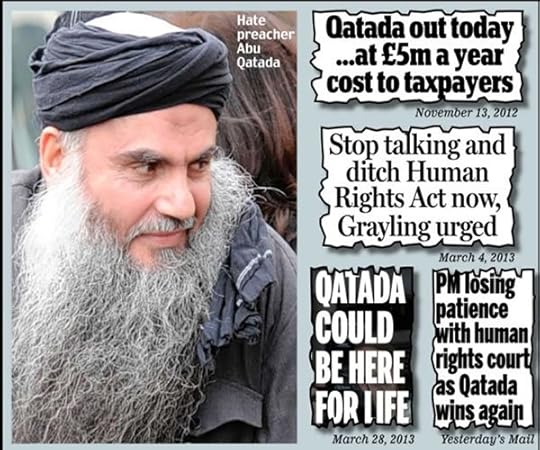
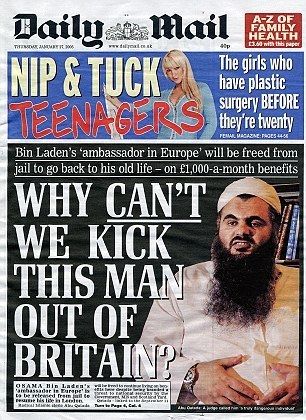
So, this guy is Jordanian but came to Britain in 1993 and claimed political asylum, which was granted. Nine years later he was arrested as a suspected member of al Qaeda and aiding and abetting terrorists. He was detained without charge for four years. under Part 4 of the Anti-terrorism, Crime and Security Act 2001. The British Government did not want to or could not put him on trial in Britain, they wanted to deport him to Jordan, where that government wished to put him on trial, but he claimed that he would be subject to torture if he was sent back there. So, under the European Convention on Human Rights, the British government couldn’t deport him.
This is what drove the British public crazy, and the British rabid attack dog press headlined the whole sorry saga for years. The public couldn’t care less whether Mr Qatada got tortured or not, they just wanted him out of the country, and they saw their own democratically elected government powerless to deport him.
But this is where Shami pops up and reminds us that torture is serious. Oh, it is? Hmph, I’d kind of forgotten that.
The whole saga kept rolling on – he was released and rearrested several times over the next few years, it was a really tortuous legal epic. For instance, the question became not that Qatada himself would be tortured, but that evidence obtained through torture on other persons would be used against him. On that point, in 2009, the one of the Law Lords (at that point Britain’s supreme court) said "There is in my opinion no authority for a rule that...the risk of the use of evidence obtained by torture necessarily amounts to a flagrant denial of justice". (I.e. sling the bugger out).
Finally the case made it to the European Court of Human Rights and they reverted to the previous position, that Qatada couldn’t be deported as he himself might be tortured.
We note that in all of this saga all the authorities agree that the Jordanian government routinely uses torture. Is this insulting to Jordan? Or were they saying sure, yes, we torture people, don’t you? Come on, we know you do!
The British government then got a swear-on-my-mother’s-grave promise from the Jordanian government that they would not torture Mr Qatada. In writing. That wasn’t good enough for the courts.
Finally finally, Mr Qatada himself broke the deadlock and said that if the Jordanians promised that they wouldn’t torture him or use torture-derived evidence in court he would return. So in July 2013 he did. And David Cameron and home secretary Theresa May danced a little jig around the dining table in 10 Downing Street.
So the Jordanians put Mr Qatada on trial for plotting against the government and last month he was acquitted. Maybe it was because they couldn’t present all that lovely damning torture-derived evidence.
Shami would say – well, this is the rule of law in operation. That’s what it’s for. Equality before the law means that whether you’re a much loved peer of the realm or a much hated Jordanian cleric you get the same deal. But people are inclined to want to shoot from the hip. They would deport, intern and in some cases execute without a qualm.
This is why I myself am opposed to the death penalty. Horrors like Ted Bundy, Ian Brady, Myra Hindley, Gary Ridgway or John Wayne Gacy should fry for sure, no question. But the police make mistakes. If Britain still had the death penalty in the 1970s the Guildford Four and the Birmingham Six would have been hung. Evidence which proved their innocence would have been unearthed years later.
We need Human Rights organisations to irritate, cajole, remind and goad us.
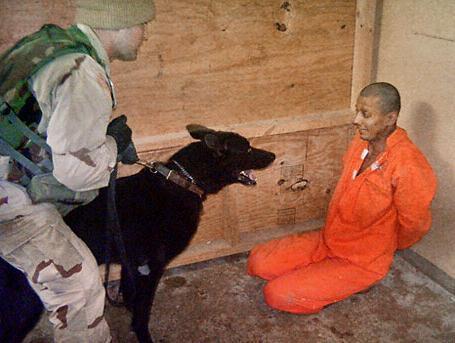
YOU SAY TORTURE, I SAY ENHANCED INTERROGATION TECHNIQUES (LET’S CALL THE WHOLE THING OFF)
Everywhere Shami goes she’s beset by people who say hey, I know you, you’re what’s it now, no don’t tell me, er, Swami Chocolate Boxy, is that it? Always going on about human rights for terrorists! Well, let me ask you a question – suppose you knew there was a nuclear bomb ticking away in London but you didn’t know where, and you got the guy who knew where it was in a room, wouldn’t you apply a little pressure to get the information? Just a little bit of torture to save the lives of millions?
Shami says
This is what the War on Terror was capable of doing to lawyers. It could turn stupid ones into yes men for corner-cutting and cruelty and clever ones into the architects of increasingly byzantine processes with which to conceal or even legitimize barbarism.
And later
Democratic states that launder their torture are no better than the tyrannies they conspire with.
Here’s an example of where Shami and Liberty lose me. Most of this world is not democratic. The West believes that it is. Shami comes along with her many examples of state misbehavior and punctures that belief. In the USA there are a lot of people who believe their own government to be tyrannical. In Britain we have a picture of our own government – during the Northern Irish Troubles and during the post-9/11 jihadi period, i.e. now, setting aside the notion of human rights, equality before the law, due process, no torture, etc , whenever they feel particularly pressured. So – where does this all leave us? In the dark, groping about, is where.
This is a somewhat boringly written short book about a whole bunch of essential stuff. I didn't enjoy it but I think I'm a very very very slightly better person now.

Shami Chakrabarti has come to harsh all governmental mellow.

October 9, 2014
This book is written in the dry and unchallenging style used by many barristers; it sets out an argument in favour of Human Rights and in opposition to recent British governments of all persuasions, with supporting evidence from well known cases that have been in our news over the past decade, and in unpretentious language that aims for clarity and simplicity. It has no literary pretensions. This approach would work better if the Home Office (referred to as "Mordar" or "The Dark Tower" because of its steady production of evil) did not devise such fiendishly convoluted legal devices to misrepresent the most blatant abuse of human rights as something else. It is obviously necessary to unravel and expose this abuse but the resulting text can sometimes require slow and perhaps even repeated reading, occasionally because it is complicated but more often because it is so astonishing. The point this book makes, in language that is calm and understated, is that the UK has a government system which consciously, persistently and with great ingenuity sets about depriving people of their most basic human rights and would go much further if it were not challenged and held to account by organisations like Liberty, by institutions like the Strasbourg Courts, by clear and definitive principles set out in the European Convention on Human Rights and brought into British legislation by the 1998 Human Rights Act. These are laws that Britain played a major part in writing and persuading other countries to accept at the end of World War Two; they are courts that cannot force the British Government to do a single thing it does not wish to do, but can only make its rulings and express its opinions for the British Government to consider. Not only is the British Government free to break every clause of the Human Rights Act if it so chooses, but in practice that is exactly what it does do. [As an aside, it is interesting to compare the sanctions to which the government will cheerfully expose itself if it fails to comply with some of its free trade agreements; I think of the imminent proposed Transatlantic Trade and Investment Partnership (TTIP).]
Like a typical barrister, Chakrabarti sets out her arguments and her supporting evidence, but is not strident or overbearing in her style, is not even nasty to the people she holds responsible for blatant abuses of human rights, or the people who tell lies about Human Rights law, or the people who actively propagate false stories and illogical arguments to undermine public support for the victims of government abuse which is often atrocious. She trusts instead that the evidence will in itself be sufficient to secure the support she needs in order to continue working on our behalf to shine a light on "The Dark Tower" and to combat the evil that is produced in "Mordar". After considering the evidence in this book, those negative metaphors will seem more than appropriate for their target. Indeed, my own conclusion is that we now need another book, something far more strident and forceful, to expose more graphically and fully the abuses referred to in this book but that is a challenge for another writer, maybe another Orwell, maybe another Russell Brand. Chakrabarti has done her job very well. Long may she continue her work. But this is a story that cries out for more emotion, more anger, more tears, more shame.
Like a typical barrister, Chakrabarti sets out her arguments and her supporting evidence, but is not strident or overbearing in her style, is not even nasty to the people she holds responsible for blatant abuses of human rights, or the people who tell lies about Human Rights law, or the people who actively propagate false stories and illogical arguments to undermine public support for the victims of government abuse which is often atrocious. She trusts instead that the evidence will in itself be sufficient to secure the support she needs in order to continue working on our behalf to shine a light on "The Dark Tower" and to combat the evil that is produced in "Mordar". After considering the evidence in this book, those negative metaphors will seem more than appropriate for their target. Indeed, my own conclusion is that we now need another book, something far more strident and forceful, to expose more graphically and fully the abuses referred to in this book but that is a challenge for another writer, maybe another Orwell, maybe another Russell Brand. Chakrabarti has done her job very well. Long may she continue her work. But this is a story that cries out for more emotion, more anger, more tears, more shame.

November 8, 2014
This is a fascinating analysis of the effect of human rights legislation and the erosion of our human rights since 9/11 and the implementation of increasingly restrictive legislation supposedly designed to counter terrorism. Its very factual in that the arguments are backed up by evidence of how such legislation has had a wider impact on our freedoms and how this could develop further leaving too much power in the hands of the authorities. Naturally the analysis is from Chakrabati's perspective from her position as Director of Liberty but that makes it all the more authentic. It's not an easy read but its an informative insight to an area most of us know little about.

April 8, 2026
A whistle stop tour of the human rights landscape in the 2000s in the UK. Crazy to read about so many things that I lived through but had no political consciousness of. She makes a compelling case for human rights and the ECHR in particular, but I'd love to read some oppositional stuff too to get more of a sense of what she's arguing against.

March 11, 2015
"Human rights empower the vulnerable and irritate and inconvenience the mighty".
Thought provoking read - can't wait to hear her speak on Thursday
Thought provoking read - can't wait to hear her speak on Thursday

August 9, 2017
A really great exploration of the importance of our human rights and the often difficult balancing act involved in upholding them. There was potential for Shami to get much deeper into some of the issues she raises but ultimately this would turn off many readers (possibly new to the ideas discussed) from picking the book up at all. As such, I think it is aimed just right. The arguments and style are such that novices and experts alike can appreciate the points raised for discussion and whether you agree with Shami or not, no one can argue that the discussion isn't important. The book is perhaps a little outdated since it was written during the time of the coalition government, but that does not detract from the relevance of the ideas, and the last sentence is perhaps particularly pertinent given the current political hot potato - 'Trust me, you won't know what you had till it's gone'.

April 21, 2018
I really did not realise how vulnerable our human rights actually are. Fascinating and poignant read.
“Human rights empower the vulnerable and irritate and inconvenience the mighty but trust me, you won’t know what you had until it’s gone!”
“Human rights empower the vulnerable and irritate and inconvenience the mighty but trust me, you won’t know what you had until it’s gone!”

December 6, 2014
Liberty, once well-known as the National Council for Civil Liberties, will be celebrating its 80th birthday next year.
It is an auspicious moment for an organisation that was born in the heat of the social and economic struggles of the 1930s, bringing radical lawyers into the fray as defenders of the rights to the unemployed workers participating in the famous hunger marches of that period. With all the news about the entrenchment of low wages and the ubiquity of food banks in the life of the nation again, one imagines there will be plenty of occasions to call on the support of legal defence teams to protect the rights of those being marginalised by the arcane workings of the economy in the days ahead.
The organisations current director, Shami Chakrabarti, offers up a personal account of the work of Liberty today, weaving it around her won involvement, firstly as in-house lawyer freshly poached from the Home Office’s legal team, and latterly as a leader who has crafted a much higher media profile for its work.
She came to the forefront during the years when New Labour was performing a peculiar volte face on its own Human Rights Act as it zealously promoted the ‘War on Terror’ alongside its US partner. Government ministers rushed to drawn the curtains down on privacy, the right to a fair trial, and the freedom to protest. Citizens found their daily dealings online and in real life being subjected to unprecedented surveillance, the Home Office threatened 90 day detention orders, ASBOs were sprinkled confetti-like across deprived housing estates, and anyone indignant enough to want to speak out risked being ‘kettled’ by police cordons for hours on end on streets that they once thought they had the right to traverse.
Once promoted by Jack Straw during his time as Home Secretary as the single measure that would come to define New Labour’s period in office, the Home Rights Act came to be reviled by government because of the way it provided opportunities to ordinary citizens to challenging the increasingly authoritarian ways of the country’s rulers. Chakraborti shows how her team at Liberty threw body and soul into the task of gathering evidence and representing people being lashed by the new harshness of the state.
But she also saw the need to go beyond the legal strategies of public trial to challenge the unhealthy, anti-liberty moods of the powers-that-be. The values of human rights needed to take root in the lives of ordinary people who were being required to fight daily battles to resist the sorts of injustices that began to rip across the land. Doreen Lawrence’s decades-long battle with the Metropolitan Police over their failings to track down the killers of her son Stephen, needed the dimension of human rights law to force disclosure and make public all the manifold failings that arose from the force’s institutionalised racism.
The loutish behaviour of local government, threatening to evict the parents of offspring deemed guilty of anti-social behaviour without any consideration being given to the degree of responsibility for such wayward action or the hardship it would cause the family, was also the subject of Liberty action as it worked to deepen and broaden the application of human rights to these situations.
Liberty was born during an epoch of struggle in which the leadership of the labour movement evinced a modicum of understanding about the class nature of the grievances that beset millions of citizens. The party that was on the streets and marching alongside impoverished workers back in the 1930s long ago withdraw itself from this role and settled back to enjoy the perks of what felt like the exercise of power and authority.
We are again standing on the threshold of austerity-driven hardship that is as likely to be as great as anything that went on during the time of the Jarrow Marches. Once again the skills of libertarian lawyers will be needed to hold the state in check as it lashes out against all the people who are being ordered to deliver up massive sacrifice in order that the profits of the private sector are safe and secure. We should be grateful that Liberty is in such obvious rude health, celebrating 80 past years of trenchant legal battling, and hopefully looking forward to many more to come.
It is an auspicious moment for an organisation that was born in the heat of the social and economic struggles of the 1930s, bringing radical lawyers into the fray as defenders of the rights to the unemployed workers participating in the famous hunger marches of that period. With all the news about the entrenchment of low wages and the ubiquity of food banks in the life of the nation again, one imagines there will be plenty of occasions to call on the support of legal defence teams to protect the rights of those being marginalised by the arcane workings of the economy in the days ahead.
The organisations current director, Shami Chakrabarti, offers up a personal account of the work of Liberty today, weaving it around her won involvement, firstly as in-house lawyer freshly poached from the Home Office’s legal team, and latterly as a leader who has crafted a much higher media profile for its work.
She came to the forefront during the years when New Labour was performing a peculiar volte face on its own Human Rights Act as it zealously promoted the ‘War on Terror’ alongside its US partner. Government ministers rushed to drawn the curtains down on privacy, the right to a fair trial, and the freedom to protest. Citizens found their daily dealings online and in real life being subjected to unprecedented surveillance, the Home Office threatened 90 day detention orders, ASBOs were sprinkled confetti-like across deprived housing estates, and anyone indignant enough to want to speak out risked being ‘kettled’ by police cordons for hours on end on streets that they once thought they had the right to traverse.
Once promoted by Jack Straw during his time as Home Secretary as the single measure that would come to define New Labour’s period in office, the Home Rights Act came to be reviled by government because of the way it provided opportunities to ordinary citizens to challenging the increasingly authoritarian ways of the country’s rulers. Chakraborti shows how her team at Liberty threw body and soul into the task of gathering evidence and representing people being lashed by the new harshness of the state.
But she also saw the need to go beyond the legal strategies of public trial to challenge the unhealthy, anti-liberty moods of the powers-that-be. The values of human rights needed to take root in the lives of ordinary people who were being required to fight daily battles to resist the sorts of injustices that began to rip across the land. Doreen Lawrence’s decades-long battle with the Metropolitan Police over their failings to track down the killers of her son Stephen, needed the dimension of human rights law to force disclosure and make public all the manifold failings that arose from the force’s institutionalised racism.
The loutish behaviour of local government, threatening to evict the parents of offspring deemed guilty of anti-social behaviour without any consideration being given to the degree of responsibility for such wayward action or the hardship it would cause the family, was also the subject of Liberty action as it worked to deepen and broaden the application of human rights to these situations.
Liberty was born during an epoch of struggle in which the leadership of the labour movement evinced a modicum of understanding about the class nature of the grievances that beset millions of citizens. The party that was on the streets and marching alongside impoverished workers back in the 1930s long ago withdraw itself from this role and settled back to enjoy the perks of what felt like the exercise of power and authority.
We are again standing on the threshold of austerity-driven hardship that is as likely to be as great as anything that went on during the time of the Jarrow Marches. Once again the skills of libertarian lawyers will be needed to hold the state in check as it lashes out against all the people who are being ordered to deliver up massive sacrifice in order that the profits of the private sector are safe and secure. We should be grateful that Liberty is in such obvious rude health, celebrating 80 past years of trenchant legal battling, and hopefully looking forward to many more to come.

November 6, 2016
This is Shami Chakrabarti's autobiography of her professional life, concentrating mainly on her time at campaigning organisation Liberty. In it, she discusses many of the pressures that come with occupying legal posts in the Government and in the third sector, and offers genuine insight into law is practised in these different settings. I really enjoyed these bits of the book.
I'm surprised to find myself saying that I enjoyed her extensive discussion and defense of Human Rights Law rather less. From my completely non-expert position, I completely support the principle of Human Rights, and haven't heard any convincing argument as to why the Human Rights Act should be changed or repealed. But I had two slight problems with Chakrabarti's discussion of the topic in this book.
The first was that I struggled to find consistency in a number of her positions. That isn't to say that her positions were necessarily inconsistent, just that I - as a non-expert - struggled to see how they were consistent. For example, Chakrabarti mounted a passionate argument against phone tapping, suggesting that this was wrong partly because the evidence was inadmissible in court, and investigations should only proceed on the basis of admissible evidence. I can see that argument. But then, Chakrabarti suggested that if evidence is obtained through torture, that information should be shared with the Police to assist investigations even though is it inadmissible in Court. I'm sure the two positions are consistent at a deeper level - for example, the intentions of the collection of information, the agency of collection, etc etc - but that wasn't explained. There are several examples of this sort of thing which left me feeling a bit unsatisfied.
The second problem I had was with the slightly dismissive tone with which Chakrabarti discussed politics and politicans. She and I completely agree that Human Rights Law is crucial - but if the population of a country actively or passively votes for repeal of that law, then isn't there a moral imperative to consider following through on that? All the more so if elected representatives are in agreement with their electors? Chakrabarti's approach seemed to be to almost ignore the supremacy of the democratic process - but never made the reasoning behind this clear.
So, all things considered, this turned out not to be quite the masterclass I had hoped that it would be. But still, the book makes a passionate and detailed case, and is probably worth reading anyway.
CoI: I think I may have been a member of Liberty at some point in the past, but don't think I am any more - though not sure on either count.
I'm surprised to find myself saying that I enjoyed her extensive discussion and defense of Human Rights Law rather less. From my completely non-expert position, I completely support the principle of Human Rights, and haven't heard any convincing argument as to why the Human Rights Act should be changed or repealed. But I had two slight problems with Chakrabarti's discussion of the topic in this book.
The first was that I struggled to find consistency in a number of her positions. That isn't to say that her positions were necessarily inconsistent, just that I - as a non-expert - struggled to see how they were consistent. For example, Chakrabarti mounted a passionate argument against phone tapping, suggesting that this was wrong partly because the evidence was inadmissible in court, and investigations should only proceed on the basis of admissible evidence. I can see that argument. But then, Chakrabarti suggested that if evidence is obtained through torture, that information should be shared with the Police to assist investigations even though is it inadmissible in Court. I'm sure the two positions are consistent at a deeper level - for example, the intentions of the collection of information, the agency of collection, etc etc - but that wasn't explained. There are several examples of this sort of thing which left me feeling a bit unsatisfied.
The second problem I had was with the slightly dismissive tone with which Chakrabarti discussed politics and politicans. She and I completely agree that Human Rights Law is crucial - but if the population of a country actively or passively votes for repeal of that law, then isn't there a moral imperative to consider following through on that? All the more so if elected representatives are in agreement with their electors? Chakrabarti's approach seemed to be to almost ignore the supremacy of the democratic process - but never made the reasoning behind this clear.
So, all things considered, this turned out not to be quite the masterclass I had hoped that it would be. But still, the book makes a passionate and detailed case, and is probably worth reading anyway.
CoI: I think I may have been a member of Liberty at some point in the past, but don't think I am any more - though not sure on either count.

June 9, 2015
A really important book. It tackles topics like the Human Rights Act, prisoners' voting rights and police snooping: all things I thought I had a clear opinion on, and all things that Chakrabarti either crystallised or altered in her arguments.
My criticisms are few. The book isn't ambitious enough as far as I'm concerned. You can't evoke John Stuart Mill and then spend your entire word count consumed by legal matters. A little more philosophy would have been great.
The writing also isn't of the highest quality. Maybe I've been spoilt by literary dexterity lately, but the prose was a little clunky and metaphors occasionally creaky. This is thrown into stark relief when Chakrabarti quotes her more eloquent human rights heroes.
That's not to say that On Liberty isn't clear and informative. A vital read if you care about civil liberties, not just for yourself but for society at large. And you should definitely care.
My criticisms are few. The book isn't ambitious enough as far as I'm concerned. You can't evoke John Stuart Mill and then spend your entire word count consumed by legal matters. A little more philosophy would have been great.
The writing also isn't of the highest quality. Maybe I've been spoilt by literary dexterity lately, but the prose was a little clunky and metaphors occasionally creaky. This is thrown into stark relief when Chakrabarti quotes her more eloquent human rights heroes.
That's not to say that On Liberty isn't clear and informative. A vital read if you care about civil liberties, not just for yourself but for society at large. And you should definitely care.

December 28, 2014
Turns out that Human Rights are I thing we need. Who knew?

November 3, 2015
Chakrabarti has interesting ideas but she's not a very good writer.
October 7, 2018
Thought provoking on the subject matter but also of interest is her career - so impressive and admirable.
A few notes made:
One of the main differences between ID databases and other ID is the breadth of data, but also the lack of direct purpose for holding it. Eg passport is proof of citizenship and only contains that info that’s relevant to do that job
Watch ‘the lives of others’ to understand importance of privacy; it’s about east Berlin/stasi
A major issue with ‘universal’ or ‘blanket’ powers to breach privacy is that they are usually discriminatory/oppressive - eg stop and search and DNA on police database is disproportionately young black men. This is in part because of the breadth and vagueness of the powers, meaning it’s impossible to enforce against all.
She describes belmarsh prison as Britain’s answer to Guantanamo. It works on basis of the legal right to detain migrants - a necessary law for border control, but one that is meant to be compatible with human rights ‘personal liberty’ laws, ie people should only be detained for a stated purpose - not indefinitely.
A key principle of human rights law on torture is that, not only must the state not torture, but it must also not send someone to a place of torture elsewhere.
It’s so impressive that she went from civil servant and lawyer to Director of Liberty. I have a new role model 😊
‘When is a law not a law? When it’s a political speech or press release masquerading as properly thought-through legislation.’
Extradition allows people to be parcelled off to other parts of the world (US...) on allegations of charges committed in the uk. Intended for fugitives, it’s now far from this.
On House of Lords: ‘in a climate of fear and feverish party politics, such delay - and with it the possibility of calm, rational debate - can be important’
Above the Old Bailey entrance it says ‘Defend the children of the poor and punish the wrongdoer’
ASBOs did away with the need for evidence, arguing that the police ‘know’ who the wrongdoers are, and that it’s easy to separate the worthy from the unworthy poor. Ie the hardworking poor and the neighbours from hell, with no in between. Because the civil evidence threshold was combined with politicians saying antisocial behaviour ‘means whatever the victim says it means’, the courts granted nearly all ASBOs: 42 of 3,069 being denied. Two of the more absurd examples of ASBOs are a suicidal woman being banned from bridges (why has no one thought of this before?!) and a ban on sarcasm. Advertised as a ‘last chance’ to avoid jail, it actually became a shortcut to avoid criminal evidence thresholds - breaching an ASBO being a criminal offence.
46% of women prisoners has experienced domestic abuse.
Tock-tick logic - rationalising things after the event
In the 1970s the home office wanted to keep our Hindi brides so conducted virginity tests at Heathrow. The logic was that the cultural norm was to abstain from sex before marriage. Therefore anyone who was not a virgin was unlikely to be a genuine bride and was probably just trying to gain entry to UK.
The European convention is berated as too ‘European’ or ‘foreign’. Forgetting that it was Churchill’s postwar legacy and a major part of it was written by our Conservative lawyers. Their aim was to share British values with smaller, frailer democracies.
A few notes made:
One of the main differences between ID databases and other ID is the breadth of data, but also the lack of direct purpose for holding it. Eg passport is proof of citizenship and only contains that info that’s relevant to do that job
Watch ‘the lives of others’ to understand importance of privacy; it’s about east Berlin/stasi
A major issue with ‘universal’ or ‘blanket’ powers to breach privacy is that they are usually discriminatory/oppressive - eg stop and search and DNA on police database is disproportionately young black men. This is in part because of the breadth and vagueness of the powers, meaning it’s impossible to enforce against all.
She describes belmarsh prison as Britain’s answer to Guantanamo. It works on basis of the legal right to detain migrants - a necessary law for border control, but one that is meant to be compatible with human rights ‘personal liberty’ laws, ie people should only be detained for a stated purpose - not indefinitely.
A key principle of human rights law on torture is that, not only must the state not torture, but it must also not send someone to a place of torture elsewhere.
It’s so impressive that she went from civil servant and lawyer to Director of Liberty. I have a new role model 😊
‘When is a law not a law? When it’s a political speech or press release masquerading as properly thought-through legislation.’
Extradition allows people to be parcelled off to other parts of the world (US...) on allegations of charges committed in the uk. Intended for fugitives, it’s now far from this.
On House of Lords: ‘in a climate of fear and feverish party politics, such delay - and with it the possibility of calm, rational debate - can be important’
Above the Old Bailey entrance it says ‘Defend the children of the poor and punish the wrongdoer’
ASBOs did away with the need for evidence, arguing that the police ‘know’ who the wrongdoers are, and that it’s easy to separate the worthy from the unworthy poor. Ie the hardworking poor and the neighbours from hell, with no in between. Because the civil evidence threshold was combined with politicians saying antisocial behaviour ‘means whatever the victim says it means’, the courts granted nearly all ASBOs: 42 of 3,069 being denied. Two of the more absurd examples of ASBOs are a suicidal woman being banned from bridges (why has no one thought of this before?!) and a ban on sarcasm. Advertised as a ‘last chance’ to avoid jail, it actually became a shortcut to avoid criminal evidence thresholds - breaching an ASBO being a criminal offence.
46% of women prisoners has experienced domestic abuse.
Tock-tick logic - rationalising things after the event
In the 1970s the home office wanted to keep our Hindi brides so conducted virginity tests at Heathrow. The logic was that the cultural norm was to abstain from sex before marriage. Therefore anyone who was not a virgin was unlikely to be a genuine bride and was probably just trying to gain entry to UK.
The European convention is berated as too ‘European’ or ‘foreign’. Forgetting that it was Churchill’s postwar legacy and a major part of it was written by our Conservative lawyers. Their aim was to share British values with smaller, frailer democracies.

July 10, 2021
Shami Chakrabarti's short account of her time as legal counsel and later chair of Liberty, the human rights organisation, disappointed and, sadly, bored me. From a barrister, I expected more lucid prose. From an activist, I expected more spirit.
Chakrabarti seems likeable enough, albeit a tad humourless. Some of her lighter remarks fall cringingly flat: "The case of Abu Qatada still haunts me like a stalker ex-boyfriend." On the plus side, this book disproved the media's caricature of Chakrabarti as an ardent left-winger who sacrificed all her principles to get a peerage: in truth, I'm not sure how strong her principles were to begin with. She records quite openly that her humanitarian convictions grew fervent only after the birth of her son. Prior to working at Liberty, she even worked on the "dark side", as she calls it, at the Home Office. The now-Labour peer never expresses anything but praise for Tories like David Davis (and even Winston Churchill) who shared some of her ideals, whereas she criticises equally both Labour and Conservative governments which didn't. Her convictions stem from a strain of European liberalism, exemplified by the cautiously generous terms of the European Convention on Human Rights. She has little to say about the "developments" Strasbourg case law has added to the original Articles over the past half a century, which often provoke criticism, instead taking the perhaps idealistic view that whatever universal rights were framed in the wake of the Second World War should suffice for us today. As for becoming Baroness Chakrabarti, this book was written a few years before her ennoblement, but perhaps with one eye on that prize already. She writes in praise of the House of Lords and its contribution to human rights legislation, taking time to compliment several of her friends who made it to the red benches before she did.
The revelations about her character were part of the problem, however. Since she seldom narrates her personal involvement with Liberty's projects (referrering to a meeting here and there, preferring to share any credit amongst her Liberty colleagues), the reader cannot help but wonder why we really needed to hear quite so much about Shami herself in these mere 146 pages. Frankly, her life doesn't seem any more exciting than yours or mine. And because this was neither quite a memoir nor a book about the law changing over time, the whole thing became muddled, with the lengthy chapters only loosely focused on the stated topic.
Upon finishing this book, I have no clear sense of what were the greatest threats to human rights during Chakrabarti's time at Liberty or what she did to tackle them. I get the overwhelming sense that she remains intensely concerned about invasions of privacy, yet there was not a chapter dedicated to that. I can't help but wonder whether she might have benefitted from a ghost writer or at least some additional support in shaping her experiences and beliefs into a more effective narrative. Overall, the impression is of someone who knows a lot and wants to share it but lacks the tools to do so; how successful a barrister or activist she was is anybody's guess after reading this.
Chakrabarti seems likeable enough, albeit a tad humourless. Some of her lighter remarks fall cringingly flat: "The case of Abu Qatada still haunts me like a stalker ex-boyfriend." On the plus side, this book disproved the media's caricature of Chakrabarti as an ardent left-winger who sacrificed all her principles to get a peerage: in truth, I'm not sure how strong her principles were to begin with. She records quite openly that her humanitarian convictions grew fervent only after the birth of her son. Prior to working at Liberty, she even worked on the "dark side", as she calls it, at the Home Office. The now-Labour peer never expresses anything but praise for Tories like David Davis (and even Winston Churchill) who shared some of her ideals, whereas she criticises equally both Labour and Conservative governments which didn't. Her convictions stem from a strain of European liberalism, exemplified by the cautiously generous terms of the European Convention on Human Rights. She has little to say about the "developments" Strasbourg case law has added to the original Articles over the past half a century, which often provoke criticism, instead taking the perhaps idealistic view that whatever universal rights were framed in the wake of the Second World War should suffice for us today. As for becoming Baroness Chakrabarti, this book was written a few years before her ennoblement, but perhaps with one eye on that prize already. She writes in praise of the House of Lords and its contribution to human rights legislation, taking time to compliment several of her friends who made it to the red benches before she did.
The revelations about her character were part of the problem, however. Since she seldom narrates her personal involvement with Liberty's projects (referrering to a meeting here and there, preferring to share any credit amongst her Liberty colleagues), the reader cannot help but wonder why we really needed to hear quite so much about Shami herself in these mere 146 pages. Frankly, her life doesn't seem any more exciting than yours or mine. And because this was neither quite a memoir nor a book about the law changing over time, the whole thing became muddled, with the lengthy chapters only loosely focused on the stated topic.
Upon finishing this book, I have no clear sense of what were the greatest threats to human rights during Chakrabarti's time at Liberty or what she did to tackle them. I get the overwhelming sense that she remains intensely concerned about invasions of privacy, yet there was not a chapter dedicated to that. I can't help but wonder whether she might have benefitted from a ghost writer or at least some additional support in shaping her experiences and beliefs into a more effective narrative. Overall, the impression is of someone who knows a lot and wants to share it but lacks the tools to do so; how successful a barrister or activist she was is anybody's guess after reading this.
November 2, 2020
Thought-provoking book on the state of human rights in UK. I was particularly struck by the description of anti-social behavioural orders:-
Her argument against identity cards is also interesting - coming from a country with identity cards by default, it's interesting that it's still an issue.
The original 1998 definition of ‘anti-social behaviour’ was ‘behaviour likely to cause harassment, alarm or distress’. When asked by a television interviewer to clarify this definition, the formidable Hazel Blears replied: ‘It means whatever the victim says it means.’
Think about how broad that definition and Blears’s qualification are. A guest arrives late and inebriated to dinner. He smokes incessantly at the table without permission while other diners look plainly uncomfortable. He goes on to hog the conversation with bad and bawdy jokes. Later he makes an unwelcomed lunge for his hostess and, when challenged, punches his host. This is all anti-social behaviour in the colloquial sense – but exactly how much of it should be regulated by law, let alone the criminal code? Granted, our unpleasant guest has behaved in a pretty impolite fashion from the start, but if we censor for style and legislate for common courtesy, what have human beings left to give each other of their own free will? Isn’t there a real danger of infantilizing all of us, with the idea that one should behave with consideration to others only for fear of punitive sanction?
The other problem is that some of us are very easily distressed. We are distressed by the mentally ill person who mutters strangely in the supermarket and the pair of boisterous youths laughing loudly on the bus, joking in a foreign language we don’t understand. We are distressed by visible signs of misery, including those who find themselves begging on our streets – former servicemen and women from two long and bloody wars among them (ex-service personnel account for one in ten rough sleepers). Young people are rowdy, whether after the fine wine of Oxbridge dinners or after a couple of cans of cider in the town centre on a Saturday night. The ‘children of the poor’, however, have of course been more usual ASBO fodder. The majority of ASBOs were imposed in some of the poorest areas in the country.
Her argument against identity cards is also interesting - coming from a country with identity cards by default, it's interesting that it's still an issue.
September 14, 2026
This was a nice little read in my series on the evolution of human rights and the various offshoots of liberty, freedom and maybe even democracy that come from that. Here we got our very own British version of the narrative, one that sought to set the time immediately before 9/11 as a time of of relevant progress and of the assumption that our major gripe was with Europe and the implementation of the ECHR, against the oncoming years of the war against terrorism. This is all coincides of course with our very own British prejudices, ones that seek to pit the elderly against the young, prisoners against reformers and most importantly freedom loving and security detesting hippies against the liberty and the wellbeing of the average worker. A tale as old as time, I know but I wonder what our author would think of these conversations now and if they have really moved on from her times. Times that make me think that Tony Blair's rhetoric as Prime Minister was no different really than any Tory we have seen in the past decade, even to some extent making them seem more liberal on the policy than our own erstwhile defenders of Human Rights. Ah, what a tricky thing and how to balance it against the inherent built in interests exemplified by social media and balance it against the bureaucracy and the unelected set of judges.

July 10, 2017
I struggled a little bit to get into, and figure out the format of, this book, but it was magnificent. I can't believe the things I didn't know about the UK's battle with human rights in the 21st century, and there seems no one better to introduce it. Shami Chakrabarti expertly illustrates the case against policies that infringe on human rights, even and perhaps especially the human rights of those who disrespect others. Her case is clear and utterly comprehensive, covering every angle from which someone might arrive at her book - from utilitarian to compassionate and everywhere in between. She avoids the trap that many polemic authors fall into of preaching to the choir and writing for those who already agree with her. She challenges her supporters, and both welcomes and respects her opponents. It was a breath of fresh air to hear someone passionately defend her moral position without slandering or dismissing those with other views - a reminder that such nuance is actually possible, even now.

June 25, 2020
Shami Chkrabarti explains succinctly why human rights being enshrined in law matters to each and every one of us whether or not we perceive our liberty as threatened. Using history, philosophy, contemporary examples, metaphor and common sense, she shines a light on the way our freedom and the wellbeing of the human race is being slowly dissolved. Almost all legal aid has been removed in the UK, which makes justice the preserve of the rich and powerful and the lessons learnt from the pogroms, totalitarian nightmares and violent abuses of power of the second world war are being unlearnt before our eyes as the press make simplistic, appealing rationalisations for this tragedy in the name of security. Do read it if you need ammunition to defend these precious rights from naysayers or just to reassure yourself that some clever, wise people out there are still bringing the fight to our leaders.

February 16, 2018
A completely revolutionary, concise book offering an excellent account as to how our freedoms as citizens have been unnecessarily eroded in the name of the 'War on Terror.' Citing deep experience and knowledge, Chakrabarti uncovers the way in which successive governments have made us less free: whether it is looking at our messages, the cutting of legal aid or the use of torture overseas, each is explored, the reasons against such a matter coherently set out, with an allowance of people forming their own judgement. There were extracts of the book, while well written, I disagreed with (e.g. giving prisoners the vote). However, that is both the whole point of the book and the way society should be: people having complete free speech (up to inciting violence) and debating in a thought-provoking, dignified manner. A superb read.

November 2, 2018
I found this quite an insightful read. It is certainly thought provoking and I'd recommend it to anyone with an interest in human rights, especially from a British perspective.
The most obvious thing I noticed in regard to this book is that its now sadly out dated, even though it was published only in 2015 but that means it pre-dates Brexit and Trump etc. It is a bit dry I suppose but then I wouldn't want such a read to be anything but serious, although if the text were to be split up in to perhaps a few more chapters or if the paragraphs were a little shorter then it may be a slightly more easy read. Its very much a worthwhile read regardless though. There are a number of legal documents which are quoted at the end of the book - the main text is 146 pages long, with another 40 pages or so of said legal documents followed by an index. A good read.
The most obvious thing I noticed in regard to this book is that its now sadly out dated, even though it was published only in 2015 but that means it pre-dates Brexit and Trump etc. It is a bit dry I suppose but then I wouldn't want such a read to be anything but serious, although if the text were to be split up in to perhaps a few more chapters or if the paragraphs were a little shorter then it may be a slightly more easy read. Its very much a worthwhile read regardless though. There are a number of legal documents which are quoted at the end of the book - the main text is 146 pages long, with another 40 pages or so of said legal documents followed by an index. A good read.

January 22, 2022
As a long time admirer of her work while director of Liberty and beyond, I was curious to see what a mixture of an autobiography and political polemic would bring to discussions about human rights.
Although only written around 2016, the UK she describes feels some distance away from us, and not just because of an unfortunate choice of sandwich filler in Wuhan in 2019. The current Nationality bill under scrutiny looking at the almost arbitrary right of the government to revoke citizenship feels far closer to being passed than it does when she describes it.
She argues eloquently for defending human rights but at times her flitting between different supporting arguements loses some of her focus on the main thesis.
Well worth a read.
Although only written around 2016, the UK she describes feels some distance away from us, and not just because of an unfortunate choice of sandwich filler in Wuhan in 2019. The current Nationality bill under scrutiny looking at the almost arbitrary right of the government to revoke citizenship feels far closer to being passed than it does when she describes it.
She argues eloquently for defending human rights but at times her flitting between different supporting arguements loses some of her focus on the main thesis.
Well worth a read.

February 15, 2018
Not always particularly well written. Shami Chakrabarti sometimes get distracted by name-dropping or legal details.
However, some of the battles with New Labour over civil liberties were written well. All these events were background noise to me growing up and so I mostly didn't notice what was going on at the time.
The illusion that many Brits have that 'at least we aren't as bad as those crazy Americans' is well refuted here. We shouldn't allow ourselves to be complacent.
However, some of the battles with New Labour over civil liberties were written well. All these events were background noise to me growing up and so I mostly didn't notice what was going on at the time.
The illusion that many Brits have that 'at least we aren't as bad as those crazy Americans' is well refuted here. We shouldn't allow ourselves to be complacent.
January 6, 2021
Great read. Examines the balance and tension between human rights and ‘security’ and how governments can create legislation that, although not overtly contravening human rights, can be so through poor drafting, application in practice or a skew in favour of government, playing the ‘increased domestic security’ card. Left me realising that the author is often portrayed by the media as a thorn in the side of government, which on reflection is exactly what I imagine she wants to be.

February 19, 2017
part human rights manifesto, part coming of age story, Shami sets out her rise to human rights superstardom. clearly irritating to some (just see other reviews) it is nonetheless interesting to hear her explanations. as ever, lawyers are high on principle and fussy on detail, but I doubt there are many that could articulate the case for human rights so clearly.

March 23, 2018
Hate to be a witch (especially given how many good reviews this has) but I found this book really dry and boring. I work in law and there's so many interesting blog posts and articles about human rights (and the threats they face). This isn't one of them. It's written in a very dry, legal style you'd expect from a barrister and is also now (2018) quite out of date.
April 25, 2018
A blend of personal and political narrative -- a searing defence of human rights and civil liberties in Britain, told through the prism of the author's time at campaigning organisation Liberty -- if anything, this book is even more timely and necessary now than when Chakrabarti wrote it. Despite its subject matter, it's a quick and compelling read - well worth it.

July 27, 2019
An informative, passionate defence of human rights. However, I thought this would be a bit more philosophical and not just legal. Nonetheless, I enjoyed the discourse on human rights, the context behind the Human Rights Act 1998, as well the bits on Chakrabarti's life and career as a lawyer, civil servant and director of Liberty.

December 5, 2017
Short, and therefore without the weight that wide-ranging and in-depth examples can offer, but the passion and the power are tangible. Worth a read, particularly for its commentary on the Human Rights Act.

January 9, 2019
Great analysis & argument throughout the chapters. It is clear to see that the European Convention on Human Rights and the Human Rights Act need to be protected as human rights are universal and can effect anybody during the course of their lives.

May 9, 2019
Interesting take on how Britain has jumped down the rabbit hole into absurdity when it comes to liberty. While I don't agree with the author's point of view on every issue, I agree on more than not and found her passion and compassion both compelling and moving.
Displaying 1 - 30 of 66 reviews