

What do you think?

Tales from Ovid
When Michael Hofmann and James Lasdun's ground-breaking anthology After Ovid (also Faber) was published in 1995, Hughes's three contributions to the collective effort were nominated by most critics as outstanding. He had shown that rare translator's gift for providing not just an accurate account of the original, but one so thoroughly imbued with his own qualities that it was as if Latin and English poetwere somehow the same person. Tales from Ovid, which went on to win the Whitbread Prize for Poetry, continued the project of recreation with 24 passages, including the stories of Phaeton, Actaeon, Echo and Narcissus, Procne, Midas and Pyramus and Thisbe. In them, Hughes's supreme narrative and poetic skills combine to produce a book that stands, alongside his Crow and Gaudete, as an inspired addition to the myth-making of our time.
288 pages, Paperback
First published January 1, 1997
About the author
Ted Hughes
392 books741 followersEdward James Hughes was an English poet, translator, and children's writer. Critics frequently rank him as one of the best poets of his generation and one of the twentieth century's greatest writers. He was appointed Poet Laureate in 1984 and held the office until his death. In 2008, The Times ranked Hughes fourth on its list of "The 50 greatest British writers since 1945".
He married fellow poet Sylvia Plath in 1956, and they lived together in the United States and then in England, in a tumultuous relationship. They had two children before separating in 1962 and Plath ended her own life in 1963.
He married fellow poet Sylvia Plath in 1956, and they lived together in the United States and then in England, in a tumultuous relationship. They had two children before separating in 1962 and Plath ended her own life in 1963.
Ratings & Reviews
Friends & Following
Create a free account to discover what your friends think of this book!
Community Reviews
Displaying 1 - 30 of 225 reviews

January 27, 2016
Ovid's Metamorphoses can be a delight for anyone who loves classical mythology, a good complement to the versions of tales you learned from Bulfinch, Hamilton, the D'Aulaires, etc. Besides, Ovid gives you the sex and violence too, which those nice children's illustrated versions leave out.
There are many translations of Metamorphoses available, but one I definitely would recommend is Tales from Ovid by Ted Hughes. As the title suggests, this is not a literal translation and does not contain every one of Ovid's stories. On the other hand, Hughes is a real poet, with a special gift for dark, mythic language, and—although he does not tell all of the tales—the tales he tells come to life.
I love poetry as well as mythology, and I think poetry should be translated by poets. Although they may sometimes betray the literal sense of a passage, they are more faithful to its sound and spirit. Because of this, if you wish to possess a complete version, I would recommend the elegant Gregory or the arch, ironic Slavitt, or—if you have in interest in something older, say from the Renaissance or Neo-Classical periods--you might give the vigorous Golding or the stately Garth a try.
But if all you want is a vivid collection of mythological tales which catalogs the changes wrought by the gods, written in memorable, laconic verse, I would go with Hughes. Hughes is particular good at conveying both the marvelousness and the callousness of such transformations—two important qualities (they tell me) of the originals. From time to time, I do miss Horace Gregory's elegance, but Ted Hughes' force and concentration is enough to make up for it. (He also has a gift for surprisingly contemporary diction. Witness the use of the phrase “vapour trail” below.)
Here follow four versions of the the fall of Phaeton, blasted by Jove's thunderbolt from the runaway chariot of Phoebus his father, god of the sun:
Ted Hughes:
Phaethon, hair ablaze,
A fiery speck, lengthening a vapour trail,
Plunged toward the earth
Like a star
Falling and burning out on a clear night.
In a remote landscape
Far from his home
The hot current
Of the broad Eridanus
Quenched his ember--
And washed him ashore.
The Italian nymphs
Buried his remains, that were glowing again
And flickering little flames
Of the three-forked fire from God.
Over his grave, on a rock they wrote this:
"Here lies Phoebus' boy who died
In the sun's chariot,
His strength too human, and too hot
His courage and his pride."
Horace Gregory:
But Phaethon, fire pouring through fiery hair,
Sailed earthward through clear skies as though he were
A star that does not fall, yet seems to fall
Through long horizons of the quiet air.
Far from his home he fell, across the globe
Where River Eridanus cooled his face.
There Naiads of the West took his charred body
Still hot with smoking flames of the forked bolt
To rest, with these carved words upon his tomb:
HERE PHAETHON LIES WHO DROVE HIS FATHER'S CAR;
THOUGH HE FAILED GREATLY, YET HE VENTURED MORE.
Joseph Addison (Garth, editor):
The breathless Pheeton, with flaming hair,
Shot from the chariot, like a falling star,
That in a summer's ev'ning from the top
Of Heav'n drops down, or seems at least to drop;
'Till on the Po his blasted corps was hurl'd,
Far from his country, in the western world.
The Latian nymphs came round him, and, amaz'd,
On the dead youth, transfix'd with thunder, gaz'd,
And, whilst yet smoaking from the bolt he lay,
His shatter'd body to a tomb convey,
And o'er the tomb an epitaph devise:
"Here he, who drove the sun's bright chariot, lies;
His father's fiery steeds he cou'd not guide,
But in the glorious enterprize he dy'd."
Arthur Golding (“Shakespeare's Ovid”)
But Phaeton (fire yet blasing stil among his yellow haire)
Shot headlong downe, and glid along the Region of the Ayre
Like to a Starre in Winter nightes (the wether cleare and fayre)
Which though it doe not fall indeede, yet falleth to our sight.
Whome almost in another world and from his countrie quite
The River Padus did receyve, and quencht his burning head.
The water Nymphes of Italie did take his carkasse dead
And buried it yet smoking still, with Joves three forked flame,
And wrate this Epitaph in the stone that lay upon the same.
"Here lies the lusty Phaeton which tooke in hand to guide
His fathers Chariot: from the which although he chaunst to slide,
Yet that he gave a proud attempt it cannot be denide.

August 22, 2018
The Poetry of Passion
The brief but brilliant introduction by former English Poet Laureate Ted Hughes to his Tales from Ovid says that the poems tell "what is feels like to live in the psychological gulf that opens at the end of an era." He might well have been talking about the end of his own century; the collection was published in 1997. But no, he was referring to the original date of Ovid's Metamorphoses themselves, 8 CE, when "the obsolete paraphernalia of the old official religion were lying in heaps, like old masks in the lumber room of a theatre, and the new ones had not yet arrived." And chief among the new ones would be Christianity, but there is no hint of that here. Instead, at least in the two dozen stories that Hughes selected, we have a prevalent spirit of violence, instability, old rules being broken, human beings changing into beasts. The hunter Actaeon, for example, who chances upon Diana bathing naked, is transformed into a stag and devoured by his own hounds. Callisto, seduced by Jupiter, is changed by the jealous Juno into a bear. Arachne, who dared to challenge Minerva in tapestry weaving, becomes a spider. King Tereus, for the crime of raping his sister-in-law Philomela and then cutting out her tongue, is served his own son chopped into a fricassée; Philomela, though, is given her voice back as the nightingale.

Titian: Diana and Actaeon
Tales from Ovid is right; this is far from a complete translation. Over two hundred stories are mentioned in the fifteen books of the Metamorphoses, about half that number treated at length, and Hughes gives only a quarter of those. Many of the tales I know best through art, opera, or other literature are left out. Hughes omits, for example, the love stories of Apollo and Daphne, Jupiter and Europa, Perseus and Andromeda, Orpheus and Eurydice, Acis and Galatea, or the old couple Philemon and Baucis. True, it is not all violence; there are a few more gentle tales such as Echo and Narcissus or Peleus and Thetis. The Rape of Prosperpina, though beginning in violence, at least ends in the compromise that brings us the annual blessing of Spring. And the story of Pygmalion, whose statue of the ideal woman at last comes to life as Galatea, even has a happy ending. But although Hughes is marvelous at depicting the more violent emotions, a dozen or more stories in this vein eventually take their toll; this is not the selection I would have advised had I been his editor.
======
Gérome: Pygmalion and Galatea
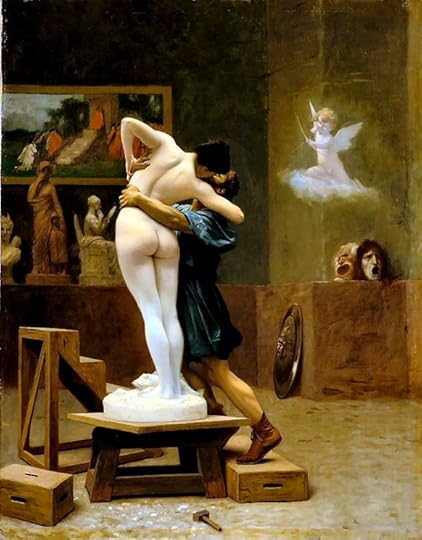
I am not sure that it is even right to call this a translation. Sometimes, Hughes follows the original pretty closely; sometimes he illuminates ancient ideas with the language of the nuclear age; often, he introduces passages that are entirely his own. As an example, let's look at a few lines from the opening account of the creation of the world and the early history of mankind. After describing the Ages of Gold, Silver, and Bronze, Ovid comes to the Age of Iron. Here is the beginning of the passage in the original Latin:
de duro est ultima ferro.And here it is in an early 18th-century translation by Sir Samuel Garth, John Dryden, and others:
protinus inrupit venae peioris in aevum
omne nefas: fugere pudor verumque fidesque;
in quorum subiere locum fraudesque dolusque
insidiaeque et vis et amor sceleratus habendi.
[vela dabant ventis nec adhuc bene noverat illos
navita, quaeque prius steterant in montibus altis…]
Hard steel succeeded then:Finally, here is the same passage from Hughes:
And stubborn as the metal, were the men.
Truth, modesty, and shame, the world forsook:
Fraud, avarice, and force, their places took.
[Then sails were spread, to every wind that blew.
Raw were the sailors, and the depths were new…]
Last comes the Age of IronThree things to note: Hughes' layout, his language, and his invention. In place of Ovid's heroic hexameters or the regular meter of earlier translators, Hughes paints freely upon the page, sometimes continuing in quasi-regular stanzas for a page or more, sometimes with wide variations of line length. Note how effective is the separation of "Modesty, Loyalty, Truth" to give each word a single line. And his language: "out of their dens in the atom… into the orbit of a smile." He draws imagery from physics or microbiology, from late 20th-century life, that Ovid could never have known. But he does it often in lines that Ovid did not even write; there are ten lines here—ten brilliant lines—that have no equivalent in the original at all; note how he gets back to some sense of regularity when he returns to direct translation.
And the day of Evil dawns.
Modesty,
Loyalty,
Truth,
Go up like a mist—a morning sigh off a graveyard.
Snares, tricks, plots come hurrying
Out of their dens in the atom.
Violence is an extrapolation
Of the cutting edge
Into the orbit of the smile.
Now comes the love of gain—a new god
Made out of the shadow
Of all the others. A god who peers
Grinning from the roots of the eye teeth.
[Now sails bulged and the cordage cracked
In winds that still bewildered the pilots…]
======

Poussin: The Triumph of Bacchus
Some of Hughes' flights of fantasy are truly marvelous. Near the beginning of the story of Bacchus and Pentheus, there is a short passage—three lines of Latin, four in the Garth/Dryden translation—describing the frenzy when the young god comes to town:
For now through prostrate Greece young Bacchus rode,Hughes, however, expands Ovid's three lines to eighteen, a headlong tumble of invention that surely channels the Browning of The Pied Piper of Hamelin:
Whilst howling matrons celebrate the God:
All ranks and sexes to his Orgies ran,
To mingle in the pomps, and fill the train.
The god has come. The claustrophobic landscape"Physicians, morticians, musicians, magicians"—Hughes is worth reading for such language alone.
Bumps like a drum
With the stamping dance of the revellers.
The city pours
Its entire population into the frenzy.
Children and their teachers, labourers, bankers.
Mothers and grandmothers, merchants, agents,
Prostitutes, politicians, police,
Scavengers and accountants, lawyers and burglars,
Builders, laybouts, tradesmen, con-men,
Scoundrels, tax-collectors, academicians,
Physicians, morticians, musicians, magicians,
The idle rich and the laughing mob,
Stretched mouths in glazed faces,
All as if naked, anonymous, freed
Into the ecstasy,
The dementia and the delirium
Of the new god.
======

Kevin McLean: Cinyras and Myrrha
I mentioned that many of my favorite stories were absent. But there were some that were real discoveries. None less than the tale of Myrrha, who, in an inversion of the usual incest stories, is consumed by the carnal desire to have sex with her father. Eventually, she gets her nurse to sneak her into his bed every night for a week, while her mother is away. On the last night, her father Cinyras takes a light to see who is this mysterious girl who has been offered to him. Myrrha flees from his wrath and wanders for nine months, at the end of which she is turned into a tree, the myrrh bush, in the very act of giving birth to Adonis.

Luigi Garza: The Birth of Adonis
A horrible subject, and Ovid makes the most of it. It is masterly how he handles the suspense, first of all warning the reader not to go any further, then building up the psychological anguish in Myrrha's mind. It combines the technique of a horror movie with the sexual pathology of the Salome of Oscar Wilde and Richard Strauss. Hughes has no need to add or embellish; he merely has to translate. Here is a short section: first a few lines in the Garth/Dryden translation:
'Twas now the mid of night, when slumbers closeAnd then the Hughes:
Our eyes, and sooth our cares with soft repose;
But no repose cou'd wretched Myrrha find,
Her body rouling, as she roul'd her mind:
Mad with desire, she ruminates her sin,
And wishes all her wishes o'er again…
Midnight. Mankind sprawledShe tries to resolve it by hanging herself, but is rescued by her nurse, who winkles the secret out of her and realizes that the only way to save her is to help her bring her wish about. This is perhaps an extreme example, but it bears out another point that Hughes makes in his Introduction: "All Ovid wants is the story of hopelessly besotted and doomed love in the most intense form imaginable." And on that, Hughes delivers. Read it indeed—but I would suggest small doses!
In sleep without a care.
But Myrrha writhed in her sheets.
To cool the fiery gnawings throughout her body
She drew great gasping breaths.
They made the flames worse.
Half of her prayed wildly—
In despair under the crushing
Impossibility—and half of her coolly
Plotted how to put it to the test.
She was both aghast at her own passion
And reckless to satisfy it.
Like a great tree that sways,
All but cut through by the axe,
Uncertain which way to fall,
Waiting for the axe's deciding blow,
Myrrha,
Bewildered by the opposite onslaughts
Of her lust and her conscience,
Swayed, and waited to fall.
Either way, she saw only death.
Her lust, consummated, had to be death;
Denied, had to be death.

August 27, 2008
I've not read any other translations of Ovid and I don't know Latin, so I have little choice but to take these selections from the Metamorphoses at face value.
That value is very high: Hughes writes gripping, driving poetry that impatiently whips you along the narrative, with hardly a chance to catch your breathe sometimes. Faster paced than many a novel, there is no chance of being lulled to sleep by endless iambs here. Startling, powerful, often brutal metaphors pay no heed to shouts of "Anachronism!" and use whatever image suits Hughes' purpose. There is hardly a dull moment in the entire volume.
Anybody who thought narrative poetry was dead needs to think again: Hughes brought nature observation back to the fore-front of modern poetry with The Hawk in the Rain and subsequent volumes; here he rescues narrative verse from the Romantics and gives it to anybody who loves a good story.
Further - if you had no interest in the Classics before, you will after reading this.
I have to look back to Crow to find the previous volume of Hughes' poetical works that I responded to so uniformly positively.
That value is very high: Hughes writes gripping, driving poetry that impatiently whips you along the narrative, with hardly a chance to catch your breathe sometimes. Faster paced than many a novel, there is no chance of being lulled to sleep by endless iambs here. Startling, powerful, often brutal metaphors pay no heed to shouts of "Anachronism!" and use whatever image suits Hughes' purpose. There is hardly a dull moment in the entire volume.
Anybody who thought narrative poetry was dead needs to think again: Hughes brought nature observation back to the fore-front of modern poetry with The Hawk in the Rain and subsequent volumes; here he rescues narrative verse from the Romantics and gives it to anybody who loves a good story.
Further - if you had no interest in the Classics before, you will after reading this.
I have to look back to Crow to find the previous volume of Hughes' poetical works that I responded to so uniformly positively.

November 30, 2018
The last time I read this was 5 years ago. This book captures the flavour of Ovid’s Metamorphoses, from which it has adapted a small selection of its tales.
Back then, like now, I’m struck by the sharp, vivid imagery.
Four lines but you just know things aren’t going to go well from Semele. Semele is one of the many women who faces Juno’s wrath for her husband’s lust. Like the other tales here, the ending is tragic, and it’s only after reflection that the embroidered words jolt.
If you’re new to Ovid’s work this is a good place to start, but I warn you, as beautiful as the poetry is, the content in places can be very unsettling.
Back then, like now, I’m struck by the sharp, vivid imagery.
Juno rose from her throne
Like a puff of smoke from a volcano.
In a globe of whirling light
She arrived at the home of Semele.
Four lines but you just know things aren’t going to go well from Semele. Semele is one of the many women who faces Juno’s wrath for her husband’s lust. Like the other tales here, the ending is tragic, and it’s only after reflection that the embroidered words jolt.
If you’re new to Ovid’s work this is a good place to start, but I warn you, as beautiful as the poetry is, the content in places can be very unsettling.

November 5, 2014
Loved these. Greek and Roman myths are some of my favourite things to read. I don't know how much was Ovid's original and how much was Hughes' translation, but it felt like a perfect blending of the two.

March 24, 2011
If I had picked up this book without ever having read the tales of Ovid, I might have enjoyed it merely for the fantastic stories of transformation, which are engagingly told in a rhythm that seemed more modern than timeless to me. But since I was already familiar with the tales, what really kept me turning the pages was Ted Hughes' creativity as a translator. Throughout the book there are passages that startled me with vivid imagery. His use of anachronistic language and concepts made me change my mind over and over again about whether or not I "liked" the translation. In the end, I realized my liking was irrelevant, Hughes had done his poet's work in making me read an old text in a new way.
Here is a comparison of Hughes' translation to the same passage translated by Dryden:
So now Jove set his mind to the deletion
Of these living generations. He pondered
Mass electrocution by lightning.
But what if the atoms ignited,
What if a single ladder of flame
Rushing up through the elements
Reduced heaven to an afterglow?
(Hughes)
Already had he toss'd the flaming brand;
And roll'd the thunder in his spacious hand;
Preparing to discharge on seas and land:
But stopt, for fear, thus violently driv'n,
The sparks should catch his axle-tree of Heav'n.
Remembering in the fates, a time when fire
Shou'd to the battlements of Heaven aspire,
And all his blazing worlds above shou'd burn;
And all th' inferior globe to cinders turn.
(Dryden)
I love this comparison, because it shows me that Hughes was not just translating words, but meanings and feelings. Uncontrolled fire is not frightening today in the same way it was in the 17th century, so Hughes conjures imagery of the electric chair and nuclear chain reaction. Had Hughes lived long enough to the see the completion of the Large Hadron Collider, I imagine his Jove might have worried about unleashing a singularity able to consume heaven and earth in a black hole!
I still love the Dryden translation. It is comfortable and familiar and the first I read, but it no longer has the power to shock me the way Hughes' translation sometimes did. I only wish Hughes' translation had been more complete. (He only translated 24 tales.)
Here is a comparison of Hughes' translation to the same passage translated by Dryden:
So now Jove set his mind to the deletion
Of these living generations. He pondered
Mass electrocution by lightning.
But what if the atoms ignited,
What if a single ladder of flame
Rushing up through the elements
Reduced heaven to an afterglow?
(Hughes)
Already had he toss'd the flaming brand;
And roll'd the thunder in his spacious hand;
Preparing to discharge on seas and land:
But stopt, for fear, thus violently driv'n,
The sparks should catch his axle-tree of Heav'n.
Remembering in the fates, a time when fire
Shou'd to the battlements of Heaven aspire,
And all his blazing worlds above shou'd burn;
And all th' inferior globe to cinders turn.
(Dryden)
I love this comparison, because it shows me that Hughes was not just translating words, but meanings and feelings. Uncontrolled fire is not frightening today in the same way it was in the 17th century, so Hughes conjures imagery of the electric chair and nuclear chain reaction. Had Hughes lived long enough to the see the completion of the Large Hadron Collider, I imagine his Jove might have worried about unleashing a singularity able to consume heaven and earth in a black hole!
I still love the Dryden translation. It is comfortable and familiar and the first I read, but it no longer has the power to shock me the way Hughes' translation sometimes did. I only wish Hughes' translation had been more complete. (He only translated 24 tales.)

February 9, 2010
This is not really a "translation," since in rendering certain well known stories from the Metamorphoses into English Hughes makes up stuff out of thin air, sometimes quite a lot of material that is nowhere found in Ovid's Latin text.
But why should that be a problem? This is a thoroughly enjoyable piece of work, one that effectively captures the essence of Ovid's brilliant style: the shifting narrative tones, authorial interventions, subtle (and not so subtle) ironies, and storytelling that is fast-paced, sensuous and vivid. If you cannot read Ovid's Metamorphoses in Latin, this is as close as you can get to it in English.
Dare I say that Hughes is as brilliant in English as Ovid is in Latin? Only a world class poet of unsurpassed skill would attempt to do what Hughes has done here, and it is breathtakingly successful. It has been remarked that translation is like a woman. If it is beautiful, it is not faithful. If it is faithful, it is most certainly not beautiful. Suffice it to say that Hughes' woman here is a stunningly gorgeous one night stand.
Highly recommended.
But why should that be a problem? This is a thoroughly enjoyable piece of work, one that effectively captures the essence of Ovid's brilliant style: the shifting narrative tones, authorial interventions, subtle (and not so subtle) ironies, and storytelling that is fast-paced, sensuous and vivid. If you cannot read Ovid's Metamorphoses in Latin, this is as close as you can get to it in English.
Dare I say that Hughes is as brilliant in English as Ovid is in Latin? Only a world class poet of unsurpassed skill would attempt to do what Hughes has done here, and it is breathtakingly successful. It has been remarked that translation is like a woman. If it is beautiful, it is not faithful. If it is faithful, it is most certainly not beautiful. Suffice it to say that Hughes' woman here is a stunningly gorgeous one night stand.
Highly recommended.

June 23, 2011
Ted Hughes' translation/interpretation of some of the tales from Ovid's Metamorphoses is a really good example of the way translation is always an interpretation -- he's played to that, and used anachronistic images and modern language, and created something dynamic and energetic and entirely his. It's much like the way Seamus Heaney and Simon Armitage took Beowulf and Sir Gawain and the Green Knight and used their own dialects to flavour it, bringing in what felt appropriate to them and what might make the old stories more interesting to a modern audience. You might disagree with the decision, but the vitality is undeniable.
The stories themselves, well, they've always been some of my favourite mythology. Ted Hughes didn't translate all of these stories -- I really need a good version that does, perhaps for my Kindle -- but he translates some good ones. I love the story of Arachne, and there's a lot to be said for the story of Pygmalion or Midas or... Yeah, I just kind of love Ovid.
The stories themselves, well, they've always been some of my favourite mythology. Ted Hughes didn't translate all of these stories -- I really need a good version that does, perhaps for my Kindle -- but he translates some good ones. I love the story of Arachne, and there's a lot to be said for the story of Pygmalion or Midas or... Yeah, I just kind of love Ovid.

April 19, 2015
Wat hou ik van deze verhalen. Sommige vertellingen herinnerde ik me nog omdat ik ze ooit als tiener uit het Latijn moest vertalen. Ik vertelde 3 verhalen - Phaeton, Callisto & Arcas en Echo & Narcissus- ook aan mijn zonen omdat ze zo mooi en magisch zijn.
How I loved reading these tales. I remembered some of them because I had to translate them from Latin as a teenager. I told three stories - Phaeton, Callisto & Arcas and Echo & Narcissus - to my sons because they're so beautiful and magical.
How I loved reading these tales. I remembered some of them because I had to translate them from Latin as a teenager. I told three stories - Phaeton, Callisto & Arcas and Echo & Narcissus - to my sons because they're so beautiful and magical.

February 19, 2014
Having only previously read Ovid's love poems, I find this work illuminating. Here is his talent, his way with words, the reason for his legacy. My favorite quotes were:
From the Age of Gold (in Four Ages)
"Cities had not dug themselves in
Behind deep moats, guarded by towers.
No sword had bitten its own
Reflection in the shield. No trumpets
Magnified the battle-cries
Of lions and bulls
Out through the mouth-holes in helmets."
From the Age of Iron
"Now sails bulged and the cordage cracked
In winds that still bewildered the pilots.
And the long trunks of trees
That had never shifted in their lives
From some mountain fastness
Leapt in their coffins
From wavetop to wavetop,
Then out over the rim of the unknown."
From the Age of Gold (in Four Ages)
"Cities had not dug themselves in
Behind deep moats, guarded by towers.
No sword had bitten its own
Reflection in the shield. No trumpets
Magnified the battle-cries
Of lions and bulls
Out through the mouth-holes in helmets."
From the Age of Iron
"Now sails bulged and the cordage cracked
In winds that still bewildered the pilots.
And the long trunks of trees
That had never shifted in their lives
From some mountain fastness
Leapt in their coffins
From wavetop to wavetop,
Then out over the rim of the unknown."

November 1, 2020
Hughes has managed to preserve the essence of Ovid's own text, while still imbuing the work with a distinct Hughesian touch. I also liked the selection of tales, and as each one one wrapped up to a finish, I found myself waiting for the expected metamorphosis that either offered some sort of solace for the reader, or gave me an etymological Eureka moment. If you love Greek mythology, this book illustrates these tales in a beautifully lucid and scintillating way.

January 4, 2025
I understand why Ted Hughes was poet laureate.

July 22, 2025
I loved this translation!! It made the stories feel so alive

April 15, 2009
nothing against ted hughes, or ovid, but i just get bored after a while. partly because of all the long crazy greek names and the fact that i'm supposed to know who these people and places are, which i don't (and don't care to) and partly just because after the first couple it's really easy to see where things are going (or at least how things are going to get there). some of the stories work better than others... callisto and arcas is pretty devastating, and tereus is amazing, and there are lots of great other moments and the guy has ideas like nobody's business, but in general it just sort of feels like everything turns into everything else and so on and so on and so on, without beginning or end or rhyme or reason... which i suppose is sort of the point, philosophically / theologically / storytellalogically / whateverally... sort of unsatisfying to me, though, after a while, and actually made me a bit queasy. it also sorta made me want to read auerbach's Mimesis The Representation of Reality in Western Literature again.
i've read other translations of ovid, meanwhile, and i have to say this one certainly is... muscular. it reads more like the iliad than i would expect. but whatever, i'm no classicist.
i've read other translations of ovid, meanwhile, and i have to say this one certainly is... muscular. it reads more like the iliad than i would expect. but whatever, i'm no classicist.

September 27, 2018
Like you, like us all, I've been meaning to read the Metamorphoses for, like, ever. The intro to this gorgeously-translated edition highlights the intense passion with which Ovid was so preoccupied, and the ways that's resonated across millennia is pretty amazing. However, as with most classics, I don't feel I've got a lot to say on this one except: if you can put aside what a dick Ted Hughes was, you're in for something pretty fucking exceptional. I spent ages trying to find the "right" translation, and if this text isn't complete, it more than makes up for it in the intensity and diction of the writing. It reads easily, beautifully, and poetically while still capturing a raw depth to Ovid's words. Also Billy's my boy and this isn't new info but oh man Shakespeare had no new ideas love yall bye
April 3, 2025
Genuinely staggering. I wish I’d never read Birthday Letters before his other work so I could enjoy this genuine artistry in its purest form. Probably the best poetry collection I’ve encountered to date. Thank you Ollie for giving me this succulent dish.

June 8, 2015
i felt like the line and rhythm of the translation, or rather the poetry resulting from the translation, since i can't read latin, sagged a little in the middle before rebounding at the end. but yeah these are wonderful stories. they are themselves retellings and expansions of foundational myths, based on who knows what, then retold and expanded themselves, and constantly reborn and dismantled.
these versions bring across the insanity and magic of desire so well. also totally PG-13. hella people dying in convoluted brutal ways.
these versions bring across the insanity and magic of desire so well. also totally PG-13. hella people dying in convoluted brutal ways.

June 26, 2014
Hughes is one of the great English poets of the 20th century, a terrific translator, and an inventor of his own mythology. His selection from Ovid's masterpiece is no substitute for the full version, but it's a powerful, satisfying recapitulation of the most famous episodes.

February 23, 2015
This is a selection of poems from Ovid's "Metamorphoses," and not the whole work. That said, Ted Hughes was a great poet in his own right and captures Ovid's flair and sardonic charm. Though there are complete translations of the "Metamorphoses" out there (including an excellent translation by Rolfe Humphries), this would be my first choice for someone wanting to get a good taste of Ovid.

February 17, 2021
kiss my ass ted hughes

August 25, 2019
I read this several days ago whilst in Cornwall, not all at once. Having just finished The Metamorphoses I found this in an Oxfam charity shop in Devon (prior to then travelling to Cornwall, where I proceeded to read it on the beach). During my time reading both this and through the Metamorphoses, ironically, I've been facing some changes in my life (not quite being changed into a bird or a rock by the Gods) but certainly some changes, large enough to seem significant. I always find it odd how what one reads reflects their life. I think that's the sign of a good book, unless it's just us looking for connections in what we read to make ourselves feel better, I don't know.
Anyway. This was damn good. Hughes' 'Full Moon and Little Freida' is one of my favourite poems and his collection Birthday Letters completely rocked me when I read it so taking the awesomeness of Ovid's Metamorphoses and having Hughes rewrite them, I was there. And I was glad to be there. Hughes is perfect for this. His love and talent for writing about nature plays hand-in-hand with the myths. I cannot possibly remember and write down all the best lines, but there were some that stand out. The first line, that excited me, which made me realise how much I was going to love it was this, on page 9:
'No sword had bitten its own
Reflection in the shield.'
That's some beautiful, and cool, imagery right there. The way Hughes wrote Narcissus was fantastic too, he cries to himself,
'I torture myself. What am I doing to myself -
Loving or being loved?'
Or how tragically he writes too, like when Tereus realised he had eaten his children, Hughes writes:
'He staggered about, sobbing
That he was the tomb of his boy.'
I could go on. This is often described as a good introduction to Ovid, in which case I have read them the wrong way round. This only includes 24 myths compared to the over 100 in the Metamorphoses. Hughes has apparently chosen his favourite, or the most important, to try his hand at. I won't comment on which is better to read first, this is far easier and far shorter. I was glad, however, to have read Ovid's first and then seen Hughes' remakes, so to speak.
Either way, Hughes has proven again to be a very good poet. But maybe, he's still not a very good man.
Anyway. This was damn good. Hughes' 'Full Moon and Little Freida' is one of my favourite poems and his collection Birthday Letters completely rocked me when I read it so taking the awesomeness of Ovid's Metamorphoses and having Hughes rewrite them, I was there. And I was glad to be there. Hughes is perfect for this. His love and talent for writing about nature plays hand-in-hand with the myths. I cannot possibly remember and write down all the best lines, but there were some that stand out. The first line, that excited me, which made me realise how much I was going to love it was this, on page 9:
'No sword had bitten its own
Reflection in the shield.'
That's some beautiful, and cool, imagery right there. The way Hughes wrote Narcissus was fantastic too, he cries to himself,
'I torture myself. What am I doing to myself -
Loving or being loved?'
Or how tragically he writes too, like when Tereus realised he had eaten his children, Hughes writes:
'He staggered about, sobbing
That he was the tomb of his boy.'
I could go on. This is often described as a good introduction to Ovid, in which case I have read them the wrong way round. This only includes 24 myths compared to the over 100 in the Metamorphoses. Hughes has apparently chosen his favourite, or the most important, to try his hand at. I won't comment on which is better to read first, this is far easier and far shorter. I was glad, however, to have read Ovid's first and then seen Hughes' remakes, so to speak.
Either way, Hughes has proven again to be a very good poet. But maybe, he's still not a very good man.

May 28, 2022
This was such a great introduction to Ovid’s poetry! My high school English teacher recommended this translation and the excerpts and writing make the Metamorphoses so much more accessible. Occasionally the translation can be a bit modern but it makes for such easy reading. If like me you haven’t read the myths of Pygmalion or Arachne yet this is your chance!
August 4, 2022
this poetry collection reminds me very much of the 2020 movie ‘emma’ - a modern adaptation that perfectly captures the essence of the original text while breathing new life into it for modern audiences

August 19, 2026
Read in Potsdam. Was stunned by the Introduction as well.

September 28, 2023
THIS WAS SO GOOD. I absolutely recommend this to anyone who studies or is interested in Classics. It absolutely reads like some fruity translation of Catullus. It is so rich and dense with figurative and beautiful language. It reads...well like if Ovid and Ted Hughes wrote a book together!

October 8, 2025
Absolutely exceptional.
Ovid's Metamorphoses contains some of the foundational myths of European culture: Midas turning everything he touches to gold; Arachne transformed into a spider for her presumptuously brilliant weaving. Shakespeare used Ovid as a source several times, notably in Titus Andronicus and in the Pyramus & Thisbe play within Midsummer Night's Dream. GB Shaw used Pygmalion as the basis for the play that later became the film My Fair Lady.
Here are a couple of dozen highlights, rendered by Hughes in a sinewy language that doesn't feel like a translation at all. It's immediate, powerful and extraordinarily vivid - see the personification of Hunger in the tale of Erisychthon; or the racing speed of Atalanta.
It's a strange world: the Gods are haughty, arbitrary and full of pride, equally likely to bless humans or damn them with cruel punishments. Jupiter, the greatest of the gods, is apt to pounce on any woman who takes his fancy. But more scientific explanations of the natural world, or of the randomness of luck falling on us, don't last in the memory and imagination half so long.
Ovid's Metamorphoses contains some of the foundational myths of European culture: Midas turning everything he touches to gold; Arachne transformed into a spider for her presumptuously brilliant weaving. Shakespeare used Ovid as a source several times, notably in Titus Andronicus and in the Pyramus & Thisbe play within Midsummer Night's Dream. GB Shaw used Pygmalion as the basis for the play that later became the film My Fair Lady.
Here are a couple of dozen highlights, rendered by Hughes in a sinewy language that doesn't feel like a translation at all. It's immediate, powerful and extraordinarily vivid - see the personification of Hunger in the tale of Erisychthon; or the racing speed of Atalanta.
It's a strange world: the Gods are haughty, arbitrary and full of pride, equally likely to bless humans or damn them with cruel punishments. Jupiter, the greatest of the gods, is apt to pounce on any woman who takes his fancy. But more scientific explanations of the natural world, or of the randomness of luck falling on us, don't last in the memory and imagination half so long.

March 28, 2014
As I was reading this, I kept taking pictures of some parts of the text and sending them over to some of my friends. At one point, one of my friend was like, "The f*** you're reading?" That is exactly how it feels to read this. Entertaining but insane. At least now I know where Shakespeare got his inspiration for Romeo & Juliet (read: Pyramus and Thisbe).
There are some obvious anachronisms in Ted Hughes's translation but the whole thing flows better for it. I also don't think I would have got as much from the stories had they been written with the stiff language some earlier translations have.
There are some obvious anachronisms in Ted Hughes's translation but the whole thing flows better for it. I also don't think I would have got as much from the stories had they been written with the stiff language some earlier translations have.

February 1, 2014
Myth can pretty much encapsulate everything through the device of archetypes - and that is what Ovid does. Then comes the psychological interpretation of Ted Hughes to elucidate and modernise these archetypes. These are tales of psychological metamorphosis - and probably my favourite book of poetry.

May 18, 2021
Wow wow wow, cannot emphasize enough how beautifully written this book is, this definitely brought me a lot of comfort during exam season and something to look forward to at the end of my day.
Baring in mind that I have yet to read Ovid's Metamorphoses, but this definitely rose a high interest for the original book in me.
Baring in mind that I have yet to read Ovid's Metamorphoses, but this definitely rose a high interest for the original book in me.

March 30, 2018
Good intro to Ovid. More than just a translation--think of it as cover song with the added touch that gives it new life. Passionate, very passionate (the dude was married to Sylvia Plath, he learned from the best).
Displaying 1 - 30 of 225 reviews