Pierre Teilhard De Chardin was one of the most distinguished thinkers and scientists of our time. He fits into no familiar category for he was at once a biologist and a paleontologist of world renown, and also a Jesuit priest. He applied his whole life, his tremendous intellect and his great spiritual faith to building a philosophy that would reconcile Christian theology with the scientific theory of evolution, to relate the facts of religious experience to those of natural science.
The Phenomenon of Man, the first of his writings to appear in America, Pierre Teilhard's most important book and contains the quintessence of his thought. When published in France it was the best-selling nonfiction book of the year.
Pierre Teilhard de Chardin was a French Jesuit priest, paleontologist, philosopher, mystic, and teacher whose life bridged science and spirituality in a unique synthesis that continues to inspire and provoke debate. Born into an intellectually and culturally rich family, with a father passionate about natural science and a mother whose lineage traced back to Voltaire, he was the fourth of eleven children and demonstrated early curiosity for geology, biology, and the natural world. He entered the Jesuit novitiate in 1899, studied literature and theology, and combined his religious vocation with an insatiable scientific drive, ultimately earning degrees in geology, zoology, and botany from the University of Paris. His early academic career included teaching physics and chemistry in Cairo and developing a strong foundation in paleontology, which later led him to China, where he collaborated with Émile Licent and others in geological surveys and excavations, most notably participating in the discovery of the Peking Man fossils at Zhoukoudian, which became a cornerstone of his reputation. Throughout his scientific work, Teilhard maintained a commitment to integrating evolutionary theory with Christian thought, producing essays and books that articulated a vision of the cosmos as a process of increasing complexity and consciousness, culminating in what he termed the Omega Point, a future unification of humanity and divinity. He served as a stretcher-bearer during World War I, receiving the Médaille militaire and the Legion of Honor, experiences that deepened both his spiritual reflections and his appreciation for human resilience. Despite repeated censorship and opposition from the Catholic Church, including prohibitions against publishing certain works and teaching assignments, he persisted in writing, producing influential works such as The Phenomenon of Man and The Divine Milieu, which attempted to reconcile scientific understanding, evolution, and the unfolding of divine purpose, offering a cosmic theology in which Christ is the unifying principle guiding the development of matter, life, and consciousness. His ideas on the noosphere, human evolution, and spiritual convergence provoked both admiration and criticism, drawing praise from thinkers such as Julian Huxley and Theodosius Dobzhansky for his visionary approach, while others, including Peter Medawar and Richard Dawkins, challenged the scientific rigor of his philosophical synthesis. Teilhard traveled extensively, conducting research across China, Central Asia, India, and Java, collaborating with leading paleontologists and geologists, and contributing to the broader understanding of human prehistory, archaeology, and geology. His writings emphasized the interdependence of material and spiritual evolution, positing that human consciousness and social cooperation are critical for continued development, and that evolution is inherently teleological, moving toward greater unity and complexity. Though controversies surrounding his work persisted during and after his lifetime, including debates over his involvement in the Piltdown Man discovery, thorough historical review and correspondence have largely vindicated him, demonstrating his integrity as a scientist and a thinker. Teilhard de Chardin’s legacy is that of a bridge between disciplines, a thinker whose vision of a spiritually and scientifically coherent universe continues to inspire theologians, scientists, and readers seeking to understand the interplay of faith, reason, and the unfolding story of humanity. He died in New York City in 1955, leaving behind a body of work that remains widely read and influential, reflecting a life devoted to exploring the convergence of human, cosmic, and divine evolution in a single, unified vision.
I’ll start this review by asking: How prescient can one person be? Completing this book in 1940, de Chardin could not have predicted the Internet, but if you read about his concept of the “noosphere,” you realize that if he were alive today (b. 1881; d. 1955) he would look at the Internet and say “That’s it! I knew it would be something like that!” If you read science books and have not yet read Teilhard, you know what you need to do. Right or wrong, De Chardin is one of the few scholars who have even attempted to come up with an answer to the unanswerable question “what is the goal of evolution?" Few books I have read attempt to deal with such BIG thoughts.
And rather than attempt to summarize all his thinking, I’ll just try to catalog some of the things that in my opinion he predicted or prefigured in this work:
The very modern idea of the “Anthropocene” – the idea that the most modern geological era is due to human influence. Most recently promoted by Erle Ellis and others around 2012. De Chardin had the scientific creds: he was trained as a geologist and paleontologist and worked in China on the then-newly-discovered “Peking Man.”
De Chardin saw “The End of Nature” coming -- Bill McKibben, 1989. We humans are in control now; we are the main geologic agent, and if an animal species or a forest survives, it’s because we allow it to do so. “We Are Nature,” frightening as that may be.
De Chardin basically lays out the Gaia hypothesis: James Lovelock, Lynn Margulis, Andrew Watson, 1989. Organisms don’t just evolve in response to their environment but help shape it. Writ large, the earth is evolving into a self-regulating organism. The analogy of black and white daisies regulating the earth's temperature -- aka “Daisyworld” -- is an example.
When I was in grad school there was much discussion of General Systems Theory, especially Von Bertalanffy’s 1968 work of that name. All about hierarchy and how the whole is greater than the sum of its parts. In particular de Chardin notes the million-fold increasing levels of hierarchical complexity from atoms to molecules; from molecules to cells; from cells to organs; from organs to organisms; from organisms to brains and from individual human brains to the emerging collective noosphere.
Some of his thoughts about the rise of the West parallel many of those in Jared Diamond’s 1997 work Guns, Germs, and Steel (which also parallels a lot of Ellsworth Huntington’s 1945 work, Mainsprings of Civilization, minus the racism and heavy dose of environmental determinism of Huntington).
De Chardin also proposes the idea that nothing can evolve that is not incipient in its precedents. An inescapable conclusion is that rocks have feelings and molecules have thoughts. Naturally a lot of scientists have no use for his work. More on that below. He also prefigures many modern ideas such as that there can be no such thing as complete scientific objectivity.
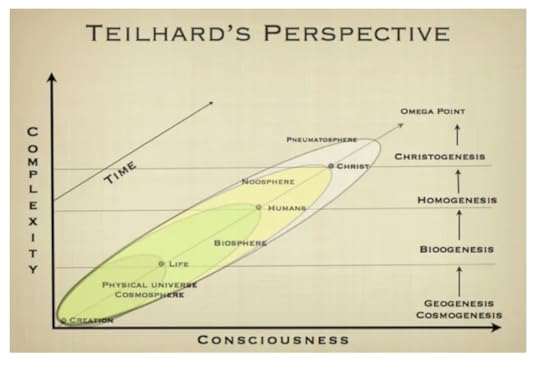
Teilhard’s main thesis, to the extent that it can be summarized in a couple of sentences, is that the divine-directed goal of evolution is the creation of a sphere of interconnected human thought that he calls the noosphere. “Sphere” is used in the same sense as atmosphere, lithosphere, hydrosphere. The noosphere is a collective interconnected human psyche and it’s a humane human psyche dependent upon interconnectedness and caring for one another. Human behaviors such as suicide, hard -drugs and isolation are its antithesis.
So here is a Catholic priest, a Jesuit, writing all this stuff. Yet I do not recall a single mention of the word God or Christ in the body of the work. Instead he writes of the Omega Point. He does talk about how the work relates to Christian doctrine in a postscript. Naturally this did not meet with the approval of the Church. De Chardin was banned from publishing his work while he was alive and at times was banned from teaching and from writing at all. He had arrangements with friends to publish his work after his death (1955) so this work was published in France in 1955 and translated into English in 1959.
Yet, ultimately the work is deeply religious. He argues at one point – I’m paraphrasing – 'Don’t worry about things like disastrous climate change, nuclear war, or a stray asteroid wiping out civilization --- CAN’T HAPPEN.'
The Purpose of cosmogenesis is noogenesis and the Purpose of noogenesis is Christogenesis. Another paraphrase: It seems to me you can interpret his work to say 'Yes, there is a God, we just haven't finished creating that Being yet.' He writes that you will have a lot less anxiety if you accept this idea that there is a Purpose to all this. The reader can see that in writing such things (not to mention rocks and molecules having incipient thoughts and feelings) most mainstream scientists dismissed him as readily as the Church did.
I like the fact that de Chardin did not attempt to carefully walk a tightrope between science and religion. He said what he had to say and therefore went “splat” on the sidewalk on both sides of the rope with no apologies.
Agree, disagree; this is one of the most thought-provoking books I have read. Certainly the noosphere is a concept that deserves thought. Will we end up like those grade-B sci-fi movies shown at 3:00 am -- brains in jars connected by wires? No, because with wi-fi we won’t need wires! Every month it seems we read of a new development connecting thoughts to computer devices – for those controlling robotic arms, for example. Can it be all that long before we can choose to “share” our brain waves with others?
[Revised 5/14/23]
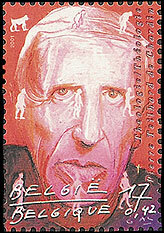
Top photo of the author from livingthequestions.com The author on a Belgian stamp from manresa-sj.org
Although he was a priest, in France he is best known for his work in paleontology, when he was a curator in the Museum of Natural History in Paris. He has rendered the subject of evolution easily accessible to all, and his point of view complements that of Darwin in many ways.
For example:
His Chapter called ‘The within of Things’ states the presence of a soul, even for the non-livings, which sounds like a common sense to me. The chapters ‘The rise of Consciousness’ and ‘The confluence of Thoughts’ echo what Jung had confirmed independently.
It may sound like an intellectual read, but it’s not. His modesty comes across all through.
Teilhard de Chardin was both a Jesuit priest and a paleontologist. He found that his scientific work supported his beliefs as a priest. His argument is of a stunning simplicity.
-1- matter organizes itself towards life -2- life organizes itself towards Christ -3- earthly matter has only transformed itself into living matter once and no longer does so -4- man cannot repeat the original transformation of matter into life in a laboratory
The implication of this is that the evolution of life on this planet is a divine process as much as it is a natural process.
This book intends to describe the past and future evolution of life. Many of the scientific concepts expressed in the first half of the book have been superseded by more recent developments.
For me, the main interesting concept in the book is the assertion that human consciousness is an aspect of evolution. Also that evolution has a goal, i.e. the increasing complexity of human consciousness (called noosphere) which will culminate in the final super-humanized form (p. 259) which the author calls the Omega point.
Since the author was trained as a priest, it would have been helpful if he had given insight as to why/how religion plays such a large part in human consciousness.
In spite of the three star rating, I do think this book is absolutely worth reading, and reading again. Chardin was an ordained Jesuit priest, but also a trained paleontologist who worked with the team that discovered the “Peking Man” fossils so just from those factors alone, the book is a must read. He offers a picture against both an atheist or, on the other side of the spectrum, a pantheistic perspective of evolution. The coherency of a world with a “personalising” God is something I do agree with. That science and faith do not necessarily conflict with one another is something I also, from the limited scope of my search, agree with. But how he gets there did not leave me convinced.
From what I understand, his main thought goes something like this: Evolution has been proven and he accepts it. As things have developed, they have evolved both radially and interiorly. The pressure from the outward expansion created a downward pressure that caused movement to double back upon itself, resulting in the interior rise of consciousness and complexity. Evolution is goal directed towards an outward movement towards the perfect, and at the same time inwardly towards complexity which all culminates in what he calls an “Omega Point”. I confess to not having studied science very much, but as far as I know, there is not much to back this up. He also confesses that the problem of evil poses, well, a problem, but offered no solution to how free will/determinism and evil play out in his picture. His defense for skipping over this was simply that it was too complex to be addressed in a work that was trying to offer a picture of homogeneity. At least he is honest?
Ultimately, this was a very interesting read and is something I will have to come back to after I learn more, but for now, three stars.
This was great reading in the first and third parts of the book…though the middle almost killed me with its technicality.
In the early 20th century, Pierre Teilhard became a forerunner in integrating evolution with a theistic worldview, but the greatest import of his work was that he took a dead-eye shot at predicting where naturalistic evolution was heading. Advancing beyond mere rosy humanism, Teilhard fervently believed in the eons-long progress of hominization—the coming to being of humanity. He expresses god-like patience by saying, “After all, half a million years, perhaps even a million, were required for life to pass from the pre-hominids to modern man—should we now start wringing our hands because, less than two centuries after glimpsing a higher state, modern man is still at [war] with himself?” This seems to be the real crux of the book. The spiraling paths of progress may not advance much in our lifetime, but the history of life in the universe has shown that progress is all the history of biological development has ever revealed. Speculate rather, how can there NOT be progress…unless life ceases to be altogether? We have no precedent for progress NOT being made in some corner of the universe. And while this development may appear to leave some species behind while focusing on a tiny growing tip of the universe, Teilhard develops the idea early that nothing in the universe is really detached from anything else. If we can accept that proposition, which he spends some time in constructing, then we can accept seeing (or being) an ostensibly forgotten tail, while the rest moves ‘ahead’. Absolutely no pun intended.
Teilhard writes to buttress hope in a ‘secret complicity between the infinite and the infinitesimal to warm, nourish and sustain to the very end…the consciousness that has emerged between the two. It is upon this complicity that we must depend’. Teilhard marvels at this ‘complicity’—what is it that causes objects in space, big and small, to attract to each other? He theorizes somewhat courageously that even the basic attraction of objects in the universe towards each other, to which we apply the name of gravity, is a type of materially evidenced ‘love’. This may sound romantic and completely absurd to our western sensibility, but as Dr. Sten Odenwald, astronomer at NASA's Goddard Spaceflight Center, stated on his website astronomycafe.net in reply to a question about our knowledge of gravity, “We don't really understand ANYTHING about our physical world at the deepest level, such as why does gravity exist?” Why couldn’t love, enlarged to subsume the law of mutual attraction that binds the universe together, seek also the unification and concord of human spirits? Would that really pose a problem in a cohesive theory of physical/relational life? To assume that love is merely an emotion, and that humanity is so different a phenomenon as the rest of nature, is to miss the mark. Teilhard boldly reasons, “The only universe capable of containing the human person is an irreversibly ‘personalizing’ universe.” And so the universe is, eo ipso, irreversibly personal. Shouldn’t that logically establish that human love has its root in a larger universal principle that has always existed, like everything else, from the beginning, in what Teilhard calls “an obscure and primordial way”?
Teilhard’s conception of an Omega Point of absolute human union (globalized love) is entirely pertinent in our culture of social networking. It represents the acme of human connections: relationship to the nth degree in what he calls the ‘noosphere’ (mind-sphere), a matrix of highly concentrated and involuted communication—or ‘inter-thinking’ as Julian Huxley put it in the intro. Modern globalization may be bringing us closer in the next century to Teilhard’s reckoning quicker than he could have imagined. When he adduced that ‘totalized love’ would be ‘impossible’ to envision by mere rational projection, it suddenly struck me, by all the signs of instant communication and complex social networking, as very possible indeed. Distance doesn’t dilute dreams…only our grasp of them. Once again, doesn’t all human progress signify the eventual emergence (evolution) of a perfect union? “A universal love is not only psychologically possible; it is the only complete and final way in which we are able to love.” This seems to me what we all want, what is woven into our religions and our highest technological/scientific aspirations, and yet some will laugh at it as if it was a silly dream. But nature has taught us to hope.
His views on the awakening human mind and self-awareness were certainly intriguing. I’ve always thought that the idea of a universe ‘groping’ towards consciousness and unified fulfillment through eons of evolutive progress is very romantic. The impression isn’t necessarily that God is waking up through a pantheistic becoming , but that the mind of God is somehow imprinted and bound together with the material/psychical world while extending beyond it (panentheism). The goal of awakening and full being is included in his Omega Point.
I was a little disappointed with the chapter “The Christian Phenomenon”, which seemed to toss his original ideas and intellectual tour de force into the catch-all, domestic doctrines of orthodox Catholicism. It was as if he was offering something truly novel, only to conclude with a unworthy bow, “The Church was right all along.” Uh, bait-and-switch anyone? Of course, knowing the history of Teilhard’s censorship by the church, this contriteness may have been what got the book in print after all. Now, I understand Teilhard’s trying to harmonize the symbolic content of religion with the flat data of science, but I’m pretty sure his work-a-day science did a good enough job paying tribute to his religious beliefs, possibly outstripping them a tad. By his own admission, his ideas weren’t meant to be taken as strictly science, but rather an ‘interiorisation of matter’, even leading some to wonder if he had been leading them “through facts, through metaphysics, or through dreams.” To which I think Teilhard would cheerily reply, ‘Yes.’ Criticizing any claim to pure objectivity he reminds us, “There is less difference than people think between research and adoration.”
I have a feeling that the thoughts and ideas introduced and reinforced by this book will be with me for a while. The more it sits with me, the more it makes a deeper change. As with every book I read, if you would like a copy of a few pages of great lines from the book, send me a message and I’ll get it to you. It’s great fodder for thought and discussion.
Chardin's posthumously published masterpiece is a must read for any student of science and or/theology. Being someone primarily on the theological side of those two, there were parts of this book that were more densely scientific than I'm used to reading. Yet, even in the most technical portions of Chardin's argument, the theological implications of his writing came through perfectly clear.
Chardin himself lived deeply in both the theological and scientific worlds as a paleontologist and geologist - he was a co-discoverer of the Peking Man - and Jesuit priest. Reading this book when I did, it was difficult not to think of the recent - and in my view absurd - debate between Ken Ham and Bill Nye. Once again religion and science were presented to the public as two rival systems: a state many of us find endlessly frustrating. Yet Chardin's work points in exactly the opposite direction. Here is a thorough study of human evolution that not only points to religion but ultimately to Christianity itself. For those who have read N.T. Wright's work, think of this book as the scientific backbone for Wright's Kingdom of God theology.
I doubt Chardin's book is well known among more fundamentalist and conservative Christians, but if it was I have no doubt he be branded a heretic - or at least seen as very suspicious - on account of his embracing the dreaded "e word". That's a shame, because this work can actually be seen as a defense for conservative Christianity (provided, that is, that we're using the adjective in a technical sense rather than a cultural one). Its conclusion argues not only for the truth of the Christian message but for its unique place among world belief. As St. Paul says in Romans 1, all creation points to God - a passage frequently quoted by conservative Christians but almost never in the sense Chardin takes it!
I say all this, not to take jabs at the Ken Ham crowd but as an expression of my ongoing hope that the false war between faith and science will end once and for all. My hope would be that people on that side would realize that someone like Chardin, with his use of evolution, is an ally not an enemy. While the fulfillment of that hope seems unlikely, history shows clearly that it is by no means impossible. After all, Chardin was once condemned by the Catholic Magisterium, only to later be embraced by many of Catholicism great thinkers - including John Paul II and Benedict XVI
I read this years ago and I remember it blowing my mind. However, I was not as knowledgeable about certain scientific subjects as I am now so I do believe a re reading is in order. I have forgotten most of the book but there are certain images that have stuck with me throughout my life. The idea of evolution being a physical manifestation of the ever increasing complexity of consciousness is one of those ideas. It is definitely a very entertaining read but like all works of man that have to do with the deepest understandings of the universe and life, it is most likely flawed and lacking in certain respects. This is undoubtedly no fault of the man himself but just a reflection of the limits of human knowledge.
"Let us then acknowledge the situation honestly: not only the "Imitation of Christ" but also the Gospel itself needs to undergo this correction, and the whole world will make them undergo it." (T. de Chardin) in: The Sheer Silliness of Teilhard de Chardin by Damien F. Mackey
Some may doubt his Christianity. His science doesn't pose problems, yet. Apparently.
I've known Teilhard de Chardin's name and influence even long before I became interested in religion myself, and this book was a long time in coming. And a long time in finishing, it just didn't woo me.
His prose is stronger than his argument. His science is not up to modern standards, but nor in many ways his own. What continuously bothered me was how often he resorts to normative statements, analogies between unrelated things and such to make both scientific and theological claims. Yes, evolution resembles a tree (if you graph it on paper) but that does not make it a tree.
All in all, very proto-New Age stuff to me. Fanciful analogy. I don't dislike his attempt at a synthesis or a grand scope of things, only the result.
I kept this book over 20 years regularly and doggedly reading it a few hours here and there. Pierre is supposed to be a Catholic Jesuit French priest who lived in China and other places. He always lived with other priests, and he seemed to change countries according to who his favorite priest friend was. He is supposed to be a Mystic. I found his writing to be obtuse and dense and nonsensical and pretentious although he asked a few good questions on the human phenomenon. I finally donated his book to the Salvation Army, hoping that someone else could discover in it what I could not. I think he was just a fifties fad like the hula hoop.
This book changed my view of both religion and science, areas in which Teilhard was expert. His explanation of the convergence of the two over many millenia is breathtaking in its scope and novelty. Reading this book was life-changing for me.
Pierre Teilhard de Chardin, in The Phenomenon of Man, wrote an enormously influential book. First published in French in 1955, it is still a landmark today. In fact, many modern ideas might fall into place on reading this book. I here review the 1970 revised English edition, which is still widely available.
First, I ran a core, five-page section of the book through computer analysis, to get an idea of its difficulty: BOOK 3, CHAPTER II. 3, The Attributes of the Omega Point. The verdict: one would do well to have studied Philosophy 101 to read this book—better, have a Bachelor of Philosophy degree.
Teilhard de Chardin was a Jesuit Father, and highly regarded as a palaeontologist. He accepted Darwinian evolution as a given. However, classic Darwinism, he writes, proceeds by “strokes of chance”, so that it cannot in itself offer meaning or hope for life. Nor can it explain, in his view, the emergence of mind.
But apart from Darwin, writes Teilhard, there is a purposive process of evolution, which he refers to as “cosmogenesis”—and within such cosmogenesis, the emergence of mind takes place, a process which he refers to as “noogenesis”. This is not merely the evolution of the individual mind, but of the collective sphere of mind on the planet, which he refers to as the “noosphere”.
Such evolution is not directionless. “Mankind in its march” is headed for a final destination, the “Omega point”, or “peace”. At this point, the noosphere will be intensely unified, having achieved a “hyper-personal” organization. This does not mean that humans will become “more highly individualized”, but “an organism which has transcended individuality”.
There are parallels here with contemporary theology. The missiologist Charles van Engen proposes a Kingdom of God which moves with “impelling force” (compare Teilhard’s “march”) towards an “anticipatory focal point” (compare Teilhard’s “Omega point”)—the goal of which is “shalom” (compare Teilhard’s “peace”). In fact, once one is on the lookout for such parallels, one sees them everywhere.
But Teilhard, in another way, might have become more relevent today than he ever was. He writes that we are on a journey of “emancipation”, to be “liberated from phyletic servitudes”. Compare the philosopher Max Horkheimer’s definition of Critical Theory: “the struggle for human emancipation”. It is an outlook which drives much of what we see today—further explored in my own work.
However, there are major problems in Teilhard’s thought, and one does not need to come to his book as an independent outsider to find them. They are inside the covers of the book itself, without reference to external views.
1. He calls his work a “scientific treatise”. Yet he points out that science, by and large, would oppose his views: “The majority of ‘scientists’ would tend to contest the validity of [my views].” “Nine biologists out of ten will today say no.” And “we cannot dream of expressing the mechanism of [emergent] evolution”.
2. He continually expresses fundamental doubt about his own ideas. While on the one hand, he claims to have an “invincible” scheme, on the other hand he considers: “The views I am attempting to put forward are … largely tentative”. “We must resign ourselves to being vague in our speculations.”
3. On the one hand, Teilhard writes about “mankind in its march” of purposive, emergent evolution. On the other hand, this evolution “can give itself or refuse itself”. If we fail to nurture it, “the whole of evolution will come to a halt”. On what basis, then, should we have much confidence in it?
4. Teilhard clearly does not know what to do with suffering. In fact he relegates it to an Appendix. What are we to make of it? He writes, “Necessarium est ut scandala eveniant”. It is a necessary scandal. “Suffering and failure, tears and blood: so many by-products … begotten by the noosphere on its way.” Where, then, is comfort for the suffering and oppressed?
Una lectura muy estimulante desde el punto de vista filosófico y especulativo, aunque sus premisas no nos puedan parecer acertadas. Conseguir algo así tiene mucho mérito.
Essential reading for anyone interested in evolution, theology, or philosophy in general. I personally approached it more interested in its spiritual concepts, so I found a fair portion of the middle of the text rather slow and inaccessible due to its focus on the scientific specifics of evolution (details that are probably outdated today anyway, which doesn't help). But there are enough interesting lines, images, and trains of thought throughout to make the whole read worthwhile, and the last third of the book in particular gets into some really interesting (if brazenly biased) spiritual territory.
In my opinion, Teilhard is at his best when he explores overtly the spiritual reality of mankind, describing it with a sense of optimism and purpose while couching it in the evolutionary framework that he presents (and, to be fair, that is essentially the crux of the entire book, it just gets lost in the mix at times). Even when he wears his Christianity on his sleeve (which, while definitely a flaw in his otherwise fairly comprehensive system of thought, is kind of cute), it is apparent that he has nothing but the best at heart for his species: a sense of spiritual well-being and a connection with something greater (i.e. The Omega Point in this case--a head-scratcher of a notion, but it almost seems like one of the more reasonable (albeit still arbitrary) defenses for Jesus-as-the-divine-entering-into-the-world that I've heard). Much like Kierkegaard, Teilhard (what's with these -ard guys anyway?) constructs a wildly intriguing system of ideas around his faith system, and in doing so gets at some really important truths while completely missing out on others.
I would recommend this book with the qualification that recent integral philosophers present a more tenable approach to its key points (i.e. the "within" of things, evolution as increasing consciousness, etc.) and a more comprehensive view of evolution in general.
Well-written, intellectual, but wrong book. De Chardin tried to connect the unconnected things: Christianity, naturalism, pantheism and nietzscheanism. Allegedly, evolution and natural selection have led to the birth of men. In turn, men can become supermen and create the God by a method of merging. The author makes extremely doubtful assumptions. For example, an initial substance supposedly has a consciousness or spirit and this has led to the emergence of life. ??? In addition, de Chardin ignores many facts. In particular, natural selection reinforces the existing norm, and doesn't lead to the perfection/development of life. Random mutations lead to degradation and death as a rule (and not to the development). Human nature is depraved and puny (especially in comparison with the scale and age of the Universe).
It is a tragedy that Teilhard de Chardin was not allowed to publish or teach his ideas in his lifetime. His work is so steeped in a deep understanding of paleontology and evolutionary biology that it holds up remarkably well today, even if the sections of this book that deal with those particular topics seem very dated. His scientific background is really just a support for this book's philosophical/theological core, and that is the other thing that makes this book so striking: if you knew nothing of its background, you wouldn't realize you were reading the work of a Jesuit until Book 4, a few hundred pages in. Regardless of what you may believe religiously or know scientifically, this is deep thinking on human evolution that will challenge and inspire any reader.
Despite the hype, I found The Phenomenon of Man to largely consist of flawed, unsupported conclusions - except for the parts that were incomprehensible.
Pierre Teilhard De Chardin in The Phenomenon of Man develops a view of evolution as an enduring and comprehensive process, a three-fold synthesis of the material, physical and the world of the mind and spirit (consciousness; this somewhat reminds me of the development of consciousness via Hegel’s Phenomenology of Spirit). It is a fascinating read in terms of thinking about the leap(s) and development of human consciousness. Chardin’s Phenomenon of Man views the planet we live on as biosphere translated (Swiss) as “the face of the earth,” and being aware that we are not just living in one place in one country, but in space and time—we’re living on a globe. We’re living on the whole earth and the earth has a face and a kind of identity, almost physiognomy, like a person, like a cosmic person.
Chardin, a Jesuit (who fully embraced evolution as a paleontologist) developed his work, partly theological, but more so, a “scientific treatise”. He seeks to help the reader “to see and to make others see what happens to humankind and what conclusions are forced upon us, when we are placed fairly and squarely with the framework of phenomenon and appearance.” He progresses from [I] “Before Life Came” (the evolution of matter), [II] “Life” (advent, expansion, ramification and tree of life) [III] “Thought” (birth of, deployment of the Noosphere, the modern earth), and finally [IV] “Survival” (collective, beyond collective, ultimate earth).
The Noosphere is an astonishing development which Teilhard is known for. It’s depicted as proceeding from a Neolithic metamorphosis that has occurred through various factors such as incessant advances of multiplication (migrations), inventions of all sorts of communal and juridical structures (property, morals, social), the appetite for research (period of growth in research and invention, e.g., horticultural, pottery, writing, metallurgy ), and conquest (the flush of expansion. Over a brief period of time relative to evolutional time, there have emerged increased exchanges in commerce, transmission of ideas, traditions have become organized and a collective memory has been formed encircling the earth. This takes us into the leap and realm today of the whole region of cyberspace. There are even those who call Teilhard the patron saint of the World Wide Web. When you read the later part of this text, you have a sense that he foresaw this idea that we will intensify our communication.
It’s a fascinating awareness to reflect thus. The biosphere is the earth of the layer of living things and the noosphere is really about the layer of thinking beings and, in fact, of consciousness. Noos (Greek nous) is about synthesis and not our reason or analysis. It’s the self-thinking, and it’s the thinking that connects us. You catch his deep concern in the fourth book, Survival, where there is a fear that is the still emerging human. Here Teilhard was interested in where we are going as a species.
Teilhard sketched humans who existed in tiny groups having their separate symbolic systems, disconnected to each other; then, these grains of thought were coalescing which corresponds to increasing the scale of society. He thought that the earth is “becoming covered by myriads of grains of thought” and “enclosed in a single thinking envelope” forming “a single vast grain of thought on the sidereal scale, the plurality of individual reflections grouping themselves together and reinforcing one another in the act of single unanimous reflection” (251-2). This is a single global consciousness, the Hyper-Personal which he called the Omega Point.
IL FENOMENO UMANO (1a edizione, giugno 1968, Il Saggiatore-Mondadori Editore)
Padre Pierre Teilhard De Chardin (Ourcines (F) 1881 – New York (USA) 1955), gesuita, teologo, filosofo e paleontologo/antropologo. Immerso nelle grandi vicende del secolo scorso, così La cugina Marguerite lo descrive: «Per Pierre Teilhard la guerra fu, probabilmente, l’avvenimento decisivo della sua vita…”. (Pierre Teilhard De Chardin: Genesi di un pensiero. Lettere dal fronte, 1914-1919. Feltrinelli, 1966). Evoluzionista e animista, e in quanto tale un po’ “proibito”, gira tutto il mondo alla ricerca di dati e partecipa alla scoperta de “L’uomo di Pechino” (Homo erectus pekinensis, 1923-1927, 680.000 anni B.P.) Il fenomeno umano, (1938-1940; aggiunte nel 1947-1948) pubblicato postumo (1955) è, secondo gli studiosi di P. De Chardin, la sua opera principale. Il postulato di partenza è la “stoffa dell’universo”, la materia prima nello spazio e nel tempo già dotata di una sua ”coscienza/energia” (così definisce P. Chardin l’energia interiore delle particelle cosmiche secondo due vettori) dalla quale si originano tutte le forme materiali secondo modalità discrete e ben definite, da quelle infinitesimali, all’atomo, alla molecola, agli elementi naturali; una stoffa che evolve passo dopo passo verso tutti i materiali sempre più complessi dell’universo. E’ la Cosmogenesi e la Geogenesi. Nel passaggio critico dalla molecola alla vita, l’autore evidenzia la fase critica da una pre-vita macromolecolare ad una vita cellulare, fino a giungere alle forme più complesse di vita, evidenziando l’enorme importanza di questo passaggio, che ritiene unico ed irripetibile e che, a differenza di tanti altri accadimenti geologici e planetari periodici o ripetibili, gli appare dai dati scientifici come pulsazione unica, come “quantum primordiale unico”. E’ la Biogenesi, orientata sempre dalla stessa “coscienza/energia” primordiale che guida l’espansione delle infinite forme viventi. E c’è un momento geologico al vertice dell’albero filogenetico della vita quando questa coscienza tende a manifestarsi esternamente come pensiero, sviluppatosi nelle forme più complesse dei mammiferi terziari, forme sulle quali si concentra il suo sguardo: i Primati Antropoidi. Ma quando è nata la coscienza, la riflessione, il pensiero ? Fra gli Antropoidi della fine del Pliocene ed il successivo livello (Pleistocene-Olocene) dove appare l’uomo con i suoi primi manufatti e arti parietali, inizia ad affiorare l’autocoscienza, la riflessione, lo specchiarsi e lo specchiare tutto il creato in se stessi. Un salto qualitativo enorme a fronte di variazioni filogenetiche minori, ad eccezione del volume del cranio. Tutto ciò in tempi brevi secondo l’autore, entro poche generazioni ed in modo simile al processo che accompagna lo sviluppo della coscienza nell’ontogenesi di un bambino. La vita diventa pensiero. E’ la Noogenesi, che cambia di nuovo il pianeta in modo unico ed irripetibile, con una nuova discontinuità nella continuità, come lo fu con l’inizio della vita. Con l’evoluzione umana, dopo l’uomo di Mauer (Heidelberg), l’uomo di Giava, l’uomo di Pechino e l’uomo di Neanderthal, ecco il pensiero dell’uomo Cro-Magnon (sapiens, l’uomo moderno) e nel Neolitico la nascita delle prime civiltà. Con un continuo cambiamento dovuto più a mutazioni di pensiero piuttosto che a mutazioni genetiche, l’uomo scopre attorno a sé e in sé l’evoluzione: “l’evoluzione siamo noi.” (pag. 311). E l’ascesa della coscienza iniziata con la stoffa dell’universo implica che l’evoluzione non possa fermarsi all’uomo, ma debba continuare e debba esistere “per noi, nel futuro, sotto una qualche forma, almeno collettiva, non solo una sopravvivenza, ma una Supervita.” (pag. 313). L’inarrestabile ascesa della coscienza genera unificazione anziché divergenza tra pezzi di umanità, nonostante gli insuccessi ripetuti nella storia, ed è frutto di una sorta di superorganizzazione alla quale tutti gli esseri pensanti della terra sono incanalati secondo un’unica direzione (amore) di rinnovamento spirituale della terra, attraverso una unione collettiva delle coscienze convergenti (supercoscienza), dove scoperta e sintesi diventano creazione. Una esigenza di cammino comune verso un centro extraplanetario (punto Omega) che chiude lo spazio-tempo, verso il quale ogni singola coscienza convergendo diventa sempre più sé stessa e dove alla fine del mondo la noosfera di tutti i tempi approderà, nella completezza della sua evoluzione. Un cammino temporale immenso, paragonabile a tempi geologici separa l’umanità di oggi dalla terra finale, cammino durante il quale l’umanità ancora giovane avrà la possibilità di superare altri “punti critici” e avviare nuove fasi evolutive con potenzialità di pensiero e di riflessione ancora maggiori; fino a che religione e scienza accomunate nella comune “conoscenza” arriveranno al vertice finale della vita. In questo senso l’enigma del “fenomeno cristiano” come lo definisce De Chardin, che nasce dal fenomeno sociale quale realtà indiscutibile nel mondo, è controprova del punto Omega.
Difficile commentare un libro come questo, che a fatica ho letto e compreso. Un libro scritto talvolta con “stile faticoso” come commentava J. Monod (Il caso e la necessità. Mondadori, 1976). In qualche caso nello stendere questo commento ho preferito usare le stesse parole dell’autore per non rischiare di deformare i suoi concetti. Questo libro lascia stupiti per l’ampiezza immensa del suo pensiero, che abbraccia tutto l’Universo dalla sua nascita al presente ed alla sua fine, per lo sforzo di megasintesi che riesce ad unire scientificamente e spiritualmente tutto il creato in modo dinamico (pre-vita, vita, pensiero, e supervita innervate dalla “coscienza/energia), per il giustificare il tutto secondo una evoluzione irreversibile ed univoca verso un ipotetico punto Omega, ma soprattutto, dal punto di vista intellettuale e personale, per la sua tenace determinazione a tratti poetica nel descriverci con convinzione estrema questa grandiosa evoluzione cosmica orientata ed incanalata nel “fenomeno cristiano”. Unisce l’evoluzione di Darwin con il “fenomeno cristiano” anticipando e dando un senso, credo, alla biologia molecolare senza un fine che descriverà Monod nel 1970 (Il caso e la necessità). Come sottolinea lo stesso autore, il volume non rappresenta certo un trattato scientifico ma neppure un’opera teologico-filosofica. L’intento è quello di vedere il fenomeno umano, tutto il fenomeno: pre-vita, vita, pensiero, supervita, ricercando nell’evoluzzione del cosmo una via, dopo aver vissuto direttamente una supercoscienza delle guerre, la supercoscienza dell’amore. In quanto datato, le descrizioni scientifiche utilizzato sono naturalmente poco attuali, soprattutto nel terzo capitolo dove tratta in dettaglio la fase preistorica della comparsa dell’uomo: i dati sono fermi agli anni ’40-’50, e ovviamente non possono considerare le nuove teorie evolutive e le numerose scoperte archeologiche emerse negli ultimi decenni, ma nonostante questo il pensiero dell’autore rimane pienamente valido.
"Hiện tượng con người" (Phenomenon of Man) là cụm từ vô cùng độc đáo và thú vị mà tác giả đã chọn làm tiêu đề. Nội dụng cuốn sách không nhằm giải thích sự xuất hiện của con người mà tác giả đã chọn việc khai thác quá khứ trên cơ sở Thuyết tiến hóa của Darwin để từ đó tìm tới những con đường tương lai của loài người. Và rằng, con người liệu có là một "hiện tượng" của Trái Đất như các giống loài khác suốt vài tỷ năm qua không? Liệu con người có biến mất khỏi Trái Đất như loài Khủng long hay liệu có tiến hóa trở thành một sinh vật mới - một "siêu nhân" như những gì mà "kẻ tâm thần" Nietzsche tôn sùng và tin tưởng. Xoay quanh tác phẩm, một mục sư Thiên chúa giáo với niềm tin và Thuyết sự sống song song liên tục mâu thuẫn với Thuyết tiến hóa của Darwin nhưng như đã nói ban đầu, khởi đầu của con người là điều ta không biết (vì đơn giản ta không chứng kiến và ghi lại được) nhưng kết thúc của con người là điều có thể tiên liệu. Rằng con người sẽ phải tiến tới điểm Omega, nơi mà mọi thứ hội tụ, trở thành nhất nguyên (điểm tương đồng khá ngẫu nhiên với Triết học Phật giáo), nơi mà năng lượng xuyên tâm có thể sẽ đạt cực đại của nó. Và từ điểm đó, "Hiện tượng con người" có thể sẽ biến mất và thay vào đó sẽ là "Hiện tượng siêu nhân" hoặc một điều thú vị nào đó đang chờ đợi chúng ta.
Chỉ tiếc là cuộc đời của con người hoặc quá ngắn để xem hết 1 chu kỳ thời gian hoặc cũng có khi, cái chu kỳ thời gian đó không tồn tại. Và rằng con người vẫn phải sống, vẫn chỉ là một hiện tượng, vẫn đang là vài giây ngắn ngủi trong 24 giờ đã qua của Trái Đất. Suy cho cùng, de Chardin vẫn đặt niềm tin vào cái sự luân hồi nhưng cũng tăng tiến lũy kế của của "Hiện tượng con người", trùng khớp kỳ lạ với một triết gia Việt Nam là Kim Định với "Chữ thời - Triết lý an vi" mà ở đó, thời gian là một vòng xoắn ốc, vừa lặp lại, vừa thăng tiến tới điểm Omega - nơi có thể là điểm đích cho "Hiện tượng con người".
The author--French philosopher, paleontologist, and Jesuit priest--organized this book into three parts that lead into a coherent and revealing picture of the earth. As Julian Huxley expressed in the introduction, Teilhard describes humankind in the evolution toward becoming conscious of itself.
My interest is to learn about Pierre Teilhard de Chardin's description of the noosphere--the collective consciousness of humanity in the immersive networks of thought and emotion--borrowed from the Soviet mineralogist and geochemist Vladimir Vernadsky.
In part 3, the author introduces the development of the "noosphere" by describing the earth as "the phosphorescence of thought" (183). Deployment of the noosphere began with the family of hominids, including man (homo sapiens: Latin: wise man).
Economic changes, social changes, technology, and industry opened the perception of space-time, duration (and distance), and self-reflection (illumination): a disquieting and challenging adaptation for early humans laboring to survive.
Currently, we participate in a harmonized collective (unity, mega-synthesis) of consciousness that leads to "a sort of super-consciousness" (251). We are rising upwards (ascending) towards convergence with the Divine (God, Spirit).
I've been meaning to read Teilhard for years. This book, considered his greatest work, is indeed an ambitious undertaking - a deep look at evolution from the very formation of our planet through to where he views we are heading (and already have at our center), the Omega of a united consciousness. While the science is dated, of course, it is beautiful to read such a fine mind at work, and here and there he comes up with some thrilling observations about what it is to be alive, to be conscious. I only give it three stars because while there is a lot of beauty in this book, it is a bit of a slog to make it through all of the science, especially complicated by the fact that the science is out of date. But it was still worth the read. It reminding me of Edward O. Wilson's Conscilience of Knowledge, and made me wonder if Wilson had read Teilhard. I bet he did. Also, his idea of universal consciousnesses seemed to me to be a close cousin to Jung's collective unconscious, and they seem good companions to one another.
Though many people have found Teilhard's ideas profound, to me this book just seems like a somewhat poetic account of cosmic and biological evolution, with some highly speculative metaphysical ideas tacked on to the end. Theologically speaking, Teilhard's remarks about evil are very problematic, since he seems to reduce evil to simply a natural part of the evolutionary process, without any concept of a historical Fall, human guilt, and the need for forgiveness; it is very understandable why the Catholic Church hierarchy sought to censor his writings during his lifetime. I am not a scientist, but my understanding is that Teilhard's ideas have not been well received by the scientific community either. Teilhardism just seems to me an expression of infatuation with the theory of evolution, without much real substance.
We were introduced to Pierre Teilhard de Chardin a few years ago at a spirituality conference. We felt lost at the conference, but have continued to so very often see and hear his name and works mentioned, we felt we should read his most famous work, The Phenomenon of Man followed by his book The Divine Milieu. Well, we trudged through The Phenomenon of Man but with persistence and difficulty, so I’m not sure we’ll even try The Divine Milieu. Maybe we should go straight for an eNotes Study Guide for Phenomenon and The Divine Milieu Explained.
I wanted to like this book, but unfortunately the author failed to maintain scientific rigour in his conclusions. The author himself suspected he had succumbed to "vain ideology", but he simply hoped it was more than that. It's unfortunate, because had he not fallen into this trap, some of his ideas could have been salvaged using just a bit more scientific discipline. For what its worth, I still enjoyed reading about his ideas, especially since I see pieces of them reflected in modern theories.
The Patron Saint of the Internet presents his theory of...well, everything. From the beginning of the universe to its ultimate culmination in the Omega point, Teilhard de Chardin explains the process that is God. Very interesting reading. Wish I were smart enough to fully grasp everything he presents!