What do you think?
Rate this book


110 pages
First published January 1, 1999
radically new modes of reading are suggested. The reader was to abandon the rigidity of linear reading for 'a new way of reading, concurrent'. The reader could begin at the start or at the end of the work. And the pages, according to an intricate system, could be reordered so that new combinations and contexts of meaning would ever be arising. As such, The Bookhad neither a beginning nor an end, no fixed meaning, only perpetual circulation.
The woodcut form the Middle Ages represents the ‘earthly Jerusalem, an imperfect transient copy of a heavenly Jerusalem that God created at the same time as paradise. In the centre we see Solomon’s Temple surrounded by several defensive walls. The city takes the shape of a spiral or labyrinth - the very function of which is to protect the centre.
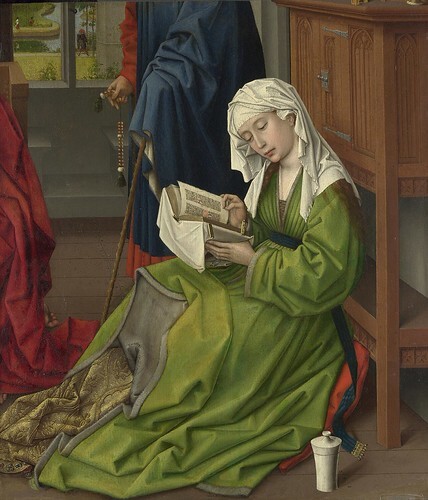
In Rogier van der Weyden’s painting The Magdalen Reading, dating from the mid-fifteenth century, the eye follows, as if hypnotized, the meandering folds of Magdalen’s green dress. The costume, which is usually peripheral to literary motif, becomes central to the work. It creates space for a paradoxical element of free, abstract painting in the middle of the century’s meticulous Flemish realism.
Proust describes the madeleine’s shape: ‘short, plump little cakes called “petites madeleines”, which look as though they had been moulded in the fluted scallop of a pilgrim’s shell.’ Isn’t the narrator’s memory a kind of pilgrimage to the lost paradise of the past?

The work of Robert Smithson occupies the field of tension between two poles: what he calls ‘site’ and ‘non-site’....a site, a kind of magical boundary zone facing the void, typically an inaccessible, godforsaken, peripheral place;... The nonsite was by its nature fragmentary, consisting of stuff ‘brought back from the original site ...along with certain topographical documentation of their provenance, i.e. their site.’... Smithson’s site was materially absent and not easily accessible to the public; on the other hand, the public could partake in the corresponding nonsite physically....Between these two poles reigned a tension; one might even call it a longing. ‘One is confronted with a very ponderous, weighty absence’.
However, in his final work Nonsite, Site Uncertain (1968), any contact with an existing original site is tenuous and left open; the referent, for which ‘nonsite’ is the signifier, is dissolved.
They embark upon the nearly infinite adventure. They pass through seven valleys or seas; the name of the penultimate is Vertigo; the last, Annihilation. Many pilgrims give up; others perish. Thirty, purified by their efforts, set foot on the mountain of the Simurgh. At last they gaze upon it: they perceive that they are the Simurgh and that the Simurgh is each one of them and all of them. In the Simurgh are the thirty birds and in each bird is the Simurgh.

the edible substance is without a precious heart, without a buried power, without a vital secret: no Japanese dish is endowed with a center...; here everything is the ornament of another ornament: first of all because on the table, on the tray, food is never anything but a collection of fragments, none of which appears privileged by an order of ingestion; to eat is not to respect a menu (an itinerary of dishes), but to select, with a light touch of the chopsticks, sometimes one color, sometimes another, depending on a kind of inspiration which appears in its slowness as the detached, indirect accompaniment of the conversation (which itself may be extremely silent).