This beautiful graphic novel tells of the time before the Era of Mass. This was the Shadow Age, a time when the planet Earth still rotated on its axis, but more and more slowly. At that time, the 'Oms, the Inhabitants of the Shadows, still lived in their fortified cities. But the ramparts of the Night were closing in on them, terrifying them and swallowing them up. And yet, among the Shadows, dreams gradually rose up in the form of primitive beings that became known as the "Others." Knowing neither pity nor hatred, these creatures had only goal: to reclaim their birthright, the land they had Lost: the Earth.
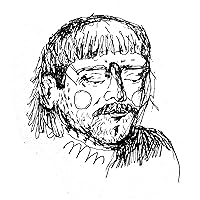
Caza, the pseudonym for Philippe Cazamayou, is a French comics artist. Caza began to publish work in Pilote magazine, starting with his series Quand les costumes avaient des dents (When Costumes had Teeth) in 1971, followed by other short work. The series of stories Scènes de la vie de banlieue (Scenes of Suburban Life) was published in 1975, followed by the L'Âge d'Ombre stories, Les Habitants du crépuscule and Les Remparts de la nuit. With the emergence of the magazine Métal Hurlant in 1975, Caza began to supply work within the science-fiction genre, with titles such as Sanguine, L'oiseau poussière, initially working with an exhaustive black and white dot technique. This was later abandoned for a style of colour use which would become a trademark, as seen in later work such as Arkhê, Chimères and Laïlah.
Philippe Cazaumayou (aka Caza) was one of the early stars of Métal Hurlant and its English-language spinoff Heavy Metal, but unfortunately interest in his work never really developed in the English-speaking world to the extent enjoyed by his peers Jean Giraud (aka Moebius), Philippe Druillet, and Enki Bilal.
That's a shame, since his dreamy, Poe-esque science fantasy works have a gothic sensibility powered by philosophy and psychedelia that make them real standouts from the early history of Heavy Metal magazine, back in the days when each issue was an explosion of wild creativity that had no equal in American publishing.
Luckily, Heavy Metal (the publishing company) has kept The Age of Darkness in print, and thank goodness for that. Most of these pieces date to the late 70's and early 80's, with the exception of the last piece ("L'Lobo") from 1997. They capture Caza at his very best, as he spins an extended tale of the Oms and their advanced technological civilization, where all that raw capability has been wielded in service of comfort and safety, to the exclusion of adventure and discovery ("For what could be safer than a prison?")
Pieces from this collection such as "Mandragora", "Nighttime", "Equinox", and "Ashes" throb with a mystical, earthy, and sexual energy that is drenched in blood, ash, and the quest for spiritual release. If the artists of Métal Hurlant and Heavy Metal were chroniclers of the wildest drug-fueled dreams, Caza was the navigator who turned the chaos into a map, and a beautiful one at that.
Caza es un dibujante de cómic francobelga que cobró notoriedad por sus historias de ciencia ficción que comenzó su carrera en los años setenta en la famosa revista del género Métal Hurlant. En los tiempos ominosos recoge varias de sus historias que giran en torno a la vida de un planeta moribundo en el que los habitantes, los oms, con forma humanoide llevan una vida decadente en ciudades amuralladas mientras el mundo exterior se rebela contra este dominio. Me ha gustado mucho la mezcla de ciencia ficción con cuestiones naturalistas y espiritista además de poseer un dibujo impresionante muy de la época. Quizá me ha faltado mayor nexo narrativo en común entre las historias pero Los tiempos ominosos es un cómic hipnótico.
Set in the very far future, in the year 666 of an unknown calendar the cities of ‘oms, a degenerated human race, begin to fail and die out under the changing world. This was the Shadow Age, a time when the planet Earth still rotated on its axis, but more and more slowly. At that time, the 'Oms, the Inhabitants of the Shadows, still lived in their fortified cities. But the ramparts of the Night were closing in on them, terrifying them and swallowing them up. And yet, among the Shadows, dreams gradually rose up in the form of primitive beings that became known as the "Others." Knowing neither pity nor hatred, these creatures had only goal: to reclaim their birthright, the land they had Lost: the Earth.
This story is told through a series of 14 vignettes set in this world mentioned above. Many have been published in Heavy Metal Magazine, and were previously published in the French Metal Hurlant. The artwork is stunning in its detail and use of color, and is ably reproduced in this book. Although each entry rarely is longer than 5 -6 pages, the plots are well-composed and show measures of quirky humor, horror, and pathos.
Holy shit this was absolutely fantastic! I am in awe, at a loss for words and just blown away how remarkable this work is. From the story, the pace, the art... everything was so fantastic I have no words and I will be definitely coming back for a re-read!
Parece increíble que nunca se haya llegado a reeditar la obra completa de Kaza en español. Los tiempos Ominosos fueron publicados originalmente como relatos en Metal Hurlant, y sin lugar a dudas dejan claro el genial talento de un autor que demuestra cómo la ciencia ficción y el lenguaje simbólico son de las mejores herramientas para abordar algunos de los conflictos que se producen en las inmediaciones del muro que separa lo consciente de lo inconsciente. En los catorce relatos de Los tiempos Ominosos, vemos cómo una a una, las ciudades de los Oms, ubicadas en la superficie del planeta, fortificadas y hasta hace poco inexpugnables, irán cayendo a manos de las fuerzas que surgen de las profundidades o del exterior de los muros. Cada relato abre una grieta por donde el otro se cuela hasta ocupar el lugar que también le corresponde. Obra de un genio.
Story: *** The book is split into many shorts that are as loosely tied to each other as you can get. If some were not interesting I would give him ** for this vague collage.
Art: ***** I love this guy's work- it's so intense and interesting! You could go through this without reading just to marvel at the precision of the art that exhibits a wonderfully bold and juicy color scheme.
Ritrovato fra le mani quasi per caso, mi accingo a leggere questa storia quasi dimenticata, sarò io ma sono riuscita a trovarla nel catalogo di goodreads con parecchia difficoltà.
Be' signori, che missile!
Parliamo subito della parte grafica, mi tocca scomodare nomi altisonanti, impossibile non citare Moebius è il suo stile oppure Druillet.
Veniamo al racconto, il volume racconta tante piccole storie, esse hanno in comune un mondo ormai in rovina, fra inquinamento e piogge acide, una tecnologia spaventosamente avanzata tanto da integrarsi perfettamente alle forme di vita organiche, e gli 'Oms anche detti gli abitanti del crepuscolo.
Vivono rintanati nelle loro abitazioni sebbene capiti di tanto in tanto che anche gli ‘Oms, ubriachi di noia, escano per le strade. L’aumento dell’inquinamento ambientale esterno ha spinto alla costruzione di cupole sigillate, dentro le quali vivere nel più completo isolamento.
Il libro non ci parla d'altro di come questo mondo ormai corrotto esiga riappropriarsi in un modo o nell'altro del suo spazio; così fra racconti che sfiorano la filosofia e la cruda realtà, l'onirico e l'ironico, vedremo la caduta e l'estinzione di questa popolazione.
Inutile aggiungere che il citazionismo si sprechi ed è impossibile non notare anche il risvolto di critica sociale verso noi stessi, perché che cosa sono gli 'Oms se non esseri umani che hanno rinunciato alla loro libertà per la loro sicurezza, ai loro sentimenti e umanità, per una vita piena di tecnologia e più agiata.
Una perla del panorama fumettistico che vi consiglio di leggere.
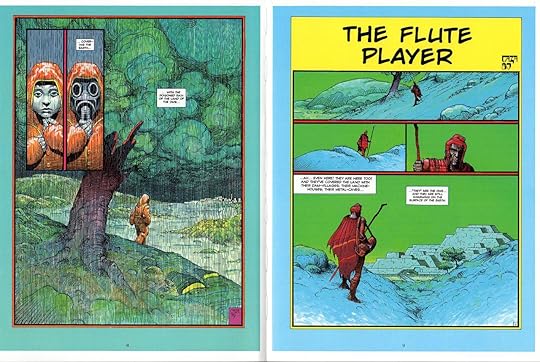
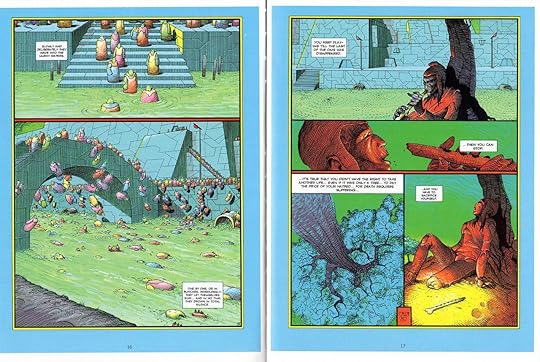
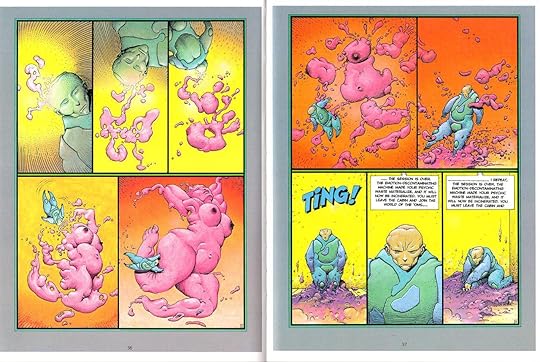
Ignore the description provided in the blurb - it's utter nonsense. The Age of Darkness doesn't have a narrative throughline, but there are visually similarities to be found in the fourteen individuals stories collected here. The setting of these unrelated stories involve various alien worlds populated by oddities and are rendered with Caza's sharp linework and striking colors. This is a visual feast from start to finish.
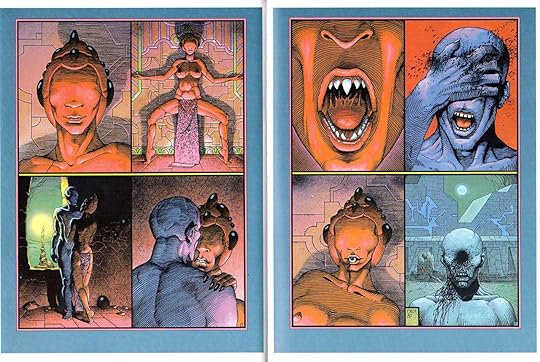
The various stories here have a surreal, dreamlike haziness to them which follows the familiar template found in many of the early entries in Métal Hurlant/Heavy Metal. There is a pseudo-philosophical outlook to the pieces here, but are accentuated by a heavy dose of mysticism, eroticism and violence. Some of the really great Caza pieces can be found here, like "The Flute Player", "Mandragora", "Nighttime", "Equinox", and "Ashes". These stories capture a sense of familiarity with more well known folklore, but Caza adds his violently psychedelic outlook to twist them into something very alien. These are bizarre tales and can leave the reader mesmerized and befuddled all at once. If you're familiar with Nicole Claveloux's work ("The Green Hand and Other Stories"), this is quite similar in terms of the striking imagery with vibrant colors and surreal sensibilities. This is truly spectacular stuff from an underappreciated master of the medium.
I've read many incredible comics by Caza, but this is far and away the best I've read. The deep cynicism behind the 'Oms, and the dark ends they meet, the absolutely bonkers art. . . . The Age of Darkness should be counted among the all-time great graphic novels.
- surprisingly good prose - fables of apocalyptopsychosex and death - there’s something Lacanian-Jungian-psychoanalytical behind all the blue alien titties, but who knows what specifically
El dibujante francés Philippe Cazaumayou, que utiliza el pseudónimo de Caza, tuvo un momento de bastante fama por sus historias de contenido ecológico, muy influenciadas por el movimiento hippie. Este álbum contiene sus relatos de temática relacionada con la ciencia ficción, originalmente publicados sobre todo por la revista “Metal Hurlant”. La temática básica es la contraposición de una humanidad mayoritariamente deforme y en decadencia con los “Otros”, que son seres relacionados con la naturaleza y con características propias de las figuras de los relatos tradicionales (hadas, duendes, etc.) La simbología a veces es demasiado obvia, pero el dibujo es de una impresionante suntuosidad. Caza es en realidad el único artista capaz de competirle a Moebius en su propio campo.