Margot and Mama have lived by the forest ever since Margot can remember. When Margot is not at school they spend quiet days together in their cottage, waiting for strangers to knock on their door—"strays," Mama calls them, people who have strayed too far from the road. Mama loves the strays. She feeds them wine, keeps them warm. Then she picks apart their bodies and toasts them off with some vegetable oil.
But Mama’s want is stronger than her hunger sometimes, and when a beautiful, white-toothed stray named Eden turns up in the heart of a snowstorm, Margot must confront the shifting dynamics of her family, untangle her own desires, and make her own bid for freedom.
With this gothic coming-of-age tale, novelist Lucy Rose explores how women swallow their anger, desire, and animal instincts—and wrings the relationship between mother and daughter until blood drips from it.
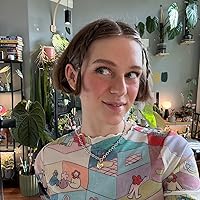
Not active here - come find me on Insta, TikTok or BlueSky @LucyRoseCreates x
Cumbrian dwelling in the North East. Writer of folktales and fables. Lucy Rose’s fiction and non-fiction have been published by Dread Central, Mslexia and more, and her films have visited BAFTA- and Oscar-qualifying film festivals internationally. Lucy’s debut novel, The Lamb, is being published by Weidenfeld & Nicolson in the UK and HarperCollins in the US. Lucy lives on the north-east coast of England with her black cat, Figgy, and is currently working on her next story.
⭐️⭐️⭐️⭐️.25 I love a cannibalistic book full of metaphors of love and grief and oh did this do it PERFECTLY. this was a claustrophobic read following a daughters coming of age and her mothers cannibalistic desire. it was incredibly isolating, remote and carried raw undertones all whilst remaining unique, eloquent and so beautiful. the ending also made me stare at a blank wall for 2 hours straight (I don't think I'll ever get over it)
Aware that I am going to sound like a complete psychopath writing this, but I prefer books about systemic cannibalism than domestic cannibalism, and The Lamb is definitely the latter. This book uses cannibalism as a symbol of the need for love and acceptance; the sheer desire to be seen and wanted for who you are manifests as an outward desire to consume to fill the endless hole. I think the ‘cannibalism as love’ idea is really doing the rounds at the moment and is a really popular idea in media, but I have always preferred cannibalism to be a symbol of systemic horror, where it exposes the greed, corruption and dehumanisation of people under capitalism rather than the need for connection. Basically, I prefer cannibalism in my media to be on a much larger scale, and this book just isn’t that.
Coupled with the above is the vibe of this book which is really fairy/folktale like, which again just isn’t the type of thing I enjoy and I don’t gravitate to folk horror. All of this is quite personal reasons why I didn’t love the book but although it tries to emulate the horror of Shirley Jackson and Angela Carter, it comes across slightly awkward. There is too much of a dissonance between it trying to be a folktale and it also trying to be a realist coming-of-age novel, and it felt really jarring. Certain things are left really unexplained and seem to happen coincidentally, and this would have worked if it was a traditional folktale with magic or supernatural elements thrown in to the more ‘normal’ scenes to make the whole world believable , but the book did not manage to straddle the line between the two genres well at all. I felt like there as nothing to hook the reader.
I have seen a lot of people praise the writing but in honestly I think it was just quite average and nothing I’ve not seen before, but I do think Rose has done really well to show her influences and be in conversation with them. I think calling this a horror however is slightly misleading, as there is no sense of terror in the book. Even Angela Carter’s stories have a sense of dread and foreboding and the horror lies in the terror of what will happen if you don’t heed their warning. Like Hansel and Gretel, which this book is quite similar to, has terror in the warning to never trust strangers. But horror was missing from this book for me. I also was expecting time kind of feminist commentary but this was missing too.
I’d love to see what Rose comes out with next as for a debut this was really fun but I didn’t absolutely love it like a lot of other people did.
Note: Thank you for the recommendations but I have read Tender is the Flesh twice and it’s one of my fave books!
Of all the things I thought a book about cannibal lesbians might be, boring was not one of them. But this was so dull and repetitive; there's a short story in here at best.
The Lamb consists almost entirely of two scenes: Margot, her mother, and Eden eating people at the dinner table; and Margot riding the bus with a concerned bus driver. That's it. It lives in its metaphors, hides behind them, and decides it does not have to explain anything. Like how all this is happening in what seems to be modern-day England without an investigation taking place.
I genuinely don't get the hype. It's not scary— a bit gross, I guess —and it honestly just repeats the same things over and over. "We're so hungry", find a person, eat a person, stare moodily at each other over some slow-roasted human thigh. The cannibals keep on cannibalising.
Yes, I understand the hunger/cannibalism metaphor for emotional hunger as it's been done before, but that alone is not enough to sustain a full-size novel. In fact, it took away something for me here, because the blurb and many reviews promised a deep dive into the mother-daughter relationship. How? These characters' entire personalities are "Hunger".
Listen, I was really here for a feminist fairy tale about a cannibalistic mother-daughter duo, I mean: What's not to love about that premise? And it started out okay, with Margot, the child (later teenager), as the narrative voice that emulates classic Jacob Grimm & Wilhelm Grimm lingo, growing up in a remote house in the woods with a mother who picks up kids who got lost and then, well, slaughters them for dinner. It's creepy, and it builds tension with the arrival of Eden, a new "stray" that becomes Margot's competition for the mother's affection.
But then, the whole thing becomes repetitive and drawn out, plus the metaphors are overly simplistic: What happened to Margot's father is not much of an enigma from the start, the mother's lover is of course a gamekeeper, subversion of the witch trope, female rage. etc. Oh, also: Queer themes, and coming-of-age by developing a personality apart from the parents. The language handles the fairy-tale-format well, the slaughtering and preparing of human meat is presented in graphic, atmospherically dense descriptions, but it's not all too gore-y (although that's a question of what you're used to, and I like extreme horror, so this is not all too disturbing by my standards).
The novel is not bad, but it started out really strong, and then, after the arrival of Eden, somehow just went on, without adding all that much. This could have been a banger if it had been significantly shorter.
Writing Style: Fairytale-like, short chapters, provocative
What You Need to Know: "A FOLK TALE. A HORROR STORY. A LOVE STORY. AN ENCHANTMENT. From an incendiary new talent, a contemporary queer folktale about a mother and daughter living in the woods."
My Reading Experience: Recommended for readers who enjoy getting their brains dirty for the sake of a well-told horror story. It's gruesome and graphic, heart-wrenching and haunting. A masterpiece of psychological horror and raw emotion. The vibes linger long after the final page-truly an immersive reading experience. The reader is immediately drawn into an isolated, wooded area where we are introduced to Margot, a young girl who lives with her mother in a rustic cabin. The very first line is an indicator of what you're getting into--a gruesome account of a claustrophobic world with a ravenous, needy mother who is never satisfied; never full. I will never forgive Lucy Rose for inviting me into this story and enchanting me with this seductive story only to dash my heart on a rock. But I do love it. A solid contender for best 2025
Comps: Brother by Ania Ahlborn, The Eyes are the Best Part by Monika Kim, Tender is the Flesh by Agustina Bazterrica
The Lamb is a gorgeously written, horrific and heartbreaking tale of a girl named Margot and her mama. This book has permanently changed my brain chemistry and the way I view the world, I was either holding my breath or sobbing the entire way through this story. There was not a moment I wanted to put it down, I even purposely made myself slow down on reading it so I could appreciate and take in Lucy Rose's stunning prose despite being desperate to reach the conclusion of Margot's story.
Margot, Margot, Margot... I am not sure I have ever rooted this hard or desperately for a character in all my life. The courage and strength this little girl shows throughout the story reminds me of fairy tales and Greek heroes, but against a much grittier backdrop and with everything and almost everyone working against her. For me, this story is about those of us who were forgotten and unloved. It's a tale about the people who are supposed to care about us and don't. It's about abuse, girlhood, queerness, and love.
At its core this story is about love, in its many twisted forms. Lucy Rose does not shy away from innocence and pure showings of love in this novel to the dark, possessive and twisted love we cannot untangle ourselves from.
The Lamb is haunting, it is a book that has stuck with me since I first read it and honestly, I think it will for the rest of my life.
2⭐️ Too visceral, too repetitive and too long. The last 20% was good, but it was kind of a slog to get there. Call me weird, but cannibalism isn't really my thing. It's seems like one of those books that people laud because its subject is a bit edgy, a bit controversial. Not my cup of hemlock tea or, indeed, slice of people pie.
This reads like a dark fairytale and it’s chock full of cannibalism and disturbing imagery. The pace of the story changes with the introduction of a third character, and it took me a bit to get used to the tonal change, but once I did I flew through it!
I loved the ending- I was expecting it to go a million different ways than the way it did but I thought it was beautifully haunting and bleak.
extremely overwritten in a way that pleads for a emotional response from the reader but fails in every way. the ending kind of just made me annoyed too, as the overwrittenness and forced tension puttered out to an absolute nothing of a ending. bleak endings are fine but bleak endings should make sense with the rest of the plot and tonally/thematically, which this one failed completely for me. also the random cut to supernatural elements at the end made the entire novel and whatever it was trying to say come across cheap/tacky and in a way, oddly conservative? i cant go into detail without spoilers but the themes surrounding queerness, pregnancy, motherhood and autonomy seemed to sharply careen into a strange almost anti feminist stance when the main plot point occurs at the end of the novel, not to mention the not-at-all subtle nods to child endangerment and the bystander effect
"On my fourth birthday, I plucked six severed fingers from the shower drain."
One of my most anticipated reads of 2025, and it opens with an absolute hook of a first sentence. On paper this had everything I love- an eerie backwoods setting, cannibalism, and a coming of age story.
Unfortunately, it ended up being painfully mid. For a novel about a cannibalistic mother-daughter duo, I was so bored. Graphic descriptions of eating fingers and reveling in the squelch of blood between your toes doesn't equate to tension. The plot felt too convenient (riddled with holes, if I’m being honest), and with little to no backstory for our protagonist, I couldn’t bring myself to care about anyone.
The prose also didn’t work for me. I’ve seen many praising Lucy's writing, but it felt overwritten, like someone trying too hard to be poetic. It never quite landed, and ultimately I wasn’t blown away.
Well done and rare, The Lamb sinks its teeth into you slowly, then tears right through to the bone. 🥩 At first, I felt like I was chewing on the same bite over and over, the first half of the novel repeats its rhythm: Margot, Mama, strays, dinner. Wash the blood, rinse, repeat. But oh, does the second half sear.
This is not a story for the squeamish. It’s a tenderloin of trauma, plated with psychological dread and a side of mother-daughter rotisserie. Lucy Rose carves out a chilling, snow-covered gothic tale where femininity, hunger, and control marinate together in something feral and grotesquely intimate. Mama is a force, equal parts seductive and monstrous, and Margot’s coming-of-age unfolds with aching, visceral tension. You can practically hear the crackle of the frying pan and the snap of control breaking.
When Eden arrives, all white teeth and warm skin, the temperature spikes and so does the suspense. The tension between survival and surrender, instinct and indoctrination, becomes unbearable in the best way. The writing sharpens as the story veers toward freedom, desire, and identity. It’s messy, it’s bloody, and it’s absolutely un-bleat-able.
🥩 Come for the horror, stay for the slow-roasted feminist fury.
Rating: 🩸🔥🦷🪓 4 out of 5 of meat, madness, and mayhem.
We are immediately plunged into the dark, macabre world of Margot and Mama (Ruth) when we begin with a 4-year-old Margot picking fingers out of the shower drain. Mama spends her time waiting for strangers, or strays as she calls them, to fall into her orbit—we soon find out why Mama loves them so much. When one day a woman named Eden shows up at their door, it changes everything in Margot's isolated world forever.
At first you are left wondering what exactly they are. Witches, vampires, just plain evil—I wasn't sure to begin with. The narrative is told mostly via Margot's perspective as she grows from child to teenager. It got off to a decent start, but by the 30% mark, the constant talk of strays and food was starting to get repetitive and, well... boring. It took until around the 70% point before it started to pick up again, so there was a considerable portion of the book where there wasn't much happening.
The writing was fine, but it did suffer from gaping plot holes. Why was no one asking questions regarding the missing people, especially since they were all disappearing in the same area? Why was no one at the school or any of the authorities concerned about Margot's welfare? She always seemed to be dirty and covered in bruises.
Margot at least went to school, but Mama and Eden spent all their time lounging around doing nothing, obsessing about strays. Where did they get their money for wine and food? Why did they not work? Why was the house always so disgusting? These are some of the details that could have been explored through that middle section of the book where it seemed to take a dip.
Everyone in this story is irredeemable, bar Margot, who grew up not knowing any better. The beginning was intriguing; the conclusion was pretty good—it was dark, sad, and bittersweet, if not a little predictable. However, the mid-part of the book would have benefited from a bit more depth and plot development to make the whole thing more coherent.
It did feel at times like it was trying too hard for the shock factor à la 'Tender is the Flesh' style, but for me at least, this one slightly missed the mark—I was left with too many unanswered questions. It just needed more meat on the bones... pardon the pun!
4.5🌟 This was haunting and disturbing but at the same time poetic and beautiful! Such an interesting exploration of mother/daughter dynamics, female relationships and coming of age. Excuse the pun but I devoured this 👀
“The Lamb” by Lucy Rose is one of the best horror novels I’ve ever read in my life, and I’ve been reading horror for over 25 years now. This was such a rollercoaster of a ride that it’s a book I will never forget for the rest of my life.
Before I dive into my book review, here are all the trigger warnings I found while reading…
- Violence against children - Cannibalism - Parental abuse - Child abuse - Violence against animals (rabbits) - Bullying
If any of these trigger you, please do not read this extreme horror novel. Moving along, this is Rose’s debut novel, and after this, she has a new reader for life in me. She has an excellent writing style, dropped some of the best horror I’ve ever read, and I loved the short, quick chapters, making this a breeze at 336 pages.
Right from the start, the opening line took this avid horror reader by surprise because it was so unexpected, it blew my mind. It’s up there with the opening lines to “The Gunslinger” by Stephen King and even “The Haunting of Hill House” by Shirley Jackson. Don’t worry, I’d never spoil it for you, but this killer opening line set the tone for the rest of this book.
There’s a lot of bloody, insane, extreme horror here. I’d highly recommend not eating or drinking anything while reading. The cannibalistic parts were next level, very graphic, disgusting, and so over the top, I enjoyed them immensely. Even though I made a lot of weird and grossed-out faces while reading, this was a very emotional read. I’m all about original horror, and Rose delivered big time in every horror part that transpired with well-written emotional twists. You can feel the joy, sadness, and conflict with every bloody bite.
Speaking of which, all those cannibalistic moments are so disturbing that they will leave readers in complete and utter shock. While it’s not a true splatterpunk novel, it will undoubtedly leave its mark on you. It’s some of the most deranged and unsettling horror I’ve ever read in my life. I won’t ever be able to look at any kind of meat the same ever again, thanks to this novel.
It was pretty emotional, but I resonated with the main character, Margot, and her horrible, grim life. It’s an addictive read, and several nights I was up late reading because I couldn't put it down. Rose has a gift of excellent storytelling in one of the most original horror novels I’ve ever read. I regret not reading this sooner when it was published in 2025. It’s a very morbid story from beginning to end with a lot of dread and sadness.
That ending. Wow... my goodness, I figured it would not end well, but I never expected what would ultimately go down. It was an incredible ending, and again, no spoilers here, but it hits you hard and leaves a scar. I’m still in shock, a bit sad, and left excited to read more of Rose’s work in the future because if she keeps writing horror novels like this, she’s going to be one of the best authors in this genre in no time.
I give “The Lamb” by Lucy Rose a 5/5 for being a brilliantly written horror novel masterpiece. If you love horror, especially of the disgusting cannibalistic kind with an insane story, unique characters, crazy events, and terror unlike anything you’ve ever read before, read this novel immediately. It’s so damn good that I couldn’t put it down and savored every page. It’s pretty messed up and sad, but it all ends in a wild yet satisfying way. I look forward to anything Rose has planned to write about because her future will be bright after writing something of this elite caliber.
Just okay for me. Not enough backstory on the MC to make me care.
My biggest problem is that the book reads like it takes place in 1940's Appalachia, but it's actually modern day England. Do police not exist in this part of England? Even without police, there would be a hundred true crime podcasts speculating as to why so many people go missing in a relatively small area. Also it appears that no search parties ever take place looking for missing hikers. No reporters investigating and asking locals for comments?
After seeing The Lamb described as a “Modern Grimm’s Fairytale”, it swiftly became one of my most anticipated reads of the year- and it did not disappoint. It’s a monstrous coming-of-age tale, about womanhood and carnal desire/lust. Once I got past the cannibalistic scenes turning my stomach, I was utterly captivated by the writing style and wondering just how dark this story would go.
Margot and her Mother, Mama Ruth, live in a secluded woodland. When Margot isn’t away at school, they spend their days waiting in their cottage for stranger to knock on their doors. For, as Mama calls, “Strays.” They offer these Strays a warm place to rest, until Mama is ready to satisfy her burning appetite, for human flesh. A chance encounter with a mysterious blonde, Eden, shifts Mama and Margot’s family dynamics forever. How will they adjust to having a third person in their unconventional household? This is the driving force behind this story- a dark, passionate, sapphic, love.
”I wondered if this was what being a real human was: accepting you were pieces of other people too. The people you loved and the people you hurt.”
if i could give this less than 1 star, i would. want to preface by saying i’m not trying to tear down the author or her work, but this was….
to me, this is what ai would come up with if you asked them to write you something that tumblr believes is “ethel cain core.” this synthetically profound idea of cannibalism being a metaphor for love…it’s been DONEE. it’s been done, and nobody’s being original about it!
when it comes to the writing style specifically, i found her phrasing awkward. she began sentences with what she should’ve ended them in. “following the freckles of black mould along the wall, i traced my fingers.” what?? why are you speaking backwards? the passive voice drove me insane. not to mention, the over explanation. you don’t need to explain why the character is doing something, just let them do it and let the action speak for itself.
when descriptive imagery was present (rarely), it seemed very typical and unoriginal. it also seemed like she was just trying to see how far she could take it. licking mold and drinking blood instead of breast milk/formula? just doesn’t even make sense. this kid would die, girl.
it seemed like she was trying very hard to be “edgy,” and it makes complete sense that tiktok loves this, because…well…
also insanely weird that she describes and continues to watch her mother having sex more than once….? strange.
to me, this read like someone’s first draft being workshopped in a college class. a lot of it should’ve been reworked.
and the ending….? girl. at least change the freezer part, you know you’re trying to be ethel cain.
ISOLATION. 🏚️ HUNGER. 🍴 OBEDIENCE. 🪢 Margot is a child growing up under the shadow of a mother whose love and violence are inseparable. They live apart from the world, surviving in ways that are grotesque and horrifying, yet for Margot, they’re simply everyday life. Told entirely through her childlike, observant perspective, her story is both heartbreaking and suffocating, capturing the rhythm of life under control.
I’m sitting here staring at a wall, trying to process what this book put me through. 😮💨 When I have this strong of an emotional reaction to a book, I usually end up struggling to write a review. One thing I’ve found helps me is reading other people’s reviews. I don’t know if other people enjoy doing this, but I tend to tell people it feels like a kind of silent book club; a way to process my emotions and have a conversation of sorts with others as I navigate my own reactions. This time around, I found digging through reviews even more helpful than usual. There are a lot of polarizing opinions about this book, and I think that after reading it, digging the reviews will help you find where you land (it did for me, anyway.)
As for my thoughts… this review will be more personal and subjective than the balance of objectivity I typically aim for, simply because this story hit me hard.
This story feels part fairy tale, part (slight) folk horror, part coming-of-age tragedy. At its core, it’s the story of a narcissistic parent and a very naive child, Margot, who has grown up in an isolated world that is the only thing she’s ever known. What makes it so different from the outside world? Well, they eat people, for starters.
"The wilds weren't quiet here. The wind outside whistled in the roads twisted, cutting through the pastures. Snow turned into mud rivers as cars and tractors and vans trudged through the newly fallen, pristine snow. Nature was beautiful. But we did such a good job of making it ugly."
For Margot, it seems and feels normal, until she begins to gain agency and realize that maybe this world isn’t what she wants for herself. Maybe she’s different. Maybe she has questions that nobody wants her to ask. It’s a slow burn, and it takes its time with every step that leads Margot closer to discovering who she is. The prose is beautiful, tragic, sad, and immersive; I found it to be enchanting... and suffocating.
"Their skin looked as white as snow beneath the water. When the hot sunlight came through the clouds, they shared a kiss. This was true love; fighting and then crashing into one another again like waves."
I was very moved by the themes Rose wove through the story, especially around hunger, love, and control. I’ve read a couple of books that explore cannibalism, but this is the first where it isn’t systemic or post-apocalyptic. Instead, it’s familial and domestic, told entirely through the eyes of a child. At first, through Margot, it seems almost like a symbol of love, strength, and nourishment. But from the outside, and through her growth, it’s clear it’s a tool for control, obsession, abuse, and violence. This story explores hunger both literally and metaphorically—how yearning, dependence, and desire twist in the most toxic of relationships. This, at its heart, is a story about monsters.
"Mama looked up, catching me at the window. I searched her expression for something familiar, but I didn't recognize the woman standing in our garden. It's impossible to truly know someone who hides so much of themselves and consumes so much of others."
Reading it was heavy for me, because I think anyone who has dealt with a narcissistic family member will find this, unfortunately, very relatable. With the story told from a child’s perspective, I often heard my own voice in Margot’s—the confusion, the hope for acceptance, the desperate wish to make a parent proud even when you know they never will be. It was painful but also strangely healing, because I was able to witness her slowly gain her own agency, to watch her begin to view the world through a lens that wasn’t forced upon her.
"I didn't see my eyes anymore. They were fragments of strays who'd come before. I wondered if this is what being a real human was: accepting you were pieces of other people too. The people you loved and the people you hurt."
I read several reviews where readers stated that they felt the middle of the book was repetitive, but for me, that’s exactly why it worked. Living under the control of a narcissistic parent IS repetitive. It is all-consuming. Every day is spent either trying not to upset them or trying to please them; often both at the same time. That cycle doesn’t let up. Rose did a phenomenal job of capturing that suffocating rhythm, of putting you in the world of a child who is not living their own life, but instead living the life of their parent. What others have seen as tedium, I personally saw as devastating truth.
"I wish you knew how hard it is to be a mama. It's the hardest thing in the whole world. It's a promise you make to be perfect and make no mistakes. And to put yourself second until you die. It mutates into this horrible burden. A weight you have to carry forever."
"'When you were small, you were so easy to love. You'd do anything for me. Every word I spoke was gospel and you looked at me like I was the most beautiful woman in the world. But something has changed, Little One,' Mama whispered careful and quiet. 'And I'm wondering if it's quite possible that I don't love you the same anymore.'"
I can truly understand why this book has been so polarizing. Some say it drags, or that Margot’s narration feels flat. For me, that’s part of its brilliance. The softness in her voice are exactly what make it believable. Children living in traumatic systems often become silent observers until something finally shifts; and that same perspective shapes how the horror is presented: it doesn’t arrive as shock from our narrator, but as something Margot treats as completely normal, even when it’s grotesque. What unsettles is not only the acts themselves, but the calm, unquestioning way she moves through them, as though they’re just another part of daily life.
"Everything happens for a reason. Something too big and too thoughtful for us to conceive. We're just animals, like little rabbits from the woods. Humanity, Margot, it is made up. Or empathy is waning as every second passes because it's not supposed to come so naturally to mortal creatures."
I think part of reading this book is suspending disbelief. It does raise questions: how do they afford their lives, what does her mother actually do, how/why is Margot still going to school, why isn’t there more attention on the people who go missing in the area? In a strictly realistic story those gaps would be distracting, but because this is built like a dark fairy tale, I found myself letting those questions go. At times I even wondered if it might have landed stronger set in an earlier time, leaning more fully into that “monster in the woods” feeling. Still, the blurring of the ordinary and the uncanny made it work for me, even when the mechanics didn’t fully add up.
In the end, this isn’t like any coming-of-age story I’ve ever read. It’s dark and gritty and strange, and it flows in and out of adult-like realizations and very childlike ones, always grounding you in the fact that Margot is still just a child. This story broke my heart, haunted me, disturbed me, and made me cry. I related to Margot more than I ever would have wanted to, but in that, I also found moments of healing.
"The absence of love had spoilt something in their souls and mine. Our love was rotten, but still looking for the burning it craved; for anything to revive the embers that have gone out long ago."
It’s not a book for everyone. It’s uncomfortable, it's unsettling, and it’s not meant to be easy. It’s also not meant to be purely entertaining. I’d describe it as a blend of some of my favorite genres (folk horror, dark fairy tales, thriller, and literary fiction) all working together in one story. There’s a deeply contemplative quality to it.
This is a book that will resonate most with readers who can sink into a slow burn, who are drawn to dark fairy tales, and who are open to sitting inside the suffocating rhythm of life under the control of another. If you're fine with mood and theme taking precedence over plot momentum, you'll enjoy it. For others, the pacing or the childlike narration may feel too quiet, too repetitive, or simply too heavy.
It isn’t a story that offers easy catharsis, but if you’re willing to sit with its darkness, there’s something haunting and beautiful to be found in it.
"Mama had told me she loved me. Eden had told me she loved me. Papa had told me he loved me. But it had all started to fray and lose its meaning, like a wave curling, crashing, and then becoming nothing at all as it disappeared back out to sea."
This was a prime example of immature writing. Somehow, in the span of 300 pages, the author failed to develop a plot engaging enough to keep me interested for more than five minutes. The endless cycle of dinner scenes and cringe dialogue didn’t help either. It tried so hard to be edgy and subversive but it failed on every aspect and makes me wonder if people who give this book five stars have ever read a novel before. I found it difficult to reconcile the fact that our narrator is a child who “couldn’t spell, even if the word was sitting right in front of [her]” and yet she narrates the story of her life in perfect English that sounds like it’s coming from a 20-year-old woman. Writing from a child’s perspective is no easy task but it felt like it was barely even attempted here. The “plot twists” about where her father went and how this story was going to end were so obvious, uninteresting and, once again, too “edgy”. The novel needed more work, more editing, and it certainly needed to be much shorter. It reads like something I could have written at uni when I was trying to be edgy and cool. I understand it’s a debut novel but it painfully reads like one.
Staring at the wall after that one. Incredibly well written, I have a feeling that I’ll be thinking about this book for a long time. Lucy Rose is going to be a new auto-buy author for me.
Most of this book was pretty boring in my opinion. It wasn’t that it was poorly written or anything, it just didn’t really engage me until the very end.
I did really enjoy the ending but most of the book I just wasn’t really interested in