Jump to ratings and reviews
Rate this book

Count to the Eschaton Sequence #4

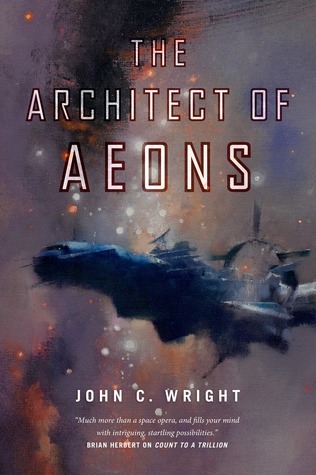
The Architect of Aeons

Rate this book
The epic and mind-blowing finale to this visionary space opera series surpasses all Menelaus Montrose, having forged an uneasy alliance with his immortal adversary, Ximen del Azarchel, maps a future on a scale beyond anything previously imagined. No longer concerned with the course of history across mere millennia, Montrose and del Azarchel have become the architects of aeons, bringing forth minds the size of planets as they steer the bizarre intellectual descendants of an extinct humanity.

Ever driving their labors and their enmity is the hope of reunion with their shared lost love, the posthuman Rania, whose eventual return is by no means assured, but who may unravel everything these eternal rivals have sought to achieve.

John C. Wright's The Architect of Aeons is the latest in his millennia spanning space opera.


At the Publisher's request, this title is being sold without Digital Rights Management Software (DRM) applied.

400 pages, Kindle Edition

First published April 21, 2015

16 people are currently reading
288 people want to read

About the author

John C. Wright

137 books449 followers
John C. Wright (John Charles Justin Wright, born 1961) is an American author of science fiction and fantasy novels. A Nebula award finalist (for the fantasy novel Orphans of Chaos), he was called "this fledgling century's most important new SF talent" by Publishers Weekly (after publication of his debut novel, The Golden Age).

Ratings & Reviews

What do you think?
Rate this book

Friends & Following

Create a free account to discover what your friends think of this book!

Community Reviews

5 stars
129 (33%)
4 stars
139 (36%)
3 stars
77 (20%)
2 stars
31 (8%)
1 star
7 (1%)
Displaying 1 - 30 of 45 reviews
Profile Image for Kalin.
Author 74 books283 followers
February 9, 2020
Wow, is the scale of this story cosmic. As far as I remember, the Golden Age trilogy had a similar time scale--but the distances and evolutionary changes and science advances covered here are staggering.

The downside is that characters (except for the two main rivals and driving forces) don't get enough pages to develop properly. The sweep of history doesn't wait for anyone to show their true depth, at least not in this volume. I miss Mickey the Witch. :(

Favorite moments:

~ The duel between Montrose and Del Azarchel is funniest when it descends to linguistics:

Montrose said, “Listen, lady. We was invited to your nice, cold, messed-up poxilicious world here because your local cliometric mugwumps want us to stop mucking with your history, right? So you want me and Blackie to suck lip and make nicey-nice, right?”
She nodded pensively. “That is not precisely the way I’d phrase it—”
“No,” murmured Del Azarchel. “You would use real words.”


Or:

Del Azarchel turned from him, raised his head, and spread his arms as if addressing a large assembly (which, of course, he had done many times in his life). His voice rang out like a trumpet of gold, pitched precisely to fill the chamber, syllables timed so that echoes would not obscure his words:
“Most great and noble, elevated and esteemed Mother Selene of the Order of the Discalced Friars of the Order of the Blessed Virgin Mary of Mount Carmel, by your kind leave, the Judge of Ages, the highly evolved Menelaus Montrose, and our royal self, Nobilissimus and Senior Officer of the Hermetic Order of the Irenic Ecumenical Conclave of Man give you greetings and salutations and express our humble thanks for having been invited into your gracious hospitality. If you would see fit to address us, our gratitude would be magnanimous!”
Only silence answered.
“Wow,” said Montrose in a flat and nasal voice. “That were so much better than my saying yoo-hoo. Ninety words to my nine, so that’s one order of magnitude less efficient, but yet somehow-r-’nother you got the same result, most exactly.”
“Nine? You surely are not counting ain’t you as one word?”
“Aintit?”


~ In all three previous books, I don't think I've ever shown the scope of the stakes. Here's a glimpse:

“What is your point?”
“The cosmos does not match what the Monument describes.”
“Come again?”
“Things are not where they should be if the laws of nature are as they should be and everything were evolving as nature directs. There should be fewer novas, far fewer supernovae. And those supernovae should be found grouped together, as one triggers the next. There should be no pulsars at all, no quasars. There are too many spiral galaxies for natural processes to account for. There should be no Great Attractor in the Virgo Supercluster, none of these long threadlike strands of superclusters, woven of clusters of galaxies, reaching in long bridges across the macrocosmic void. What if…”
As Del Azarchel spoke, he also opened his files for Montrose to inspect. Montrose said nothing, letting the figures and logic symbols dance in their grave waltz through the several layers of his mind.
Come to think of it, had he not himself been noticing the odd violence among the stars? Had he not had a hunch that the star furnaces in Carina or the galactic collisions beyond Alphecca were the handiwork of titans?


(It's not that simple, of course. :D However, the rest of this dialogue is a severe spoiler, so I'm leaving it out.)
Profile Image for Suzannah Rowntree.
Author 34 books592 followers
June 9, 2015
John C Wright never fails to amaze.

It's a simple story he's telling here (Architect of Aeons is the fourth of a projected six-book series). Boy meets girl. Boy happens to be insane at the time, owing to injecting himself with an experimental superintelligence serum, and girl happens to have been genetically engineered from the DNA of a murdered space-captain according to alien equations from a trap set to catch starfaring civilisations and subject them to the tyranny of an interstellar empire, but whatever. Superintelligent girl cures boy. Boy discovers that best friend has gone evil and enslaved humanity while uploading himself to giant computer covering the whole face of the earth. Best friend, driven to jealousy, challenges boy to duel while girl sets off on 70,000-year-voyage to plead the case for mankind's freedom before an unknown entity in a distant galaxy, leaving boy and best friend to continue their duel across countless millenia while awaiting the arrival of interstellar enslavers, their battleground reaching across aeons of human history, whole planets, the solar system, and beyond...

Heady stuff, especially when you juggle words like asymptote, divarication, cliometry, picotechnology, and goodness knows what else, along with knotty discussions of life versus liberty, hierarchy and freedom, faith and reason. Plus, the mind-boggling scale of everything that's going on here: A moon that's become a nun? A fleet composed of small planetoids? A sixty-thousand-year-old man duelling a sentient planet? Every time you think Wright's finished boggling your mind, he comes up with something else.

And then, on the other hand...

There are small problems. Like how unwieldy it is to try to cover this sheer amount of timeline in a few short books. By Book 4, a pattern's emerged: our hero Menelaus Montrose wakes from cryogenic suspension to a world that looks nothing like the one he planned, and has to dig through layers of half-truth and lies to uncover what actually happened in history, what went wrong, and how he can fix it. Or, the fact that amidst all the gee-whizzery and techno-speak and philosophical filibustering, the plot itself seems fairly messy: when your central cast jumps millenia like this, supporting characters fade into the rearview mirror faster than you can say "Your current symbol-forms have no correspondence to our thinking-forms."

And there are the bigger problems. Just as I often find it difficult to recommend Tim Powers books on account of their ickiness, so I also find it difficult to recommend Wright's books on account of their crassness. There is the central character, Montrose, and his endlessly crude remarks; there is the obligatory cheesecake female, though, thank goodness, she doesn't appear in Architect until the last thirty pages or so, and is nowhere near as outrageous as Oenoe the Nymph from the last two books. I once left a comment on Wright's blog asking why the cheesecake, since he professes Christianity, and seems a fairly conservative pro-marriage fellow; his reply, rationally and humbly proffered, was that decades of unbelief and immersion in pop culture may have scorched his conscience and gutted his ability to correctly discern what's appropriate and what's not. I record this for what it's worth.

If you can find it in yourself to hold your nose for the niffy bits, Wright's super-super-space-opera is dense and crazy but enormous fun. I particularly enjoyed Architect of Aeons, which is not merely clever, but also in many passages tear-jerkingly beautiful.

"How brightly flamed the midnights on any one of them, those emerald-bright earths! As the gigantic and milticolored suns set across the towering landing craft or space elevators and cast purple twilight across the self-aware gardens with fall of night would rise, adorned with stars like the uplifted limbs of an odalisque with gems, the auroras and auras of the nebula as arms of fire more splendid than a peacock's tail! How poor and blank is Earth's dull sky to eyes that drank such wonders!
"But in a single day of wrath, those colonies died, every one...
...
"You told your dream, sir. It is only fitting I tell mine. The component races who form the architects and constituents of the intricate rivers and oceans of self-aware information flowing from star to star of Sagittarius were once, in times long past, biological creatures just as we are now. The Circumincession of Sagittarius has stood with my neck beneath its bootheel. In times to come, the proportion must be reversed, be that time soever long as it must be. That day is far, but it must come."
"Revenge against minds that dwarf the constellations? You are mad."
"All who love are mad, are they not?" said the squire with his most charming and disarming smile.
Profile Image for Terence.
1,308 reviews468 followers
August 26, 2016
By this point I’m reading only to find out how things turn out for humanity and its post-human off-spring. Wright is writing on such a tremendous canvas that he’s lost nearly all connection to the characters in his story. It’s only in the last hundred pages or so that we spend any amount of time with real characters doing real things and not wading through page after page of exposition about what’s happened through the millennia as Menelaus and del Azarchel continue their feud. Wright devotes an appendix to human history up to the 52nd millennium CE, where this book ends, which mentions a whole bunch of potentially interesting milieux in which to set a novel and he might have achieved one (several, in fact) if he paused long enough to focus on something at a human level. But he doesn’t. His characters are caricatures and what little development they had took place in Count to a Trillion and The Hermetic Millennia, the first two books. Everything takes a back seat to the author’s vision of the next 50,000+ years and humanity’s role in it.

Don’t get me wrong. I eat this stuff up. I’m of that cast of mind that enjoys it. My favorite section of The Return of the King is the Appendices, and I love browsing the last third of The Thousandfold Thought to read about all the things that lay behind Bakker’s Eärwa. My shelves groan under the weight of all the reference books of imaginary worlds like Westeros, Tekumel and the Black Company. I no longer play D&D nor read the novels but I have the encyclopedias for the Forgotten Realms, Kara-Tur and Greyhawk, along with other fantasy realms.[1]

And I enjoy this series for that reason and for the same reason I enjoy reading Olaf Stapledon’s Last and First Men and Star Maker – these are epic visions of (post-)humanity. There is, however, a profound difference between the two authors’ visions. Wright’s is an amoral wasteland of ineluctable logic where species, entire solar systems are remorselessly swept away by the imperative of what Wright calls the “Cold Equations,” and all is subordinate to the dubious goal (IMO) of converting all matter to thinking matter. Stapledon can acknowledge the heartlessness of Nature and the selfishness and self-destructiveness of our own psyches but his ends never justify his means. The most successful of his eighteen human races (the Second, Fifth and Seventeenth, IIRC) aspire to a more humane consciousness and never lose sight of the value of compassion and love. Which makes his the more attractive vision. [Though there are hints that Wright’s future might be closer in spirit to Stapledon’s than apparent now. (Though we’ll have to wade through two more books to get resolution.)]

Unless you too have a fascination with epic space opera and a deep tolerance for storyless stories, I can’t recommend this series. But if you’re willing to put up with the clownish antics of the protagonists, the excruciating writing[2] and the lack of a compelling story for the opportunity to get lost in the drama of interstellar life then this is a series to look into.

[1] I long for the day Steven Erikson comes out with a sourcebook for the Book of the Fallen.

[2] I shouldn’t dismiss all of the writing, which really does comes alive around page 300 when Wright introduces Norbert the Assassin and we reach the ridiculous climax.
Profile Image for Mary Catelli.
Author 57 books203 followers
August 6, 2017
The aeons roll on in the grand plan. Spoilers for the earlier books in the series -- and this is very dependent on the books before, because the story is building.

It opens with Menelaus and Blackie arguing about what happened to the planet Earth. Goes on with the question of what happened when the alien force arrived, the question of human colonies, whether to hide people from the great computer mind, the question of why Tellus went mad, that the Moon has become a nun, questions about calendars and assassination, Myrmidons and Fox-Maidens and other races of man, and much more, in three parts.
Profile Image for Daniel Bensen.
Author 25 books81 followers
September 7, 2021
Two men with opposed views on life and freedom butt heads as Earth's deep future evolves around them. This is the fourth book in the Count to the Eschaton Sequence, and you really do have to read books one and two to get what's going on. Unfortunately, you also have to read book three, which caused me to drop this series for years. Wright must have been very angry when he wrote it. Book Four, however, is better. The ideas are big and interesting, and we dig satisfyingly into a couple of characters. To paraphrase one of them: "your reaction to the universe can either be despair, anger, or faith." Wright seems to be trying to move from anger to faith. I appreciate that. Me too.
9 reviews
April 23, 2015
Tremendous addition to this series. Once again, the timescale goes up and the novel primarily deals with 3 significant period of future history, the immediate aftermath of the first encounter, the preparation and the eventual second encounter, and the linger after effect of the third encounter with the alien.

The primary point of the book is hubris and faith. Both main characters were sure of their abilities and the righteous of their method and cause. Both will be subject to tremendous hubris when struggles against Gods reminds them of their limitation. When all else fails, faith is the only thing that sustains.
Profile Image for hevs.
130 reviews16 followers
April 23, 2016
The rest of the series is very good, but this one... this one left me speechless and that's not an easy thing to do. I have no words to describe how awesome it is.

And Blackie. Finally we're getting a lot of Blackie.
Profile Image for Pinky 2.0.
133 reviews13 followers
June 29, 2025
4 novels into the series I can say that this might just be the most ambitious concept for a novel I've encountered with an incredibly difficult style of narrative. This makes the book unique and a fantastic read in some ways, but also draws it back because, thus far, the narrative has spand for 55000 years. Lots of imagination and scale, but also reaching for what might be unreachable.
Profile Image for N.T. Narbutovskih.
Author 3 books25 followers
December 29, 2021
John C Wright is an absolute madman in the best possible way. I've loved all of his books despite the barely contained "ok, that's too much" nature of many if his plots. This book, the conclusion of what I can only describe as a flint rollercoaster soaked in kerosene packed with tannerite, does not disappoint. Massive timescales? Check. Hubris? Check. Alien invasion at the limits of the physics of our universe? Double check. Grab your dueling armor and your cryo pods, it's about to get weird!
Profile Image for Joshua.
371 reviews18 followers
January 7, 2016
JC Wright is my favourite scifi author - the only one I've read doesn't leave you feeling like you've swallowed a glass of dystopia (Jules Verne is a possible exception, but his strict scientific approach feels a bit sterile). And still, he manages to obliterate races, level civilizations and blow up planets. He gets away with all this destruction because he always has a comic (in the old sense of the word) ending: the final joy is always worth the pain.

In this fourth book of the Count to Eschaton series, Menelaus Montrose has a truce with his arch-enemy, Ximen del Azarchel. Both love the same girl, due to return in several thousand years from a space voyage. In the meantime, why not argue about how to run the solar system?

Good science fiction explores the consequences of worldviews, particularly within a political context (a nod to JC Wright); the technological advances allow otherwise impossible situations to be imagined and explored. So, the battle in this book is between the two greatest men in the history of the solar system: one who believes man should be free, the other that life and slavery is better than liberty and death. One will do anything so that mankind might live, the other will not violate his conscience: in the words of one subchapter title "Blind Reason, Rational Faith". Ximen therefore tries to make the course of history predictable (the science of cliometry allows historical predictions to be made), so that mankind will certainly fulfill stipulations imposed by the Hyades - but this means mankind must lose its freedom. Montrose continually introduces new things to disrupt these attempts of Blackie, but also (and primarily) to allow mankind freedom of choice. But even Montrose is not perfect and his choices can lead to disaster, not matter how well intentioned. The resulting titanic clash of brains and brawn is enormous fun to read.

For the uninitiated: JC Wright writes as if he were exulting in a sort of fountain of technological terms, but as long as you’re used to scifi, it doesn’t seem dense, but rather enthusiastic, exuberant prose. If you aren’t used to it, I recommend a re-read to help clear things up. And also, there is always the space princess, for whom clothes might as well be optional, to put it mildly, Catholic though he is… at his age too.

Overall, this book is complex and to adequately review it would be a task beyond the time I have available… but that only makes it all the more worthwhile to read, doesn’t it?
Profile Image for Johan Haneveld.
Author 112 books105 followers
May 14, 2015
3,5 stars, but certainly not less. I mean this is a book in which a man has a duel to the death with a living planet. How can you not love that? In true Wrightian style, this is a book filled to the brim and overflowing with idea's, concepts, plottwists, science and magic, in which literally every page contains something mind blowing (not literally, luckily). Of course there is some 'handwavium' in the explanations (with artifical elements, and picotechnology postulated without question), but a lot of astronomy and fysics seemed correct to me. This particular book in the series dealt with the 'cold equations' a lot -based on a famous SF-story in which a stowaway on a spaceship has to be thrown out of the airlock because the added mass would mean ending up lost in space for the whole crew. Here the math is as uncompromising. Characters have to make choices spanning ten thousands of years, in order to survive exploitation by a galactic power and to light a beam that can bring the princess Rania safely home. Both the main characters want to see that last bit happen, even though on their service to the alien power they are at odds, so they strike an uncomfortable alliance, surviving different species of humans, and having to confront their deepest motivations. And in the mean time there are their artificial copies, some as large as planets, having their own designs ... I liked this a lot for its idea's, and the respectful but not preachy treatment of religion, but be warned: this is all about the idea's, as the characters are treated like idea's as well. Which is all fine and dandy, and pretty entertaining as well, but don't expect a lot of character development. And don't start with this book! It's pretty incomprehensible if you haven't read the first three books, and if you haven't read much SF as well. For the experienced SF-afficionado this is a treasure trove and heartily recommended. N.B. I don't think I agree with John Wright politically and even filosofically, but that doesn't keep me from enjoying his books.
Profile Image for Micheal Boudreaux.
93 reviews
March 16, 2016
By the far best book in the Count to Eschaton sequence, Wright really hits it out of the park with this one. The editing is still a bit rough at times, but much improved over previous installments. The pacing problems and lack of orientation are entirely remedied, with the alliance between our hero and villain (once close as brothers, and the only two men from their era still alive) forming a fascinating first third of the work. As the Monument aliens come and go, humanity is uplifted brutally to spacefarer status, and Montrose compromises and pays the price, we cover millennia of activity. The work ends with a tense duel between a mere mortal and a superintelligent planet, with our hero scrambling to prep for the return of his beloved wife.
Profile Image for Michael Hirsch.
580 reviews7 followers
December 26, 2015
Man, John C. Wright has one active imagination. It's a pity he can't control it. There was way too much in this book. I admit that it is hard to write a book that covers 50,000 or so years, but there are entire chapters that are essentially just recitations of things that happened in the preceding millennia. There was no real story to hang the events on.

This book would have probably made a great series of 10 books, but as one book it was almost unreadable.
74 reviews
March 18, 2023
Of all the books in the Eschaton series thus far, this one is the weakest. I am probably not going going to finish the series at this point as there are many books out there that I suspect are better that I haven't read yet. Heck, I suspect earlier works by John C. Wright are better than this one. I know this for certain because his earlier Golden Age series was superior to this one by a country mile. It is too bad because conceptually I love the idea of this series. I had misgivings about the previous book, Judge of Ages, but continued because the mythos Wright wrote was somewhat compelling. The whole dipping into moments in (future) history was fascinating because it was like an alien visiting the familiar history of Earth in a way. I say "an alien" because the future history that Wright constructs is very weird in a hypnotic way, at least as shown in the last book.

How about this book though? This book zooms out to deal with a larger plot involving minds existing in interstellar space of humongous intelligences. Millennia are thought of as the way we currently think of centuries. Other celestial bodies are turned into mass artificial intelligences. The plot is clever and weaves cleverly but I just couldn't care much emotionally about it. Some parts were good but as an overall story it had lost my interest. Giant stellar or interstellar minds don't really create much emotion in me. I care about the human characters (or I guess human enough characters) but there are very few of them in this novel. It is just about the main character overcoming plot challenges that just don't have emotional resonance. I just kept waiting for things to get more interesting and it never really did. The novel's climax was somewhat interesting but only somewhat.

I remember feeling somewhat the same way about the last book, The Judge of Ages, but it grew on me the further away I was from having read it so I decided to pick this one up. I am sorry to say that it disappointed.
Profile Image for Leigh Kimmel.
Author 58 books13 followers
March 12, 2022
We all have a pretty good idea of what an alien invasion is going to look like. It goes back to H.G. Wells and The War of the Worlds, and has been reinforced by a multitude of subsequent sources, from 50's flying saucer movies to current military sf like John Ringo's Legacy of the Aldenata.

In this novel John C. Wright gives us not one, but two alien invasions that look completely different from the standard image of alien invasions. And it all comes down to what the aliens want, and why -- and it's very different from the motivations of the aliens in your standard alien invasion story.

The final section is very different in feel -- yet it carries on the theme of the interrupted duel from the earlier novels.

Overall, it's a solid contribution to a very impressive and innovative series
Profile Image for Danielle.
107 reviews2 followers
July 29, 2017
I really had to struggle to finish this one. I suppose it's not surprising that a book covering 30,000 years might have pacing issues, but it was disappointingly slow for at least three quarters of the book.

Still looking forward to the next installments and seeing how Wright winds everything up, though.
3 reviews
December 15, 2021
This story is better balanced than books 2/3

I left a 3 star comment on the previous book because the setting seemed to never change and the duel lasted forever. Well this book is much more balanced, lots more action, less histrionics, and minor completions adding up to a good ending. Time for book 5! 5 out of 5.
Profile Image for Richard Sampson.
72 reviews1 follower
June 4, 2017
Still pulling for this series and dying to see what comes next.
7 reviews1 follower
June 10, 2018
I think this book was written by a astrophysicist on LSD while compiling a brand new dictionary.
624 reviews
October 16, 2021
Two guys spending eternity fighting over a woman who isn't there
Profile Image for Russell Newquist.
Author 9 books374 followers
April 28, 2016
It has been more than two months now since Mr. John C. Wright surprised me with the delivery of a review copy of one of his latest novels, The Architect of Aeons. Yes, I have had the extreme good fortune to receive not one but two unsolicited works from Mr. Wright now. That is why I must begin this review with a sincere apology to the book’s author. It has taken me far too long to finish reading this book and get this review online.


In my defense, they have been two insanely busy months. We have a new baby in the house (my youngest turns three months old today). In that time, I’ve also planned and hosted a major martial arts seminar, attended a Judo tournament, put editing work into Silver Empire‘s first full length novel (look for announcements on that very soon!), had to find a new cover artist, plugged away at two short stories for our next anthology (more on that project soon as well), had to plow through some submissions for the same anthology (some not so great, some… very, very excellent), had a major software delivery do at work, made a trip to visit my ailing grandmother in Washington, D.C., and, of course, have had all of the normal duties of adult life on top of all that.


A week or so ago, however, I finally hit a nice point. My editing notes had been sent off to Susan, I’d passed the halfway point on my own first novel, seminars and tournaments were done, and I finally had a moment to relax. If it assuages Mr. Wright’s ego in any way, this book was my reward for finishing all of the important things in my life – and I used this book as motivation, telling myself I could not read it until I finished those things. Then, of course, it still took me far longer to actually read it than it should have.


Now that I have finally finished it, I must say that this book is an intriguing read. I have to admit that I struggled a bit with the first half of the book. It’s a difficulty of the format that I’ve had with much of this series. Mr. Wright has adopted the most difficult task of telling the story mostly in “catch up” sessions. Large periods of time elapse with the main character, Menelaus Montrose, either in time dilation from space travel or, more commonly, in suspended animation. Each time he re-enters “normal time” there are large bits of dialogue catching him up on the history (sometimes millennia worth) that happened while he was away.


I can think of no better way to tell a story such as this. And it’s a testament to Mr. Wright’s amazing skill as an author that he makes it work at all. Nevertheless, it can at times be a difficult way to read a story.


The second half of the book, however, really shines. Indeed, I zipped through that part of the book easily. And it is here that Mr. Wright once more touches on the issues that have really defined the series. How does a normal(ish) human survive in a world that is dominated by posthuman intelligences far superior to his? Not just superior, but orders of magnitude superior?


There are moments in the second half that are pure gold: the duel between Montrose and an entire planet, the Foxes, Montrose forcing a galactic level superintelligence into a deal on his terms.


The work also continues to explore other issues that have been hallmarks of Mr. Wright’s work dating back to The Golden Age trilogy. What is the true nature of identity? If my mind is uploaded in full into another host, which one is truly me? What about when those minds diverge? What if one of them sees its intelligence amplified – or reduced? These questions of identity and intelligence are what continue to make this series fascinating. And despite the somewhat sluggish nature of the book’s beginning, this is why Architect of Aeons still merits four out of five stars. A strong showing from Mr. Wright, and I continue to look forward to the rest of this series.
Profile Image for Nathan.
109 reviews2 followers
February 28, 2017
my least favorite of the series, but it ended well
Profile Image for Sheppard.
57 reviews
September 24, 2015
The other 3 books in this series got 5 stars from me, why only 4 stars for this last book? The last 60 pages dragged on and I felt that the conclusion left me wanting. I didn't want it to end as it did in such an anti-climatic fashion. Even though the last 60 pages did drag, I was intrigued and laughed quite a bit during them, I just wanted a more robust conclusion and it was clear I wasn't going to get it. I am not sure given the history he laid out in the appendix why he ended this final book as he did.
The series as a whole delivered on all levels and is worthy of strong and positive comparisons to Assimov's Foundation, Zindell's Requiem for Homo Sapiens, Diaspora by Egan and Eon & Eternity by Bear. It has detailed qualities similar to those of Peter Hamilton's Nights Dawn Trilogy as well. A series like this takes you out of your comfort zone.
With the recent passing of Iain Banks, I am so happy to see this kind of work for epic scifi, space opera emerging. I hope the author considers expanding on this abrupt ending and writing a 5th and 6th book in the series to match the ambition he laid out.
But if he doesn't which would be a shame, he now has 2 credible space opera epics to be proud of.
1,434 reviews9 followers
May 28, 2015
John C. Wright has been mapping the far future in which complications come from interstellar civilizations that move at light speed. In the first tale Count to a Trillion (paper) an expedition to a near star finds a monument and a signal sent to powerful aliens. Menelaus Montrose’s girl friend takes a 60,000 year round trip to argue for humanity while Montrose and his enemy Ximen del Azarchel fight and survive the milleniums. They fled Earth when the first huge, alien vessel arrived in the 111th century and return to find the Earth moved in its orbit and most of it’s population taken to create colonies on other worlds. They can only survive if a massive brain is created in Jupiter, a brain that would control humanity. The colonies fail and that leads to a second confrontation with aliens in the 221th century. In the 515th century Montrose and Ximen are in conflict again with Jupiter which leads to an unusual duel. The Architect of Aeons (hard from Tor) is the fourth of six books and is either a work of genius or a mess. Some parts work well and the historical span is fascinating.Review printed by Philadelphia Weekly Press
Profile Image for Brian Smith.
74 reviews2 followers
May 2, 2015
This is a bananas mind-fuck of a read! The scale, imagination and scope of this 4th novel of the Count to a Trillion series is insane. For that reason alone it's worth the read, and Mr Wright is a fantastic wordsmith as well.

This said, while the mind-fuck content is 5 stars, there are several 3 star aspects:
- SO MUCH happens that you'd need to constantly be taking notes to understand it all. I don't want to have to study books I'm reading.
- The logical insult battles between the main characters get tiring, and it's especially irritating at the start of the novel.
- Lastly, there is a lot of deception upon deception, upon deception, etc. You'll commonly see pages or chapter-length explanations by characters be rendered false by subsequent explanations. There is even one section where this happens 3 times in a row without breaks! This eventually made revelations or plot twists much less impactful because I couldn't help but think that it could just end up being false 40 pages later.

Still will get the 5th novel in the series when it comes out though! :p
Profile Image for Kurt.
156 reviews5 followers
March 4, 2019
What happens when a Catholic Lawyer fluent in Hermetic traditions channels eschatological post-humanism and translates this starry data into a sweeping yet intricately detailed epic about the merging of human civilization into a galactic wide hierarchical empire based upon THE socio-economic form of predictive meta-mathematics, aka CLIOMETRICS!

Yep!

Also, a Swan Princess, a red-blooded shit-kickin' Texan, and a Swarthy, Promethean Spaniard.

Intellectually Virtuoso in a way unlike any other, written with a sometimes ridiculous, sometimes moving, highly stylized and formal yet slang-ridden style that is kinda maddening yet uniquely lucid in a now four-book buildup that only shows signs of getting better and better as questions are answered and long-shadowed plot points are revealed.

A totally acquired taste, but if any of this tastes possibly interesting at all, do your imagination a favor and give this series a try. But be prepared for a trek: not easy reading but the opposite of usual!


Profile Image for Michael Haupt.
11 reviews
August 2, 2015
This is volume four in the six-part Count to the Eschaton series, and the cover text humorously marks it as the final volume. This is ironic, as the series appears to be rather long already. Spanning a total of some 60,000 years, a vast time line must be filled with storytelling. While the first two books were rather wonderful, the third started to be a bit longish, and this, fourth, is too long. It's probably just me talking, but there appears to be too little development for too many pages. Instead: long dialogues dozenfold, with little more a point than the two participants trying to talk the other down. Forgive me, but: yawn. There are other, more interesting, parts to this book: the stories of the invasions by the Hyades, and how Earth tries to fend them off. This is great SF. - Anyway, I'm going to read on until the end. Hopefully the two final volumes will have less, um, stretches of sheer length.
491 reviews27 followers
September 12, 2015
The latest installment in "Count to the Eschaton" picks up the action after THE JUDGE OF AGES. In this volume, the ... fraught conflict and partnership of Menelaus Montrose (who still insists on talking Texan all the time) and Ximen del Azarchel continues over 42,000 years, with the transformation of strange new posthuman races on a scale not known since Stapledon. And we now get to know some more about the BIG picture, and where the Hyades overlords really fit into it.

I hope this will be up for the Hugo next year, and not only because the CHORFs would have hysterics again.
Profile Image for Chris Stutts.
44 reviews2 followers
May 4, 2015
A lot of technology indistinguishable from magic, but I don't think relativity works that way. There was a book once where the author had his spaceships collapsing into black holes when they went too fast, and there is a similar mistake here.

Or maybe not. There is no layman description of the situation, but according to one paper, GR says the pull felt from a passing spaceship goes up by twice as much as if you plugged in the SR mass, the x2 being a GR geodesic something something.
Displaying 1 - 30 of 45 reviews

Can't find what you're looking for?

Get help and learn more about the design.