

What do you think?

Głodne duchy
Trynidad, lata czterdzieste XX wieku. Na wzgórzu ponad miasteczkiem Bell wznosi się farma, gdzie Dalton i Marlee Changoorowie mieszkają w luksusie, o jakim ich sąsiedzi mogą jedynie pomarzyć. Pod Bell, nad rzeką, znajduje się Barak – rozpadający się budynek z drewna i blachy, podzielony na prowizoryczne mieszkania dla kilku rodzin, których życie naznaczone jest ciężką pracą i ubóstwem. Wśród nich są Saroopowie – Hans, Szueta i Kryszna, spokojni ludzie walczący o lepszą przyszłość.
Kiedy Dalton nagle znika, a jego żonie może grozić niebezpieczeństwo, Hans, zwabiony wizją oszałamiającego zarobku, godzi się pracować jako nocny stróż w willi Changoorów. Nie wie jeszcze, jak ta decyzja wpłynie na jego rodzinę, której losy podstępnie splotą się z losami bogaczy. Czy zagadkę zniknięcia Daltona uda się rozwikłać i jaki będzie tego koszt?
Książka Kevina Jareda Hoseina to osadzona w krajobrazie Trynidadu mroczna opowieść o różnicach klasowych, przemocy, rodzinnych więzach i międzypokoleniowej traumie. To także przypowieść o fatum, zbrodni i karze; o tkwiących w nas wiecznie głodnych duchach, których mimo wszelkich starań nie da się nakarmić.
Kiedy Dalton nagle znika, a jego żonie może grozić niebezpieczeństwo, Hans, zwabiony wizją oszałamiającego zarobku, godzi się pracować jako nocny stróż w willi Changoorów. Nie wie jeszcze, jak ta decyzja wpłynie na jego rodzinę, której losy podstępnie splotą się z losami bogaczy. Czy zagadkę zniknięcia Daltona uda się rozwikłać i jaki będzie tego koszt?
Książka Kevina Jareda Hoseina to osadzona w krajobrazie Trynidadu mroczna opowieść o różnicach klasowych, przemocy, rodzinnych więzach i międzypokoleniowej traumie. To także przypowieść o fatum, zbrodni i karze; o tkwiących w nas wiecznie głodnych duchach, których mimo wszelkich starań nie da się nakarmić.
520 pages, Paperback
First published February 7, 2023
About the author
Kevin Jared Hosein
15 books212 followersKevin Jared Hosein was born and raised in Trinidad and Tobago. He has published three books: The Beast of Kukuyo (2017 Burt Award for Caribbean Literature), The Repenters (Fiction shortlist, 2017 OCM Bocas Prize) and Littletown Secrets.
His writings are published in numerous regionally and internationally acclaimed anthologies and outlets including Lightspeed, Adda and Moko Arts & Letters. His other accolades include the 2015 Commonwealth Short Story Prize and being twice shortlisted for the Small Axe Literary Prize for Prose.
His writings are published in numerous regionally and internationally acclaimed anthologies and outlets including Lightspeed, Adda and Moko Arts & Letters. His other accolades include the 2015 Commonwealth Short Story Prize and being twice shortlisted for the Small Axe Literary Prize for Prose.
Ratings & Reviews
Friends & Following
Create a free account to discover what your friends think of this book!
Community Reviews
Displaying 1 - 30 of 527 reviews

March 11, 2023
Hungry Ghosts is a monster of a book from Kevin Jared Hosein, a dark voyage through the heart of 1940s Trinidad. This is historical fiction at its best: immersive in its setting and haunting in its prose. Thematically, Hosein examines a handful of issues from racism to imperialism, but at its core this is a humane look at nuanced characters, making their way in a world marked by violence. The star here is Hosein's prose, evocative and otherworldly. This is a heady reclamation of Trinidadian creole and a showcase for its place in literature. For my taste, the story arc and tidy ending, dramatically speaking, didn't quite match the searing prose, but I suspect this will be seen as a plus by most readers. Trinidadian fiction is having a moment and Hosein is up there with the best.

September 18, 2022
Atmospheric, immersive, un-put-down-able, truly impressive storytelling from a Caribbean voice you will want to hear from again…and again….
Hungry Ghosts opens with four boys doing a blood pact that will make them brothers for the rest of their lives. Do they know what this pact means? How will it impact their individual lives? That is exactly what we find out in this book.
Set on the island of Trinidad and Tobago in the 1940s we are taken to the Barrack, a community that lives in poverty, no running water barely able to make ends meet but proud people. Overlooking Barrack is the Changoor Farm where Marlee and her husband, Dalton lives in a big house that is taken care of by three men. Dalton is known by the community to have a lot money but no one knows where it comes from. Marlee, lives in the house and hardly interacts with anyone from the community so rumours are made up about her. One day Marlee wakes up and her husband is nowhere to be found. She starts getting messages and death threats. In an effort to protect herself, she hires one of the men from the Barrack to be a guard at the house until her husband “comes back home”. Hans, the new watchman for Marlee is faced with a lot of choices- take the job in order to make enough to get his family out of the Barrack, or continue to live simple life… his choice leads to immeasurable consequences.
A corbeau will always be a corbeau, hated by the world that it will eventually eat…
Kevin Jared Hosein is an expert storyteller, how he is able to tell nuanced story rich with history, and explores classism, racism, religion, traditions, jealousy, love and violence is truly magical. Hungry Ghost is rich in atmosphere, you feel like you are transported to Barrack and immersed into the lives of the people there. You get so invested in how the story will go and that all goes back to Hosein’s writing. The writing in this book is absolutely impeccable, the characters’ stories are told with care and deeply tender. You feel for each character and you recognize that they are each going through so much and I loved that the author made them characters we could relate to.
There is a lot of strong themes happening in the book and generally that is hard for an author to explore each and do it justice but Hosein was able to do it expertly. We had coming-of-age, love, poverty, classism, religion and racism well explored- each leaving you with food for thought. I also loved how truly authentic the book felt- you were taken to the island of Trinidad and Tobago during the 1940s and you feel that through the writing and research done.
In the author’s note he said, “Fifteen years ago, my own stories were set in places I had never visited… The few Trinidadian stories I had written felt painstaking and derivative, embarrassingly littered with footnotes attempting to explain what is a corbeau… I wanted to write a book that not only electrified but was also more than its plotline and its characters- that could be a portal to the Caribbean, even at such a dark time of Trinidadian history.”
I truly cannot recommend this book enough. Please read.
Hungry Ghosts opens with four boys doing a blood pact that will make them brothers for the rest of their lives. Do they know what this pact means? How will it impact their individual lives? That is exactly what we find out in this book.
Set on the island of Trinidad and Tobago in the 1940s we are taken to the Barrack, a community that lives in poverty, no running water barely able to make ends meet but proud people. Overlooking Barrack is the Changoor Farm where Marlee and her husband, Dalton lives in a big house that is taken care of by three men. Dalton is known by the community to have a lot money but no one knows where it comes from. Marlee, lives in the house and hardly interacts with anyone from the community so rumours are made up about her. One day Marlee wakes up and her husband is nowhere to be found. She starts getting messages and death threats. In an effort to protect herself, she hires one of the men from the Barrack to be a guard at the house until her husband “comes back home”. Hans, the new watchman for Marlee is faced with a lot of choices- take the job in order to make enough to get his family out of the Barrack, or continue to live simple life… his choice leads to immeasurable consequences.
A corbeau will always be a corbeau, hated by the world that it will eventually eat…
Kevin Jared Hosein is an expert storyteller, how he is able to tell nuanced story rich with history, and explores classism, racism, religion, traditions, jealousy, love and violence is truly magical. Hungry Ghost is rich in atmosphere, you feel like you are transported to Barrack and immersed into the lives of the people there. You get so invested in how the story will go and that all goes back to Hosein’s writing. The writing in this book is absolutely impeccable, the characters’ stories are told with care and deeply tender. You feel for each character and you recognize that they are each going through so much and I loved that the author made them characters we could relate to.
There is a lot of strong themes happening in the book and generally that is hard for an author to explore each and do it justice but Hosein was able to do it expertly. We had coming-of-age, love, poverty, classism, religion and racism well explored- each leaving you with food for thought. I also loved how truly authentic the book felt- you were taken to the island of Trinidad and Tobago during the 1940s and you feel that through the writing and research done.
In the author’s note he said, “Fifteen years ago, my own stories were set in places I had never visited… The few Trinidadian stories I had written felt painstaking and derivative, embarrassingly littered with footnotes attempting to explain what is a corbeau… I wanted to write a book that not only electrified but was also more than its plotline and its characters- that could be a portal to the Caribbean, even at such a dark time of Trinidadian history.”
I truly cannot recommend this book enough. Please read.

February 19, 2023
Good Gawd. This was ferocious. Am I biased because of my Trinidadian heritage? Nah, it’s a bloody fantastic book. If this doesn’t make the Booker longlist, I’m gonna riot haha.
Hooked right from the start because of the extraordinary use of language and the claustrophobic imagery (Hosein definitely knows how to conjure up atmosphere). This is a brutal and devastating read, but you just know it’s going to turn out that way right from the start. Every character is wound up so tight, you’re just waiting for the eruption (and everyone gets their moment, believe me). All the characters are desperately searching for a way out of their current circumstances.
A dissection of class, disloyalty, extreme poverty, colonialism, generational trauma, abuse, explosive barbarity, (disclaimer: if you can’t handle reading about violence against animals, don’t go here).
I would’ve loved to read this in a school setting because it would’ve forced me into writing a badass essay. This book just kept getting better and better as it went along (the story of the pirate attack will forever brutalize my mind). I am obsessed with this thing.
Hooked right from the start because of the extraordinary use of language and the claustrophobic imagery (Hosein definitely knows how to conjure up atmosphere). This is a brutal and devastating read, but you just know it’s going to turn out that way right from the start. Every character is wound up so tight, you’re just waiting for the eruption (and everyone gets their moment, believe me). All the characters are desperately searching for a way out of their current circumstances.
A dissection of class, disloyalty, extreme poverty, colonialism, generational trauma, abuse, explosive barbarity, (disclaimer: if you can’t handle reading about violence against animals, don’t go here).
I would’ve loved to read this in a school setting because it would’ve forced me into writing a badass essay. This book just kept getting better and better as it went along (the story of the pirate attack will forever brutalize my mind). I am obsessed with this thing.
Read
February 10, 2023Not a review—just a message from the author.
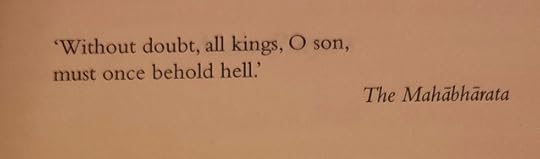
‘𝑾𝒊𝒕𝒉𝒐𝒖𝒕 𝒅𝒐𝒖𝒃𝒕, 𝒂𝒍𝒍 𝒌𝒊𝒏𝒈𝒔, 𝑶 𝒔𝒐𝒏, 𝒎𝒖𝒔𝒕 𝒐𝒏𝒄𝒆 𝒃𝒆𝒉𝒐𝒍𝒅 𝒉𝒆𝒍𝒍.’
- 𝑻𝒉𝒆 𝑴𝒂𝒉𝒂̄𝒃𝒉𝒂̄𝒓𝒂𝒕𝒂
This opening quote from Hungry Ghosts is from the Hindu epic, the Mahābhārata. Some have been curious about it.
To put into brief context—these are the words from the Lord of Dharma to a future king, Yudhishthira. When told that his brothers were in hell, the future king demanded to be taken there. Once there, he searched but could not find them. Instead, he found himself smothered under the screams of souls hollowed by unending fright. At first, Yudhishthira could not stomach it—he was tempted to leave many times. But he spent a long time there, surveying suffering and blight, only to eventually learn that his brothers were in heaven.
It was a test, devised by the Lord. And he passed. The Lord appeared before the future king and spoke the quote. Yudhishthira was now worthy of being a king. A king is often spoilt and not subjected to suffering, but must come to know it for the sake of his subjects. So the quote isn’t about being tortured or punished, but a divine call for sensibility, for empathy...
...that you must see hell, stare long into it, so you can know when others are going through it—or had gone through it.
So the novel opens with this divine call. This novel wasn’t an easy write and it’s not going to be an easy read—you may be tempted to leave many times. Because the world of Hungry Ghosts is hell. Awashed in bodies and blood. And you are about to walk side by side with its inhabitants: Krishna, Hansraj, Shweta, Marlee, Rustam, Rudra, Tarak, Niala, White Lady, and the others.
Like Yudhishthira—𝒀𝑶𝑼, dear reader, are about to behold the hell of the ancestors. Turn the page—and walk into the shadow of the Barbary lion that once trampled a colossus.
Thank you if you're planning on getting, borrowing, stocking, recommending, gifting, being gifted, or even considering Hungry Ghosts. It means a lot to have these stories told in print. With the old style of the coloniser blended with our Creole words and dialect we've often degraded as 'dirty' and 'backwards'. It hasn't been easy being from Trinidad and Tobago and having the dream of being a writer. It's sometimes considered a phenomenon so many of us have that dream here. But, like the ancestors, we dreamed regardless.
Bless,
KJH.
‘𝑾𝒊𝒕𝒉𝒐𝒖𝒕 𝒅𝒐𝒖𝒃𝒕, 𝒂𝒍𝒍 𝒌𝒊𝒏𝒈𝒔, 𝑶 𝒔𝒐𝒏, 𝒎𝒖𝒔𝒕 𝒐𝒏𝒄𝒆 𝒃𝒆𝒉𝒐𝒍𝒅 𝒉𝒆𝒍𝒍.’
- 𝑻𝒉𝒆 𝑴𝒂𝒉𝒂̄𝒃𝒉𝒂̄𝒓𝒂𝒕𝒂
This opening quote from Hungry Ghosts is from the Hindu epic, the Mahābhārata. Some have been curious about it.
To put into brief context—these are the words from the Lord of Dharma to a future king, Yudhishthira. When told that his brothers were in hell, the future king demanded to be taken there. Once there, he searched but could not find them. Instead, he found himself smothered under the screams of souls hollowed by unending fright. At first, Yudhishthira could not stomach it—he was tempted to leave many times. But he spent a long time there, surveying suffering and blight, only to eventually learn that his brothers were in heaven.
It was a test, devised by the Lord. And he passed. The Lord appeared before the future king and spoke the quote. Yudhishthira was now worthy of being a king. A king is often spoilt and not subjected to suffering, but must come to know it for the sake of his subjects. So the quote isn’t about being tortured or punished, but a divine call for sensibility, for empathy...
...that you must see hell, stare long into it, so you can know when others are going through it—or had gone through it.
So the novel opens with this divine call. This novel wasn’t an easy write and it’s not going to be an easy read—you may be tempted to leave many times. Because the world of Hungry Ghosts is hell. Awashed in bodies and blood. And you are about to walk side by side with its inhabitants: Krishna, Hansraj, Shweta, Marlee, Rustam, Rudra, Tarak, Niala, White Lady, and the others.
Like Yudhishthira—𝒀𝑶𝑼, dear reader, are about to behold the hell of the ancestors. Turn the page—and walk into the shadow of the Barbary lion that once trampled a colossus.
Thank you if you're planning on getting, borrowing, stocking, recommending, gifting, being gifted, or even considering Hungry Ghosts. It means a lot to have these stories told in print. With the old style of the coloniser blended with our Creole words and dialect we've often degraded as 'dirty' and 'backwards'. It hasn't been easy being from Trinidad and Tobago and having the dream of being a writer. It's sometimes considered a phenomenon so many of us have that dream here. But, like the ancestors, we dreamed regardless.
Bless,
KJH.

December 13, 2022
Kevin Jared Hosein you are such a great author. I couldn't put your book down. Hungry Ghosts opens with four boys doing a blood pact that will make them brothers for the rest of their lives. Do they know what this pact means? How will it impact their individual lives? That is exactly what we find out in this book. Atmospheric, immersive, un-put-down-able, truly impressive storytelling. You will be sad when you get to the end of this book because you don't want this intriguing story to stop. Highly recommend.

January 24, 2023
4.5. Highly recommended. A stunningly powerful first novel, and an early contender for the 2023 Booker Prize.
Hosein immediately immerses the reader into the post-plantation landscape of multiracial and multicultural 1940s Trinidad, brimming with (sometimes overly) lush descriptions of flora, fauna, and food. He doesn't overexplain the local culture of Bell Village and its surroundings to outsiders like us, leaving Hindi and Creole vocabulary untranslated, and accepting the religious tension between elite Christians and lower-caste Hindus as a social fact. His prose swivels sharply between dialogue rendered in local patois and high literary narration with archaic and obscure vocabulary (which I found Cormac McCarthy-esque).
This is a story of profound social inequality, pivoting between the family of Hans Saroop, a poor farm worker whose extended family lives in an decrepit plantation barrack with other impoverished outcasts, and the Changoors, a wealthy and childless couple who own a large estate house nearby. The inter-generational trauma of abusive fathers and husbands, rendered as mythically as Greek tragedy, drives the novel's action to a vividly violent conclusion that was terrifyingly nightmarish.
But the underlying plot mechanisms are essentially noirish: the rich landowner Dalton Changoor goes inexplicably missing, and his beautiful wife Marlee (whose origins are suitably suspicious) delays reporting it to the police, even after receiving threatening blackmail notes and Dalton's guard dogs are murdered one by one. She recruits Hans to work as her night watchman, offering him a princely sum of money that will allow his family to buy a plot of land in the village and finally leave the barrack behind. As the sexual tension between them escalates, their best-laid plans implode unpredictably.
I will end my review there, at least until this is published in the US and UK in early February. What made this such a powerful reading experience was that I knew nothing beyond the jacket copy!
I am extremely grateful to Ecco Press and Netgalley for giving me a free ARC of this novel in exchange for an honest, unbiased review.
Hosein immediately immerses the reader into the post-plantation landscape of multiracial and multicultural 1940s Trinidad, brimming with (sometimes overly) lush descriptions of flora, fauna, and food. He doesn't overexplain the local culture of Bell Village and its surroundings to outsiders like us, leaving Hindi and Creole vocabulary untranslated, and accepting the religious tension between elite Christians and lower-caste Hindus as a social fact. His prose swivels sharply between dialogue rendered in local patois and high literary narration with archaic and obscure vocabulary (which I found Cormac McCarthy-esque).
This is a story of profound social inequality, pivoting between the family of Hans Saroop, a poor farm worker whose extended family lives in an decrepit plantation barrack with other impoverished outcasts, and the Changoors, a wealthy and childless couple who own a large estate house nearby. The inter-generational trauma of abusive fathers and husbands, rendered as mythically as Greek tragedy, drives the novel's action to a vividly violent conclusion that was terrifyingly nightmarish.
But the underlying plot mechanisms are essentially noirish: the rich landowner Dalton Changoor goes inexplicably missing, and his beautiful wife Marlee (whose origins are suitably suspicious) delays reporting it to the police, even after receiving threatening blackmail notes and Dalton's guard dogs are murdered one by one. She recruits Hans to work as her night watchman, offering him a princely sum of money that will allow his family to buy a plot of land in the village and finally leave the barrack behind. As the sexual tension between them escalates, their best-laid plans implode unpredictably.
I will end my review there, at least until this is published in the US and UK in early February. What made this such a powerful reading experience was that I knew nothing beyond the jacket copy!
I am extremely grateful to Ecco Press and Netgalley for giving me a free ARC of this novel in exchange for an honest, unbiased review.

March 12, 2023
Lyrically narrated and inspired by storytelling traditions, Hungry Ghost is astonishing -- my first SIX-STAR book of 2023. It’s hard to summon words to convey how resonant and remarkable this book is.
The reader is instantly plunged into Trinidad in the 1940s and the inexplicable disappearance of wealthy landowner Dalton Changoor. His wife Marlee, whose mysterious past is questionable, lures barrack dweller Hans to move to the farm as her night watchman, in exchange for a healthy stipend. Her motives are less than transparent.
That decision, initially supported by Hans’ wife Shweta, sets forth a propulsive chain of events that rises to the true definition of tragedy: a tragic hero in his prime who is disastrously brought down by his own flaws, in this case, trying to escape from an impoverished and restricted life. The organic trajectory of the plot is breathtakingly wrenching and painstakingly profound.
As Hans, Shweta, and their young teenage son Krishna forego their solidarity with each other, the forces of a nature and entrenched social structure rise up to cut them down. The novel is peopled with hungry ghosts – Hema, Hans and Shweta’s first child, whose death from a catastrophic illness cannot be mentioned and whose presence never recedes for one. In the course of these pages, we also meet an ensemble cast of indentured laborers, and who encounter the most treacherous betrayals, far-reaching blood feuds, blood-curling misogyny and unspeakable desperation.
I cannot recommend this book highly enough.
The reader is instantly plunged into Trinidad in the 1940s and the inexplicable disappearance of wealthy landowner Dalton Changoor. His wife Marlee, whose mysterious past is questionable, lures barrack dweller Hans to move to the farm as her night watchman, in exchange for a healthy stipend. Her motives are less than transparent.
That decision, initially supported by Hans’ wife Shweta, sets forth a propulsive chain of events that rises to the true definition of tragedy: a tragic hero in his prime who is disastrously brought down by his own flaws, in this case, trying to escape from an impoverished and restricted life. The organic trajectory of the plot is breathtakingly wrenching and painstakingly profound.
As Hans, Shweta, and their young teenage son Krishna forego their solidarity with each other, the forces of a nature and entrenched social structure rise up to cut them down. The novel is peopled with hungry ghosts – Hema, Hans and Shweta’s first child, whose death from a catastrophic illness cannot be mentioned and whose presence never recedes for one. In the course of these pages, we also meet an ensemble cast of indentured laborers, and who encounter the most treacherous betrayals, far-reaching blood feuds, blood-curling misogyny and unspeakable desperation.
I cannot recommend this book highly enough.

February 15, 2023
Hungry Ghosts, set in Trinidad of the 1940's, is composed of histories passed from one generation to the next, demonstrating the power of oral tradition. Kevin Jared Hosein credits his elders with providing the raw material, with conversation delivered in the patois native to the island nation, and by setting it during wartime adds a lot of outside influence on the proceedings. By turns atmospheric, realistic and tragic, this is a novel to watch, to read with care, and to recommend to others.

April 16, 2023
Author Kevin Jared Hosein has noted that in Hindu tradition a hungry ghost is destined never to get what it wants because its mouth is too small to satisfy its appetite. This image is a metaphor that enhances the author’s portrayal of Trinidad and Tobago in the 1940s, when the island was lurching through the final stages of American occupation and British colonialism. The author employs graphically suggestive imagery and richly textured prose laced with patois that illuminate the struggles of a society on the cusp of self determination and heightened expectations.
The paths of two families animate this political and personal snapshot,radiating a visceral feel to the individual and collective struggles for self definition. The Swaroops…father Hans, mother Shweeta and son Krishna…are mired in poverty living in Bell Village, a former sugar cane barracks with subdivided rooms and no running water.While they struggle to earn a living and maintain a vestige of pride, they are able to glance up a hill and glimpse the Changoor Farm looming above them.Dalton and his wife Marlee live on this property,cosseted in wealth and luxury unimaginable to the residents of Bell Village. One day Dalton suddenly disappears and the rhythms and assurance of Marlee’s life are unsettled. Becoming anxious about her safety, Marlee entices Hans to become her watchman,dangling a hefty salary that could alter the trajectory of Hans’ family fortunes.
The promise of riches intermingles the lives of the two families and triggers unexpected consequences that expose the difficulties of merging two different realities.The two families embody a microcosm of differing economic and aspirational segments of Trinidadian society.Hans’ entry into Marlee’s world creates difficulties for both families.They struggle to understand each other’s backgrounds and aspirations, symbolically mirroring the society’s challenges in recalibrating its expectations as political autonomy and the hope of personal fulfillment hover in the future.
The author has created a group of characters that are morally ambiguous and complex. They doggedly nurture their aspirations while discovering that dreams can morph into nightmares and appetites can transform to despair.Their depth is enhanced by a cadence that has echoes of a griot’s oral recitation. The atmosphere reeks of impending tragedy and slowly unfolds a history of poverty, racial and religious discrimination and class stratification.The secondary characters are well drawn and function at times akin to a Greek chorus, commenting on events and occasionally shaping the trajectory of future developments.The gap between desires and fulfillment becomes more palpable as events unfold.
These elements combine to create a novel that stimulates through imagery and cadence, augmenting the political and social themes woven throughout the text.This heady combination will resonate with many readers and linger after the novel has concluded.
The paths of two families animate this political and personal snapshot,radiating a visceral feel to the individual and collective struggles for self definition. The Swaroops…father Hans, mother Shweeta and son Krishna…are mired in poverty living in Bell Village, a former sugar cane barracks with subdivided rooms and no running water.While they struggle to earn a living and maintain a vestige of pride, they are able to glance up a hill and glimpse the Changoor Farm looming above them.Dalton and his wife Marlee live on this property,cosseted in wealth and luxury unimaginable to the residents of Bell Village. One day Dalton suddenly disappears and the rhythms and assurance of Marlee’s life are unsettled. Becoming anxious about her safety, Marlee entices Hans to become her watchman,dangling a hefty salary that could alter the trajectory of Hans’ family fortunes.
The promise of riches intermingles the lives of the two families and triggers unexpected consequences that expose the difficulties of merging two different realities.The two families embody a microcosm of differing economic and aspirational segments of Trinidadian society.Hans’ entry into Marlee’s world creates difficulties for both families.They struggle to understand each other’s backgrounds and aspirations, symbolically mirroring the society’s challenges in recalibrating its expectations as political autonomy and the hope of personal fulfillment hover in the future.
The author has created a group of characters that are morally ambiguous and complex. They doggedly nurture their aspirations while discovering that dreams can morph into nightmares and appetites can transform to despair.Their depth is enhanced by a cadence that has echoes of a griot’s oral recitation. The atmosphere reeks of impending tragedy and slowly unfolds a history of poverty, racial and religious discrimination and class stratification.The secondary characters are well drawn and function at times akin to a Greek chorus, commenting on events and occasionally shaping the trajectory of future developments.The gap between desires and fulfillment becomes more palpable as events unfold.
These elements combine to create a novel that stimulates through imagery and cadence, augmenting the political and social themes woven throughout the text.This heady combination will resonate with many readers and linger after the novel has concluded.

January 9, 2023
Tragedies of epic, ancestral relevance in 1940s Trinidad
I wish I had been able to surrender to what the writer was doing here, as this is a book encompassing huge themes within a strong narrative. I felt as if I was reading something which at heart was as bold, deep and important as a book about Russia and its soul by Dostoievsky, or Steinbeck’s Grapes of Wrath, or a Greek tragedy like Oedipus Rex, but with its own specific setting, which could open out to universality.
This is an account of dark, bleak, violent humanity, riven by injustice of class, race, religion, gender, with graphic accounts of killings, beatings and maimings of humans and animals. There is little, if any, hope to be found here.
The problem I found which made for the low rating, was one of relentless overwriting. If I had read this as a hard copy book, I would have abandoned it within pages – the author clearly loves complex language – and so do I, but if, at times a dictionary is needed every few lines, it becomes exhausting and interferes with the narrative flow and absorption.
I completely appreciate that a book set so intensely within Trinidadian geography, complex culture, and linguistic patterns will of course be referencing plants, birds, animals, often using local names, and that characters will speak with their own regional and national dialects. It is not that which felt overwritten but the use of language, over and over, which one might only expect to find in a gathering of lexicographers, or a convention of thesaurus compilers.
And sometimes, the overcomplex images made no sense :
“During the first year of marriage, she had deconstructed her entire self with the revered language of dead writers. Patched herself with ideas and metaphors until she wasn’t sure where her former self dies and this new self was born. Her mind its own Ship of Theseus”
Sometimes, images are wonderful, striking, unusual – but when a writer is doing this almost on every line, there is something which gets in the way of the necessary forward propulsion of a novel
“The swifts in the darkening sky were moving like a knife slitting the dusk”
“the distant rain looking like grey marionette strings dangling from the sky”
I was not surprised to find that the author is a poet. Yes, often the precision and load of language poetry demands will bring wonderful freshness of image and avoidance of cliché to a novel, when poets also are novelists. And for sure, Jared Hosein does this. But far too often.
Reading on my Kindle I was at least able to fairly quickly locate some of the words unfamiliar – plants, birds, items of clothing – more problematic was that there were SO many words not in the Kindle’s own dictionary, even. Meaning that if a reader wanted to pay attention and really understand, they needed to read with access to wifi so that online dictionaries, including arcane, archaic, words could be found.
In the end, I stopped looking up all the new words, which could not be found in the Kindle’s own dictionary and began to skim read. Which is no way to be reading.
Less would have been so much more. This IS an ‘important’ book, as all those other books which made their way into my mind as I read, were telling me, but the overwriting stopped me from the kind of powerful resonances which those named books and writings created.
I wish I had been able to surrender to what the writer was doing here, as this is a book encompassing huge themes within a strong narrative. I felt as if I was reading something which at heart was as bold, deep and important as a book about Russia and its soul by Dostoievsky, or Steinbeck’s Grapes of Wrath, or a Greek tragedy like Oedipus Rex, but with its own specific setting, which could open out to universality.
This is an account of dark, bleak, violent humanity, riven by injustice of class, race, religion, gender, with graphic accounts of killings, beatings and maimings of humans and animals. There is little, if any, hope to be found here.
The problem I found which made for the low rating, was one of relentless overwriting. If I had read this as a hard copy book, I would have abandoned it within pages – the author clearly loves complex language – and so do I, but if, at times a dictionary is needed every few lines, it becomes exhausting and interferes with the narrative flow and absorption.
I completely appreciate that a book set so intensely within Trinidadian geography, complex culture, and linguistic patterns will of course be referencing plants, birds, animals, often using local names, and that characters will speak with their own regional and national dialects. It is not that which felt overwritten but the use of language, over and over, which one might only expect to find in a gathering of lexicographers, or a convention of thesaurus compilers.
And sometimes, the overcomplex images made no sense :
“During the first year of marriage, she had deconstructed her entire self with the revered language of dead writers. Patched herself with ideas and metaphors until she wasn’t sure where her former self dies and this new self was born. Her mind its own Ship of Theseus”
Sometimes, images are wonderful, striking, unusual – but when a writer is doing this almost on every line, there is something which gets in the way of the necessary forward propulsion of a novel
“The swifts in the darkening sky were moving like a knife slitting the dusk”
“the distant rain looking like grey marionette strings dangling from the sky”
I was not surprised to find that the author is a poet. Yes, often the precision and load of language poetry demands will bring wonderful freshness of image and avoidance of cliché to a novel, when poets also are novelists. And for sure, Jared Hosein does this. But far too often.
Reading on my Kindle I was at least able to fairly quickly locate some of the words unfamiliar – plants, birds, items of clothing – more problematic was that there were SO many words not in the Kindle’s own dictionary, even. Meaning that if a reader wanted to pay attention and really understand, they needed to read with access to wifi so that online dictionaries, including arcane, archaic, words could be found.
In the end, I stopped looking up all the new words, which could not be found in the Kindle’s own dictionary and began to skim read. Which is no way to be reading.
Less would have been so much more. This IS an ‘important’ book, as all those other books which made their way into my mind as I read, were telling me, but the overwriting stopped me from the kind of powerful resonances which those named books and writings created.

January 20, 2024
Kevin Jared Hosein's novel, Hungry Ghosts compares to a Greek tragedy.
His story is set in 1941 in the then British colony of Trinidad as small villages have been forced to make way for a new American naval base. The novel showcases the divide in culture and socioeconomic class and the severely limited opportunity for upward mobility. There are the British, the descendants of Spanish and French settlers, the descendants of freed slaves, and the descendants of the indentured Indians brought over to work the sugar cane fields.
Hosein puts faces on these people. Among them are the Saroops and their neighbors who live in the barracks, a dilapidated building where one room serves as home for an entire family; the Changoors the prosperous owners of a farm; Robinson and Baig, men who work for the Changoors; the Lakhans, twins ostracized because of their father's history; and the Badrees, a town policeman and his sons.
Hosein creates memorable, nuanced primary and secondary characters. He skillfully portrays their frustrations and crushed aspirations. Though his descriptions are occasionally overblown, his prose is atmospheric, evocative, and visceral. Hosein constructs a mood of unease and disquiet which pervades the novel; I am on pins and needles as I read. The plot complements the prose and they propel me along in my read.
This read has reminded me once again of my good fortune. I have a comfortable home with electricity, plumbing, and efficient HVAC. I don't have to struggle for food. I have an abundance of clothing. And I have lots of other belongings (probably too many)--from my smart phone to my stack of books.
One caution, Hungry Ghosts is a bleak look at human suffering with the barest glimmer of hope. Be sure you are in the right head and heart space when you pick this one up.
Publication 2022
His story is set in 1941 in the then British colony of Trinidad as small villages have been forced to make way for a new American naval base. The novel showcases the divide in culture and socioeconomic class and the severely limited opportunity for upward mobility. There are the British, the descendants of Spanish and French settlers, the descendants of freed slaves, and the descendants of the indentured Indians brought over to work the sugar cane fields.
Hosein puts faces on these people. Among them are the Saroops and their neighbors who live in the barracks, a dilapidated building where one room serves as home for an entire family; the Changoors the prosperous owners of a farm; Robinson and Baig, men who work for the Changoors; the Lakhans, twins ostracized because of their father's history; and the Badrees, a town policeman and his sons.
Hosein creates memorable, nuanced primary and secondary characters. He skillfully portrays their frustrations and crushed aspirations. Though his descriptions are occasionally overblown, his prose is atmospheric, evocative, and visceral. Hosein constructs a mood of unease and disquiet which pervades the novel; I am on pins and needles as I read. The plot complements the prose and they propel me along in my read.
This read has reminded me once again of my good fortune. I have a comfortable home with electricity, plumbing, and efficient HVAC. I don't have to struggle for food. I have an abundance of clothing. And I have lots of other belongings (probably too many)--from my smart phone to my stack of books.
One caution, Hungry Ghosts is a bleak look at human suffering with the barest glimmer of hope. Be sure you are in the right head and heart space when you pick this one up.
Publication 2022

March 5, 2023
I loved this novel of 1940’s Trinidad. Set on a sugar cane farm and environs, the book is focused on Hindu families of Indian descent that live in a 10 room barrack-a dilapidated tin and wood structure, with water leaks, flooded floors, rats, a common cooking yard and outhouse, and little to no privacy. Bound by religion, affection, and need, the women share what they can, and support and depend on each other to keep their families fed and cared for in a constant battle against spoiled food, lethal, stagnant water, and lack of sanitation.
At the top of the hill is the comfortable, but isolated manor house of the farm owner and his beautiful, young and lonely wife.
The story opens with 4 young teenage boys, two cousins from the barrack and orphaned, mysterious twins that even adults fear, making a pact to always support and defend each other against the village boys and whatever else may harm them.
When the farm owner mysteriously disappears the consequences threaten the heart of the barracks and the pact between the boys is tested.
Like Toni Morrison, Kevin Jared Hosein draws intimate portraits of the characters: their loves and losses, hopes and fears, the bonds between women, friendship among children, and the impossible lives of men who want to provide for their families, be good husbands and fathers in the face of relentless oppression, while also drawing back and making clear the larger framework of classism, religious bigotry, grinding poverty, and generational violence in which this fantastic novel is set.
I highly recommend this novel and hope that Kevin Jared Hosein writes more like this!
At the top of the hill is the comfortable, but isolated manor house of the farm owner and his beautiful, young and lonely wife.
The story opens with 4 young teenage boys, two cousins from the barrack and orphaned, mysterious twins that even adults fear, making a pact to always support and defend each other against the village boys and whatever else may harm them.
When the farm owner mysteriously disappears the consequences threaten the heart of the barracks and the pact between the boys is tested.
Like Toni Morrison, Kevin Jared Hosein draws intimate portraits of the characters: their loves and losses, hopes and fears, the bonds between women, friendship among children, and the impossible lives of men who want to provide for their families, be good husbands and fathers in the face of relentless oppression, while also drawing back and making clear the larger framework of classism, religious bigotry, grinding poverty, and generational violence in which this fantastic novel is set.
I highly recommend this novel and hope that Kevin Jared Hosein writes more like this!

Read
September 13, 2025Titlu : Năluci flămânde
Autor: Kevin Jared Hosein
Ed. Trei, aprilie 2025
464 de pagini
⭐️⭐️⭐️
Trinidad, anii 1940, aproape de finalul ocupației americane și al colonialismului britanic, unde ierarhiile sociale sunt clar stabilite. Există oameni ca Dalton și Marlee Changoor, bogați și lipsiți de scrupule ce trăiesc în opulență și desfătare și oameni care trăiesc în barăci dărăpănate, fiecare familie sub același acoperiș despărțite doar de niște pereți subțiri de pământ.
La fel ca mulți alți hinduși asemenea lor, cei trei membri ai familiei Saroop – Hans, Shweta și fiul lor, Krishna – locuiesc în barăcile de la marginea plantațiilor de trestie unde viața muncitorilor este grea și condițiile inimaginabile, cu latrine ce miros urât,folosite de toți vecinii și fără pic de intimitate in camere unde dorm de-a valma copii și părinți ba chiar și bunicii uneori.
Când Dalton Changoor dispare fără urmă, Hans este rugat de soția lui să rămână câteva nopți la conac ca să-l păzească de hoți. Afacerea pare una avantajoasă, pentru că ar permite familiei Saroop să cumpere un teren într-o zonă mai bună, pentru a-și face o colibă separată dar lucrurile nu sunt cum par a fi și de aici ar trebui så înceapă acțiunea însă mie nu mi s-a părut ca nu a fost o acțiune propriu-zisă a romanului ci mai multe separat. Fiecare poveste cu acțiunea ei.
M-am chinuit puțin să mă implic în această carte. Părea să sară atât de mult încât am pierdut mereu noțiunea despre cine vorbea și care era intervalul de timp precum și multe descrieri foarte detaliate de la începutul cărții m-au descurajat. Modificările au fost pentru a descrie contextul personajelor și nu sunt sigură cum altfel s-ar fi putut face, dar tot m-a pierdut.
Pasajele de o violență extremă descrise detaliat mi-au dat impresia că citesc o carte horror, nu o ficțiune istorică. Abuzul asupra femeilor, convingerea că bărbații au drept de viață și de moarte asupra lor și ca pot să o folosească ca și monedă de schimb m-au îndurerat iar sadismul copiilor este același cu al taților pentru că acest fenomen este învățat și perpetuat în familie. Scena în care un copil încearcă să înece un câine mi sa părut de-a dreptul groteascå.
Nu sunt o persoană căreia să i se facă rău ușor când aude de mațe, vomă, sânge sau altele dar aici ceva m-a deranjat, poate pentru că erau diferite asocieri nefericite cred eu și comparații între o scena de omor și de cadavru sfârtecat cu sânul unei femei cu dragostea și altele asemenea. Te făcea să-ți fie greață și să fie imposibil de asociat cele 2. Nu știu dacă m-am făcut înțeleasă dar nu cred ca asocierile dintre un lucru rău și unul bun e ok. Nu e bine sa pui semnul egal între o crimă și o dragoste, între ceva urât și ceva frumos, duios. Asta m-a deranjat cel mai rău.
Nu știu dacă e doar problema mea sau a mai sesizat cineva și nu știu dacă autorul a dorit sa creeze această reacție sau e dar o scăpare.
Îmi este greu să fac o recenzie a acestei cărți, pentru că mi-am dorit să o iubesc, dar pur și simplu nu m-a captivat pe deplin. Am crezut că a fost o lectură bună, am fost bucuroasă să continui să dau paginile și am fost cu siguranță expusă unei culturi și unor personaje pe care nu le-am mai întâlnit până acum, dar, per total, nu cred că a fost cartea potrivită pentru mine.
Autor: Kevin Jared Hosein
Ed. Trei, aprilie 2025
464 de pagini
⭐️⭐️⭐️
Trinidad, anii 1940, aproape de finalul ocupației americane și al colonialismului britanic, unde ierarhiile sociale sunt clar stabilite. Există oameni ca Dalton și Marlee Changoor, bogați și lipsiți de scrupule ce trăiesc în opulență și desfătare și oameni care trăiesc în barăci dărăpănate, fiecare familie sub același acoperiș despărțite doar de niște pereți subțiri de pământ.
La fel ca mulți alți hinduși asemenea lor, cei trei membri ai familiei Saroop – Hans, Shweta și fiul lor, Krishna – locuiesc în barăcile de la marginea plantațiilor de trestie unde viața muncitorilor este grea și condițiile inimaginabile, cu latrine ce miros urât,folosite de toți vecinii și fără pic de intimitate in camere unde dorm de-a valma copii și părinți ba chiar și bunicii uneori.
Când Dalton Changoor dispare fără urmă, Hans este rugat de soția lui să rămână câteva nopți la conac ca să-l păzească de hoți. Afacerea pare una avantajoasă, pentru că ar permite familiei Saroop să cumpere un teren într-o zonă mai bună, pentru a-și face o colibă separată dar lucrurile nu sunt cum par a fi și de aici ar trebui så înceapă acțiunea însă mie nu mi s-a părut ca nu a fost o acțiune propriu-zisă a romanului ci mai multe separat. Fiecare poveste cu acțiunea ei.
M-am chinuit puțin să mă implic în această carte. Părea să sară atât de mult încât am pierdut mereu noțiunea despre cine vorbea și care era intervalul de timp precum și multe descrieri foarte detaliate de la începutul cărții m-au descurajat. Modificările au fost pentru a descrie contextul personajelor și nu sunt sigură cum altfel s-ar fi putut face, dar tot m-a pierdut.
Pasajele de o violență extremă descrise detaliat mi-au dat impresia că citesc o carte horror, nu o ficțiune istorică. Abuzul asupra femeilor, convingerea că bărbații au drept de viață și de moarte asupra lor și ca pot să o folosească ca și monedă de schimb m-au îndurerat iar sadismul copiilor este același cu al taților pentru că acest fenomen este învățat și perpetuat în familie. Scena în care un copil încearcă să înece un câine mi sa părut de-a dreptul groteascå.
Nu sunt o persoană căreia să i se facă rău ușor când aude de mațe, vomă, sânge sau altele dar aici ceva m-a deranjat, poate pentru că erau diferite asocieri nefericite cred eu și comparații între o scena de omor și de cadavru sfârtecat cu sânul unei femei cu dragostea și altele asemenea. Te făcea să-ți fie greață și să fie imposibil de asociat cele 2. Nu știu dacă m-am făcut înțeleasă dar nu cred ca asocierile dintre un lucru rău și unul bun e ok. Nu e bine sa pui semnul egal între o crimă și o dragoste, între ceva urât și ceva frumos, duios. Asta m-a deranjat cel mai rău.
Nu știu dacă e doar problema mea sau a mai sesizat cineva și nu știu dacă autorul a dorit sa creeze această reacție sau e dar o scăpare.
Îmi este greu să fac o recenzie a acestei cărți, pentru că mi-am dorit să o iubesc, dar pur și simplu nu m-a captivat pe deplin. Am crezut că a fost o lectură bună, am fost bucuroasă să continui să dau paginile și am fost cu siguranță expusă unei culturi și unor personaje pe care nu le-am mai întâlnit până acum, dar, per total, nu cred că a fost cartea potrivită pentru mine.

April 20, 2023
1940s Trinidad is not a place I’ve journeyed before in books. It was a wild and haunting absorption for me, especially once the pilot light was lit and the plot got cooking. The class differences were stark and chilling; the bad taste of British colonialism suffuses and persists. In this group of well-wrought characters, we are introduced to the barrack of five poverty-stricken families. The barrack is a rotting and tilting fortification of wood and tin, one that leaks and fails to protect from any extreme temperatures. The cast is almost Dickensian in its specificity of traits, but more eerie in atmosphere. Grief is front and center right from the start, and when death came before the opening pages, it never really left. The presence of prologue remains, and shadows the lives of those who forebear. The wealthy couple in this story is also tormented. It is a violent place to inhabit within these pages, on this farm and barrack. Even the big house, with the monied Changoor couple, Dalton and Marlee, is haunted by a portrait. Dalton is a paranoid monomaniac and Marlee has a storied, secret past.
Down in the barrack, Shweta and her handsome husband, Hans Saroop, lost a baby daughter, Hema, before the conception of Krishna, their young son. Shweta cannot get over Hema’s death and especially the subsequent cremation, especially as Hans, who she has known since childhood, won’t talk about it. Hema is now one of the hungry ghosts, the dead who cannot be satiated. Krishna is bullied daily at school, has a spunky heart, nevertheless, and gets excited when his father brings home old issues of Popular Mechanics. The people he surrounds himself with also protect him—his cousin, Tarek, and a set of twins who are always rough and ready to brawl if someone messes with them. The barrack, however, continues to deteriorate. “The barrack was a fossil embedded in quicksand. No longer attached to an estate. Attached to any higher purpose whatsoever. And anything without a higher purpose was destined to be eaten by time.”
In this exquisitely written novel, Kevin Jared Hosein delivers a transcendently tragic exploration of life and death in this time and within these people. Some worship in the old African tradition, and there are others willing to convert to Christianity, believing it will transform their lives into prosperity. I read in shock as characters I thought were upright are led astray by the promise of money and power. There are times I had to put the book down for a minute or two while I took some deep breaths. The big house on the farm and the barrack below mingle in an unforgettable and resounding tale that unfolds and reflects the art of oral storytelling.
Recalling a situation about unlikable people he needed to endure, a character relates it to a bison and its flies. “While the bison grazed in the field, it would swish its tail at the gathering flies. There is rarely a moment when the bison wouldn’t have to do this, and so someone seeing the bison for the first time would think it just enjoys swishing its tail. It has gotten so accustomed to this dance that its facial expression never shifts while its tail, like an automaton, bats away fly after fly. He said that people might mistake the bison’s impassiveness for laziness. But such was a daily dance that became part of its personality.”
Down in the barrack, Shweta and her handsome husband, Hans Saroop, lost a baby daughter, Hema, before the conception of Krishna, their young son. Shweta cannot get over Hema’s death and especially the subsequent cremation, especially as Hans, who she has known since childhood, won’t talk about it. Hema is now one of the hungry ghosts, the dead who cannot be satiated. Krishna is bullied daily at school, has a spunky heart, nevertheless, and gets excited when his father brings home old issues of Popular Mechanics. The people he surrounds himself with also protect him—his cousin, Tarek, and a set of twins who are always rough and ready to brawl if someone messes with them. The barrack, however, continues to deteriorate. “The barrack was a fossil embedded in quicksand. No longer attached to an estate. Attached to any higher purpose whatsoever. And anything without a higher purpose was destined to be eaten by time.”
In this exquisitely written novel, Kevin Jared Hosein delivers a transcendently tragic exploration of life and death in this time and within these people. Some worship in the old African tradition, and there are others willing to convert to Christianity, believing it will transform their lives into prosperity. I read in shock as characters I thought were upright are led astray by the promise of money and power. There are times I had to put the book down for a minute or two while I took some deep breaths. The big house on the farm and the barrack below mingle in an unforgettable and resounding tale that unfolds and reflects the art of oral storytelling.
Recalling a situation about unlikable people he needed to endure, a character relates it to a bison and its flies. “While the bison grazed in the field, it would swish its tail at the gathering flies. There is rarely a moment when the bison wouldn’t have to do this, and so someone seeing the bison for the first time would think it just enjoys swishing its tail. It has gotten so accustomed to this dance that its facial expression never shifts while its tail, like an automaton, bats away fly after fly. He said that people might mistake the bison’s impassiveness for laziness. But such was a daily dance that became part of its personality.”

March 9, 2023
For a flicker, as if God made him see out of his father's eyes, he realised a life in the Changoor house. Where the rooms were ventilated and cool. Where Marlee Changoor pretended to be a mother and he pretended to be a son. His stomach filled with foreign flavours. The dress and aroma of a sahib's son tattooed onto his skin. And privilege as both a shield and a sword that could be used against his enemies.A life where problems evaporated in the sound of his voice, in a stare. Where revenge could be carried out in the swish of a signature. Where he would eventually ascend and own this house. Territory and earthly delights. He could have Lata, and Lata could have him — somebody greater than some village boy, some flunky deputy's son. And all his sons and daughters, free from danger and disease. Life could be like the photographs in the magazines. Life could finally be lived.
It was only a flicker of a daydream — but in it, he saw the promise of another world. For that moment, he held adoration for another life.
And you couldn't live in two worlds. You had to choose one.
Highly recommended by several Goodreads friends and lived up to expectations. Form-wise as a 300+ page relatively conventional narrative, this isn't my usual literary fare but elevated by the stunning writing. 4.5 stars.
Here the setting of the novel, in 1940s Trinidad, is introduced:
The three lived in a sugarcane estate barrack. These barracks were scattered like half-buried bones across the plain, strewn from their colonial corpse. In their marrow, the ghosts of the indentured. And the offspring of those ghosts. This particular barrack sat by its lonesome, raw and jagged as a yanked tooth in the paragrass-spangled stretch of meadow, beyond the canefield, beyond the rice paddies, the village proper and the sugar mill — in a corner where God had to squint to see. Neighbour to nothing. One donkey-cart ride away from the closest dry goods store. This, a place of lesser lives. A tangle of wood and iron that seemed to slightly shift shape every time a strong wind galloped over it. There was a communal yard for cooking and drinking arid fighting. Inside, five families and five rooms, ten-by-ten-feet. Between each were cracked wooden partitions that didn't go all the way up. The cold earthen ground. Clothes stitched from old flour bags. Coconut fibre mattresses, permanently depressed, topped with pillows stuffed with sugarcane tassels. The macadam roads here had no names. Only distinguished by the frequency of their fractures.
Here, the snakes' calls blurred with the primeval hiss of wind through the plants. Picture en plein air, all shades of green soaked with vermilion and red and purple and ochre. Picture what the good people call fever grass, wild caraille, shining bush, tirnaries, tecomarias, bois gris, bois canot, christophene, chenet, moko, moringa, pommerac, pommecythere, barbadine, barhar. Humanity as ants on the savannah. Picture curry leaves springing into helices; mangroves cross-legged in the decanted swamp; bastions of sugarcane bowing and sprawled even and remote; the spoiled smell of sulphate of ammonia somewhere in there; pink hearts of caladium that beat and bounce between burnt thatches of bird cucumber — all lain like tufts and bristles and pelages upon the back of some buried colossus. The Churchill—Roosevelt Highway sliced that colossus in half. On one side, the belief of bush and burlap and sohari and jute and rattan and thatch and tapia. On the other was Bell Village, the dogma of a new world, howling and preaching steel and diesel and rayon and vinyl and gypsum and triple-glazed glass.
It was only a flicker of a daydream — but in it, he saw the promise of another world. For that moment, he held adoration for another life.
And you couldn't live in two worlds. You had to choose one.
Highly recommended by several Goodreads friends and lived up to expectations. Form-wise as a 300+ page relatively conventional narrative, this isn't my usual literary fare but elevated by the stunning writing. 4.5 stars.
Here the setting of the novel, in 1940s Trinidad, is introduced:
The three lived in a sugarcane estate barrack. These barracks were scattered like half-buried bones across the plain, strewn from their colonial corpse. In their marrow, the ghosts of the indentured. And the offspring of those ghosts. This particular barrack sat by its lonesome, raw and jagged as a yanked tooth in the paragrass-spangled stretch of meadow, beyond the canefield, beyond the rice paddies, the village proper and the sugar mill — in a corner where God had to squint to see. Neighbour to nothing. One donkey-cart ride away from the closest dry goods store. This, a place of lesser lives. A tangle of wood and iron that seemed to slightly shift shape every time a strong wind galloped over it. There was a communal yard for cooking and drinking arid fighting. Inside, five families and five rooms, ten-by-ten-feet. Between each were cracked wooden partitions that didn't go all the way up. The cold earthen ground. Clothes stitched from old flour bags. Coconut fibre mattresses, permanently depressed, topped with pillows stuffed with sugarcane tassels. The macadam roads here had no names. Only distinguished by the frequency of their fractures.
Here, the snakes' calls blurred with the primeval hiss of wind through the plants. Picture en plein air, all shades of green soaked with vermilion and red and purple and ochre. Picture what the good people call fever grass, wild caraille, shining bush, tirnaries, tecomarias, bois gris, bois canot, christophene, chenet, moko, moringa, pommerac, pommecythere, barbadine, barhar. Humanity as ants on the savannah. Picture curry leaves springing into helices; mangroves cross-legged in the decanted swamp; bastions of sugarcane bowing and sprawled even and remote; the spoiled smell of sulphate of ammonia somewhere in there; pink hearts of caladium that beat and bounce between burnt thatches of bird cucumber — all lain like tufts and bristles and pelages upon the back of some buried colossus. The Churchill—Roosevelt Highway sliced that colossus in half. On one side, the belief of bush and burlap and sohari and jute and rattan and thatch and tapia. On the other was Bell Village, the dogma of a new world, howling and preaching steel and diesel and rayon and vinyl and gypsum and triple-glazed glass.

March 24, 2024
A rich, powerful novel, filled with grief, tragedy and insight.

October 6, 2022
Kevin Hosein's tale is a remarkable tale of life between the rich and the poor, how no matter how much money you have, you are never truly sated. Instead, you are always looking for or missing something money cannot buy.
In Hungry Ghosts, we follow the lives of 2 separate families and their situations.
First, we follow Hans Saroop, his wife Shweta, and their son Krishna. At first glance, Hans and Shweta seem like a happy couple, Shweta a dutiful wife and Hans a hardworking, faithful husband. Their son Krishna on the other hand is full of mischief and tends to get into trouble.
The Saroops live in a Sugar Cane estate in Trinidad; these are old, dilapidated barracks from long ago.
Five families with five rooms that are only 10x10 feet with nothing between each but a cracked wooden partition.
However, where Krishna goes to school is where everyone with money lives (and where everyone in this God-forsaken shanty would love to go). Bell Village, where it appears that Trinidad is reborn, stands the Presbyterian Church, proud and tall
.
Krishna is the only one from the barracks who goes to school in Bell Village, and he hates it. He is constantly taunted and bullied mercilessly, and when he retaliates, he's the one who gets expelled. But Hans begs the Headmaster for Krishna to return, even though he hates it.
Krishna doesn't understand how you can be Hindu at home and Presbyterian at school; you can't serve two masters. This alone confuses and irritates Krishna.
I said before that Hans and Shweta appeared to be a happy couple, but something happened before Krishna was born. Something that no one ever speaks about, so life-altering that you must read it for yourself to find out exactly what. (SORRY)
The Changoor's:
Dalton Changoor is a very well-to-do man; however, of late, he has been acting very strangely.
Before disappearing, he went to the shed (where Marlee was listening) and had a conversation with his mother (Dalton believes his deceased mother is trapped inside a picture), where he spoke of a proper heir.
When he came out, he told Marlee to ensure she untied the dog, and then he vanished from sight.
Hans works for Mr. Changoor, so when the dogs get killed, the ransom notes start appearing; that's when Marlee gets the notion to hire Hans to stay overnight to guard the house.
The next day Hans comes to ask Mrs. Changoor about her husband, to which she says she has no idea when he'll return. He goes on to explain with further coaxing that he wants to ask for a raise and purchase land on Bell Village to build a house for his family.
Mrs. Changoor agrees and then states her terms about night guarding, which she then doubles his pay. To that, he cannot say no, plus she is offering meals with the income, the outshed, and his return at first light.
Hans accepts but hesitates to tell Shweta because staying at another man's home is not proper. This arrangement works perfectly until it doesn't matter when one of Hans's friends tells him that Hindu marriage is not recognized in the eyes of the law, only marriage by the church. So that means that Hans is a free man to do as he pleases.
Until it doesn't; Krishna peers through the window and sees that his father has lied to his mother about his whereabouts, then when she gets sick, Hans is nowhere to be found.
Until it isn't; "KRISHNA HAS HAD ENOUGH."
Hosein takes the idyllic, fairytale world Americans believe T&T to be and gives us Pure, Honest, and Unadulterated truth. The truth is that not everything is like a magazine cover, with gorgeous tropical beaches.
Hosein's word-building is "MIND BLOWING," he is a true "WORDSMITH."
He ensures his verbiage is authentic and stays true to his heritage and the Trinidadian culture.
Hosein paints a very detailed image of the dilapidated barracks the Saroops live in. The descriptive imagery is so true to life you can hear the flies buzzing over the food.
Hoseins' Novel is highly thought-provoking and awakening, filled with grief, despair, and love.
I still stand by my thoughts that this Novel has a far deeper layer.
A deeper layer means that there are lessons to be learned, especially if these are folktales. I'll say that they are 2, to be exact.
1. is a commandment
1. is of the 7 deadly sins
The only thing I wish was that he had a dictionary for the words native to Trinidad. For instance, (I know Jamaican patois very well) a Duppy and a Jumbie are the same, just different cultures. However! Being from NYC, that's a word I'm highly familiar with. But there was a lot that I had to look up because they were more proper in tone. Just a guess! As I said, I listened to my ex speak Jamaican Patois for 35 years.
Splendidly Executed Novel
Looking Forward to Hosein's Next Novel
An epic tale of Caribbean Folklore
"WELL DONE"
"BRILLIANT."
Thank you, NetGalley/Kevin Jared Hosein/Ecco/ For This Amazing eARC for my honest review. My opinions are of my own volition.
In Hungry Ghosts, we follow the lives of 2 separate families and their situations.
First, we follow Hans Saroop, his wife Shweta, and their son Krishna. At first glance, Hans and Shweta seem like a happy couple, Shweta a dutiful wife and Hans a hardworking, faithful husband. Their son Krishna on the other hand is full of mischief and tends to get into trouble.
The Saroops live in a Sugar Cane estate in Trinidad; these are old, dilapidated barracks from long ago.
Five families with five rooms that are only 10x10 feet with nothing between each but a cracked wooden partition.
However, where Krishna goes to school is where everyone with money lives (and where everyone in this God-forsaken shanty would love to go). Bell Village, where it appears that Trinidad is reborn, stands the Presbyterian Church, proud and tall
.
Krishna is the only one from the barracks who goes to school in Bell Village, and he hates it. He is constantly taunted and bullied mercilessly, and when he retaliates, he's the one who gets expelled. But Hans begs the Headmaster for Krishna to return, even though he hates it.
Krishna doesn't understand how you can be Hindu at home and Presbyterian at school; you can't serve two masters. This alone confuses and irritates Krishna.
I said before that Hans and Shweta appeared to be a happy couple, but something happened before Krishna was born. Something that no one ever speaks about, so life-altering that you must read it for yourself to find out exactly what. (SORRY)
The Changoor's:
Dalton Changoor is a very well-to-do man; however, of late, he has been acting very strangely.
Before disappearing, he went to the shed (where Marlee was listening) and had a conversation with his mother (Dalton believes his deceased mother is trapped inside a picture), where he spoke of a proper heir.
When he came out, he told Marlee to ensure she untied the dog, and then he vanished from sight.
Hans works for Mr. Changoor, so when the dogs get killed, the ransom notes start appearing; that's when Marlee gets the notion to hire Hans to stay overnight to guard the house.
The next day Hans comes to ask Mrs. Changoor about her husband, to which she says she has no idea when he'll return. He goes on to explain with further coaxing that he wants to ask for a raise and purchase land on Bell Village to build a house for his family.
Mrs. Changoor agrees and then states her terms about night guarding, which she then doubles his pay. To that, he cannot say no, plus she is offering meals with the income, the outshed, and his return at first light.
Hans accepts but hesitates to tell Shweta because staying at another man's home is not proper. This arrangement works perfectly until it doesn't matter when one of Hans's friends tells him that Hindu marriage is not recognized in the eyes of the law, only marriage by the church. So that means that Hans is a free man to do as he pleases.
Until it doesn't; Krishna peers through the window and sees that his father has lied to his mother about his whereabouts, then when she gets sick, Hans is nowhere to be found.
Until it isn't; "KRISHNA HAS HAD ENOUGH."
Hosein takes the idyllic, fairytale world Americans believe T&T to be and gives us Pure, Honest, and Unadulterated truth. The truth is that not everything is like a magazine cover, with gorgeous tropical beaches.
Hosein's word-building is "MIND BLOWING," he is a true "WORDSMITH."
He ensures his verbiage is authentic and stays true to his heritage and the Trinidadian culture.
Hosein paints a very detailed image of the dilapidated barracks the Saroops live in. The descriptive imagery is so true to life you can hear the flies buzzing over the food.
Hoseins' Novel is highly thought-provoking and awakening, filled with grief, despair, and love.
I still stand by my thoughts that this Novel has a far deeper layer.
A deeper layer means that there are lessons to be learned, especially if these are folktales. I'll say that they are 2, to be exact.
1. is a commandment
1. is of the 7 deadly sins
The only thing I wish was that he had a dictionary for the words native to Trinidad. For instance, (I know Jamaican patois very well) a Duppy and a Jumbie are the same, just different cultures. However! Being from NYC, that's a word I'm highly familiar with. But there was a lot that I had to look up because they were more proper in tone. Just a guess! As I said, I listened to my ex speak Jamaican Patois for 35 years.
Splendidly Executed Novel
Looking Forward to Hosein's Next Novel
An epic tale of Caribbean Folklore
"WELL DONE"
"BRILLIANT."
Thank you, NetGalley/Kevin Jared Hosein/Ecco/ For This Amazing eARC for my honest review. My opinions are of my own volition.

May 30, 2023
An unflinching exploration of quotidian existence in 1940s Trinidad. Hosein is especially good at portraying the difficulty of life in a brutal world, and the paradoxically beautiful moments that visit those who struggle to survive. This is a very sensual novel, teeming with life but also frequently focused on decay, disease, death, and rebirth. The writing is rich and vivid. The subject matter is often unpleasant, but I was very invested in the story of this diverse, complicated, resilient community.
Triggers include violence, sexual assault, animal cruelty, child death, extreme poverty, racism, and bullying.
4.5 stars
Triggers include violence, sexual assault, animal cruelty, child death, extreme poverty, racism, and bullying.
4.5 stars
February 25, 2023
An impressive and powerful novel by a real storyteller that makes for an immersive reading experience. I am sad that I finished it and will miss the characters, but I am pretty sure this is a book that will be talked about in the coming months. I would not be surprised if this shows up on the Booker longlist.
The language is lyrical and the vocabulary so rich that I actually made a list of words to look up - a confronting reminder of the fact that I am not an English native speaker.
If this happens to you, please don't give up: the book becomes a real pageturner with an intricate plot, lively characters and lots to learn about Trinidadian life, culture, religion, food, weather and nature.
The form is not innovative, but the setting of 1940s Trinidad and Tobago is so unusual that it all feels very fresh.
A very clear 5 stars.
The language is lyrical and the vocabulary so rich that I actually made a list of words to look up - a confronting reminder of the fact that I am not an English native speaker.
If this happens to you, please don't give up: the book becomes a real pageturner with an intricate plot, lively characters and lots to learn about Trinidadian life, culture, religion, food, weather and nature.
The form is not innovative, but the setting of 1940s Trinidad and Tobago is so unusual that it all feels very fresh.
A very clear 5 stars.

June 26, 2023
Bleak. Gritty. Uncomfortable.
Rounded down to 3.5 because of bleakness.
Rounded down to 3.5 because of bleakness.

January 13, 2025
4.75 stars
“Even without a mouth, the woman can scream, she said. Even without a stomach, one can go hungry. And even in death, one can lust for life.”
Set in Trinidad and written by Trinidadian author Kevin Jared Hosein, this has been described as Trinidadian Gothic. I am not sure this is entirely accurate. It is set in the 1940s and concerns the lives of a group of families. It is a time when the American occupation has ended and colonial rule is coming to an end.
The geographical area covered is limited. There is a house on a hill with a farm where the owners live in some luxury. It overlooks Bell village. Further down is The Barrack, an old building of wood, corrugated iron and tin, half falling down. It is divided into rooms with a family in each room and some communal areas. It is where the poorest live. Hosein writes about the characters that populate these places, but he also captures the flavour of the natural world and the creatures that share the area. Hosein does use some vernacular, but this works well.
Hosein uses the myths, fables, parables and oral traditions of Trinidad. As he says:
“I often say that Trinidad writes itself. Many stories I write are drawn from actual people, communities or events. We are a theatrical kind—people of entertainment. Revenge, salvation, and madness continue to be three thematic sources of entertainment and dramatic intrigue in our oral traditions. At the same time, I am interested in up-ending expectations of these themes. I’m drawn to thinking about moments that cause humans to react in the most seemingly inexplicable ways, and how madness can be relative to scenario and time.”
The themes of hunger, desire, ambition, religion (particularly Hindu), life and death, betrayal, lust and love and petty officialdom.
This is a memorable novel and a good way to start the new year. I have always loved Caribbean literature and this just confirms that.
“Even without a mouth, the woman can scream, she said. Even without a stomach, one can go hungry. And even in death, one can lust for life.”
Set in Trinidad and written by Trinidadian author Kevin Jared Hosein, this has been described as Trinidadian Gothic. I am not sure this is entirely accurate. It is set in the 1940s and concerns the lives of a group of families. It is a time when the American occupation has ended and colonial rule is coming to an end.
The geographical area covered is limited. There is a house on a hill with a farm where the owners live in some luxury. It overlooks Bell village. Further down is The Barrack, an old building of wood, corrugated iron and tin, half falling down. It is divided into rooms with a family in each room and some communal areas. It is where the poorest live. Hosein writes about the characters that populate these places, but he also captures the flavour of the natural world and the creatures that share the area. Hosein does use some vernacular, but this works well.
Hosein uses the myths, fables, parables and oral traditions of Trinidad. As he says:
“I often say that Trinidad writes itself. Many stories I write are drawn from actual people, communities or events. We are a theatrical kind—people of entertainment. Revenge, salvation, and madness continue to be three thematic sources of entertainment and dramatic intrigue in our oral traditions. At the same time, I am interested in up-ending expectations of these themes. I’m drawn to thinking about moments that cause humans to react in the most seemingly inexplicable ways, and how madness can be relative to scenario and time.”
The themes of hunger, desire, ambition, religion (particularly Hindu), life and death, betrayal, lust and love and petty officialdom.
This is a memorable novel and a good way to start the new year. I have always loved Caribbean literature and this just confirms that.

January 31, 2023
3.5 stars.
I did struggle a little to engage with this book. It did seem to jump around so much that I kept losing track of who it was talking about and what the timeframe was. The changes were to describe the background to the characters and I'm not sure how else it could have been done but it still lost me.
The story in itself is really quite depressing whereby one unhappy event leads to a more unhappy one. It all begins with the disappearance of the local "bigwig" Dalton Changoor. His wife, Marlene, is quite content not to see him return but when she starts being harassed she invents a more pressing reason for her handyman, Hansraj, to stay at her home. Once there the two begin an affair. This affects Hans' whole family and one disaster leads to another.
I can't say I enjoyed the book because it gives a view of the lives of people who are simply too downtrodden by their circumstances to drag themselves out of the mire. There are so many strikes against them from birth that unless a miracle occurs they will remain in poverty.
I have to say that throughout I was willing something good to come from something bad but that might be simply because I am an optimist. Either way the triggering event of Changoor's disappearance is the catalyst for all the other problems and tragedies that occur.
This is not an easy read dealing, as it does, with racism, sexual and physical abuse, murder, blackmail and abuse of animals. Its an interesting read once you have worked out who is who though so I would recommend it.
I did struggle a little to engage with this book. It did seem to jump around so much that I kept losing track of who it was talking about and what the timeframe was. The changes were to describe the background to the characters and I'm not sure how else it could have been done but it still lost me.
The story in itself is really quite depressing whereby one unhappy event leads to a more unhappy one. It all begins with the disappearance of the local "bigwig" Dalton Changoor. His wife, Marlene, is quite content not to see him return but when she starts being harassed she invents a more pressing reason for her handyman, Hansraj, to stay at her home. Once there the two begin an affair. This affects Hans' whole family and one disaster leads to another.
I can't say I enjoyed the book because it gives a view of the lives of people who are simply too downtrodden by their circumstances to drag themselves out of the mire. There are so many strikes against them from birth that unless a miracle occurs they will remain in poverty.
I have to say that throughout I was willing something good to come from something bad but that might be simply because I am an optimist. Either way the triggering event of Changoor's disappearance is the catalyst for all the other problems and tragedies that occur.
This is not an easy read dealing, as it does, with racism, sexual and physical abuse, murder, blackmail and abuse of animals. Its an interesting read once you have worked out who is who though so I would recommend it.

July 15, 2023
88th book of 2023.
Probably the heaviest and most depressing book I've read in a while. A relentless novel set in 1940s Trinidad following a family and their entanglement with Marlee Changoor, wife of a prosperous man who has gone missing. Krishna, a thirteen year old boy, is one of the main focusses of the novel. He has trouble with some of the local boys. There is a lot of animal abuse in the book, mostly dogs. At one point some boys hold a dog by her hind legs in the river, drowning her. Later, the hacked-up bits of a dog are found in a bag. There's murder, attempted rape, poverty. By the end of the book (after things progressively get worse and worse, sadder and sadder), I couldn't help but feel delated by it all. Tirelessly violent and sad, and for what? There's not even a glimmer of hope within these pages. It's fairly dense, but well-written. An angry, angry book that drains you.
Probably the heaviest and most depressing book I've read in a while. A relentless novel set in 1940s Trinidad following a family and their entanglement with Marlee Changoor, wife of a prosperous man who has gone missing. Krishna, a thirteen year old boy, is one of the main focusses of the novel. He has trouble with some of the local boys. There is a lot of animal abuse in the book, mostly dogs. At one point some boys hold a dog by her hind legs in the river, drowning her. Later, the hacked-up bits of a dog are found in a bag. There's murder, attempted rape, poverty. By the end of the book (after things progressively get worse and worse, sadder and sadder), I couldn't help but feel delated by it all. Tirelessly violent and sad, and for what? There's not even a glimmer of hope within these pages. It's fairly dense, but well-written. An angry, angry book that drains you.

May 22, 2023
Just wow.
The more I thought about this book, the more it grew on me. I would have given it five stars had it not been so crushingly violent in places, so let's call it 4.5.
full post here:
https://www.readingavidly.com/2023/05...
Trinidad is one of our favorite Caribbean island destinations so when I heard about this book, I knew I had to read it. I also love Caribbean literature and I was not at all disappointed with this novel -- Hungry Ghosts is a dark yet phenomenal story and Trinidadian author Kevin Jared Hosein is a phenomenal writer.
The family at the center of this story lives in a small space known as "the Barrack." These structures, as we are told, were "sugarcane estate barrack(s)," and were
"scattered like half-buried bones across the plain, strewn from their colonial corpse. In their marrow, the ghosts of the indentured. And the offspring of those ghosts."
It's the 1940s, and in the rural countryside of Trinidad, the Saroop family, Hansraj (Hans), Shweta and their son Krishna, share the five-room, "tangle of wood and iron" barrack with four other families, each occupying a 10x10 foot room. Although there are partitions between the rooms, they do not allow for any sort of privacy; these impoverished families live with no running water, dress in clothes made of old flour sacks, and cook outside in a "communal yard," also the place for "drinking and fighting." Shweta is haunted by the loss of her baby girl Hema, about whom Hans will never speak and who has become, as one of the older women in the barrack revealed to Shweta, a "preta -- a hungry ghost" whose insatiable hunger must be appeased, as well as that of the other ghosts Hema brings with her. Shweta has a hunger as well: she dreams of getting out of the Barrack, escaping this "fossil embedded in quicksand" and buying a plot of land in Bell Village,
"the dogma of a new world, howling and preaching steel and diesel and rayon and vinyl and gypsum and triple-glazed glass,"
in hopes of securing for her family a better quality of life. The Barrack and its inhabitants fall at the lower echelon of a carefully-maintained social and class structure; while Krishna is the only barrack child enrolled at the school (which he despises) in Bell Village, the village children never let him forget where he lives or his barrack upbringing. Although there are other Hindus who attend the school, many are "Hindu at home but Presbyterian at school," at a time when identifying as Christian offered the promise of better opportunities. Towering over all of these people are the Changoors, Dalton and Marlee, who live uphill at Changoor Farm. Wealthy and powerful, no one really knows how Dalton came to have so much money, and no one really knows Marlee, who generally stays inside the walls of the house. She has no real friends and rarely interacts with people on the outside. Things change though when Dalton disappears with no warning, leaving Marlee a "cryptic note" on the kitchen table that says very little. She is now alone on the farm with the three hired workers (who by Dalton's orders were to "never set foot inside his house") one of which is Hans Saroop. Marlee makes up stories about Dalton's absence, reassuring the farmhands that he will be back, but when she receives a ransom note attached to a dead rat demanding money, she offers Hans a high-paying job staying at the farm as a guard until Dalton's return. Hans knows that with the money that Marlee is willing to pay he can make a down payment on the patch of land in Bell Village and improve his family's life; what he doesn't know is that his decision will launch a tidal wave of completely unforeseen consequences.
Eventually it becomes very clear that Hema is not the only ghost that haunts these people; there are many others with their own unfulfilled and unfulfillable appetites that ultimately lead them into despair. In the bigger scheme of things though, it's the ghosts of Trinidad's colonial past that are the most haunting of all. "Behold hell" indeed.
I absolutely loved Hungry Ghosts mainly because of the author's original approach in exploring the history of his homeland and his heritage. While the novel is often brutally violent and emotionally difficult to read, the author's beautiful prose cuts through the horrors, offering readers the sensation that they are there in that time as a witness to a slice of Trinidad's past. Definitely highly recommended -- I will read whatever this author has to offer in the future.
The more I thought about this book, the more it grew on me. I would have given it five stars had it not been so crushingly violent in places, so let's call it 4.5.
full post here:
https://www.readingavidly.com/2023/05...
Trinidad is one of our favorite Caribbean island destinations so when I heard about this book, I knew I had to read it. I also love Caribbean literature and I was not at all disappointed with this novel -- Hungry Ghosts is a dark yet phenomenal story and Trinidadian author Kevin Jared Hosein is a phenomenal writer.
The family at the center of this story lives in a small space known as "the Barrack." These structures, as we are told, were "sugarcane estate barrack(s)," and were
"scattered like half-buried bones across the plain, strewn from their colonial corpse. In their marrow, the ghosts of the indentured. And the offspring of those ghosts."
It's the 1940s, and in the rural countryside of Trinidad, the Saroop family, Hansraj (Hans), Shweta and their son Krishna, share the five-room, "tangle of wood and iron" barrack with four other families, each occupying a 10x10 foot room. Although there are partitions between the rooms, they do not allow for any sort of privacy; these impoverished families live with no running water, dress in clothes made of old flour sacks, and cook outside in a "communal yard," also the place for "drinking and fighting." Shweta is haunted by the loss of her baby girl Hema, about whom Hans will never speak and who has become, as one of the older women in the barrack revealed to Shweta, a "preta -- a hungry ghost" whose insatiable hunger must be appeased, as well as that of the other ghosts Hema brings with her. Shweta has a hunger as well: she dreams of getting out of the Barrack, escaping this "fossil embedded in quicksand" and buying a plot of land in Bell Village,
"the dogma of a new world, howling and preaching steel and diesel and rayon and vinyl and gypsum and triple-glazed glass,"
in hopes of securing for her family a better quality of life. The Barrack and its inhabitants fall at the lower echelon of a carefully-maintained social and class structure; while Krishna is the only barrack child enrolled at the school (which he despises) in Bell Village, the village children never let him forget where he lives or his barrack upbringing. Although there are other Hindus who attend the school, many are "Hindu at home but Presbyterian at school," at a time when identifying as Christian offered the promise of better opportunities. Towering over all of these people are the Changoors, Dalton and Marlee, who live uphill at Changoor Farm. Wealthy and powerful, no one really knows how Dalton came to have so much money, and no one really knows Marlee, who generally stays inside the walls of the house. She has no real friends and rarely interacts with people on the outside. Things change though when Dalton disappears with no warning, leaving Marlee a "cryptic note" on the kitchen table that says very little. She is now alone on the farm with the three hired workers (who by Dalton's orders were to "never set foot inside his house") one of which is Hans Saroop. Marlee makes up stories about Dalton's absence, reassuring the farmhands that he will be back, but when she receives a ransom note attached to a dead rat demanding money, she offers Hans a high-paying job staying at the farm as a guard until Dalton's return. Hans knows that with the money that Marlee is willing to pay he can make a down payment on the patch of land in Bell Village and improve his family's life; what he doesn't know is that his decision will launch a tidal wave of completely unforeseen consequences.
Eventually it becomes very clear that Hema is not the only ghost that haunts these people; there are many others with their own unfulfilled and unfulfillable appetites that ultimately lead them into despair. In the bigger scheme of things though, it's the ghosts of Trinidad's colonial past that are the most haunting of all. "Behold hell" indeed.
I absolutely loved Hungry Ghosts mainly because of the author's original approach in exploring the history of his homeland and his heritage. While the novel is often brutally violent and emotionally difficult to read, the author's beautiful prose cuts through the horrors, offering readers the sensation that they are there in that time as a witness to a slice of Trinidad's past. Definitely highly recommended -- I will read whatever this author has to offer in the future.

January 30, 2023
Hosein’s fictional universe is wonderfully sensorial. The narrative is unhurried but infused with a current of tension. His characters are patiently constructed with individuated emotional ranges. The face, body, voice—each character will use them in their own way to show their eccentricity, fear, superstitions, anger, joy, dignity, hopelessness. The mix of characters is artful from the eccentric and paranoid estate owner to the group of young boys who stumble through adolescence and steal your heart along the way.
The legacy of the despicable system of indentured servitude is humming through the architecture of the story. One of the families Hosein follows, Hans and Shweta Saroop and their son Krishna, lives in a sugarcane estate barrack, a corpse from Trinidad’s colonial past when East Indians arrived on its shore as indentured laborers. It is a dilapidated building with ten-by-ten-feet rooms separated by cracked wooden partitions that provide only the suggestion of privacy. No inside plumbing, no kitchen, metal roofs and wooden walls that leak. The Saroops and four other impoverished families live in this building, sharing the sting of racism where town folks package Hindus as cow god devil worshipers who can’t read or count. The Saroop’s destiny is linked to the shady estate owner, Dalton Shangoor and his wife Marlee, both unprincipled. It will be a treacherous association that Hosein will unflinchingly explore.
My gratitude goes to NetGalley and Ecco for providing this eARC.
The legacy of the despicable system of indentured servitude is humming through the architecture of the story. One of the families Hosein follows, Hans and Shweta Saroop and their son Krishna, lives in a sugarcane estate barrack, a corpse from Trinidad’s colonial past when East Indians arrived on its shore as indentured laborers. It is a dilapidated building with ten-by-ten-feet rooms separated by cracked wooden partitions that provide only the suggestion of privacy. No inside plumbing, no kitchen, metal roofs and wooden walls that leak. The Saroops and four other impoverished families live in this building, sharing the sting of racism where town folks package Hindus as cow god devil worshipers who can’t read or count. The Saroop’s destiny is linked to the shady estate owner, Dalton Shangoor and his wife Marlee, both unprincipled. It will be a treacherous association that Hosein will unflinchingly explore.
My gratitude goes to NetGalley and Ecco for providing this eARC.

February 10, 2023
2.5
“There is the silence that lingers and the silence that devours”
I’ve gone down the middle with rating this for these reasons:
-text that was dense and difficult to get into
-unlikeable characters
-depressing and heavy content with no silver linings
I thought this had some really solid storylines and they all tied in well together at the end. There were some really well written parts, and the plot was interesting to follow.
I struggled with the text; there were a lot of uncommon words I came across that at first I would look up, but after a few pages I realised it was disturbing the flow of reading and also taking twice as long to get through a chapter. Once I stopped looking up words it was easier to get into the story.
Ultimately, this was a depressing and heavy read and I was disappointed that there weren’t many references to ghosts at all. I don’t think I really liked any of the characters? Apart from Rookmin.
Also a lot of cw to be wary of: ableism, colourism, racism, death (including graphic violence towards people and animals) domestic abuse, sexism, sexual assault and murder amongst any others I may have forgotten.
Not sure if I’d recommend it, simply because I came away feeling very heavy and that’s not what I like or want from my reads. If you like a challenging read that tackles some of the issues I’ve listed above then this might be the read for you.
“There is the silence that lingers and the silence that devours”
I’ve gone down the middle with rating this for these reasons:
-text that was dense and difficult to get into
-unlikeable characters
-depressing and heavy content with no silver linings
I thought this had some really solid storylines and they all tied in well together at the end. There were some really well written parts, and the plot was interesting to follow.
I struggled with the text; there were a lot of uncommon words I came across that at first I would look up, but after a few pages I realised it was disturbing the flow of reading and also taking twice as long to get through a chapter. Once I stopped looking up words it was easier to get into the story.
Ultimately, this was a depressing and heavy read and I was disappointed that there weren’t many references to ghosts at all. I don’t think I really liked any of the characters? Apart from Rookmin.
Also a lot of cw to be wary of: ableism, colourism, racism, death (including graphic violence towards people and animals) domestic abuse, sexism, sexual assault and murder amongst any others I may have forgotten.
Not sure if I’d recommend it, simply because I came away feeling very heavy and that’s not what I like or want from my reads. If you like a challenging read that tackles some of the issues I’ve listed above then this might be the read for you.

June 24, 2023
A very powerful novel that explores the multicultural, complex world of post-plantation Trinidad in the 1940s. In the spirit of clear reviews this novel is relentless bleak (trigger warnings for lots of things) but in my reading experience I felt that this story needed to be so, to truly capture the nature of life and survival in a highly stratified society that had been shaped so significantly by imperialism. That doesn’t mean that this isn’t a really compelling, and interesting story to read. Hosein’s writing reminded me a lot of Rohinton Mistry’s A Fine Balance, which is high praise from me. I found this story immersive, like I was truly in this place, and felt that I understood these flawed characters to their cores. It’s a slow burn in the first half and that’s all that held me back from 5 stars. Hoping to see this on the Booker list this year.

January 11, 2023
A gritty yet poetic novel. There is something devastatingly imaginative about this narrative. Hungry Ghosts deserves all the attention it receives. I can't wait for it to be out in the world.
This is not an easy read, however it is a rewarding one and will stay with its readers. The Creole combined with some of the most beautiful English words is a symphony of language.
Besides the synopsis, what would prospective readers want to know?
1. This novel is extremely well edited.
2. There are a number of well developed and interesting characters. Shweta and Rookmin are probably my favourite.
3. Great plot! So much happens for a shorter novel.
4. Themes of class, inequality, friendship, death, family relationships are dealt with in ways that open up discussion and debate. This novel has so much depth.
5. Will this novel win prizes? Undoubtedly. In fact it is the first book I have read this year that I hope to see on the Booker Longlist.
Thank you to NetGalley and Bloomsbury for providing me with an ARC.
This is not an easy read, however it is a rewarding one and will stay with its readers. The Creole combined with some of the most beautiful English words is a symphony of language.
Besides the synopsis, what would prospective readers want to know?
1. This novel is extremely well edited.
2. There are a number of well developed and interesting characters. Shweta and Rookmin are probably my favourite.
3. Great plot! So much happens for a shorter novel.
4. Themes of class, inequality, friendship, death, family relationships are dealt with in ways that open up discussion and debate. This novel has so much depth.
5. Will this novel win prizes? Undoubtedly. In fact it is the first book I have read this year that I hope to see on the Booker Longlist.
Thank you to NetGalley and Bloomsbury for providing me with an ARC.

February 26, 2023
CW: animal abuse
In short, my review is "This book was an interesting read with characters whose motivations and perspectives ranged widely. I was really enjoying it. Then I hit a passage describing deliberate cruelty to an animal—written with detail—and I had to stop reading and try to erase that last bit of reading from my memory. Thus far, I haven't succeeded in doing so." And there we are. Three stars because I was enjoying the book, but I couldn't keep going with it.
In short, my review is "This book was an interesting read with characters whose motivations and perspectives ranged widely. I was really enjoying it. Then I hit a passage describing deliberate cruelty to an animal—written with detail—and I had to stop reading and try to erase that last bit of reading from my memory. Thus far, I haven't succeeded in doing so." And there we are. Three stars because I was enjoying the book, but I couldn't keep going with it.

August 1, 2023
I'm blown away by this magical writing. Hosein captures the bigness of humanity, the Trinidadian environment and the spirit world in epic fashion. Characters collide, develop, or crumble. It's often heartbreaking, but truly impressive.
Displaying 1 - 30 of 527 reviews