

What do you think?

Mislaid
LONGLISTED FOR THE 2015 NATIONAL BOOK AWARD
A sharply observed, mordantly funny, and startlingly original novel from an exciting, unconventional new voice—the author of the acclaimed The Wallcreeper—about the making and unmaking of the American family that lays bare all of our assumptions about race and racism, sexuality and desire.
Stillwater College in Virginia, 1966. Freshman Peggy, an ingénue with literary pretensions, falls under the spell of Lee, a blue-blooded poet and professor, and they begin an ill-advised affair that results in an unplanned pregnancy and marriage. The two are mismatched from the start—she’s a lesbian, he’s gay—but it takes a decade of emotional erosion before Peggy runs off with their three-year-old daughter, leaving their nine-year-old son behind.
Worried that Lee will have her committed for her erratic behavior, Peggy goes underground, adopting an African American persona for her and her daughter. They squat in a house in an African-American settlement, eventually moving to a housing project where no one questions their true racial identities. As Peggy and Lee’s children grow up, they must contend with diverse emotional Byrdie deals with his father’s compulsive honesty; while Karen struggles with her mother’s lies—she knows neither her real age, nor that she is “white,” nor that she has any other family.
Years later, a minority scholarship lands Karen at the University of Virginia, where Byrdie is in his senior year. Eventually the long lost siblings will meet, setting off a series of misunderstandings and culminating in a comedic finale worthy of Shakespeare.
A sharply observed, mordantly funny, and startlingly original novel from an exciting, unconventional new voice—the author of the acclaimed The Wallcreeper—about the making and unmaking of the American family that lays bare all of our assumptions about race and racism, sexuality and desire.
Stillwater College in Virginia, 1966. Freshman Peggy, an ingénue with literary pretensions, falls under the spell of Lee, a blue-blooded poet and professor, and they begin an ill-advised affair that results in an unplanned pregnancy and marriage. The two are mismatched from the start—she’s a lesbian, he’s gay—but it takes a decade of emotional erosion before Peggy runs off with their three-year-old daughter, leaving their nine-year-old son behind.
Worried that Lee will have her committed for her erratic behavior, Peggy goes underground, adopting an African American persona for her and her daughter. They squat in a house in an African-American settlement, eventually moving to a housing project where no one questions their true racial identities. As Peggy and Lee’s children grow up, they must contend with diverse emotional Byrdie deals with his father’s compulsive honesty; while Karen struggles with her mother’s lies—she knows neither her real age, nor that she is “white,” nor that she has any other family.
Years later, a minority scholarship lands Karen at the University of Virginia, where Byrdie is in his senior year. Eventually the long lost siblings will meet, setting off a series of misunderstandings and culminating in a comedic finale worthy of Shakespeare.
256 pages, Kindle Edition
First published May 19, 2015
About the author
Nell Zink
12 books425 followersNell Zink was raised in rural Virginia, a setting she draws on in her second novel, Mislaid. She attended Stuart Hall School and the College of William and Mary. In 1993, while living in West Philadelphia, Zink founded a zine called Animal Review, which ran until 1997.
Zink has worked as a secretary at Colgate-Palmolive and as a technical writer in Tel Aviv. She moved to Germany in May 2000, completing a PhD in Media Studies from the University of Tübingen. Zink has been married twice, to US citizen Benjamin Alexander Burck and to Israeli composer and poet Zohar Eitan.
After 15 years writing fiction exclusively for a single pen pal, the Israeli postmodernist Avner Shats, Zink caught the attention of Jonathan Franzen. The two writers began a correspondence.
In early 2012, Zink sent Franzen her collected manuscripts. Franzen tried unsuccessfully to interest publishers in her 1998 novel. It was Franzen’s agent who ultimately negotiated a six-figure publishing deal for Zink’s Mislaid, a novel she has described as “agent bait”.
ZInk's debut, The Wallcreeper, was published by Dorothy, a publishing project in the US in 2014 and named one of 100 Notable Books of 2014 by The New York Times. Zink lives in Bad Belzig, Germany.
Zink has worked as a secretary at Colgate-Palmolive and as a technical writer in Tel Aviv. She moved to Germany in May 2000, completing a PhD in Media Studies from the University of Tübingen. Zink has been married twice, to US citizen Benjamin Alexander Burck and to Israeli composer and poet Zohar Eitan.
After 15 years writing fiction exclusively for a single pen pal, the Israeli postmodernist Avner Shats, Zink caught the attention of Jonathan Franzen. The two writers began a correspondence.
In early 2012, Zink sent Franzen her collected manuscripts. Franzen tried unsuccessfully to interest publishers in her 1998 novel. It was Franzen’s agent who ultimately negotiated a six-figure publishing deal for Zink’s Mislaid, a novel she has described as “agent bait”.
ZInk's debut, The Wallcreeper, was published by Dorothy, a publishing project in the US in 2014 and named one of 100 Notable Books of 2014 by The New York Times. Zink lives in Bad Belzig, Germany.
Ratings & Reviews
Friends & Following
Create a free account to discover what your friends think of this book!
Community Reviews
Displaying 1 - 30 of 1,025 reviews

January 26, 2017
I really enjoyed the writing in this book and the plot line was interesting but I think that Zink really lost out by transitioning to the future where Karen and Temple end up at university and she just so happens to run into Byrdie. I was enjoying the book when it was just about Peggy trying to figure out herself and how she fit into a society where she didn't feel comfortable on the expectations put on her as a female. I also liked the way sexuality was represented fluidly. I just couldn't get behind the plot after Peggy leaves with Karen and they pretend to be African American. The book just seemed to get more and more ridiculous from there but even if it's satire he didn't have to write it that way. I missed the subtly for the beginning of the story and didn't enjoy the in your face way the rest of the story unfolded. If I wanted to read something convoluted and unbelievable I'd go read Shakespeare.

July 5, 2015
This novel is so smart, almost too smart for it's own good. There are times when it is clear the writer is simply enamored with her wit, to hell with anything else. But oh this is a damn fine read. So much to chew on. True absurdist comedy. The race stuff is a bit off kilter but not distressingly so. Really liked this book.

August 29, 2015
Nell Zink has been the recipient of an extraordinary amount of media hype recently, some of it quite fawning. From the reviews, opening her second novel, Mislaid, you would expect something eccentrically brilliant, witty, challenging, subversive. I didn’t feel it lived up to those expectations at all. The quirkiness is all pretty contrived and superficial, and beneath the surface hipnicity (I borrowed that term from the Washington Post review), it’s actually rather soft-centered and arch and in love with its own cuteness. I did read it to the end, but only just.
One thing for which this book has been praised is for its fearless satire on racism, the vehicle for which is a plotline where a white mother and daughter pass longterm as African-American. This plot device is used as a way of showing up the racism of those around them, expressed in pretty broad and predictable terms (this is set in the ‘60s-‘70s).
That’s all very well, but I wasn’t at all sure that Mislaid avoided an element of racism itself. There’s something rather distasteful about using a couple of white characters masquerading as black to show up the evils of racism, and then having them happily redeemed into their privileged blonde destiny at the end of the novel without so much as a backward glance. There’s a revealingly crass passage at the end of the novel where the mother who has created a black persona for her daughter by stealing the identity of a neighbor’s little girl who died in infancy drives past the house of the dead girl and sees her father. “Her borrowing of his dead daughter seemed to have caused no ill effects” is the narrator’s breezy reflection, seeming based on nothing more than the fact that the father is out trimming a hedge.
That passage brought home to me that this is a novel about racism that isn’t really interested in anyone who isn’t white. In fact, despite its ostensible interest in the marginalized, it has a disconcerting soft spot for wealthy and patrician Southern white men. The Cartier-pen-wielding, Paul-Newman-lookalike young white male protagonist Byrdie is the most idealized figure in Mislaid, presented in a gushing manner which I associate with a quite different kind of novel. Even the “suburbanite” prosecutor in a ridiculous court case at the end of the novel in which Byrdie is the defendant seemingly can’t resist his old-money charms (“Byrdie was money incarnate, and the prosecutor looked up to him as slightly glamorous and decadent in spite of himself.”)
If that sentence doesn’t sound quite what you might expect from someone being touted as a rising star of American literary fiction, it’s not alone. I was quite surprised by how weak some of the writing was in Mislaid, despite the occasional felicitous quip. There are some very clunky ominiscient-narrator interjections explaining characters’ inner workings; and also some very lax passages that feel as if they were written at a single pass and never revised. By way of illustration, here’s a sequence of observations, all falling within two pages in my ebook edition:
Meg was a shallow smartass brimming with fierce, self-sacrificing maternal feelings, saddled with a passion to be loved that no one had seen but Lee.
Meg’s feelings for Byrdie were fierce and self-sacrificing.
… the fierce desire to see him, the self-sacrificing willingness to avoid disrupting his life.
Er …
One thing for which this book has been praised is for its fearless satire on racism, the vehicle for which is a plotline where a white mother and daughter pass longterm as African-American. This plot device is used as a way of showing up the racism of those around them, expressed in pretty broad and predictable terms (this is set in the ‘60s-‘70s).
That’s all very well, but I wasn’t at all sure that Mislaid avoided an element of racism itself. There’s something rather distasteful about using a couple of white characters masquerading as black to show up the evils of racism, and then having them happily redeemed into their privileged blonde destiny at the end of the novel without so much as a backward glance. There’s a revealingly crass passage at the end of the novel where the mother who has created a black persona for her daughter by stealing the identity of a neighbor’s little girl who died in infancy drives past the house of the dead girl and sees her father. “Her borrowing of his dead daughter seemed to have caused no ill effects” is the narrator’s breezy reflection, seeming based on nothing more than the fact that the father is out trimming a hedge.
That passage brought home to me that this is a novel about racism that isn’t really interested in anyone who isn’t white. In fact, despite its ostensible interest in the marginalized, it has a disconcerting soft spot for wealthy and patrician Southern white men. The Cartier-pen-wielding, Paul-Newman-lookalike young white male protagonist Byrdie is the most idealized figure in Mislaid, presented in a gushing manner which I associate with a quite different kind of novel. Even the “suburbanite” prosecutor in a ridiculous court case at the end of the novel in which Byrdie is the defendant seemingly can’t resist his old-money charms (“Byrdie was money incarnate, and the prosecutor looked up to him as slightly glamorous and decadent in spite of himself.”)
If that sentence doesn’t sound quite what you might expect from someone being touted as a rising star of American literary fiction, it’s not alone. I was quite surprised by how weak some of the writing was in Mislaid, despite the occasional felicitous quip. There are some very clunky ominiscient-narrator interjections explaining characters’ inner workings; and also some very lax passages that feel as if they were written at a single pass and never revised. By way of illustration, here’s a sequence of observations, all falling within two pages in my ebook edition:
Meg was a shallow smartass brimming with fierce, self-sacrificing maternal feelings, saddled with a passion to be loved that no one had seen but Lee.
Meg’s feelings for Byrdie were fierce and self-sacrificing.
… the fierce desire to see him, the self-sacrificing willingness to avoid disrupting his life.
Er …

March 16, 2015
“Mislaid,” indeed. The title of Nell Zink’s new novel is just the first wry, indecorous joke in this zany-brainy story about a teenage lesbian who sleeps with a gay man. Zink writes with such faux innocence that her subversive cracks about sexuality and race detonate only after she has riffed off to the next unlikely incident. If you’re easily offended or confused, mislay this book and go back to “All the Light We Cannot See.”
Few fiction writers break out in their 50s, but Zink, who was raised in Virginia and lives in Berlin, is making up for lost time. Just last year, her debut, “The Wallcreeper,” caught the attention of Jonathan Franzen, whose lavish endorsement lifted her from obscurity into All the Important Places. This time around, the literary pump is primed: Harper’s ran an excerpt of “Mislaid” in March; the Guardian and the New Yorker recently profiled her; Pulitzer Prize-winner Jeffrey Eugenides will interview her in Brooklyn next week; and her publisher compares “Mislaid” to Shakespeare — but, in a sign of admirable restraint, not to Chaucer or Aristophanes....
To read the rest of this review, go to The Washington Post:
http://www.washingtonpost.com/enterta...
Few fiction writers break out in their 50s, but Zink, who was raised in Virginia and lives in Berlin, is making up for lost time. Just last year, her debut, “The Wallcreeper,” caught the attention of Jonathan Franzen, whose lavish endorsement lifted her from obscurity into All the Important Places. This time around, the literary pump is primed: Harper’s ran an excerpt of “Mislaid” in March; the Guardian and the New Yorker recently profiled her; Pulitzer Prize-winner Jeffrey Eugenides will interview her in Brooklyn next week; and her publisher compares “Mislaid” to Shakespeare — but, in a sign of admirable restraint, not to Chaucer or Aristophanes....
To read the rest of this review, go to The Washington Post:
http://www.washingtonpost.com/enterta...
December 22, 2015
If you told me this author has literally never interacted with an actual human being in her entire life, I would believe you.

June 2, 2015
Sort of flat. I see why Franzen endorses it.

June 14, 2015
After I finished Mislaid by Nell Zink, I read nearly every review I could find trying to discern why this novel was being lauded when I couldn’t figure it out myself. Read more.

August 30, 2019
Eh, Nell Zink's making southern gothic a little gothicker. A smothered, eclipsed child-wife of an alcoholic, closeted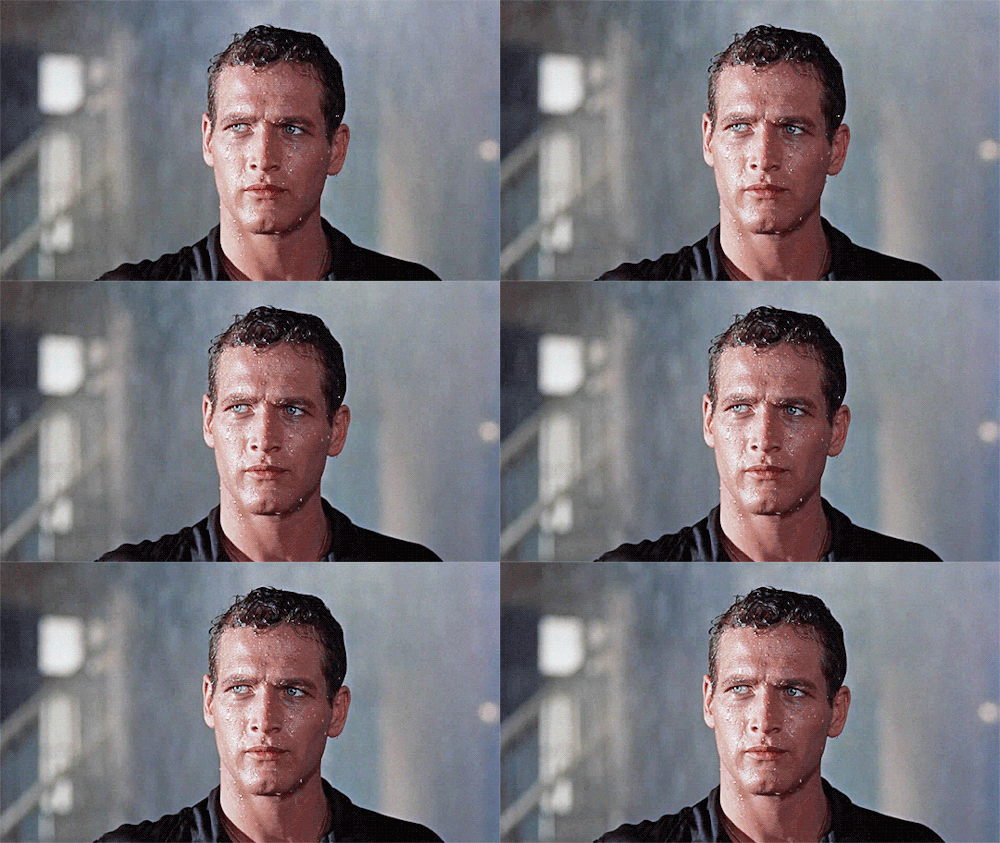
Holy shades of Cat on a Hot Tin Roof, Batman
professor-poet would be commonplace as a southern gothic heroine.
So Zink makes her heroine a lesbian creative writing student whose career is waylaid (and sexual orientation hijacked) by an intermittently bi alcoholic serial-seducing poet-professor. Yep, he's definitively bi, and in contrast she's painted more dismissively as merely sexually confused in this book's moral universe.
Fast-forward a few years, and our heroine gets annoyed enough to flee with the couple's young daughter. Mother and daughter hide in plain sight by passing the blonde daughter as black, thereby guaranteeing that she'll be overlooked and underestimated in her school and community.
More satirical hijinks if this kind ensue, and Zink is plenty talented enough to keep us interested and reading, not least of all by thoroughly lampooning southern gothic tropes. But she also gets us seriously questioning the wisdom of the empty attention-getting ploy of making a major black character white. This character bops sunnily through a gauntlet of systemic racist mistreatment and emerges seemingly unscathed at the novel's end (and restored to her privileged white identity). I understand that Zink is trying to highlight white culture's absurd, unexamined, racist double standards. But the end result here wrong-headedly implies that little white girls, given the chance, could totally kick racism's ass.
I can't think of any era (not this one, for sure) that benefits from stylishly trivialized racism.
And the stylishly trivialized sexism isn't especially welcome either.
Holy shades of Cat on a Hot Tin Roof, Batman
professor-poet would be commonplace as a southern gothic heroine.
So Zink makes her heroine a lesbian creative writing student whose career is waylaid (and sexual orientation hijacked) by an intermittently bi alcoholic serial-seducing poet-professor. Yep, he's definitively bi, and in contrast she's painted more dismissively as merely sexually confused in this book's moral universe.
Fast-forward a few years, and our heroine gets annoyed enough to flee with the couple's young daughter. Mother and daughter hide in plain sight by passing the blonde daughter as black, thereby guaranteeing that she'll be overlooked and underestimated in her school and community.
More satirical hijinks if this kind ensue, and Zink is plenty talented enough to keep us interested and reading, not least of all by thoroughly lampooning southern gothic tropes. But she also gets us seriously questioning the wisdom of the empty attention-getting ploy of making a major black character white. This character bops sunnily through a gauntlet of systemic racist mistreatment and emerges seemingly unscathed at the novel's end (and restored to her privileged white identity). I understand that Zink is trying to highlight white culture's absurd, unexamined, racist double standards. But the end result here wrong-headedly implies that little white girls, given the chance, could totally kick racism's ass.
I can't think of any era (not this one, for sure) that benefits from stylishly trivialized racism.
And the stylishly trivialized sexism isn't especially welcome either.

May 16, 2015
The ascendancy of Donald Trump has resulted in many outsiders peering more intently than ever at the socio-political framework of America, looking for cracks and knotholes. In this regard, Nell Zink’s second novel seems almost prescient. Of course, written and published well before Trump, Mislaid is nevertheless aimed like a lance at the boil of gender/race/class discrimination festering in the American body politic.
The plot reads like a soap opera: lesbian student falls for gay poetry lecturer, gets married to him and has children, then abandons him, retreating to rural Virginia with her daughter where they assume an Afro-American identity (to put it politely) in order to remain hidden. And access social benefits. Nothing is ever so simple though, and Peggy soon becomes enmeshed in those great American pastimes: drug-dealing and racism.
This is a deeply funny and equally disturbing novel, as it elicits unexpected laughter from the reader at the most dire circumstances that Zink’s characters find themselves in, which immediately makes the reader complicit in their socio-political entrapment.
It is an uncomfortable dichotomy, but Zink writes so tenderly about her excruciatingly fucked-up characters that the reader cannot help fall in love with them. This has to be one of the most non-PC books I have ever read, with Zink savagely pushing every race and gender button.
But it is not enough to be polemical. This is such a consummate and assured follow-up to The Wallcreeper. Zink is an immensely gifted writer, with an almost poetic ear for dialogue and an acute turn of phrase. Combined with her fearlessness, it makes for a truly searing reading experience.
The plot reads like a soap opera: lesbian student falls for gay poetry lecturer, gets married to him and has children, then abandons him, retreating to rural Virginia with her daughter where they assume an Afro-American identity (to put it politely) in order to remain hidden. And access social benefits. Nothing is ever so simple though, and Peggy soon becomes enmeshed in those great American pastimes: drug-dealing and racism.
This is a deeply funny and equally disturbing novel, as it elicits unexpected laughter from the reader at the most dire circumstances that Zink’s characters find themselves in, which immediately makes the reader complicit in their socio-political entrapment.
It is an uncomfortable dichotomy, but Zink writes so tenderly about her excruciatingly fucked-up characters that the reader cannot help fall in love with them. This has to be one of the most non-PC books I have ever read, with Zink savagely pushing every race and gender button.
But it is not enough to be polemical. This is such a consummate and assured follow-up to The Wallcreeper. Zink is an immensely gifted writer, with an almost poetic ear for dialogue and an acute turn of phrase. Combined with her fearlessness, it makes for a truly searing reading experience.

July 16, 2015
Much was made of the fact that Franzen recommended Zink and her books to the world, but I’m glad I read 'Mislaid' regardless. You must know they are nothing alike and Franzen could sit and think for 20 years and he wouldn’t come up with anything nowhere near this zany and inventive. I heard that they just bonded over birds.
I suppose you can say ‘Mislaid’ is an attempt at ‘The Great American novel’. All that will damn you in America is there: race, gender, and poverty. It explains everything so perfectly. The country is hell if you are poor and black but it is also a land of opportunity and all you need to do to get your happy ending is work hard and not give up. Lol. I’m kidding. All you need to do is stop being poor and black and become white and rich instead – yes, so the plot of this book is a little ludicrous and you just have to be on board with that because Zink is trying to say something here.
It’s a story of Peggy, a lesbian liberal arts students who gets pregnant by her gay college professor whom she subsequently marries. Mislaid. MIS-LAID. Get it? It gets weirder from there.
Since Zink keeps a straight poker face throughout the whole thing, including the outlandish ending, some of the reviewers might be forgiven for believing she is for real. But come on. This is not your typical MFA number. There is something brave, maybe even careless or reckless about this novel. The way it tried to talk about race, attacking the supposed new-era ‘colour-blindness’ of the US (especially the South). Zink’s satirical blade is very sharp and she risks being misunderstood. Most readers probably won’t like this book. Don’t be most readers.
I suppose you can say ‘Mislaid’ is an attempt at ‘The Great American novel’. All that will damn you in America is there: race, gender, and poverty. It explains everything so perfectly. The country is hell if you are poor and black but it is also a land of opportunity and all you need to do to get your happy ending is work hard and not give up. Lol. I’m kidding. All you need to do is stop being poor and black and become white and rich instead – yes, so the plot of this book is a little ludicrous and you just have to be on board with that because Zink is trying to say something here.
It’s a story of Peggy, a lesbian liberal arts students who gets pregnant by her gay college professor whom she subsequently marries. Mislaid. MIS-LAID. Get it? It gets weirder from there.
Since Zink keeps a straight poker face throughout the whole thing, including the outlandish ending, some of the reviewers might be forgiven for believing she is for real. But come on. This is not your typical MFA number. There is something brave, maybe even careless or reckless about this novel. The way it tried to talk about race, attacking the supposed new-era ‘colour-blindness’ of the US (especially the South). Zink’s satirical blade is very sharp and she risks being misunderstood. Most readers probably won’t like this book. Don’t be most readers.

November 15, 2015
I had been meaning to read Nell Zink for a while but when this novel was longlisted for the National Book Award, I moved her up in my list. She didn't make the shortlist but I still wanted to read it.
I should also say that I read this book despite the Jonathan Franzen endorsement quote on the cover. Carry on.
The novel starts out at a small women's college in rural Virginia in the 1960s. Peggy, a young woman who has always been drawn to the masculine side of her own sexuality, ends up having an affair and married to a gay male poet who teaches at the school. What starts out seeming like it will be a tale of budding lesbian self-discovery turns into a bizarre story of rural poverty, fluid sexual activity within a pretty condemning and confining setting, and shall we say "modern" marriage.
Because mislaid plans... and Peggy was mislaid... get it.
On the one hand, I felt like I was reading something I hadn't read before. But the characters never felt realistic to me. This isn't the gritty Appalachian hills of someone like Bonnie Jo Campbell or even the very folksy character capture of Scott McClanahan (who writes almost exclusively about West Virginia.) This is poverty within absurdity, a fun read but probably not something that will really stick with me. I will probably still read other novels by the author because she seems to have a unique approach.
I should also say that I read this book despite the Jonathan Franzen endorsement quote on the cover. Carry on.
The novel starts out at a small women's college in rural Virginia in the 1960s. Peggy, a young woman who has always been drawn to the masculine side of her own sexuality, ends up having an affair and married to a gay male poet who teaches at the school. What starts out seeming like it will be a tale of budding lesbian self-discovery turns into a bizarre story of rural poverty, fluid sexual activity within a pretty condemning and confining setting, and shall we say "modern" marriage.
Because mislaid plans... and Peggy was mislaid... get it.
On the one hand, I felt like I was reading something I hadn't read before. But the characters never felt realistic to me. This isn't the gritty Appalachian hills of someone like Bonnie Jo Campbell or even the very folksy character capture of Scott McClanahan (who writes almost exclusively about West Virginia.) This is poverty within absurdity, a fun read but probably not something that will really stick with me. I will probably still read other novels by the author because she seems to have a unique approach.
January 18, 2016
(Jan) It's rare I give a book 1*. While I love to read, I don't have any pretensions that I could sit down and write a book. Usually I give the author credit for putting pen to paper and making a story come out, even if I don't like it. This one, however...well, you ever read a book and finish it and think to yourself "WTF did I just read?!!" I honestly don't understand how this got published. When I think of how many struggling authors send in manuscripts to publishing houses hoping to rise above the slush pile and be noticed, I really can't fathom how this one got noticed enough to catch anyone's interest. How did someone read this and think "yes, this should be published; people will like this?!"
There was honestly no storyline, no plot that made sense, no purpose to the story. It's like the author jumbled a bunch of disconnected ideas in her head and threw them in a literary blender and poured out what she had onto paper and voilà! A book was born. There is a frustrated teenage girl who decides she is a lesbian but has sex with a guy who is gay and gets pregnant. She's unhappy, he's a jerk who sleeps around w/men and women, they are both somewhat estranged from their families, a second child comes along, she gets mad at him, takes the young daughter and runs away. They live super poor, she pretends they are black (daughter is pale skinned and blonde hair - oh and she has a fake birth certificate aging her 2 years, plus she skips a year in school so she's 7 in 5th grade), people accept that they are black, she becomes a drug...assistant?...the girl becomes bff w/a black guy who is smart, they go to college, she meets her older brother there (they don't know who each other are), there is a drug scandal that brings them together, the family reunites (sorry for the spoiler, but honestly, it's so awful hopefully you won't read the book so it doesn't matter that I spoiled it). There is nothing remotely interesting or redeemable about any of the characters. The only thing that was not in the book is the incest I was afraid it was moving towards (thank you for leaving that out). Was this supposed to be funny? It wasn't. Literary highbrow? Nope, wasn't that either. I truly don't know what it was, other than a huge waste of my time. The only reason I finished it was because we chose it for bookclub because it sounded interesting. It wasn't. Maybe I'm not intellectual enough to understand it? Ok, maybe - but that's fine, because I really don't want to be the person who understands and likes this mess of a novel. I hate writing reviews like this, but sorry, this was just an awful piece of crap.
There was honestly no storyline, no plot that made sense, no purpose to the story. It's like the author jumbled a bunch of disconnected ideas in her head and threw them in a literary blender and poured out what she had onto paper and voilà! A book was born. There is a frustrated teenage girl who decides she is a lesbian but has sex with a guy who is gay and gets pregnant. She's unhappy, he's a jerk who sleeps around w/men and women, they are both somewhat estranged from their families, a second child comes along, she gets mad at him, takes the young daughter and runs away. They live super poor, she pretends they are black (daughter is pale skinned and blonde hair - oh and she has a fake birth certificate aging her 2 years, plus she skips a year in school so she's 7 in 5th grade), people accept that they are black, she becomes a drug...assistant?...the girl becomes bff w/a black guy who is smart, they go to college, she meets her older brother there (they don't know who each other are), there is a drug scandal that brings them together, the family reunites (sorry for the spoiler, but honestly, it's so awful hopefully you won't read the book so it doesn't matter that I spoiled it). There is nothing remotely interesting or redeemable about any of the characters. The only thing that was not in the book is the incest I was afraid it was moving towards (thank you for leaving that out). Was this supposed to be funny? It wasn't. Literary highbrow? Nope, wasn't that either. I truly don't know what it was, other than a huge waste of my time. The only reason I finished it was because we chose it for bookclub because it sounded interesting. It wasn't. Maybe I'm not intellectual enough to understand it? Ok, maybe - but that's fine, because I really don't want to be the person who understands and likes this mess of a novel. I hate writing reviews like this, but sorry, this was just an awful piece of crap.

May 4, 2015
I'd rate this 2.5 stars.
Hmm. This book was definitely intriguing.
Peggy Jackson grew up in Virginia in the 1960s, a girl of some means raised by parents with more of an eye on social niceties and appropriateness than actual parenting, especially when she realizes she is a lesbian. She convinces them to send her to Stillwater College, a small, all-girls school, where she can pursue her dreams of literary success, and perhaps find a girlfriend. They are none too happy to send her away.
But it isn't long before she winds up under the spell of Lee Fleming, Stillwater's resident poet, whose wealthy family allows him to indulge his profligate lifestyle and invite poets from across the country to share their talents, not to mention share their drugs and alcohol. Despite one major complication—Lee is gay and Peggy is a lesbian—the two begin an affair, which quickly leaves 18-year-old Peggy pregnant and forced to withdraw from school.
Peggy is unprepared for marriage and motherhood, despite the fact that she loves her son and daughter. But her jealousy at Lee's serial infidelity and his unwillingness to help her advance her literary career leaves her angry and depressed. An impulsive act has Lee threatening to commit Peggy to a psychiatric institution, so with no other choice, she runs away with her three-year-old daughter in tow, leaving her nine-year-old son Byrdie behind with Lee.
Determined to live a life outside the margins, Peggy (now Meg) and her daughter Karen squat in an abandoned shack in the midst of an African-American settlement, and she adopts African-American personae for both of them (despite their outward appearances). They live in near-abject poverty, supplemented by Meg's odd jobs (including aiding a drug dealer), but eventually the two move into a housing project, where Karen can be closer to her best friend, Temple, whose intellect and potential far outweighs those around him, and this helps propel Karen forward as well, despite that she is younger than Meg has led everyone to believe.
Years later, Temple and Karen wind up as students at the University of Virginia (Karen on a minority scholarship), and it is there the two encounter Byrdie, now a senior, happy to be living a life away from his father's emotional complexity. The lives of the three intersect one Halloween night, the implications of which not only threaten to unravel each of their academic lives, but the lies that have been told for years prior.
I thought the concept of this book was really fascinating, and Nell Zink is a very good storyteller with a knack for language and dialogue. However, I felt more often than not, this book was satirical when I expected it to be serious, and chose a heavier hand when dealing with more farcical material. I think it wanted to be a commentary on the heavy weights of racial and sexual prejudice, social mores, and the damages that family can cause, but often it got mired in more exposition than it needed, and I felt the ending was a little too pat for a book that was really unique in most other ways.
If you enjoy social satire, this may be your cup of tea. Zink's writing is crisp and her ideas are really creative, but for me, Mislaid , well, missed the mark.
See all of my reviews at http://itseithersadnessoreuphoria.blo....
Hmm. This book was definitely intriguing.
Peggy Jackson grew up in Virginia in the 1960s, a girl of some means raised by parents with more of an eye on social niceties and appropriateness than actual parenting, especially when she realizes she is a lesbian. She convinces them to send her to Stillwater College, a small, all-girls school, where she can pursue her dreams of literary success, and perhaps find a girlfriend. They are none too happy to send her away.
But it isn't long before she winds up under the spell of Lee Fleming, Stillwater's resident poet, whose wealthy family allows him to indulge his profligate lifestyle and invite poets from across the country to share their talents, not to mention share their drugs and alcohol. Despite one major complication—Lee is gay and Peggy is a lesbian—the two begin an affair, which quickly leaves 18-year-old Peggy pregnant and forced to withdraw from school.
Peggy is unprepared for marriage and motherhood, despite the fact that she loves her son and daughter. But her jealousy at Lee's serial infidelity and his unwillingness to help her advance her literary career leaves her angry and depressed. An impulsive act has Lee threatening to commit Peggy to a psychiatric institution, so with no other choice, she runs away with her three-year-old daughter in tow, leaving her nine-year-old son Byrdie behind with Lee.
Determined to live a life outside the margins, Peggy (now Meg) and her daughter Karen squat in an abandoned shack in the midst of an African-American settlement, and she adopts African-American personae for both of them (despite their outward appearances). They live in near-abject poverty, supplemented by Meg's odd jobs (including aiding a drug dealer), but eventually the two move into a housing project, where Karen can be closer to her best friend, Temple, whose intellect and potential far outweighs those around him, and this helps propel Karen forward as well, despite that she is younger than Meg has led everyone to believe.
Years later, Temple and Karen wind up as students at the University of Virginia (Karen on a minority scholarship), and it is there the two encounter Byrdie, now a senior, happy to be living a life away from his father's emotional complexity. The lives of the three intersect one Halloween night, the implications of which not only threaten to unravel each of their academic lives, but the lies that have been told for years prior.
I thought the concept of this book was really fascinating, and Nell Zink is a very good storyteller with a knack for language and dialogue. However, I felt more often than not, this book was satirical when I expected it to be serious, and chose a heavier hand when dealing with more farcical material. I think it wanted to be a commentary on the heavy weights of racial and sexual prejudice, social mores, and the damages that family can cause, but often it got mired in more exposition than it needed, and I felt the ending was a little too pat for a book that was really unique in most other ways.
If you enjoy social satire, this may be your cup of tea. Zink's writing is crisp and her ideas are really creative, but for me, Mislaid , well, missed the mark.
See all of my reviews at http://itseithersadnessoreuphoria.blo....

July 6, 2015
I won this in a First Reads giveaway! with thanks to Harper Collins Australia and Goodreads.
This was not even remotely what I was expecting; all the reviews of The Wallcreeper led me to believe that Zink's style must be completely inaccessible and uncompromising and not one bit fun at all. But I laughed out loud a few times during this. Oh no! I have to interrupt myself here because while thinking about Zink's style I suddenly flashed onto A Confederacy of Dunces which I read about twelve years ago and did not particularly enjoy. (Way more interesting is the backstory behind its publication.) Are the two books similar? Hell if I remember. Anyway, moving on: I really liked the plot of this; I dunno, it just seemed ballsy - to write about . I thought Zink nailed the tone (it really did read like 1950s-1980s, but mostly 1950s). And she seemed genuinely fond of her characters, no matter (because of?) how badly they behaved; they were entertaining and human. I could imagine her revisiting them in a sequel, although it's not particularly necessary. I didn't love-love it, but I have to give it four stars for guts and because it was bloody well-written.
This was not even remotely what I was expecting; all the reviews of The Wallcreeper led me to believe that Zink's style must be completely inaccessible and uncompromising and not one bit fun at all. But I laughed out loud a few times during this. Oh no! I have to interrupt myself here because while thinking about Zink's style I suddenly flashed onto A Confederacy of Dunces which I read about twelve years ago and did not particularly enjoy. (Way more interesting is the backstory behind its publication.) Are the two books similar? Hell if I remember. Anyway, moving on: I really liked the plot of this; I dunno, it just seemed ballsy - to write about . I thought Zink nailed the tone (it really did read like 1950s-1980s, but mostly 1950s). And she seemed genuinely fond of her characters, no matter (because of?) how badly they behaved; they were entertaining and human. I could imagine her revisiting them in a sequel, although it's not particularly necessary. I didn't love-love it, but I have to give it four stars for guts and because it was bloody well-written.

October 13, 2015
On the plus side, this was inventive and unpredictable. There were so many topical threads woven into the story, often at odd times and in unexpected and intriguing ways. Alas, there are also bizarre inconsistencies and Zink's handling of characterization and circumstance can be erratic and outright bizarre. The same can be said of her sense of humor. Sometimes I laughed out loud but more often a joke fell flat or -worse - caused me to cringe.
This started out well and showed great promise but gradually grew diffuse, moved through confusion, and progressed to disappointment.
This started out well and showed great promise but gradually grew diffuse, moved through confusion, and progressed to disappointment.

July 14, 2015
I was misled by a glowing NYTimes review into reading this. The story is a mess and as it unravels, the prose gets more cliched and lazy. The portrayal of race and poverty is superficial.

July 6, 2015
Hm. Okay. Well...
If Faulkner wrote an unfinished manuscript based on a lost, unfinished comedy of Shakespeare, then Jonathan Franzen discovered this twice-lost Shakespearian/Faulknerian draft, cleaned it up a bit, and made notes toward a screenplay adaptation that John Waters finally completed and directed - then the end result might look something like this book. It is a kind of snappy Southern dysfunctional family madcap farce that plays around with sexuality, race, and class and is rife with tweaked but typical Shakespearean comedic elements like: mistaken identity, assumed disguises, crossdressing, flights into the woods, random coincidences, trading places, unnecessarily-long-kept secrets, sustained and exaggerated overreactions to small or perceived personal slights, mass interpersonal meddling and interferences, buffoons and kindhearted ne'er-do-wells, a ridiculous trial, campy performances, revenge plots, the marriage plot, and a histrionic finale with revelations galore and everyone on stage together freaking out.
I wanted to like this book more than I did, but I didn't dislike it. I made peace with it once the Shakespeare comedy conventions started emerging (at least to my grasping mind) to lend the whole thing some structure in its lack of structure and coherence in its lack of coherence. Until that point, I often felt like I was reading something Nell Zink (who is pretty clearly some kind of wacky savant) was energetically making up as she went along. It reads like a brilliant slacker student's creative writing final exam frantically composed under the fevered influence of a Costco crate of 5-Hour Energy.
To further describe this novel is beyond my limited talents. It also won't really be helpful to describe what happens in the book beyond what the jacket copy offers. The straightforward Spark Notes summaries of Shakespeare's best comedies sound pretty dumb when boiled down to the basic facts, and this book would probably fare even worse. The best advice I can give is to read the first 50-ish pages to determine whether you find the whiz-bang acerbic style wildly witty and wonderful, or as grating as all getout. If you enjoy it, you may continue, but know that the plot tributaries and tangents will ensue and gain momentum as the book wends its way toward the climax of ultimately conventional Shakespearean-style hilarity previously described.
If Faulkner wrote an unfinished manuscript based on a lost, unfinished comedy of Shakespeare, then Jonathan Franzen discovered this twice-lost Shakespearian/Faulknerian draft, cleaned it up a bit, and made notes toward a screenplay adaptation that John Waters finally completed and directed - then the end result might look something like this book. It is a kind of snappy Southern dysfunctional family madcap farce that plays around with sexuality, race, and class and is rife with tweaked but typical Shakespearean comedic elements like: mistaken identity, assumed disguises, crossdressing, flights into the woods, random coincidences, trading places, unnecessarily-long-kept secrets, sustained and exaggerated overreactions to small or perceived personal slights, mass interpersonal meddling and interferences, buffoons and kindhearted ne'er-do-wells, a ridiculous trial, campy performances, revenge plots, the marriage plot, and a histrionic finale with revelations galore and everyone on stage together freaking out.
I wanted to like this book more than I did, but I didn't dislike it. I made peace with it once the Shakespeare comedy conventions started emerging (at least to my grasping mind) to lend the whole thing some structure in its lack of structure and coherence in its lack of coherence. Until that point, I often felt like I was reading something Nell Zink (who is pretty clearly some kind of wacky savant) was energetically making up as she went along. It reads like a brilliant slacker student's creative writing final exam frantically composed under the fevered influence of a Costco crate of 5-Hour Energy.
To further describe this novel is beyond my limited talents. It also won't really be helpful to describe what happens in the book beyond what the jacket copy offers. The straightforward Spark Notes summaries of Shakespeare's best comedies sound pretty dumb when boiled down to the basic facts, and this book would probably fare even worse. The best advice I can give is to read the first 50-ish pages to determine whether you find the whiz-bang acerbic style wildly witty and wonderful, or as grating as all getout. If you enjoy it, you may continue, but know that the plot tributaries and tangents will ensue and gain momentum as the book wends its way toward the climax of ultimately conventional Shakespearean-style hilarity previously described.

September 17, 2015
As a writer Nell Zink is equivalent to a mother who slips vegetables into her kids desserts. She gives a lot of sweet of fluffy goodness with a strong heap of what's good for us (intellectual puzzles and social commentary). Mislaid is a comedy of errors that much resembles Elizabethan theater as well the theater of the absurd.
Written as what the author calls "agent bait," Zink's premise for this novel is simple and strange: lesbian woman marries gay poet from the South. She tires of his repeated cheating and his threats to have her committed to an institution, so she leaves her son behind and runs away with her three-year-old blonde blue-eyed daughter and goes into hiding as an African-American mother-daughter pair. Absolutely wacky and improbable...but that bizarre premise provides a unique platform to examine race, sex and poverty in Southern America.
This novel is simultaneously erudite and light; it makes the reader think while being highly entertaining. Not a perfect novel but a pretty darn memorable one.
Written as what the author calls "agent bait," Zink's premise for this novel is simple and strange: lesbian woman marries gay poet from the South. She tires of his repeated cheating and his threats to have her committed to an institution, so she leaves her son behind and runs away with her three-year-old blonde blue-eyed daughter and goes into hiding as an African-American mother-daughter pair. Absolutely wacky and improbable...but that bizarre premise provides a unique platform to examine race, sex and poverty in Southern America.
This novel is simultaneously erudite and light; it makes the reader think while being highly entertaining. Not a perfect novel but a pretty darn memorable one.

January 30, 2017
I wish I could come up with an accurate string of letters to form a giggle, because the subversive nature of this book makes me do just that- giggle! Laugh outright in parts. So freaking clever while shooting a tall, proud middle finger to the southern sensibilities it shines a glaring light on. (I am a left-coaster, and one of those so called liberal elites[does that label mean I am liberal and intelligent?, If yes I'll take it!!], but I am southern born to southern parents and I related to a lot of the characterization in this book) Loved it!!

June 3, 2018
[2.7] Mislaid is like a sitcom with offbeat characters and clever writing. Listening to Cassandra Campbell's excellent narration was a breeze. Unfortunately, the novel is thin on substance and plot. There is a lack of momentum. The cleverness grew tedious. If I had mislaid this book in the middle, I probably wouldn't have bothered to search for it.

July 29, 2015
Set in 1966, at the campus of Stillwater College, Mislaid tells the story of Peggy. A freshman with literary aspirations, Peggy finds herself falling for Lee, a poet and one of her professors. Peggy falls pregnant and the two end up married. The only problem is, Peggy identifies herself as a lesbian and Lee as gay. This turns into some wry joke; they are an odd couple that has been mislaid.
Nell Zink takes it upon herself to explore the complex issue of sexuality with a mismatched pair stuck in a marriage that neither are interested in. The problem with Mislaid, is that this is such a complex issue and Zink was unable to handle the novel in a way it deserves. From the first chapter when the term ‘Mecca for lesbians’ was used, I felt uneasy about the way the GSM (Gender and/or Sexual Minorities) community was being treated. Then the wit found in Mislaid did not work for the majority of the novel. I was less than impressed with this book; it could have been a great story but nothing seemed to come together the way I expected.
Nell Zink takes it upon herself to explore the complex issue of sexuality with a mismatched pair stuck in a marriage that neither are interested in. The problem with Mislaid, is that this is such a complex issue and Zink was unable to handle the novel in a way it deserves. From the first chapter when the term ‘Mecca for lesbians’ was used, I felt uneasy about the way the GSM (Gender and/or Sexual Minorities) community was being treated. Then the wit found in Mislaid did not work for the majority of the novel. I was less than impressed with this book; it could have been a great story but nothing seemed to come together the way I expected.

October 17, 2017
Nell Zink! Please write more!
I loved this book. As others have said, it's very smart. Weird, but smart. Zink hints at all sort of Southern taboos and secrets in this short novel, but her masterful blending of the idiosyncrasies of the worlds of both the tony and peckerwood South--how charming that various characters opine that rabbit fur coats hardly connote wealth and that "If you left white people alone, they would put crawfish in a blender" in the same novel!--perhaps suggests a mixed economic heritage of her own. Although the gender and sexuality issues often seem improbable (and what is it with straight female authors thinking it's fine to conflate homosexuality with pederasty? I'm looking at you, Hanya Yanagihara!), the dialogue is fascinating and the story ceaselessly engrossing, generating an impressive plot over a short number of pages.
And there's a whole part about Woodberry Forrest and UVA! And they're pitch perfect. Brava, Nell Zink. I'm very impressed by this author.
I loved this book. As others have said, it's very smart. Weird, but smart. Zink hints at all sort of Southern taboos and secrets in this short novel, but her masterful blending of the idiosyncrasies of the worlds of both the tony and peckerwood South--how charming that various characters opine that rabbit fur coats hardly connote wealth and that "If you left white people alone, they would put crawfish in a blender" in the same novel!--perhaps suggests a mixed economic heritage of her own. Although the gender and sexuality issues often seem improbable (and what is it with straight female authors thinking it's fine to conflate homosexuality with pederasty? I'm looking at you, Hanya Yanagihara!), the dialogue is fascinating and the story ceaselessly engrossing, generating an impressive plot over a short number of pages.
And there's a whole part about Woodberry Forrest and UVA! And they're pitch perfect. Brava, Nell Zink. I'm very impressed by this author.

May 3, 2018
Nell Zink is a latter-day Thomas Pynchon without the paranoid conspiracy theories. Her take on offbeat lives lived on the margins is hilariously insouciant. Her sentences zing with brilliance; her economical prose is both refreshingly feminist and cheerfully optimistic. If realism is a summary of collective miseries, Zink is an anti-realist. Her characters shine in the glow of their own uniqueness, affected by the larger movements of society but not afflicted by them. This novel’s identity-shifting main character, Peggy, starts out as a more or less typical southern woman of the 1950s. Instead of nurturing her own creative aspirations, she ends up married to a gay poet who teaches in one of the early versions of a writing program. They have a couple of kids that she raises while he pursues the boozey, libidinous life of the famous poet who knows all the other famous poets of the day. One day, Peggy decides she’s had enough of living on the fringes of her husband’s life and takes off with one of her children, the youngest, a girl. To escape detection, she changes, not just her name (from Peggy to Meg), but her racial profile. She and her daughter officially become black, which allows them to do pretty much whatever they please, since very little is now expected of them. Though her husband hires a detective to search for his missing females, her own father is far from broken up by their disappearance, because, as Zink reminds us, the “ruling class is made up of hardened professionals . . . When two females vanish from a patriarchy, both of them attached to a homosexual, the ripples can be truly minimal.”
Sharp and surprising, Mislaid doles out transfixing revelations on every page without ever becoming pretentious; its plot twists are satisfying without being taxing. Zink practices the radical irony of fulfilled possibility. Her characters, by refusing to be haunted by what might have been, are, like all of us, prey to “the existential angst that incessantly haunts all mankind in modernity.” Taken in context, that is a very funny idea.

August 3, 2016
Zink's The Wallcreeper was one of the best novels I read this year, which is a lot to live up to and not something 'Mislaid' can equal. It is a funny and original piece of writing, but doesn't sustain the same brilliant tautness and balance of sincerity and irony. The story is of a troubled, divided family in 1960s and 70s America and includes some wonderful set pieces, mainly involving drugs. From the courtroom denouement onwards, though, the narrative seemed more like a play and thus didn't work as well. Of course, I'm probably being more critical than I otherwise would be had Zink's other novel not blown me away. Such is the unfairness of setting the bar high. Still, I happily read the whole novel on a long train journey and it made the miles fly by. There are some excellent moments of deadpan wit, including this conversation between drug dealers who've got high on their own product and realised that the wholesaler has been giving them PCP while claiming it's cocaine:
Nell Zink is a great writer and has a particularly good ear for non sequiturs. I'll definitely keep an eye out for her next novel.
"Why don't we deal booze?" Lomax said. "Like in Prohibition."
"Are you nuts?" the Seal said. "Going up against a state monopoly! You want the ATF coming down on us? If you're going to do a crime, you've got to do something illegal, so you're not competing directly with the government. That would be like if I started my own army instead of hiring on in Sri Lanka. Or smuggling cigarettes. That's not little piss-ant drug dealer shit. For that, you need the Mafia."
There was a brief silence, broken by the sound of Flea struggling with thick brownie batter in the kitchen.
"You know what's fun?" Meg said, leaning forward suddenly. "Tennis."
Nell Zink is a great writer and has a particularly good ear for non sequiturs. I'll definitely keep an eye out for her next novel.
December 5, 2016
I loved this madcap novel. It was funny and free. The plot is simple: a young lesbian and a gay professor fall for each other, marry, and have a son and daughter. The idyll goes downhill. She faces the drudgery of an unloved housewife without a creative outlet while he traipses around with his gay poet friends. So she takes off with Mireille, the girl, and the son, Byrdie, stays with his father.
The mother and her blonde daughter are soon passing as black as a way to lie low in rural Virginia. As everyone knows, to approach race these days is to tread very sensitive ground. Zink seems to toss any such concern aside. Throw in drugs and poverty and “Indians” and homosexuality and gross frat boys and conniving lawyers. Zink happily also seems not to be preoccupied with herself, always a relief for readers.
There were many funny passages of character and situation. Here’s one on the daughter’s choice of college major:
Mireille (aka Karen) … “planned tentatively, to major in English. As she explained to her mother in a letter, she knew English already, so she could probably get okay grades. There was no point majoring in something she didn’t already know, as she would just get into trouble or, more likely, major in the wrong thing. Whereas with English you can’t go wrong. Employers always need English.”
The mother and her blonde daughter are soon passing as black as a way to lie low in rural Virginia. As everyone knows, to approach race these days is to tread very sensitive ground. Zink seems to toss any such concern aside. Throw in drugs and poverty and “Indians” and homosexuality and gross frat boys and conniving lawyers. Zink happily also seems not to be preoccupied with herself, always a relief for readers.
There were many funny passages of character and situation. Here’s one on the daughter’s choice of college major:
Mireille (aka Karen) … “planned tentatively, to major in English. As she explained to her mother in a letter, she knew English already, so she could probably get okay grades. There was no point majoring in something she didn’t already know, as she would just get into trouble or, more likely, major in the wrong thing. Whereas with English you can’t go wrong. Employers always need English.”

Read
December 15, 2016Bailed only a couple chapters in. Much too snarky for my taste, or at least this month. Not even Laurence Bouvard - the narrator who made The Portable Veblen come so alive - could redeem this one in my ears.

April 25, 2015
[3.5, but rounded up]
Mislaid is a complicated novel, but I was so delighted to see that it had more of a structured narrative than The Wallcreeper did. I don't even know how to describe it. A gay professor and a lesbian student bone a lot, get married, have two kids, then the wife runs away, taking her little girl with her. To hide from her husband, Peggy/Meg and her daughter take up the identities of two deceased African Americans and live in poverty passing as black despite being very white. Shenanigans ensue, but like in the most intellectual sense.
The characters are all ridiculous, the plot is ridiculous, but it is soooo smart and funny. Zink does not hold back in her social commentary, and I'm glad she goes so boldly into the absurd while looking at identity. Having read The Wallcreeper, which was a bit of a narrative clusterfuck, I was pretty satisfied with the ending of her second novel. Granted, when you look back at it once you're done, you'll wonder why certain events and characters were included at all. Overall, though, it was pretty entertaining and it definitely makes you think.
Full review: Outlandish Lit - 3 Books About People Who Aren't What They Seem
Mislaid is a complicated novel, but I was so delighted to see that it had more of a structured narrative than The Wallcreeper did. I don't even know how to describe it. A gay professor and a lesbian student bone a lot, get married, have two kids, then the wife runs away, taking her little girl with her. To hide from her husband, Peggy/Meg and her daughter take up the identities of two deceased African Americans and live in poverty passing as black despite being very white. Shenanigans ensue, but like in the most intellectual sense.
The characters are all ridiculous, the plot is ridiculous, but it is soooo smart and funny. Zink does not hold back in her social commentary, and I'm glad she goes so boldly into the absurd while looking at identity. Having read The Wallcreeper, which was a bit of a narrative clusterfuck, I was pretty satisfied with the ending of her second novel. Granted, when you look back at it once you're done, you'll wonder why certain events and characters were included at all. Overall, though, it was pretty entertaining and it definitely makes you think.
Full review: Outlandish Lit - 3 Books About People Who Aren't What They Seem

November 5, 2016
"Mislaid" is the perfect title for this book: it was obviously placed in the "to be published" stack instead of thrown in the nearest dumpster. How bad is this David Sedaris wanna-be? Here is one paragraph: "Now, you'd think two dykes might be on the same team. But sexual deviance doesn't trump anything. It just makes a person more paranoid. The weak are always the first to turn on each other in a clinch, like Peter denying Jesus three times before the cock crowed. If ever two deviants were on the same team, it was Jesus and the rock on which he would build his church."
This is senseless, unfunny, and what a stretch comparing a lesbian couple to Jesus and his rock. This isn't the worst book I've read this year, but it's definitely the worst imitation of a great author (David Sedaris) I've ever read. And as far as I'm concerned, the quoted paragraph, above, is the greatest stretch in all of literature. Read only if being held at gunpoint.
This is senseless, unfunny, and what a stretch comparing a lesbian couple to Jesus and his rock. This isn't the worst book I've read this year, but it's definitely the worst imitation of a great author (David Sedaris) I've ever read. And as far as I'm concerned, the quoted paragraph, above, is the greatest stretch in all of literature. Read only if being held at gunpoint.

April 24, 2018
Well I guess I'm not hip. The book shrieks "DO YOU LIKE ME?!" from start to finish, and the 4 (FOUR!?) pages of blurbgasms before the title page lay down a "like it or else" law of approach. Sure, it's funny or quirky or zany or whatever (what it really is is sitcomesque) but to me it reads like a Young Adult primer: "You Hatched at Hogwarts and Now... You Think You're Ready for Undergrad Novels!!!!" The premise--she's a lesbian; he's gay--is a groaner. None of the touted social themes are explored to any challenging or illuminating depth. It's not a terrible book, there's some fair writing throughout, but the experience is like being trapped with a precocious, hyperactive child who is doubtlessly very very special but is too mortified of silence to stop trying to impress you for even a second.

June 3, 2015
This book tricked the shit out of me. Everything I read about it told me I would like it. But it took me 2 days to read 100 pages and I still cannot get into it. It's not what I hoped it would be. I think I've finally quit reading it. It was hard for me to be honest enough to do that, because every time I try to put it down I take another look and say, 'but it sounds so great! Maybe you're wrong. Try, try again." But Jesus Christ, I can't force myself to sit down with it anymore.
Displaying 1 - 30 of 1,025 reviews