სიმონ დე ბოვუარის ყველაზე წარმატებული წიგნი. რამდენიმე ნოველისგან შემდგარი კრებული, რომელიც ავტორის პირველი ნაწარმოებია. თითოეული ამბავი ბოვუარის პირადი ცხოვრების გამოძახილია და იმ სიტუაციებს აღწერს, რომლებსაც ავტორი მოგვიანებით სხვა რომანებშიც განავითარებს. ესაა დოკუმეტური მასალა ‘’ქალთა განსხვავებულობის’’ ფენომენზე 20-იანი წლების ბურჟუაზიულ საზოგადოებაში.
Simone de Beauvoir was a French existentialist philosopher, novelist, essayist, memoirist, and feminist whose writings profoundly shaped twentieth-century philosophy, literature, and modern feminist thought. Born in Paris into a bourgeois Catholic family, she displayed exceptional intellectual ability from an early age. After studying philosophy at the Sorbonne, she passed the prestigious agrégation examination in 1929, becoming one of its youngest successful candidates. During her studies she met Jean-Paul Sartre, with whom she formed a lifelong intellectual and personal partnership that became central to the development of French existentialism. Although Beauvoir often rejected the title of philosopher during her lifetime, her work established her as one of the discipline's most influential modern thinkers. She explored themes of freedom, responsibility, ethics, oppression, and human existence through both philosophical and literary writing. Her groundbreaking book The Second Sex (1949) transformed feminist theory by arguing that femininity is shaped primarily by social and historical conditions rather than biology, introducing the celebrated idea that "one is not born, but rather becomes, woman." The work challenged traditional assumptions about gender and became one of the foundational texts of contemporary feminism. Beauvoir also authored influential philosophical studies, including The Ethics of Ambiguity, alongside acclaimed novels such as She Came to Stay, The Blood of Others, The Mandarins, which received the Prix Goncourt in 1954, and The Woman Destroyed. Her four-volume autobiography, beginning with Memoirs of a Dutiful Daughter, remains an important account of twentieth-century intellectual and cultural life. Throughout her career she served as co-founder and editor of the influential journal Les Temps Modernes, contributing essays on politics, literature, philosophy, and contemporary social issues. Beyond her writing, Beauvoir was deeply engaged in public life. She campaigned for women's rights, reproductive freedom, and social equality, signing the Manifesto of the 343 that called for the legalization of abortion in France. She also opposed colonialism, criticized social injustice, and supported progressive political causes throughout her life. Her travels inspired widely read travel books and essays examining cultures in the United States and China. Beauvoir's legacy extends far beyond feminism, influencing existential philosophy, literary criticism, political theory, ethics, sociology, and gender studies. Despite continuing debate over aspects of her personal life and controversial relationships, her intellectual contributions remain central to modern scholarship. Her books have been translated into numerous languages and continue to be studied worldwide for their philosophical depth and literary achievement. Honored with distinctions including the Prix Goncourt, the Jerusalem Prize, and the Austrian State Prize for European Literature, Simone de Beauvoir is widely regarded as one of the defining intellectual figures of the twentieth century, whose writings permanently transformed discussions of gender, freedom, morality, and the human condition while continuing to inspire scholars, writers, and activists across generations.
Simone de Beauvoir wrote these five short stories before the war, when she was between 27 and 29 years old.
They were rejected by two publishing houses (in one case for "heaviness and tedium" and in the other for lacking "any originality at a deeper level"). They would not be made available to the public until 1979, when de Beauvoir was 71.
Conscious of its "obvious faults", she described the book as "a beginner's piece of work", even though she had already written rough drafts of several unpublished novels.
With the benefit of hindsight, I think all concerned underestimated the merit of her stories.
"Nothing Without Engagement"
These tales were the first works in which de Beauvoir injected aspects of herself and her life (as opposed to what she called the "phantasms" of her imagination) into her fiction.
Each story captures the experience of a young woman. Some are fictionalised versions of actual friends of de Beauvoir's. However, it's hard to tell whether and how much they are biographical, projections of her own concerns, and/or manufactured.
All of the stories show women attempting to define themselves, while circumscribed by the dictates of both religion and family, what she calls "beliefs and codes".
All of the girls attended Catholic single sex schools, and had little exposure to boys outside their own family. Their parents discouraged any subsequent contact with men, unless it was an approved engagement that would lead to marriage. Certainly, there was no expectation of premarital sex.
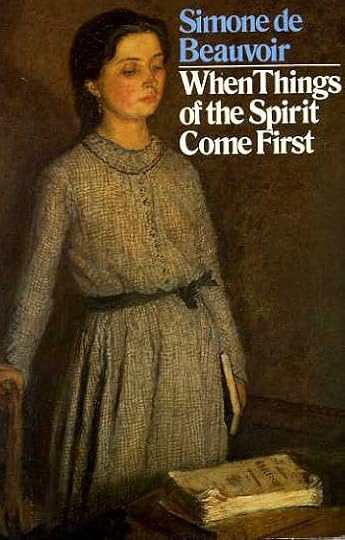
The cover of the paperback I read.
"Without Me Grasping It"
Marcelle has to get engaged and eventually married in order to experience a relationship of any kind with a male.
A creative person, she is lonely within a framework of institutional obedience. When it comes to a relationship, she is resistant, fearful of being carried away by illicit passion. When finally she is married, her experience is one of humiliation, "awkward silence","passionate submission". Her wedding night is a fall into a "bottomless pit of abjection". She clings to her new husband, "ecstatically, drunk with shame":
"'I'm his thing, his slave,' she thought to herself; and aloud, 'I adore you.'"
Eventually, Marcelle realises that she must seek the meaning of her life within herself, not in or through a man. Only then does she come to "the wonderful revelation of her fate. 'I am a woman of genius,' she decided." She was now free to realise her creative ambitions.
Chantal paints a picture of herself as someone who wants "no part of life to go by me without grasping it". Yet, her journal reveals that she feels empty and on edge: "I am stifling. I have the feeling of being buried alive." Unfortunately, she passes only conformist values onto her 14 year old pupils.
In contrast, Lisa seems to be the "disgusting romantic" Chantal warns her class about. A woman accuses her of being her husband's mistress. It's not true, but she nevertheless fantasises about the "dark flower of my passion":
"Perhaps one day I shall get some man to keep me."
Anne is most overtly inhibited by her mother's religious and moral strictness, much to Chantal's frustration as her friend:
"You have told me yourself that this total submission to the divine will is often only a cover for laziness and cowardice. Your resignation is in fact a definite choice: you choose peace. How do you know that God does not require of you the very thing that is hardest, not renouncement but resistance, not refusing to live but life itself?"
"Nothing Forbidden, Nothing Impossible"
Marguerite's story is the only one that is told wholly in the first person. De Beauvoir says in the Preface that it is the one most based on her own family life. Marguerite describes the experiences that "helped liquidate the last vestiges of religion in me". In its place, she develops her own philosophy and moral code. Initially, she does so tentatively:
"I belonged to a mean and reasonable breed - I was a dreary little bourgeoise. I was preparing my future liberty with the same careful economy as Mama, when she put money aside for her old age."
This conservatism is reflected in her apprehension about sex:
"I lost the clarity of mind I was so proud of and all my self-assurance when I saw a prostitute on a street corner stop a passing man - I was seized with distress and repulsion."
Yet it's her introduction to the world of Paris bars that propels her development. She feels some veneration for the whores she finds there:
"I should have liked to know by what series of initiations they had won the splendid freedom they enjoyed in relation to their bodies. They were beyond fear, beyond disgust; nothing was forbidden to them, nothing impossible: for my part I was ashamed of my virginity."
"There in the Centre of Things"
Of course, Marguerite doesn't become a whore: "a kind of election was required; and I had not been chosen."
When she pretends to be a prostitute in a bar, her pretense is apparent to all. One of the customers remarks, "You are a little bourgeoise trying to act the bohemian."
Still, she throws caution to the wind. In retrospect, she realises that "I had made a blind use of my freedom, I had let myself drift on the currents of chance and things had happened - slight, no doubt, and even squalid, but that made the fragment of miracle hidden in the depths of the vulgar happening seem to me all the more precious."
Abandoned by her first real love interest (Denis), she has a revelation of almost revolutionary proportions:
"What treasures of time I had wasted! Slowly I walked off; the world was shining like a new penny, and although I did not yet know what I wanted to do with it, everything was possible, since there in the centre of things, in the place Denis had left empty, I had found myself."
A Young Woman's Liberation
If the first four stories are sometimes dry, the last is a profound and skillful tale of personal liberation, while the collection as a whole is a fictional rehearsal of the ideas that Simone de Beauvoir would explore 12 years later in "The Second Sex".
Today, some women might not believe or relate to the limitations to which de Beauvoir's characters were subjected (especially if they decline to embrace the term Feminism). However, that doesn't make her work any less real or true. Anybody who reads these stories will appreciate why there had to be a movement called Feminism, and why it requires eternal vigilance to protect its gains (quite apart from any question as to whether it has yet achieved everything it set out to).
Reading Simone is the antidote to when you’ve been subjected to too much Instagram influencer frivolity. I wonder what she would make of social media. _______
Exactly what you expect from early short stories written by Simone but that's what makes them so, so good. "Dreary little bourgeois" girls creating an identity for themselves outside of their family & religious upbringing. a girl dried up from academia in her a worn out overcoat spending her last bits of change on Violets & the only physical contact she receives is from her dentist. I love all of these stories.
Tekintve, hogy Beauvoir már az előszóban kilistázza e könyv hibáit, úgy érzem, ki van lopva a számból a falat. Kénytelen vagyok hát a szöveg pozitívumaira koncentrálni. Szerencsére van neki olyan. Ez a könyv ugyanis csak első blikkre visz minket ismerős világba (a ’20-as, ’30-as évek Franciaországába), valójában egy hihetetlenül egzotikus tájon játszódik: Nőországban. E kötet szereplői közé a férfi csak mint vendég érkezhet, mint egy idegen kultúra képviselője, akiről szinte csak közvetett ismereteket szerezhetünk: pletykákból, rémhírekből, stikában elolvasott versekből és regényekből. Ebben a világban nem létezik szexualitás – amikor meg aztán kiderül, hogy mégis, csak eddig mindenki úgy csinált, mintha a babákat a káposztaföldről takarítanák be… hát… az igen nagy meglepetés. A hit hatalma nyíltan a képmutatás kritikája, és egyben annak a traumának a dokumentuma, ahogy a világba kilépő nő egyszer csak ráébred: amit eddig mondtak neki, köszönő viszonyban sincs a valósággal. Bizonyos értelemben feminista propaganda, de sokat lágyít rajta, hogy Beauvoir kellő (ön)iróniával ábrázolja lazán összekapcsolódó novelláinak hősnőit. Sajnos a szerző (itt) érezhetően nem a jellemábrázolás mestere, szereplői a szakmányban lefolytatott egzisztencialista párbeszédek ellenére is (vagy éppen azért) élettelenek maradnak. Aminek köszönhetően izgalmas, okos szöveget kapunk, ami valahogy mégis hideg és merev marad.
Mijn de Beauvoir ontgroening, ik ben tevreden. Ik vind de structuur van het boek erg leuk bedacht en goed uitgewerkt. Je merkt dat ze zich heel veel bezighield met maatschappelijke onderwerpen, existentialisme, feminisme en het patriarchaat en ze laat in dit boek duidelijk zien wat allerlei negatieve invloeden kunnen doen met jonge vrouwen. Soortvan de originele Skins/Euphoria met een beetje Camus aan het einde haha. Aanrader!
In the 1940s, in France, people like the ones in this novel had beliefs about what how to act, what one can and cannot do, what is right or wrong or desirable, that brought them much suffering. From my perspective, I want to (gently) yell at them: there's no reason why you have to keep yourself to this unreasonable standard, why you have to act in accordance with these other people's wishes, why you have to be this certain type of person. Can't you see the trouble and strife it brings you? But of course I am just the same, it is merely that instead of thinking I have to adhere to certain Christian notions, or obey/satisfy my parents and family, or fulfill a certain sort of role as a woman, I believe in other things about adhering to notions of success and intellect, of obeying or satisfying a more nebulous group of unidentified people I may want to help or impress, of fulfilling a certain different sort of role as a certain different sort of person. The content may have changed, but the form is the same. Simone uses such beautiful words, and even without replacing the variables with new values, they still describe reality.
Beauvoir’s story collection When Things of The Spirit Come First is said to be semi-autobiographical, and if you’ve previously read Memoirs of A Dutiful Daughter, you will very likely be able to charmingly pin point the especially apt details true to Beauvoir herself. I particularly found the first and last stories included to be the most evocative of her own traits and experiences posited in her lengthy memoir, and as well to be the ones I resonated with the most. Honestly, if you’ve enjoyed anything you’ve read by Beauvoir, or enjoy French literature in general, I think you will really love this one, and I can say I really loved it as well, which is saying something quite grand considering I am quite unlucky in lit when it comes to short story collections.
It is refreshing to encounter philosophical fiction, especially when written by Simone De Beauvoir. In the hands of an artist of her caliber, these stories rather glow on the page, shining with thought. I quite admire the ability of an author to present the tenets of a philosophy within the context of a piece of fiction, particulary within the confines of a short story. The fact that these pieces were written quite early in the author's career is of no consequence. They simply show how good she was at the outset and the promise of her future work.
Problemas de mujeres jóvenes en los años de la bohemia francesa. Beauvoir, en esta novela que escribió muy joven y fue rechazada por las editoriales, narra varios relatos entrelazados en los que varias mujeres se ven atadas por diferentes factores sociales (la moral cristiana, la figura maternal, los propios prejuicios) y se comportan de manera que propician su propio final fatal. Una novela triste, aunque sin demasiada hondura emocional. Las protagonistas se sienten lejanas, atrapadas en sus propias circunstancias frente a un lector espectador. La propia Simone de Beauvoir confesaba que no era su mejor novela. No obstante como friki que soy me gusta saber qué hubo antes de El segundo sexo 🤓.
Over een moeizame leesbeurt gesproken.. één voor één vervelende personages. Vooral Chantal.
“Sinds ik begon te schrijven, is het hart van de anemonen donkerder geworden, is de geur van de nacht veranderd en duizend net ontloken schoonheden vragen om een tederheid om mij heen die precies bij ze past… Niets in het leven wil ik voorbij laten gaan zonder het te grijpen.”
2.5/5 - door de beperkte functionaliteit van Goodreads wel gebuisd in theorie, helaas.
3,5 En 'Cuando predomina lo espiritual' nos encontramos cinco relatos protagonizados por mujeres más o menos relacionadas entre sí y en las que hay un punto en común: algo insólito brilla en su interior de forma que no pueden aceptar una forma de vida mediocre ni seguir tolerando la opresión que todo su alrededor ejerce contra ellas. Como primer encuentro con la autora, me ha parecido que no ha estado mal, pero sigo queriendo conocer esas grandes y conocidísimas obras suyas que espero realmente me fascinen. ° "Hay más de una mujer en mí".
"He aquí lo que me pasa: quisiera gigantes, y sólo existen hombres".
Hellyttävä teos 1930-luvulta, josta aistii paitsi eri aikakauden myös kirjoittajan (suhteellisen) nuoruuden. Kirjassa on viisi toisiinsa kietoutuvaa novellia, jotka kaikki käsittelevät naisena olemisen vaikeutta. Sosiokulttuuriset raamit olivat vielä tuolloin, vajaa sata vuota sitten, melko ahtaat, ja novellihenkilöiden pienet kapinatkin vaikuttavat nykynäkökulmasta kovin kesyiltä. Seksuaalisuus ja elämän tarkoitus ovat selvästi mietityttäneet kirjoittajaa.
I first picked De Beauvoir’s “When Things of the Spirit Come First” thinking that it was a bunch of short stories only to discover that it is really an experimental novel, and it a pretty damn good at that. The only weak part of the book, for me, was the Chantel section. But once I labored through, I couldn’t put this book down.
69. En dan te bedenken dat vrouwen die nooit iets van het leven hebben gekend de taak hebben gekregen jullie te leren leven! 211 zelfs de vrijheid, Marguerite, moet je uit het raam gooien; de dag dat ze onverschillig, dat alles je onverschillig laat, pas dan zul je haar bezitten.
This entire review has been hidden because of spoilers.
“Chantal leant towards the fire. A great wave over her; after all these weeks of sterile regret she suddenly felt that she had not been cheated at all: her course of action had failed and the future had not meekly obeyed her, but in return she had been given a past. In the calm shadows of this old house she had at last found what she had been seeking for so long, something that belonged to her alone, something that others might envy her for: from now on her life would always bear the burden of a beautiful and tragic tale. From now on mysterious shadows would pass across her face from time to time; her movements and her words would possess subtle resonances; and people's eyes would dwell upon her, intensely eager to penetrate her secret. Chantal's head bowed lower. This wonderful burden weighed heavy on her heart; she could not yet foresee all the wealth it would bring her, but already she felt transfigured by its presence. She would be able to love, understand, enlighten and comfort better than before; and perhaps one day she might even be capable of transforming her painful experience into a serenely beautiful book.”
It is hilarious to me that two publishers rejected this (Beauvoir's collection of interconnected short stories which would have been her first published fiction) when it is much much better than a lot of stuff she did that came after. I am not surprised though: this is much less stale than the political/existential fiction that she and Sartre wrote after, but which unfortunately was the hallmark of the crowd of literati and philosophers they hung out with before the turn towards the nouveau roman.
I like where Beauvoir's ideas take me; as a writer, she has been a bit uninspiring. But this collection, there are moments here that make go "yes, wish you would have continued to write in this vein." The struggle between shame and desire, the attention to the body, that's where she gets onto something good. Her fiction is particularly good when she indulges in some of her more idealistic or even surrealist impulses. But then it almost always veers into this didactic, pre-existentialist jargon and then she loses me and makes me sad.
De gedachten en interne conflicten van verschillende personages die ze schetst zijn verbazingwekkend herkenbaar, ook in de huidige tijdsgeest. De verwachtingspatronen en normen waar vrouwen aan moeten voldoen, die ons worden aangeleerd vanaf de vroege jeugd vanuit alle kanten van de opvoeding, stroken op latere leeftijd met de verlangens en gevoelens die daar vervolgens mee stroken. Wel een wat chaotisch boek in stijl, maar zoals ze achteraf noemt is ze hier zelf ook bewust van (en ergens heeft het ook wel zijn charme dat het geen strak plot volgt). Leuke introductie van Beauvoirs werk!
Interconnected stories of young women, and a few young men as well, trying to find meaning in their lives, struggling to find a way between the demands of respectability and conventionality and the lure of bohemian abandon. Most lose their way; in the best section of the book, one finds the radical freedom of being authentic to herself and taking life head on without preconceived notions. Very existential!
იდეალურადაა აღწერილი რელიგიურ მისტიციზმს და სულიერების ზეიმს შეწირული ცხოვრება, მაგრამ სამწუხაროა, რომ ეს ახალგაზრდა ქალები არ იბრძვიან ამ ყველაფრისგან თავის დასაღწევად, ან ცდილობენ და ვერ აღწევენ თავს, გარდა შანტალისა. ბურჟუაზიული აღზრდისა და მორალისგან გათავისუფლებას ცდილობენ, მაგრამ ზოგი უფრო ღრმად ეფლობა, ერთი კი, საერთოდაც, კვდება. ყველაზე სპეტაკებეეეე.
ძალიან მკტივნეული თემებია, რომლებიც, სამწუხაროდ, დღესაც აქტუალურია ჩვენთან. "გასათხოვარი გოგო ასე არ უნდა იქცეოდეს" :)))) საბედნიეროდ, ჩემს ირგვლივ არ ტრიალებს ასეთი ხალხი, მაგრამ ვიცი, რომ ეს დიდი პრობლემაა ისევ.
მიუხედავად მთარგმნელისადმი დიდი სიყვარულისა, გული შემიღონა ამდენმა "სულკურთხეულმა", "სვეგამწარებულმა", "ოქროცურვილმა" და სხვ.
"Sinds ik begon te schrijven, is het hart van de anemonen donkerder geworden, is de geur van de nacht veranderd en duizend net ontloken schoonheden vragen om een tederheid om mij heen die precies bij ze past... Niets in het leven wil ik voorbij laten gaan zonder het te grijpen."
Een waardevolle inkijk in het gevoelsleven in maatschappelijk constructies gekenmerkt door sterke institutionalisering en weinig openheid. In een ver verleden, of minder ver dan we graag denken? Zijn we zo vrij als we zelf graag willen geloven dat we zijn? Welke beperkingen staan we onszelf toe?
De debuutroman van Simone de Beauvoir bestaat uit een verzameling van verweven levens van jonge vrouwen, wiens ervaringen mooi verteld en vaak verrassend herkenbaar zijn. Eenvoudig en toch zeer krachtig!
La De Beauvoir è una garanzia, anche alla sua prima prova. I suoi personaggi femminili abitano un mondo, la Francia degli anni '30, che inizia a star loro decisamente stretto. Non sono ancora scevre dalle convenzioni, ma già iniziano in cuor loro a desiderare "altro" rispetto alle loro madri o alle loro coetanee. Sono personaggi di donna estremamente vividi, pieni di difetti, donne amareggiate d'esistere, talvolta annoiate, sempre in cerca della bellezza del vivere, insoddisfatte e inquiete. Vengono da un ambiente ancora profondamente cattolico, ai cui dettami cercano di ribellarsi ognuna a modo loro. La prima è Marcelle, convinta di essere una "donna di genio", che si dedica al prossimo con abnegazione e finisce per legarsi a Denis, sfaccendato bohémien che le renderà la vita un inferno. C'è Chantal, una delle mie preferite, elegante professoressa malata di romanticismo che cerca di colorire la vita grigia e borghese in cui è costretta riempiendola di bellezza e poesia. Cerca la purezza e la perfezione specialmente in una sua allieva, Monique, che si rivelerà però essere una semplice ragazza di quindici anni la cui vita è legata da scelte e convenzioni. Cercherà allora di aiutare l'amore di Anne, senza però essere preparata a fronteggiarne le conseguenze, e vedrà disgregarsi le proprie convinzioni. Tocca poi a Lisa, "donna senza bellezza" che spasima e immagina l'amore che non ha ancora conosciuto, e ad Anne, che l'amore lo conosce ma è ostacolata dalla famiglia e se ne ammala. Infine c'è Marguerite, che dall'amore ha la forza di smarcarsi e che nel vuoto dell'esistenza trova se stessa, in nome di un futuro che vuole crearsi da sé. La struttura è quella di una raccolta di racconti, tutti collegati tra loro grazie alla presenza di protagonisti ricorrenti. I miei preferiti sono stati quello riguardante Chantal per via dell'ambientazione collegiale, da me molto amata, quello su Lisa per la bella caratterizzazione del personaggio e quello di Marguerite, in cui la prosa brilla letteralmente di luce propria. Proprio l'amore è ciò che fa da perno alla ribellione, l'amore in quanto sentimento non ingabbiabile, non pilotabile. La De Beauvoir ne mostra varie sfaccettature e diversi gradi, divide le sue donne tra formalità e passione. C'è fra loro chi si rassegnerà al destino, chi verrà distrutta, chi riuscirà a vincere le proprie paure e battaglie. C'è un piccolo universo femminile ottimamente descritto con una prosa pulita, di grande suggestione e delicatezza, francesissima (e chi ha letto Proust o Flaubert sa cosa intendo), che io personalmente amo. Bellissima lettura.