Jump to ratings and reviews
Rate this book

Notas al Pie de Gaza

Rate this book
From the great cartoonist-reporter, a sweeping, original investigation of a forgotten crime in the most vexed of places

Rafah, a town at the bottommost tip of the Gaza Strip, is a squalid place. Raw concrete buildings front trash-strewn alleys. The narrow streets are crowded with young children and unemployed men. On the border with Egypt, swaths of Rafah have been bulldozed to rubble. Rafah is today and has always been a notorious flashpoint in this bitterest of conflicts.

Buried deep in the archives is one bloody incident, in 1956, that left 111 Palestinians dead, shot by Israeli soldiers. Seemingly a footnote to a long history of killing, that day in Rafah—cold-blooded massacre or dreadful mistake—reveals the competing truths that have come to define an intractable war. In a quest to get to the heart of what happened, Joe Sacco immerses himself in daily life of Rafah and the neighboring town of Khan Younis, uncovering Gaza past and present. Spanning fifty years, moving fluidly between one war and the next, alive with the voices of fugitives and schoolchildren, widows and sheikhs, Footnotes in Gaza captures the essence of a tragedy.

As in Palestine and Safe Area Goražde, Sacco’s unique visual journalism has rendered a contested landscape in brilliant, meticulous detail. Footnotes in Gaza, his most ambitious work to date, transforms a critical conflict of our age into an intimate and immediate experience.

400 pages, Unknown Binding

First published January 1, 2009

420 people are currently reading
11993 people want to read

About the author

Joe Sacco

69 books1,588 followers
Joe Sacco was born in Malta on October 2, 1960. At the age of one, he moved with his family to Australia, where he spent his childhood until 1972, when they moved to Los Angeles. He began his journalism career working on the Sunset High School newspaper in Beaverton, Oregon. While journalism was his primary focus, this was also the period of time in which he developed his penchant for humor and satire. He graduated from Sunset High in 1978.

Sacco earned his B.A. in journalism from the University of Oregon in 1981 in three years. He was greatly frustrated with the journalist work that he found at the time, later saying, "[I couldn't find] a job writing very hard-hitting, interesting pieces that would really make some sort of difference." After being briefly employed by the journal of the National Notary Association, a job which he found "exceedingly, exceedingly boring," and several factories, he returned to Malta, his journalist hopes forgotten. "...I sort of decided to forget it and just go the other route, which was basically take my hobby, which has been cartooning, and see if I could make a living out of that," he later told the BBC.

He began working for a local publisher writing guidebooks. Returning to his fondness for comics, he wrote a Maltese romance comic named Imħabba Vera ("True Love"), one of the first art-comics in the Maltese language. "Because Malta has no history of comics, comics weren't considered something for kids," he told Village Voice. "In one case, for example, the girl got pregnant and she went to Holland for an abortion. Malta is a Catholic country where not even divorce is allowed. It was unusual, but it's not like anyone raised a stink about it, because they had no way of judging whether this was appropriate material for comics or not."

Eventually returning to the United States, by 1985 Sacco had founded a satirical, alternative comics magazine called Portland Permanent Press in Portland, Oregon. When the magazine folded fifteen months later, he took a job at The Comics Journal as the staff news writer. This job provided the opportunity for him to create another satire: the comic Centrifugal Bumble-Puppy, a name he took from an overly-complicated children's toy in Aldous Huxley's Brave New World.

But Sacco was more interested in travelling. In 1988, he left the U.S. again to travel across Europe, a trip which he chronicled in his autobiographical comic Yahoo. The trip lead him towards the ongoing Gulf War (his obsession with which he talks about in Yahoo #2), and in 1991 he found himself nearby to research the work he would eventually publish as Palestine.

The Gulf War segment of Yahoo drew Sacco into a study of Middle Eastern politics, and he traveled to Israel and the Palestinian territories to research his first long work. Palestine was a collection of short and long pieces, some depicting Sacco's travels and encounters with Palestinians (and several Israelis), and some dramatizing the stories he was told. It was serialized as a comic book from 1993 to 2001 and then published in several collections, the first of which won an American Book Award in 1996.

Sacco next travelled to Sarajevo and Goražde near the end of the Bosnian War, and produced a series of reports in the same style as Palestine: the comics Safe Area Goražde, The Fixer, and the stories collected in War's End; the financing for which was aided by his winning of the Guggenheim Fellowship in April 2001. Safe Area Goražde won the Eisner Award for Best Original Graphic Novel in 2001.

He has also contributed short pieces of graphic reportage to a variety of magazines, on subjects ranging from war crimes to blues, and is a frequent illustrator of Harvey Pekar's American Splendor. Sacco currently lives in Portland.

Ratings & Reviews

What do you think?
Rate this book

Friends & Following

Create a free account to discover what your friends think of this book!

Community Reviews

5 stars
3,668 (52%)
4 stars
2,436 (34%)
3 stars
688 (9%)
2 stars
140 (1%)
1 star
72 (1%)
Displaying 1 - 30 of 583 reviews
Profile Image for Seth T..
Author 2 books959 followers
November 12, 2011
Let’s be honest for a moment: the only thing I know about Willard Quine, the 20th century Harvard philosopher, is a tacit understanding of his idea of recalcitrant experiences. And, having picked it up in a casual conversation at a Thanksgiving party more than a decade ago, I may not even have that right.

The idea is 1) that each person has created a complex web of beliefs that fit together in such a way as to support their perception of the world and 2) as new pieces of information are assimilated, they are woven into the web in such a way that the worldview is supported still more strongly. Recalcitrant experiences, however, are those pieces of new information that cannot be assimilated into the web and, because of this, shatter a portion of the web of belief to such a degree that it must be rewoven—a task that alters sometimes greatly the shape and pattern of that web (and therefore the worldview it supports). The end of the matter is that the worldview shifts in previously unexpected ways.

Reading the work of Joe Sacco was, for me, a recalcitrant experience.

Let’s go back a decade or two to my formative Christian education. I grew up in California’s premiere non-denominational denomination. Calvary Chapel, an outgrowth of (and reaction to) the Four-Square tradition, is what one might call: very dispensational. As a teenager, it was not uncommon to see intricate charts illustrating all the maddening complexities of the eschatological framework that despotically governed our motivations; much of what we did was in mind of the imminent rapture of the church and its concordant seven years of tribulation (with a capital T). And above all things in our late-twentieth-century world, there was one idea that was of the utmost importance: to bless Israel was to curry favour with God and to curse Israel was to invite wrath and judgment. And even thinking a negative thought about the nation skirted cursing Israel so closely as to be indistinguishable from it.

In point of fact, the Israeli nation could do no wrong.

Israel occupies a special place in the dispensational understanding of things. As opposed to covenantal perspectives, dispensationalism holds Israel and her children in such high esteem that Messianic Jews are often seen as some glorious chimera who, being Jews, likely hold the keys to interpreting all the particularly knotty issues the Scriptures hold. Maps in textbooks of the region called Palestine are edited with Sharpies to become maps of Israel. There is within dispensational circles some variety of opinion as to just how deeply those descended from Abraham, Isaac, and Jacob should be revered, but in common to the last man, American dispensationalists seem to be deeply fearful of the president who finally gives in to the powers of the world and decides to stop supporting Israel.

Such an action would surely lead to the ruin of the American nation. We would be cursed of God. We would flee in seven ways from before our enemies. The skies would be as bronze. There would be molds. Plural.

So then, what did Joe Sacco do? The first thing and the one that affected me recalcitrantly was craft a comic called Palestine.

A typical day in Palestine

Palestine and the Shifting Sands of Paradigms
Sacco is a special kind of journalist. Over the last fifteen years, he’s produced book after book giving readers an up-close perspective of areas of the world torn by the kind of traumas that Americans will likely never have to face. At least not in our generation. Maybe in the next if they are especially unlucky.

1999's Palestine was a sprawling, 288-page non-fictional comic book that chronicles Sacco’s experience in Palestine at the tail end of the First Intifada (that is, the uprising of the Palestinian people against what they considered to be the oppressive Israeli regime—this lasted from 1987 through 1993). Sacco peppers his narrative with interview after interview, speaking to both Palestinians and Israelis, though spending more time on the Palestinian side of the equation. At one point he responds to a skeptical Israeli woman who wonders why he isn’t more interested in interviewing Israelis, telling the reader that he’s heard Israel’s side of things his entire life.

I could relate.

Joe Sacco confesses the reason behind his biases

Ever since I was old enough to know that there was still a nation called Israel and old enough to know that there was a PLO and Arabs and a Palestinian people, I knew that Israel was the good guy and all those nations around them were the enemy who wanted Israel dead, who wanted God’s chosen people dead. There was no way I was able to process information that might portray Israel in a negative light save to either spin it positively or simply reject it as the, quote-unquote, Bias of the Liberal Media.

What? Israel attacked Palestine and a bunch of citizens were killed? Well, the Palestinians know that Israel’s policy is to return an attack with a force greater than that with which they were attacked. They should just stop attacking! What? Israel’s taking land from the Palestinians in order to house new Jewish immigrants? Well, it is their land after all. God did promise it to them. The Palestinians are just lucky the Israelis don’t act like God commanded them to in the Old Testament. What? Israel’s torturing and killing innocent people? In cold blood? Liberal lies.

It’s very easy to maintain a belief system when one is immune to new information. Of course, Sacco’s Palestine hit me in a way I was totally unprepared for. Instead of railing against Israel, instead of merely exposing some of their more dubious methods of controlling the Palestinian people, it took a far more direct route. It did something I could never have expected or defended against.

It humanized the people of Palestine.

It did the same for the Israelis, sure, but in my mind they were already quite human. It was the Palestinians who were essentially kobolds or orcs, fantastic creatures whose whole existence was devoted to the hope of Israel’s destruction. Yet Sacco unveils a people rich in culture, grievously wronged by world powers generations earlier, and presently stuck in circumstances with no ready solution. Their populace is as varied in its opinions, beliefs, and desires as is our own. Some want peace at all costs. Some want a fair and equitable resolution to the conflict. Some want reparations. And some want war so badly that it hurts. These were people with dreams and nightmares. People governed by hope and by hopelessness.

These were, whether I liked it or not, people.

And so, Joe Sacco, with a single book, turned my ability to (mis)understand Israel’s place in the Middle East on its ear. Suddenly I was able to hear things I had been previously deaf to. I was able at last to empathize with the plights of my brothers and sisters who happen to be Palestinian. More, I became able to empathize with people in a vast array of cultures that had previously been marginalized by my theological framework. By the time I had read Palestine, I had abandoned dispensationalism a couple years earlier but had still retained my warm-hearted sentiment toward the Israeli nation. I can’t imagine how chaotic this shift in thinking would have been had I still held doggedly to the dispensational system.

Footnotes in Gaza: A New Opportunity
Still, that was years ago. And really, not much has changed in the Palestinian/Israeli relationship. Palestinians still feel oppressed (and rightly so) and lob bombs into Israel destroying the lives of random people with mothers and children and lovers; and Israelis still feel attacked (and rightly so) and shoot missiles into Palestine destroying the lives of random people with mothers and children and lovers. The tragic circle of self-perpetuated war and terror continues and my anger at both groups swells like the tides under a full moon. So why bring this up now?

The thing is: Joe Sacco has a new book and I got it for Christmas. (And devoured it before New Year's.)

After several excellent journalistic comics featuring the Bosnian war and its aftermath, Sacco returns once more to the Palestinian conflict. And this time he has a far more specific goal in mind. Footnotes in Gaza, at 432 lushly illustrated pages, offers a new avenue for Americans who support Israel unreservedly to experience a paradigm shift and the opportunity to experience the conflict from the eyes of those who hold a perspective unique from anything we could ever muster on our own.

Footnotes in Gaza by Joe Sacco

In Footnotes, Sacco splits time between present-day Gaza (that is, 2003—these things take a long time to draw) and Gaza in 1956 where he hopes to unveil the truth behind two massacres the Israelis purportedly carried out against Palestinian civilians at the end of the Suez Crisis. In the present day, Sacco moves from contact to contact with his guide and advisor, Abed, as they seek out anyone who lived through the terrible events. Along the way, Sacco treats subjects as various as the mindset of insurgents, the demolition of Palestinian homes at the edge of the refugee camps, the sheer mass of poverty these people experience, Palestinian reaction to American interventionism, and (briefly) the death of Rachel Corrie.

Joe and Abed tour the destroyed home they had visited weeks earlier

As he slowly unveils what happened and what may have happened (Sacco is at all times circumspect about the fact that his interviewees are all very old and that their stories oftentimes conflict), we’re given a sense of just how desperate the situation is—not for the region but for the people. What is so often lost in the news reports we hear from Gaza is that these terrible circumstances are not just part of a larger political struggle and the ways of nations, but that these horrors are the fabric from which individual human lives are cut. If not for the hand of a fate that we can neither predict nor understand, that could be my mother whose leg was blown off in the most recent shelling. That could be my daughter who was killed in a Palestinian incursion. That could be my home being demolished suddenly for no better reason than that it provides decent cover for potential insurrectionists.

A woman speaks of the shelling that she and her sister fell prey to the previous night while running an errand

In Footnotes, Sacco proves that he is becoming better and better at what he does. Prior books Palestine and Safe Area: Gorazde are both fantastic treatments of their unique subjects, but with his present work, Sacco shows a lot of narrative growth. The book is hard and unrelenting and funny and insightful—and the way Sacco threads the whole thing together speaks to the fact that he is becoming a master at the craft.

Faris Barbakh as an old man remembering the massacre at Khan Younis as a fourteen-year-old in 1956

There have been criticisms that Sacco is too biased toward the plight of the Palestinians and that Footnotes is clearly a work of propaganda. These arguments however show that either the critics failed to actually read the work or they were so ready to assign the author blame that they missed the nuance that carries Sacco through his endeavor. The author continually remarks at how little verifiable information they have on these massacres. He notes baldly his skepticism toward a number of interviewers. He records with faithfulness the distasteful rhetoric of some of his contacts (e.g. those who wish for more suicide bombings and those who wish for the destruction of America). He records the Israeli perspective of how and why certain things happened. Or even if they happened.

Joe and Abed contemplate the uncertainties that plague all historians

Joe Sacco, like everyone, has his sympathies, but they certainly should not get in the way of this beautifully rendered, thoughtful remark upon a situation that is even now tearing at the seams of the world and baffling world leaders who want to see it end but can puzzle out no easy solution.

I try not to read Sacco’s books too often because they tear at my soul. My first reaction is rage and fury, but then I recall that this entire situation is built on the stuff. Rage and fury never solved these kinds of conflict. And so, instead I am overcome by grief and a sadness that I am completely powerless to protect these people, to offer them any kind of real support (beyond educating myself and those within my circles). I try not to read Sacco’s books too often, but I do read them because they are important and essential. They work to keep me human and they work to remind me that others are too. I think of the Palestinians (our brothers and sisters) who live under constant threat simply for the fact that they were born in the wrong place. I think: we can do better than this. We don’t have to be so cruel and hateful and angry and greedy and terrifying. And then, I remember history and how if history teaches us anything, it’s that there will be no end to this kind of horror save for the grave.

[review courtesy of Good Ok Bad]
Profile Image for Paul Bryant.
2,408 reviews12.6k followers
November 26, 2013
This book is all about Gaza, where those Palestinians live. You’ve heard all this woebegone Palestinian stuff before, too many times. What a benighted people they are, either victims or terrorists, that’s all they ever seem to be, and this big book reinforces that stereotype on every page. It’s about Joe Sacco’s quixotic one-man research mission into two atrocities committed by Israeli armed forces in 1956 - oh yeah, very worthy. Joe was offended that these two massacres had been simply beneath the notice of every writer about the period. It wasn’t that they’d been airbrushed out of history, they'd never managed to get into history to be airbrushed out. They just hadn’t ever been mentioned, apart from one truncated UN report which no one read. So Joe takes himself to Gaza in 2002 and 2003 and tries to interview all the old men and women who were there back in 1956.

So this painfully earnest book is about

- Joe’s dogged attempts to find, interview and understand the survivors of these atrocities
- Joe’s reconstruction of events of 1956

and bursting brutally into everything Joe does

- the shit that was going down all around Joe as he treks around Rafah with his Palestinian mate Abed. Demolitions, bullets flying, people being killed, day in, day out.

I think that the day to day stuff is what this book is really about.

Not unreasonably, some people Joe meets tend to say things like “What the [something untranslatable] do you want to bother with 1956 for, are you crazy? They just bulldozed my house and my mother’s house! Write about that!”

Joe encounters all sorts of stuff, including Hamas demonstrations featuring balaclava'd guys wearing fake suicide bomber jackets and holding up pix of their hero Saddam Hussain.

I don’t deny that this book is one long festival of misery and tears and you do tend to get inured to all these scenes of horror. Occasionally something gets through and jolts the reader’s composure, like the taxi driver who suddenly freaks out and yells “They killed a pregnant woman yesterday AND THEY SAID THEY WERE SORRY! Let’s do what WE need to do and then WE CAN SAY WE’RE SORRY!”

I remember my own mother, watching the tv news about Palestine, this was years ago, and she would sometimes say “Why do they treat these people like that? The Jews of all people should know what it’s like.” But the way I see it, the abused child does not grow up to be a saint, quite often the opposite happens and the abused becomes in turn the abuser. I don't think that's an original thought.

Joe Sacco creates beautiful, painful books. But, you know, history will teach us nothing.

Profile Image for Jared Millet.
Author 20 books66 followers
June 17, 2015
This book will make you angry. It will also break your heart, assuming you have one.

In 1956, during a brief conflict between Israel and Egypt that no one in America knows about since we weren't there and never made a TV show about it, Israeli troops raided the refugee towns of Khan Younis and Rafah in the Gaza Strip and killed upwards of 111 Arabs, most of whom were innocent bystanders.

So why should we care about ancient history? Many of Joe Sacco's sources say the same thing as he basically goes door-to-door through Gaza on the eve of the 2nd Iraq War gathering oral histories. Who wants to talk about the past when there are plenty of atrocities to go around today?

But he presses on. Footnotes in Gaza is as much the story of Sacco's search for an unrecorded piece of history as it is the story of what he uncovers. That he renders the stories he collects into a comic book of all things is what really makes it work. Words on paper are too cold, too abstract. We hear them every day: 20 killed in Pakistan, 30 in Afghanistan. Numbers mean nothing. Besides, they're "others" - Muslims, terrorists, or whatever else Fox News wants us to be afraid of.

What Sacco does is to give each victim a face - each dead body, each child running for his life, each grieving widow who watches her home demolished, and every angry father, brother and son who sees no way out except through violence or surrender. Sacco makes it impossible to turn away, except by the conscious effort of closing his book, and closing your eyes.
Profile Image for Malia.
Author 7 books660 followers
November 17, 2021
It took me a long time to finish this, which may seem surprising, since so often graphic novels read quickly. But this one is very dense and the material it discusses is complex, to say the least. Sacco tells this story through individual tales, footnotes, so to speak, that really illustrate the broader picture. History is often told through large headlines, not these "small" stories of one family here, one man or woman there, but Sacco chooses to do just that, and he does so effectively.
Though I think some parts were a bit repetitive, maybe that was intentional to emphasize the point that everything in this conflict repeats and repeats and nothing seems to be resolved and maybe never will be. There are old resentments on both sides and peace seems elusive, if not downright impossible. There is something quite brilliant and certainly memorable about this book, but it is far from light reading, so if you're looking for a graphic novel in the ilk of Persepolis (truly fascinating and well done but also far more digestible), this may not be it.
I think Sacco achieves his aim of telling a compelling, tragic story, but one is also left with a feeling that history is not the best teacher after all, and mistakes and cruelty are repeated again and again.

Find my book reviews and more at http://www.princessandpen.com
232 reviews164 followers
May 25, 2022
A Palestinian boy in this book was asking Joe Sacco about the reason he's chosen 1956 in particular? and what good does it do to look at the past? since Palestinians are going through the same situations nowadays if not worse. His answer was simple and sufficient:"one day" I tell him, "50 years from now they'll forget about you, too".

This book is about his adventure to get to the bottom of what happened in Khan Younis and in Rafah in November 1956. According to UN figures quoted in the book, Israeli forces killed 275 Palestinians in Khan Younis on 3 November 1956 and 111 in Rafah on 12 November 1956.

I never heard of 56' before I read this comic, and I am Palestinian. But my parents never told me about it, neither is it mentioned a long with the well-known massacres in Palestine and Lebanon. It was very shocking to me and very new that it made me feel like an ignorant about my country's history.

The book starts with Khan Younis's side, and describes the mass murders of Palestinians where Israeli soldiers would line Palestinian men along long walls then start shooting blindly with countless numbers of bullets. I read the testimonies of survivors and some massacred men's wives, or little children who witnessed it with their own eyes. But this one testimony of a man who was a child then was so emotional to me and I reached this page and couldn't hold it.


The great thing about Joe's documentation is that he isn't afraid to show flaws or inaccuracies in testimonies and he shows it when he feels that about a Palestinian's version of a story.

Then he sets off to Rafah which had an even more tragic massacre and even more shocking stories. It was more complicated and detailed than Khan Younis's, where men were gathered in a local school then were showered by bullets.. But not all even managed to get there, the slow ones were shot before reaching the school, and soldiers with sticks were standing at the gates of the school beating whoever they can from the Palestinians, who had to jump over barbed wires when entering. With minor differences in the stories of the witnesses, it was a very solid documentation from Sacco about this massacre 56 years ago.

This is an image of a poignant memory that almost all witnesses had.. And all their stories were identical about this part, because of the fear they had at that moment


He also mentioned some stories from the modern time of the demolishing of houses in Rafah, and the story of Rachel Corey's death where he was present and visited the hospital she was transferred to after her death.. He was actually a bit skeptical about the attention given to it as he mentioned the death of a Palestinian who died in the same day but had not as half as the attention that was given to Corey's case. He explained it by how It became pretty normal for Palestinians to be killed and how their families are pretty much expecting it in any day.

All in all this was a very unique experience for me, and I think Sacco's done an amazing job! This is by far more well put together and stronger than his book Palestine. Loved it!
Profile Image for Greg.
560 reviews143 followers
June 10, 2025
The son shall not bear the iniquity of the father, neither shall the father bear the iniquity of the son…

~ Ezekiel 18:20

“When the facts come home to roost, let us try at least to make them welcome…to give due account for the sake of freedom to the best in men and to the worst.”

~ Hannah Arendt

But I believe there'll come a day when the lion and the lamb
Will lie down in peace together in Jerusalem

And there'll be no barricades then
There'll be no wire or walls
And we can wash all this blood from our hands
And all this hatred from our souls

And I believe that on that day all the children of Abraham
Will lay down their swords forever in Jerusalem


~ Steve Earle, Jerusalem
Joe Sacco, to quote The New York Review of Books, “is legitimately unique.” He is a journalist, cartoonist, and historian. And he is, based on the books of his I’ve read, one hell of a Mensch. He focuses on the stories few journalists are willing to investigate. Footnotes in Gaza is his masterpiece. It tells the story of a little-known and mostly forgotten historical episode: the massacres of Palestinians in Khan Younis and Rafah, two cities in the extreme southern part of the Gaza Strip, that took place in 1956. Forty-seven years after the events, in 2003, Sacco went to Gaza to find and interview people who lived at that time when, as he acknowledges throughout his book, memories were fragile and fallible. He examined historical records. He intertwined his account with the current events of 2003, when the U.S. was preparing to invade Iraq and Israeli Defense Forces (IDF) were destroying houses in Rafah, which is on the Egyptian border, because of their suspected ties to terrorist activity. His cartoonist’s eye creates stunning images that make up for the lack of a visual record of the events he describes. Although his vantage point is, for the most part, from within Gaza, only the most cynical, ideological, and narrow-minded of critics could claim that Sacco’s telling of the story and conclusions are not judicious.

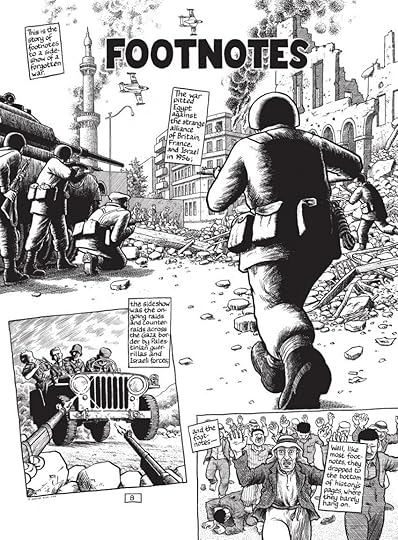
In 1956, British and French forces, supported by Israel, attempted to take control of the Suez Canal and oust the Egyptian leader, Gamal Abdel Nasser. It was a failed fiasco that led to an American-brokered cease fire that strengthened Nasser’s standing in the Arab world. The Gaza Strip, which was part of Egypt, was controlled by the IDF in 1956 and they tried to quell any resistance efforts from the local Palestinian population. This set the stage for the events Sacco investigated.

“description”/

According to Sacco, this was a forgotten footnote in history, one that he first learned about as he worked on his book Palestine.

description

The first incident took place in Khan Younis. According to the “Special Report of the Director of the United Nations Relief and Workers Agency for Palestinian Refugees in the Near East,” (UNRWA):
The town of Khan Yunis and the Agency’s camp adjacent thereto were occupied by Israel troops on the morning of 3 November…The Israel authorities state that there was resistance to their occupation and that the Palestinian refugees formed part of that resistance. On the other hand, the refugees state that all resistance had ceased at the time of the incident and that many unarmed citizens were killed as the Israel troops went through the town and camp, seeking men in possession of arms. The exact number of dead and wounded are not known, but…trustworthy lists…of persons allegedly killed…[are] 275 individuals…
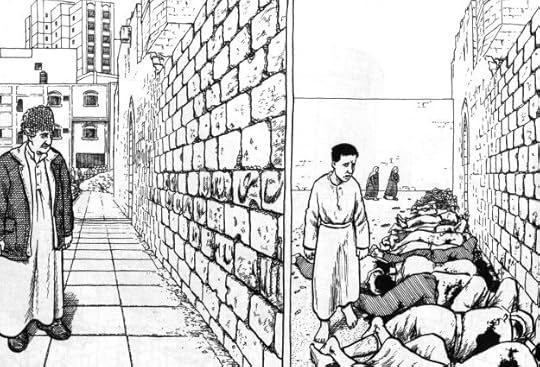
In conversations with people living at that time, Sacco describes how the men of Khan Younis were gathered together and lined up facing a wall. Indiscriminate shots were fired both at them and over their heads with the dead and wounded falling where they stood. Sacco himself acknowledges, “The U.N. report presents to incompatible versions of the Khan Younis ‘incident,’ and so in this case, as in many others, history-by-document drops us into a muddied soup of ‘on the other hands’ and ‘possibilities’ seasoned, perhaps, with a few ‘probables.’ But clearly the refugees’ claim in the U.N. report dovetails with the eyewitness testimony Abed and I gathered many nears later. Namely: the fighting had stopped; the men were unarmed; they did not resist.”
“description”/

According to the same UNRWA report quoted above, another raid took place, ostensibly to find more than 200 Egyptian soldiers suspected of hiding in Rafah:
On 12 November, a serious incident occurred in the Agency’s camp at Rafah. Both the Israel authorities and UNRWA’s other sources of information agree that a number of refugees were killed and wounded at that time by occupying forces. A difference of opinion exists as to how the incident happened and as to the numbers of killed and wounded. It is agreed, however, that the incident occurred during a screening operation conducted by Israel forces…The facts appear to be as follows: Rafah is a very large camp (more than 32,000 refugees) and the loudspeaker vans which called upon the men to gather at designated screening points were not heard by some of the refugee population…sufficient time was not allowed for men to walk to the screening points…In the confusion, a large number of refugees ran toward the screening points for fear of being late, and some Israel soldiers apparently panicked and opened fire on this running crowd…sources consider[ed] trustworthy lists…persons allegedly killed…numbering 111…
As with the Khan Younis incident, Sacco sorts through some conflicting accounts to conclude that some memories seem to have invented incidents, especially immediately after the shootings, and distorted time sequences.
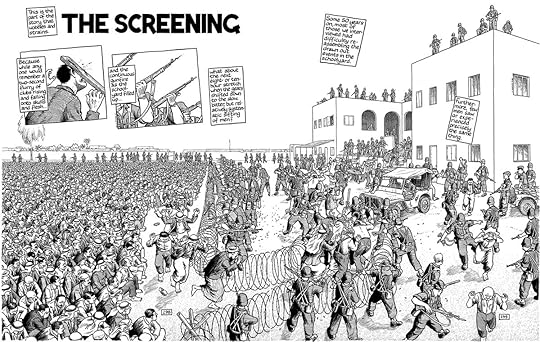
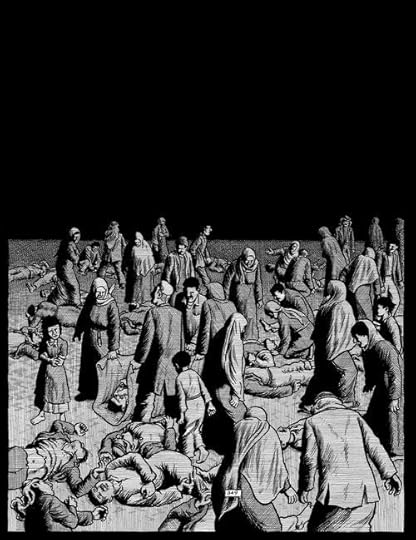
“description”/

For example, “Without corroboration, Abed and I are about to file this story under ‘legend’ until, one day, someone tells us he had hear that the Israelis forced the director of the UN sanitation center to pick some workers to collect the bodies.”

“description"/

People’s ability to take impromptu videos has changed history, but even when video evidence exists, it does not necessarily change preconceived conclusions or lead to justice. For the events of 1956, for which no visual record exists, Sacco’s cartoons help us to visualize how these images might have horrified people around the world. Would contemporaneous photographs have changed the course of history? Could they have humanized Palestinians and Israelis? Would it have altered the public discussion about the Middle East?

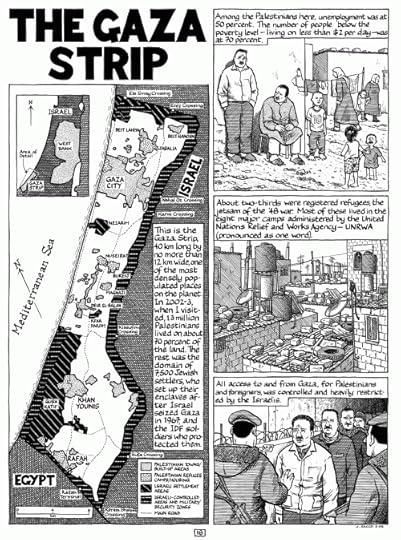
What makes Sacco’s works so compelling, however, is not just his investigative historical research, it is also how he puts his own experiences in field research. We meet his guides and coworkers, who are locally based. He also ties in the events around him as they are happening. In this case, the destruction of houses along the Gaza-Sinai border, the daily violence, the cheering of Saddam Hussein during the onset of the Iraq War, the struggle to survive in Gaza, and the uncertainty of day-to-day life for the residents of Gaza who are innocent victims of geo-political conflict all become part of the narrative to find out about the history of 1956.

It took Sacco more than six years to write this book. As he said in his acceptance speech of the Ridenhour Prize, during that time, many of the people he interviewed had died; they did not live to see his work. I think it would have meant a great deal to them. This book proves that the aphorism attributed to George Berkeley—“If a tree falls in a forest and no one is around to hear it, does it make sound?”—has an answer. If we are willing to learn about the causes of forgotten or hidden events, they can make a thunderous sound. But will the fact that we can now hear it make any difference in how we will act in the future?

Addendum: A great companion to Footnotes in Gaza is the Israeli film Lemon Tree .
Profile Image for Sleepy Boy.
1,009 reviews
February 17, 2025
Poignant, powerful, and I'd argue an important piece of Palestinian history. While all nations in a broad stroke have done terrible things to other human beings, the state of Israel since 1948 seems to have operated under the impression that they needed to play "catch up" to nations that existed longer in their cruel treatment of fellow human beings.
Profile Image for Sheehan.
663 reviews36 followers
January 28, 2010
Joe Sacco is not only a great illustrator, he is the Studs Terkel of war reporting, interviewing his many subjects, and compiling a history of two ignominious events in the Gaza Strip during 1956-7.

I have read Sacco's other two books, Palestine and Safe Area Gorazade, both also insightful treatments of genuinely heart-wrenching daily living circumstances; and based on a solid foundation of Sacco's experience investigating the stories and the people whom service grand narrative structure.

The only thing I kept thinking while reading it was, how I have read Speigelman's Maus series in college, and have heard some secondary school teachers teaching Maus' portrayal of the Holocaust, and yet no one seems to be teaching Sacco's Palestine and/or Footnotes in Gaza.

I am not positing some hair-brained conspiracy, nor baiting for comments of anti-Semitism; but it is worth pointing out that the graphic novel as a means of telling/selling a hard truth is very effective, and if it is accepted generally in academic world for Maus' treatment of the Holocaust, it seems only equitable the suffering of the Palestinians would be addressed in concert.

I guess it points out a larger absence of personhood/voice that the whole circumstances surrounding Palestinians in the world's mind's eye...and that's a shame in my opinion.

Read this book, and if your teach, TEACH THIS BOOK!
Profile Image for Vartika.
523 reviews772 followers
September 29, 2024
In his Palestine, Joe Sacco gave us a journalist's view of the tragedy of Palestinian lives over five decades of Zionist settler-colonial occupation. It was an important book that went against the grain of the mainstream Western media and polity's unwavering support of Israel, and brought the barbaric and inhumane ground reality to the fore. Today, the Israeli assault on Palestine has surpassed genocidal proportions, and the West – having installed a Jewish state in the Middle East to assuage itself of the guilt of the Holocaust and the responsibility of protecting Jewish lives in its own bounds, in addition to securing its own interests in a culturally-distinct, resource-rich region – continues to laud on, pretending that the relentless military obliteration of a whole population by one of the world's most well-armed (and well-funded) militaries is still righteous self-defence. If crimes at this scale – livescreened and plain for all to see – can be ignored and indeed, bolstered by the so-called Civilised World, made into footnotes in the brutal march of history, what of the crimes that were committed when burying crimes was easier?

In Footnotes in Gaza, Joe Sacco goes back to the Gaza Strip to investigate two such historical massacres, from 1956, that had hitherto been deliberately erased from public memory: the large scale ethnic cleansing of civilians in Khan Younis during the Suez Crisis, and the day-long guerilla screening operation in Rafah that left over a hundred Palestinians dead.
Here, again, Sacco gives space to long-ignored Palestinian voices and memories, trying to build a record of what really happened. It is a difficult mission in a place like Gaza, where – during the Second Intifada when Sacco conducted his research, and otherwise – violence, arbitrary killings, and IDF incursions have long become the norm. Indeed, a journalist could
file last month's story – or last year's, for that matter – and who'd know the difference?
The past and the present often collapse into each other in Gaza, but Sacco persists in drawing out – with the help of his Palestinian translator and, equally importantly, the local historian who has already created an Arabic-language account of the incidents – a clearer picture of this painful footnote from the eyewitnesses who survived it. The result is a painful, heartbreaking book, perhaps more destabilising than the previous one, and just as unabating in its narrativisation of the unrelenting violence in Gaza past and present.

The present – Sacco continues to write about the war on Gaza in his column, now focused on getting the West to hold itself accountable. Here's a panel from his latest column at the time of writing:
Profile Image for Nadia Fadhillah.
Author 2 books43 followers
February 24, 2016
Komik yang menggetarkan batin.

Footnotes from Gaza adalah graphic novel terbaik Joe Sacco menurutku, sepanjang karya-karyanya sebelumnya yang sudah aku baca. Penelusurannya terhadap fakta Insiden Rafah dan Khan Yunis tahun 1956 membuat Joe dan Abed (partner lokal dan penerjemahnya) keduanya menjadi ahli sejarah Insiden Rafah 1956 di dunia. Graphic novel ini bikin aku takut, merinding, nyaris menangis, dan tertawa di tengah-tengah halaman-halamannya. Meskipun sangat menyenangkan untuk terus membaca ulang novel grafis ini, aku menuntut Joe Sacco menulis dan menggambar komik-komik hebat lainnya sebelum dia meninggal. Haha. Pembaca penuntut ya aku ini.

Untuk tesis, sebenarnya buku ini jauh lebih bermanfaat untuk Tugas Akhirku yang dulu sudah duluan kubuat. Tesisku tentang Tepi Barat sekarang, tapi setidaknya, buku ini menjelaskan banyak tentang suasana pemukiman dan pengungsian penduduk Palestina (yang general terjadi di bagian manapun di seluruh Palestina) dan sejarah awal terbentuknya pemukiman-pengungsian tersebut.

Terima kasih sudah membuat graphic-novel luar biasa ini, Joe Sacco, you are my all-time favorite writer.
Profile Image for Kristina.
196 reviews14 followers
June 13, 2018
Δεν θα σταματήσω να υπερασπίζομαι ποτέ την δύναμη του graphic novel και την διακεκριμένη θέση που οφείλει να έχει στην λογοτεχνία. Το βιβλίο αυτό είναι ένα οδυνηρό και σπαραξικάρδιο χρονικό για δύο περιστατικά που στέκονται με το ένα πόδι στην αφάνεια σαν υποσημειώσεις σε μία αιματοβόρα υπόθεση που γνωρίζουμε όλοι και εξελίσσεται χθες,σήμερα, αύριο, ανενόχλητη σε έναν τόπο μακριά απο εμάς.Δεν μπορείς να επιβάλλεις σε κανέναν να ενδιαφερθεί για κάτι που δεν τον επηρεάζει άμεσα αλλά δεν μπορώ να διαννοηθώ να μην έχουμε όλοι την ίδια άποψη για την φρίκη του πολέμου, για τα εγκλήματα που αν δεν είναι στην μόδα δεν καταγράφονται, για έναν λαό που ζει μία καθημερινότητα απελπιστική, μαρτυρίες ανθρώπων που δεν έχουν καμία σημασία, κραυγες και θρήνοι που επαναλαμβάνονται ξανα και ξανα, ωχ αδερφέ πως θα μας πείσεις αφού όλοι εσείς οι μουσουλμάνοι είστε τρομοκράτες, τόσοι πολλοί νεκροί, τόσος καημός.
50 years from now they'll forget about you, too.

#Readathon18: Ένα βιβλίο που αφορά ένα πραγματικό έγκλημα (11/26)
Profile Image for Jefi Sevilay.
794 reviews93 followers
December 18, 2020
Gazze'nin Dipnotları alışılmışın çok dışında bir çizgiroman. Büyük bir araştırmanın ürünü. Hatta belki de bir tarih kitabının grafikleştirilmiş hali gibi. Joe Sacco iki koca sayfa makale yazar gibi araştırmasının kısıtlılıklarına değinmiş. Ben bu kalibrede bir çizgiroman okumadım.

Çizimler muhteşem ötesi. Gece sahneleri bile inanılmaz detaylı. Sayfaya her bakışınızda farklı bir detay görebilirsiniz. Muhteşem bir şehir manzarasından, salatanın içindeki yuvarlak kesilmiş domatese kadar.

Hikaye olarak dünyanın en büyük trajedilerinden. Ben elbette ki hikayenin geçtiği savaşı biliyordum ancak sivilleri duvara dayayıp kurşuna dizecek kadar olduğunu bilmiyordum. Evet tarihi güçlüler yazıyor ama kitabı okuduktan sonra yaptığım araştırmalarda da neredeyse hiç buna benzer bir olaya rastlamadım. Umarım yazılanlar gerçekten olmamıştır ya da anlatıcılar tarafından abartılmıştır.

Herkese keyifli okumalar!
Profile Image for Yaiza Castro.
8 reviews
February 14, 2024
Increíble. Muestra sin tapujos las opiniones, testimonios y vivencias de las personas que viven en Gaza. Un altavoz muy importante y más hoy día.

Que viva la lucha del pueblo palestino.
Profile Image for Nea Poulain.
Author 7 books545 followers
July 24, 2017
http://divagaciones-de-una-poulain.bl...

Desde que vi las novelas gráficas Palestine, me interesó el trabajo de Joe Sacco. Esta fue la primera novela gráfica de su autoría a la que le pude poner las manos encima y con más de cuatrocientas páginas, lo que la vuelve todo un tocho de novela gráfica. LO VALE. Sacco, en plena guerra, en vez de escribir sobre la guerra, va en busca de una historia más vieja, una historia que podría sólo pasar a la Historia con mayúsculas como una lista de muertos, o más que como una lista, una simple cantidad. Algo que se escribiría más o menos así: "En tal día de tal mes de 1956 murieron tantos palestinos". Punto. No más. Joe Sacco anda tras esa historia, buscando afectados, preguntando a la gente.

Y casi toda la gente, en el mejor de los casos, reacciona incrédula. ¿Por qué anda tras esa historia cuando en ese momento les están derrumbado sus casas? ¿Por qué no escribe (o en este caso, dibuja) de lo que está pasando en ese momento? Pero no. Sacco va en busca de la historia que quiere, la de 1956, al tiempo que cuenta como es la vida en Rafah, ese pequeño pueblo en la Franja de Gaza, y hace notar lo comunes que son los funerales de mártires, las casas derrumbadas por israelís, los muertos de un día sí y un día también. Primero, tengo que admitir que no sabía nada o casi nada de la Franja de Gaza cuando empecé a leer aquí, del conflicto Palestina/Israel también sabía poco, muy poco. Y lo que sabía era por comentarios de Facebook que decían que los judíos tenían bien merecido el holocausto por lo que estaban haciendo en Palestina de gente que cree que las tragedias se comparan y se justifican con otras, así que no se puede decir que mis fuentes sean fiables.

Hablando en específico de este libro, por supuesto que lo recomiendo si les interesa saber un poco más. Me hubiera gustado que Sacco buscara más pluralidad de voces para su historia (léase, no acudir a las mujeres sólo cuando era el último recurso), pero en general está bien contada. Junta el pasado con el presente y lo hace bien. Habla de como depura las historias y cómo comprueba que quizá le estén diciendo la verdad. Sin embargo, con todo eso, reconoce que no se siente con derecho a juzgar los recuerdos de la gente, por más falsos que sean, porque ellos parecen recordarlo como si de verdad hubiera ocurrido ayer. Ocurre en uno dos casos, en los que alguna persona aseguro haber hecho algo, huído de alguna manera, haber visto morir a alguien. Y luego ni siquiera sus familiares lo confirman.

Sobre la historia no tengo nada que criticar. Pasó y así la recuerdan, así que, igual que Sacco, ¿quién soy yo para meterme con los recuerdos de la gente? Pareciera que Footnotes In Gaza es uno de esos trabajos hechos específicamente para dejarte pensando que el mundo es una mierda, pero creo que no. Al menos no desde la perspectiva que lo pone el dibujante y escritor. En su tiempo en Gaza hizo amigos y creo lazos y nos deja ver eso en su historia. Yo, finalmente, por interés, busqué algunas imágenes para darme una idea de dónde demonios estaba ubicada la historia, y aunque me gustaría decir que me sorprendí, la verdad es que no.

Bueno, después de una ligera sequía de libros y reseñas, este es el último libro que he leído y que, por supuesto, merecía una reseña en condiciones, aunque presiento que no le interesará a mucha gente. Aun así, por el increíble trabajo periodístico... ¡recomendado!
Profile Image for Álvaro Velasco.
275 reviews43 followers
November 18, 2017
Se trata de una crónica periodística más que cualquier otra cosa. La investigación del autor de los hechos acontecidos en la Franja de Gaza en 1956, tal y como se produjo dicha investigación. Por lo tanto, quizá también podría considerarse un libro de historia, aunque en este queda más claro como se ha obtenido la información.

Por cierto, la forma de presentar su trabajo periodístico-histórico es mediante viñetas, con lo que el autor consigue transmitir una interpretación que no se lograría exclusivamente con palabras. Ya se sabe que una imagen (en este caso, dibujada) vale más que mil palabras (aunque muchos de los que frecuentamos este bario nos apuntamos a las mil palabras).
Profile Image for Laura.
11 reviews6 followers
January 24, 2010
Joe Sacco's whole career has been leading up to writing this book. He's documenting a massacre that's been little-known except by its survivors until now, and also writing about the problems of documenting a particular trauma from 50 years ago in a place saturated by layer after layer of trauma, where fresh and current traumas keep interceding. It's brilliant. But not exactly a light read.
Profile Image for Mads.
169 reviews2 followers
Read
February 2, 2024
If you can't donate, if you can't protest, if you can't boycott, please just educate yourself.

There's so much I want to say but I don't know how to do so eloquently or decisively.

May the people of Palestine one day soon know peace and freedom.
Profile Image for Doc..
240 reviews86 followers
August 9, 2025
“𝑯𝒊𝒔𝒕𝒐𝒓𝒚 𝒄𝒉𝒐𝒌𝒆𝒔 𝒐𝒏 𝒇𝒓𝒆𝒔𝒉 𝒆𝒑𝒊𝒔𝒐𝒅𝒆𝒔 𝒂𝒏𝒅 𝒔𝒘𝒂𝒍𝒍𝒐𝒘𝒔 𝒘𝒉𝒂𝒕𝒆𝒗𝒆𝒓 𝒐𝒍𝒅 𝒐𝒏𝒆𝒔 𝒊𝒕 𝒄𝒂𝒏.” — Joe Sacco

Today marks twenty-one years since Rachel Corrie died. No, scratch that. Only black and brown people die mysteriously due to no known cause; Rachel Corrie was killed, run over by the IOF as she protested the wanton bulldozing of Palestinian homes—not yesterday, not after October 7, but in 2003. In 2024, as the genocide is live-streamed, we have an idea of what her mangled body might have looked like. Sacco was in Gaza researching events from 1956 when Corrie was killed, during the second intifada.

The same day that she was murdered, a man was also murdered by the IOF, named Ahmed Nijjar. I know nothing else about him and I never will. White people who protest the empire are heroes that will be remembered; the same cannot be said for @palestinianmartyrs (Visit their page on Instagram.) No disrespect to Aaron Bushnell, but why do the people who praise his actions condemn Palestinian sacrifice in the same breath? Perhaps, because, as Sacco writes: “𝑷𝒂𝒍𝒆𝒔𝒕𝒊𝒏𝒊𝒂𝒏𝒔 𝒏𝒆𝒗𝒆𝒓 𝒔𝒆𝒆𝒎 𝒕𝒐 𝒉𝒂𝒗𝒆 𝒕𝒉𝒆 𝒍𝒖𝒙𝒖𝒓𝒚 𝒐𝒇 𝒅𝒊𝒈𝒆𝒔𝒕𝒊𝒏𝒈 𝒐𝒏𝒆 𝒕𝒓𝒂𝒈𝒆𝒅𝒚 𝒃𝒆𝒇𝒐𝒓𝒆 𝒕𝒉𝒆 𝒏𝒆𝒙𝒕 𝒐𝒏𝒆 𝒊𝒔 𝒖𝒑𝒐𝒏 𝒕𝒉𝒆𝒎.” There are simply too many bodies to count.

As I write this, Israel has stopped offering justifications for bombing hospitals or killing starving people as they look for food. They want to numb us, exhaust us and flatten our questions. And yet, documentation continues, to preserve in our memories the truth as it occurs. That is the stupendous achievement of ‘Footnotes In Gaza’ as well, that despite the onslaught of Israeli aggressions, reminds us that each massacre demands attention, research and justice, no matter how elusive.

And what an achievement this graphic narrative is: a triumph of war reportage and investigative journalism that shows us the tedium of interviews, including that of such magnitude as the right-hand man of Moshe Dayan, and the process of research, with all the attendant problems of digging so far in the past. The art, the writing, the maps, are all unforgettable. The refugee camps, in particular, haunt me, more so when you see Israel's present concerted attack to demolish UNRWA.

In November of 1956, Israel rounded up and shot 276* and 111* Palestinian men in Khan Younis and Rafah, respectively, known thereafter as The Day of the School. You may ask, naturally, why? The context begins in 1953 with the Israeli killing of 42 in the West Bank village of Qibya, 38 of whom were women and children, having only recently killed 50 men in Khan Younis. So when the greedy Western powers attacked Nasser's Egypt, a guerrilla force of Palestinian fedayeen were more than eager to help weaken Israel, and Israel sought revenge (because how dare the victims stand up for themselves) by killing innocents.

But context is not reason. The reason is and always has been the destruction of the Palestinian people, constructing a Jewish state through denial and obliteration of history. Enter Sacco, who refuses to let this become a footnote, and what a debt we all owe to him. This was a significant day indeed, not least because a young boy witnessed Israeli soldiers gunning down his uncle, and that young boy grew up to be a paediatrician, a professor of parasitology and a founder of Hamas.

Nothing happens in a vacuum. Read Palestine.
Profile Image for Karyl.
2,131 reviews151 followers
October 16, 2015
I am no scholar on the Middle East and its conflicts, but when I was a young child, I always wondered how a country could be carved out for a people from a nation that was already there, and that it was expected that the people already there would simply capitulate and allow the new settlers in without any issue. I mean, haven't we Americans learned anything from the way we treated the Native Americans? Granted, the Jews/Israelis do have ties to that area, something we immigrants didn't have when it came to the New World, but it's only to be expected that the people who had lived there for generations would be a bit put out to be expelled.

Personally, I'd vote for the two-state solution, but then no one asked me, and I do tend to wear rose-colored, "can't we all just get along peacefully" glasses.

Joe Sacco does an amazing job of bringing the conflict of the Gaza Strip to life. Regardless of your politics, if you can read this book and have not a shred of sympathy for the Palestinians, you need to head to Oz and find yourself a new heart. I understand that the Palestinians are not guiltless and innocent, and I know that there are two sides to every story. But if you read this book, not only about two massacres perpetrated upon the Palestinians but also about the current infringement onto and demolition of Palestinian land by the Israelis, you will realize that perhaps the media reports that we get here in the States might be a little skewed on the part of the Israelis.

I'm always blown away by Sacco's artwork. There is a little of the cartoonish about his drawings, especially in his self-portraits, but there's also so much emotion and energy that leaps off the page. Even with broad strokes, he's able to evoke so much pain and suffering. There's a point at which perhaps the reader will say, "OK, Joe, you've said this already...!" but I think he gives so much evidence so that the reader can't simply dismiss it out of hand as pro-Palestinian propaganda. And the many perspectives that he gives about the Day of the School in Rafah prove that it was a terrible horror, even allowing for differences in memory and experiences and the fact that it was 50 years ago.

It's sad to think that nearly every Palestinian alive seems to have seen a friend or relative or loved one shot down in front of him or her. My life here in America is so easy, so carefree in comparison.

Highly recommended.
Profile Image for Dimitris Papastergiou.
2,524 reviews82 followers
December 13, 2023
Footnotes in Gaza.

I have no idea where to begin. I read a tragedy once again, from Sacco. The sad thing is that I read what Sacco lived and went through while trying to tell a story of what happened to Palestinians in the 50s and all the while I was reading this it was like it was written and published this month for the latest tragic events that's been happening and I was reading a documented war.

Sadly this massacre didn't start now, or a few years ago, but decades ago. So let me make it a little bit clearer before going into my actual review of what I just learned about the Israeli-Palestinian conflict in Gaza during 1956.

After WWII with so many misplaced, the UN partition plan proposed dividing Palestine into seperate Jewish and Arab states in the late 40s. So in short, Palestine was divided so the Jewish people can have somewhere to stay and live their lives.

"I expect to be killed." - Khaled

In 1948 Israel declared independence, leading to the first Arab-Israeli war with casualties on both sides... and so it begun. People kept dying. Innocents mostly on both sides. And ever since, the Israel kept pushing and pushing and killing innocents while obtaining Palestinian's houses by force, lies and/or by any means really. (just search on google and you'll easily see what was Palestine before the 50s and what's the Palestinian land nowadays)

And now we're here in the 50s, the conflict in Gaza during 1956 to be exact, which wasn't much as a conflict, but rather someone using extortion by force because they can and have the means and the money backed up from USA.

Brutally beaten, killed, tortured, thrown away from their homes, kicked out from their cities, destroyed their homes, went through so much, lost so much, family, friends, their whole lives.

Footnotes in Gaza is a masterful graphic novel that meticulously examines the lesser-explored history of those people and what they went through in the 50s, and I only wish this could only be the case, but unfortunately, they went through the same in the 60s, and the 70s, the 80s and the 00s and guess what, you know exactly what's been happening right now in Gaza strip.

In the late 60s there was the Six-Day War, in which Israel "captured" the West Bank, East Jerusalem the Gaza Strip and other some other places I don't remember now. Simply because they wanted more land. More everything. With the help of the USA and the UK. The USA which by the way was funding Palestine too, so they can rebuild and create jobs for their people, the misplaced people who got extorted and killed and thrown away to the desert, they were giving them (some of them) jobs, so they can create jobs to build new houses, just so the Israel can come in a few years and claim those houses or just destroy them so they can kill those who won't leave, and then make them (Palestinians) rebuild them for the Israelis. I know. Shocked. But Palestinians said to Sacco that they were getting jobs and funds from USA to rebuild and take jobs just so they can forget about going to war with the Israel or showing any kind of retaliation, while they're being killed again and again.

In the late 80s it was the first Palestinian Intifada, or what they called it, and what Sacco calls it in his book, an uprising, against the Israeli occupation in the West Bank and Gaza. Which up until then (and later on up until nowadays) they were having Palestinians live in the worst possible situations, go through hell, just to get to buy things to eat or to go to school, they had to be searched, lie down, wait for hours, whatever disgusting thing you can possible imagine, it was their everyday life throughout the occupation. Before and after.

"We have children without milk and food, and now they're demolishing our houses. They're not human. They're animals. Hitler didn't do this to them. Hitler didn't exile them from their land. Hitler didn't demolish their homes!"

In the 90s the Oslo Accords signed for a peace treaty, still people were dying, from both sides. From the Israeli army in one side, killing innocents as always and from the Palestinian suicide bombers and/or fighters who were killing also innocent Israelis and that went through the 00s too, with both sides, being in a constant war all the while, this was the second uprising of the Palestinians, trying to get their land back.

Since 2010 or so, up until now, Israel kept releasing the military in Gaza Strip mainly, aerial attacks, you name it, and kept on the killings until 2014? where the Palestinians fought back and started a new war with both sides losing so many people.

Daily they kill us.

And we're now in 2023, with the recent conflict between Israel and Palestine, where we have the media bombing us with "Israel VS Hamas" and the reality before our eyes Israel nonstop bombing innocents and killing so many without stoppin.

This particular conflict began with Hamas attacking Israel with 1,400 Israeli deaths to date and this was Israel's perfect opportunity to keep on killing like they do for decades now, and destroy every single Palestinian's life.

More than 18,200 Palestinian deaths to date. This is namely with facts the worst and deadliest war for children in modern times with women and children making up more than 62% of the fatalities. (since around the start of the war in the 50s, Sacco stated that Israelis were killing mostly men, and they were living the women behind with the kids)

More than 6,000 kids are dead until late November 2023. The killings, the massacres. The bombings. The beatings. The extortions. The stealings. It's a tragedy. Whole generations of lives going through an endless tragedy, an endless war. Kids losing their parents and growing up without their loved ones, reliving again and again the same non-stopping drama is unacceptable.

They killed a pregnant woman yesterday and they said they were sorry. Let's do what we need to do and say sorry too.

Sacco's artistry is exceptional, capturing the intricacies of the region's landscape and the emotional gravity of its people. The use of comic footnotes serves as an innovative storytelling device, seamlessly blending historical analysis with such personal narratives. This work transcends traditional comic boundaries, functioning as both a compelling visual narrative and a profound historical document and I can't stress this enough.

Sacco's dedication to journalistic integrity is evident, providing readers with a nuanced understanding of the complex socio-political landscape. His work speaks for itself and it's magnificent and I wish Sacco's work never existed.

I said too much. If there is a God, the ugliest sight in the eyes of our God, is humanity's reflection.
Profile Image for Stewart Tame.
2,475 reviews121 followers
January 22, 2014
Good, but exhausting. The things these people have suffered ... I could only take reading this in small doses. As always, Sacco takes comics journalism to new levels. Good, just not especially happy.
Profile Image for Adan.
Author 32 books27 followers
August 21, 2013
Every time I read something by Joe Sacco, I hate the world all over again.
Profile Image for Lars Guthrie.
546 reviews192 followers
March 14, 2010
History is usually written in broad strokes. Historians appreciate nuances and contradictions as they try to make sense of events, but to explain or even just to retell, they must generalize. And to generalize they must edit.

Beneath any retelling are incidents of kindness and cruelty, justice and injustice, that are lost in that retelling. To focus on a single story would mean missing the larger story, so those individual tales become footnotes, only valued if enough of them accumulate to indicate significance.

But real people were really affected by the events that become those footnotes in history. And sometimes the forgotten stories let you see a bigger picture more clearly, because the bigger picture can tend to overwhelm.

I know that I feel my eyes glazing over when I confront the problems between Israelis and Palestinians. Many Israelis and many Palestinians present their case so peremptorily that there is little room to ask questions, to understand the point of view, much less to try to see some way to resolve the conflict. The situation seems hopeless. It’s easy to give up on it, and to give up learning about it.

Enter Joe Sacco, with his deepest and most assured work to date. By focusing on two ‘Footnotes in Gaza,’ and, just as importantly, his own search for what can be found of the truth of those events a half century later, Sacco allows his readers an opportunity for empathy.

No matter what your take on the Mideast, it would be hard to deny that a large number of the Palestinians in Gaza live there as refugees, under the most trying of conditions. It’s also hard to deny that their dispossession was engineered by forces beyond their control. If you take that outlook, as I do, the Palestinians are victims of injustice. Sacco begins with this outlook.

But he is even-handed in his treatment. Testimony from Israelis is treated with the same respect as that of Palestinians, who are hardly presented as saints or martyrs. Sacco makes it clear, in this most advantageous of mediums for doing so, that his story is only what he found out about two incidents in November, 1956, in Gaza.

In the aftermath of the Suez crisis, the Israeli army occupied Gaza, then under Egyptian control, and combed the area for Palestinian fighters. That canvassing of the local population led to instances of what one side calls collateral damage, and what the other side calls war crimes. In Khan Younis and Rafah, there were hundreds of civilian casualties.

Many years later, a bespectacled and sometimes befuddled cartoonist interviews Palestinian witnesses in the Gaza of 2004. He is frustrated by the shaky memories of older Palestinians. Younger Palestinians are frustrated that he is investigating the past, rather than the dour circumstances of the present.

The cartoonist persists. He finds out some answers to what happened in Khan Younis and Rafah, and he will convince most readers that some horrible things happened. Just as importantly, he portrays real people, good people, who have been victimized by real events in history.

'When I read Arabic names,' Sacco said in a presentation at Powell’s Bookstore in Portland (http://vimeo.com/9480865), 'I often just glance over it because it’s just…such a mouthful of stuff….I didn’t want the reader to do this, so I actually draw everyone’s face every time they start talking again. And so, you can look at the face and say, "Oh that was the guy, oh, three pages ago, this happened to him…."'

Through the comics medium, we begin to have some understanding of where Palestinians are coming from, and see them as real people who can sometimes deliver hurtful polemic, but who can often be humorous and honest, warm and generous, and who love to eat, talk, and drink lots of tea.

Many of these real people living in Gaza are refugees, many second and third generation refugees, living in poverty and in constant fear of war, just miles from the lands their families used to own and farm. Sacco quotes a eulogy for a kibbutznik killed by Gazans in 1956, a eulogy delivered by, of all people, Moshe Dayan: 'Who are we that we should bewail their mighty hatred of us? …[T:]hey sit in refugee camps in Gaza, and opposite their gaze we appropriate for ourselves as our own portion the land and the villages in which they and their fathers dwelled.'

As hopeless as the situation of Israel and Palestine appears, there has got to be some value in Americans seeing Palestinians as people who are victims of injustice. In 'Literature as Exploration,' Louise Rosenblatt writes, 'The reading of the morning newspaper with its accounts, say, of war, famine, the suppression of human freedom, the death of scores of people here and there in automobile accidents may take place with hardly an emotional quiver on the reader’s part. He registers only the abstract sense of the words and may never glimpse what they mean in actual human experience.'

By opening a small window into history, Joe Sacco lets us glimpse actual human experience. 'My story isn’t about the big picture,' he said in an interview about 'Footnotes in Gaza.' 'It’s really about the incidents that get left out when the story of the big picture is told. I wanted to get into the stuff that is forgotten.' By getting into the forgotten stuff, he makes the big picture register as more than abstract words.

Highly recommended.
Profile Image for Renaud.
13 reviews
February 2, 2022
Travail journalistique incroyable de Joe Sacco! Le scénario relate avec habileté et intensité les évènements survenus dans la bande de Gaza en 1956. Plusieurs fois j'ai dû faire des pauses dans la lecture tellement les témoignages et le récit des évènements me choquaient. Mais la curiosité d'en savoir plus me ramenait chaque fois à la lecture.
Les illustrations du journaliste sont remarquables.
Une lecture dont je me souviendrai! Je lirai sans aucun doutes d'autres ouvrage de l'auteur.
Profile Image for Mohammed omran.
1,839 reviews190 followers
July 29, 2022
عزيزي. النضال فلسطين
العزه فلسطين
القلب فلسطين
الدم فلسطين
انا دمي فلسطينى
اذا تحدثت عن نضال
فهو فلسطين
Profile Image for Dakota Morgan.
3,390 reviews53 followers
September 10, 2024
The reporting in Footnotes in Gaza is almost 20 years old, but the content remains evergreen. If you haven't read this eye-opening account of life in the Gaza Strip, you really ought too. It's not only one of the standout graphic works of our time, it's one of the standout non-fiction works. The level of detail and immersion are sensational. If this kind of reporting were done around the world, humanity would be far better off.
Profile Image for E.T..
1,031 reviews295 followers
October 16, 2018
3.5/5 "The death of one man is a tragedy, the death of millions is a statistic." - Stalin
It is my pet theory that history should be taught in the form of historical fiction - we must develop empathy by humanising the victims, instead of just making students learn dates/facts by heart. Maybe we can also teach history via graphic novels such as these.
This was my 3rd book by the author and because I have already read his well-rounded "Palestine", I wondered whether it was worth reading this one. But, this one deals with 2 "footnotes of history", 2 events in which the Israeli army massacred civilians and these events ultimately fell off the pages of history. The author also described the events of 1948 focusing on the suffering of the Palestinians who had to leave their houses and flee to Gaza. Also, along with the massacres, another eye-opener was the no. of Palestinian houses destroyed by Israeli forces for reasons of security ; and all this is corroborated by the UN and some foreign observers.
In the end, the book got a little repetitive but still it is a story that needs to be told. It is amazing how many perspectives are there to an issue !
8 reviews1 follower
May 28, 2022
Masterwork. Everyone should read it
115 reviews10 followers
March 22, 2010
This book was so big and dense that it took me an entire day, with a couple of sanity breaks in between to finish it. A truly amazing book from start to finish. I truly respect Joe Socco for undertaking a book like this. Years of work for one incredible story. This book mainly centers on a particularly bad year of the forever war between Israel and Palestine.The year was 1956. I'm not qualified to comment on the accurateness or facts from this time. All I know is Socco did his homework and it shows. As he states often in the book, with time, memories fade and facts blend together. It really was a long time ago. This war has been in the headlines for as long as there have been headlines, and personally it is a war I am tired of hearing and reading about. So many peace plans and accords have come and gone, that it seems impossible to believe anything but that this is where the end of the world as we know it will surely start. I would love peace there. Is it ever even possible?
As to the book itself, the story is straight forward enough. Socco interviews and interviews and interviews. The story is intense and overwhelming most of the time. The art is exquisite. The cross hatching and detail is mind numbingly good. It looks almost like photography. It will stand up there this year right next to The Photographer as the best in portraying war torn countries as humanized studies on the worst that man can be to his fellow man. Both books will both give Maus a run for its money years from now when people look back at this long 100 year spell of violence.
Displaying 1 - 30 of 583 reviews

Can't find what you're looking for?

Get help and learn more about the design.