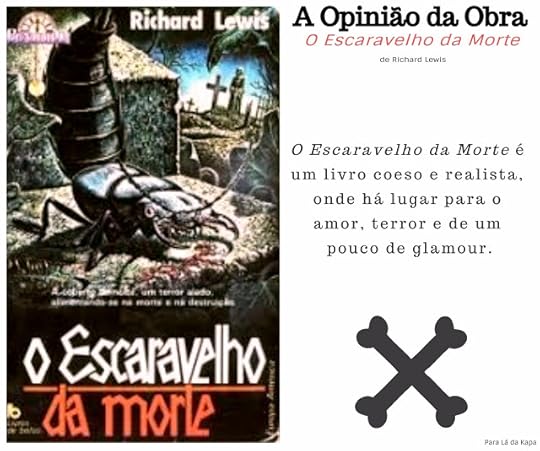
It begins when a small charter plane crashes into the Alps. All the passengers are killed - a party of international scientists starting a lecture tour. But the doomed aircraft also carries live specimens. And as the insects escape their cages they search out the warmest place of refuge they can find-inside the human dead. When the frozen corpses are recovered for burial, they contain the seeds of the most natural scourge that ever threatened Britain. By the time the disaster is recognised it's almost too late. A bloodthirsty tide is sweeping across the country, and every human being faces a hideous death.
Was really impressed with this one, quite short but impactful and straight to the point. The balance of well crafted horror scenes and military strategy balanced out well and I was invested in our main character. I would say the secondary characters were very paper thin, but I would expect that from this sort of smaller action packed story. Ending was very abrupt and slightly disappointing for me personally but overall I would recommend this.
When a strain of beetle is frozen along with dead scientist, it gets the taste for blood and starts to rapidly breed causing a deadly threat to the world's population. A British bug expert is tasked with finding a way to exterminate them,can he find a way as well as battling with the military powers at large?
Δεύτερο βιβλίο του Ρίτσαρντ Λιούις που διαβάζω, μετά το "Αράχνες" που διάβασα και... απόλαυσα (;) τον μακρινό Δεκέμβριο του 2012, ενώ είναι και το τρίτο βιβλίο που έχει να κάνει με έντομα, αράχνες ή αρθρόποδα που τρώνε ανθρώπους, αφού τον Δεκέμβριο του 2011 διάβασα και το "Ανθρωποφάγα καβούρια" του Γκάι Ν. Σμιθ. Εντάξει, τι μπορεί να περιμένει κανείς από ένα παλπ μυθιστόρημα της πεντάρας, η κεντρική ιδέα του οποίου είναι ότι κάποια σκαθάρια άρχισαν μετά από ένα συγκεκριμένο τραγικό περιστατικό να γουστάρουν να τρώνε κρέας, και ειδικά ανθρώπινο; Μιλάμε για καλτίλα, όχι αστεία. Αλλά σχετικά ωραία καλτίλα, δηλαδή η ώρα πέρασε ευχάριστα, είχε τη φάση του, είχε την πλάκα του, σιχάθηκα κιόλας λίγο και μπορεί να μην τρόμαξα (για όνομα δηλαδή, από τι να τρομάξω;) αλλά αν μη τι άλλο ανατρίχιασα και μόνο στην ιδέα εκατοντάδων χιλιάδων τέτοιων σκαθαριών να είναι παντού και να μασουλάνε ανθρώπινη σάρκα (όπου βρουν διαθέσιμη). Η γραφή είναι όπως θα περίμενε κανείς, καλούτσικη και γλαφυρή αλλά σε καμία περίπτωση λογοτεχνική, ενώ φυσικά δεν λείπουν κάποιες σιχαμερές περιγραφές και μερικές gore σκηνές. Προφανώς δεν είναι για όλα τα γούστα. (5.5/10)
Creepy crawlies go on a rampage in Devil's Coach-Horse (1979), a Hamlyn nasty by Richard Lewis. One of Lewis' many insect horror novels (Spiders, Night Killers etc), it's a slim, fast-paced read very much in the mold of James Herbert's classic The Rats (1974).
Although named after the most evil-sounding beetle, the novel actually features several species. They get a taste for human flesh in the Alps; scientists returning from a conference crash their plane on a mountainside along with a number of bug specimen on board. To survive, the beetles seek shelter inside the humans. Later, the frozen corpses are brought home and properly buried – together with the eggs the beetles have laid in their rotting intestines.
Thus it begins. Soon swarms of beetles attack man and beast alike. As in all animal attack novels, the victims get their stories told. An abattoir guard whose wife has left him is one of the first victims, followed by a paranoid junior lecturer on a sexual escapade, as well as many others. It's all very predictable, sooner or later the bugs appear and all the petty grudges and worries are forgotten as thousands of mandibles cut into the victims' flesh.
And that's the fun and the appeal of the format. Devil's Coach-Horse isn't original by any stretch of the imagination, but the vignettes are well written and the action is reliably creepy, proceeding at a good, rapid pace. For depth, there's an ecological aspect as well. It's hinted that the chemicals we pour on our crops may be one of the reasons the bugs went berserk. The solution isn't free of doubt either, and its implications create a sense of lingering horror. The threat might be over for now, but who knows what mankind will next create to bring about its own demise.
οκ, είναι σκουπίδι ε και; πέρασα καλά, αν και αυτο το πράμα δεν μπορώ να το θεωρήσω ''λογοτεχνία'' μαζί με τα ''καβούρια'' της ίδιας σειράς, είναι ο ορισμός του wtf αλλά έχει χαβαλέ για κάποιο νωθρό απογευματινό απόγεμα
It begins when a small charter plane crashes into the Alps. All the passengers – a party of international entomologists starting a lecture tour – on board are killed but the doomed aircraft also carries live specimens. And as the insects escape their cages, they search out the warmest place of refuge they can find-inside the human dead. When the frozen corpses are recovered for burial, they contain the seeds of the most natural scourge that ever threatened Britain and the world. By the time the disaster is recognized it's almost too late. A bloodthirsty tide is sweeping across the country, and every human being faces a hideous death. I mean, seriously, how could you resist that? This was originally published – as a Hamlyn Horror paperback original - in 1979 and has long been on my radar, ever since I read Lewis’ “The Spiders” and thoroughly enjoyed that. This one is much more difficult to find (my lovely wife bought me a terrific looking copy for my birthday and it jumped to the top of my TBR) and, I have to say, it’s great fun. Certainly, when you read this couple of lines on page 18 – “But the adults were passing on a new legacy to their unborn young as the eggs were laid in the still-warm folds of the long, tubular tissue. An inherited taste for human flesh and blood, the food on which the hatching creatures would develop”, you know you’re in for a good time. The dead bodies are unrecoverable over winter so, by the time the scientists are retrieved and buried (some in Chicago, one, John Masters, in Cambridge), the insects are now killers and, with the heat, they soon escape to, quite literally, chew their way through the population. In a beautiful touch (which I’m sure is nostalgic glow), this features that staple of the era, a chapter featuring characters – Geoffrey and Alison, the young lovers and Emma Little and her nursery glass – who are introduced mainly to be eaten by the end of their chapter (and yes, Lewis does kill a group of school children in a field though, thankfully, it’s off-camera). Which, obviously, is glorious. Paul Adams, an associate of Masters, is quickly drafted into the team to stop the pestilence and teamed up with copper Inspector Tom Mallett and the glamorous doctor Irene Buckley, the latter of whom becomes his lover. The second half of the book then becomes the race against time, as various characters – a rich womaniser in Manchester, a young mother and her daughter on a train, amongst others – become food and the end seems increasingly bleak. Lewis writes well, hitting the gore quotient without going over the top and the environmental concerns he tackles aren’t out of place today. In fact, for a novel that’s 47 years old as I write this, it doesn’t seem particularly dated at all (apart from some of the writing style). I really enjoyed this, I’m glad I got the chance to read it (thanks Alison!) and it does exactly what it’s supposed to do – it’s a trashy, schlocky horror novel and it delivers perfectly. It obviously depends on your tolerance for this kind of fiction, but if you and I have similar tastes, then I would highly recommend it.
O Escaravelho da morte mostrou-se um livro de bolso de tirar o fôlego! Com descrições emotivas e realistas, Richard Lewis conseguiu criar um mundo atual e cativante, mesmo após 40 anos desde a sua publicação.
Esta obra foi um dos tesouros que encantei nos alfarrabistas. Li-a com algumas expectativas, que foram largamente ultrapassadas. Richard Lewis escreveu um livro com moral e cultura. Ao longo das páginas, não são poucas as vezes que ele nos relembra como a ciência é delicada e tem de ser manuseada com cuidado. Um descuido pode gerar o pânico.
Para além do interesse do tema, o Escaravelho da Morte presenteia-nos com uma escrita fluída e bonita. Alerto, porém, que a obra tem descrições fantásticas, mas sangrentas, que podem impressionar os mais sensíveis.
Com isto, posso reafirmar a minha convicção de a editora Publicações Europa-América ser uma mais valia no nosso mercado, com material acessível e de qualidade. Na verdade, fiquei triste quando descobri que é um dos únicos romances do escritor Richard Lewis.
Em poucas palavras, O Escaravelho da Morte é um livro coeso e realista, onde há lugar para o amor, terror e, talvez, também um pouco de glamour.
I love a good cheesy creature feature - this one is not as creepy or gruesome as his previous titles, I thought it followed a similar plot to "Spiders". Overall an easy pulp horror, worth a read if you are a fan of the genre.
“O escaravelho da morte” foi editado pela primeira vez em 1979, tendo sido editado pela Europa - América a primeira vez em 1984.
O avião que levava um grupo de cientistas para uma conferência despenha-se nas montanhas em pleno Inverno. Neste avião além dos cientistas viajavam também um conjunto de espécies de invertebrados, como Besouros Colorado, Escaravelhos, Besouros Hércules e Cabras - Louras, juntamente com alguns coelhos e pássaros.
Quando o avião se despenha, o instinto de sobrevivência destes invertebrados leva-os a fazerem algo que ninguém se encontrava à espera. Procuram os últimos focos de calor, neste caso os corpos dos cientistas e dos animais, alimentando-se deles e depositando os seus ovos no seu anterior.
Desta forma começa a mais mortífera praga alguma vez vista. Escaravelhos assassinos! Assassinando não só animais, como mais tarde também pessoas.
O livro de Richard Lewis é um livro que se lê extremamente bem porque embora seja um pouco “repugnante”, e uso esta expressão porque o autor nos descreve vários ataques destes insectos a pessoas, sendo que os ataques feitos a crianças me fizeram alguma confusão, é também um livro que custa largar, pois queremos saber sempre mais. Além disto é um livro pequeno, o que em certas partes deu-me a ideia de a narrativa se desenrolar de forma demasiado rápida, em especial no inicio.
Gosto da temática abordada por este autor porque é algo que ainda nos dias que correm acontece.
Neste livro é defendido que o Homem usa a Natureza a seu belo prazer sem ter em mente as consequências. Neste caso especifico, o uso contínuo de insecticidas, fez com que as espécies de invertebrados se tornassem imunes a estes. Sendo um caso claro de adaptação a situações adversas, que os fez mais fortes e consequentemente com maiores aptidões para transmitir essa informação à sua descendência.
O livro defende também que o Homem preocupa-se demasiado com a prosperação, com o desenvolvimento das tecnologias, colocando de parte a Natureza que é a sustentabilidade da sua espécie.
Se tivesse de mencionar aspectos negativos teria de falar na revisão, pois o livro tem alguns erros mas sendo um livro tão antigo é compreensível. O facto de a narrativa se desenrolar de uma forma apressada fez-me alguma confusão mas por outro lado, não sentimos que houvesse o chamado “enchimento de chouriços”. Por fim, outra coisa que não gostei muito foi o final dado à personagem principal.
Numa generalidade gostei bastante do livro, pois possui óptimas descrições, que tal como mencionei anteriormente, se encontram de tal forma bem-feitas que em certas circunstâncias me arrepiavam e noutras me faziam realizar caretas. (Quem me visse a ler o livro nos transportes, não sei o que pensaria. :P).
A estória em si é interessante, ainda mais se tivermos em conta que é um livro com 32 anos, actual e com personagens cativantes.