Jump to ratings and reviews
Rate this book

Ulysses S. Grant: The Unlikely Hero

Rate this book
One of the first two volumes in Harper's Eminent Lives series, Korda brings his acclaimed storytelling talents to the life of Ulysses S. Grant – a man who managed to end the Civil War on a note of grace, serve two terms as president, write one of the most successful military memoirs in American literature, and is today remembered as a brilliant general but a failed president.

Ulysses S. Grant was the first officer since George Washington to become a four–star general in the United States Army, and the only president between Andrew Jackson and Woodrow Wilson to serve eight consecutive years in the White House. In this succinct and vivid biography, Michael Korda considers Grant's character and reconciles the conflicting evaluations of his leadership abilities.

Grant's life played out as a true Horatio Alger story. Despite his humble background as the son of a tanner in Ohio, his lack of early success in the army, and assorted failed business ventures, his unwavering determination propelled him through the ranks of military leadership and into the presidency. But while the general's tenacity and steadfastness contributed to his success on the battlefield, it both aided and crippled his effectiveness in the White House.

Assessing Grant both within the context of his time and in contrast to more recent American leaders, Korda casts a benevolent eye on Grant's presidency while at the same time conceding his weaknesses. He suggests that though the general's second term ended in financial and political scandals, the fact remains that for eight years Grant exerted a calming influence on a country that had only just emerged from a horrendous civil war. Ulysses S. Grant is an even–handed and stirring portrait of a man who guided America through a pivotal juncture in its history.

176 pages, Hardcover

First published September 28, 2004

59 people are currently reading
634 people want to read

About the author

Michael Korda

75 books186 followers
is an English-born writer and novelist who was editor-in-Chief of Simon & Schuster in New York City.

Ratings & Reviews

What do you think?
Rate this book

Friends & Following

Create a free account to discover what your friends think of this book!

Community Reviews

5 stars
203 (28%)
4 stars
291 (41%)
3 stars
166 (23%)
2 stars
27 (3%)
1 star
20 (2%)
Displaying 1 - 30 of 86 reviews
Profile Image for Darwin8u.
1,835 reviews9,034 followers
July 4, 2016
"...any politician contemplating the use of force should read Grant before doing so."
- Michael Korda

description

This is my third in the James Atlas (general editor) and HarperCollins' Eminent Lives series dealing with American presidents. I liked Korda's book better than Johnson's biography of George Washington, but not as well as Hitchens' biography of Thomas Jefferson. I read this mainly as a preamble to reading the Personal Memoirs of Ulysses S. Grant.

I'm going to pause here for a second and just push a question out into the universe. Why, when James Atlas was putting together this series, did he pick three public intellectuals who were born in Great Britain and educated at Oxford to write about Washington (Paul Johnson), Jefferson (Christopher Hitchens, and Grant (Michael Korda)? I wonder if he was aiming for some outsider view of the American Presidency? And, just as I write that, I also acknowledge that Christopher Hitchens during the last couple decades of his life was definitely just as much an insider (he became an American citizen and knew our politics and problems as much as any American public intellectual) as an outsider. It just seems too coincidental to be an accident, but I can't discover any big rational for it. Perhaps, it was just that James Atlas was shrewd enough to use writers he knew as an editor at the New York Times and as an editor and publisher at HarpersCollins. Perhaps, it was just the Brits who were more interested in this project. I'm not sure.

Anyway, this micro-biography of Grant was smoothly superficial while still engaging the reader. It was too short to give much detail or depth into the most interesting aspects of Grant's life (the Mexican War, the Civil War, his presidency, scandals, the writing of his memoirs, etc), but was long enough to make an argument about why Grant is currently under appreciated as an American. After Lincoln, Grant is probably the one man most responsible for ending the Civil War. He also understood the realities of modern, total war generations before the rest of the world would catch up. He was a man with evident weaknesses, but also a man who would never give up, never retreat. He was constantly on the move and had the ability to recognize and adapt to the changing landscape either on the battlefield or his own life. In many ways Grant symbolizes both the greatest aspects of the American myth (anyone can, under the right circumstances, rise to greatness) and the limits too of talent and energy. Grant constantly needed to be surrounded by family and friends who could protect and defend him, or he would sink into drink and despair.

I love too the whole idea of how his memoirs came to be (see Samuel Clemens). I love how Grant was financially and morally restored with his words and by his illness. His memoir seems a fitting epilogue to America's greatest General, the man who isn't buried in Grant's Tomb.
Profile Image for Mike.
1,235 reviews175 followers
July 16, 2020
From Ulysses S. Grant: The Unlikely Hero:
Grant probably did more than anyone except Lincoln to destroy the institution of slavery in North America, but, like Lincoln, he shared the social attitude toward Negroes of his own race and his time. However, his innate good manners, natural courtesy, and a certain broadminded tolerance always marked his behavior toward them. It was typical of him that while very few other generals in that age would have had a Native American officer on their staffs, Grant did, and as president he deplored the way in which government agents exploited the Indians, seeming to have felt that Custer got what was coming to him at the Little Big Horn.

This book had little charm for me. It won’t make the permanent shelf despite some excellent illustrations, cartoons and other visual depictions from the era. According to Korda, Grant:
-was the town drunk
-had an ugly wife
-was very low class
-had a couple of good years bookended by many bad ones
Korda grated on me almost from the start, which was unexpected because I read another book by him and loved it. Here I could imagine his Oxford plummy accent tut-tutting down at every point on poor, low class Grant. He basically repeats multiple times every suspected shortcoming or vice of poor Gen Grant. Korda can imagine at any point what Grant is thinking, feeling, etc. I can only give 3 Stars, which is probably too high but the illustrations were decent.
Profile Image for Mara.
413 reviews309 followers
September 11, 2014
National hero though he may be, it turns out it wasn’t all that easy being Ulysses S. Grant. Michael Korda’s brief biography captures the ups and downs of Grant the man, the general and the president in enjoyable and pithy prose.

Young Ulysses was quite the animal lover. He had a knack for “horse whispering,” and disliked meat- refusing to eat it unless charred beyond recognition. The problem was, Papa Grant was a tanner, meaning the crux of the family trade involved the bloody process of skinning and handling the hide of the farm animals of which Ulysses was so fond. (Perhaps this contributed to his father’s nicknaming him “Useless”).


However, Grant’s horsemanship would prove useful in his military endeavors. Frankly, I give him points for losing his usually calm temper when he came upon a Union soldier beating a horse about the head.

Like a lot of presidents, it seems, Grant’s name as we now know it metamorphosed from its original form (Hiram Ulysses Grant). When you show up to West Point, it turns out that having the initials “H.U.G.” is not ideal, so Grant was happy enough to go along with a registrar’s error that had his first name listed as Ulysses and his second initial as "S" for his mother’s maiden name, Simpson.

Korda doesn’t mince words when it comes to describing Grant’s bride, Julia, who held an appeal that only Ulysses seemed to be able to see. Some might chalk it up to his tendency to hit the sauce, but he confided in her throughout his travails at war and was happiest when in her company, so to each his own.
Julia Grant

Speaking of war time travails, in addition to having presidential runners sent to make sure Grant wasn’t too lost in the cups, and, an increasingly disgruntled army to lead, Grant struck another bit of bad luck en route to Vicksburg. While aboard ship on the Mississippi, someone tossed Grant’s false teeth overboard. Grant’s dental woes would, ultimately, be his downfall, as his 20-cigar a day smoking habit led to a painful protracted death by oral cancer.

Grant was a complex man full of flaws, and thrust into office without any political or financial know-how. He definitely had his less than admirable moments (Hey, you know who we should probably blame all this plundering on? The Jews!), but they by no means outweighed his more memorable heroic features. I definitely plan on picking up a more in-depth bio, if not his own memoirs, to learn more about our 18th pres, and would also happily read more of Korda’s work.

Ulysses S Grant
Profile Image for Jim.
140 reviews2 followers
July 22, 2015
A very slight biography of former General of the Army and President of the United States, Ulysses S. Grant. Although its purpose is not to provide an in depth look at Grant, this work barely succeeds in its mission of providing a basic overview of its subject. While some sections are more readable than others the overall impression is one of a competent though unspectacular college thesis paper.

Falsely derided as a butcher and a drunk after the failure of reconstruction, Grant's reputation has undergone a long overdue rehabilitation in recent years, and to its credit, this book does make an attempt at continuing that trend. Other than that however, with so many better Grant biographies to choose from, I don't really see any purpose for this book. It really provides little more than you would get from Grant's Wikipedia entry, with some significant flaws.

There are a number of well worn and tiresome ways in which some historians will try and illuminate their subjects. Sadly, this book seems to make use of most of them, although I was happy to see the author didn't, despite Grant's well known attachment to horses, describe him as the "best horseman of his age." I really hate that one! However he did include pointless and often insulting descriptions of several of the women he includes in his narrative, as well as wild assumptions about the character and mood of people based on a single still life photograph.

The trend of including long-winded opinions on the relative attractiveness of historical figures (usually female), is one I particularly disdain. Unless it has a tangible and verifiable bearing on that person's place in history or in how others related to them, I do not see the point. In this case the author goes to great pains to describe Grant's wife, Julia Dent Grant, in insulting and sexist terms. Curiously I cannot recall a single instance where the author included such extensive descriptions of Grant or other males included in the narrative. Oh, and as if that wasn't enough, he also includes a little dollop of racial stereotyping as well! Consider the following:

"Julia was, to put it kindly, "plain," as even her nearest and dearest in the Dent family were obliged to admit. Indeed, "plain" seems like a generous description of Julia Dent. A photograph of her taken as a young woman...reveals a bumpy nose, a strong chin, and what appears to be a pronounced squint in one eye, or perhaps, as [William] McFeely suggests, strabismus, a weakening of the eye muscles combined with a squint (some people unkindly described her as walleyed), hair pulled back unflatteringly tight, and a compact, dumpy figure. The fashions of the times apparently do nothing to help her, and her expression in the photograph is severe, impatient, and unwelcoming. Although she was to come to think of herself as a Southern belle, as kind of a border state Scarlett O'Hara, Julia was by far the plainest member of the Dent family, and even the colored servants (slaves, of course) seem to have told her so."


Yes, Mr. Korda, we get it, you think she is ugly...so ugly in fact even "the coloreds" think so. I have to say of the literally hundreds of biographies I have read this has got to be the most insulting passage I have ever seen. I really am at a loss as to why the author thought it was important to include it.

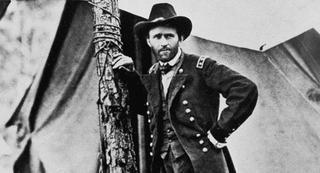
In addition to the above, in several places, the author makes unwarranted assumptions about the demeanor, mood and even the character of people based on a single black and white photograph. This is another trend I really despise. I see no evidence that such concrete assertions about a person can be gleaned from a single image in this way. Consider again:

"He [Grant] looks careworn and miserably unhappy, as he surely was, and perhaps [was] in need of a stiff drink"


Now this description was applied to possibly the most famous photograph of Grant. He is at his City Point, Virginia headquarters, leaning rather jauntily against a tree in front of one of his headquarters tents. At this point in the war Grant is at the peak of his power, in complete charge of a war machine unprecedented up to that time in American history. Most observers, if they ascribe any demeanor to him at all, note the confidence in Grant's face and the pose he chose to be photographed in. There is no evidence that I know of that backs up the author's description of Grant's demeanor in this photograph. It's just a lazy way of ascribing a description to a person without having to do any corroborating research.

Finally, the author makes some assertions about Grant's career that are just not correct. In particular he completely misrepresents Grant's record on civil rights. The author correctly notes that Grant refused to send troops into Mississippi in 1875 to protect blacks against an increase in violent intimidation. As perhaps the foremost historian on the Reconstruction era, Michael Foner, notes however, this "reflected the broader Northern retreat from Reconstruction and its ideal of racial equality." Korda, misleadingly uses this one incident to represent the entirety of Grants policy towards freedmen. In fact, Grant strenuously and often heroically tried to protect blacks from the violence perpetrated against them by the Ku Klux Klan, and he worked to make sure they were free to exercise rights guaranteed to them by the Constitution. That this ultimately failed is not due to lack of effort on Grant's part.

The motto emblazoned on Grant's tomb in New York City says simply "Let Us Have Peace." In a far superior biography of Grant, author H.W. Brands correctly notes that this relfected not only Grant's desire for a reunification of the country, but also his desire for the complete application of the war's main aims, a restoration of the union and the full emancipation of the slaves.

Korda's work reflects none of this. Given this and the other flaws noted above, I cannot recommend this book. There are many better Grant biographies to choose from.
Profile Image for Al.
475 reviews3 followers
November 2, 2018
There are quite a few Grant biographies available. Ron Chernow's is likely to be the most pre-eminent, but William McFeely's Grant:A Biography and Ronald White's American Ulysses are also rather well-known among many others and the man wrote a memoir his self, so there's plenty of places to go.

I have rather enjoyed the idea of the Eminent Lives series. Its conceit is that it's not intended for those who want to pick up a 700-page tome, and already have some knowledge of the subject. Indeed, one of the books I remember most from childhood was about Grant (and probably not coincidentally, a trip to Galena, Illinois). The series also pairs the famous historic figure with a popular contemporary author, in this case the British-born Korda who has a military background.

This is a very quick read, but I like Korda's takes and light style. Korda covers at a very superficial level (which is intended) and looks mostly at his military deeds.

Of this I found interesting

-Grant was really not cut out to be a farmer or a businessman or much of anything else, really, but was a born General and naturally became one of the best to ever be on the battlefield. It's a bit of an oddshot that he even ended up where he did, but by serendipity, he saved the Union.

-Korda knows the Robert E Lee is an American icon. The distinguished white haired general in his sharp buttoned up jacket is still a cult of personality (read some recent headlines) while our image of Grant is dumpy and plain. Most will think of the picture of Grant, plain, dumpy, tired and leaning on a tree.

-Grant was a brilliant strategist and sometimes that strategy was just to have more men. Grant wasn't flashy. He's wasn't particularly unsympathetic, but he also knew he needed a battle or attrition and that meant he was going to have large casualties. At the end of the day, Lee was a great general, but Grant was the better one.

-Korda does not spend a lot of time on the Presidency, but he offers reasons for Grant's scandals which have plagued his image. Grant was naive and trusting, and made bad decisions as a President and as a post-White House resident because of that trust.

-Korda ends the book with a fantastic metaphor of Grant as his generation's Eisenhower. Neither were flashy in style or militaristic action, but knew that slow and steady smart moves and an obedience to the President were what won wars. Like Ike, he was surrounded by men with bigger ambitions, but led them well. Korda compares WW2 to the Civil War generals of both sides where the union and the confederates had generals with particular strengths and weaknessess. Korda has his Patton (Stonewall Jackson), MacArthur (the ambitious and vain McLellan), Harold Alexander (the dogged Meade) and Omar Bradley (Longstreet). Interestingly, the generals of WW2 Germany had studied Grant.

-Like Truman 80 years later, Grant did not know how to adjust back to civilian life. He wasn't rich like the early Virginians or the Roosevelts and Hoover of later days. He went around the world and was treated as a celebrity and hero. He hoped (in vain) the GOP would re-nominate him for a third term. He ended up being encouraged by Mark Twain to write his memoir.

You may know a lot of this, but Korda is a great storyteller and it feels fresh. He adds enough insight to make it really enjoyable.

I would recommend this for those interested in a book about Grant that can be read in minimal sittings. I would be likely to pick up Korda's longer books on Lee and Eisenhower, and I certainly could see myself going back to the Eminent Lives series.
Profile Image for Karen.
43 reviews
January 13, 2022
I borrowed this book from the library at the same time I borrowed Chernow's version of Grant's biography. Both looked very readable at a glance. I read part of the chapter about Grant's childhood in both books, as well as a couple of other Grant biographies. The only two that agreed with another were this book and the Chernow book. So these were the two I have read.

The advantage of Korda's biography is it is only a fraction of the size of Chernow's. It is well written, thus hard to put down. It didn't read like "A Typical History Book" from school.

This is the first book I've read that describes battles and doesn't make my eyes glaze over. In fact, it got me to look up more details of some of the battles and other generals.

Another thing I liked were the human details that made it into this book. In one, a battle plan had been made by Grant, Grant's superior, and at least one other general. But as soon as the boss (the superior) leaves, the second general decides he is going to attack the town Grant was supposed to. Because of the slowness of communication then (sounds like usually a messenger carried messages), no one was able to stop him in time, and he beat Grant to the prize. From what I can tell, there were no consequences, either. These generals were at war with each other, too.

Another thing that seems unthinkable now is that when there was a surrender, a general from each side would meet in person and craft the surrender document themselves, taking only a few hours. For Grant's meeting with General Lee, Grant had to ride his horse through three miles of enemy territory. During such a bitter war, it's hard for me to imagine why no one harassed him, let alone shoot at him.

Next I want to finish the Chernow book and read Gramt's Memoirs.

Only 157 pages. Worth a read.
Profile Image for Brayden Raymond.
561 reviews13 followers
July 29, 2022
A slow afternoon allowed me the chance to zoom through this. It's good despite being so short and held my attention. I personally felt however that reading this depended on 1) the reader having a fairly good understanding of the Civil War to begin with and 2) being accepting of the author constantly comparing Grant to others to visualize the man. What I mean by that is while the battle and troop movements are described and laid out , there is a lack of depth to the war , of course this is likely because of the length of the book but I just found this glossed over many moments. As for the comparisons I found the author almost overly compares Grant to Ike and others and even in the Epilogue spends all too much time detailing other General's and why Grant is like them as opposed to why THEY are like Grant. Perhaps this is simply so readers of more modern wars will be able to liken Grant to familiar names but it bugged me.
Profile Image for Roe.
30 reviews
July 19, 2024
A short book with a high-level overview of Ulysses S. Grant. This is part of The Eminent Lives series where popular authors write about “the greatest figures in history, people whose lives and achievements have shaped our view of the world”.
I will be reading other books in the series. A great way to learn about interesting people from the past thru short biographies.
Fun Fact: Grant’s real name is Hiram Ulysses Grant, but was accidentally recorded when he went to West Point as Ulysses Simpson Grant. It was mildly embarrassing for him to have the initials U.S. Grant, but much better than H.U.G..
Profile Image for Erik.
Author 3 books9 followers
August 9, 2022
Entertaining, short narrative version of Grant's life, describing most of the usual highlights plus some new stories and interpretations. I'm not sure that it's as accurate as bigger tomes by Grant biographers like Brooks Simpson, Joan Waugh or Ron Chernow, but it's a much quicker read.
Profile Image for Abbie Young.
85 reviews
December 12, 2023
I think this guy talked about other generals almost as much as he talked about Grant, and talked about battle tactics much more than he talked about Grant’s life and character
Profile Image for Mshelton50.
367 reviews10 followers
August 19, 2022
A very lively brief biography of Ulysses S. Grant. Michael Korda was, for many years, editor-in-chief at Simon & Schuster, so it is not surprising that he writes well, and succinctly. Grant's life was certainly interesting, so this little book is definitely a page-turner.
11 reviews
March 27, 2011
What made me pick this book, was that, I read a similar book like this, but it was about George Washington. When I saw this book, I wanted to read it because I had enjoyed reading the George Washington book which gave me more insight into the presidents life before and after his presidentcy. That is also what I had learned once I had finished reading the book on Ulysses S. Grant. I learned more about this mans life. From when he went into wars, and when he left the presidents seat.

One thing that I had enjoyed in this book, besides all of the information I found out about Grant, was that recently(recent as in when the book was published), Beyonce Knowles wanted to do a music video infront of Grants Monument at Riverside Park. I enjoyed this specific event because Beyonce was this stupid to try and criticise the memory of Grant by having half naked women dancing on his monument. I enjoyed this mainly because people didn't let Beyonce do this to Grants monument. I don't see why she would even think about doing this to one of our presidents, this just seems really rude to me. I'm just glad that people had stopped her. This event also was the one that I disliked. By her actually trying to do this act.

What surprised me, was that during the war, the people with who he was working with, had betrayed him in the end. What I mean by betray, is that he ended up fighting against these men while he was president. This really was the only thing that surprised me in this book, except for one other thing. Which is finding out that in the end, that Grant wasn't doing so well after his presidentcy, until h wrote some articles in the news paper, which ended up helping him as well. I didn't know that piece of information prior to this book, and I thought it was a little moving, in some way, when I read it.

I don't believe that anything could have been better or changed in this book, because I thought that this book was a good read. With the authors attention to detail, which I liked because I learned a lot more about Grant than I had before hand.

For next time, I would like to find another book, like the George Washington book, and the Grant book, which I had finished. Because they are good reads which give excellent attention to detail about our presidents's lives. Before and after their reign as president.


Profile Image for Chris Gager.
2,062 reviews88 followers
December 14, 2023
Picked this one off the local library's for sale shelf a couple of days ago and started last night. This book scores an A+ for readability and despite it's short length will likely give me all I need or want to know about Grant. Last night I read a description of a conversation between Grant and Sherman sitting by a fire under a tent in the rain. That day's battling was done and more would be following the next day. The overall outcome is known to all of us. As I read I realized that this scene had made it into the blockbuster film "How the West Was Won." John Ford directed "The Civil War" part of it. John Wayne was Sherman and Harry Morgan was Grant. Good stuff.

Finished with this compact life-of-Grant book. An enjoyable read and a welcome relief from that idea that I need to someday read a 500-pager on Grant's life. Probably NOT going to happen now. The author makes the typical misquote of Sherman's famous line. It usually gets simplified to "War is hell," but I think it's actually "War is all hell."

- A solid 4* book.
23 reviews
November 7, 2008
Ulysses S. Grant wasn't the ordinary military general. In fact, no one would've guessed that Grant would become one of the best generals in United States history. His massive military knowledge helped unite the Union and the Confederacy through the civil war. As Grant grew up, he was a shy individual. But although shy, he was always serious with a lack of sense of humor. His military career was shaped at the West Point academy.
In my opinion, if we had a general like Ulysses S. Grant commanding America's foreign policy today, our wars would be won a lot faster. The reason I make this inference is because of his military doctrine. His military doctrine included always being on the go and pushing the enemy back, and never stopping. You see, if we had generals like Grant, we would be winning wars yearly. I do agree that politics are involved in too many wars today, and that is why they cannot be won.
Profile Image for Grey.
32 reviews4 followers
August 26, 2012
A quick, breezy read of one of those well-known names who's famous-but-not-famous nowadays.

With such a short bio that isn't terribly exhaustively researched, it's hard for an average reader like me to know if his conclusions hold water. He makes some wide-ranging comparisons to Napoleon, Churchhill and Eisenhower which are interesting.

Awfully sympathetic to the subject, which isn't altogether bad considering most people can only tell you two things about Grant beyond the war: (a) he was a drunk (b) his presidency was a cesspool of scandal. Korda delves past those elements a bit, highlights little-known incidents (Santo Domingo, averting war with Britain in the 1870s) in a readable way.

I was also struck, as always, by how everything old is new again: in politics, social attitudes, rhetoric and the rest.

Certainly not a serious scholarly work, but a fun way to spend a couple of hours if you're into the lesser-trod corners of American history.
Profile Image for Erez Davidi.
103 reviews10 followers
May 6, 2021
I admit to being rather ignorant of Grant's life aside from a few anecdotes I read about him in a few Civil War history books. For some unexplained reason I was never very interested in reading about him. Therefore, I am no position to comment on the accuracy of this short biography, which from what I read, is oftentimes inaccurate, although chiefly on small and somewhat less important details.

I managed to learn quite a bit about Grant. Grant lived a most interesting life filled with failures but also with successes. While it's apparent that Korda admires Grant, he managed to write a balanced biography without skipping the many failures of Grant, especially as a civilian.

This is a very easy read, perfect for people who are interested in Grant, but not enough to read a lengthy biography.
Profile Image for Joe Stack.
914 reviews6 followers
August 1, 2016
I think this is an evenhanded biography of Grant. In less than 200 pages the reader gets a clear and concise portrait of Grant. The brevity of the biography shows that one does not need a lengthy bio filled with details to get an understanding of the person that includes both strengths and weaknesses. The author is sympathetic, as was this reader, so my praise of this biography may be biased. Nonetheless, I enjoyed the succinctness and appreciated this summary of Grant's life. If you don't know too much about Grant, this bio is a good place to start, and this is a good refresher on Grant if you've read other bios but have forgotten much (as was the case with this reader). Grant is frequently rated as a failed President, but this bio presents a perspective that Grant as President may not be quite the failure as he is thought to be.
Profile Image for Jason.
112 reviews4 followers
February 20, 2010
This was a very short biography, but very readable and enjoyable. I have not read any other biographies of Grant yet and this one was a great place to start. I think that Korda did a nice job of piecing together parts of Grant's life to give us a nice picture of who he was, what he was driven by and to a small extent, how things ended up as they did in Grant's life. And while the asides to current times or the comparisons so other presidents don't add to the story of Grant, they do make it more comprehensible to a non-history buff reader.
10 reviews1 follower
March 14, 2012
Excellent read of talented man at the right place at the right time with the boldness to make it happen.
Profile Image for Steph (loves water).
464 reviews19 followers
April 3, 2016
Outstanding. Four and 1/2 stars. Loved this little book on my favorite Civil War general, and yes, my second favorite President...the last U.S. president not bought and paid for by Big Business.
Profile Image for Daniel Godfrey.
146 reviews16 followers
July 5, 2024
Wanted to know more about the man on the 50 dollar bill. Had read contrasting viewpoints on his presidency and wondered what side of the fence I would land on. (I'm favorable, so far.) Haven't read much history, but this one starts with a Beyoncé concert, so I pretty much had to keep reading. The author also relates the book's events to similar ones from other eras, such as the Napoleonic Wars or World War II. I think I would like to read Ike, his book on Eisenhower, too because this book was a very approachable summary of Grant's early life, military career, presidency, and retirement.

The author did a really good job of making several points "hit home" for me, helping me to see them in a way I hadn't before. Some of those points:

Significance of the battles. We visited Civil War battlefields and watched documentaries when we were in the area. I don't have much of a head for history, so some parts are a bit of a blur to me and my impression of them was loosely "one (or both) sides suffered terrible losses." I felt it helped me to distinguish one conflict from another when the author would sometimes say something that made me wonder about the meaning behind the struggle. A good example is the battle of Vicksburg, in which Grant attempted various feats of engineering such as destroying a levee and creating a canal, leading the author to conclude that "the pick and shovel were more important weapons than the rifle."

Brother against brother. I'd heard phrases like that applied to the Civil War before. But I don't think I grasped them like I did after the descriptions in here of Grant facing off against his classmates from West Point. Kind of the image I had was needing to be adversarial toward friends you joked with in the school hallways, or dined with in the cafeteria, or "burnt the midnight oil" with studying for a test. And just as I started thinking of the strained friendship between Messala and Ben-Hur, author Lew Wallace showed up! (Briefly.)

Anyone can be president. Grant was an exemplary military leader. But before that, as the epilogue excellently points out, he had humbler beginnings as a tanner and store clerk; he wasn't necessarily brought up to be the leader of a great nation. And his life story inspired not just fellow Americans but people from all over, as Grant found out on a world tour following his second term in office.

I liked the book! There were a couple of things that were a little unusual to me, though. One was that my interpretations didn't always line up with the author's. There are many excellent color and B&W photos, figures, and illustrations--political cartoons even. Sometimes I would look at a picture, usually a photograph of Grant, and arrive at a different conclusion than the text did. Another unusual thing is that Grant's memoir, while featured prominently in Chapter 10 and said to have been second only to the Bible as a best-seller, isn't explicitly listed among this book's resources. (Maybe it went without saying.) McFeely's biography, however, is referenced a few times in the footnotes. I think I'd like to try them out, given how both books are described in glowing terms.
Profile Image for Olivia Plasencia.
162 reviews42 followers
August 21, 2020
A very unimpressive work on one of the greatest presidents of the United States. I have read a lot of biographies on Grant and I never turn one away. This will be my 3rd on to buy this year alone and the 2nd I have read, this year. I found it a very brief glimpse into the life of Grant. Normally I would say it would be a great over view of the President's life if you were looking to just start your knowledge on Grant but the writer for some reason chose to cite anecdotal stories of Grant and enjoyed showing off how much he knows about history by annoyingly and constantly drawing parallels to Grant and many other presidents and leaders. The first few times the writer did this was not bothersome but by the end of the book it felt like the writer was A. trying to make the book longer. B. showing off his own personal memory bank of information. and C. trying to just put words on a page. No new information that I did not already know about Grant was written, and the writer kept noting that Grant drank at certain points in history despite that there was no evidence except that it was "widely known." To be clear Grant did drink. The recent TV special on Grant did a better job dealing with the topic of Grant's possible drinking "problem." Also many other books have stated that Mark Twain and Grant were friends, while Mr. Korda says they they were merely acquainted. The length of this book shows the book is not meant for deep analysis of education of President Grant. Look elsewhere for a deep look into this man and his time as president and his fight to finish his memoirs. A quick look into Grant's life cheats you of how much of a fighter he really was and helps you understand what Grant was really up against.
Profile Image for Steven Clark.
Author 19 books4 followers
March 29, 2025
I read Chernow's Grant, and enjoyed this one for its conciseness and a balanced view of who has been considered a kind of loser who got a lucky break. I heard this instead of read it as I was driving from St. Louis to Nashville, so I was in Grant country, and Sam Tsoutsouvas's reading was very good. I liked the major biographical points as they were touched, and also the comparison Korda made with WWII generals and Grant. Also, the early experience in the Mexican war was very well done; Grant did everything, from fight to manage supplies to bravely get a message. It was good training.
Grant's "failure" in the 1850s was well-written. Of course, the reader is reminded that this dismal period was only for a few years. It is agreed by many that Grant was the best all-around general of the war, and his strategy of grinding down the enemy without splashy moves has been the standard for US battle experience. Until the Gulf War, our last war of maneuver and quick strikes was the Mexican War.
Grant is always an enigma, and Korda helps to point the ways to understanding him. If Korda is unsympathetic to Julia, well, it wasn't a glamorous marriage, but Korda makes the point that they had something that clicked. As for the Negro problem after the war, you simply couldn't force equality down peoples throats, and despite Grant's sympathies, another Civil War wasn't worth anything. Seeing how the last few decades of compulsory Civil rights have been, we might be more sympathetic to Southern views, sine WE are the South now.
But this was an enjoyable listen, and as a "starter" biography of Grant, it does its job very well.
Profile Image for Leah.
356 reviews45 followers
September 30, 2021
Really enjoyed this one. I recently read a biography from this series about Sigmund Freud, and enjoyed it enough that I thought I'd grab another from the same series.

This was a nice concise little biography of Grant, almost so much so that I felt at the end it was too short. Now that I've read this that I really want to read a full-length biography of Grant (compare to my earlier experience with the Freud bio; I hope I never read another book about that man). Michael Korda's great strength, to me, was his ability to briefly and clearly describe long battles in just a few pages. I always get a bit bogged down and lost in Civil War battles and end up skipping to the end to find out who won, so Korda's brief and clear descriptions were much appreciated. Korda's weakness, I'd say, is his need to relate everything from Grant's day to something from ours, as if his readers won't understand words like 'recession' or 'celebrity' without being reminded of something from the 90's.

Overall, very good. Taught me a bit, and also left me wanting to know more, which is all I ask of nonfiction.
Profile Image for Peter.
875 reviews4 followers
August 17, 2022
In 2004, the British-born Writer Michael Korda published a biography of Ulysses S. Grant entitled Ulysses S. Grant: An Unlikely Hero. Korda was a member of the British military (161). I read this book on the Kindle. Korda’s biography of Grant focuses on Grant as a military commander in Mexican American War (37-45) and in the American Civil War (58-110). This book is only 162 pages old, so Grant’s military career is most of the biography. The book does not have an index. I felt like Korda’s biography is in conversation with Josiah Bunting III’s political 2004 biography of Ulysses S. Grant. Both Bunting and Korda agree that Grant was a skilled military leader. Korda only spent a single chapter on the presidency of Ulysses S. Grant (Korda 116-136). For Bunting, the focus of his biography for the American Presidents series is the presidency of Grant (Bunting 81-146). Michael Korda’s book entitled Ulysses S. Grant: An Unlikely Hero provides an interesting overview and introduction to Grant’s life, focused on his military career. A reader will probably find reading both biographies of Grant at the same time. Korda’s biography to gain an overview of Grant’s life and Bunting’s biography to understand a more positive view of Grant’s presidency.
Work Cited:
Bunting, Josiah III. 2004. Ulysses S. Grant. New York: Henry Holt and Company. [2012 Kindle edition].
117 reviews
May 15, 2022
I read this to follow up Korda's Clouds of Glory book on General Lee. While not as expansive and detailed as his account of Lee's life, this does maintain to still hit on all the same facets of life as the Lee book did. It was an enjoyable and quick read. I now have even more respect and a connection to Ulysses S. Grant than ever before because of this book. From rough beginnings, to generalship, to the presidency, and then back to bankruptcy at one point later in life, Grant's story is a roller coaster that should leave anyone in awe of his ability to fight through it with a true soldier's composure.

The only thing I wish more from this book is that it would have been longer. As much justice as could be done with this limited amount of pages for Korda was done, but it would definitely have been even greater to have more stories included in this great work.
Profile Image for Mary Youtz.
23 reviews
December 22, 2017
Learning to appreciate Ulysses S. Grant

The first chapter of this book is an extraordinary introduction to the life of Grant. Then the rest of the book did not disappoint, often interesting and sometimes entertaining. The book, like Grant, is memorable and a fair and insightful look at Ulysses S. Grant.
Profile Image for Michael Jolls.
Author 8 books9 followers
November 25, 2020
A shorter biography, one that seems a little entrapped by 2003/2004 (the year it was written), and the parallels to W. Bush and Iraq. Nonetheless this is the elongated "cliff notes" of the 500/600 page biographies, hitting the important scenes. The book makes a number of parallels to IKE and Napoleon, ones that gives the reader a good understanding of Grant's philosophies as a general.
Profile Image for Robin Kirk.
Author 29 books69 followers
April 20, 2021
Korda REALLY doesn't like women. He does capture Grant well. The book is light on the ins and outs of the Civil War and the scandals that accompanied Grant's turn in the White House (he really gives him a pass on emerging violence against African-Americans) but it's an informative read. The audio reader is excellent.
Profile Image for Taylor Dorrell.
27 reviews6 followers
December 9, 2024
Despite the bad first impression (Kissinger wrote the blurb on the back and the author starts the book by dwelling on Beyonce's performance in front of Grant's memorial as being in bad taste), this was an amusingly short and readable biography. Any Ohioan who doesn't eat meat, gets migraines, and wins the Civil War gets my vote.
Displaying 1 - 30 of 86 reviews

Can't find what you're looking for?

Get help and learn more about the design.